


 |
市場調查報告書
商品編碼
2072978
用於溫室栽培的種子:市場佔有率分析、行業趨勢和統計數據、成長預測(2026-2031 年)Protected Cultivation Seeds - Market Share Analysis, Industry Trends & Statistics, Growth Forecasts (2026 - 2031) |
||||||

※ 本網頁內容可能與最新版本有所差異。詳細情況請與我們聯繫。
根據 Mordor Intelligence 預測,保護性栽培種子市場規模預計將在 2025 年達到 3.2387 億美元,從 2026 年的 3.4796 億美元成長到 2031 年的 4.9823 億美元,2026 年至 2031 年的複合年成長率將達到 7.4%。
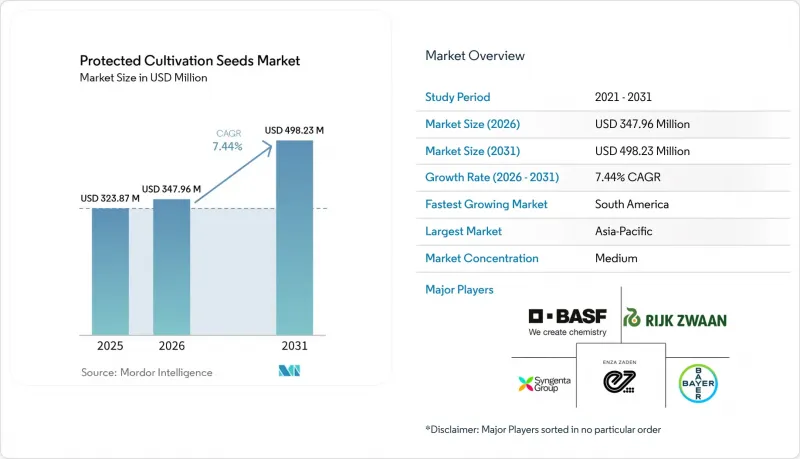
本報告按作物類型(十字花科、葫蘆科、根莖類、茄科和未分類蔬菜)和地區(北美、南美、歐洲、亞太地區以及中東和非洲)進行細分。市場預測以價值(美元)和數量(公噸)表示。
全球保育種子市場趨勢及洞察
擴大溫室及網室栽培面積
溫室及其他覆蓋式栽培面積的擴張直接影響保護地栽培種子市場。每增加一公頃保護地栽培面積,對高性能種子的需求就會持續成長。根據加拿大統計局預測,到2025年,加拿大溫室總面積預計將達到3,590萬平方公尺,比2024年增加1.4%。這反映了對可控環境農業的持續投資。隨著溫室栽培面積的擴大,種植者擴大採用雜交品種和專為保護地栽培設計的種子品種。這些種子具有許多優勢,例如在可控條件下提高產量、提高作物品質的均勻性以及延長生產週期。這一趨勢透過增加現代保護地栽培系統中每公頃的種子需求和用量,推動了保護地栽培種子市場的持續成長。
全年對優質蔬菜的需求
保護性栽培種子市場的發展動力源自於零售商和餐飲服務業對全年穩定新鮮農產品的需求,他們需要穩定的供應和統一的品質。根據美國農業部預測,2024年露天新鮮番茄產量將比前一年下降9%,凸顯了市場對溫室種植番茄日益成長的依賴,以維持市場供應。為了滿足零售商對穩定供應的需求,種植者擴大採用保護性栽培種子品種,這些品種能夠在可控條件下保證果實品質一致、產量穩定,並延長生產週期。這種轉變正在推動對高性能保護性栽培種子的需求,從而促進市場成長。
雜交種子和抗病種子價格較高。
保護地栽培種子市場受到限制,因為先進的雜交品種和抗病品種的價格遠高於傳統品種。雜交品種結合了多種專為溫室生產設計的性狀,由於育種、病害篩檢和法規遵從等方面需要大量投資,因此推高了市售種子的價格。雖然這些品種具有抗病性強、產量穩定、產品一致性高等優勢,但其高昂的初始成本阻礙了其推廣應用,尤其對於中小型生產者而言。在資金籌措管道和風險分擔機制往往有限的發展中國家,這個問題尤其突出。因此,雜交品種和抗病種子的高價持續阻礙其在對成本敏感的保護地栽培系統中的進一步市場滲透。
細分市場分析
到2025年,茄科植物將佔據溫室栽培種子市場40.6%的最大佔有率。這一主導地位主要歸功於番茄、辣椒和茄子等高價值作物在溫室和塑膠大棚等可控環境下的廣泛種植。這些作物因其強勁的市場需求、在可控條件下的高產量以及與先進雜交種子技術的兼容性而備受商業種植者的青睞。此外,旨在穩定產量和提高作物品質的保護性栽培系統的日益普及,也持續推動對茄科植物種子的需求,進一步鞏固了該細分市場在市場上的主導地位。
預計2026年至2031年間,茄科作物保護栽培種子市場將以8.0%的複合年成長率高速成長。這一成長主要得益於溫室專用雜交番茄、辣椒和茄子品種,這些品種因其產量高、坐果均勻、抗病性強等優點,價格是露地品種的3至5倍。此外,兼具種植和採收功能的菜花和西蘭花品種也逐漸被出口市場接受。葫蘆科作物,特別是為單性結實、節間短、抗白粉病而培育的溫室黃瓜和酸黃瓜品種,仍是保護栽培中最有價值的種子類別之一。
區域分析
預計到2025年,亞太地區將成為全球最大的保護地栽培種子市場,佔63.9%的市佔率。這一主導地位主要歸功於中國、印度、日本和韓國等國家廣泛採用溫室、塑膠棚和網室等技術。蔬菜消費量高、耕地壓力日益增大以及政府支持環境控制農業的措施等因素,都在推動對保護地栽培系統的投資。此外,該地區的生產者對高產量、抗病性和品質優良的種子品種的需求也日益成長。這些因素共同鞏固了亞太地區在保護地栽培、種子消費和品種研發領域的主導地位。
南美洲是成長最快的地區,預計2026年至2031年複合年成長率將達到9.0%。這一成長主要得益於對保護性農業的投資,尤其是在巴西聖保羅州的溫室帶、阿根廷門多薩州和科爾多瓦州的蔬菜合作社,以及巴塔哥尼亞試點集群,這些叢集延長了茄科作物和綠葉蔬菜的生產季節。巴西農業、畜牧業和食品供應部(MAPA)持續加強商業種子登記的植物檢疫認證標準。此舉正逐步將未經認證的種苗從正規供應鏈中剔除,並擴大已註冊雜交品種的市場。此外,巴西農業和畜牧業研究公司(EMBRAPA)正在進行區域品種試驗,以加速雜交品種在保護性栽培中的推廣。
北美仍然是保護性作物種子的重要市場,這主要得益於溫室現代化、自動化和可控環境農業的投資。根據美國農業部國家農業統計局的數據顯示,2024年美國園藝產品銷售額達183億美元。這凸顯了商業溫室和特種作物生產的大規模,從而支撐了對先進種子品種的需求。該地區全年對新鮮農產品的強勁零售需求以及精準農業技術的日益普及也推動了這一成長。相較之下,中東、南美和非洲正在擴大保護性作物蔬菜的生產,以增強糧食安全和穩定供應鏈。
其他好處:
- Excel格式的市場預測(ME)表
- 3個月的分析師支持
目錄
第1章:引言
- 研究假設和市場定義
- 調查範圍
- 調查方法
第2章:本報告的內容
第3章:執行摘要和主要發現
第4章:主要產業趨勢
- 面積
- 蔬菜
- 最受歡迎的功能
- 高麗菜和洋蔥
- 米和玉米
- 番茄和辣椒
- 小麥和棉花
- 育種技術
- 蔬菜
- 法律規範
- 價值鍊和通路分析
- 市場促進因素
- 擴大溫室和網室的種植面積
- 全年對優質蔬菜的需求。
- 集約化蔬菜種植系統中雜交品種的採用率
- 節水型可控制環境農業
- 性狀累積對快速傳播的溫室病原體的抗性
- 透過多周期室內生產提高種子周轉率
- 市場限制因素
- 混合子和抗病種子價格高昂
- 品種登記和植物檢疫合規的負擔。
- 過熱保護系統中的能源成本波動
- 授粉和雜交種子生產的複雜性
第5章 市場規模與成長預測
- 按作物類型
- 十字花科
- 高麗菜
- 花椰菜和綠花椰菜
- 其他十字花科作物
- 葫蘆科植物
- 黃瓜和酸黃瓜
- 南瓜和果汁汽水
- 其他類型的葫蘆
- 根莖類根莖類和球莖類蔬菜
- 蒜
- 洋蔥
- 馬鈴薯
- 其他根莖類和球莖類蔬菜
- 茄科
- 辣椒
- 茄子
- 番茄
- 其他茄科
- 未分類蔬菜
- 蘆筍
- 萵苣
- 秋葵
- 豌豆
- 菠菜
- 其他未分類蔬菜
- 十字花科
- 按地區
- 北美洲
- 美國
- 加拿大
- 墨西哥
- 其他北美國家
- 南美洲
- 巴西
- 阿根廷
- 其他南美國家
- 歐洲
- 德國
- 法國
- 義大利
- 西班牙
- 英國
- 俄羅斯
- 其他歐洲國家
- 亞太地區
- 中國
- 印度
- 日本
- 泰國
- 菲律賓
- 印尼
- 澳洲
- 其他亞太國家
- 中東
- 伊朗
- 土耳其
- 沙烏地阿拉伯
- 其他中東國家
- 非洲
- 南非
- 坦尚尼亞
- 奈及利亞
- 其他非洲國家
- 北美洲
第6章 競爭情勢
- 市場集中度
- 策略趨勢
- 市佔率分析
- 公司簡介
- Bayer AG
- BASF SE
- Syngenta AG
- Rijk Zwaan Zaadteelt en Zaadhandel BV
- Enza Zaden Beheer BV
- Limagrain(Societe Cooperative Agricole Limagrain)
- Yuan Longping High-Tech Agriculture Co., Ltd.(CITIC Agriculture Technology Co., Ltd.)
- Gansu Dunhuang Seed Industry Group Co., Ltd.
- Sakata Seed Corporation
- Takii & Co., Ltd.
- Bejo Zaden BV
- East-West Seed International Ltd.(EW Group)
- Namdhari Seeds Pvt. Ltd.
- UPL Limited
- NongWoo Bio Co., Ltd.(NongHyup Agribusiness Group Inc.)
第7章 執行長需要思考的關鍵策略問題
According to Mordor Intelligence, the protected cultivation seeds market was valued at USD 323.87 million in 2025 and is projected to grow from USD 347.96 million in 2026 to USD 498.23 million by 2031, registering a CAGR of 7.44% from 2026 to 2031.
This report is Segmented by Crop Type (Brassicas, Cucurbits, Roots and Bulbs, Solanaceae, and Unclassified Vegetables) and by Geography (North America, South America, Europe, Asia-Pacific, Middle East, and Africa). The Market Forecasts are Provided in Terms of Value (USD) and Volume (Metric Tons).
Global Protected Cultivation Seeds Market Trends and Insights
Greenhouse and Net-House Acreage Expansion
The protected cultivation seeds market is directly influenced by the growth of greenhouse and other covered cultivation areas. Each additional hectare of protected production creates a consistent demand for high-performance seeds. According to Statistics Canada, Canada's total greenhouse area increased by 1.4% in 2025 compared to 2024, reaching 35.9 million square meters. This reflects continued investment in controlled-environment agriculture. As greenhouse acreage expands, growers are increasingly adopting hybrid and protected-cultivation-specific seed varieties. These seeds offer benefits such as higher yields, uniform crop quality, and extended production cycles under controlled conditions. This trend drives sustained growth in the protected cultivation seeds market by increasing both the volume of seed demand and the value of seeds utilized per hectare in modern protected farming systems.
Year-Round Premium Vegetable Demand
The protected cultivation seeds market is driven by the consistent year-round demand for fresh vegetables from retailers and food service channels, which require a steady supply and uniform quality. According to the United States Department of Agriculture, field-grown fresh tomato production decreased by 9% in 2024 compared to the previous year, underscoring the growing reliance on greenhouse-grown tomatoes to maintain market supply. To meet retailer demands for consistent availability, growers are increasingly adopting protected cultivation seed varieties that ensure uniform fruit quality, stable yields, and extended production cycles in controlled environments. This shift is boosting the demand for high-performance protected cultivation seeds and contributing to the market's growth.
Premium Pricing of Hybrid and Resistant Seeds
The protected cultivation seeds market encounters growth limitations due to the significantly higher prices of advanced hybrid and disease-resistant seed varieties compared to conventional options. Trait-stacked hybrids designed for greenhouse production involve considerable investments in breeding, disease screening, and regulatory compliance, which drive up the cost of commercial seeds. Although these varieties provide advantages such as enhanced disease resistance, yield stability, and product uniformity, their elevated initial cost poses a challenge for adoption, especially among small and medium-sized growers. This issue is particularly pronounced in developing markets, where access to financing and risk-sharing mechanisms is often constrained. Consequently, the premium pricing of hybrid and resistant seeds continues to hinder wider market penetration in cost-sensitive protected cultivation systems.
Other drivers and restraints analyzed in the detailed report include:
- Hybrid Penetration in Intensive Vegetable Systems
- Trait-Stacked Resistance to Fast-Moving Greenhouse Pathogens
- Variety Registration and Phytosanitary Compliance Burden
For complete list of drivers and restraints, kindly check the Table Of Contents.
Segment Analysis
The protected seeds cultivation market share for the Solanaceae segment held the largest 40.6% in 2025. This dominance is attributed to the extensive cultivation of high-value crops such as tomatoes, peppers, and eggplants in controlled environments like greenhouses and polyhouses. These crops are preferred by commercial growers due to their strong market demand, high productivity under controlled conditions, and compatibility with advanced hybrid seed technologies. Furthermore, the growing adoption of protected cultivation systems to enhance yield consistency and crop quality continues to drive demand for Solanaceae seeds, solidifying the segment's leading position in the market.
The protected cultivation seeds market for Solanaceae crops is projected to grow at the fastest CAGR of 8.0% from 2026 to 2031. This growth is driven by greenhouse-specific hybrid varieties of tomato, chili, and eggplant, which command prices 3 to 5 times higher than their open-field counterparts due to their combination of yield performance, uniform fruit set, and pathogen tolerance. Additionally, dual-use cauliflower and broccoli varieties are gaining acceptance in export markets. Cucurbits, particularly greenhouse cucumber and gherkin varieties bred for parthenocarpy, compact internodes, and resistance to powdery mildew, continue to rank among the highest-value seed categories in protected cultivation.
Complete Report Scope:
- By Crop Type
- Brassicas
- Cabbage
- Cauliflower and Broccoli
- Other Brassicas
- Cucurbits
- Cucumber and Gherkin
- Pumpkin and Squash
- Other Cucurbits
- Roots and Bulbs
- Garlic
- Onion
- Potato
- Other Roots and Bulbs
- Solanaceae
- Chilli
- Eggplant
- Tomato
- Other Solanaceae
- Unclassified Vegetables
- Asparagus
- Lettuce
- Okra
- Peas
- Spinach
- Other Unclassified Vegetables
- Brassicas
- By Geography
- North America
- United States
- Canada
- Mexico
- Rest of North America
- South America
- Brazil
- Argentina
- Rest of South America
- Europe
- Germany
- France
- Italy
- Spain
- United Kingdom
- Russia
- Rest of Europe
- Asia-Pacific
- China
- India
- Japan
- Thailand
- Philippines
- Indonesia
- Australia
- Rest of Asia-Pacific
- Middle East
- Iran
- Turkey
- Saudi Arabia
- Rest of Middle East
- Africa
- South Africa
- Tanzania
- Nigeria
- Rest of Africa
- North America
Geography Analysis
The Asia-Pacific market share led with the largest 63.9% share in 2025, making it the largest regional market for protected cultivation seed demand. This dominance is attributed to the widespread adoption of greenhouses, polyhouses, and net-houses in countries such as China, India, Japan, and South Korea. Factors such as high vegetable consumption, increasing pressure on arable land, and government initiatives supporting controlled-environment agriculture drive investments in protected cultivation systems. Additionally, growers in the region are increasingly demanding seed varieties that offer higher productivity, disease resistance, and enhanced quality traits. These elements collectively reinforce the region's leadership in protected cultivation, seed consumption, and variety development.
South America is the fastest-growing region, with a 9.0% CAGR projected from 2026 to 2031. This growth is driven by investments in protected agriculture, particularly in Brazil's Sao Paulo greenhouse corridors, vegetable cooperatives in Argentina's Mendoza and Cordoba provinces, and pilot clusters in Patagonia that are extending the production season for Solanaceae and leafy greens. Brazil's Ministry of Agriculture, Livestock and Food Supply (MAPA) continues to enforce phytosanitary certification standards for commercial seed registration. This initiative is gradually eliminating uncertified planting material from the formal supply chain and expanding the market for registered hybrid programs. Additionally, Empresa Brasileira de Pesquisa Agropecuaria (EMBRAPA) is conducting local varietal trials to accelerate hybrid adoption in protected cultivation segments.
North America remains a important market for protected cultivation seeds, driven by investments in greenhouse modernization, automation, and controlled-environment agriculture. According to the United States Department of Agriculture National Agricultural Statistics Service, horticultural operations in the United States generated USD 18.3 billion in sales in 2024. This highlights the scale of commercial greenhouse and specialty crop production, which supports the demand for advanced seed varieties. The region also benefits from strong retail demand for year-round fresh produce and the growing adoption of precision cultivation technologies. In contrast, the Middle East, South America, and Africa are expanding protected vegetable production to enhance food security and ensure supply stability.
- Bayer AG
- BASF SE
- Syngenta AG
- Rijk Zwaan Zaadteelt en Zaadhandel B.V.
- Enza Zaden Beheer B.V.
- Limagrain (Societe Cooperative Agricole Limagrain)
- Yuan Longping High-Tech Agriculture Co., Ltd. (CITIC Agriculture Technology Co., Ltd.)
- Gansu Dunhuang Seed Industry Group Co., Ltd.
- Sakata Seed Corporation
- Takii & Co., Ltd.
- Bejo Zaden B.V.
- East-West Seed International Ltd. (EW Group)
- Namdhari Seeds Pvt. Ltd.
- UPL Limited
- NongWoo Bio Co., Ltd. (NongHyup Agribusiness Group Inc.)
Additional Benefits:
- The market estimate (ME) sheet in Excel format
- 3 months of analyst support
TABLE OF CONTENTS
1 INTRODUCTION
- 1.1 Study Assumptions and Market Definition
- 1.2 Scope of the Study
- 1.3 Research Methodology
2 REPORT OFFERS
3 EXECUTIVE SUMMARY & KEY FINDINGS
4 KEY INDUSTRY TRENDS
- 4.1 Area Under Cultivation
- 4.1.1 Vegetables
- 4.2 Most Popular Traits
- 4.2.1 Cabbage and Onion
- 4.2.2 Rice and Corn
- 4.2.3 Tomato and Chilli
- 4.2.4 Wheat and Cotton
- 4.3 Breeding Techniques
- 4.3.1 Vegetables
- 4.4 Regulatory Framework
- 4.5 Value Chain and Distribution Channel Analysis
- 4.6 Market Drivers
- 4.6.1 Greenhouse and net-house acreage expansion
- 4.6.2 Year-round premium vegetable demand
- 4.6.3 Hybrid penetration in intensive vegetable systems
- 4.6.4 Water-efficient controlled-environment farming
- 4.6.5 Trait-stacked resistance to fast-moving greenhouse pathogens
- 4.6.6 Multi-cycle indoor production increasing seed turns
- 4.7 Market Restraints
- 4.7.1 Premium pricing of hybrid and resistant seeds
- 4.7.2 Variety registration and phytosanitary compliance burden
- 4.7.3 Energy-cost volatility in heated protected systems
- 4.7.4 Pollination and hybrid seed production complexity
5 MARKET SIZE AND GROWTH FORECASTS (VALUE AND VOLUME)
- 5.1 By Crop Type
- 5.1.1 Brassicas
- 5.1.1.1 Cabbage
- 5.1.1.2 Cauliflower and Broccoli
- 5.1.1.3 Other Brassicas
- 5.1.2 Cucurbits
- 5.1.2.1 Cucumber and Gherkin
- 5.1.2.2 Pumpkin and Squash
- 5.1.2.3 Other Cucurbits
- 5.1.3 Roots and Bulbs
- 5.1.3.1 Garlic
- 5.1.3.2 Onion
- 5.1.3.3 Potato
- 5.1.3.4 Other Roots and Bulbs
- 5.1.4 Solanaceae
- 5.1.4.1 Chilli
- 5.1.4.2 Eggplant
- 5.1.4.3 Tomato
- 5.1.4.4 Other Solanaceae
- 5.1.5 Unclassified Vegetables
- 5.1.5.1 Asparagus
- 5.1.5.2 Lettuce
- 5.1.5.3 Okra
- 5.1.5.4 Peas
- 5.1.5.5 Spinach
- 5.1.5.6 Other Unclassified Vegetables
- 5.1.1 Brassicas
- 5.2 By Geography
- 5.2.1 North America
- 5.2.1.1 United States
- 5.2.1.2 Canada
- 5.2.1.3 Mexico
- 5.2.1.4 Rest of North America
- 5.2.2 South America
- 5.2.2.1 Brazil
- 5.2.2.2 Argentina
- 5.2.2.3 Rest of South America
- 5.2.3 Europe
- 5.2.3.1 Germany
- 5.2.3.2 France
- 5.2.3.3 Italy
- 5.2.3.4 Spain
- 5.2.3.5 United Kingdom
- 5.2.3.6 Russia
- 5.2.3.7 Rest of Europe
- 5.2.4 Asia-Pacific
- 5.2.4.1 China
- 5.2.4.2 India
- 5.2.4.3 Japan
- 5.2.4.4 Thailand
- 5.2.4.5 Philippines
- 5.2.4.6 Indonesia
- 5.2.4.7 Australia
- 5.2.4.8 Rest of Asia-Pacific
- 5.2.5 Middle East
- 5.2.5.1 Iran
- 5.2.5.2 Turkey
- 5.2.5.3 Saudi Arabia
- 5.2.5.4 Rest of Middle East
- 5.2.6 Africa
- 5.2.6.1 South Africa
- 5.2.6.2 Tanzania
- 5.2.6.3 Nigeria
- 5.2.6.4 Rest of Africa
- 5.2.1 North America
6 COMPETITIVE LANDSCAPE
- 6.1 Market Concentration
- 6.2 Strategic Moves
- 6.3 Market Share Analysis
- 6.4 Company Profiles (Includes Global Level Overview, Market Level Overview, Core Segments, Financials as Available, Strategic Information, Market Rank/Share for Key Companies, Products and Services, and Recent Developments)
- 6.4.1 Bayer AG
- 6.4.2 BASF SE
- 6.4.3 Syngenta AG
- 6.4.4 Rijk Zwaan Zaadteelt en Zaadhandel B.V.
- 6.4.5 Enza Zaden Beheer B.V.
- 6.4.6 Limagrain (Societe Cooperative Agricole Limagrain)
- 6.4.7 Yuan Longping High-Tech Agriculture Co., Ltd. (CITIC Agriculture Technology Co., Ltd.)
- 6.4.8 Gansu Dunhuang Seed Industry Group Co., Ltd.
- 6.4.9 Sakata Seed Corporation
- 6.4.10 Takii & Co., Ltd.
- 6.4.11 Bejo Zaden B.V.
- 6.4.12 East-West Seed International Ltd. (EW Group)
- 6.4.13 Namdhari Seeds Pvt. Ltd.
- 6.4.14 UPL Limited
- 6.4.15 NongWoo Bio Co., Ltd. (NongHyup Agribusiness Group Inc.)
7 KEY STRATEGIC QUESTIONS FOR FEED ADDITIVE CEOS

 基於自然的碳解決方案市場預測(至2034年)—按解決方案類型、生態系統、碳去除方法、專案階段、最終用戶和地區分類的全球分析
 農業可變速率技術市場-2026-2032年全球市場預測2034年全球果園自主管理市場預測-按組件、果園類型、技術、應用和區域分類的分析
 農業技術市場規模、佔有率和成長分析:按組件、應用、分銷管道和地區分類-2026-2033年產業預測全球保護性栽培市場預測至2034年-按結構類型、材料、技術、應用、最終用戶和地區分類的分析農業技術平台市場預測至2034年:按平台類型、部署模式、技術、應用、最終用戶和地區分類的全球分析基於自然的解決方案 (NbS) 市場預測至 2034 年——按解決方案類型、生態系統類型、資金籌措機制、應用、最終用戶和地區分類的全球分析
 2026年全球農業技術市場報告2026年全球Agutech市場報告
 農業技術市場分析及預測(至2035年):類型、產品類型、服務、技術、組件、應用、部署狀態、最終用戶、解決方案