


 |
市場調查報告書
商品編碼
2072708
人力資源管理服務:市場佔有率分析、產業趨勢與統計、成長預測(2026-2031 年)Managed HR Services - Market Share Analysis, Industry Trends & Statistics, Growth Forecasts (2026 - 2031) |
||||||

※ 本網頁內容可能與最新版本有所差異。詳細情況請與我們聯繫。
根據 Mordor Intelligence 預測,人力資源管理服務市場將從 2025 年的 518.2 億美元成長到 2031 年的 553.2 億美元,然後成長到 2031 年的 886 億美元,2026 年至 2031 年的複合年成長率為 9.88%。
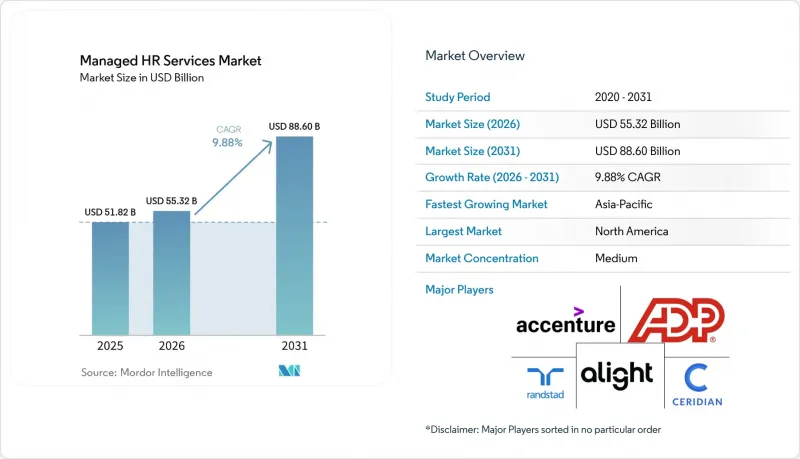
本報告按服務類型(例如,招聘流程外包 (RPO)、薪資福利管理服務)、部署模式(雲端、混合、本地部署)、企業規模(大型企業、中小企業)、最終用戶行業(例如,商業金融服務 (BFSI)、醫療保健和生命科學)以及地區進行細分。市場預測以價值(美元)表示。
全球人力資源管理服務市場趨勢與洞察
核心人力資源職能外包程度提高
隨著企業將薪資核算、福利、人力資源營運和技術支援整合到少數幾家供應商手中,人力資源管理服務市場正進一步轉向全流程外包模式。由於人力資源營運越來越依賴數據,也更容易受到違規風險的影響,買家現在將人力資源職能外包不僅視為短期成本削減措施,更將其視為營運模式選擇。服務水準與薪資核算準確性、合規率和員工體驗的關聯性日益提高,這使得那些僅依賴勞動力套利的供應商吸引力下降。截至2026年4月,超過140個國家的110多萬客戶將使用領先的人力資源和薪資平台,這充分展現了大規模平台供應商在人力資源管理服務市場中所提供的規模經濟效益。這種規模至關重要,因為它使中型買家能夠透過外包合約利用離職率監控、薪資基準分析和勞動力規劃等分析功能,而無需自行建立內部工具。因此,在人力資源管理服務市場,對多方合作的需求日益成長,而試圖為每個核心人力資源職能管理單獨供應商的採購公司則越來越少。
多邊薪資核算標準化的必要性
管理型人力資源服務市場也受到跨多個稅務、申報和福利系統管理薪資核算的難度影響。到2025年,超過36%的企業將在六個或更多國家處理薪資核算,7%的企業將在51個或更多地區開展業務。在如此廣泛的環境下,企業內部薪資核算標準化管理難度極高,尤其是在還需要薪資資料用於員工人數、離職率和薪資分析的情況下。將於2026年5月發布的Workforce人工智慧薪資核算平台旨在將薪資核算處理時間從“幾天”縮短到“幾小時”,同時保留對例外情況的人工審核,這反映了買家的期望。即時申報規則、強制性工資透明度以及社會保險繳款的變化不斷增加各國的複雜性。在管理型人力資源服務市場,擁有原生跨國能力的供應商在降低延遲、減少交接環節以及提高整個薪資核算營運的資料一致性方面具有明顯的優勢。
員工資訊的資料隱私和安全風險
資料保護仍然是限制人力資源管理服務市場進一步擴張的最重要因素之一。外包人力資源環境儲存大規模員工的薪資記錄、銀行帳戶資訊、福利資料和個人識別資訊,因此極易成為勒索軟體和資料竊盜的攻擊目標。如今,買家在評估供應商時,不僅關注其服務範圍,還關注其存取控制、審計準備、事件回應和資料外洩通知等方面的措施。 2025年至2026年間隱私法規的變化影響了外包合約中的責任分配和風險管理。這增加了供應商選擇的成本和時間,尤其是在監管嚴格的行業和跨境交易中。因此,人力資源管理服務市場越來越青睞那些不僅能夠提供廣泛的服務,而且擁有成熟的安全管理系統、符合協同處理要求以及可重複管治的供應商。
細分市場分析
2025年,薪資福利管理佔人力資源管理服務市場的32.47%,成為此類別的主要收入來源。這一領域至關重要,因為薪水支付不能延遲,合規錯誤可能會給雇主帶來直接的財務和法律風險。因此,即使在審查其他服務領域以降低成本和簡化營運時,企業也不願重組內部薪酬業務。招聘流程外包在銀行、金融和保險(BFSI)以及科技業中保持穩定的需求,因為這些行業的招聘人數波動較大,招聘時間商業性至關重要。人力資源職能外包也繼續佔據重要地位,買家尋求員工記錄、服務請求、文件管理和日常行政任務的標準化工作流程。
預計2026年至2031年間,人力資源技術管理服務將以12.86%的複合年成長率成長,成為人力資源管理服務市場中成長最快的服務類別。推動這項成長的因素是,企業更傾向於利用Workday、SAP SuccessFactors和Oracle HCM Cloud等以成果為導向的管理模式,而非依賴大規模的內部支援團隊。在2025會計年度,得益於數據、人工智慧和基於代理的解決方案在整體人力資源和財務流程管理營運中的應用,先進技術解決方案的銷售額成長了17%。 2026年5月發布的人工智慧主導勞動力平台,展示如何將薪資核算、人力資源工作流程、考勤管理和福利管理整合到一個面向中小企業的單一服務中。隨著客戶對技能提升、政策保障和更順暢的資料流的需求日益成長,學習和人才管理服務以及諮詢和合規支援在整個人力資源管理服務行業的重要性也日益凸顯。
到2025年,雲端託管服務將佔總收入的63.29%,使其成為託管人力資源服務市場中最大的佔有率。這一領先地位反映了企業長期向雲端原生人力資源平台轉型的趨勢,這些平台支援自動更新、強大的容量和快速的報告功能。採購企業也非常重視將薪資、福利、考勤和個案管理等資料整合到一個統一的營運模式中,而不是將其分散在多個互不連結的工具中。雲端交付通常能夠加快新功能的採用速度,尤其是在分析、員工自助服務和工作流程自動化方面。然而,並非所有企業都能將所有敏感的員工資料遷移到完整的公共雲端環境。
預計到2031年,混合部署將以11.72%的複合年成長率成長,成為人力資源管理服務市場中成長最快的部署模式。金融服務和醫療保健公司是主要驅動力,因為這些行業通常需要雲端的柔軟性,同時又不希望失去對敏感記錄和舊有系統的控制。 「自主HCM」框架於2026年5月發布,支援跨雲和本地層的AI編配,這表明混合環境的延續不再是過渡階段,而是一種設計前提。在南美洲和中東部分地區,由於主權儲存法規和長期合約仍然有效,本地部署功能仍然為政府機構和組織提供服務。由於人力資源管理服務市場遵循著一個不統一的現代化週期,能夠銜接所有三種模式的供應商將在留住客戶方面擁有顯著優勢。
區域分析
預計到2025年,北美將佔據全球人力資源管理服務市場佔有率的38.92%,成為貢獻最大的區域市場。該地區受益於其龐大的基本客群、大規模跨國公司總部,以及對大規模內部人力資源管理模式的法規環境。截至2026年4月,超過140個國家的110多萬客戶將使用領先的人力資源和薪資平台,這凸顯了美國核心人力資源管理服務市場的規模和成熟度。大規模收購拓展了中型企業市場,並增強了小規模企業的人力資本管理(HCM)能力。同時,墨西哥和加拿大對跨境招聘、製造和物流所需的整合薪資核算和合規工作流程的需求日益成長。
在強勁的需求和嚴格的勞動法規的推動下,歐洲仍然佔據人力資源管理服務市場的重要佔有率。儘管德國、英國、法國和荷蘭在採用該服務方面處於領先地位,但由於員工代表委員會、外包實務和當地勞動法規缺乏統一性,各國的採購需求各不相同。在英國,純粹以成本為導向的合約模式正向以技術為導向、以結果為導向的模式轉變,這為全球供應商和區域專家都創造了機會。人工智慧驅動的招聘分析和遍布北歐和中歐的跨國薪資核算服務表明,本地化公司如何在與大型平台的競爭中保持競爭力。
預計到2031年,亞太地區將以15.36%的複合年成長率成長,成為人力資源管理服務市場成長最快的區域板塊。印度扮演雙重角色:既是全球服務提供者的重要服務中心,隨著全球能力中心(GCC)活動的擴展,印度也正成為一個不斷成長的買方市場。中國、東南亞、日本、韓國、澳洲和紐西蘭也透過現代化專案、老化勞動力和成熟的外包生態系統,為區域成長提供支援。中東和非洲雖然規模仍然較小,但由於沙烏地阿拉伯的勞動力本土化政策以及南非和奈及利亞就業實踐的製度化,對合規和薪資核算專業服務的需求正在成長。南美洲仍然是一個新興機遇,儘管技術預算有限,但頻繁變化的勞動法規、貨幣波動和跨司法管轄區的薪資核算,仍然維持著人力資源管理服務市場的重要性。
其他好處:
- Excel格式的市場預測(ME)表
- 3個月的分析師支持
目錄
第1章:引言
- 研究假設和市場定義
- 調查範圍
第2章:調查方法
第3章執行摘要
第4章 市場狀況
- 市場概覽
- 市場促進因素
- 核心人力資源職能外包程度提高
- 多邊薪資核算標準化的必要性
- 各勞動法管轄區的合規負擔均增加。
- 利用人工智慧擴展人力資源工作流程的自動化程度
- 以員工體驗為主導的服務模式轉型
- 分散式和遠端勞動力隊伍的擴張
- 市場限制因素
- 資料隱私和員工資訊安全風險
- 勞動法規碎片化且複雜,各國情況不一。
- 傳統人力資源系統轉型成本高昂
- 由於報告不足、依賴準確的主資料以及人事記錄品質不佳而產生的風險。
- 產業價值與價值鏈分析
- 監理情勢
- 技術展望
- 宏觀經濟因素對市場的影響
- 波特五力分析
第5章 市場規模與成長預測
- 按服務類型
- 招募流程外包(RPO)
- 薪資福利管理服務
- 人力資源外包(HRO)
- 學習與人力資源管理服務
- 人力資源技術管理服務 (AMS/MSP)
- 諮詢和合規服務
- 按部署模式
- 雲
- 混合
- 現場
- 按公司規模
- 大公司
- 小型企業
- 按最終用戶行業分類
- BFSI
- 醫療保健和生命科學
- 資訊科技/通訊
- 零售與電子商務
- 工業製造
- 政府/公共部門
- 其他終端用戶產業
- 按地區
- 北美洲
- 美國
- 加拿大
- 墨西哥
- 南美洲
- 巴西
- 阿根廷
- 其他南美國家
- 歐洲
- 德國
- 英國
- 法國
- 義大利
- 西班牙
- 俄羅斯
- 荷蘭
- 其他歐洲國家
- 亞太地區
- 中國
- 日本
- 印度
- 韓國
- 澳洲和紐西蘭
- 其他亞太國家
- 中東
- 沙烏地阿拉伯
- 阿拉伯聯合大公國
- 其他中東國家
- 非洲
- 南非
- 奈及利亞
- 其他非洲國家
- 北美洲
第6章 競爭情勢
- 市場集中度
- 策略趨勢
- 市佔率分析
- 公司簡介
- Automatic Data Processing, Inc.
- Accenture plc
- Alight, Inc.
- Aon plc
- Capita plc
- CGI Inc.
- Ceridian HCM Holding Inc.
- Genpact Limited
- IBM Corporation
- Infosys Limited
- International Business Machines Corporation
- Kronos Incorporated
- Mercer LLC
- NGA Human Resources Inc.
- NorthgateArinso NV
- Paychex, Inc.
- Randstad NV
- Tata Consultancy Services Limited
- Ultimate Kronos Group, Inc.
- Wipro Limited
- Zalaris ASA
第7章 市場機會與未來展望
According to Mordor Intelligence, the managed HR services market size is projected to expand from USD 51.82 billion in 2025, USD 55.32 billion to USD 88.60 billion by 2031, registering a CAGR of 9.88% during 2026-2031.
This report is Segmented by Service Type (Recruitment Process Outsourcing (RPO), Payroll and Benefits Administration Services, and More), Deployment Model (Cloud, Hybrid, and On-Premise), Enterprise Size (Large Enterprises, and Small and Medium Enterprises), End-User Industry (BFSI, Healthcare and Life Sciences, and More), and Geography. The Market Forecasts are Provided in Terms of Value (USD).
Global Managed HR Services Market Trends and Insights
Rising Outsourcing of Core HR Operations
The managed HR services market is moving further toward full-process outsourcing as enterprises combine payroll, benefits, HR operations, and technology support under fewer vendors. Buyers now treat external HR delivery as an operating model choice rather than a short-term cost program, because HR has become more data-intensive and more exposed to compliance failures. Service levels are increasingly tied to payroll accuracy, compliance pass rates, and employee experience, thereby reducing the appeal of providers that rely solely on labor arbitrage. More than 1.1 million clients across 140-plus countries relied on a major HR and payroll platform as of April 2026, which shows the scale advantage large platform providers hold in the managed HR services market. This scale matters because mid-sized buyers can access analytics such as attrition monitoring, pay benchmarking, and workforce planning through outsourced contracts rather than building those tools internally. As a result, the managed HR services market is seeing more demand for multi-tower relationships and fewer buyers willing to manage separate point vendors across core HR tasks.
Need for Multi-Country Payroll Standardization
The managed HR services market is also being shaped by the difficulty of running payroll across multiple tax, filing, and benefits systems. More than 36% of organizations handled payroll in 6 or more countries, and 7% operated across 51 or more territories in 2025. That level of spread makes internal payroll standardization hard to manage, especially when payroll data is also needed for headcount, turnover, and compensation analysis. A payroll platform with Workforce AI launched in May 2026 was designed to cut payroll processing from days to hours while keeping human review for exceptions, which reflects where buyer expectations are moving. Real-time filing rules, wage transparency mandates, and social contribution changes have continued to add complexity across countries. In the managed HR services market, providers with native multi-country capability have a clear advantage because they reduce latency, cut handoffs, and improve data consistency across payroll operations.
Data Privacy And Employee Information Security Risks
Data protection remains one of the clearest limits on faster expansion in the managed HR services market. Outsourced HR environments store payroll records, bank details, benefits data, and personal identifiers for large employee groups, making them attractive targets for ransomware and data theft. Buyers now evaluate vendors not only on service scope but also on access controls, audit readiness, incident response, and breach notification commitments. Changing privacy rules during 2025-2026 affected how outsourcing contracts allocate responsibility and manage risk. This adds cost and time to vendor selection, especially in regulated sectors and cross-border engagements. The managed HR services market is therefore favoring providers that can show mature security controls, shared-processor compliance, and repeatable governance rather than broad service menus alone.
Other drivers and restraints analyzed in the detailed report include:
- Rising Compliance Burden Across Labor Jurisdictions
- Expansion of AI-Enabled HR Workflow Automation
- Fragmented Country-Specific Labor Regulation Complexity
For complete list of drivers and restraints, kindly check the Table Of Contents.
Segment Analysis
Payroll and benefits administration accounted for 32.47% of the managed HR services market in 2025, making it the revenue anchor for the category. The segment stays essential because payroll cannot be delayed, and compliance errors can create direct financial and legal exposure for employers. This makes enterprises less willing to rebuild payroll operations internally, even when they review other service towers for savings or simplification. Recruitment process outsourcing maintained steady demand in BFSI and technology settings, where hiring volumes fluctuate and time-to-fill remains commercially important. HR operations outsourcing also remained important for buyers seeking standardized workflows for employee records, service requests, document handling, and routine administration.
HR technology managed services are projected to grow at a 12.86% CAGR from 2026 to 2031, making it the fastest-moving service category in the managed HR services market. Growth is being pulled by companies that prefer outcome-based management with Workday, SAP SuccessFactors, and Oracle HCM Cloud rather than large internal support teams. Advanced technology solutions revenue rose 17% in full-year 2025, supported by data, AI, and agentic solutions across HR and finance process management work. The launch of an AI-led workforce platform in May 2026 also showed how payroll, HR workflows, time tracking, and benefits administration are being combined into a single offering for smaller businesses. Learning and talent management services, along with advisory and compliance support, gained importance as buyers sought reskilling, policy assurance, and cleaner data flows across the broader managed HR services industry.
Cloud-enabled managed services held 63.29% of revenue in 2025, giving this model the largest share of the managed HR services market. The lead reflects a long migration toward cloud-native HR platforms that support automatic updates, elastic capacity, and faster reporting. Buyers also value the ability to unify data from payroll, benefits, time, and case management into a single operating model rather than across disconnected tools. Cloud delivery often improves rollout speed for new capabilities, especially in analytics, employee self-service, and workflow automation. Even so, not every enterprise can move all sensitive employee data into a fully public cloud setup.
Hybrid delivery is projected to expand at an 11.72% CAGR through 2031, making it the fastest-growing deployment path in the managed HR services market. Financial services and healthcare buyers are major drivers because they often need cloud flexibility without losing control over sensitive records or legacy systems. An Autonomous HCM framework presented in May 2026, with support for AI orchestration across cloud and on-premise layers, signaled that hybrid persistence is now a design assumption rather than a temporary stage. On-premise support still serves governments and state-linked organizations in parts of South America and the Middle East where sovereign storage rules and long contracts remain in place. Providers that can bridge all 3 models are better positioned to retain spend as the managed HR services market navigates uneven modernization cycles.
Complete Report Scope:
- By Service Type
- Recruitment Process Outsourcing (RPO)
- Payroll and Benefits Administration Services
- HR Operations Outsourcing (HRO)
- Learning and Talent Management Services
- HR Technology Managed Services (AMS/MSP)
- Advisory and Compliance Services
- By Deployment Model
- Cloud
- Hybrid
- On-Premise
- By Enterprise Size
- Large Enterprises
- Small and Medium Enterprises
- By End-user Industry
- BFSI
- Healthcare and Life Sciences
- Information Technology and Telecom
- Retail and E-commerce
- Industrial Manufacturing
- Government and Public Sector
- Other End-user Industries
- By Geography
- North America
- United States
- Canada
- Mexico
- South America
- Brazil
- Argentina
- Rest of South America
- Europe
- Germany
- United Kingdom
- France
- Italy
- Spain
- Russia
- Netherlands
- Rest of Europe
- Asia-Pacific
- China
- Japan
- India
- South Korea
- Australia and New Zealand
- Rest of Asia-Pacific
- Middle East
- Saudi Arabia
- United Arab Emirates
- Rest of Middle East
- Africa
- South Africa
- Nigeria
- Rest of Africa
- North America
Geography Analysis
North America accounted for 38.92% of the managed HR services market share in 2025, making it the largest regional contributor. The region benefits from a deep buyer base, large multinational headquarters, and a rule environment that makes self-managed HR harder to sustain at scale. More than 1.1 million clients across 140-plus countries relied on a major HR and payroll platform in April 2026, which highlights the scale and maturity of the U.S. core in the managed HR services market. A major acquisition expanded the mid-market's reach and strengthened HCM capabilities for smaller organizations, while Mexico and Canada add demand for unified payroll and compliance workflows required by cross-border employment, manufacturing, and logistics.
Europe remains a large part of the managed HR services market because the region combines substantial demand with dense labor regulation. Germany, the United Kingdom, France, and the Netherlands lead adoption, but buyer needs differ by country because works councils, outsourcing norms, and local employment rules are not uniform. The United Kingdom has moved away from pure cost-driven contracts and toward technology-enabled, outcome-based models, creating space for both global providers and regional specialists. AI-powered recruiting analytics and multi-country payroll delivery across Northern and Central Europe show how regionally embedded firms defend their position against larger platforms.
Asia-Pacific is projected to expand at a 15.36% CAGR through 2031, which makes it the fastest-growing regional segment in the managed HR services market. India plays a dual role: it is both a major delivery hub for global providers and a growing buyer market as Global Capability Center activity scales. China, Southeast Asia, Japan, South Korea, Australia, and New Zealand also support regional growth through modernization programs, aging workforces, and mature outsourcing ecosystems. The Middle East and Africa are smaller today, but Saudi Arabia's workforce nationalization policies and the formalization of employment practices in South Africa and Nigeria are supporting demand for specialist compliance and payroll services. South America remains an emerging opportunity where frequent labor rule changes, currency pressure, and multi-jurisdiction payroll needs keep the managed HR services market relevant even when technology budgets are tight
- Automatic Data Processing, Inc.
- Accenture plc
- Alight, Inc.
- Aon plc
- Capita plc
- CGI Inc.
- Ceridian HCM Holding Inc.
- Genpact Limited
- IBM Corporation
- Infosys Limited
- International Business Machines Corporation
- Kronos Incorporated
- Mercer LLC
- NGA Human Resources Inc.
- NorthgateArinso N.V.
- Paychex, Inc.
- Randstad N.V.
- Tata Consultancy Services Limited
- Ultimate Kronos Group, Inc.
- Wipro Limited
- Zalaris ASA
Additional Benefits:
- The market estimate (ME) sheet in Excel format
- 3 months of analyst support
TABLE OF CONTENTS
1 INTRODUCTION
- 1.1 Study Assumptions and Market Definition
- 1.2 Scope of the Study
2 RESEARCH METHODOLOGY
3 EXECUTIVE SUMMARY
4 MARKET LANDSCAPE
- 4.1 Market Overview
- 4.2 Market Drivers
- 4.2.1 Rising Outsourcing of Core HR Operations
- 4.2.2 Need for Multi-Country Payroll Standardization
- 4.2.3 Rising Compliance Burden Across Labor Jurisdictions
- 4.2.4 Expansion of AI-Enabled HR Workflow Automation
- 4.2.5 Shift Toward Employee Experience-Led Service Models
- 4.2.6 Growth of Distributed and Remote Workforces
- 4.3 Market Restraints
- 4.3.1 Data Privacy and Employee Information Security Risks
- 4.3.2 Fragmented Country-Specific Labor Regulation Complexity
- 4.3.3 High Switching Costs During Legacy HR Transformation
- 4.3.4 Under-Reported Risk, Dependence on Clean Master Data and HR Record Quality
- 4.4 Industry Value and Supply-Chain Analysis
- 4.5 Regulatory Landscape
- 4.6 Technological Outlook
- 4.7 Impact of Macroeconomic Factors on the Market
- 4.8 Porter's Five Forces Analysis
- 4.8.1 Threat of New Entrants
- 4.8.2 Bargaining Power of Buyers
- 4.8.3 Bargaining Power of Suppliers
- 4.8.4 Threat of Substitutes
- 4.8.5 Intensity of Competitive Rivalry
5 MARKET SIZE AND GROWTH FORECASTS (VALUE)
- 5.1 By Service Type
- 5.1.1 Recruitment Process Outsourcing (RPO)
- 5.1.2 Payroll and Benefits Administration Services
- 5.1.3 HR Operations Outsourcing (HRO)
- 5.1.4 Learning and Talent Management Services
- 5.1.5 HR Technology Managed Services (AMS/MSP)
- 5.1.6 Advisory and Compliance Services
- 5.2 By Deployment Model
- 5.2.1 Cloud
- 5.2.2 Hybrid
- 5.2.3 On-Premise
- 5.3 By Enterprise Size
- 5.3.1 Large Enterprises
- 5.3.2 Small and Medium Enterprises
- 5.4 By End-user Industry
- 5.4.1 BFSI
- 5.4.2 Healthcare and Life Sciences
- 5.4.3 Information Technology and Telecom
- 5.4.4 Retail and E-commerce
- 5.4.5 Industrial Manufacturing
- 5.4.6 Government and Public Sector
- 5.4.7 Other End-user Industries
- 5.5 By Geography
- 5.5.1 North America
- 5.5.1.1 United States
- 5.5.1.2 Canada
- 5.5.1.3 Mexico
- 5.5.2 South America
- 5.5.2.1 Brazil
- 5.5.2.2 Argentina
- 5.5.2.3 Rest of South America
- 5.5.3 Europe
- 5.5.3.1 Germany
- 5.5.3.2 United Kingdom
- 5.5.3.3 France
- 5.5.3.4 Italy
- 5.5.3.5 Spain
- 5.5.3.6 Russia
- 5.5.3.7 Netherlands
- 5.5.3.8 Rest of Europe
- 5.5.4 Asia-Pacific
- 5.5.4.1 China
- 5.5.4.2 Japan
- 5.5.4.3 India
- 5.5.4.4 South Korea
- 5.5.4.5 Australia and New Zealand
- 5.5.4.6 Rest of Asia-Pacific
- 5.5.5 Middle East
- 5.5.5.1 Saudi Arabia
- 5.5.5.2 United Arab Emirates
- 5.5.5.3 Rest of Middle East
- 5.5.6 Africa
- 5.5.6.1 South Africa
- 5.5.6.2 Nigeria
- 5.5.6.3 Rest of Africa
- 5.5.1 North America
6 COMPETITIVE LANDSCAPE
- 6.1 Market Concentration
- 6.2 Strategic Moves
- 6.3 Market Share Analysis
- 6.4 Company Profiles (includes Global Level Overview, Market Level Overview, Core Segments, Financials as available, Strategic Information, Market Rank/Share, Products and Services, Recent Developments)
- 6.5 Automatic Data Processing, Inc.
- 6.6 Accenture plc
- 6.7 Alight, Inc.
- 6.8 Aon plc
- 6.9 Capita plc
- 6.10 CGI Inc.
- 6.11 Ceridian HCM Holding Inc.
- 6.12 Genpact Limited
- 6.13 IBM Corporation
- 6.14 Infosys Limited
- 6.15 International Business Machines Corporation
- 6.16 Kronos Incorporated
- 6.17 Mercer LLC
- 6.18 NGA Human Resources Inc.
- 6.19 NorthgateArinso N.V.
- 6.20 Paychex, Inc.
- 6.21 Randstad N.V.
- 6.22 Tata Consultancy Services Limited
- 6.23 Ultimate Kronos Group, Inc.
- 6.24 Wipro Limited
- 6.25 Zalaris ASA
7 MARKET OPPORTUNITIES AND FUTURE OUTLOOK
- 7.1 White-Space and Unmet-Need Assessment

 人力資源外包市場-2026-2032年全球市場預測
 神經多樣性職場適應解決方案市場預測——按解決方案類型、經營模式、交付方式、最終用戶和地區分類的全球分析——2034 年
 2026-2030年全球人力資源外包(HRO)市場
 人力資源共享服務軟體:市場佔有率分析、產業趨勢與統計、成長預測(2026-2031)外包合約管理服務(AOR):市場佔有率分析、產業趨勢與統計資料、成長預測(2026-2031 年)退休和離職管理軟體:市場佔有率分析、行業趨勢和統計數據以及成長預測(2026-2031 年)
 2026年全球人力資源分析軟體市場報告2026年全球人力資源外包業務流程外包市場報告2026年全球人力資源外包與諮詢服務市場報告2026年全球員工折扣計劃市場報告