


 |
市場調查報告書
商品編碼
2065447
退休和離職管理軟體:市場佔有率分析、行業趨勢和統計數據以及成長預測(2026-2031 年)Employee Offboarding And Exit Management Software - Market Share Analysis, Industry Trends & Statistics, Growth Forecasts (2026 - 2031) |
||||||

※ 本網頁內容可能與最新版本有所差異。詳細情況請與我們聯繫。
預計到 2025 年,退休和離職管理軟體市場將達到 18 億美元,到 2026 年將達到 19.9 億美元,到 2031 年將達到 34 億美元。
預計從 2026 年到 2031 年,其複合年成長率將達到 11.31%。
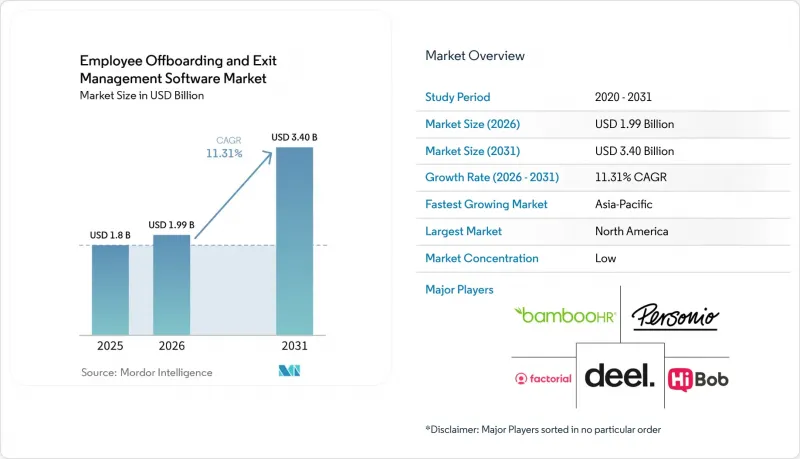
本報告按部署模式(雲端、本地部署、混合部署)、企業規模(大型企業等)、元件(軟體、服務)、應用程式(人力資源管理、合規管理等)、最終用戶產業(銀行、金融服務和保險、醫療保健和生命科學等)以及地區進行細分。市場預測以美元計價。
全球退休與離職管理軟體市場趨勢與洞察
關於進入許可權權限和審計追蹤的監管壓力日益增大
在員工離職和離職管理軟體市場,監管機構越來越傾向於將撤銷進入許可權的延遲視為行政缺陷,而不僅僅是例行流程錯誤。 NIS2 指示強制要求制定書面離職流程,並提供撤銷、資產返還和資料刪除的證據,違規者可能面臨最高 1,000 萬歐元(1,130 萬美元)或全球年收入 2% 的罰款。在金融進入許可權,紐約州金融服務部 (NYDFS) 於 2025 年 10 月進一步加大了監管力度,要求特定機構記錄並維護從入職到離職的整個訪問生命週期管理,包括第三方服務供應商的訪問生命週期管理。此外,GDPR 第 32 條確保安全的帳戶處理和檢驗的行政實務仍然是雇主在員工離職時處理個人資料的關鍵所在。這些因素共同意味著,離職流程的自動化程度越來越依賴行政措施的實施,而非招募規模。此外,即使在勞動力市場疲軟的情況下,這也為「員工離職和退休管理解決方案市場」創造了一個穩定的、合規主導的需求基礎。
在人力資源數位化和工作流程自動化方面的支出
人力資源部門不斷面臨壓力,需要在不增加相應人員配置的情況下完成更多重複性任務,這使得工作流程自動化成為員工離職和人員流動管理軟體市場的關鍵挑戰。到2026年,92%的首席人力資源長(CHRO)預計其組織將進一步採用人工智慧,而可重複的事務性工作流程將成為其廣泛應用的自然領域。離職清單、權限撤銷程序、薪資核算結算和文件流程等都符合此模式,因為它們基於規則且易於標準化。隨著核心人力資源系統的整合度不斷提高,雇主越來越需要結構化的離職數據,用於勞動力規劃、合規性審查和流程改進。這就催生了對能夠以可用格式收集離職原因、資產歸還狀態和完成證明的平台的需求,而不是將這些任務留給電子郵件往來。因此,隨著自動化有助於提高員工效率和管理透明度,員工離職和人員流動管理軟體市場採用自動化的理由正在進一步擴展。
整合人力資源、IT、薪資和身分管理系統的複雜性。
要實現真正有效率的員工離職流程,需要同時整合人力資源記錄、身分提供者、薪資核算引擎、SaaS 應用和資產追蹤系統,這對許多組織來說仍然是一個難題。如果流程中即使只有一個環節出現問題,團隊就必須退回電子郵件協調和人工跟進,從而削弱新實施系統的價值。在大型企業中,這個問題尤其突出,因為這些企業往往同時存在傳統的 ERP 環境和現代 SaaS 系統,而且各個業務部門採用的流程也略有不同。開發連接器、核准邏輯和異常處理機制可能需要數月的部署時間,才能讓第一個自動化流程在生產環境中運作。因此,部署成本可能會顯著高於基本訂閱費用,導致成本增加。這會減緩員工離職和離職管理解決方案市場的普及速度,並延長買家獲得投資回報 (ROI) 的時間。
細分市場分析
到2025年,基於雲端的退休和離職管理軟體市場佔有率將達到69.42%。這反映了買家對雲端的偏好,因為雲端具有集中式策略管理、降低基礎設施負擔以及易於與雲端原生身分管理工具整合等優勢。雲端採用的主導地位與更廣泛的趨勢相符,例如人力資源營運中軟體訂閱模式的轉變以及產品持續更新。集中式稽核日誌、共用工作流程範本以及跨地域的快速部署,使得這種模式對需要大規模一致執行的組織極具吸引力。此外,當地退休要求或內部控制更新時,雲端系統還能幫助雇主快速應用規則變更。
預計到2031年,混合模式將以12.47%的複合年成長率成長,因為企業在推進人員流動流程現代化的同時,無需一次性將所有人力資源和薪資核算工作負載遷移到共用雲端環境。混合設計在員工記錄、系統日誌和薪資文件的資料居住規則不同的司法管轄區尤其有用。在公共部門、國防和其他嚴格管控的環境中,本地部署仍然至關重要,因為在這些環境中,租戶共用雲端的使用仍然受到限制。 ISO 27001:2022標準持續對所有部署方案施加壓力,因為安全目標、存取權限變更和證據追蹤不僅需要在主要環境中定義,而且需要在所有環境中定義。在「員工流動和退休管理系統市場」中,擁有靈活託管、可審計控制和本地資料選項的供應商比那些依賴單區域架構的供應商更具優勢。
預計到2025年,大型企業將佔62.31%的市場。這主要得益於軟體預算的增加、多系統環境的建構以及企業內部對記錄員工離職流程每個步驟的強烈需求。這些採購企業通常經營複雜的人力資源、IT、薪資核算和安全系統,因此更有能力證明編配的價值。此外,由於連接的系統數量龐大,如果員工離職後進入許可權仍然有效,則這些企業將面臨更大的風險。因此,目前員工離職和離職管理軟體市場的收入基礎仍主要來自大型企業的需求。
預計到2031年,中小企業(SME)市場將以13.82%的複合年成長率成長,這將導致該類別的需求結構發生轉變。其中一個關鍵原因是整合式人力資源平台的普及,這些平台將員工離職工作流程納入更廣泛的訂閱服務中,使中小企業無需購買獨立系統。這降低了以往使用電子表格和簡單清單管理員工離職的雇主的進入門檻。 Employment Hero在2026年4月報告稱,其年度經常性收入將超過3億澳元(1.95億美元),並為超過35萬家公司提供支持,這凸顯了目前中小企業市場所取得的規模。在員工離職和退休管理軟體市場,這意味著儘管大型企業仍然佔據當前支出的大部分,但基本客群中規模較小的企業正在以更快的速度成長。
區域分析
到2025年,北美將佔據員工流動和離職管理軟體市場41.03%的佔有率。這主要得益於成熟企業軟體的普及、身分管治支出的增加,以及直接推動存取控制和稽核合規性的法規環境。美國憑藉其大規模的企業基礎和涵蓋人力資源技術、SaaS管理和身分管治的密集供應商生態系統,為該地區貢獻了大部分收入。加拿大和墨西哥也為市場成長做出了貢獻,尤其是在墨西哥,越來越多的跨國公司開始使用「名義雇主」(Employer-of-Record)架構進行跨國招聘和人員流動管理。歐洲仍然是第二大區域市場,這得益於GDPR的實施、NIS2的強制執行以及金融機構的DORA管理要求。在德國,勞動委員會在解僱相關程序中的共同決策權進一步增加了複雜性,因為離職流程通常需要本地客製化的核准邏輯,而不是簡單的全球範本。
預計到2031年,亞太地區將以13.71%的複合年成長率成長,成為員工離職和退休管理軟體成長最快的區域市場。印度市場尤其值得關注。 Darwinbox於2025年3月融資1.4億美元,隨後於2025年8月追加融資4000萬美元,用於支持國際擴張和產品開發,這表明該地區對可擴展人力資源平台的信心日益增強。澳洲和紐西蘭也是活躍的成長中心,Employment Hero計畫於2026年將其「管理式僱用」模式擴展到這些市場,以滿足中小企業在薪資核算、合規和人力資源管理方面的需求。南美洲仍處於應用初期,但JumpCloud於2026年1月收購巴西的MacSolution表明,南美洲正在增加對身分和存取管理基礎設施的投資,以支持更完善的離職流程。
中東和非洲地區仍處於發展階段,相關應用主要集中在波灣合作理事會(GCC)成員國。在該地區,數位化專案和跨國公司總部正在推動企業人力資源現代化。沙烏地阿拉伯和阿拉伯聯合大公國(阿拉伯聯合大公國)尤其重要,因為當地的勞動法規、外籍勞工的流動性以及嚴格的薪資合規要求,使得人員流動流程比許多全球模板所預期的更為複雜。 Keka計劃於2026年5月擴展其面向全球企業的薪資和財務服務,並明確針對海灣合作理事會成員國,這反映出供應商已意識到該地區的人員流動流程是一個至關重要的細分市場。非洲仍然是該地區最小的市場,但需求集中在南非、奈及利亞以及一些特定的科技中心,這些地區的跨國公司子公司需要更規範的員工生命週期管理。
其他好處:
- Excel格式的市場預測(ME)表
- 3個月的分析師支持
目錄
第1章:引言
- 研究假設和市場定義
- 調查範圍
第2章:調查方法
第3章執行摘要
第4章 市場狀況
- 市場概覽
- 市場促進因素
- 監管壓力日益加大,要求撤銷進入許可權並建立審計追蹤機制
- 在人力資源數位化和工作流程自動化方面的支出
- 混合型和分散式辦公室模式下人員流動問題的複雜性
- 優先考慮雇主品牌和校友體驗
- 跨境 EOR 與全球薪資核算。
- 將人力資源主導的離職流程與身分管治結合。
- 市場限制因素
- 整合人力資源、IT、薪資和身分管理系統的複雜性。
- 關於高度敏感離職資料的隱私和安全問題
- 員工代表委員會與地區核准之間的摩擦
- 離職率率低正在降低小規模企業的獨立投資報酬率。
- 宏觀經濟因素對市場的影響
- 產業價值鏈分析
- 監理情勢
- 技術展望
- 波特五力分析
第5章 市場規模與成長預測
- 按部署模式
- 基於雲端的
- 現場
- 混合
- 按最終用戶公司規模分類
- 大公司
- 小型企業
- 按組件
- 軟體
- 服務
- 透過使用
- 人力資源管理
- 合規管理
- IT存取和資產恢復
- 薪資核算與最終結算
- 知識轉移和退出回饋
- 其他用途
- 按最終用戶行業分類
- BFSI
- 醫療保健和生命科學
- IT/通訊
- 零售與電子商務
- 工業製造
- 政府/公共部門
- 按地區
- 北美洲
- 美國
- 加拿大
- 墨西哥
- 南美洲
- 巴西
- 阿根廷
- 其他南美國家
- 歐洲
- 德國
- 英國
- 法國
- 義大利
- 西班牙
- 俄羅斯
- 荷蘭
- 其他歐洲國家
- 亞太地區
- 中國
- 日本
- 印度
- 韓國
- 澳洲和紐西蘭
- 其他亞太國家
- 中東
- 沙烏地阿拉伯
- 阿拉伯聯合大公國
- 其他中東國家
- 非洲
- 南非
- 奈及利亞
- 埃及
- 肯亞
- 其他非洲國家
- 北美洲
第6章 競爭情勢
- 市場集中度
- 策略趨勢
- 市佔率分析
- 公司簡介。
- Bamboo HR LLC
- Deel Inc.
- Personio SE and Co. KG
- Hi Bob Ltd.
- EVERYDAY SOFTWARE, SL
- HR Cloud, Inc.
- GoCo.io, Inc.
- Enboarder Inc.
- Greytip Software Private Limited
- Darwinbox Digital Solutions Private Limited
- PeopleForce LTD.
- Employment Hero Pty Ltd.
- Keka Inc.
- Zimyo Consulting Private Limited
- 4i Apps Solutions Pvt Ltd.
- BetterCloud, Inc.
- JumpCloud, Inc.
- SailPoint Technologies, Inc.
- Saviynt, Inc.
- Torii Labs Ltd.
第7章 市場機會與未來展望
According to Mordor Intelligence, the employee offboarding and Exit Management Software Market size is projected to be USD 1.80 billion in 2025, USD 1.99 billion in 2026, and reach USD 3.40 billion by 2031, growing at a CAGR of 11.31% from 2026 to 2031.
This report is Segmented by Deployment Model (Cloud-Based, On-Premises, and Hybrid), Enterprise Size (Large Enterprises, and More), Component (Software, and Services), Application (HR Management, Compliance Management, and More), End-User Industry (BFSI, Healthcare and Life Sciences, and More), and Geography. The Market Forecasts are Provided in Terms of Value (USD).
Global Employee Offboarding And Exit Management Software Market Trends and Insights
Rising Regulatory Pressure for Access Revocation And Audit Trails
Regulators increasingly treat delayed access removal as a control failure rather than a routine process gap in the employee offboarding and exit management software market. The NIS2 Directive requires documented offboarding procedures with evidence of access revocation, asset return, and data erasure, and it allows penalties up to EUR 10 million (USD 11.3 million) or 2% of global annual turnover for noncompliance. In the financial sector, NYDFS expanded the pressure in October 2025 by requiring covered entities to maintain documented access lifecycle controls from onboarding through offboarding for third-party service providers as well. GDPR Article 32 has also kept secure account handling and verifiable control operation in active focus for employers handling personal data at exit. This combination makes offboarding automation less tied to hiring volume and more tied to the need to prove control execution. It also provides the Employee Offboarding and Exit Management Solutions Market with a stable, compliance-led demand base, even when labor conditions soften.
HR Digitization and Workflow Automation Spend
HR teams are under steady pressure to complete more repeatable work without increasing staffing at the same pace, which keeps workflow automation high on the agenda in the employee offboarding and exit management software market. In 2026, 92% of CHROs expected further AI adoption in their organizations, with repeatable transactional workflows emerging as a natural area for broader use. Exit checklists, access-removal sequences, payroll closure, and documentation routing fit that pattern because they are rule-based and easy to standardize. As core HR systems become more connected, employers also want structured exit data for workforce planning, compliance reviews, and process improvement. That creates space for platforms to capture exit reasons, return-of-asset status, and completion evidence in a usable format, rather than leaving these tasks in email threads. The result is a broader buying case for the employee offboarding and exit management software market, where automation serves both labor efficiency and control visibility.
Integration Complexity Across HR, IT, Payroll, and Identity Systems
A useful exit workflow must simultaneously connect HR records, identity providers, payroll engines, SaaS applications, and asset-tracking systems, and that is still a hard task in many organizations. If even one layer stays outside the workflow, teams revert to email coordination and manual follow-up, weakening the value of the system they just bought. This is especially difficult in large enterprises where legacy ERP environments sit alongside modern SaaS stacks, and where each business unit may use a slightly different process. Connector development, approval logic, and exception handling can stretch implementation for months before the first automated workflow runs in production. The cost burden then rises because deployment work can move well beyond the base subscription. That slows adoption in the employee offboarding and exit management solutions market and delays the point at which buyers feel a clear return on investment.
Other drivers and restraints analyzed in the detailed report include:
- Hybrid And Distributed Workforce Exit Complexity
- Identity Governance Convergence With HR-Triggered Offboarding
- Sensitive Exit Data Privacy And Security Concerns
For complete list of drivers and restraints, kindly check the Table Of Contents.
Segment Analysis
Cloud-based deployment accounted for 69.42% of the Employee Offboarding and Exit Management Software Market share in 2025, reflecting buyer preference for centralized policy updates, reduced infrastructure burden, and easier integration with cloud-native identity tools. The leading role of cloud deployment also fits the broader shift toward subscription software and continuous product updates in HR operations. Centralized audit logs, shared workflow templates, and faster rollout across sites make the model attractive for organizations that need consistent execution at scale. Cloud systems also help employers apply rule changes quickly when local separation requirements or internal controls are updated.
The hybrid model is projected to expand at a 12.47% CAGR through 2031, as organizations modernize offboarding without moving every HR and payroll workload into a shared cloud environment at once. A hybrid design is especially useful in jurisdictions where data residency rules vary across employee records, system logs, and payroll files. On-premises deployment still matters in the public sector, defense, and other tightly controlled settings where tenant-shared cloud usage remains constrained. ISO 27001:2022 keeps pressure on all deployment choices because security objectives, access changes, and evidence trails must be defined across every environment, not only the primary one. In the Employee Offboarding and Exit Management Systems Market, vendors with flexible hosting, auditable controls, and local data options are in a stronger position than providers tied to a single-region architecture.
Large enterprises held 62.31% share in 2025, supported by higher software budgets, multi-system environments, and stronger internal pressure to document every offboarding step. These buyers typically run complex HR, IT, payroll, and security stacks, making the value of orchestration easier to justify. They also face higher exposure when access remains active after a departure because the number of connected systems is much larger. As a result, enterprise demand continues to anchor the current revenue base of the employee offboarding and exit management software market.
SMEs are projected to grow at a 13.82% CAGR through 2031, altering the category's demand profile. A major reason is the spread of bundled HR platforms that include offboarding workflows as part of broader subscriptions, rather than requiring smaller firms to buy a standalone system. That lowers the entry barrier for employers that previously managed exits with spreadsheets or simple checklists. Employment Hero reported in April 2026 that it had surpassed AUD 300 million (USD 195 million) in annual recurring revenue while supporting more than 350,000 businesses, underscoring the scale now being achieved in the SME-focused segment. In the employee offboarding and exit management software market, this means growth is widening faster at the lower end of the customer base, even as large enterprises continue to account for most of the current spend.
Geography Analysis
North America accounted for 41.03% of the employee offboarding and exit management software market share in 2025, supported by mature enterprise software adoption, deeper identity governance spending, and a regulatory environment that directly pressures access control and audit readiness. The United States generated most of that regional revenue because it combines a large enterprise base with a dense vendor ecosystem across HR technology, SaaS management, and identity governance. Canada and Mexico added incremental growth, with Mexico attracting interest from multinational employers using employer-of-record structures to manage cross-border hiring and separations. Europe remained the second-largest regional market, supported by GDPR obligations, NIS2 enforcement, and the DORA control requirements for financial institutions. Germany adds a further layer because works councils hold codetermination rights in dismissal-related procedures, which means offboarding workflows often need localized approval logic rather than a simple global template.
Asia-Pacific is projected to grow at a 13.71% CAGR through 2031, making it the fastest-expanding regional market for employee offboarding and exit management software. India stands out because Darwinbox raised USD 140 million in March 2025 and then secured another USD 40 million in August 2025 to support international expansion and product development, signaling rising confidence in scalable HR platforms in the region. Australia and New Zealand are also active growth points, with Employment Hero extending its managed employment model across these markets in 2026 to address payroll, compliance, and HR administration needs for SMEs. South America remains at an earlier adoption stage, but JumpCloud's January 2026 acquisition of MacSolution in Brazil points to growing investment in identity and access infrastructure that supports stronger offboarding execution.
The Middle East and Africa region is still emerging, with adoption concentrated in the Gulf Cooperation Council states, where digitization programs and multinational headquarters are driving enterprise HR modernization. Saudi Arabia and the United Arab Emirates matter most because local labor rules, expatriate workforce flows, and compliance-heavy payroll closure create a more complex exit process than many global templates assume. Keka's May 2026 payroll and finance expansion for global employers, with explicit GCC relevance, reflects vendor recognition that the region's separation workflows have become a meaningful niche. Africa remains the smallest regional market, with demand centered on South Africa, Nigeria, and selected technology hubs where multinational subsidiaries need more formal employee lifecycle controls.
- Bamboo HR LLC
- Deel Inc.
- Personio SE and Co. KG
- Hi Bob Ltd.
- EVERYDAY SOFTWARE, S.L.
- HR Cloud, Inc.
- GoCo.io, Inc.
- Enboarder Inc.
- Greytip Software Private Limited
- Darwinbox Digital Solutions Private Limited
- PeopleForce LTD.
- Employment Hero Pty Ltd.
- Keka Inc.
- Zimyo Consulting Private Limited
- 4i Apps Solutions Pvt Ltd.
- BetterCloud, Inc.
- JumpCloud, Inc.
- SailPoint Technologies, Inc.
- Saviynt, Inc.
- Torii Labs Ltd.
Additional Benefits:
- The market estimate (ME) sheet in Excel format
- 3 months of analyst support
TABLE OF CONTENTS
1 INTRODUCTION
- 1.1 Study Assumptions and Market Definition
- 1.2 Scope of the Study
2 RESEARCH METHODOLOGY
3 EXECUTIVE SUMMARY
4 MARKET LANDSCAPE
- 4.1 Market Overview
- 4.2 Market Drivers
- 4.2.1 Rising Regulatory Pressure For Access Revocation and Audit Trails
- 4.2.2 HR Digitization and Workflow Automation Spend
- 4.2.3 Hybrid and Distributed Workforce Exit Complexity
- 4.2.4 Employer Brand and Alumni Experience Prioritization
- 4.2.5 Cross-Border EOR and Global Payroll Separation Complexity
- 4.2.6 Identity Governance Convergence With HR-Triggered Offboarding
- 4.3 Market Restraints
- 4.3.1 Integration Complexity Across HR, IT, Payroll, and Identity Systems
- 4.3.2 Sensitive Exit Data Privacy and Security Concerns
- 4.3.3 Works Council and Jurisdiction-Specific Approval Friction
- 4.3.4 Low Exit Frequency Weakening Standalone ROI For Small Employers
- 4.4 Impact of Macroeconomic Factors on the Market
- 4.5 Industry Value Chain Analysis
- 4.6 Regulatory Landscape
- 4.7 Technological Outlook
- 4.8 Porter's Five Forces Analysis
- 4.8.1 Threat of New Entrants
- 4.8.2 Bargaining Power of Buyers
- 4.8.3 Bargaining Power of Suppliers
- 4.8.4 Threat of Substitutes
- 4.8.5 Intensity of Competitive Rivalry
5 MARKET SIZE AND GROWTH FORECASTS (VALUE)
- 5.1 By Deployment Model
- 5.1.1 Cloud-Based
- 5.1.2 On-Premises
- 5.1.3 Hybrid
- 5.2 By End User Enterprise Size
- 5.2.1 Large Enterprises
- 5.2.2 Small and Medium-Sized Enterprises
- 5.3 By Component
- 5.3.1 Software
- 5.3.2 Services
- 5.4 By Application
- 5.4.1 HR Management
- 5.4.2 Compliance Management
- 5.4.3 IT Access and Asset Recovery
- 5.4.4 Payroll and Final Settlement
- 5.4.5 Knowledge Transfer and Exit Feedback
- 5.4.6 Other Applications
- 5.5 By End User Industry
- 5.5.1 BFSI
- 5.5.2 Healthcare and Life Sciences
- 5.5.3 Information Technology and Telecom
- 5.5.4 Retail and E-commerce
- 5.5.5 Industrial Manufacturing
- 5.5.6 Government and Public Sector
- 5.6 By Geography
- 5.6.1 North America
- 5.6.1.1 United States
- 5.6.1.2 Canada
- 5.6.1.3 Mexico
- 5.6.2 South America
- 5.6.2.1 Brazil
- 5.6.2.2 Argentina
- 5.6.2.3 Rest of South America
- 5.6.3 Europe
- 5.6.3.1 Germany
- 5.6.3.2 United Kingdom
- 5.6.3.3 France
- 5.6.3.4 Italy
- 5.6.3.5 Spain
- 5.6.3.6 Russia
- 5.6.3.7 Netherlands
- 5.6.3.8 Rest of Europe
- 5.6.4 Asia-Pacific
- 5.6.4.1 China
- 5.6.4.2 Japan
- 5.6.4.3 India
- 5.6.4.4 South Korea
- 5.6.4.5 Australia and New Zealand
- 5.6.4.6 Rest of Asia-Pacific
- 5.6.5 Middle East
- 5.6.5.1 Saudi Arabia
- 5.6.5.2 United Arab Emirates
- 5.6.5.3 Rest of Middle East
- 5.6.6 Africa
- 5.6.6.1 South Africa
- 5.6.6.2 Nigeria
- 5.6.6.3 Egypt
- 5.6.6.4 Kenya
- 5.6.6.5 Rest of Africa
- 5.6.1 North America
6 COMPETITIVE LANDSCAPE
- 6.1 Market Concentration
- 6.2 Strategic Moves
- 6.3 Market Share Analysis
- 6.4 Company Profiles (includes Global Level Overview, Market Level Overview, Core Segments, Financials as available, Strategic Information, Market Rank/Share, Products and Services, Recent Developments).
- 6.4.1 Bamboo HR LLC
- 6.4.2 Deel Inc.
- 6.4.3 Personio SE and Co. KG
- 6.4.4 Hi Bob Ltd.
- 6.4.5 EVERYDAY SOFTWARE, S.L.
- 6.4.6 HR Cloud, Inc.
- 6.4.7 GoCo.io, Inc.
- 6.4.8 Enboarder Inc.
- 6.4.9 Greytip Software Private Limited
- 6.4.10 Darwinbox Digital Solutions Private Limited
- 6.4.11 PeopleForce LTD.
- 6.4.12 Employment Hero Pty Ltd.
- 6.4.13 Keka Inc.
- 6.4.14 Zimyo Consulting Private Limited
- 6.4.15 4i Apps Solutions Pvt Ltd.
- 6.4.16 BetterCloud, Inc.
- 6.4.17 JumpCloud, Inc.
- 6.4.18 SailPoint Technologies, Inc.
- 6.4.19 Saviynt, Inc.
- 6.4.20 Torii Labs Ltd.
7 MARKET OPPORTUNITIES AND FUTURE OUTLOOK
- 7.1 White-Space and Unmet-Need Assessment

 人力資源外包市場-2026-2032年全球市場預測
 神經多樣性職場適應解決方案市場預測——按解決方案類型、經營模式、交付方式、最終用戶和地區分類的全球分析——2034 年
 人力資源管理服務:市場佔有率分析、產業趨勢與統計、成長預測(2026-2031 年)
 2026-2030年全球人力資源外包(HRO)市場人力資源共享服務軟體:市場佔有率分析、產業趨勢與統計、成長預測(2026-2031)外包合約管理服務(AOR):市場佔有率分析、產業趨勢與統計資料、成長預測(2026-2031 年)
 2026年全球人力資源分析軟體市場報告2026年全球人力資源外包業務流程外包市場報告2026年全球人力資源外包與諮詢服務市場報告2026年全球員工折扣計劃市場報告