


 |
市場調查報告書
商品編碼
2072679
人力資源共享服務軟體:市場佔有率分析、產業趨勢與統計、成長預測(2026-2031)HR Shared Services Software - Market Share Analysis, Industry Trends & Statistics, Growth Forecasts (2026 - 2031) |
||||||

※ 本網頁內容可能與最新版本有所差異。詳細情況請與我們聯繫。
根據 Mordor Intelligence 預測,人力資源共享服務軟體市場預計將從 2025 年的 347.2 億美元成長到 2026 年的 377.1 億美元,到 2031 年達到 589.5 億美元,2026 年至 2031 年的複合年成長率預計為 9.35%預計。
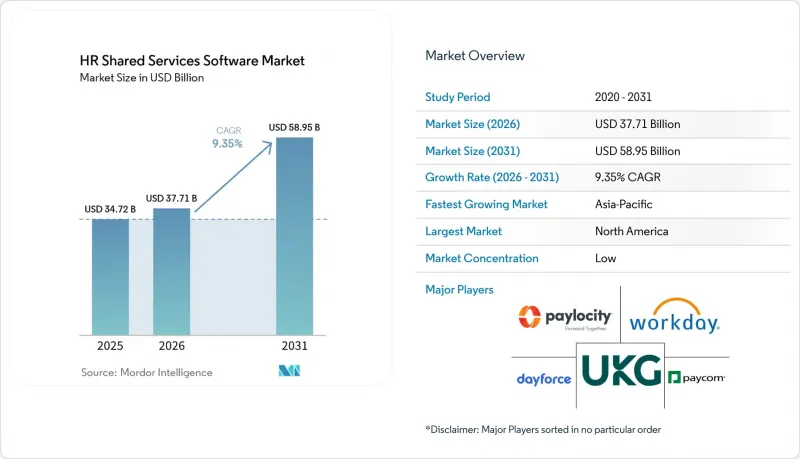
本報告按部署模式(雲端、本地部署、混合部署)、企業規模(大型企業等)、應用領域(核心人力資源和員工自助服務、案例管理和工單管理等)、最終用戶行業(銀行、金融服務和保險、醫療保健和生命科學、資訊科技和電信等)以及地區進行細分。市場預測以美元計價。
全球人力資源共享服務軟體市場趨勢與洞察
人工智慧驅動的案件解決和知識搜尋正在加速零級醫療機構的轉變。
人力資源共享服務軟體市場最大的轉變在於從諮詢型人工智慧轉型為基於代理的人工智慧轉型,後者無需人工干預即可解決案例。 2026年4月, Oracle發布了Fusion Agentic Applications for HR,該軟體採用協作式人工智慧代理,能夠跨越政策層級、核准流程和員工記錄,完成端到端的操作。 ServiceNow也在2025年12月擴展了其HRSD版本,引進了基於代理的流程,利用檢索增強生成技術來搜尋0級諮詢和關鍵案例。隨著個案傳輸率的提高,共享服務中心的成本基礎將會降低,使更多的人力資源員工能夠轉向員工關係和諮詢工作。這提高了人力資源共享服務軟體市場中那些無法展現大規模案例解決能力的平台的投資報酬率門檻。
員工對自助服務的期望日益提高,正在重塑平台架構。
員工對人力資源共享服務的期望正在發生巨大變化。到2026年,員工的需求將不再侷限於簡單的密碼重設或薪資下載。他們希望能夠透過入口網站處理複雜的多階段請求,例如重新計算產假天數、在職位變更時核實股票授予情況以及在發生人生大事後更新福利,而無需人力資源部門的干預。微軟基於Copilot建構的員工自助服務代理(Employee Self-Service Agent)凸顯了這一轉變,它將人力資源、IT和園區服務整合到一個統一的、全公司範圍的體驗中,並透過減少工單數量帶來了可衡量的成效。預計到2026年,企業人力資源人工智慧預算將飆升至160萬美元,比2023年成長十倍,這主要得益於自動化入職、人力資源文件創建和人工智慧輔助工作流程等應用情境的推動。同時,美國人力資源管理協會(SHRM)指出,外勤員工和非辦公室人員將佔全球勞動力的80%。因此,供應商現在優先考慮行動優先、生物識別和可透過簡訊存取的支援層,而不是僅限瀏覽器的入口網站。
資料隱私問題以及敏感員工記錄可能洩漏的風險增加了實施的風險。
人力資源共享服務平台將薪資、健康、紀律、移民和績效等相關數據整合到單一系統中,加劇了人力資源共享服務軟體市場的風險。這種集中化不僅擴大了攻擊面,也給採購方帶來了更大的合規負擔。根據CMS法律追蹤器顯示,與員工資料相關的罰款已達191起,總額達360,807,141歐元(約3.897億美元)。歐洲資料保護委員會(EDPB)於2026年採取的協調措施進一步提高了對雇主透明度的關注。此外,義大利資料保護機構於2026年就基於Slack的壓力偵測工具發出警告,指出即使尚未確認發生資料外洩,這些工具仍存在未來違反GDPR第9條的風險。因此,人力資源共享服務軟體市場的採購週期正在延長,因為法律、隱私和安全團隊現在要求在簽訂合約前提供ISO 27001、DPIA和子處理者合規性方面的證明。
細分市場分析
至2025年,基於雲端的部署將佔人力資源共享服務軟體市場66.12%的佔有率,成為企業人力資源營運的標準選擇。企業持續青睞雲,尤其重視人工智慧、自動化和基於代理的服務工具的快速功能更新。混合部署仍然是成長最快的模式,預計到2031年將以11.75%的複合年成長率成長。這一趨勢反映的是企業對資料儲存和審計需求的務實應對,而非對雲端的摒棄。
隨著企業將工作負載分散到雲端和本地環境,預計到2031年,混合部署的人力資源共享服務軟體市場將以11.75%的複合年成長率成長。在監管嚴格的環境中,薪資核算和身分驗證資料通常保留在私人基礎架構上,而服務交付、分析和人工智慧功能則遷移到雲端。這種混合部署模式在那些高度敏感的員工記錄無法完全遷移到公共雲端環境的行業和國家正變得越來越普遍。由於與傳統ERP系統的整合以及漫長的許可週期會延遲遷移決策,本地部署在新計畫中的市場佔有率持續下降。因此,人力資源共享服務軟體市場正進入一個更加成熟的階段,部署選擇越來越受到工作負載保密性和管治需求的驅動。
預計2025年,大型企業將佔人力資源共享服務軟體銷售額的62.50%。這一主導地位反映了共享服務中心的規模經濟效益、集中式服務等級協定 (SLA) 管理以及跨多個國家/地區的薪資核算協調。這些企業可以將軟體成本分攤到眾多員工和實體上。此外,他們在選擇平台時也更加重視多語言支援、合規性和工作流程的靈活性。
預計到2031年,中型企業將以12.31%的複合年成長率成長,成為該領域成長最快的買家群體。雲端交付和模組化定價模式使得那些以前無法承擔企業級部署成本的公司也能獲得案例管理、文件處理和分析功能。許多此類買家是在首次收購或國際擴張期間進入人力資源共享服務軟體市場,這意味著他們通常沒有太多需要拆除的舊共享服務基礎設施。這為成熟供應商和新興供應商都帶來了極具吸引力的待開發區商機。 ISG的研究顯示,84%的組織計劃在未來兩年內改變其人力資源採購模式,而內部共享服務的擴展是主要驅動力。
區域分析
到2025年,北美將繼續保持在該地區人力資源共享服務軟體市場的領先地位,佔據42.00%的市場佔有率。該地區受益於大型企業雄厚的預算、成熟的共享服務中心模式以及密集的軟體供應商群體。採購行為也傾向於SaaS採購,並快速部署人工智慧主導的員工支援工作流程。在美國一些已頒布與勞動力相關的人工智慧法律的州,許多人力資源負責人並不了解這些法規。這正是買家要求平台具備更嚴格合規措施的原因之一。在加拿大,各省的薪資核算和休假法規以及魁北克省對雙語職場環境的需求進一步加劇了情況的複雜性,從而推動了對企業級系統的需求。
歐洲仍然是人力資源共享服務軟體的第二大區域市場。 GDPR和歐盟人工智慧法規提高了該地區人力資源平台在管治、可審計性和透明度方面的最低標準。協調一致的執法措施正在加強對雇主在處理員工資料方面透明度義務的監督。德國和英國是該地區需求的主要驅動力,英國的假期工資記錄保存法規將於2026年4月6日生效,這將引發對文件管理模組的短期需求。南美市場規模仍然小規模,但巴西和阿根廷正吸引越來越多的跨國公司,他們尋求合規的區域人力資源數據平台。
預計到2031年,亞太地區將以14.25%的複合年成長率成長,成為人力資源共享服務軟體市場成長最快的地區。這一成長主要得益於印度IT人才招聘的擴張、中國製造業勞動力的數位轉型以及東南亞醫療保健產業人力資源部門的現代化。調查顯示,該地區75%的組織已在人力資源部門使用人工智慧,63%的組織預計其人工智慧預算將在2026年增加,但只有11%的組織表示已準備好在整個公司全面部署人工智慧。在以沙烏地阿拉伯和阿拉伯聯合大公國為首的中東地區以及非洲部分地區(特別是南非和奈及利亞),與企業集團、跨國公司子公司擴張以及對合規人力資源基礎設施的需求相關的商機仍然很大。
其他好處:
- Excel格式的市場預測(ME)表
- 3個月的分析師支持
目錄
第1章:引言
- 研究假設和市場定義
- 調查範圍
第2章:調查方法
第3章執行摘要
第4章 市場狀況
- 市場概覽
- 宏觀經濟因素對市場的影響
- 市場促進因素
- 員工對自助服務的期望日益提高
- 人工智慧驅動的案例解決和知識搜尋
- 多邊人力資源運作的集中化
- 薪資核算、休假和員工相關文件的合規負擔增加。
- 實現入職、調動和離職流程中跨部門工作流程的自動化。
- 併購後對多語言共享服務支援的需求
- 市場限制因素
- 資料隱私和高度敏感員工記錄的洩露
- 人力資源資訊系統、薪資核算、身分管理系統和文件管理系統整合面臨的挑戰。
- 流程問責機制缺失和資料完整性差限制了投資報酬率。
- 基於代理的人工智慧在關鍵人事決策中引發的管治風險
- 產業價值鏈分析
- 監理情勢
- 技術展望
- 波特五力分析
第5章 市場規模與成長預測
- 按部署模式
- 基於雲端的
- 現場
- 混合
- 按最終用戶公司規模分類
- 大公司
- 中型公司
- 透過使用
- 核心人力資源管理與員工自助服務
- 案件管理和票據發放
- 工作流程自動化與員工體驗
- 文件管理和電子簽章
- 勞動力分析和報告編制
- 薪資和福利支持
- 人力資源發展與學習支持
- 按最終用戶行業分類
- BFSI
- 醫療保健和生命科學
- 資訊科技/通訊
- 零售與電子商務
- 工業製造
- 政府/公共部門
- 其他終端用戶產業
- 按地區
- 北美洲
- 美國
- 加拿大
- 墨西哥
- 南美洲
- 巴西
- 阿根廷
- 其他南美國家
- 歐洲
- 德國
- 英國
- 法國
- 義大利
- 西班牙
- 俄羅斯
- 荷蘭
- 其他歐洲國家
- 亞太地區
- 中國
- 日本
- 印度
- 韓國
- 澳洲和紐西蘭
- 其他亞太國家
- 中東
- 沙烏地阿拉伯
- 阿拉伯聯合大公國
- 其他中東國家
- 非洲
- 南非
- 奈及利亞
- 其他非洲國家
- 北美洲
第6章 競爭情勢
- 市場集中度
- 策略趨勢
- 市佔率分析
- 公司簡介
- Workday, Inc.
- UKG Inc.
- Dayforce, Inc.
- Paycom Software, Inc.
- Paylocity Holding Corporation
- BambooHR LLC
- HiBob Ltd.
- Darwinbox Digital Solutions Private Limited
- Cezanne HR Limited
- Neocase Software
- Rippling People Center Inc.
- Factorial HR, SL
- SAP SuccessFactors
- Zalaris ASA
- Ramco Systems Limited
- Servicenow
- Deel Inc.
- PayFit SAS
- Paychex, Inc.
- Neocase Software
第7章 市場機會與未來展望
According to Mordor Intelligence, the HR shared services software market size is expected to increase from USD 34.72 billion in 2025 to USD 37.71 billion in 2026 and reach USD 58.95 billion by 2031, growing at a CAGR of 9.35% over 2026-2031.
This report is Segmented by Deployment Model (Cloud-Based, On-Premise, and Hybrid), Enterprise Size (Large Enterprises, and More), Application (Core HR and Employee Self-Service; Case Management and Ticketing, and More), End-User Industry (BFSI, Healthcare and Life Sciences, Information Technology and Telecom, and More), and Geography. The Market Forecasts are Provided in Terms of Value (USD).
Global HR Shared Services Software Market Trends and Insights
AI-Enabled Case Resolution and Knowledge Retrieval Accelerates Tier-0 Deflection
The biggest shift in the HR shared services software market is the move from advisory AI to agentic AI that can resolve cases without human escalation. Oracle introduced Fusion Agentic Applications for HR in April 2026, using coordinated AI agents that can work across policy hierarchies, approval flows, and employee records to complete actions end to end. ServiceNow also extended its HRSD release in December 2025 with agentic flows that use retrieval-augmented generation for tier-0 queries and critical case routing. As deflection rates rise, the cost base of shared service centers falls, allowing more HR staff to shift into employee relations and advisory work. That is lifting the ROI bar in the HR shared services software market for platforms that cannot prove case resolution at scale.
Expansion of Employee Self-Service Expectations Reshapes Platform Architecture
Employee expectations in HR shared services have evolved dramatically. By 2026, employees want far more than simple password resets or pay-stub downloads; they expect portals to handle complex multi-step requests, such as recalculating leave after maternity return, confirming equity grants during role changes, and updating benefits after life events, without HR desk intervention. Microsoft highlighted this shift with its Employee Self-Service Agent, built on Copilot, which unified HR, IT, and campus services into a single enterprise-wide experience, resulting in measurable ticket deflection. Enterprise HR-AI budgets surged to USD 1.6 million in 2026, a tenfold increase from 2023, driven by use cases such as onboarding automation, HR document creation, and AI-assisted workflows. Meanwhile, SHRM emphasized that frontline and deskless workers make up 80% of the global workforce, prompting vendors to prioritize mobile-first, biometric-authenticated, and SMS-accessible support layers rather than browser-only portals.
Data Privacy and Sensitive Employee Record Exposure Elevates Deployment Risk
HR shared services platforms consolidate salary, health, disciplinary, immigration, and performance data in a single system, which increases the risk profile of the HR shared services software market. That concentration creates both a larger attack surface and a more serious compliance burden for buyers. The CMS Law tracker recorded 191 employee-data fines totaling EUR 360,807,141 (USD 389.7 million), and the 2026 coordinated action from the EDPB has tightened attention on employer transparency. Italy's data protection authority also issued a warning in 2026 regarding a Slack-based stress-detection tool, citing a risk of future GDPR Article 9 violations even without a confirmed breach. As a result, procurement cycles in the HR shared services software market are taking longer, as legal, privacy, and security teams require ISO 27001, DPIA, and sub-processor evidence before signing contracts.
Other drivers and restraints analyzed in the detailed report include:
- Centralization of Multi-Country HR Operations Creates Demand For Unified Platforms
- Rising Compliance Burden Across Payroll, Leave, and Employee Documentation Drives Platform Adoption
- Integration Friction Across HRIS, Payroll, Identity, and Document Systems Delays Value Realization
For complete list of drivers and restraints, kindly check the Table Of Contents.
Segment Analysis
Cloud-based deployment accounted for 66.12% of the HR shared services software market in 2025, making it the standard choice across enterprise HR operations. Enterprises continue to favor cloud because feature updates arrive faster there, especially for AI, automation, and agentic service tools. Hybrid deployment remains the fastest-growing model and is projected to grow at 11.75% through 2031. That pattern reflects a practical response to data-residency and audit needs rather than a retreat from cloud.
The HR shared services software market for hybrid deployment is projected to expand at a 11.75% CAGR through 2031 as organizations split workloads across cloud and on-premises environments. In regulated settings, payroll and identity data often stay in private infrastructure while service delivery, analytics, and AI capabilities move into cloud layers. This mix is becoming more common in sectors and countries where sensitive employee records cannot be fully migrated to public cloud environments. On-premise deployments continue to lose ground in new projects because legacy ERP links and long license cycles slow migration decisions. The result is a more mature HR shared services software market, where deployment choices are increasingly driven by workload sensitivity and governance needs.
Large enterprises accounted for 62.50% of 2025 revenue in the HR shared services software market. That lead reflects the scale economics of shared service centers, centralized SLA management, and multi-country payroll orchestration. These organizations can spread software spending across very large employee populations and many legal entities. They also place greater weight on multilingual support, depth of compliance, and breadth of workflow when selecting platforms.
Medium-sized enterprises are projected to grow at 12.31% CAGR through 2031, making them the fastest-growing buyer group in this segmentation. Cloud delivery and modular pricing are opening access to case management, document handling, and analytics for firms that previously could not justify the costs of enterprise-grade deployment. Many of these buyers are entering the HR shared services software market during their first acquisition or international expansion, which means they often have little legacy shared services infrastructure to unwind. That makes them attractive greenfield opportunities for incumbent and challenger vendors alike. ISG found that 84% of organizations planned to change their HR sourcing model within 2 years, with the expansion of internal shared services identified as a major lever
Complete Report Scope:
- By Deployment Model
- Cloud-Based
- On-Premise
- Hybrid
- By End User Enterprise Size
- Large Enterprises
- Medium-Sized Enterprises
- By Application
- Core HR and Employee Self-Service
- Case Management and Ticketing
- Workflow Automation and Employee Journeys
- Document Management and E-Signature
- Workforce Analytics and Reporting
- Payroll and Benefits Support
- Talent and Learning Support
- By End-user Industry
- BFSI
- Healthcare and Life Sciences
- Information Technology and Telecom
- Retail and E-commerce
- Industrial Manufacturing
- Government and Public Sector
- Other End-user Industries
- By Geography
- North America
- United States
- Canada
- Mexico
- South America
- Brazil
- Argentina
- Rest of South America
- Europe
- Germany
- United Kingdom
- France
- Italy
- Spain
- Russia
- Netherlands
- Rest of Europe
- Asia-Pacific
- China
- Japan
- India
- South Korea
- Australia and New Zealand
- Rest of Asia-Pacific
- Middle East
- Saudi Arabia
- United Arab Emirates
- Rest of Middle East
- Africa
- South Africa
- Nigeria
- Rest of Africa
- North America
Geography Analysis
North America held 42.00% of the HR shared services software market in 2025, maintaining the region's lead. The region benefits from large enterprise budgets, mature shared service center models, and a dense software vendor base. Buying behavior also favors SaaS procurement and faster deployment of AI-led workflows in employee support. Many HR professionals in the US states with workforce-related AI laws were unaware of those rules, which helps explain why buyers want stronger compliance guardrails in their platforms. Canada adds another layer of complexity through province-level payroll and leave rules and bilingual workplace needs in Quebec, which supports demand for enterprise-grade systems.
Europe remained the second-largest regional market for HR shared services software. GDPR and the EU AI Act have raised the minimum standard for governance, auditability, and transparency across HR platforms used in the region. Coordinated enforcement actions have increased scrutiny of employer transparency obligations in employee data processing. Germany and the United Kingdom anchor regional demand, and the UK's holiday pay recordkeeping rules, effective April 6, 2026, created a near-term trigger for document management modules. South America remains smaller, but Brazil and Argentina are seeing increased interest from multinationals seeking compliant regional HR data platforms.
Asia-Pacific is projected to grow at 14.25% CAGR through 2031, the fastest regional pace in the HR shared services software market. Growth is being supported by India's expanding IT hiring base, the digitization of China's manufacturing workforce, and healthcare HR modernization across Southeast Asia. Surveys show that 75% of organizations in the region were already using AI in HR, and 63% expected AI budgets to rise in 2026, although only 11% felt fully prepared to scale AI across the enterprise. The Middle East, led by Saudi Arabia and the UAE, and parts of Africa, especially South Africa and Nigeria, remain earlier-stage opportunities tied to conglomerate expansion, multinational subsidiaries, and demand for compliance-ready HR infrastructure.
- Workday, Inc.
- UKG Inc.
- Dayforce, Inc.
- Paycom Software, Inc.
- Paylocity Holding Corporation
- BambooHR LLC
- HiBob Ltd.
- Darwinbox Digital Solutions Private Limited
- Cezanne HR Limited
- Neocase Software
- Rippling People Center Inc.
- Factorial HR, S.L.
- SAP SuccessFactors
- Zalaris ASA
- Ramco Systems Limited
- Servicenow
- Deel Inc.
- PayFit SAS
- Paychex, Inc.
- Neocase Software
Additional Benefits:
- The market estimate (ME) sheet in Excel format
- 3 months of analyst support
TABLE OF CONTENTS
1 INTRODUCTION
- 1.1 Study Assumptions and Market Definition
- 1.2 Scope of the Study
2 RESEARCH METHODOLOGY
3 EXECUTIVE SUMMARY
4 MARKET LANDSCAPE
- 4.1 Market Overview
- 4.2 Impact of Macroeconomic Factors on the Market
- 4.3 Market Drivers
- 4.3.1 Expansion Of Employee Self-Service Expectations
- 4.3.2 AI-Enabled Case Resolution And Knowledge Retrieval
- 4.3.3 Centralization Of Multi-Country HR Operations
- 4.3.4 Rising Compliance Burden Across Payroll, Leave, And Employee Documentation
- 4.3.5 Cross-Functional Workflow Automation For Joiner-Mover-Leaver Journeys
- 4.3.6 Demand For Multilingual Shared-Service Support After Mergers And Acquisitions
- 4.4 Market Restraints
- 4.4.1 Data Privacy And Sensitive Employee Record Exposure
- 4.4.2 Integration Friction Across HRIS, Payroll, Identity, And Document Systems
- 4.4.3 Weak Process Ownership And Poor Data Harmonization Limit ROI
- 4.4.4 Governance Risk From Agentic AI In High-Stakes HR Decisions
- 4.5 Industry Value Chain Analysis
- 4.6 Regulatory Landscape
- 4.7 Technological Outlook
- 4.8 Porter's Five Forces Analysis
- 4.8.1 Threat of New Entrants
- 4.8.2 Bargaining Power of Buyers
- 4.8.3 Bargaining Power of Suppliers
- 4.8.4 Threat of Substitutes
- 4.8.5 Intensity of Competitive Rivalry
5 MARKET SIZE AND GROWTH FORECASTS (VALUE)
- 5.1 By Deployment Model
- 5.1.1 Cloud-Based
- 5.1.2 On-Premise
- 5.1.3 Hybrid
- 5.2 By End User Enterprise Size
- 5.2.1 Large Enterprises
- 5.2.2 Medium-Sized Enterprises
- 5.3 By Application
- 5.3.1 Core HR and Employee Self-Service
- 5.3.2 Case Management and Ticketing
- 5.3.3 Workflow Automation and Employee Journeys
- 5.3.4 Document Management and E-Signature
- 5.3.5 Workforce Analytics and Reporting
- 5.3.6 Payroll and Benefits Support
- 5.3.7 Talent and Learning Support
- 5.4 By End-user Industry
- 5.4.1 BFSI
- 5.4.2 Healthcare and Life Sciences
- 5.4.3 Information Technology and Telecom
- 5.4.4 Retail and E-commerce
- 5.4.5 Industrial Manufacturing
- 5.4.6 Government and Public Sector
- 5.4.7 Other End-user Industries
- 5.5 By Geography
- 5.5.1 North America
- 5.5.1.1 United States
- 5.5.1.2 Canada
- 5.5.1.3 Mexico
- 5.5.2 South America
- 5.5.2.1 Brazil
- 5.5.2.2 Argentina
- 5.5.2.3 Rest of South America
- 5.5.3 Europe
- 5.5.3.1 Germany
- 5.5.3.2 United Kingdom
- 5.5.3.3 France
- 5.5.3.4 Italy
- 5.5.3.5 Spain
- 5.5.3.6 Russia
- 5.5.3.7 Netherlands
- 5.5.3.8 Rest of Europe
- 5.5.4 Asia-Pacific
- 5.5.4.1 China
- 5.5.4.2 Japan
- 5.5.4.3 India
- 5.5.4.4 South Korea
- 5.5.4.5 Australia and New Zealand
- 5.5.4.6 Rest of Asia-Pacific
- 5.5.5 Middle East
- 5.5.5.1 Saudi Arabia
- 5.5.5.2 United Arab Emirates
- 5.5.5.3 Rest of Middle East
- 5.5.6 Africa
- 5.5.6.1 South Africa
- 5.5.6.2 Nigeria
- 5.5.6.3 Rest of Africa
- 5.5.1 North America
6 COMPETITIVE LANDSCAPE
- 6.1 Market Concentration
- 6.2 Strategic Moves
- 6.3 Market Share Analysis
- 6.4 Company Profiles (includes Global Level Overview, Market Level Overview, Core Segments, Financials as available, Strategic Information, Market Rank/Share, Products and Services, Recent Developments)
- 6.4.1 Workday, Inc.
- 6.4.2 UKG Inc.
- 6.4.3 Dayforce, Inc.
- 6.4.4 Paycom Software, Inc.
- 6.4.5 Paylocity Holding Corporation
- 6.4.6 BambooHR LLC
- 6.4.7 HiBob Ltd.
- 6.4.8 Darwinbox Digital Solutions Private Limited
- 6.4.9 Cezanne HR Limited
- 6.4.10 Neocase Software
- 6.4.11 Rippling People Center Inc.
- 6.4.12 Factorial HR, S.L.
- 6.4.13 SAP SuccessFactors
- 6.4.14 Zalaris ASA
- 6.4.15 Ramco Systems Limited
- 6.4.16 Servicenow
- 6.4.17 Deel Inc.
- 6.4.18 PayFit SAS
- 6.4.19 Paychex, Inc.
- 6.4.20 Neocase Software
7 MARKET OPPORTUNITIES AND FUTURE OUTLOOK
- 7.1 White-Space and Unmet-Need Assessment

 人力資源外包市場-2026-2032年全球市場預測
 神經多樣性職場適應解決方案市場預測——按解決方案類型、經營模式、交付方式、最終用戶和地區分類的全球分析——2034 年
 人力資源管理服務:市場佔有率分析、產業趨勢與統計、成長預測(2026-2031 年)
 2026-2030年全球人力資源外包(HRO)市場外包合約管理服務(AOR):市場佔有率分析、產業趨勢與統計資料、成長預測(2026-2031 年)退休和離職管理軟體:市場佔有率分析、行業趨勢和統計數據以及成長預測(2026-2031 年)
 2026年全球人力資源分析軟體市場報告2026年全球人力資源外包業務流程外包市場報告2026年全球人力資源外包與諮詢服務市場報告2026年全球員工折扣計劃市場報告