


 |
市場調查報告書
商品編碼
2072615
氧化還原液流電池:市佔率分析、產業趨勢與統計、成長預測(2026-2031)Redox Flow Battery - Market Share Analysis, Industry Trends & Statistics, Growth Forecasts (2026 - 2031) |
||||||

※ 本網頁內容可能與最新版本有所差異。詳細情況請與我們聯繫。
根據 Mordor Intelligence 預測,氧化還原液流電池市場規模將從 2025 年的 18.3 億美元和 2026 年的 21.7 億美元成長到 2031 年的 49.6 億美元,2026 年至 2031 年的年複合成長率(CAGR)為 17.99%。
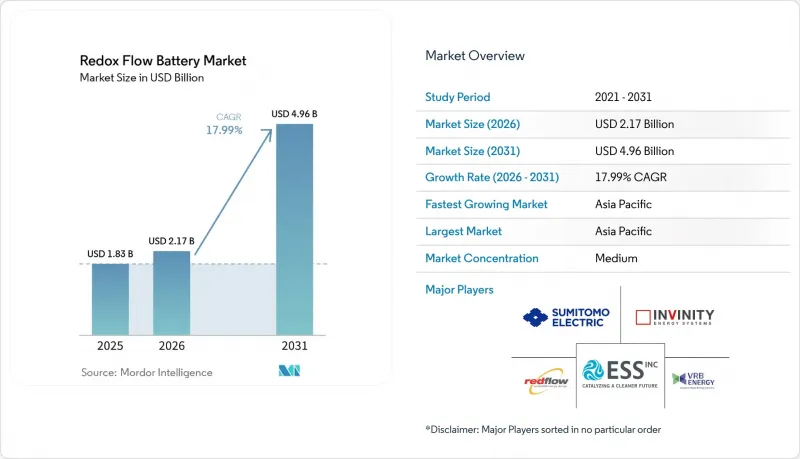
本報告按類型(釩液流電池及其他)、應用(公用事業規模儲能、商業和工業設施及其他)、最終用戶(電力公司/獨立發電商、商業和工業設施業主、政府和國防機構及其他)以及地區(北美、歐洲、亞太及其他)進行細分。市場預測以美元計價。
全球氧化還原液流電池市場趨勢與洞察
系統穩定性要求有助於融入批發市場。
美國聯邦能源監管委員會 (FERC) 第 841 號指令強制要求美國批發市場接受儲能資產用於所有技術上可行的服務,這為液流電池開闢了新的收入來源。此前,液流電池的收入來源僅限於降低用戶端的成本。歐洲的「清潔能源包裝」計畫也計劃在 2026 年前實施類似的改革,開發商已宣佈在德國、英國和北歐地區建設總計 1.2 吉瓦的液流電池項目。第 2222 號指令進一步促進了分散式資源的整合,允許商業設施將液流電池集中起來,用於容量和輔助收入,從而將太陽能發電比例高的州的項目投資回收期從 12 年縮短至 7 年。加州和德克薩斯州的美國電力公司目前在競標6 小時或更長時間的服務時,明確優先考慮非鋰基化學品。這是因為液流系統將功率與能量分離,因此可以在不更換整個系統的情況下逐步增加容量。因此,這些規定支持營運計畫的柔軟性和經濟確定性,並加快了受監管市場和自由化市場的採購決策。
釩租賃模式加速降低資本成本
以Storion Energy的85美元/千瓦時專案為例,電解租賃協議可將初始資本需求降低高達60%,並將商品價格波動風險轉移給承租者。由於釩的回收率高達99%,租賃公司可以在20年的週期內多次重複使用電解,從而創造鋰離子電池所不具備的循環經濟優勢。中國開發商已證明「租賃購買」模式的有效性,該模式在大約10年後將營運成本轉移給資產所有者,使成本結構與公司的可再生能源購電協議(PPA)保持一致。學術研究預測,如果採用電解租賃方式,每千瓦時運作10小時的釩液流電池系統成本將低於每千瓦時300美元,使其比運作時間相近的磷酸鋰鐵鋰電池更經濟。隨著金融創新在全球的普及,資本密集型長期專案的資金籌措潛力正在增加,從而擴大了液流電池的潛在市場規模。
釩價格波動會造成投資不確定性。
五氧化二釩的價格從2022年的每磅9.20美元跌至2026年3月的每磅5.60美元,跌幅達40%,主要原因是中國鋼鐵需求疲軟。儘管價格下跌抑制了新計畫的資本投資,但不確定性也使長期啟動合約的簽訂變得複雜,並阻礙了貸款機構的進入。 CRU集團預計,中國12GWh的部署目標將在本世紀下半葉推高價格,但來自巴西和馬達加斯加的新供應可能會減緩價格上漲的速度。因此,開發商正透過電解租賃來對沖價格波動風險,但價格波動仍影響債務償還比率,並略微減緩了液流電池市場的成長。
細分市場分析
到2025年,釩基液流電池系統在氧化還原液流電池市場將維持49.2%的市場佔有率,主要得益於中國、日本和韓國成熟的產業生態系統。同時,預計到2031年,鐵基液流電池系統將以22.2%的複合年成長率成長,這主要得益於供應商減少了對關鍵礦物的依賴,並將能量密度較第一代電池堆提高了20%。釩基系統之所以能夠維持其主導地位,是因為其99%的電解可回收利用,從而保證了電池報廢後的殘值;然而,原料價格的波動正促使風險規避型金融相關人員轉向鐵基替代方案。鋅基和溴基系統佔據了通訊備用電源和離網應用等細分市場,而有機和混合電池仍處於商業化前的階段。在整個預測期內,不太可能出現單一化學系統在氧化還原液流電池市場佔據絕對主導地位的情況;相反,區域政策將影響市場採用趨勢,技術多樣性也可能持續存在。
第二代釩液流電池組的循環壽命已達2萬次,是磷酸鋰鐵的兩倍。這為尋求穩定現金流的基礎設施投資者提供了極具吸引力的保障。同時,膜技術創新者正致力於在歐洲法規推出前推出不含PFAS的解決方案。整體而言,技術變革正逐步降低市場進入門檻,出貨量也不斷成長,但到2031年,釩的市佔率可能降至40%以下,這意味著液流電池市場的競爭格局將進一步加劇。
區域分析
預計到2025年,亞太地區將佔全球釩液流電池產能的45.9%,並在2031年之前維持19.3%的複合年成長率。這主要歸功於中國強制部署12吉瓦時釩液流電池系統,以降低可再生能源的波動性。在省級政府提供每千瓦時0.04至0.07美元的補貼以保障發電收入的同時,榮科電力等國內大型企業正在湖北省建設一座800兆瓦時的釩液流電池廠,預計將於2026年竣工。日本和澳洲也在測試和營運鐵基液流電池,以規避對關鍵礦產資源的依賴風險,這表明全部區域化學儲能系統的多元化程度正在不斷提高。
儘管北美在2025年將佔據相當大的市場佔有率,但「第45X條」稅額扣抵將延長至2029年,這可能使其在2031年之前佔據北美液流電池市場三分之一的佔有率。光是加州在2024年就採購了1.8吉瓦的長期儲能系統,其中40%採用液流技術,運作時間超過6小時。加拿大各省正在評估液流系統以穩定水力發電出口,墨西哥電力公司CFE正在審查競標指南。這些都顯示整個北美大陸的需求正在不斷成長。住友電工在加州建設的51兆瓦、306兆瓦時的儲能系統將於2024年投入運作,這是北美最大的液流電池項目,也凸顯了日本製造商在美國市場佔有率的成長。在歐洲,預計到2025年將佔全球產能的18%,以德國和英國為首的無PFAS薄膜技術正在推廣。隨著歐洲化學品管理局(ECHA)發布關於PFAS法規的最新文件和最終意見,IONOMR、弗勞恩霍夫應用物理研究所(Fraunhofer IAP)和Cellfion等公司正在推進相關投資,歐洲供應商也積極準備滿足法規主導的需求。
在德國的創新競標和英國的容量市場中,根據運作時長提供獎勵,顯著提高了液流電池的經濟效益。然而,隨著 PFAS 法規即將實施,傳統薄膜供應商面臨的實施風險日益增加,原始設備製造商 (OEM) 正在加速採用不含 PFAS 的產品。在專注於風能和氫能混合發電系統的斯堪地那維亞和波羅的海國家,液流電池正被納入專案規劃,以緩解季節性電力短缺問題。
智利和巴西正在製定政策框架,強調長期儲能作為電力傳輸的替代方案;南非電力公司Eskom已透過部署12兆瓦時的釩系統來緩解電力緊張,證明了儲能技術在新興電網中的適用性。隨著太陽能發電的平準化度電成本(LCOE)不斷降低,到2031年,這些地區的累計儲能裝置容量可望達到8吉瓦時。
其他好處
- Excel格式的市場預測(ME)表
- 3個月的分析師支持
目錄
第1章:引言
- 研究假設和市場定義
- 調查範圍
第2章:調查方法
第3章執行摘要
第4章 市場狀況
- 市場概覽
- 市場促進因素
- 關於系統穩定性的法規(FERC 841、歐盟清潔能源包裝)
- 釩礦租賃模式的成本正在迅速下降。
- 太陽能和風能的平準化度電成本已達到相當水平,這在長期儲能方面造成了差距。
- 一家擁有 8-12 小時儲能能力的 PPA 公司進行淨零排放採購。
- 美國製造的非鋰基化學品可享有稅額扣抵(《通膨控制法》第 45X 條)
- 資料中心驅動微電網,運轉率達 99.999%(超過 10 小時)。
- 市場限制因素
- 釩價波動與鋼鐵需求相關
- 與鋰離子電池相比,往返效率較低。
- 關於不含 PFAS 薄膜的法規增加了老舊煙囪的成本。
- 運輸容量超過 50 MWh 的電解以及儲存危險材料的卡車許可證申請流程正在變得越來越漫長。
- 供應鏈分析
- 監理情勢
- 技術展望
- 波特五力分析
第5章 市場規模與成長預測
- 按類型
- 釩液流電池(VRFB)
- 鋅溴液流電池
- 鐵流電池
- 有機/混合液流電池
- 其他化學物質(例如,Fe/Cr、H2-Br2)
- 透過使用
- 實用規模的儲能(10兆瓦時或以上)
- 微電網和獨立系統
- 商業和工業設施
- 住宅微電網
- 電動車充電站的緩衝
- 其他(國防、採礦、離網通訊)
- 最終用戶
- 電力公司/獨立發電商
- 可再生能源專案開發商
- 商業和工業設施的所有者
- 政府和國防機構
- 研究和學術機構
- 按地區
- 北美洲
- 美國
- 加拿大
- 墨西哥
- 歐洲
- 德國
- 英國
- 法國
- 義大利
- 北歐國家
- 俄羅斯
- 其他歐洲國家
- 亞太地區
- 中國
- 印度
- 日本
- 韓國
- ASEAN
- 其他亞太國家
- 南美洲
- 巴西
- 阿根廷
- 其他南美國家
- 中東和非洲
- 沙烏地阿拉伯
- 阿拉伯聯合大公國
- 南非
- 埃及
- 其他中東和非洲國家
- 北美洲
第6章 競爭情勢
- 市場集中度
- 策略趨勢(併購、聯盟、購電協議)
- 市場佔有率分析(主要公司的市場排名和市場佔有率)
- 公司簡介
- Sumitomo Electric Industries
- VRB Energy
- Invinity Energy Systems
- ESS Inc.
- Redflow Limited
- Primus Power
- Largo Clean Energy
- CellCube(Enerox GmbH)
- VoltStorage GmbH
- VFlow Tech
- Lockheed Martin(GridStar Flow)
- HydraRedox
- H2 Inc.
- Bushveld Energy
- Rongke Power
- Stryten Energy
- EnerVenue
- UniEnergy Tech(UET)
- Volterion GmbH
- StorEn Technologies
第7章 市場機會與未來展望
According to Mordor Intelligence, the redox flow battery market size is projected to expand from USD 1.83 billion in 2025 and USD 2.17 billion in 2026 to USD 4.96 billion by 2031, registering a CAGR of 17.99% between 2026 to 2031.
This report is Segmented by Type (Vanadium Redox Flow Battery, and More), Application (Utility-Scale Energy Storage, Commercial and Industrial Facilities, and More), End-User (Power Utilities/IPPs, Commercial and Industrial Owners, Government and Defense, and More), and Geography (North America, Europe, Asia-Pacific, and More). The Market Forecasts are Provided in Terms of Value (USD).
Global Redox Flow Battery Market Trends and Insights
Grid-Stability Mandates Drive Wholesale Market Integration
Federal Energy Regulatory Commission Order 841 obliges U.S. wholesale markets to accept storage assets for all services for which they are technically capable, unlocking new revenue streams for flow batteries that previously relied on behind-the-meter savings alone. Europe's Clean Energy Package imposes similar reforms by 2026, and developers have already announced 1.2 GW of flow projects in Germany, the United Kingdom, and the Nordic region. Order 2222 further aggregates distributed resources, allowing commercial sites to pool flow batteries and earn capacity and ancillary revenue, which shortens project payback from 12 years to 7 years in solar-heavy states. U.S. utilities in California and Texas now issue tenders that explicitly favor non-lithium chemistries for six-hour-plus services because flow systems decouple power and energy, enabling incremental capacity additions without full system replacement. Mandates, therefore, underpin scheduling flexibility and economic certainty, accelerating procurement decisions across both regulated and deregulated markets.
Vanadium Leasing Models Accelerate Capital Cost Reduction
Electrolyte leasing agreements, exemplified by Storion Energy's USD 85 kWh program, cut initial capital requirements by up to 60% and transfer commodity risk to the lessor. Because vanadium retains 99% recyclability, leasing firms can redeploy electrolyte over multiple 20-year cycles, creating a circular-economy advantage that lithium-ion lacks. Chinese developers have validated lease-to-own structures that convert operating expenses into asset ownership after roughly a decade, aligning cost profiles with corporate renewable PPAs. Academic studies project that ten-hour vanadium systems fall below USD 300 kWh when electrolyte is leased, undercutting lithium iron phosphate at equivalent durations. As financial innovations diffuse globally, capital-intensive long-duration projects gain bankability, widening the total addressable redox flow battery market.
Volatile Vanadium Pricing Creates Investment Uncertainty
Vanadium pentoxide fell from USD 9.20 lb in 2022 to USD 5.60 lb in March 2026, a 40% slide tied to weak Chinese steel demand. Although the slump lowered capex for new projects, uncertainty complicates long-term offtake agreements and deters lenders. CRU Group expects demand from China's 12 GWh mandate to lift prices later in the decade, but fresh supply from Brazil and Madagascar could mute any rally. Developers thus hedge price swings through electrolyte leasing, but fluctuations still sway debt-service coverage ratios, marginally slowing redox flow battery market growth.
Other drivers and restraints analyzed in the detailed report include:
- Solar and Wind LCOE Parity Creates Duration-Specific Storage Demand
- Corporate Net-Zero Procurement Drives 8-12-Hour Storage PPAs
- Lower Round-Trip Efficiency Versus Lithium-Ion
For complete list of drivers and restraints, kindly check the Table Of Contents.
Segment Analysis
Vanadium designs maintained 49.2% redox flow battery market share in 2025 on the back of a mature ecosystem in China, Japan, and South Korea. Iron flow systems, however, are projected to grow at 22.2% CAGR to 2031 as vendors eliminate reliance on critical minerals and boost energy density 20% over first-generation stacks. Vanadium's dominance persists because 99% electrolyte recyclability underwrites residual value at end-of-life, yet feedstock volatility nudges risk-averse financiers toward iron alternatives. Zinc-bromine occupies telecom backup and off-grid niches, while organic and hybrid concepts remain pre-commercial. Over the forecast period, technology pluralism is likely, with regional policies shaping deployment preferences rather than a single chemistry winning outright in the redox flow battery market.
Second-generation vanadium stacks now tout 20,000-cycle lifetimes, double that of lithium iron phosphate, supporting warranty terms that appeal to infrastructure investors seeking stable cash flows. Meanwhile, membrane innovators are striving for PFAS-free solutions to pre-empt European regulation. Altogether, technology shifts are starting to erode barriers to entry, suggesting that vanadium's share may slip below 40% by 2031 even as absolute shipments grow, broadening competitive dynamics within the redox flow battery market.
Complete Report Scope:
- By Type
- Vanadium Redox Flow Battery (VRFB)
- Zinc-Bromine Flow Battery
- Iron Flow Battery
- Organic/Hybrid Flow Battery
- Other Chemistries (e.g., Fe/Cr, H2-Br2)
- By Application
- Utility-Scale Energy Storage (Above 10 MWh)
- Micro-grids and Islands
- Commercial and Industrial Facilities
- Residential Nanogrids
- EV-Charging Plaza Buffering
- Other (Defense, Mining, Off-grid Telecom)
- By End-user
- Power Utilities/IPPs
- Renewable Project Developers
- Commercial and Industrial Owners
- Government and Defense
- Research and Academic
- By Geography
- North America
- United States
- Canada
- Mexico
- Europe
- Germany
- United Kingdom
- France
- Italy
- NORDIC Countries
- Russia
- Rest of Europe
- Asia Pacific
- China
- India
- Japan
- South Korea
- ASEAN Countries
- Rest of Asia Pacific
- South America
- Brazil
- Argentina
- Rest of South America
- Middle East and Africa
- Saudi Arabia
- United Arab Emirates
- South Africa
- Egypt
- Rest of Middle East and Africa
- North America
Geography Analysis
Asia-Pacific held 45.9% of capacity in 2025 and is forecast to maintain a 19.3% CAGR through 2031, chiefly due to China's 12 GWh mandate for vanadium systems that decouple renewable volatility. Provincial subsidies of USD 0.04 - 0.07 kWh guarantee dispatch revenues, while domestic giants like Rongke Power are erecting an 800 MWh array in Hubei slated for 2026 completion. Japan and Australia are piloting iron flow chemistries to hedge critical-mineral exposure, signaling chemistry diversification across the region.
North America contributed a significant share of capacity in 2025, but with Section 45X tax credits in force until 2029, the region's share of the redox flow battery market size could climb to one-third by 2031. California alone procured 1.8 GW of long-duration storage in 2024, 40% of which favored flow chemistry for six-hour-plus services. Canadian provinces are evaluating flow systems to firm hydropower exports, while Mexico's utility CFE is reviewing tender guidelines for eight-hour storage near industrial corridors, illustrating expanding continental demand. Sumitomo Electric's 51-megawatt, 306-megawatt-hour California installation, operational in 2024, is the largest North American deployment, showcasing Japanese manufacturers' U.S. market share gains. Europe, with 18% of 2025 capacity, led by Germany and the UK, is advancing PFAS-free membrane technologies. The European Chemicals Agency's updated PFAS restriction dossier and final opinions drive investments by IONOMR, Fraunhofer IAP, and Cellfion, positioning European suppliers to meet regulatory-driven demand.
Germany's innovation auctions and the United Kingdom's Capacity Market both award duration bonuses that materially improve flow economics. Yet pending PFAS restrictions raise execution risk for legacy membrane suppliers, prompting OEMs to accelerate PFAS-free rollouts. Scandinavia and the Baltic states, vested in wind-plus-hydrogen hybrids, now include flow batteries in project pipelines to mitigate seasonal deficits.
Chile and Brazil are mapping policy frameworks that value long-duration storage as a transmission alternative, while South Africa's Eskom deployed a 12 MWh vanadium system to cut load shedding, demonstrating applicability in emerging grids. These regions could collectively account for 8 GWh of cumulative deployments by 2031 as solar LCOE parity spreads.
- Sumitomo Electric Industries
- VRB Energy
- Invinity Energy Systems
- ESS Inc.
- Redflow Limited
- Primus Power
- Largo Clean Energy
- CellCube (Enerox GmbH)
- VoltStorage GmbH
- VFlow Tech
- Lockheed Martin (GridStar Flow)
- HydraRedox
- H2 Inc.
- Bushveld Energy
- Rongke Power
- Stryten Energy
- EnerVenue
- UniEnergy Tech (UET)
- Volterion GmbH
- StorEn Technologies
Additional Benefits:
- The market estimate (ME) sheet in Excel format
- 3 months of analyst support
TABLE OF CONTENTS
1 Introduction
- 1.1 Study Assumptions & Market Definition
- 1.2 Scope of the Study
2 Research Methodology
3 Executive Summary
4 Market Landscape
- 4.1 Market Overview
- 4.2 Market Drivers
- 4.2.1 Grid-stability mandates (FERC 841, EU-Clean-Energy Package)
- 4.2.2 Rapid cost decline of vanadium leasing models
- 4.2.3 Solar & Wind LCOE parity creating long-duration storage gaps
- 4.2.4 Corporate net-zero procurement of 8-12 h storage PPAs
- 4.2.5 "Made-in-USA" tax credits for non-Li chemistries (Inflation Reduction Act under Section 45X)
- 4.2.6 Data-center drive for 99.999 % uptime micro-grids (Over 10 h)
- 4.3 Market Restraints
- 4.3.1 Volatile vanadium price linked to steel demand
- 4.3.2 Lower round-trip efficiency vs Li-ion
- 4.3.3 PFAS-free membrane regulations raising cost of legacy stacks
- 4.3.4 Long permitting cycle for Above 50 MWh electrolyte trucking & Haz-mat storage
- 4.4 Supply-Chain Analysis
- 4.5 Regulatory Landscape
- 4.6 Technological Outlook
- 4.7 Porter's Five Forces Analysis
- 4.7.1 Threat of New Entrants
- 4.7.2 Bargaining Power of Buyers
- 4.7.3 Bargaining Power of Suppliers
- 4.7.4 Threat of Substitutes
- 4.7.5 Competitive Rivalry
5 Market Size & Growth Forecasts
- 5.1 By Type
- 5.1.1 Vanadium Redox Flow Battery (VRFB)
- 5.1.2 Zinc-Bromine Flow Battery
- 5.1.3 Iron Flow Battery
- 5.1.4 Organic/Hybrid Flow Battery
- 5.1.5 Other Chemistries (e.g., Fe/Cr, H2-Br2)
- 5.2 By Application
- 5.2.1 Utility-Scale Energy Storage (Above 10 MWh)
- 5.2.2 Micro-grids and Islands
- 5.2.3 Commercial and Industrial Facilities
- 5.2.4 Residential Nanogrids
- 5.2.5 EV-Charging Plaza Buffering
- 5.2.6 Other (Defense, Mining, Off-grid Telecom)
- 5.3 By End-user
- 5.3.1 Power Utilities/IPPs
- 5.3.2 Renewable Project Developers
- 5.3.3 Commercial and Industrial Owners
- 5.3.4 Government and Defense
- 5.3.5 Research and Academic
- 5.4 By Geography
- 5.4.1 North America
- 5.4.1.1 United States
- 5.4.1.2 Canada
- 5.4.1.3 Mexico
- 5.4.2 Europe
- 5.4.2.1 Germany
- 5.4.2.2 United Kingdom
- 5.4.2.3 France
- 5.4.2.4 Italy
- 5.4.2.5 NORDIC Countries
- 5.4.2.6 Russia
- 5.4.2.7 Rest of Europe
- 5.4.3 Asia Pacific
- 5.4.3.1 China
- 5.4.3.2 India
- 5.4.3.3 Japan
- 5.4.3.4 South Korea
- 5.4.3.5 ASEAN Countries
- 5.4.3.6 Rest of Asia Pacific
- 5.4.4 South America
- 5.4.4.1 Brazil
- 5.4.4.2 Argentina
- 5.4.4.3 Rest of South America
- 5.4.5 Middle East and Africa
- 5.4.5.1 Saudi Arabia
- 5.4.5.2 United Arab Emirates
- 5.4.5.3 South Africa
- 5.4.5.4 Egypt
- 5.4.5.5 Rest of Middle East and Africa
- 5.4.1 North America
6 Competitive Landscape
- 6.1 Market Concentration
- 6.2 Strategic Moves (M&A, Partnerships, PPAs)
- 6.3 Market Share Analysis (Market Rank/Share for key companies)
- 6.4 Company Profiles (includes Global level Overview, Market level overview, Core Segments, Financials as available, Strategic Information, Products & Services, and Recent Developments)
- 6.4.1 Sumitomo Electric Industries
- 6.4.2 VRB Energy
- 6.4.3 Invinity Energy Systems
- 6.4.4 ESS Inc.
- 6.4.5 Redflow Limited
- 6.4.6 Primus Power
- 6.4.7 Largo Clean Energy
- 6.4.8 CellCube (Enerox GmbH)
- 6.4.9 VoltStorage GmbH
- 6.4.10 VFlow Tech
- 6.4.11 Lockheed Martin (GridStar Flow)
- 6.4.12 HydraRedox
- 6.4.13 H2 Inc.
- 6.4.14 Bushveld Energy
- 6.4.15 Rongke Power
- 6.4.16 Stryten Energy
- 6.4.17 EnerVenue
- 6.4.18 UniEnergy Tech (UET)
- 6.4.19 Volterion GmbH
- 6.4.20 StorEn Technologies
7 Market Opportunities & Future Outlook
- 7.1 White-Space & Unmet-Need Assessment

 2034年液流電池市場預測-按電池類型、額定功率、應用、最終用戶和地區分類的全球分析有機液流電池市場預測至2034年—按電池類型、額定功率、應用、最終用戶和地區分類的全球分析
 釩液流電池(VRFB):市場佔有率分析、行業趨勢和統計數據以及成長預測(2026-2031 年)
 氧化還原液流電池市場:市場洞察、競爭格局及市場預測(2033 年)
 氧化還原液流電池市場規模、佔有率和成長分析:按液流電池類型、應用、儲能時間、功率等級、最終用戶和地區分類-2026-2033年產業預測
 氧化還原液流電池市場報告:按類型、產品類型、應用和地區分類(2026-2034年)
 氧化還原液流電池儲能市場機會、成長促進因素、產業趨勢分析及2025-2034年預測
 水性有機氧化還原液流電池市場-全球產業規模、佔有率、趨勢、機會和預測(按類型、應用、地區和競爭細分,2020-2030 年)
 氧化還原液流電池:市場預測線(23 條線)、路線圖、技術、製造商(59 家公司)、最新研究管線(2025-2045)