


 |
市場調查報告書
商品編碼
2066602
釩液流電池(VRFB):市場佔有率分析、行業趨勢和統計數據以及成長預測(2026-2031 年)Vanadium Redox Flow Battery (VRFB) - Market Share Analysis, Industry Trends & Statistics, Growth Forecasts (2026 - 2031) |
||||||

※ 本網頁內容可能與最新版本有所差異。詳細情況請與我們聯繫。
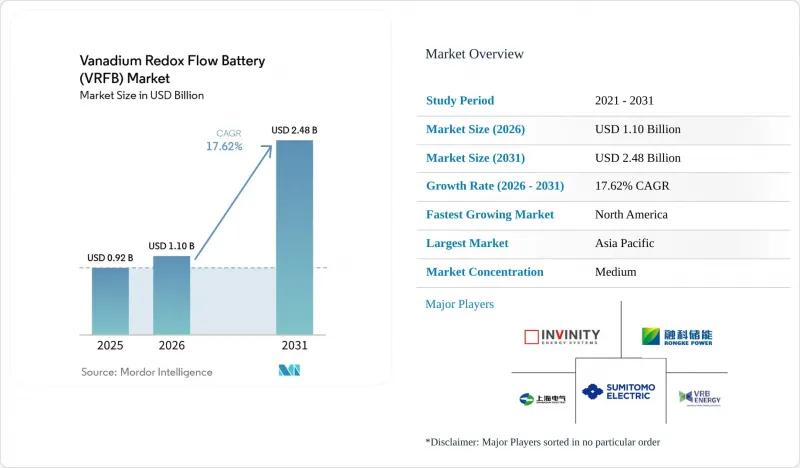
根據 Mordor Intelligence 預測,釩液流電池市場規模將從 2025 年的 9.2 億美元和 2026 年的 11 億美元成長到 2031 年的 24.8 億美元,2026 年至 2031 年的年複合成長率(CAGR)為 17.62%。
本報告按產品類型(貨櫃式系統和櫃式/機架式系統)、組件(電解、電池堆、膜)、額定功率(小於 100 kW、100-500 kW 和大於 100 kW)、系統規模(大型、中型和其他)、應用(例如,可再生能源分類)、最終
全球釩液流電池(VRFB)市場趨勢與洞察
中美兩國電網儲能計畫快速擴張,儲能時間超過4小時
中國國家電網計畫在2024年至2025年間,將375兆瓦/1.5吉瓦時的潮流型儲能系統併入電網,其核心是裝置容量為200兆瓦/1吉瓦時的吉姆薩爾陣列,旨在穩定哈密走廊沿線的風電輸出。在美國,到2025年,新增電池中僅有3%的續航力超過4小時。為了彌補這個缺口,加州強制要求建造1吉瓦的長效儲能系統,聯邦政府也為離網儲能計畫提供30%的稅額扣抵。住友電工與聖地牙哥天然氣電力公司合作開發的4兆瓦/16兆瓦時儲能項目,在七年內實現了超過68%的往返效率,即使在每日充放電循環的情況下,年容量劣化率也低於0.5%。如此長的使用壽命使其與鋰電池系統相比具有顯著優勢,因為鋰電池系統在七年後需要昂貴的性能升級,而電網營運商通常要求15年的保固。新的稅額扣抵項目所需的內部收益率 (IRR) 從 12% 降低到大約 8%,使財務回報達到與公用事業規模太陽能發電相當的水平,從而加快了德克薩斯州和亞利桑那州等州的採購速度。
歐洲釩電解租賃模式降低資本支出
Bushveld Energy在南非的試點計畫表明,將電解所有權與系統硬體分離,可將初始投資減少28%,並將借貸利率從傳統模式下的6.5%降至4.2%。 Invinity在其7兆瓦/30兆瓦時的牛津項目中複製了這一機制,利用嘉能可支持的基金為電解成本融資,並滿足了歐洲投資銀行(EIB)的覆蓋率要求,而此前,此類項目一直未能達到這一要求。潘齊瓦地方政府也採用了類似的方法,計劃於2024年啟動一個50兆瓦的項目,並在未超過省級債務上限的情況下實現了目標。由於釩即使在20年後仍能維持95%的殘值,廢電解的次市場正在興起,這為專注於環境、社會和治理(ESG)的基金創造了極具吸引力的循環經濟獎勵。
釩價波動與鋼鐵需求相關。
中國螺紋鋼產量下降8%導致五氧化二釩價格從2022年的每磅9美元跌至2024年的每磅4-5美元,給像Largo Clean Energy這樣的垂直一體化供應商帶來了壓力,該公司已對2026年之前60%的期貨敞口進行了套期保值。尖峰時段%,但期貨市場仍處於期貨溢價狀態,這表明交易員預計,隨著中國經濟獎勵策略的實施,建築需求復甦後,供應將趨近。中國政府在2023年實施的出口配額導致交貨延遲六週,迫使Invinity提前採購了相當於18個月用量的電解庫存。雖然租賃合約結構可以吸收部分價格波動,但最終用戶仍需承擔部分風險,因為如果現貨釩價格超過合約價格區間(領口價),承租人最終會將成本轉嫁給用戶。
細分市場分析
到2025年,貨櫃式裝置將佔銷售額的67.0%,反映出電力公司對整合電力轉換和滅火功能的40英尺承包模組的強勁需求。貨櫃式釩液流電池市場預計到2025年將達到7.4億美元,並有望隨著中國和美國吉瓦級採購計畫的推進而持續成長。 Jimsar的200兆瓦/1吉瓦時建設工程使用了250個相同的貨櫃,實現了分階段試運行。這使得專案能夠在後續單元完成工廠驗收測試的同時,儘早累計效益。機櫃式和機架式系統能夠滿足空間受限的安裝需求,預計到2031年將以21.1%的複合年成長率成長。 Vanevo的重力供水式10千瓦/40千瓦時設計為此提供了有力支撐,該設計無需外部泵,並將維護量減少了35%。這種轉變反映了電網邊緣通訊和資料中心的發展趨勢,但電力電子產業的規模經濟可能會使貨櫃式產品在大型企劃中繼續佔據主導地位。
貨櫃的便攜性提高了EPC(工程、採購和施工)的效率,模組在交付前經過測試,最大限度地減少了現場工作。此外,兩個單元可以堆疊,將土地面積降低到每兆瓦時僅15平方公尺。相較之下,機櫃可安裝在19吋機架中,並可安裝在標準開關設備後面,使其成為商業和工業設施維修的理想選擇。 Redflow的熱插拔200千瓦時模組已證明,模組化可以將停機時間縮短至兩小時,而資料中心每小時避免的停機價值高達5萬美元。在整個預測期內,貨櫃運輸預計仍將佔總容量的60%以上,但機櫃銷售的顯著成長預計將使模組化交付在2031年之前佔總交付量的近三分之一。因此,釩液流電池市場將沿著兩條路徑發展:一是面向電力公司的大容量儲能,二是面向分散式用戶的靈活外形規格。
2025年,電解佔組件銷售額的43.3%。這反映了釩佔成本的35%至40%,以及二次利用所蘊含的價值。高純度VPURE+配方價格較高,但可將再平衡週期延長12個月,並降低每兆瓦時每年8,000美元的維運成本。預計到2031年,膜的複合年成長率將達到18.4%。這是因為即使釩價格反彈,低成本的PBI和PFSA方案也將擴大毛利率空間。儘管預計到2031年,隨著電堆和膜成本的快速下降,電解在釩液流電池市場的佔有率將下降至38%,但隨著租賃協議將資本支出轉化為可預測的服務費,電解的戰略重要性將會增加。
電堆的成本趨勢同樣迅速。隨著大連工廠引入自動化碳氈和壓製成型的雙極板,預計到2025年,電堆的單位成本將達到每千瓦150美元,比2022年下降45%。這使得電堆成為利潤率面臨的下一個壓力點。太平洋西北國家實驗室開發的高密度電解可將儲槽體積減少40%,進而降低屋頂式和貨櫃式系統中輔助設備的成本。總而言之,薄膜和電堆成本的降低將減輕系統的整體資本支出,並鼓勵採用服務導向型經營模式,使專案現金流量與商品價格波動脫鉤。
區域分析
中國正努力實現30吉瓦的儲能目標,目前武石和金薩爾兩座儲能電站均已運作,佔全球液流電池儲能裝置容量的40%。這意味著到2025年,亞太地區將佔全球儲能收入的48.7%。日本已批准對熊本8兆瓦時液流電池儲能電站的首筆補貼,這反映出隨著太陽能發電滲透率超過國內發電量的12%,政策上的調整與中國的發展趨勢相符。印度的國家儲能框架草案規定,運作時間超過6小時的系統可享有電價溢價,預計到2030年,液流電池儲能將佔其10吉瓦儲能計畫規劃的15%至20%。
預計到2031年,北美將以22.5%的複合年成長率推動成長,這得益於30%的聯邦稅收稅額扣抵以及加州一項1吉瓦的長期儲能競標。聖地牙哥天然氣電力公司長期營運的4兆瓦/16兆瓦時儲能裝置已向美國金融機構證明了其可靠性能,年衰減率低於0.5%。加拿大「清潔電力法規」正在加速實施,因為電力公司必須在2035年之前實現淨零排放,亞伯達和薩斯喀徹爾省已購買了500兆瓦的長期儲能系統。在墨西哥索諾拉太陽能走廊,墨西哥聯邦電力公司(CFE)2024年的競標正在尋求一套能夠儲存6小時的300兆瓦儲能系統,優先考慮適用於高溫運行的流動式化學儲能系統。
到2025年,歐洲約佔市場佔有率的18%。在英國,牛津引進電解租賃方案後,債務收入比提高至1.5倍,資本支出減少了28%。德國的「EEG 2023」計畫對超過4小時的儲能提供每千瓦時0.10歐元的獎勵,並在2024年至2025年間採用了80兆瓦的液流電池(VRFB)。西班牙實施的一套1.1兆瓦/8.8兆瓦時的系統使卡斯提爾-萊昂地區太陽能發電廠的棄光率降低了9%。鑑於冬季用電高峰比夏季太陽能發電量高出60%,北歐電力公司正考慮季節性效益,而200兆瓦的液流式儲能系統也備受關注。
中東和非洲地區佔總銷售額的8%。杜拜為穆罕默德·本·拉希德·阿勒馬克圖姆公園競標一套300兆瓦/2.4吉瓦時、8小時的儲能系統,理由是該系統在環境溫度低於45攝氏度的情況下具有安全性。沙烏地阿拉伯的NEOM Giga計畫需要至少1吉瓦的液流電池來平衡間歇性的太陽能發電。南非電力公司Eskom在成功完成6兆瓦的試點計畫後,目前正在競標液流電池的化學成分,以用於尖峰容量的儲能。儘管液流電池在南美洲仍處於部署初期,但巴西2024年的競標框架建議其設計壽命為20年或更長,這項標準充分發揮了液流電池的優勢。
其他好處:
- Excel格式的市場預測(ME)表
- 3個月的分析師支持
目錄
第1章:引言
- 研究假設和市場定義
- 調查範圍
第2章:調查方法
第3章執行摘要
第4章 市場狀況
- 市場概覽
- 市場促進因素
- 中國和美國併網儲能專案快速擴張,運行時間超過4小時。
- 歐洲釩電解租賃模式可降低資本支出 (CapEx)。
- 為穩定太陽能發電,中東和北非地區對長期儲能的需求激增
- 膜和電解質效率的技術突破
- 市場限制因素
- 釩價波動與鋼鐵需求相關
- VRFB專案缺乏融資合格標準
- 競爭來自下方,首先是價格低於 250 美元/千瓦時、服務時間低於 4 小時的鋰離子電池。
- 供應鏈分析
- 監理展望
- 技術展望
- 波特五力模型
第5章 市場規模與成長預測
- 依產品類型
- 基於容器的系統
- 機櫃/機架系統
- 按組件
- 電解質
- 單元堆疊
- 膜
- 額定功率
- 小於100千瓦
- 100~500 kW
- 501 kW~5 MW
- 按系統大小
- 大型(10兆瓦時或以上)
- 中等規模(1-10兆瓦時)
- 小規模(小於 1 兆瓦時)
- 透過使用
- 可再生能源併網
- 電網調峰/負載轉移
- 微電網和離網
- 最終用戶
- 公用事業
- 商業和工業用途
- 住宅
- 按地區
- 北美洲
- 美國
- 加拿大
- 墨西哥
- 歐洲
- 英國
- 德國
- 法國
- 西班牙
- 北歐國家
- 俄羅斯
- 其他歐洲國家
- 亞太地區
- 中國
- 印度
- 日本
- 韓國
- 東南亞國協
- 其他亞太國家
- 南美洲
- 巴西
- 阿根廷
- 哥倫比亞
- 其他南美國家
- 中東和非洲
- 阿拉伯聯合大公國
- 沙烏地阿拉伯
- 南非
- 埃及
- 其他中東和非洲國家
- 北美洲
第6章 競爭情勢
- 市場集中度
- 策略趨勢(併購、聯盟、購電協議)
- 市場佔有率分析(主要公司的市場排名和佔有率)
- 公司簡介
- Invinity Energy Systems plc
- VRB Energy
- Sumitomo Electric Industries Ltd.
- CellCube Energy Storage Systems
- RedT Energy
- VanadiumCorp Resource Inc.
- Bushveld Energy
- Largo Clean Energy
- ESS Tech Inc.(Iron-based comparator)
- Primus Power Corp.
- Redflow Ltd.
- Vionx Energy
第7章 市場機會與未來展望
According to Mordor Intelligence, the vanadium redox flow battery market size is projected to expand from USD 0.92 billion in 2025 and USD 1.10 billion in 2026 to USD 2.48 billion by 2031, registering a CAGR of 17.62% between 2026 to 2031.
This report is Segmented by Product Type (Containerised Systems and Cabinet/Rack Systems), Component (Electrolyte, Cell Stack, and Membrane), Power Rating (Below 100 KW, 100 To 500 KW, and More), System Size (Large-Scale, Medium, and More), Application (Renewable Energy Integration, and More), End-User (Utilities, and More), and Geography (North America, Europe, Asia-Pacific, and More).
Global Vanadium Redox Flow Battery (VRFB) Market Trends and Insights
Rapid Build-Out of above 4 h Grid-Storage Projects in China & U.S.
China's State Grid connected 375 MW/1.5 GWh of flow storage between 2024 and 2025, anchored by the 200 MW/1 GWh Jimsar array that stabilizes wind output along the Hami corridor. In the United States, only 3% of 2025 battery additions exceed four-hour duration, leaving a gap that California's 1 GW long-duration mandate and the federal 30% standalone storage tax credit are designed to close. Sumitomo Electric's 4 MW/16 MWh project with San Diego Gas & Electric logged round-trip efficiencies above 68% over seven years, confirming sub-0.5% annual capacity fade even under daily cycling. Because grid operators demand 15-year warranties, this longevity offers a decisive edge over lithium systems that require costly augmentation after year seven. The new tax credit lowers required project IRRs from 12% to roughly 8%, bringing financial returns in line with utility-scale solar and accelerating procurement pipelines in Texas and Arizona.
Vanadium Electrolyte Leasing Models Lowering CapEx in Europe
Bushveld Energy's South African pilot proved that separating electrolyte ownership from system hardware cuts upfront capital by 28% and secures debt at 4.2%, versus 6.5% for traditional structures. Invinity replicated the construct at its 7 MW/30 MWh Oxford project, using a Glencore-backed fund to cover electrolyte and thereby meet European Investment Bank coverage ratios that flow projects had previously missed. Municipal utilities in Panzhihua adopted the same approach for 50 MW in 2024 without breaching provincial debt ceilings. A secondary market for spent electrolyte is emerging, because vanadium retains 95% residual value after two decades, creating a circular-economy incentive that appeals to ESG-focused funds.
Vanadium Price Volatility Tied to Steel Demand
Vanadium pentoxide prices fell from USD 9/lb in 2022 to USD 4-5/lb in 2024 as Chinese rebar production slid 8%, squeezing vertically integrated suppliers such as Largo Clean Energy, which hedged 60% of its forward exposure through 2026. European ferrovanadium settled near EUR 30/kg in 2024, 40% below 2022 peaks, yet futures remain in contango, signaling trader expectations of supply tightness once China's stimulus revives construction demand. Export quotas imposed by Beijing in 2023 created six-week delivery delays that forced Invinity to pre-purchase 18 months of electrolyte inventory. Leasing structures absorb some volatility, but lessors ultimately pass costs through when spot vanadium exceeds contracted collars, leaving end-users partially exposed.
Other drivers and restraints analyzed in the detailed report include:
- Surging Demand for Long-Duration Storage to Firm Solar in MENA
- Technology Breakthroughs in Membrane and Electrolyte Efficiency
- Lack of Bankability Standards for VRFB Projects
For complete list of drivers and restraints, kindly check the Table Of Contents.
Segment Analysis
Containerised units commanded 67.0% of 2025 revenue, underscoring utility appetite for turnkey 40-foot modules that integrate power conversion and fire suppression. The vanadium redox flow battery market size for containerised systems reached USD 740 million in 2025 and is projected to expand in line with multi-gigawatt procurement programs in China and the United States. Jimsar's 200 MW/1 GWh build used 250 identical containers, enabling phased commissioning that brought early revenue online while later strings completed factory acceptance tests. Cabinet and rack formats address space-constrained sites and will grow at a 21.1% CAGR through 2031, supported by Vanevo's gravity-fed 10 kW/40 kWh design that removes external pumps and trims maintenance by 35%. The shift mirrors grid-edge trends in telecom and data centers, but economies of scale in power electronics will keep containerised offerings dominant for mega-projects.
Container mobility unlocks EPC efficiencies, modules arrive factory-tested and require minimal on-site labor, while the ability to stack them two-high reduces land use to 15 m2 MWh-1. In contrast, cabinets slot into 19-inch racks and fit behind standard switchgear, appealing to commercial and industrial retrofits. Redflow's hot-swappable 200 kWh pods illustrate how modularity shortens downtime to two hours, a metric valued by data centers at USD 50,000 per avoided outage hour. Over the forecast, containerised shipments will still account for more than 60% of capacity, but high-volume cabinet sales lift modular solutions to almost one-third of delivered units by 2031. The vanadium redox flow battery market will therefore display a two-track dynamic: bulk storage for utilities and flexible form factors for distributed customers.
Electrolyte generated 43.3% of component revenue in 2025, reflecting vanadium's 35-40% cost share and the value locked in secondary reuse. High-purity VPURE+ formulations demand a premium yet extend rebalancing intervals by 12 months, lowering O&M by USD 8,000 MWh-1 yr-1. Membranes will post an 18.4% CAGR to 2031 as low-cost PBI and PFSA options widen gross-margin headroom even when vanadium prices rebound. The vanadium redox flow battery market share of electrolyte is projected to fall to 38% by 2031 as stack and membrane costs compress faster, but electrolyte will grow in strategic importance because leasing converts a capital line item into a predictable service fee.
Stack cost trajectories are equally aggressive: automated carbon-felt and stamped bipolar plates in Dalian plants drove unit prices to USD 150 kW-1 by 2025, down 45% from 2022, making stacks the next focus for margin pressure. Pacific Northwest National Laboratory's higher-density electrolyte permits a 40% reduction in tank volume, shrinking balance-of-plant expenses for rooftop and shipping-container footprints. Together, falling membrane and stack costs ease total system capex and strengthen the case for service-based business models that decouple commodity volatility from project cash flows.
Geography Analysis
Asia-Pacific generated 48.7% of 2025 revenue as China pursued a 30 GW storage target and commissioned both Wushi and Jimsar, which now represent 40% of global VRFB capacity. Japan green-lit its first VRFB subsidy for the 8 MWh Kumamoto site, reflecting policy alignment as solar penetration crosses 12% of national generation. India's draft National Energy Storage Framework assigns tariff premiums to >6-hour systems, positioning VRFBs for 15-20% of a 10 GW pipeline by 2030.
North America will lead growth at a 22.5% CAGR to 2031, underpinned by the federal 30% standalone credit and California's 1 GW long-duration solicitation. San Diego Gas & Electric's long-running 4 MW/16 MWh unit verified less than 0.5% annual fade, demonstrating bankable performance to U.S. lenders. Canada's Clean Electricity Regulations accelerate adoption as utilities must reach net-zero by 2035, driving 500 MW of long-duration procurement in Alberta and Saskatchewan. Mexico's Sonora solar corridor seeks 300 MW of six-hour storage under CFE's 2024 tender that favors flow chemistries for high-temperature operation.
Europe held roughly 18% market share in 2025. The United Kingdom showcased electrolyte leasing at Oxford, raising debt-service coverage to 1.5X and reducing capex by 28%. Germany's EEG 2023 offers a EUR 0.10 kWh-1 bonus for >4-hour storage, prompting 80 MW of VRFB awards between 2024 and 2025. Spain's 1.1 MW/8.8 MWh install cut curtailment at a Castilla y Leon solar farm by 9%. Nordic utilities weigh seasonal benefits as winter peaks exceed summer solar by 60%, making 200 MW of flow storage attractive.
The Middle East and Africa held 8% of revenue. Dubai tendered 300 MW/2.4 GWh of eight-hour storage for its Mohammed bin Rashid Al Maktoum park, citing safety under 45 °C ambient temperatures. Saudi Arabia's NEOM giga-projects call for at least 1 GW of VRFB to balance intermittent solar, and South Africa's Eskom now evaluates flow chemistries for peaking capacity after a successful 6 MW pilot. South America remains nascent, but Brazil's 2024 auction framework favors >20-year design life, a criterion that plays to VRFB's strengths.
- Invinity Energy Systems plc
- VRB Energy
- Sumitomo Electric Industries Ltd.
- CellCube Energy Storage Systems
- RedT Energy
- VanadiumCorp Resource Inc.
- Bushveld Energy
- Largo Clean Energy
- ESS Tech Inc. (Iron-based comparator)
- Primus Power Corp.
- Redflow Ltd.
- Vionx Energy
Additional Benefits:
- The market estimate (ME) sheet in Excel format
- 3 months of analyst support
TABLE OF CONTENTS
1 Introduction
- 1.1 Study Assumptions & Market Definition
- 1.2 Scope of the Study
2 Research Methodology
3 Executive Summary
4 Market Landscape
- 4.1 Market Overview
- 4.2 Market Drivers
- 4.2.1 Rapid Build-out of Above 4 h Grid-Storage Projects in China & U.S.
- 4.2.2 Vanadium Electrolyte Leasing Models Lowering CapEx in Europe
- 4.2.3 Surging Demand for Long-Duration Storage to Firm Solar (MENA)
- 4.2.4 Technology Breakthroughs in Membrane and Electrolyte Efficiency
- 4.3 Market Restraints
- 4.3.1 Vanadium Price Volatility Tied to Steel Demand
- 4.3.2 Lack of Bankability Standards for VRFB Projects
- 4.3.3 Competition from Below USD 250 kWh Li-ion for Less than 4 h Services
- 4.4 Supply-Chain Analysis
- 4.5 Regulatory Outlook
- 4.6 Technological Outlook
- 4.7 Porter's Five Forces
- 4.7.1 Bargaining Power of Suppliers
- 4.7.2 Bargaining Power of Buyers
- 4.7.3 Threat of New Entrants
- 4.7.4 Threat of Substitutes
- 4.7.5 Intensity of Competitive Rivalry
5 Market Size & Growth Forecasts
- 5.1 By Product Type
- 5.1.1 Containerised Systems
- 5.1.2 Cabinet/Rack Systems
- 5.2 By Component
- 5.2.1 Electrolyte
- 5.2.2 Cell Stack
- 5.2.3 Membrane
- 5.3 By Power Rating
- 5.3.1 Below 100 kW
- 5.3.2 100 to 500 kW
- 5.3.3 501 kW to 5 MW
- 5.4 By System Size
- 5.4.1 Large-Scale (Above 10 MWh)
- 5.4.2 Medium (1 to 10 MWh)
- 5.4.3 Small-Scale (Below 1 MWh)
- 5.5 By Application
- 5.5.1 Renewable Energy Integration
- 5.5.2 Grid-Peaking/Load-Shifting
- 5.5.3 Microgrids and Off-Grid
- 5.6 By End-User
- 5.6.1 Utilities
- 5.6.2 Commercial and Industrial
- 5.6.3 Residential
- 5.7 By Geography
- 5.7.1 North America
- 5.7.1.1 United States
- 5.7.1.2 Canada
- 5.7.1.3 Mexico
- 5.7.2 Europe
- 5.7.2.1 United Kingdom
- 5.7.2.2 Germany
- 5.7.2.3 France
- 5.7.2.4 Spain
- 5.7.2.5 Nordic Countries
- 5.7.2.6 Russia
- 5.7.2.7 Rest of Europe
- 5.7.3 Asia-Pacific
- 5.7.3.1 China
- 5.7.3.2 India
- 5.7.3.3 Japan
- 5.7.3.4 South Korea
- 5.7.3.5 ASEAN Countries
- 5.7.3.6 Rest of Asia-Pacific
- 5.7.4 South America
- 5.7.4.1 Brazil
- 5.7.4.2 Argentina
- 5.7.4.3 Colombia
- 5.7.4.4 Rest of South America
- 5.7.5 Middle East and Africa
- 5.7.5.1 United Arab Emirates
- 5.7.5.2 Saudi Arabia
- 5.7.5.3 South Africa
- 5.7.5.4 Egypt
- 5.7.5.5 Rest of Middle East and Africa
- 5.7.1 North America
6 Competitive Landscape
- 6.1 Market Concentration
- 6.2 Strategic Moves (M&A, Partnerships, PPAs)
- 6.3 Market Share Analysis (Market Rank/Share for key companies)
- 6.4 Company Profiles (includes Global level Overview, Market level overview, Core Segments, Financials as available, Strategic Information, Products & Services, and Recent Developments)
- 6.4.1 Invinity Energy Systems plc
- 6.4.2 VRB Energy
- 6.4.3 Sumitomo Electric Industries Ltd.
- 6.4.4 CellCube Energy Storage Systems
- 6.4.5 RedT Energy
- 6.4.6 VanadiumCorp Resource Inc.
- 6.4.7 Bushveld Energy
- 6.4.8 Largo Clean Energy
- 6.4.9 ESS Tech Inc. (Iron-based comparator)
- 6.4.10 Primus Power Corp.
- 6.4.11 Redflow Ltd.
- 6.4.12 Vionx Energy
7 Market Opportunities & Future Outlook
- 7.1 White-space & Unmet-Need Assessment

 2034年液流電池市場預測-按電池類型、額定功率、應用、最終用戶和地區分類的全球分析有機液流電池市場預測至2034年—按電池類型、額定功率、應用、最終用戶和地區分類的全球分析
 氧化還原液流電池:市佔率分析、產業趨勢與統計、成長預測(2026-2031)
 氧化還原液流電池市場:市場洞察、競爭格局及市場預測(2033 年)
 氧化還原液流電池市場規模、佔有率和成長分析:按液流電池類型、應用、儲能時間、功率等級、最終用戶和地區分類-2026-2033年產業預測
 氧化還原液流電池市場報告:按類型、產品類型、應用和地區分類(2026-2034年)
 氧化還原液流電池儲能市場機會、成長促進因素、產業趨勢分析及2025-2034年預測
 水性有機氧化還原液流電池市場-全球產業規模、佔有率、趨勢、機會和預測(按類型、應用、地區和競爭細分,2020-2030 年)
 氧化還原液流電池:市場預測線(23 條線)、路線圖、技術、製造商(59 家公司)、最新研究管線(2025-2045)