


 |
市場調查報告書
商品編碼
2072539
專用通訊類比IC:市場佔有率分析、產業趨勢與統計資料、成長預測(2026-2031 年)Application Specific Communications Analog IC - Market Share Analysis, Industry Trends & Statistics, Growth Forecasts (2026 - 2031) |
||||||

※ 本網頁內容可能與最新版本有所差異。詳細情況請與我們聯繫。
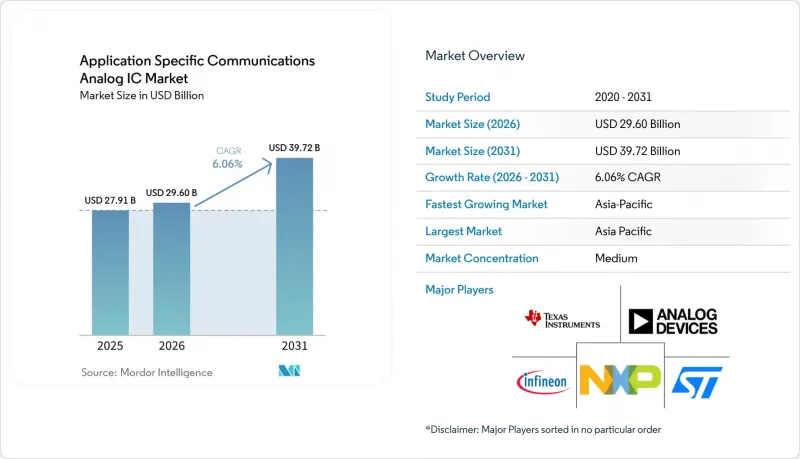
據 Mordor Intelligence 稱,2025 年專用通訊類比IC市值為 279.1 億美元,預計到 2031 年將達到 397.2 億美元,而 2026 年為 296 億美元,預測期(2026-2031 年)的複合年成長率為 6.06%。
本報告按產品類型(RF收發器IC、電源管理IC及其他)、通訊標準(5G NR、4G LTE和LTE-Advanced及其他)、應用領域(通訊基礎設施、智慧型手機和行動裝置及其他)、終端用戶產業(通訊業者及其他)和地區進行細分。市場預測以美元計價。
全球專用類比類比IC市場趨勢與洞察
全球5G基礎設施擴建
到2024年,商用5G網路部署數量將達到329個,提供21億個連接,通訊業者計劃在2029年將連接數提升至86億以上。新型基地台需要雜訊係數小於1dB的類比前端模組和耐熱功率放大器,使得組件成本比4G無線電設備增加約40%。中國移動將在2024年投資1,800億元人民幣(約252億美元)用於5G升級,而Verizon已撥款185億美元用於擴大其在美國的中頻段覆蓋範圍。開放式無線存取網(Open RAN)測試的引入,對用於時序積體電路和介面控制器的積體電路插座解決方案提出了新的需求。同時,能效仍然是一個重要議題。支援網路切片的邊緣運算引擎進一步增加了對高精度電壓基準的需求,以確保寬頻資料轉換器的線性度保持在較窄的範圍內。
物聯網設備普及率的激增正在推動低功耗模擬前端的發展。
預計到2024年,蜂巢式物聯網模組的出貨量將達到4.23億個,到2030年,NB-IoT連接數將翻倍達到19億,LoRa連接數將達到13億。工業感測器目前的目標是實現10年的電池壽命,因此設計人員正努力將靜態電流控制在1微安培以下,並將能源採集功能整合到晶片上。雖然由於授權頻寬的可靠性,NB-IoT正在歐洲和亞太地區的智慧城市計量合約中佔據主導地位,但LoRa因其更低的基礎建設成本而受到北美農業和物流營運商的青睞。 Nordic Semiconductor的nRF54平台僅用20天就完成了交付,展示了多重通訊協定無線電如何簡化材料清單。人工智慧推理正在資產追蹤設備和穿戴式裝置中興起,導致對具有動態電壓調節和感測器介面柔軟性的類比前端的需求增加。
設計複雜性和檢驗成本不斷增加
到2024年,單晶片內涵蓋射頻、電源和數位域的混合訊號檢驗將使先進類比裝置的設計週期延長至24個月。多標準合規性增加了電晶體數量並引入了寄生效應,導致最先進的無線模組的非迭代設計成本(NRE)超過500萬美元。自動化佈局工具比數位EDA落後約10年,需要手動佈局,增加了工程人事費用。 28奈米以下的先進製程節點引入了針對電遷移和熱載子注入的新型可靠性檢查,每項檢查都需要進行全面的角點模擬。規模小規模的無廠半導體公司面臨嚴重的融資限制,並且擴大將高性能元件業務讓給擁有更廣泛產品系列、能夠攤銷成本的成熟公司。
細分市場分析
預計到2025年,RF收發器IC市場規模將達到83億美元,並在2031年之前以8.45%的複合年成長率成長,超過專用通訊類比IC市場的整體成長率。 5G基地台、Wi-Fi 6E路由器和77 GHz車載雷達中使用的6 GHz以下和毫米波無線電設備是推動該類別專用通訊類比IC市場規模成長的主要因素,而噪聲係數低於1 dB、輸出電平達到26 dBm的產品的高價也支撐了這一成長。供應商正在將功率放大器、低雜訊放大器和濾波器整合到尺寸小至3 mm x 4 mm的模組中,為行動電話終端和CPE的設計人員節省基板面積。此外,開放式RAN的採用也進一步推高了市場需求,開放式RAN要求在同一硬體中支援寬頻和多載波,以最大限度地減少軟體升級期間的線路滾動。
預計到2025年,電源管理IC將在通訊專用類比IC市場佔據31.68%的佔有率。然而,由於低壓穩壓器的商品化以及來自中國IDM廠商的強勁價格壓力,其銷售成長預計將略低於整體市場成長率。數據轉換器IC仍處於小眾市場,但在連貫光纖通訊和測試設備領域,其單通道售價已超過150美元。時鐘定時IC正受益於5G傳輸網路中同步乙太網路的發展,而介面IC則隨著USB-C的普及和車載乙太網路PHY向10Gbps訊號傳輸邁進而不斷擴張。
預計5G NR將以12.1%的複合年成長率成長,鞏固其作為專用通訊類比IC市場成長最快細分市場的地位。獨立組網的5G核心網需要覆蓋6GHz以下頻段和毫米波頻段的無線模組,這推動了前端設備的銷售,因為大多數通訊業者選擇平台級的全面升級,而不是分階段疊加4G網路。企業和住宅閘道的Wi-Fi 6E更新周期也進一步推動了市場成長,尤其是在6GHz頻段,需要整合聲波濾波器來降低干擾。
4G LTE 和 LTE-Advanced 仍佔據重要地位,預計到 2025 年將佔 46.85% 的市場佔有率,並持續支撐新興市場大型基地台對類比IC的需求。低功耗廣域網路 (LPWAN) 由於法規環境不同,分為 NB-IoT 和 LoRa 兩大類,兩者都需要超低功耗前端,而非單純的頻寬。因此,最佳化成本績效是關鍵的差異化因素。衛星通訊和關鍵任務通訊鏈路雖然規模較小,但盈利豐厚,因此需要抗輻射的氮化鎵 (GaN) 功率放大器和矽鍺 (SiGe) 低雜訊放大器。這些產品的使用壽命超過五年。
區域分析
預計到2025年,亞太地區將佔全球銷售額的62.74%,並以9.18%的複合年成長率高於其他任何地區。這主要得益於中國加大自給自足投入、台灣在特種晶圓代工領域的持續領先地位,以及印度透過100億美元的激勵基金投資新建晶圓廠。中國第三期半導體投資基金規模達3,440億元人民幣(約482億美元),主要投資於類比電路設計公司及化合物半導體晶圓廠。台積電(TSMC)已在其成熟製程節點上開始每月生產超過20萬片類比晶圓,大規模支援射頻、電源和資料轉換器客戶。
北美市佔率約為18.41%,但預計527億美元的《晶片法案》(CHIPS Act)補貼將增強北美本土產能。台積電位於亞利桑那州、投資650億美元的園區將於2024年開始生產28奈米和16奈米模擬元件。英特爾位於俄亥俄州、投資200億美元的園區則專注於180奈米和130奈米汽車及工業類比晶片節點。歐洲市佔率約為12.16%,這得益於義法半導體和全球晶圓代工廠為滿足法國汽車市場需求而進行的聯合投資。儘管南美洲和中東的市場佔有率仍然較小,但衛星地面站部署和油田遙測等應用領域對高性能類比類比IC而言是盈利的細分市場。
其他好處
- Excel格式的市場預測(ME)表
- 3個月的分析師支持
目錄
第1章:引言
- 研究假設和市場定義
- 調查範圍
第2章:調查方法
第3章執行摘要
第4章 市場狀況
- 市場概覽
- 市場促進因素
- 全球5G基礎設施擴建
- 物聯網設備部署的激增正在推動對低功耗模擬前端的需求。
- 光纖網路。
- 軟體定義無線電(SDR) 和開放式無線存取網 (Open RAN) 架構的發展
- 汽車的電氣化和互聯化正在推動汽車產業對類比IC的需求。
- 美國國家半導體公司的國內資金回流舉措將重振資本投資週期。
- 市場限制因素
- 設計複雜性和檢驗成本不斷增加
- 對先進製程節點的地緣政治出口限制
- 類比電路領域熟練人才短缺,導致產品上市時間延後。
- 特種晶圓供應鏈的波動
- 產業價值鏈分析
- 監理情勢
- 技術展望
- 波特五力分析
- 宏觀經濟因素對市場的影響
第5章 市場規模與成長預測
- 依產品類型
- RF收發器積體電路
- 電源管理積體電路
- 數據轉換器積體電路
- 時鐘和定時積體電路
- 介面 API
- 按通訊標準
- 5G NR
- 4G LTE 和 LTE-Advanced
- Wi-Fi 6 和 6E
- 物聯網低功耗廣域網路(NB-IoT、LoRa、Sigfox)
- 衛星通訊和關鍵通訊
- 透過使用
- 通訊基礎設施
- 智慧型手機和行動裝置
- 物聯網邊緣設備
- 汽車通訊系統
- 工業自動化與機器人技術
- 按最終用戶行業分類
- 通訊業者
- 家用電器OEM廠商
- 汽車製造商和一級供應商
- 工業OEM
- 航太和國防承包商
- 按地區
- 北美洲
- 美國
- 加拿大
- 墨西哥
- 南美洲
- 巴西
- 阿根廷
- 其他南美國家
- 歐洲
- 德國
- 英國
- 法國
- 義大利
- 俄羅斯
- 其他歐洲國家
- 亞太地區
- 中國
- 日本
- 印度
- 韓國
- 台灣
- 東南亞
- 大洋洲
- 其他亞太國家
- 中東
- 沙烏地阿拉伯
- 阿拉伯聯合大公國
- 土耳其
- 其他中東國家
- 非洲
- 南非
- 奈及利亞
- 埃及
- 其他非洲地區
- 北美洲
第6章 競爭情勢
- 市場集中度
- 策略趨勢
- 市佔率分析
- 公司簡介
- Texas Instruments Incorporated
- Analog Devices, Inc.
- Infineon Technologies AG
- NXP Semiconductors NV
- STMicroelectronics NV
- Skyworks Solutions, Inc.
- Qorvo, Inc.
- Microchip Technology Incorporated
- Renesas Electronics Corporation
- ON Semiconductor Corporation
- Broadcom Inc.
- Marvell Technology, Inc.
- Qualcomm Incorporated
- MediaTek Inc.
- Rohm Co., Ltd.
- Cirrus Logic, Inc.
- Silicon Laboratories Inc.
- Diodes Incorporated
- Semtech Corporation
- MaxLinear, Inc.
- Novosense Microelectronics Co., Ltd.
- Chipanalog Microelectronics Co., Ltd.
- SkyWater Technology Foundry, Inc.
- Nordic Semiconductor ASA
- Realtek Semiconductor Corp.
第7章 市場機會與未來展望
According to Mordor Intelligence, the application-specific communications analog IC market size was valued at USD 27.91 billion in 2025 and estimated to grow from USD 29.6 billion in 2026 to reach USD 39.72 billion by 2031, at a CAGR of 6.06% during the forecast period (2026-2031).
This report is Segmented by Product Type (RF Transceiver ICs, Power Management ICs, and More), Communication Standard (5G NR, 4G LTE/LTE-A, and More), Application (Telecom Infrastructure, Smartphones and Mobile Devices, and More), End-User Industry (Telecommunication Operators, and More), and Geography. The Market Forecasts are Provided in Terms of Value (USD).
Global Application Specific Communications Analog IC Market Trends and Insights
Proliferation of 5G Infrastructure Worldwide
Commercial 5G networks reached 329 deployments, serving 2.1 billion connections in 2024, and operators plan to surpass 8.6 billion by 2029.Each new base station requires analog front-end modules with sub-1 dB noise figures and thermally robust power amplifiers, increasing the bill of materials value over 4G radios by approximately 40%.China Mobile spent CNY 180 billion (USD 25.2 billion) on 5G upgrades in 2024, while Verizon allocated USD 18.5 billion to extend mid-band coverage in the United States. Open RAN trials add fresh demand for IC socket solutions used in timing ICs and interface controllers, even as energy efficiency remains under review. Edge computing engines that support network slicing further raise demand for precision voltage references that keep wide-bandwidth data converters within tight linearity windows.
Surge in IoT Device Deployments Driving Low-Power Analog Front-Ends
Cellular IoT module shipments reached 423 million units in 2024, with NB-IoT connections set to double to 1.9 billion and LoRa connections forecast to reach 1.3 billion by 2030.Industrial sensors now target ten-year battery life, so designers push quiescent current below one microamp and integrate energy-harvesting support on-chip. Smart-city metering contracts across Europe and the Asia Pacific tend toward NB-IoT for licensed-spectrum reliability, while agriculture and logistics operators in North America favor LoRa for lower infrastructure costs. Nordic Semiconductor's nRF54 platform, which shipped in 20 days, demonstrates how multi-protocol radio simplifies the bill of materials. AI inference is emerging in asset trackers and wearables, which in turn pulls in analog front-ends capable of dynamic voltage scaling and sensor-interface flexibility.
Escalating Design Complexity and Verification Costs
Design cycles for advanced analog parts stretched to up to 24 months in 2024 as mixed-signal verification spanned RF, power, and digital domains within a single die. Non-recurring engineering expenses exceeded USD 5 million for leading-edge radios, as multi-standard compliance increased transistor counts and parasitic interactions. Automated layout tools lag behind digital EDA by around ten years, necessitating manual placement that increases engineering labor costs. Advanced process nodes below 28 nm introduce fresh reliability checks for electromigration and hot-carrier injection, each demanding exhaustive corner simulations. Smaller fabless companies face a pronounced cash strain, often ceding high-performance segments to incumbents that can amortize costs across broad product portfolios.
Other drivers and restraints analyzed in the detailed report include:
- Rising Demand for High-Speed Data Converters in Optical Networks
- Electrification and Connectivity in Automobiles Boosting In-Vehicle Analog ICs
- Geopolitical Export Controls on Advanced Process Nodes
For complete list of drivers and restraints, kindly check the Table Of Contents.
Segment Analysis
The RF transceiver segment captured USD 8.3 billion in 2025 and is on track for an 8.45% CAGR, which outpaces the application-specific communications analog IC market through 2031. Sub-6 GHz and millimeter-wave radios inside 5G base stations, Wi-Fi 6E routers, and 77 GHz automotive radars lift the overall application-specific communications analog IC market size for this category, supported by premium pricing for sub-1 dB noise figures and 26 dBm output levels. Vendors merge power amplifiers, low-noise amplifiers, and filters in modules as small as 3 mm by 4 mm, shrinking board area for handset and CPE designers. Demand is further heightened by Open RAN deployments that require wide-bandwidth, multi-carrier support within the same hardware to minimize the need for truck rolls during software upgrades.
Although power management ICs held 31.68% of the application-specific communications analog IC market share in 2025, the commoditization of low-voltage regulators and intense price pressure from Chinese IDMs will likely limit their revenue growth to just shy of the market pace. Data converter ICs remain a niche, yet they fetch selling prices above USD 150 per channel in coherent optics or test equipment. Clock-and-timing ICs ride the synchronous Ethernet wave in 5G transport networks, while interface ICs expand with USB-C and automotive Ethernet PHYs that move toward 10 Gbps signaling.
5G New Radio will post a 12.1% CAGR, solidifying its position as the fastest riser within the application-specific communications analog IC market. Stand-alone 5G cores require radios that span both sub-6 GHz and millimeter-wave bands, driving front-end sales because most operators opt for complete platform swap-outs rather than incremental 4G overlays. Wi-Fi 6E refresh cycles in enterprise and residential gateways create further momentum, particularly as the 6 GHz band needs integrated acoustic-wave filters to mitigate interference.
4G LTE and LTE-Advanced still deliver scale, holding 46.85% share in 2025 and sustaining analog IC demand in emerging-market macro cells. Low-power wide-area networks are split between NB-IoT and LoRa by their regulatory environments, each calling for ultra-low-power front-ends rather than raw bandwidth, which makes price-performance optimization a decisive differentiator. Satellite and mission-critical links occupy a small but lucrative corner that prefers radiation-hardened GaN power amplifiers and SiGe low-noise amplifiers, where lifetimes extend five years or more.
Complete Report Scope:
- By Product Type
- RF Transceiver ICs
- Power Management ICs
- Data Converter ICs
- Clock and Timing ICs
- Interface ICs
- By Communication Standard
- 5G NR
- 4G LTE / LTE-A
- Wi-Fi 6 and 6E
- IoT LPWAN (NB-IoT, LoRa, Sigfox)
- Satellite and Critical Comms
- By Application
- Telecom Infrastructure
- Smartphones and Mobile Devices
- IoT Edge Devices
- Automotive Communication Systems
- Industrial Automation and Robotics
- By End-user Industry
- Telecommunication Operators
- Consumer Electronics OEMs
- Automotive OEMs and Tier 1s
- Industrial OEMs
- Aerospace and Defense Contractors
- By Geography
- North America
- United States
- Canada
- Mexico
- South America
- Brazil
- Argentina
- Rest of South America
- Europe
- Germany
- United Kingdom
- France
- Italy
- Russia
- Rest of Europe
- Asia Pacific
- China
- Japan
- India
- South Korea
- Taiwan
- Southeast Asia
- Oceania
- Rest of Asia Pacific
- Middle East
- Saudi Arabia
- United Arab Emirates
- Turkey
- Rest of Middle East
- Africa
- South Africa
- Nigeria
- Egypt
- Rest of Africa
- North America
Geography Analysis
The Asia Pacific region accounted for 62.74% of 2025 revenue and is projected to compound at 9.18%, faster than any other region, as China increases its self-sufficiency spending, Taiwan maintains its leadership in specialty foundries, and India funds new fabs through its USD 10 billion incentive pool. China's third semiconductor investment fund, capitalized at CNY 344 billion (USD 48.2 billion), channels capital toward analog design houses and compound semiconductor fabs. Taiwan Semiconductor Manufacturing Company already exceeds 200,000 analog wafer starts per month on mature nodes, supporting RF, power, and data converter customers at scale.
North America held approximately an 18.41% share, but the CHIPS Act subsidies, valued at USD 52.7 billion, are expected to bolster domestic capacity. TSMC's USD 65 billion Arizona campus began production of 28 nm and 16 nm analog devices in 2024. Intel's USD 20 billion Ohio complex targets automotive and industrial analog nodes at 180 nm and 130 nm. Europe, at roughly 12.16%, benefits from STMicroelectronics' and GlobalFoundries' joint investments to support automotive demand in France. South America and the Middle East remain small, but satellite ground station deployment and oil-field telemetry provide profitable niches for rugged analog ICs.
- Texas Instruments Incorporated
- Analog Devices, Inc.
- Infineon Technologies AG
- NXP Semiconductors N.V.
- STMicroelectronics N.V.
- Skyworks Solutions, Inc.
- Qorvo, Inc.
- Microchip Technology Incorporated
- Renesas Electronics Corporation
- ON Semiconductor Corporation
- Broadcom Inc.
- Marvell Technology, Inc.
- Qualcomm Incorporated
- MediaTek Inc.
- Rohm Co., Ltd.
- Cirrus Logic, Inc.
- Silicon Laboratories Inc.
- Diodes Incorporated
- Semtech Corporation
- MaxLinear, Inc.
- Novosense Microelectronics Co., Ltd.
- Chipanalog Microelectronics Co., Ltd.
- SkyWater Technology Foundry, Inc.
- Nordic Semiconductor ASA
- Realtek Semiconductor Corp.
Additional Benefits:
- The market estimate (ME) sheet in Excel format
- 3 months of analyst support
TABLE OF CONTENTS
1 INTRODUCTION
- 1.1 Study Assumptions and Market Definition
- 1.2 Scope of the Study
2 RESEARCH METHODOLOGY
3 EXECUTIVE SUMMARY
4 MARKET LANDSCAPE
- 4.1 Market Overview
- 4.2 Market Drivers
- 4.2.1 Proliferation of 5G Infrastructure Worldwide
- 4.2.2 Surge in IoT Device Deployments Driving Low-Power Analog Front-Ends
- 4.2.3 Rising Demand for High-Speed Data Converters in Optical Networks
- 4.2.4 Growth of Software-Defined Radios and Open RAN Architectures
- 4.2.5 Electrification and Connectivity in Automobiles Boosting In-Vehicle Analog ICs
- 4.2.6 National Semiconductor Reshoring Initiatives Unlocking Capex Cycles
- 4.3 Market Restraints
- 4.3.1 Escalating Design Complexity and Verification Costs
- 4.3.2 Geopolitical Export Controls On Advanced Process Nodes
- 4.3.3 Analog Talent Shortage Slowing Time-to-Market
- 4.3.4 Supply-Chain Volatility in Specialty Wafers
- 4.4 Industry Value Chain Analysis
- 4.5 Regulatory Landscape
- 4.6 Technological Outlook
- 4.7 Porter's Five Forces Analysis
- 4.7.1 Threat of New Entrants
- 4.7.2 Bargaining Power of Buyers
- 4.7.3 Bargaining Power of Suppliers
- 4.7.4 Threat of Substitute Products
- 4.7.5 Intensity of Competitive Rivalry
- 4.8 Impact of Macroeconomic Factors on the Market
5 MARKET SIZE AND GROWTH FORECASTS (VALUE)
- 5.1 By Product Type
- 5.1.1 RF Transceiver ICs
- 5.1.2 Power Management ICs
- 5.1.3 Data Converter ICs
- 5.1.4 Clock and Timing ICs
- 5.1.5 Interface ICs
- 5.2 By Communication Standard
- 5.2.1 5G NR
- 5.2.2 4G LTE / LTE-A
- 5.2.3 Wi-Fi 6 and 6E
- 5.2.4 IoT LPWAN (NB-IoT, LoRa, Sigfox)
- 5.2.5 Satellite and Critical Comms
- 5.3 By Application
- 5.3.1 Telecom Infrastructure
- 5.3.2 Smartphones and Mobile Devices
- 5.3.3 IoT Edge Devices
- 5.3.4 Automotive Communication Systems
- 5.3.5 Industrial Automation and Robotics
- 5.4 By End-user Industry
- 5.4.1 Telecommunication Operators
- 5.4.2 Consumer Electronics OEMs
- 5.4.3 Automotive OEMs and Tier 1s
- 5.4.4 Industrial OEMs
- 5.4.5 Aerospace and Defense Contractors
- 5.5 By Geography
- 5.5.1 North America
- 5.5.1.1 United States
- 5.5.1.2 Canada
- 5.5.1.3 Mexico
- 5.5.2 South America
- 5.5.2.1 Brazil
- 5.5.2.2 Argentina
- 5.5.2.3 Rest of South America
- 5.5.3 Europe
- 5.5.3.1 Germany
- 5.5.3.2 United Kingdom
- 5.5.3.3 France
- 5.5.3.4 Italy
- 5.5.3.5 Russia
- 5.5.3.6 Rest of Europe
- 5.5.4 Asia Pacific
- 5.5.4.1 China
- 5.5.4.2 Japan
- 5.5.4.3 India
- 5.5.4.4 South Korea
- 5.5.4.5 Taiwan
- 5.5.4.6 Southeast Asia
- 5.5.4.7 Oceania
- 5.5.4.8 Rest of Asia Pacific
- 5.5.5 Middle East
- 5.5.5.1 Saudi Arabia
- 5.5.5.2 United Arab Emirates
- 5.5.5.3 Turkey
- 5.5.5.4 Rest of Middle East
- 5.5.6 Africa
- 5.5.6.1 South Africa
- 5.5.6.2 Nigeria
- 5.5.6.3 Egypt
- 5.5.6.4 Rest of Africa
- 5.5.1 North America
6 COMPETITIVE LANDSCAPE
- 6.1 Market Concentration
- 6.2 Strategic Moves
- 6.3 Market Share Analysis
- 6.4 Company Profiles {(includes Global level Overview, Market level overview, Core Segments, Financials as available, Strategic Information, Market Rank/Share for key companies, Products and Services, and Recent Developments)}
- 6.4.1 Texas Instruments Incorporated
- 6.4.2 Analog Devices, Inc.
- 6.4.3 Infineon Technologies AG
- 6.4.4 NXP Semiconductors N.V.
- 6.4.5 STMicroelectronics N.V.
- 6.4.6 Skyworks Solutions, Inc.
- 6.4.7 Qorvo, Inc.
- 6.4.8 Microchip Technology Incorporated
- 6.4.9 Renesas Electronics Corporation
- 6.4.10 ON Semiconductor Corporation
- 6.4.11 Broadcom Inc.
- 6.4.12 Marvell Technology, Inc.
- 6.4.13 Qualcomm Incorporated
- 6.4.14 MediaTek Inc.
- 6.4.15 Rohm Co., Ltd.
- 6.4.16 Cirrus Logic, Inc.
- 6.4.17 Silicon Laboratories Inc.
- 6.4.18 Diodes Incorporated
- 6.4.19 Semtech Corporation
- 6.4.20 MaxLinear, Inc.
- 6.4.21 Novosense Microelectronics Co., Ltd.
- 6.4.22 Chipanalog Microelectronics Co., Ltd.
- 6.4.23 SkyWater Technology Foundry, Inc.
- 6.4.24 Nordic Semiconductor ASA
- 6.4.25 Realtek Semiconductor Corp.
7 MARKET OPPORTUNITIES AND FUTURE OUTLOOK
- 7.1 White-Space and Unmet-Need Assessment

 類比前端積體電路市場機會、成長要素、產業趨勢分析及2026-2035年預測
 電晶體振盪器市場規模、佔有率和成長分析:按振盪器類型、頻段、應用、最終用戶、安裝類型和地區分類 - 產業預測,2026-2033 年
 類比IC市場預測至2034年-全球分析(依產品類型、技術、訊號類型、晶圓尺寸、應用、最終用戶、通路及地區分類)
 2026年全球金屬氧化物半導體(MOS)通用邏輯市場報告
 類比IC體電路用矽晶圓:市場佔有率分析、產業趨勢與統計數據以及成長預測(2026-2031 年)2026年全球消費積體電路市場報告
 應用特定標準產品(ASSP)市場:按類型、應用和地區分類 2026-2034 年電壓監測IC市場:按類型、應用和地區分類(2026-2034年)
 類比IC市場:按產品類型、應用和地區分類
 奈米功率比較器市場報告:趨勢、預測和競爭分析(至2035年)