


 |
市場調查報告書
商品編碼
2066717
郵政服務:市場佔有率分析、行業趨勢和統計數據、成長預測(2026-2031 年)Postal Services - Market Share Analysis, Industry Trends & Statistics, Growth Forecasts (2026 - 2031) |
||||||

※ 本網頁內容可能與最新版本有所差異。詳細情況請與我們聯繫。
根據 Mordor Intelligence 預測,全球郵政服務市場預計將從 2025 年的 3,299.3 億美元成長到 2026 年的 3,366.7 億美元,到 2031 年達到 3,599.4 億美元,2026 年至 2031 年的複合年成長率為 1.35%。
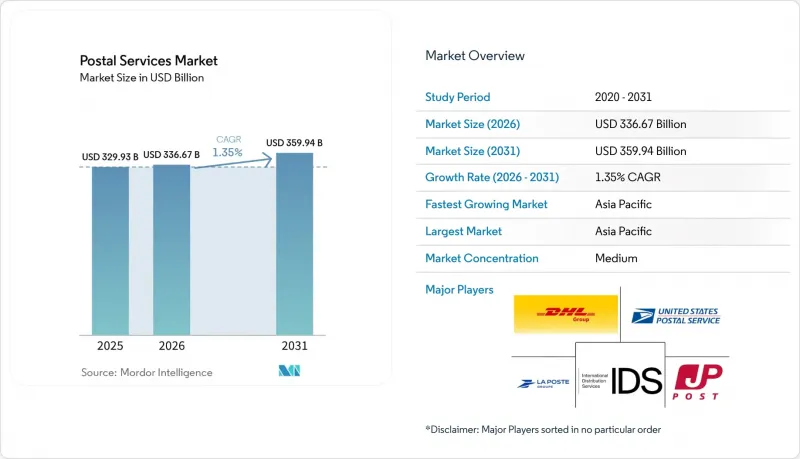
對溫控醫療物流日益成長的需求、數位化平台加速了海關流程,以及企業重視低碳配送網路的ESG政策,正推動企業採用高階小包裹服務和電動車(EV)。本報告按類型(標準郵政服務和快遞服務)、類別(信件和小包裹)、目的地(國內和國際)、最終用戶(B2B、B2C、C2C)、配送方式(陸運、空運、海運、鐵路)和地區(北美、南美、亞太、歐洲、中東和非洲)進行細分。市場預測以美元(USD)為單位。
全球郵政服務市場趨勢與洞察
針對企業托運人的 ESG 評分卡,強制要求實現碳中和郵政遞送。
企業採購部門如今已將碳減排條款納入物流契約,並要求郵政業者實現車輛電氣化、採購可再生能源,並按照ISO 14083標準公佈排放數據。未能滿足這些要求的企業可能面臨被排除在大型訂單競標之外的風險。德國郵政敦豪集團已撥款70億歐元(約82.3億美元)用於2030年前的脫碳計劃,目前已部署3.7萬輛電動送貨車,併計劃到2024年底將其永續航空燃料的採購比例提高到30%。沃爾瑪、亞馬遜和聯合利華等公司要求其物流夥伴逐年減少碳排放。由於環境、社會和治理(ESG)合規性在2024年68%的提案文件中位列前三,因此,在ESG合規方面落後的企業將被競標500強企業拒之門外。這一趨勢有利於那些在運輸的每個階段量化排放的運營商,而使那些缺乏透明報告系統的運營商處於劣勢。因此,高級小包裹運費擴大包含碳計量證書,托運人可將其用於範圍 3 揭露。
數位海關平台的全球推廣正在加速低價值小包裹的清關。
歐盟的ICS-2系統將於2024年3月起強制郵政業者使用,該系統要求在包裹到達前提交電子數據,從而將受監管的低價值小包裹的清關時間縮短高達42%。同時,美國的ACE 2.0系統可自動計算價值低於800美元的貨物的關稅,使業者小包裹的處理成本最多可降低1.20美元。跨境電商小包裹在2024年激增23%,令那些不具備自動風險篩檢能力的門戶不堪負荷。像荷蘭郵政(PostNL)和瑞士郵政這樣的早期採用者已將包裹停留時間縮短了18%至22%,從而騰出倉庫空間用於利潤更高的快遞業務。然而,合規需要大量投資,中型郵政業者在IT平台和資料品管方面需要花費1500萬至2500萬美元。未能達到資料完整性標準的業者將面臨罰款、運輸延誤和客戶流失。
歐盟強制實施 NIS-2 和 CISA 導致網路安全遵循成本。
歐盟的NIS-2指令將郵政服務列為“關鍵營業單位”,要求其在24小時內報告違規行為,並對違規者處以最高1000萬歐元(1176萬美元)或全球銷售額2%的罰款。在美國,網路安全和基礎設施安全局(CISA)強制要求在2025年3月前實施多因素身份驗證和網路分段。英國皇家郵政集團在2023年遭受勒索軟體攻擊後投資了4,700萬英鎊(5,900萬美元),但業界研究表明,仍有31%的郵政工作人員無法通過網路釣魚模擬測試。中型企業被迫將4%至7%的IT預算用於合規,這迫使他們聘請昂貴的網路安全人員或將安全性外包給託管安全服務供應商。這給企業的自由現金流帶來了壓力,並延緩了自動化專案的實施。
細分市場分析
亞太地區仍是成長的主要驅動力,年複合成長率達3.51%,預計到2025年將佔全球郵政服務市場佔有率的36.45%。在越南,受小包裹量激增至25億件的推動,郵政收入在2019年至2023年間加倍,達到59兆越南盾(約23億美元)。印度郵政配備RFID技術的節點式配送中心正在提升可追溯性,而中國郵政正透過與菜鳥網路成立的25億美元合資企業,在「一帶一路」沿線部署40個樞紐。日本郵政正透過向Toll集團投資12億美元,拓展在大洋洲的業務。然而,各國不同的商品及服務稅(課稅)標準和海關制度加重了合規營運的負擔,要求業者針對每個市場最佳化其IT系統。電動摩托車在人口密集的都市區上的應用日益普及,每次停靠的成本降低了18%。
到2025年,北美將佔全球郵政服務市場佔有率的約28%。美國郵政總局(USPS)的「為美國服務2.0」計畫旨在十年內削減360億美元的成本,但2024會計年度95億美元的虧損引發了關於私有化的討論。網路安全和基礎設施安全局(CISA)的合規要求為中型郵政服務機構帶來了1200萬至1800萬美元的網路安全相關成本。加拿大郵政正在推動小包裹分揀自動化,並與Shopify合作,以遏止郵件量每年8.2%的下降。阿拉斯加和蒙大拿州的農村寬頻試點計畫預計將帶來批發頻寬收入,從而實現收入多元化,並展現基礎設施政策與郵政服務現代化之間的緊密聯繫。快捷郵件快遞小包裹提高了收入密度,但航空燃油額外費用正在擠壓利潤空間。
德國郵政在歐洲的市佔率已接近26%。丹麥計劃於2024年取消普遍服務義務(USO),預示著市場正朝著自由化方向發展,而歐盟的NIS-2和EPR法規則正在加強營運規範。德國郵政的人工智慧分類機已將人事費用降低了28%,使其擁有了競爭優勢,法國郵政和英國皇家郵政也在尋求類似的競爭優勢。 EPR費用為每公斤包裝增加0.08至0.15歐元,每年總合1.8億至2.8億歐元(約2.1173億至3.2936億美元)。法國將340家郵局改造為微型倉配中心,實現了電商平台的當日送達服務,彌補了廣告郵件數量的下降。雖然跨境小包裹的數量受益於 ICS-2 效率的提高,但燃油價格的波動以及與英國脫歐相關的海關程序的複雜性繼續給快遞業務的利潤率帶來壓力。
區域分析
B2C市場正以4.33%的複合年成長率快速擴張,預計到2028年,隨著D2C(直接面對消費者)藥品、二手時尚和餐飲訂閱服務的日益普及,其市場佔有率將超過50%。該領域對速度的迫切需求推動了對當日達微型倉配中心和人工智慧路線規劃器的投資。Capgemini SA預測,到2029年,快速商務銷售額將達到2,660億美元,將進一步提升小包裹遞送的迫切性。 B2B市場在2025年仍維持52.06%的市佔率。在二手電商平台的推動下,C2C(消費者對消費者)配送正以3.2%的複合年成長率穩定成長,儘管電子帳單和文件的數位化程度不斷提高,B2B市場仍保持停滯狀態。企業正在透過實施附加價值服務來解決 B2B 業務停滯的問題,例如提供清關服務,從而賺取郵資以外的服務費;以及提供價值鏈增值儀表板,從而賺取郵資以外的服務費。
醫療保健訂閱計劃正在進一步擴大B2C市場佔有率。藥局正與郵政服務提供者合作,利用低溫運輸設施供應慢性病藥物包,進而創造穩定的需求,保障每日銷售。儘管面臨零工經濟競爭對手的價格壓力,但成熟的郵政服務提供商憑藉其覆蓋全國的服務網路、安全的倉儲和運輸鏈以及合規性,在競爭中脫穎而出。
到2025年,小包裹市場將佔整體市場規模的59.49%,預計到2031年將以2.90%的複合年成長率成長,屆時電子商務在全球零售市場的滲透率將接近25%。在小包裹市場中,醫療保健和生鮮食品的成長速度最快,這主要得益於居家照護和食材自煮包日益普及,二者的複合年成長率均超過8%。 2024年,自動化分類系統投資金額達9.9494億美元,預計到2031年將達到15.5億美元,這將有望提高處理能力和可追溯性。目前佔郵件處理量40.51%的信件,由於電子帳單發票的普及,正以每年1.8%的速度下降,而且信件的收件人越來越傾向於50歲以上的人群。到2030年,基於區塊鏈技術的電子掛號郵件可能會取代高達20%的掛號郵件,加速這一趨勢。儘管全球郵政服務市場中的郵件市場規模仍超過1,400億美元,但盈利取決於重組成本以及與數位身分服務的商品搭售。
儘管信件業務正在萎縮,但法律和政府要求仍維持著一定的需求水準。業者正在利用地址資料庫進行身份驗證並實現盈利,並利用投遞確認網路開展選民投票項目。在新興市場,農村地區寬頻基礎設施的改善推動了小額信貸機構帳單郵件數量的成長。然而,如果不引入動態定價和成本分攤模式,信件業務在全球郵政服務市場的佔有率將持續下降。
2025年,國內運輸佔據了83.07%的市場佔有率,但隨著消費者從世界各地購買商品,預計到2031年,國際小包裹的複合年成長率將達到3.65%,超過國內運輸。即使考慮到美國對中國進口商品徵收34%關稅等新的關稅措施(BBC),預計到2031年,與國際運輸相關的全球郵政服務市場規模仍將達到640億美元。 ICS-2等數位海關技術的進步正在縮短海關手續並提高可靠性。然而,燃油額外費用和地緣政治衝擊是市場波動的因素,而那些實現樞紐多元化並提供仲介服務的業者能夠更好地抵禦這些衝擊。 DHL Express不斷擴展的「關稅包含」選項正在提升消費者的便利性,並增強中小型出口商的忠誠度。
國內網路持續推動規模經濟,尤其是在人口大國。印度和巴西農村地區的寬頻基礎設施提高了國內小包裹密度,並提升了配送路線的效率。然而,都市區擁擠費和低排放氣體區政策加重了成本結構,加速了向集中式儲物櫃配送和自行車宅配的轉變。
2025年,快遞服務佔了24.85%的市場佔有率,預計將以3.91%的複合年成長率成長,幾乎是標準服務1.12%增速的三倍,這主要得益於托運人越來越重視送達保證和物聯網追蹤。到2031年,全球郵政服務市場中由快遞服務貢獻的規模預計將達到894億美元,這主要得益於生物類似藥的推出和直接面向患者的配送計劃。對溫度敏感型貨物的額外收費提高了每件小包裹的收入,抵消了不斷上漲的航空燃油成本。營運商正在為飛機配備主動式貨櫃並整合GPS感測器,以產生詳細數據,滿足製藥業的合規性審計要求。標準服務對於大量郵件和非緊急小包裹仍然至關重要,但由於信件自動替換和普遍服務義務的放鬆,其發展面臨挑戰。自動化升級,例如德國郵政的人工智慧分類機,正在降低人事費用,即使在業務量下降的情況下也能保持盈利。
2025年,主要面向政府通訊和低成本小包裹遞送的標準服務將佔據全球郵政服務市場佔有率的75.15%。然而,法規結構的變化(例如丹麥將於2024年終止其強制性普遍郵件服務)表明,企業面臨越來越大的壓力,需要調整價格以匹配成本。混合郵件服務具有成長空間。這項服務透過雲端平台出具紙本帳單,為金融機構在日益猖獗的網路攻擊面前提供了受監管的替代方案。然而,如果以標準服務為中心的營運商不向增值物流服務領域多元化發展,它們將面臨因環境報告(EPR)和網路安全成本飆升而導致的利潤率壓力。
2025年,陸運仍維持74.93%的市場佔有率,而隨著客運的復甦,貨運能力也隨之恢復,航空貨運以2.76%的複合年成長率成長。波音公司2024年僅交付了14架777F貨機,導致供應緊張,包機業務利潤增加。儘管航空貨運在全球郵政服務中所佔比例仍不到15%,但其速度對於醫療低溫運輸和洲際電子商務至關重要。業者正透過採用混合運輸網路來降低燃油價格波動風險,即透過空運運輸高優先級SKU,而透過海運或鐵路運輸優先順序較低的小包裹。 2024年,中國鐵路快運營運了1.7萬列中歐班列,運輸了190萬個標準箱。這代表了一種新興的中速、低碳運輸方式。陸路運輸引進電動貨車後,每個小包裹的二氧化碳排放減少了24%,符合托運人的環境、社會和治理(ESG)評估標準。
對於超過10天的交貨期,海運利潤率更高。雖然國際海事組織(IMO)的硫排放規定會使每個標準箱(TEU)額外增加22美元的成本,但其單位成本仍只有空運的二十分之一,因此對大型服裝托運商來說極具吸引力。鐵路在紅海航運中斷期間展現的韌性促使郵政業者投資跨歐亞大陸線路,從而分散風險。多式聯運構成了一個高度靈活的運輸網路的基礎,能夠抵禦燃油價格波動和地緣政治衝擊。
其他好處:
- Excel格式的市場預測(ME)表
- 3個月的分析師支持
目錄
第1章:引言
- 研究假設和市場定義
- 調查範圍
第2章:調查方法
第3章執行摘要
第4章 市場狀況
- 市場概覽
- 市場促進因素
- 企業和托運人的 ESG 評分卡:強制要求碳中和郵政遞送。
- 透過在全球部署數位化海關平台(例如歐盟的ICS-2、美國的ACE 2.0),加速低價值小包裹的清關速度。
- 對溫度敏感的醫療小包裹(疫苗、生技藥品、診斷試劑)數量激增,需要追蹤和管理郵政解決方案。
- 農村地區的寬頻補貼使得電子政府服務和數位郵政服務得以捆綁提供,從而提高了商業郵件的處理量。
- 基於區塊鏈的電子掛號郵件正在獲得跨境合約和合規文件的法律授權。
- 重新利用的郵政房地產正在被用來創建都市區當日送達微型倉配中心,從而提高高階小包裹的獲利能力。
- 市場限制因素
- 歐盟的 NIS-2 標準、美國的 CISA 監管要求,以及因勒索軟體事件增加而導致的遵循成本不斷上升。
- 航空和海運燃料附加費的波動給國際快遞航線的利潤帶來了壓力。
- 基於生產者延伸責任制 (EPR) 的包裝法規正在推高與小包裹處理和退貨相關的營運成本。
- 廣告電子郵件預算正在轉向無 cookie 的數位管道,導致高利潤行銷電子郵件的收入減少。
- 價值供應鏈分析
- 監理展望
- 技術展望
- 波特五力分析
- 地緣政治事件對市場的影響
第5章 市場規模與成長預測
- 按類型
- 標準郵政服務
- 快遞郵政服務
- 按類型
- 信件
- 小包裹和包裹
- 按地區
- 國內的
- 國際的
- 最終用戶
- 企業對企業 (B2B) 交易
- 企業對消費者 (B2C)
- 個人對個人(C2C)交易
- 按配送方式
- 土地
- 航空
- 海
- 鐵路
- 按地區
- 北美洲
- 美國
- 加拿大
- 墨西哥
- 南美洲
- 巴西
- 秘魯
- 智利
- 阿根廷
- 其他南美國家
- 亞太地區
- 印度
- 中國
- 日本
- 澳洲
- 韓國
- 東南亞(新加坡、馬來西亞、泰國、印尼、越南、菲律賓)
- 其他亞太國家
- 歐洲
- 英國
- 德國
- 法國
- 西班牙
- 義大利
- 比荷盧經濟聯盟(比利時、荷蘭、盧森堡)
- 北歐國家(丹麥、芬蘭、冰島、挪威、瑞典)
- 其他歐洲國家
- 中東和非洲
- 阿拉伯聯合大公國
- 沙烏地阿拉伯
- 南非
- 奈及利亞
- 其他中東和非洲國家
- 北美洲
第6章 競爭情勢
- 市場集中度
- 策略趨勢
- 市佔率分析
- 公司簡介
- Aramex
- Australia Post
- bpost Group
- Brazil Correios
- Canada Post
- China Post Group
- Correos(Spain)
- DHL Group
- Emirates Post Group
- FedEx
- International Distribution Services
- Japan Post Holdings
- La Poste Group
- New Zealand Post
- Poste Italiane
- Posti Group(Finland)
- PostNL
- PostNord AB
- SF Express(KEX-SF)
- Singapore Post
- Swiss Post
- United Parcel Service of America, Inc.
- United States Postal Service*
第7章 市場機會與未來展望
According to Mordor Intelligence, the global postal services market size is expected to increase from USD 329.93 billion in 2025 to USD 336.67 billion in 2026 and reach USD 359.94 billion by 2031, growing at a CAGR of 1.35% over 2026-2031.
Escalating demand for temperature-controlled healthcare logistics, accelerated customs clearance through digital platforms, and corporate ESG mandates that reward low-carbon delivery networks are steering operators toward premium parcel services and electric vehicle fleets. This report is Segmented by Type (Standard Postal Services and Express Postal Services), by Item (Letters and Parcels), by Destination (Domestic and International), by End-User (B2B, B2C and C2C), by Delivery Mode (Road, Air, Sea, and Rail), and by Geography (North America, South America, Asia-Pacific, Europe, and Middle East and Africa). The Market Forecasts are Provided in Terms of Value (USD).
Global Postal Services Market Trends and Insights
Corporate-Shipper ESG Scorecards Mandating Carbon-Neutral Postal Delivery
Corporate procurement teams now embed carbon-reduction clauses into logistics contracts, obligating postal operators to electrify fleets, procure renewable energy, and publish ISO 14083-aligned emissions data or risk exclusion from high-volume tenders. Deutsche Post DHL allocated EUR 7 billion (USD 8.23 billion) to decarbonization through 2030, already fielding 37,000 electric delivery vehicles and sourcing 30% sustainable aviation fuel by end-2024. Walmart, Amazon, and Unilever require year-on-year carbon cuts from logistics partners, pushing laggards out of Fortune 500 bids as 68% of 2024 RFPs ranked ESG alignment among the top three selection criteria. The dynamic rewards operators that quantify emissions across every shipment leg and penalize those without transparent reporting frameworks. As a result, premium parcel rates increasingly bundle carbon-accounting certificates that shippers can apply toward Scope 3 disclosures.
Global Rollout of Digital Customs Platforms Accelerating Low-Value Parcel Clearance
The EU's ICS-2 system, mandatory for postal operators since March 2024, demands pre-arrival electronic data, reducing compliant low-value parcel clearance times by up to 42%. Concurrently, United States, ACE 2.0 automates duty assessment for shipments under USD 800, saving operators as much as USD 1.20 per parcel in processing costs. Cross-border e-commerce parcels jumped 23% in 2024, overwhelming gateways that lacked automated risk screening. Early adopters such as PostNL and Swiss Post cut dwell times 18-22% and freed warehouse space for higher-margin express goods. Compliance, however, is capital-intensive, with mid-sized postal administrations investing USD 15-25 million in IT platforms and data-quality controls. Operators unable to meet the data-integrity thresholds face penalties, shipment delays, and customer churn.
Escalating Cyber-Security Compliance Spend under EU NIS-2 and CISA Mandates
The EU's NIS-2 Directive classifies postal services as "essential entities," prescribing 24-hour breach reporting and fines up to EUR 10 million (USD 11.76 million) or 2% of global revenue for non-compliance. In the United States, CISA requires multi-factor authentication and network segmentation by March 2025. Royal Mail Group invested GBP 47 million (USD 59 million) after a 2023 ransomware attack, yet industry surveys show 31% of postal workers still fail phishing simulations. Mid-sized operators must divert 4-7% of IT budgets to compliance, hiring expensive cyber-talent or outsourcing to managed-security providers, tightening free cash flow, and delaying automation projects.
Other drivers and restraints analyzed in the detailed report include:
- Boom in Temperature-Controlled Healthcare Parcels Needing Track-and-Trace Postal Solutions
- Rural Broadband Subsidies Enabling Bundled E-Government and Postal Digital Services
- Volatile Jet-Fuel and Marine Bunker Surcharges Compress International Express Margins
For complete list of drivers and restraints, kindly check the Table Of Contents.
Segment Analysis
Asia-Pacific remains the growth engine, expanding 3.51% CAGR, and a commanding Global postal services market share at 36.45% in 2025. Vietnam's postal revenue doubled between 2019 and 2023 to VND 59 trillion (USD 2.3 billion) as parcels soared to 2.5 billion items. India Post's RFID-equipped Nodal Delivery Centres heighten traceability, while China Post's USD 2.5 billion joint venture with Cainiao deploys 40 hubs across Belt-and-Road corridors. Japan Post's USD 1.2 billion stake in Toll Group expands its Oceania footprint. Yet heterogenous GST thresholds and customs regimes multiply compliance workloads; operators must tailor IT systems market by market. Electrified two-wheeler fleets proliferate for dense urban routes, slashing cost per stop by 18%.
North America contributed roughly 28% of Global postal services market share in 2025. The USPS's Delivering for America 2.0 pursues USD 36 billion in savings over 10 years, yet a USD 9.5 billion fiscal-2024 deficit spurs privatization debates. CISA compliance imposes USD 12-18 million in cyber outlays on mid-tier operators. Canada Post targets parcel-sorting automation and Shopify alliances to stem 8.2% annual letter declines. Rural broadband pilots in Alaska and Montana promise wholesale bandwidth rents that diversify revenue, illustrating how infrastructure policy intersects with postal modernization. Express healthcare parcels lift revenue density, but air-fuel surcharges pressure margins.
Europe represented nearly 26% market share. Denmark's 2024 abolition of the letter USO signals liberalization momentum, while the EU's NIS-2 and EPR rules tighten operational discipline. Deutsche Post's AI sorters slash labor by 28%, enhancing competitiveness worth emulating across La Poste and Royal Mail networks. EPR fees add EUR 0.08-0.15 per kilogram of packaging, totaling an extra EUR 180-280 million (USD 211.73-329.36 million) annually. Micro-fulfillment conversions of 340 French post offices enable same-day delivery for e-commerce platforms, countering declining ad-mail. Cross-border parcel volumes benefit from streamlined ICS-2, yet fuel volatility and Brexit-related customs complexity continue to cloud express margins.
Geography Analysis
B2C will grow 4.33% CAGR, lifting its share above 50% by 2028, as direct-to-consumer pharma, fashion resales, and meal subscriptions proliferate. The segment's premium on speed prompts investment in same-day micro-fulfillment hubs and AI route planners. Capgemini forecasts quick-commerce turnover of USD 266 billion by 2029, reinforcing parcel urgency. B2B retained 52.06% market share in 2025. C2C shipments, propelled by recommerce platforms, add steady tailwinds at 3.2% CAGR, while B2B remains flat amid e-invoicing and digitized documentation. Operators counter B2B stagnation by layering supply-chain visibility dashboards and customs brokerage value-adds that capture service fees beyond postage.
Healthcare subscription programs enlarge the B2C share further. Pharmacies partner with posts to supply chronic-care medication kits, leveraging cold-chain nodes and providing recurring traffic that stabilizes daily volumes. Gig-economy rivals exert price pressure, but postal incumbents differentiate on nationwide coverage, secure chain of custody, and regulatory compliance.
Parcels owned 59.49% of 2025 market size and will grow 2.90% CAGR as e-commerce penetration nears 25% of global retail by 2031. Within parcels, healthcare and fresh groceries set the fastest trajectory, each above 8% CAGR, as home-based care and meal-kit adoption rise. Automated sortation investment reached USD 994.94 million in 2024 and is projected at USD 1.55 billion by 2031, driving throughput and traceability. Letters, now 40.51% of items handled, decline 1.8% annually due to digital invoices, with volumes increasingly skewed to recipients aged 50+. Blockchain e-registered mail could displace up to 20% of certified letters by 2030, accelerating contraction. The Global postal services market size for letters still exceeds USD 140 billion, but profitability hinges on cost restructuring and bundling with digital identity services.
Although the letters segment shrinks, legal and government requirements sustain a baseline. Operators monetize address databases for identity verification and leverage delivery confirmation networks for voter-ballot programs. In emerging markets, gap-filled rural broadband triggers incremental statement mail for micro-finance providers. Nonetheless, without dynamic pricing or cost-sharing models, letters' contribution to the Global postal services market will diminish steadily.
Domestic shipments held 83.07% of 2025 market share, yet international parcels will outpace at 3.65% CAGR through 2031 as shoppers source products globally. The Global postal services market size tied to international deliveries is forecast at USD 64 billion by 2031, even with new tariffs such as the United States 34% levy on Chinese imports BBC. Digital customs advances like ICS-2 shorten clearance, enhancing reliability. However, fuel surcharges and geopolitical shocks introduce volatility; operators with diversified hubs and broker services absorb shocks better. Duty-paid options, expanded by DHL Express, simplify consumer experience and build loyalty among SMB exporters.
Domestic networks still drive scale economies, especially in populous countries. Rural broadband grants in India and Brazil raise domestic parcel density, improving route productivity. Yet urban congestion charges and low-emission zones strain cost structures, intensifying the shift toward consolidated locker deliveries and bicycle couriers.
Express services represented 24.85% of the 2025 market share yet are forecast to expand at a 3.91% CAGR, nearly triple standard services' 1.12% pace, as shippers favor guaranteed delivery and IoT-enabled tracking. The Global postal services market size attributable to express services is projected to reach USD 89.4 billion by 2031, buoyed by biosimilar launches and direct-to-patient programs. Temperature-controlled consignments command surcharges, lifting per-parcel yield and offsetting higher aviation fuel costs. Operators retrofit aircraft with active containers and embed GPS sensors, generating granular data that satisfies pharma compliance audits. Standard services remain crucial for bulk mail and low-urgency parcels but suffer from automated letter substitution and relaxed universal service obligations. Automation upgrades, such as Deutsche Post's AI sorters, trim labor expense, sustaining profitability even as volumes wane.
Standard services held 75.15% of the Global postal services market share in 2025, anchored by government correspondence and low-cost parcel delivery. However, shifts in regulatory frameworks Denmark ended its letter USO in 2024 signal mounting pressure to realign prices with cost. Growth pockets exist in hybrid mail, where printed statements are triggered from cloud-based platforms, offering financial institutions a compliant fallback as cyber breaches rise. Yet without diversified value-added logistics, standard-centric operators risk margin compression amid EPR and cybersecurity cost inflation.
Road retained 74.93% market share in 2025, yet air cargo expands 2.76% CAGR, benefiting from restocked belly-hold capacity as passenger traffic rebounds. Boeing delivered only 14 777F freighters in 2024, so constrained supply lifts charter yields. The Global postal services market share of air freight remains below 15%, but healthcare cold-chain and cross-continental e-commerce rely on its speed. Operators mitigate fuel exposure via hybrid networks flying priority SKUs while routing non-urgent parcels by sea or rail. China Railway Express ran 17,000 China-Europe trains in 2024, carrying 1.9 million TEU, an emerging option for mid-speed, low-carbon delivery. Electric vans deployed for road legs cut per-parcel CO2 by 24%, aligning with shipper ESG scorecards.
Sea freight widens margin where delivery windows exceed 10 days. The IMO sulfur cap tacks USD 22 per TEU, but unit costs remain one-twentieth of air, appealing to mass-market apparel shippers. Rail's resilience amid Red Sea disruptions drew postal operators to invest in Eurasian land bridges, diversifying risk. Combined modes underpin adaptive networks that weather fuel and geopolitical shocks.
List of Companies Covered in this Report:
- Aramex
- Australia Post
- bpost Group
- Brazil Correios
- Canada Post
- China Post Group
- Correos (Spain)
- DHL Group
- Emirates Post Group
- FedEx
- International Distribution Services
- Japan Post Holdings
- La Poste Group
- New Zealand Post
- Poste Italiane
- Posti Group (Finland)
- PostNL
- PostNord AB
- SF Express (KEX-SF)
- Singapore Post
- Swiss Post
- United Parcel Service of America, Inc.
- United States Postal Service*
Additional Benefits:
- The market estimate (ME) sheet in Excel format
- 3 months of analyst support
TABLE OF CONTENTS
1 Introduction
- 1.1 Study Assumptions and Market Definition
- 1.2 Scope of the Study
2 Research Methodology
3 Executive Summary
4 Market Landscape
- 4.1 Market Overview
- 4.2 Market Drivers
- 4.2.1 Corporate-Shipper ESG Scorecards Mandating Carbon-Neutral Postal Delivery
- 4.2.2 Global Rollout of Digital Customs Platforms (E.G., EU ICS-2, US ACE 2.0) Accelerating Low-Value Parcel Clearance
- 4.2.3 Boom in Temperature-Controlled Healthcare Parcels (Vaccines, Biologics, Diagnostics) Needing Track-and-Trace Postal Solutions
- 4.2.4 Rural Broadband Subsidies Enabling Bundled E-Government and Postal Digital Services, Lifting Transaction Mail Volumes
- 4.2.5 Blockchain-Based E-Registered Mail Gaining Legal Acceptance for Cross-Border Contracts and Compliance Documentation
- 4.2.6 Same-Day Urban Micro-Fulfilment Hubs Repurposing Post-Office Real Estate and Boosting Premium Parcel Yield
- 4.3 Market Restraints
- 4.3.1 Escalating Cyber-Security Compliance Spend under EU NIS-2, US CISA Mandates and Rising Ransomware Incidents
- 4.3.2 Volatile Jet-Fuel and Marine Bunker Surcharges Compressing Profit in International Express Lanes
- 4.3.3 Extended-Producer-Responsibility (EPR) Packaging Laws Raising Operational Costs for Parcel Handling and Returns
- 4.3.4 Ad-Mail Budget Migration to Cookieless Digital Channels Reducing High-Margin Marketing Mail Revenue
- 4.4 Value / Supply-Chain Analysis
- 4.5 Regulatory Outlook
- 4.6 Technological Outlook
- 4.7 Porter's Five Forces Analysis
- 4.7.1 Threat of New Entrants
- 4.7.2 Bargaining Power of Buyers
- 4.7.3 Bargaining Power of Suppliers
- 4.7.4 Threat of Substitutes
- 4.7.5 Intensity of Competitive Rivalry
- 4.8 Impact of Geo-Political Events on the Market
5 Market Size and Growth Forecasts (Value)
- 5.1 By Type
- 5.1.1 Standard Postal Services
- 5.1.2 Express Postal Services
- 5.2 By Item
- 5.2.1 Letters
- 5.2.2 Parcels
- 5.3 By Destination
- 5.3.1 Domestic
- 5.3.2 International
- 5.4 By End-User
- 5.4.1 Business-to-Business (B2B)
- 5.4.2 Business-to-Consumer (B2C)
- 5.4.3 Consumer-to-Consumer (C2C)
- 5.5 By Delivery Mode
- 5.5.1 Road
- 5.5.2 Air
- 5.5.3 Sea
- 5.5.4 Rail
- 5.6 By Geography
- 5.6.1 North America
- 5.6.1.1 United States
- 5.6.1.2 Canada
- 5.6.1.3 Mexico
- 5.6.2 South America
- 5.6.2.1 Brazil
- 5.6.2.2 Peru
- 5.6.2.3 Chile
- 5.6.2.4 Argentina
- 5.6.2.5 Rest of South America
- 5.6.3 Asia-Pacific
- 5.6.3.1 India
- 5.6.3.2 China
- 5.6.3.3 Japan
- 5.6.3.4 Australia
- 5.6.3.5 South Korea
- 5.6.3.6 South East Asia (Singapore, Malaysia, Thailand, Indonesia, Vietnam, and Philippines)
- 5.6.3.7 Rest of Asia-Pacific
- 5.6.4 Europe
- 5.6.4.1 United Kingdom
- 5.6.4.2 Germany
- 5.6.4.3 France
- 5.6.4.4 Spain
- 5.6.4.5 Italy
- 5.6.4.6 BENELUX (Belgium, Netherlands, and Luxembourg)
- 5.6.4.7 NORDICS (Denmark, Finland, Iceland, Norway, and Sweden)
- 5.6.4.8 Rest of Europe
- 5.6.5 Middle East and Africa
- 5.6.5.1 United Arab of Emirates
- 5.6.5.2 Saudi Arabia
- 5.6.5.3 South Africa
- 5.6.5.4 Nigeria
- 5.6.5.5 Rest of Middle East and Africa
- 5.6.1 North America
6 Competitive Landscape
- 6.1 Market Concentration
- 6.2 Strategic Moves
- 6.3 Market Share Analysis
- 6.4 Company Profiles (Includes Global-Level Overview, Market-Level Overview, Core Segments, Financials, Strategic Information, Market Rank/Share, Products and Services, Recent Developments)
- 6.4.1 Aramex
- 6.4.2 Australia Post
- 6.4.3 bpost Group
- 6.4.4 Brazil Correios
- 6.4.5 Canada Post
- 6.4.6 China Post Group
- 6.4.7 Correos (Spain)
- 6.4.8 DHL Group
- 6.4.9 Emirates Post Group
- 6.4.10 FedEx
- 6.4.11 International Distribution Services
- 6.4.12 Japan Post Holdings
- 6.4.13 La Poste Group
- 6.4.14 New Zealand Post
- 6.4.15 Poste Italiane
- 6.4.16 Posti Group (Finland)
- 6.4.17 PostNL
- 6.4.18 PostNord AB
- 6.4.19 SF Express (KEX-SF)
- 6.4.20 Singapore Post
- 6.4.21 Swiss Post
- 6.4.22 United Parcel Service of America, Inc.
- 6.4.23 United States Postal Service*
7 Market Opportunities and Future Outlook
- 7.1 White-Space and Unmet-Need Assessment

 北美郵政服務:市場佔有率分析、產業趨勢與統計、成長預測(2026-2031 年)歐洲郵政服務:市場佔有率分析、行業趨勢和統計數據以及成長預測(2026-2031 年)
 全球郵政服務市場東南亞郵政服務:市場佔有率分析、產業趨勢與統計、成長預測(2025-2030 年)