


 |
市場調查報告書
商品編碼
2117218
歐洲郵政服務:市場佔有率分析、行業趨勢和統計數據以及成長預測(2026-2031 年)Europe Postal Services - Market Share Analysis, Industry Trends & Statistics, Growth Forecasts (2026 - 2031) |
||||||

※ 本網頁內容可能與最新版本有所差異。詳細情況請與我們聯繫。
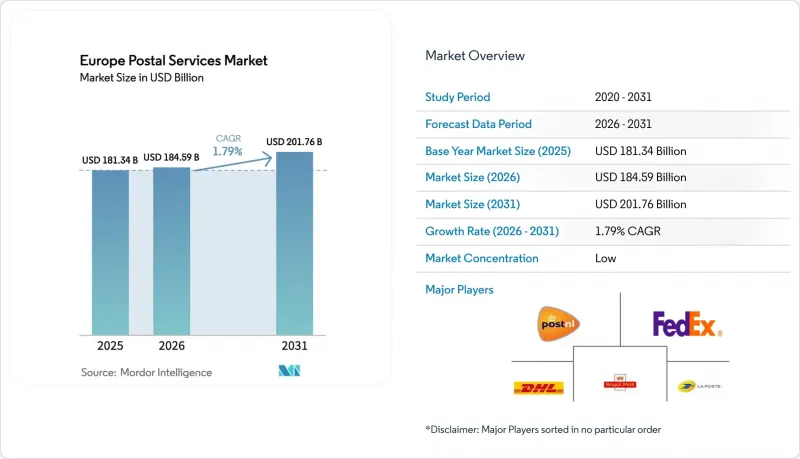
根據 Mordor Intelligence 估計,到 2026 年,歐洲郵政服務市值將達到 1,845.9 億美元,高於 2025 年的 1,813.4 億美元,預計到 2031 年將達到 2,017.6 億美元。
預計 2026 年至 2031 年的複合年成長率為 1.79%。
本報告按服務類型(快遞服務和普通郵政服務)、物品類型(信件和小包裹)、目的地(國內和國際)以及國家/地區(德國、英國、法國、義大利、西班牙、荷蘭、北歐國家(瑞典、丹麥、挪威、芬蘭)以及其他歐洲國家/地區(包括東歐和巴爾幹半島))進行細分。市場預測以美元計價。
歐洲郵政服務市場的趨勢與洞察
電子商務的快速成長正在推動德國和英國小包裹數量的增加。
儘管消費支出放緩,但德國2024年第二季的小包裹量仍年增9% 。英國也出現了類似的趨勢,預計到2024年,電子商務將佔英國零售總額的26%,到2028年將達到31%。小包裹和信件需求的不平衡導致網路利用率失衡,迫使企業將部分信件投遞路線改造為小包裹收發路線。由此產生的一個新發現是,原本用於郵件分揀的郊區分揀中心正在悄悄轉型為小包裹微型倉配,從而釋放了這些隱藏資產的生產力。
歐盟碳排放法規正在加速對汽車電氣化的投資。
更嚴格的排放上限正在加速電動車的普及。 UPS在巴黎推出了100多輛新型電動車,並計畫在2024年底在歐洲部署600輛。比利時郵政(Bpost)的電動貨車車隊規模加倍,荷蘭郵政(PostNL)在2023年實現了82%的零排放配送里程。這背後的根本意義在於,領先可以創建雙層服務模式,透過對碳中和配送收取少量附加費來抵消監管成本。
北歐地區傳統郵件處理量下降
據北歐郵政(PostNord)稱,北歐國家76%的消費者現在進行跨境網購,導致他們對國內郵政服務的關注度下降。信件量的減少加速了單封信成本的上漲,迫使服務提供者裁員。義大利郵政(Posti)最近的裁員也印證了這個趨勢。這表明,北歐地區或許是率先採用公私合營混合資金籌措模式來維持普遍服務的先驅。
細分市場分析
在歐洲郵政服務市場,快遞服務的市場規模預計將在2026年至2031年間以6.96%的複合年成長率成長,遠高於標準服務的成長速度。標準服務在2025年仍將佔據52.35%的市場。這種不斷擴大的差距凸顯了限時特快服務如何利用消費者對速度的付費意願來創造利潤。目前的觀點認為,網路設計正在向更晚的收件截止時間和更早的清晨投遞高峰期轉變,旨在最大限度地運轉率現有車隊。
儘管標準郵件服務成長速度放緩,但對於履行監管服務義務和確保全國覆蓋仍然至關重要。修訂後的德國郵政法將自2025年起將95%信件的可接受投遞時間延長至三個工作日,並允許承運人合併收件。預計這項監管放寬措施將使標準郵件服務作為一項成本最佳化的核心服務變得日益重要,而快遞服務則將產生盈餘資金。
其他好處:
- Excel格式的市場預測(ME)表
- 3個月的分析師支持
目錄
第1章:引言
- 研究假設和市場定義
- 調查範圍
第2章:調查方法
第3章執行摘要
第4章 市場狀況
- 市場概覽
- 市場促進因素
- 電子商務的蓬勃發展正在推動德國和英國小包裹數量的成長。
- 歐盟碳排放法規正在加速對汽車電氣化的投資。
- 跨國單一市場舉措旨在簡化中小企業的海關手續。
- 由於人口老化,對行政文件郵政服務的需求仍然存在。
- 「當日送達」的期望推高了快遞服務的溢價。
- 物流自動化的引入降低了每件商品的分類成本。
- 市場限制因素
- 北歐地區傳統郵件處理量下降
- 西歐高昂的人事費用和工會組織
- 都市區擁擠和通行限制正在增加最後一公里交通的成本。
- 數位化替代方案(電子帳單發票、通訊)正在蠶食郵政收入。
- 價值供應鏈分析
- 監管和技術展望
- 波特五力模型
- 地緣政治事件對市場的影響
第5章 市場規模與成長預測
- 按服務類型
- 快捷郵件服務
- 標準郵政服務
- 依項目類型
- 信
- 小包裹
- 按目的地
- 國內的
- 國際的
- 國家
- 德國
- 英國
- 法國
- 義大利
- 西班牙
- 荷蘭
- 北歐國家(瑞典、丹麥、挪威、芬蘭)
- 歐洲其他地區(包括東歐和巴爾幹半島)
第6章 競爭情勢
- 市場集中度
- 策略趨勢
- 市佔率分析
- 公司簡介
- Deutsche Post DHL Group
- La Poste SA(DPDgroup/GeoPost)
- Royal Mail Group plc
- United Parcel Service Inc.(UPS)
- FedEx Corp.(incl. TNT Express)
- Poste Italiane SpA
- PostNL NV
- Swiss Post AG
- Bpost SA/NV
- PostNord AB
- GLS Group
- Hermes Europe GmbH(Evri)
- Asendia Management SAS
- DPD HL LLP(Russia)
- CTT Correios de Portugal SA
- Bring(Norwegian Posten)
- Omniva(Eesti Post AS)
- Correos y Telegrafos SA
- InPost SA
- Russian Post*
第7章 市場機會與未來展望
According to Mordor Intelligence, Europe postal services market size in 2026 is estimated at USD 184.59 billion, growing from 2025 value of USD 181.34 billion with 2031 projections showing USD 201.76 billion, growing at 1.79% CAGR over 2026-2031.
This report is Segmented by Service Type (Express Postal Service and Standard Postal Service), by Item Type (Letters and Parcels), by Destination (Domestic and International), by Country (Germany, United Kingdom, France, Italy, Spain, Netherlands, Nordics (Sweden, Denmark, Norway, Finland) and Rest of Europe (incl. Eastern Europe & Balkans)). The Market Forecasts are Provided in Terms of Value (USD).
Europe Postal Services Market Trends and Insights
E-commerce Boom Driving Parcel Volumes in Germany & the UK
Parcel volumes in Germany rose 9 % year-on-year during Q2 2024 even as consumer spending moderated. The United Kingdom echoes this pattern, with e-commerce holding 26 % of retail in 2024 and set to reach 31 % by 2028. This demand imbalance between parcels and letters is producing asymmetric network utilisation that nudges operators to repurpose letter routes for parcel pickups. A fresh inference is that suburban depots originally designed for mail sorting are quietly morphing into parcel micro-fulfilment hubs, unlocking hidden asset productivity.
EU Carbon Regulations Accelerating Fleet Electrification Investments
Stricter emission caps have accelerated electric-vehicle roll-outs, with UPS deploying more than 100 new EVs in Paris and planning 600 across Europe by end-2024 . Bpost doubled its electric van fleet, while PostNL logged 82 % emission-free delivery kilometres in 2023. The underlying inference is that early movers can price carbon-neutral delivery at a modest premium, creating a two-tier service catalogue that hedges against regulatory costs.
Declining Traditional Letter Volumes in Nordic Region
PostNord notes that 76 % of Nordic consumers now purchase cross-border online, diverting attention from domestic mail services. Letter declines accelerate cost-to-serve, forcing operators to trim headcount; Posti's recent layoffs confirm this restructuring path. The inference is that the Nordic region may pioneer hybrid public-private funding models to keep universal service afloat.
Other drivers and restraints analyzed in the detailed report include:
- Cross-Border Single Market Initiatives Simplifying Customs for SMEs
- Ageing Population Sustaining Letter-Mail Demand for Government Correspondence
- High Labor Costs & Unionization in Western Europe
For complete list of drivers and restraints, kindly check the Table Of Contents.
Segment Analysis
Express services hold a Europe Postal Services market size that is forecast to expand at 6.96 % CAGR from 2026-2031, significantly faster than standard services, which still command 52.35 % market share in 2025. The widening spread highlights how premium time-definite products monetise consumer willingness to pay for speed. A current inference is that network design is pivoting toward later collection cut-offs and earlier morning delivery waves, squeezing utilisation out of existing fleets.
Standard services, although lower growth, remain indispensable for regulatory service obligations and nationwide coverage. Germany's revised Postal Act extends permissible delivery time to three business days for 95 % of letters starting 2025, freeing operators to batch deliveries. This regulatory slack implies that standard services will increasingly serve as the cost-optimised backbone, while express layers generate surplus cash.
Complete Report Scope:
- By Service Type
- Express Postal Service
- Standard Postal Service
- By Item Type
- Letters
- Parcels
- By Destination
- Domestic
- International
- By Country
- Germany
- United Kingdom
- France
- Italy
- Spain
- Netherlands
- Nordics (Sweden, Denmark, Norway, Finland)
- Rest of Europe (incl. Eastern Europe & Balkans)
List of Companies Covered in this Report:
- Deutsche Post DHL Group
- La Poste SA (DPDgroup/GeoPost)
- Royal Mail Group plc
- United Parcel Service Inc. (UPS)
- FedEx Corp. (incl. TNT Express)
- Poste Italiane SpA
- PostNL NV
- Swiss Post AG
- Bpost SA/NV
- PostNord AB
- GLS Group
- Hermes Europe GmbH (Evri)
- Asendia Management SAS
- DPD HL LLP (Russia)
- CTT Correios de Portugal SA
- Bring (Norwegian Posten)
- Omniva (Eesti Post AS)
- Correos y Telegrafos SA
- InPost SA
- Russian Post*
Additional Benefits:
- The market estimate (ME) sheet in Excel format
- 3 months of analyst support
TABLE OF CONTENTS
1 Introduction
- 1.1 Study Assumptions & Market Definition
- 1.2 Scope of the Study
2 Research Methodology
3 Executive Summary
4 Market Landscape
- 4.1 Market Overview
- 4.2 Market Drivers
- 4.2.1 E-commerce Boom Driving Parcel Volumes in Germany & the UK
- 4.2.2 EU Carbon Regulations Accelerating Fleet Electrification Investments
- 4.2.3 Cross-Border Single Market Initiatives Simplifying Customs for SMEs
- 4.2.4 Ageing Population Sustaining Letter-Mail Demand for Government Correspondence
- 4.2.5 Same-Day Delivery Expectations Propelling Express Service Premiums
- 4.2.6 Logistics Automation Adoption Reducing Sortation Cost per Piece
- 4.3 Market Restraints
- 4.3.1 Declining Traditional Letter Volumes in Nordic Region
- 4.3.2 High Labor Costs & Unionization in Western Europe
- 4.3.3 Urban Congestion & Access Restrictions Increasing Last-Mile Costs
- 4.3.4 Digital Substitutes (e-Billing, Messaging) Eroding Letter Revenues
- 4.4 Value / Supply-Chain Analysis
- 4.5 Regulatory & Technological Outlook
- 4.6 Porter's Five Forces
- 4.6.1 Threat of New Entrants
- 4.6.2 Bargaining Power of Buyers/Consumers
- 4.6.3 Bargaining Power of Suppliers
- 4.6.4 Threat of Substitute Products
- 4.6.5 Intensity of Competitive Rivalry
- 4.7 Impact of Geo-Political Events in the market
5 Market Size & Growth Forecasts (Value)
- 5.1 By Service Type
- 5.1.1 Express Postal Service
- 5.1.2 Standard Postal Service
- 5.2 By Item Type
- 5.2.1 Letters
- 5.2.2 Parcels
- 5.3 By Destination
- 5.3.1 Domestic
- 5.3.2 International
- 5.4 By Country
- 5.4.1 Germany
- 5.4.2 United Kingdom
- 5.4.3 France
- 5.4.4 Italy
- 5.4.5 Spain
- 5.4.6 Netherlands
- 5.4.7 Nordics (Sweden, Denmark, Norway, Finland)
- 5.4.8 Rest of Europe (incl. Eastern Europe & Balkans)
6 Competitive Landscape
- 6.1 Market Concentration
- 6.2 Strategic Moves
- 6.3 Market Share Analysis
- 6.4 Company Profiles (includes Global Level Overview, Market Level Overview, Core Segments, Financials as available, Strategic Information, Market Rank/Share, Products & Services, Recent Developments)
- 6.4.1 Deutsche Post DHL Group
- 6.4.2 La Poste SA (DPDgroup/GeoPost)
- 6.4.3 Royal Mail Group plc
- 6.4.4 United Parcel Service Inc. (UPS)
- 6.4.5 FedEx Corp. (incl. TNT Express)
- 6.4.6 Poste Italiane SpA
- 6.4.7 PostNL NV
- 6.4.8 Swiss Post AG
- 6.4.9 Bpost SA/NV
- 6.4.10 PostNord AB
- 6.4.11 GLS Group
- 6.4.12 Hermes Europe GmbH (Evri)
- 6.4.13 Asendia Management SAS
- 6.4.14 DPD HL LLP (Russia)
- 6.4.15 CTT Correios de Portugal SA
- 6.4.16 Bring (Norwegian Posten)
- 6.4.17 Omniva (Eesti Post AS)
- 6.4.18 Correos y Telegrafos SA
- 6.4.19 InPost SA
- 6.4.20 Russian Post*
7 Market Opportunities & Future Outlook

 北美郵政服務:市場佔有率分析、產業趨勢與統計、成長預測(2026-2031 年)郵政服務:市場佔有率分析、行業趨勢和統計數據、成長預測(2026-2031 年)
 全球郵政服務市場東南亞郵政服務:市場佔有率分析、產業趨勢與統計、成長預測(2025-2030 年)