


 |
市場調查報告書
商品編碼
2125604
北美郵政服務:市場佔有率分析、產業趨勢與統計、成長預測(2026-2031 年)North America Postal Services - Market Share Analysis, Industry Trends & Statistics, Growth Forecasts (2026 - 2031) |
||||||

※ 本網頁內容可能與最新版本有所差異。詳細情況請與我們聯繫。
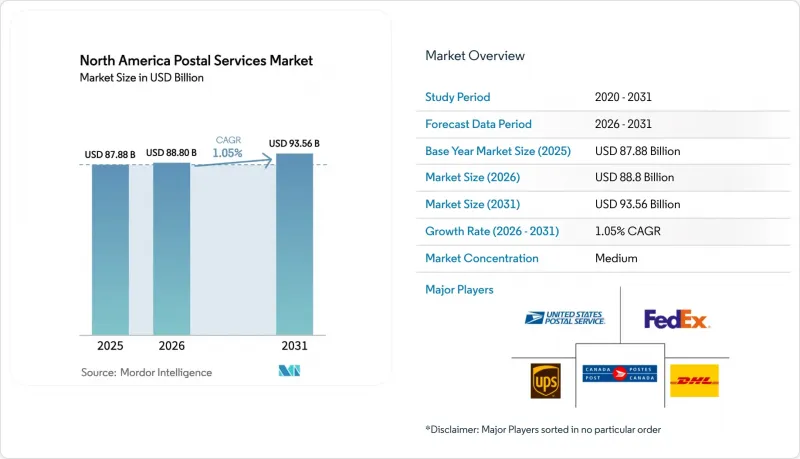
根據 Mordor Intelligence 估計,北美郵政服務市場在 2026 年的價值將達到 888 億美元,高於 2025 年的 878.8 億美元,預計到 2031 年將達到 935.6 億美元。
預計從 2026 年到 2031 年,其複合年成長率將達到 1.05%。
本報告按類型(標準郵政服務、快捷郵件郵政服務)、物品(信件、小包裹)、目的地(國內、國際)、最終用戶(B2B、B2C 等)、遞送方式(陸運、空運等)和國家/地區(美國等)對行業進行分類。市場預測以美元計價。
北美郵政服務市場趨勢與洞察
電子商務小包裹量的激增是由當日送達的需求所驅動的。
2023年,美國小包裹處理量達到217億件,預計到2029年將增加至290億件,迫使郵政工作人員優先考慮小包裹處理能力而非郵件投遞路線。由於可靠性已成為網路購物消費者的關鍵考量因素,企業現在更注重兩到三天的可預測送達時間,而非超快速送達的承諾。美國郵政服務公司(USPS)已將其季節性包裹處理能力提升至每日約6000萬件,以應對2024年的假期季節,這反映出郵政網路正永久性地向以小包裹為中心的模式轉變。
美國中小企業採用混合郵件和履約API的情況
由於美國郵政署 (USPS) 和私人承運商提供的易於整合的配送 API,小規模目前占美國郵政總量的 28.9%。 2024 年的 Web Tools 更新增加了端到端追蹤和統一海關數據,使小型企業也能直接從其電子商務控制面板列印合規標籤。這一數位化橋樑使企業級物流能力得以廣泛應用,從而維持了整個網路的獲利流量。
由於美國政府機構向數位轉型,一級郵件數量下降。
從2008會計年度到2023會計年度,一級郵件量下降了50%,削弱了美國郵政署(USPS)最盈利的收入來源之一。過去郵寄稅務通知和福利報表的政府機構現在也開始採用數位化遞送,這進一步加劇了收入壓力。儘管小包裹收入有所成長,但美國郵政署在2023會計年度累計淨虧損65億美元,紙質通訊的進一步減少威脅資金籌措。
細分市場分析
預計快遞服務成長率將超過整體市場成長速度,2026年至2031年間的複合年成長率將達到3.55%。這主要歸功於企業支付額外費用以獲得可預測的送達時間所帶來的利益。宅配業者的持續需求,各大業者正透過延長取件截止時間和加快送達速度來強化定時配送服務。
服務最廣泛基本客群的標準服務正面臨郵件量長期下降的趨勢。然而,旨在建立全國性投遞網路的普遍服務授權(Universal Service Mandate)預計到2025年仍將佔據北美郵政服務市場62.85%的佔有率。美國郵政署(USPS)正在修訂其標準,以使承諾與實際投遞量相符,確保75%的一級郵件保持1-5天的投遞時間,另有14%的郵件提供更快的服務。
到2025年,小包裹將佔北美郵政服務市場58.05%的市場佔有率,成為該市場的主要收入來源。透過擴大機械化分揀,並將人員從信件處理中心調配到小包裹處理線,操作員已成功將每個包裹的處理時間縮短至最短20秒,即使在高峰期也是如此。受電子商務商品種類不斷擴大(包括超大件家居用品和對溫度敏感的食品)的推動,北美郵政服務市場中與小包裹服務相關的市場規模預計將以3.65%的複合年成長率成長。
與之形成鮮明對比的是,郵件處理量持續下降。 2008年至2023年間,一級郵件的處理量減少了一半,因此,郵件在北美郵政服務市場的佔有率也隨之下降。儘管如此,法律文件、選舉相關資料和廣告信行銷的需求仍然存在,這為選擇性投資高速郵件分揀技術提供了支持,以確保盈利。
其他好處:
- Excel格式的市場預測(ME)表
- 3個月的分析師支持
目錄
第1章:引言
- 市場分析與定義的前提條件
- 分析範圍
第2章 分析方法
第3章執行摘要
第4章 市場狀況
- 市場概覽
- 市場促進因素
- 電子商務小包裹量的激增是由當日送達的需求所驅動的。
- 美國中小企業採用混合郵件和履約API的情況
- 美國郵政服務網路的現代化提高了處理能力。
- 加拿大郵政擴大小包裹處理點,正在加強其跨境遞送網路。
- 墨西哥物流園區近岸外包的激增正在推動郵件收發業務的外包。
- 各州層級的永續性指令正在加速車輛電氣化。
- 市場限制因素
- 由於美國政府機構向數位轉型,一級郵件數量下降。
- 全國郵政服務長期面臨人手不足,工會也加大了薪資壓力。
- 機場和邊境處理能力的瓶頸正在減緩跨境小包裹的流通速度。
- 墨西哥農村地區地址資訊不足,導致最後一公里配送成本上升。
- 價值鍊和供應鏈分析
- 監理情勢
- 技術展望
- 波特五力分析
第5章:預測市場規模與成長率
- 按類型
- 標準郵政服務
- 快捷郵件服務
- 按項目
- 信
- 小包裹
- 按目的地
- 國內的
- 國際的
- 最終用戶
- B2B(企業對企業交易)
- B2C(企業對消費者)交易
- C2C(消費者對消費者交易)
- 透過分配法
- 路
- 航空
- 海路
- 鐵路
- 國家
- 美國
- 加拿大
- 墨西哥
第6章 競爭情勢
- 市場集中度
- 策略趨勢
- 市佔率分析
- 公司簡介
- United States Postal Service(USPS)
- Canada Post Corporation
- FedEx Corporation
- United Parcel Service Inc.(UPS)
- Deutsche Post DHL Group(DHL Express)
- Purolator Inc.
- OnTrac Logistics
- LaserShip/OnTrac Group
- Pitney Bowes Inc.
- Stamps.com(Auctane)
- Correos de Mexico(SEPOMEX)
- SCI Group
- Spee-Dee Delivery Service
- GLS-US(formerly GSO)
- RR Donnelley Logistics
- Neopost(Quadient)
- Sendle USA
- ShipBob Inc.*
第7章 市場機會與未來展望
According to Mordor Intelligence, North America postal services market size market size in 2026 is estimated at USD 88.8 billion, growing from 2025 value of USD 87.88 billion with 2031 projections showing USD 93.56 billion, growing at 1.05% CAGR over 2026-2031.
This report Segments the Industry Into by Type (Standard Postal Services and Express Postal Services), by Items (Letters and Parcels), by Destination (Domestic and International), by End-User (Business-To-Business (B2B), Business-To-Consumer (B2C) and More), by Delivery Mode (Road, Air and More) and by Country (United States, and More). The Market Forecasts are Provided in Terms of Value (USD).
North America Postal Services Market Trends and Insights
E-commerce Parcel Volume Boom Driven by Same-Day Delivery Demands
Parcel traffic reached 21.7 billion pieces in the United States during 2023 and is projected to climb toward 29 billion by 2029, adding pressure on postal operators to prioritise parcel capacity over letter routes. Operators are now favouring predictable two-to-three-day windows over ultra-fast promises because reliability has become the key buying criterion for online shoppers. USPS upgraded seasonal processing to about 60 million parcels per day for the 2024 holiday peak, reflecting a permanent shift toward parcel-centric networks.
SMB Adoption of Hybrid Mail & Fulfilment APIs in the United States
Small and midsize businesses now contribute 28.9% of total U.S. postal volume, catalysed by easy-to-integrate shipping APIs offered by USPS and private carriers. Web Tools updates released during 2024 add end-to-end tracking and harmonised customs data, enabling even micro-merchants to print compliant labels directly from e-commerce dashboards. This digital bridge is democratising enterprise-grade logistics capabilities and sustaining higher-margin traffic across the network.
First-Class Mail Volume Decline from Digital Substitution in U.S. Government Agencies
First-Class Mail fell by 50% between FY 2008 and FY 2023, eroding one of USPS's most profitable revenue streams. Government bodies that once mailed tax notices and benefits statements are now defaulting to digital delivery, deepening revenue pressure. Even with higher parcel income, USPS posted a USD 6.5 billion net loss in FY 2023, and further declines in physical correspondence threaten funding for universal-service mandates.
Other drivers and restraints analyzed in the detailed report include:
- U.S. Postal Service's Network Modernization Increasing Processing Capacity
- Canada Post's Parcel Expansion Hubs Enhancing Cross-Border Reach
- Chronic Labor Shortages & Rising Union Wage Pressures at National Posts
For complete list of drivers and restraints, kindly check the Table Of Contents.
Segment Analysis
Express services recorded a 3.55% CAGR for 2026-2031, surpassing overall market momentum. The benefits from premium pricing as businesses pay for predictable arrival windows. Continuous Producer Price Index gains for couriers confirm sustained demand, and major operators bolster time-definite lanes with later cut-offs and earlier clearances.
Standard services, although covering the broadest addressable base, wrestle with secular mail decline. Yet they still commanded 62.85% of the North America postal services market share in 2025 due to universal-service obligations that entrench nationwide delivery networks. USPS is recalibrating standards so 75% of First-Class Mail maintains a 1-5-day window and 14% gains faster service, aligning commitments with real-world transport flows.
Parcels held 58.05% share in 2025, generating the lion's share of revenue for the North America postal services market. Operators expanded mechanised sortation and shifted labour from letter plants to parcel lanes, enabling single-piece handling rates as low as 20 seconds per unit during peak periods. The North America postal services market size tied to parcel business is forecast to grow at 3.65% CAGR on the back of expanding e-commerce categories such as oversized home goods and temperature-controlled groceries.
Letter volumes, in contrast, continue their downtrend. Between 2008 and 2023, First-Class Mail halved, and the North America postal services market share for letters slipped accordingly. Still, legal documents, voter materials, and direct-mail marketing keep a rump demand that supports selective investments in high-speed letter sorting technology meant to safeguard remaining profitability.
Complete Report Scope:
- By Type
- Standard Postal Services
- Express Postal Services
- By Item
- Letters
- Parcels
- By Destination
- Domestic
- International
- By End-User
- Business-to-Business (B2B)
- Business-to-Consumer (B2C)
- Consumer-to-Consumer (C2C)
- By Delivery Mode
- Road
- Air
- Sea
- Rail
- By Country
- United States
- Canada
- Mexico
List of Companies Covered in this Report:
- United States Postal Service (USPS)
- Canada Post Corporation
- FedEx Corporation
- United Parcel Service Inc. (UPS)
- Deutsche Post DHL Group (DHL Express)
- Purolator Inc.
- OnTrac Logistics
- LaserShip / OnTrac Group
- Pitney Bowes Inc.
- Stamps.com (Auctane)
- Correos de Mexico (SEPOMEX)
- SCI Group
- Spee-Dee Delivery Service
- GLS-US (formerly GSO)
- RR Donnelley Logistics
- Neopost (Quadient)
- Sendle USA
- ShipBob Inc.*
Additional Benefits:
- The market estimate (ME) sheet in Excel format
- 3 months of analyst support
TABLE OF CONTENTS
1 Introduction
- 1.1 Study Assumptions & Market Definition
- 1.2 Scope of the Study
2 Research Methodology
3 Executive Summary
4 Market Landscape
- 4.1 Market Overview
- 4.2 Market Drivers
- 4.2.1 E-commerce Parcel Volume Boom Driven by Same-Day Delivery Demands
- 4.2.2 SMB Adoption of Hybrid Mail & Fulfilment APIs in the United States
- 4.2.3 U.S. Postal Service's Network Modernization Increasing Processing Capacity
- 4.2.4 Canada Post's Parcel Expansion Hubs Enhancing Cross-Border Reach
- 4.2.5 Mexico's Logistics-Park Near-shoring Surge Raising Mailroom Outsourcing
- 4.2.6 State-Level Sustainability Mandates Accelerating Fleet Electrification
- 4.3 Market Restraints
- 4.3.1 First-Class Mail Volume Decline from Digital Substitution in U.S. Gov. Agencies
- 4.3.2 Chronic Labor Shortages & Rising Union Wage Pressures at National Posts
- 4.3.3 Airport & Border Capacity Bottlenecks Slowing Cross-Border Parcel Flows
- 4.3.4 Mexican Rural Addressing Gaps Increasing Last-Mile Delivery Costs
- 4.4 Value / Supply-Chain Analysis
- 4.5 Regulatory Outlook
- 4.6 Technological Outlook
- 4.7 Porter's Five Forces
- 4.7.1 Competitive Rivalry
- 4.7.2 Bargaining Power of Buyers
- 4.7.3 Bargaining Power of Suppliers
- 4.7.4 Threat of Substitutes
- 4.7.5 Threat of New Entrants
5 Market Size & Growth Forecasts (Value)
- 5.1 By Type
- 5.1.1 Standard Postal Services
- 5.1.2 Express Postal Services
- 5.2 By Item
- 5.2.1 Letters
- 5.2.2 Parcels
- 5.3 By Destination
- 5.3.1 Domestic
- 5.3.2 International
- 5.4 By End-User
- 5.4.1 Business-to-Business (B2B)
- 5.4.2 Business-to-Consumer (B2C)
- 5.4.3 Consumer-to-Consumer (C2C)
- 5.5 By Delivery Mode
- 5.5.1 Road
- 5.5.2 Air
- 5.5.3 Sea
- 5.5.4 Rail
- 5.6 By Country
- 5.6.1 United States
- 5.6.2 Canada
- 5.6.3 Mexico
6 Competitive Landscape
- 6.1 Market Concentration
- 6.2 Strategic Moves
- 6.3 Market Share Analysis
- 6.4 Company Profiles {(includes Global level Overview, Market level overview, Core Segments, Financials as available, Strategic Information, Market Rank/Share for key companies, Products & Services, and Recent Developments)}
- 6.4.1 United States Postal Service (USPS)
- 6.4.2 Canada Post Corporation
- 6.4.3 FedEx Corporation
- 6.4.4 United Parcel Service Inc. (UPS)
- 6.4.5 Deutsche Post DHL Group (DHL Express)
- 6.4.6 Purolator Inc.
- 6.4.7 OnTrac Logistics
- 6.4.8 LaserShip / OnTrac Group
- 6.4.9 Pitney Bowes Inc.
- 6.4.10 Stamps.com (Auctane)
- 6.4.11 Correos de Mexico (SEPOMEX)
- 6.4.12 SCI Group
- 6.4.13 Spee-Dee Delivery Service
- 6.4.14 GLS-US (formerly GSO)
- 6.4.15 RR Donnelley Logistics
- 6.4.16 Neopost (Quadient)
- 6.4.17 Sendle USA
- 6.4.18 ShipBob Inc.*
7 Market Opportunities & Future Outlook

 歐洲郵政服務:市場佔有率分析、行業趨勢和統計數據以及成長預測(2026-2031 年)郵政服務:市場佔有率分析、行業趨勢和統計數據、成長預測(2026-2031 年)
 全球郵政服務市場東南亞郵政服務:市場佔有率分析、產業趨勢與統計、成長預測(2025-2030 年)