


 |
市場調查報告書
商品編碼
2066642
加速感應器和偏航率感測器:市場佔有率分析、行業趨勢和統計數據、成長預測(2026-2031 年)Acceleration And Yaw Rate Sensors - Market Share Analysis, Industry Trends & Statistics, Growth Forecasts (2026 - 2031) |
||||||

※ 本網頁內容可能與最新版本有所差異。詳細情況請與我們聯繫。
根據 Mordor Intelligence 預測,加速感應器和偏航率感測器的市場規模預計將從 2025 年的 67.5 億美元成長到 2026 年的 73.8 億美元,到 2031 年將達到 117.6 億美元,2026 年至 2031 年的複合成長率為 9.77%。
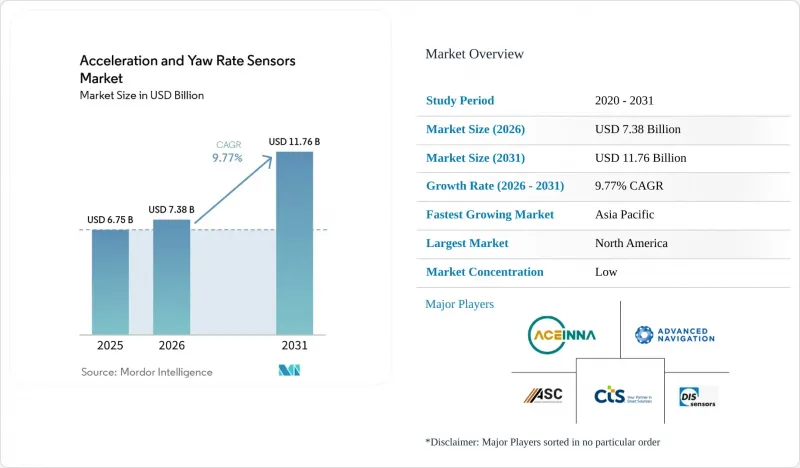
本報告按感測器類型(微型機械感測器、壓電感測器等)、銷售管道(原廠正品、售後替換零件)、最終用途(汽車[乘用車、輕型商用車、重型商用車、非公路用車]、航太和國防等)以及地區進行細分。市場預測以價值(美元)表示。
全球加速感應器和偏航率感測器市場趨勢及洞察
電子穩定控制系統(ESC)和高階駕駛輔助系統(ADAS)的廣泛應用
電子穩定控制系統 (ESC) 仍然是橫擺角速度感測器的主要應用領域,並且由於其在所有車輛類型中廣泛應用,因此也持續成為加速感應器和橫擺角速度感測器市場需求的可靠下限。美國安全法規強制要求輕型車輛配備 ESC,相關要求正在擴展到更大型的車輛。這使得橫擺角速度感測成為車輛控制的核心功能,而非可選配置。 FMVSS 127 強制要求輕型車輛安裝自動緊急煞車系統 (AEB),最終合規期限為 2029 年 9 月。這意味著支援更快煞車決策的感測器需要多年的採購週期。這一點至關重要,因為 AEB 校準需要比傳統 ESC 配置更高的橫擺角速度和橫向加速度訊號精確度。因此,原始設備製造商 (OEM) 正在轉向高性能感測器,而不是簡單地添加低成本的感測器。這種規格的轉變正在提高感測器的附加價值,即使在感測器搭載率已經很高的成熟車輛類別中也是如此。
電動和混合動力汽車在乘坐舒適性和車身控制方面使用的感測器數量增加
電動和混合動力汽車平台正在為加速感應器和橫擺角速度感測器市場創造新的需求,因為乘坐舒適性、車身控制和扭力控制功能都依賴於高速慣性回饋。這些車輛通常需要扭矩向量控制和懸吊行為之間的即時協調,這要求量產系統中慣性測量單元 (IMU) 的更新頻率達到 100Hz 或更高。 2026 年 1 月發表在《執行器》(Actuators) 雜誌上的一項研究表明,即使在感測器性能的實際極限下,採用車身安裝式 IMU、車輪加速感應器和車輪速度感測器的道路預測半主動懸吊策略也能保持卓越的乘坐舒適性和操控性能。這一結果支持了 OEM 廠商在電動車懸吊 ECU 中添加多軸慣性感測器,而不是為了降低成本而減少感測器節點的趨勢。Panasonic工業株式會社的「EWTS5G」六合一裝置也展示了供應商如何將三軸加速器和三軸陀螺儀整合到緊湊的MEMS封裝中,最高支援ASIL D等級。隨著電動車封裝限制日益嚴格,能夠在更小的空間內提供更多感測功能的供應商將能夠更清晰地確保其邁向下一代平台的道路。
長期汽車認證和ASIL檢驗週期
在汽車加速感應器和偏航率感測器市場,產品必須通過可靠性認證和功能安全審查,才能被原始設備製造商 (OEM) 納入其平台專案。這個過程通常需要 18 到 36 個月,並且需要提供感測器積體電路中每項安全機制的證據。在 ASIL D 級別,要求更加嚴格,供應商必須證明其產品在 -40 度C至 125 度C的整個動作溫度範圍內,故障檢測覆蓋率超過 99%。博世半導體將 SMI980 定位為 ASIL D 等級的汽車應用產品,而 TDK InvenSense 則將 IAM-20685HP 定位為符合 ISO 26262:2018 ASIL B 要求的產品。這兩個例子都說明了在設計被採用之前,預商業化開發需要投入大量精力。小規模的專業供應商如果依賴外部代工廠,則還面臨與客戶設計凍結期限和漫長的檢驗週期協調的額外挑戰。這種時間上的不匹配會減緩新型感測架構從技術成熟到實際銷售的轉換速度。
細分市場分析
到2025年,微機械感測器將佔據加速感應器和偏航率感測器市場63.56%的佔有率,這表明MEMS在汽車安全和控制應用領域的出貨量方面將繼續保持領先地位。這一地位得益於多年來晶圓級製程的改進、批量生產規模的擴大以及與ESC、安全氣囊和ADAS控制單元的深度整合。博世半導體、意法半導體和TDK InvenSense的產品線體現了這一發展歷程,涵蓋了從ASIL B到ASIL D等級的汽車級MEMS產品,以及從低G舒適性檢測到高G碰撞檢測的加速計。電容式感測器仍然佔據著重要的地位,尤其是在慣性導航和結構測試等領域,這些領域對高解析度和低雜訊要求極高。其他架構,包括諧振MEMS和熱電堆架構,則在加速感應器和偏航率感測器產業中一些較為有限的工業測量應用中得到應用。
壓電感測器是加速感應器和偏航率感測器市場中成長最快的類型,預計從2026年到2031年將以10.13%的複合年成長率成長。其主要優勢在於卓越的高頻振動性能,而電容式MEMS設計的有效性在許多標準頻寬範圍的上限之後就會下降。 Kistler公司於2025年7月推出的「KiVibe Miniature」產品,透過將PiezoStar晶體技術與客製化ASIC電子裝置結合,展示了將三軸IEPE感測功能整合到0.9克、6x6毫米封裝中的能力。該產品非常適合對品質和訊號品質要求極高的應用,例如衛星結構測試、PCB振動分析和輕型航太平台。在加速感應器和偏航率感測器市場領域,由於採購要求,ISO 16063系列標準正受到越來越多的關注,以滿足先進測試環境中對專用壓電解決方案的需求。
區域分析
預計到2025年,北美將佔據加速感應器和偏航率感測器市場40.45%的佔有率。這主要得益於嚴格的聯邦安全標準以及強調戰術級慣性性能的國防採購系統。在美國,高階產品繼續主導該地區市場,這主要受電子穩定控制系統(ESC)要求、未來自動緊急煞車(AEB)準備工作以及需要高動態範圍感測的國防項目等因素的驅動。 2026年3月,VectorNav在其戰術系列產品中新增了90G和250G量程的加速計計以及4000°/秒的陀螺儀功能,以滿足高G任務的需求,從而鞏固了其市場地位。此外,加拿大進行的自動駕駛汽車測試以及墨西哥在汽車製造業的地位也進一步推動了全部區域加速感應器和偏航率感測器市場的發展。
亞太地區是加速感應器和橫擺角速度感測器市場成長最快的地區,預計2026年至2031年的複合年成長率將達到10.41%。中國電動車產量的擴張以及智慧汽車型式認證的推進,迫使汽車製造商(OEM)為其智慧網聯汽車(ICV)專案採購在地採購和進口的慣性感測器解決方案。 MEMSIC Semiconductor面向電子穩定控制系統(ESC)、電子停車煞車和主動懸吊的產品系列,體現了隨著汽車產量的成長,國內供應能力的增強。日本仍然是精密製造領域的關鍵參與者,Panasonic的EWTS5G產品反映了當地供應商如何在滿足汽車安全要求的同時,兼顧緊湊整合。隨著一級汽車製造商的生產、摩托車和商用車產量的增加以及電子元件的在地化,韓國、印度和東南亞國協的需求正在逐步成長。
歐洲在加速感應器和橫擺角速度感測器市場中繼續佔據著舉足輕重的地位。這主要歸功於德國汽車製造商不斷增加每輛車的感測器數量,以滿足不斷發展的ADAS(高級駕駛輔助系統)評估要求。英國、法國、義大利和西班牙也透過產品安全標準的統一、電動車的普及以及工業領域物流機器人的日益普及,推動了市場需求。南美洲市場雖然規模較小,但巴西汽車製造業和阿根廷農業機械產業對慣性感測器的強勁需求為其提供了支撐。非洲和中東是最早進入該市場的地區,其初期需求主要集中在與波灣合作理事會(GCC)在智慧運輸和基礎設施方面的投資相關的自主檢測和物流機器人。 IEC 60812和ISO 26262等合規架構正日益被納入歐洲和海灣合作理事會市場的採購條件,提高了所有供應商的最低品質標準。
其他好處:
- Excel格式的市場預測(ME)表
- 3個月的分析師支持
目錄
第1章:引言
- 研究假設和市場定義
- 調查範圍
第2章:調查方法
第3章執行摘要
第4章 市場狀況
- 市場概覽
- 市場促進因素
- 電子穩定控制系統(ESC)和高階駕駛輔助系統(ADAS)的普及率不斷提高
- 為了提高乘坐舒適性和車輛控制性能,電動和混合動力汽車中安裝了更多感測器。
- 2026年將實施更嚴格的安全評估規程和功能安全要求
- 工業機器人和自主移動平台中慣性感測技術的應用
- 軟體定義車輛底盤架構中運動感測功能的擴展
- 在GNSS不可用的環境中,IMU輔助車輛定位技術得到了廣泛應用。
- 市場限制因素
- 延長汽車認證和ASIL檢驗週期
- 由於大規模生產平台中感測器的商品化,價格面臨壓力。
- 汽車用MEMS和ASIC晶片供應產能瓶頸
- 安全關鍵型整合中的校準、網路安全和冗餘帶來的負擔。
- 產業價值鏈分析
- 監理情勢
- 技術展望
- 波特五力分析
- 市場宏觀經濟趨勢的評估
第5章 市場規模與成長預測
- 依感測器類型
- 微機械感測器
- 壓電感測器
- 電容式感測器
- 其他感測器類型
- 按銷售管道
- OEM設備
- 售後替換零件
- 按最終用途
- 車
- 搭乘用車
- 輕型商用車
- 大型商用車輛
- 非公路用車輛
- 航太/國防
- 工業和機器人領域
- 家用電子產品
- 其他最終用途
- 車
- 按地區
- 北美洲
- 美國
- 加拿大
- 墨西哥
- 南美洲
- 巴西
- 阿根廷
- 其他南美國家
- 歐洲
- 德國
- 英國
- 法國
- 義大利
- 西班牙
- 其他歐洲國家
- 亞太地區
- 中國
- 日本
- 印度
- 韓國
- ASEAN
- 其他亞太國家
- 中東和非洲
- 中東
- 沙烏地阿拉伯
- 阿拉伯聯合大公國
- 土耳其
- 其他中東國家
- 非洲
- 南非
- 奈及利亞
- 其他非洲國家
- 中東
- 北美洲
第6章 競爭情勢
- 市場集中度
- 策略趨勢
- 市佔率分析
- 公司簡介
- ACEINNA Inc.
- Advanced Navigation Pty Ltd.
- ASC GmbH
- CTS Corporation
- DIS Sensors BV
- Diversified Technical Systems, Inc.
- Exail SAS
- Gladiator Technologies, Inc.
- InnaLabs Ltd
- Jewell Instruments LLC
- Kistler Instrumente AG
- MEMSIC Semiconductor Co., Ltd.
- OxTS Limited
- Safran Colibrys SA
- Safran Sensing Technologies Norway AS
- SBG Systems SAS
- Silicon Sensing Systems Limited
- Tronics Microsystems SA
- VectorNav Technologies, LLC
- Xsens Technologies BV
第7章 市場機會與未來展望
According to Mordor Intelligence, the acceleration and yaw rate sensors market size is expected to grow from USD 6.75 billion in 2025 to USD 7.38 billion in 2026 and is forecast to reach USD 11.76 billion by 2031 at 9.77% CAGR over 2026-2031.
This report is Segmented by Sensor Type (Micromechanical Sensors, Piezoelectric Sensors, and More), Sales Channel (OEM Fitment, and Aftermarket Replacement), End-Use Application (Automotive [Passenger Cars, Light Commercial Vehicles, Heavy Commercial Vehicles, and Off-Highway Vehicles], Aerospace and Defense, and More), and Geography. The Market Forecasts are Provided in Terms of Value (USD).
Global Acceleration And Yaw Rate Sensors Market Trends and Insights
Rising Penetration of Electronic Stability Control and ADAS
Electronic stability control remains the base application for yaw rate sensors, and its wide fitment across vehicle classes still acts as a dependable volume floor for the acceleration and yaw rate sensors market. U.S. safety rules require ESC across light vehicles and extend related requirements to heavy vehicles, which keeps yaw sensing tied to core vehicle control functions rather than optional features. FMVSS No. 127 added mandatory AEB for light vehicles with a final compliance deadline in September 2029, which creates a multi-year sourcing cycle for sensors that support faster braking decisions. That matters because AEB calibration needs yaw rate and lateral acceleration signals with tighter fidelity than older ESC-only layouts. OEMs, therefore, move toward better-performing sensors instead of simply adding more low-cost units. This specification shift raises content value even in mature vehicle categories where unit penetration is already high.
Higher Sensor Content in Electric and Hybrid Vehicle Ride and Body Control
Electric and hybrid platforms add a second demand layer for the acceleration and yaw rate sensors market because ride, body, and torque control functions depend on fast inertial feedback. These vehicles often coordinate torque vectoring and suspension behavior in real time, and that raises the need for IMU update rates of 100Hz or more in production systems. A January 2026 study in Actuators showed that a road-preview semi-active suspension strategy using a body-mounted IMU, wheel acceleration sensors, and wheel-speed sensors maintained strong ride and handling performance under practical sensor limits. That result supports a wider pattern in which OEMs add multi-axis inertial sensing inside EV suspension ECUs instead of removing sensor nodes for cost control. Panasonic Industry's EWTS5G 6-in-1 device also shows how suppliers are combining 3-axis accelerometers and 3-axis gyroscopes in a compact MEMS package with support up to ASIL D. As EV packaging constraints tighten, suppliers that deliver more sensing functions in smaller footprints gain a clearer path into next-generation platforms.
Lengthy Automotive Qualification and ASIL Validation Cycles
Automotive-grade devices in the acceleration and yaw rate sensors market must pass both reliability qualification and functional safety review before OEMs accept them into a platform program. This process often runs for 18 to 36 months and requires evidence for each safety mechanism inside the sensor integrated circuit. The burden grows further at ASIL D, where suppliers must show fault detection coverage above 99% across operating temperatures from -40 °C to 125 °C. Bosch Semiconductors positions its SMI980 for ASIL D automotive applications, while TDK InvenSense positions the IAM-20685HP to ISO 26262:2018 ASIL B requirements, and both examples show how much pre-revenue development effort is needed before design-in can begin. Smaller specialist vendors face an added hurdle when they depend on outside foundries and must match customer design-freeze dates with long validation cycles. That timing mismatch slows the pace at which newer sensing architectures can convert technical readiness into booked revenue.
Other drivers and restraints analyzed in the detailed report include:
- Adoption of Inertial Sensing in Industrial Robotics and Autonomous Mobile Platforms
- Tighter 2026 Safety Assessment Protocols and Functional Safety Requirements
- Price Pressure from Sensor Commoditization in High-Volume Platforms
For complete list of drivers and restraints, kindly check the Table Of Contents.
Segment Analysis
Micromechanical sensors held 63.56% of the acceleration and yaw rate sensors market size in 2025, which keeps MEMS as the clear volume leader across automotive safety and control applications. That position rests on long-running wafer-level process gains, batch manufacturing scale, and deep integration into ESC, airbag, and ADAS control units. The product breadth of Bosch Semiconductors, STMicroelectronics, and TDK InvenSense reflects that installed base, with automotive-grade MEMS lines spanning ASIL B to ASIL D and accelerometer ranges from low-g comfort sensing to high-g crash detection. Capacitive sensors continue to hold a useful position where high resolution and low noise matter more than scale, especially in inertial navigation and structural testing tasks. Other architectures, including resonant MEMS and thermopile-based formats, serve narrower industrial measurement roles inside the acceleration and yaw rate sensors industry.
Piezoelectric sensors are the fastest-growing type in the acceleration and yaw rate sensors market, with a projected 10.13% CAGR from 2026 to 2031. Their main advantage is strong high-frequency vibration performance, an area where capacitive MEMS designs become less effective above the upper end of many standard bandwidth ranges. Kistler's KiVibe Miniature launch in July 2025 showed how PiezoStar crystal technology and custom ASIC electronics can fit triaxial IEPE sensing into a 6 X 6 mm package that weighs 0.9 g. That product direction fits satellite structural testing, PCB vibration analysis, and lightweight aerospace platforms where both mass and signal quality matter. The ISO 16063 family is increasingly visible in procurement language for this part of the acceleration and yaw rate sensors market, which supports demand for specialized piezoelectric solutions in advanced test environments.
Geography Analysis
North America held 40.45% of the acceleration and yaw rate sensors market share in 2025, supported by dense federal safety mandates and a defense procurement base that values tactical-grade inertial performance. The United States combines ESC requirements, future AEB compliance work, and defense programs that demand high dynamic range sensing, which keeps the regional mix weighted toward premium specifications. VectorNav reinforced that positioning in March 2026 by introducing 90G and 250G accelerometer ranges and 4000°/sec gyroscope capability across its Tactical Series for high-G mission profiles. Canada's autonomous vehicle testing activity and Mexico's role in automotive manufacturing add further support to the acceleration and yaw rate sensors market across the region.
Asia-Pacific is the fastest-growing region in the acceleration and yaw rate sensors market, with a 10.41% CAGR from 2026 to 2031. China's scale in EV production and its smart-vehicle homologation direction are pushing OEMs to source both local and imported inertial sensing solutions for intelligent connected vehicle programs. MEMSIC Semiconductor's portfolio for ESC, electronic parking brake, and active suspension shows that domestic supply depth is rising alongside vehicle production volume. Japan remains important for precision manufacturing, and Panasonic Industry's EWTS5G reflects how local suppliers pair compact integration with automotive safety requirements. South Korea, India, and ASEAN are adding incremental demand through tier-1 automotive manufacturing, two-wheeler expansion, commercial vehicle production, and electronics localization.
Europe remains structurally significant in the acceleration and yaw rate sensors market because Germany's OEM base continues to raise per-vehicle sensing content in response to evolving ADAS evaluation requirements. The United Kingdom, France, Italy, and Spain also support demand through product safety alignment, EV adoption, and rising logistics robot deployment across industrial settings. South America is smaller, but Brazil's automotive production and Argentina's agricultural machinery base still create a credible demand floor for inertial sensing adoption. The Middle East and Africa are the earliest-stage regional tier, and initial demand is centered on autonomous inspection and logistics robots tied to Gulf Cooperation Council investment in smart mobility and infrastructure. Compliance frameworks such as IEC 60812 and ISO 26262 are increasingly written into procurement language across Europe and GCC markets, which raises the minimum quality bar for all suppliers.
- ACEINNA Inc.
- Advanced Navigation Pty Ltd.
- ASC GmbH
- CTS Corporation
- DIS Sensors B.V.
- Diversified Technical Systems, Inc.
- Exail SAS
- Gladiator Technologies, Inc.
- InnaLabs Ltd
- Jewell Instruments LLC
- Kistler Instrumente AG
- MEMSIC Semiconductor Co., Ltd.
- OxTS Limited
- Safran Colibrys SA
- Safran Sensing Technologies Norway AS
- SBG Systems S.A.S.
- Silicon Sensing Systems Limited
- Tronics Microsystems SA
- VectorNav Technologies, LLC
- Xsens Technologies B.V.
Additional Benefits:
- The market estimate (ME) sheet in Excel format
- 3 months of analyst support
TABLE OF CONTENTS
1 INTRODUCTION
- 1.1 Study Assumptions and Market Definition
- 1.2 Scope of the Study
2 RESEARCH METHODOLOGY
3 EXECUTIVE SUMMARY
4 MARKET LANDSCAPE
- 4.1 Market Overview
- 4.2 Market Drivers
- 4.2.1 Rising Penetration of Electronic Stability Control and ADAS
- 4.2.2 Higher Sensor Content in Electric and Hybrid Vehicle Ride and Body Control
- 4.2.3 Tighter 2026 Safety Assessment Protocols and Functional Safety Requirements
- 4.2.4 Adoption of Inertial Sensing in Industrial Robotics and Autonomous Mobile Platforms
- 4.2.5 Growing Motion Sensing Content in Software-Defined Vehicle Chassis Architectures
- 4.2.6 Expansion of Combined IMU Use in GNSS-Denied Vehicle Localization
- 4.3 Market Restraints
- 4.3.1 Lengthy Automotive Qualification and ASIL Validation Cycles
- 4.3.2 Price Pressure From Sensor Commoditization in High-Volume Platforms
- 4.3.3 MEMS and ASIC Capacity Bottlenecks for Automotive-Grade Supply
- 4.3.4 Calibration, Cybersecurity, and Redundancy Burdens in Safety-Critical Integration
- 4.4 Industry Value Chain Analysis
- 4.5 Regulatory Landscape
- 4.6 Technological Outlook
- 4.7 Porter's Five Forces Analysis
- 4.7.1 Bargaining Power of Suppliers
- 4.7.2 Bargaining Power of Buyers
- 4.7.3 Threat of New Entrants
- 4.7.4 Threat of Substitutes
- 4.7.5 Intensity of Competitive Rivalry
- 4.8 Assessment of Macroeconomic Trends on the Market
5 MARKET SIZE AND GROWTH FORECASTS (VALUE)
- 5.1 By Sensor Type
- 5.1.1 Micromechanical Sensors
- 5.1.2 Piezoelectric Sensors
- 5.1.3 Capacitive Sensors
- 5.1.4 Other Sensor Types
- 5.2 By Sales Channel
- 5.2.1 OEM Fitment
- 5.2.2 Aftermarket Replacement
- 5.3 By End-Use Application
- 5.3.1 Automotive
- 5.3.1.1 Passenger Cars
- 5.3.1.2 Light Commercial Vehicles
- 5.3.1.3 Heavy Commercial Vehicles
- 5.3.1.4 Off-Highway Vehicles
- 5.3.2 Aerospace and Defense
- 5.3.3 Industrial and Robotics
- 5.3.4 Consumer Electronics
- 5.3.5 Other End-Use Applications
- 5.3.1 Automotive
- 5.4 By Geography
- 5.4.1 North America
- 5.4.1.1 United States
- 5.4.1.2 Canada
- 5.4.1.3 Mexico
- 5.4.2 South America
- 5.4.2.1 Brazil
- 5.4.2.2 Argentina
- 5.4.2.3 Rest of South America
- 5.4.3 Europe
- 5.4.3.1 Germany
- 5.4.3.2 United Kingdom
- 5.4.3.3 France
- 5.4.3.4 Italy
- 5.4.3.5 Spain
- 5.4.3.6 Rest of Europe
- 5.4.4 Asia-Pacific
- 5.4.4.1 China
- 5.4.4.2 Japan
- 5.4.4.3 India
- 5.4.4.4 South Korea
- 5.4.4.5 ASEAN
- 5.4.4.6 Rest of Asia-Pacific
- 5.4.5 Middle East and Africa
- 5.4.5.1 Middle East
- 5.4.5.1.1 Saudi Arabia
- 5.4.5.1.2 United Arab Emirates
- 5.4.5.1.3 Turkey
- 5.4.5.1.4 Rest of the Middle East
- 5.4.5.2 Africa
- 5.4.5.2.1 South Africa
- 5.4.5.2.2 Nigeria
- 5.4.5.2.3 Rest of Africa
- 5.4.5.1 Middle East
- 5.4.1 North America
6 COMPETITIVE LANDSCAPE
- 6.1 Market Concentration
- 6.2 Strategic Moves
- 6.3 Market Share Analysis
- 6.4 Company Profiles (includes Global level Overview, Market level overview, Core Segments, Financials as available, Strategic Information, Market Rank/Share for key companies, Products and Services, and Recent Developments)
- 6.4.1 ACEINNA Inc.
- 6.4.2 Advanced Navigation Pty Ltd.
- 6.4.3 ASC GmbH
- 6.4.4 CTS Corporation
- 6.4.5 DIS Sensors B.V.
- 6.4.6 Diversified Technical Systems, Inc.
- 6.4.7 Exail SAS
- 6.4.8 Gladiator Technologies, Inc.
- 6.4.9 InnaLabs Ltd
- 6.4.10 Jewell Instruments LLC
- 6.4.11 Kistler Instrumente AG
- 6.4.12 MEMSIC Semiconductor Co., Ltd.
- 6.4.13 OxTS Limited
- 6.4.14 Safran Colibrys SA
- 6.4.15 Safran Sensing Technologies Norway AS
- 6.4.16 SBG Systems S.A.S.
- 6.4.17 Silicon Sensing Systems Limited
- 6.4.18 Tronics Microsystems SA
- 6.4.19 VectorNav Technologies, LLC
- 6.4.20 Xsens Technologies B.V.
7 MARKET OPPORTUNITIES AND FUTURE OUTLOOK
- 7.1 White-space and Unmet-Need Assessment

 2026-2030年全球加速計市場
 高階加速計:市場佔有率分析、產業趨勢和統計數據以及成長預測(2026-2031 年)加速計:市場佔有率分析、產業趨勢與統計資料、成長預測(2026-2031)
 加速計市場:2026-2032年全球市場預測(依感測器技術、軸心、測量範圍、產出類型、最終用途產業及通路分類)
 2026年全球加速計和偏航速度感測器市場報告
 全球加速計市場規模、佔有率、趨勢和成長分析報告(2026-2034年)
 高階加速計市場報告:按類型、軸類型、應用和地區分類(2026-2034 年)加速計市場規模、佔有率、成長及全球產業分析:按類型、應用和地區分類的洞察,2026-2034 年預測2026年全球加速計市場報告石英伺服加速計市場:按產品類型、應用、終端用戶產業和銷售管道- 全球預測(2026-2032 年)