


 |
市場調查報告書
商品編碼
2121806
加速計:市場佔有率分析、產業趨勢與統計資料、成長預測(2026-2031)Accelerometer - Market Share Analysis, Industry Trends & Statistics, Growth Forecasts (2026 - 2031) |
||||||

※ 本網頁內容可能與最新版本有所差異。詳細情況請與我們聯繫。
根據 Mordor Intelligence 預測,加速計市場規模將從 2025 年的 35.4 億美元成長到 2026 年的 37.7 億美元,然後在 2031 年達到 51.4 億美元,2026 年至 2031 年的複合年成長率為 6.41%。
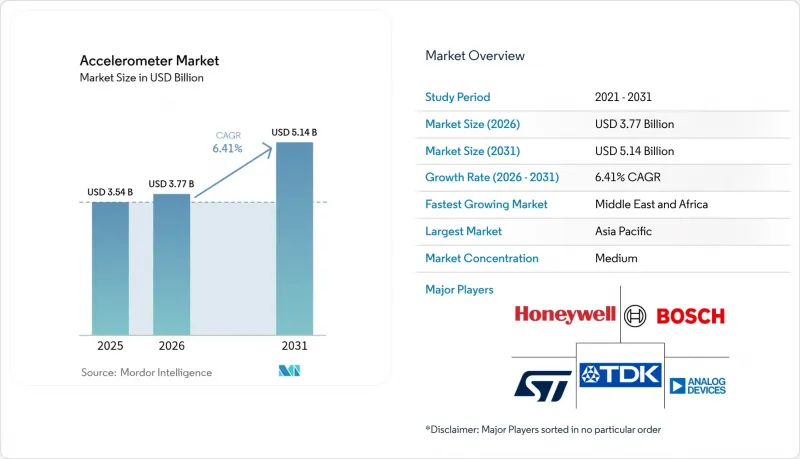
本報告按類型(MEMS加速計、壓電加速計等)、軸數(單軸、雙軸等)、最終用戶(消費性電子、汽車等)、性能等級(消費級、工業級等)和地區(北美、南美等)進行分類。市場預測以美元(USD)計價。
全球加速計市場趨勢及洞察
MEMS的微型化和成本降低
第三代MEMS製程能夠製造亞毫米級質量塊結構,在不犧牲雜訊密度的前提下,縮小晶片尺寸和功耗。博斯的2024系列小型加速計就是一個絕佳的例子,它展示了晶圓級晶片封裝(WLCSP)如何在保持±2 g至±16 g動態範圍的同時降低材料成本。大規模的300毫米MEMS晶圓廠將帶來更大的規模經濟效益,使OEM廠商能夠在更嚴格的材料清單清單(BOM)預算控制下,將預算分配給其他感測功能。意法半導體的LIS2DUXS12整合了一個機器學習核心,能夠實現微瓦級的事件分類,無需配套的MCU即可縮小基板尺寸。隨著代工廠轉向更大的晶圓,平均售價將會下降,從而刺激對成本敏感的物聯網節點的潛在需求,並進一步鞏固加速計市場的成長動能。
消費性電子產品和穿戴式裝置的蓬勃發展
儘管智慧型手機、耳機和健身追蹤器仍是銷售的主要驅動力,但2025年的設計藍圖顯示,市場正加速向醫療級穿戴裝置轉型,這類設備要求噪音低於30 μg/√Hz,並能實現數天的持續續航。 Analog Devices的ADXL380專為真無線耳機設計,採用雙訊號通路,只需一個感測器即可支援主動降噪回饋和頭部手勢姿態辨識。在醫療設備領域,感測器內建的AI推理功能減輕了雲端處理的負擔,使得符合IEC 60601-1標準並獲得醫院認證的跌倒偵測穿戴裝置成為可能。高價值的臨床應用正在緩解利潤壓力,並將加速計市場拓展到監管嚴格的醫療管道,在這些管道中,品質比最低價格更為重要。
價格壓力與商品化
在智慧型手機領域,預計2022年至2024年間,慣性感測組件的物料清單(BOM)佔比將縮減近30%,迫使供應商透過嵌入式機器學習核心和低功耗休眠模式等技術實現差異化。 Kionix的KX224系列售價低於每百萬個0.30美元,凸顯了老舊組件平均售價的下降。儘管供應商正在投資自動化校準以提高利潤率,但由於工廠縮減營運導致資本支出增加,抵消了部分利潤。這種不平衡使得許多競爭對手難以達到損益平衡點,限制了加速計市場的短期銷售成長。
細分市場分析
微機電系統(MEMS)裝置憑藉其無與倫比的成本績效,預計到2025年將佔據加速計市場71.35%的佔有率。採用200毫米晶圓進行大規模生產以及晶圓層次電子構裝技術,已使MEMS成為智慧型手機、穿戴式裝置和汽車電子控制單元(ECU)的核心組件。壓電市場規模雖小,但由於國防和航太公司對偏壓穩定性小於1微克以及抗輻射性能的需求,其年成長率仍高達7.42%。壓阻式和電容式加速度計則應用於一些對抗衝擊性和超低功耗要求高於絕對精度的特定工業領域。
MEMS的優勢在於其整合性。意法半導體(STMicroelectronics)的感測器中心架構將數位機器學習核心和FIFO緩衝器直接整合到晶片上,從而減少了外部元件的數量。然而,當加速度範圍、極端溫度或偏壓穩定性超出MEMS的極限時,設計人員就會轉而採用壓電堆疊結構。
在全六自由度測量趨勢的推動下,預計到2025年,三軸加速器的銷售量將佔總銷售量的63.90%。原始設備製造商(OEM)傾向於整合XYZ測量功能,以支援手勢姿態辨識和振動診斷,同時最大限度地減少感測器融合的開銷。同時,在無人機、AR/ VR頭戴裝置和機器人等應用的推動下,整合六軸或九軸功能的組合式慣性測量單元(IMU)的銷量正呈現8.05%的成長態勢,其同步的陀螺儀和加速計資料簡化了演算法調優。單軸設備仍應用於傾斜開關和汽車安全氣囊執行器等應用中,但其市場佔有率正在穩步下降。
柯林斯太空公司的SiIMU02是一款高階多軸整合產品,其在手掌大小的MEMS組件中實現了與光纖陀螺儀相媲美的精度。對於中端消費產品,供應商正將加速計、陀螺儀,有時甚至磁力計整合到可程式設計位濾波器的單一ASIC晶片上。這種整合減少了PCB面積和元件成本,即使應用複雜性不斷增加,也能維持加速計市場的成長動能。
區域分析
預計到2025年,亞太地區將佔全球銷售額的46.10%,主要得益於中國消費電子出口中心和密集的8吋MEMS晶圓代工廠網路。總部位於深圳的MEMSIC專注於為國內智慧型手機OEM廠商提供電容式加速計,實現了三位數的成長。日本和韓國為汽車和工業領域提供高可靠性產品,而台灣的專業晶圓代工廠則支援契約製造。儘管晶圓產能限制和人事費用上升正在減緩成長速度,但該地區的加速計市場預計將以6.08%的複合年成長率穩定成長。
預計到2031年,中東和非洲地區的複合年成長率將達到8.33%,位居全球之首。這主要得益於沙烏地阿拉伯「2030願景」下的獎勵策略,這些措施為當地半導體舉措提供資金,並擴大需要渦輪機振動監測的可再生能源資產。埃及和摩洛哥的風電場正在採用三軸加速器,以滿足ISO 10816預測性維護標準。與歐洲感測器製造商建立的區域官民合作關係正在促進技術轉讓,加速本地生產,並推動當地加速計市場的成長。
北美穩居第二,這主要得益於汽車業ADAS(高級駕駛輔助系統)法規的推出以及先進工業IoT)技術的強勁應用基礎。石油天然氣、化學和金屬產業對工業4.0維護策略的採用,推動了對耐環境腐蝕、經危險區域認證的加速計的需求。歐洲略微落後,但由於原始設備製造商(OEM)優先考慮品質和功能安全,其平均售價更高。歐盟「地平線歐洲」機器人計畫的資助進一步加速了高精度感測器的應用,並鞏固了該地區在加速計市場的地位。
其他好處:
- Excel格式的市場預測(ME)表
- 3個月的分析師支持
目錄
第1章:引言
- 研究假設和市場定義
- 調查範圍
第2章:調查方法
第3章執行摘要
第4章 市場狀況
- 市場概覽
- 市場促進因素
- MEMS的微型化和成本降低
- 消費性電子產品和穿戴式裝置的蓬勃發展
- 汽車ADAS/安全功能的整合
- 工業4.0中狀態監測技術的實施現狀
- 精密農業無人機的引進
- 轉向可再生能源/對振動的需求
- 市場限制因素
- 價格壓力與商品化
- 精度局限性和壓電高g感測器
- 8吋MEMS代工廠產能瓶頸
- 韌體/安全漏洞
- 價值供應鏈分析
- 監理情勢
- 技術展望
- 波特五力分析
第5章 市場規模與成長預測
- 按類型
- MEMS加速計
- 壓電加速計
- 壓阻式加速計
- 電容式加速計
- 熱能和其他類型
- 按軸數
- 1軸
- 2軸
- 3軸
- 6軸或更多軸(組合式IMU)
- 最終用戶
- 消費性電子產品
- 車
- 航太/國防
- 工業和製造業
- 醫療保健和醫療設備
- 其他最終用戶
- 表現等級
- 消費級
- 工業級
- 戰術級
- 導航等級
- 航太級
- 按地區
- 北美洲
- 美國
- 加拿大
- 墨西哥
- 南美洲
- 巴西
- 阿根廷
- 其他南美國家
- 歐洲
- 德國
- 英國
- 法國
- 義大利
- 西班牙
- 俄羅斯
- 其他歐洲國家
- 亞太地區
- 中國
- 日本
- 印度
- 韓國
- 台灣
- 東南亞
- 其他亞太國家
- 中東和非洲
- 中東
- 沙烏地阿拉伯
- 阿拉伯聯合大公國
- 土耳其
- 其他中東國家
- 非洲
- 南非
- 奈及利亞
- 其他非洲國家
- 中東
- 北美洲
第6章 競爭情勢
- 市場集中度
- 策略趨勢
- 市佔率分析
- 公司簡介
- Analog Devices Inc.
- Robert Bosch GmbH
- STMicroelectronics
- TDK InvenSense
- Honeywell International Inc.
- Murata Manufacturing Co., Ltd.(Kionix)
- NXP Semiconductors NV
- MEMSIC Inc.
- TE Connectivity(Measurement Specialties)
- Silicon Sensing Systems Ltd.
- Sensonor AS
- PCB Piezotronics(MTS Systems)
- Northrop Grumman LITEF GmbH
- Rockwell Automation Inc.
- Kearfott Corporation
- Meggitt PLC(Endevco)
- Dytran Instruments Inc.
- Al Cielo Inertial Solutions Ltd.
- Atlantic Inertial Systems Ltd.
- LORD MicroStrain(HBK)
- QST Corporation
第7章 市場機會與未來展望
According to Mordor Intelligence, the accelerometer market size is expected to grow from USD 3.54 billion in 2025 to USD 3.77 billion in 2026 and is forecast to reach USD 5.14 billion by 2031 at 6.41% CAGR over 2026-2031.
This report is Segmented by Type (MEMS Accelerometers, Piezoelectric Accelerometers, and More), Dimension (1-Axis, 2-Axis, and More), End User (Consumer Electronics, Automotive, and More), Performance Grade (Consumer Grade, Industrial Grade, and More), and Geography (North America, South America, and More). The Market Forecasts are Provided in Terms of Value (USD).
Global Accelerometer Market Trends and Insights
MEMS Miniaturization and Cost Reduction
Third-generation MEMS processes now fabricate sub-millimeter proof-mass structures that cut die size and power draw without degrading noise density. Bosch's miniature 2024 accelerometer series exemplifies how wafer-level chip-scale packaging lowers material cost while sustaining +-2 g to +-16 g dynamic range. Larger 300 mm MEMS fabs promise further scale economies, allowing OEMs to allocate tighter bill-of-materials budgets to additional sensing functions. STMicroelectronics' LIS2DUXS12 integrates a machine-learning core enabling event classification at microwatt levels, removing the need for a companion MCU and shrinking board footprint. As foundries migrate to larger wafers, average selling prices decline and unlock latent demand in cost-sensitive IoT nodes, reinforcing the growth loop for the accelerometer market.
Consumer Electronics and Wearables Boom
Smartphones, earbuds and fitness trackers remain volume engines, but 2025 design roadmaps reveal an accelerating pivot toward medical-grade wearables that require sub-30 μg/√Hz noise floors and continuous operation for multi-day battery life. Analog Devices' ADXL380 targets true-wireless earbuds with dual signal paths so a single sensor supports both active-noise-cancellation feedback and head-gesture recognition. In medical devices, AI-inference embedded in the sensor offloads cloud processing, enabling fall-detection wearables certified under IEC 60601-1 for hospital use. Higher-value clinical applications ease margin pressure and expand the accelerometer market into regulated healthcare channels that favor quality over lowest price.
Price Pressure and Commoditization
In smartphones the bill-of-materials allotment for inertial sensing shrank by nearly 30% between 2022 and 2024, pushing suppliers to differentiate with embedded ML cores and lower power-suspend modes. Kionix's KX224 series sells below USD 0.30 at million-piece volumes, underscoring deteriorating average selling prices for legacy parts. Vendors invest in automated calibration to recoup margin; however, factory-trim routines raise capex and erode benefit. The imbalance confines many competitors to break-even PandL positions, tempering near-term revenue expansion for the accelerometer market.
Other drivers and restraints analyzed in the detailed report include:
- Automotive ADAS / Safety Integration
- Industry-4.0 Condition Monitoring Uptake
- Accuracy Limits vs. Piezoelectric High-G
For complete list of drivers and restraints, kindly check the Table Of Contents.
Segment Analysis
MEMS devices captured 71.35% accelerometer market share in 2025 owing to unmatched cost-performance balance. Volume manufacturing on 200 mm wafers combined with wafer-level packaging positions MEMS at the heart of smartphones, wearables and automotive ECUs. Piezoelectric units, while representing a smaller base, advance at 7.42% annually as defense and aerospace operators demand sub-1 µg bias stability and radiation tolerance. Piezoresistive and capacitive variants serve niche industrial uses where shock survivability or ultra-low power trumps absolute precision.
MEMS leadership rests on integration advantages. STMicroelectronics' sensor-hub architecture merges a digital machine-learning core and FIFO buffers directly on the die, trimming external component count. Still, when g-range, temperature extremes or bias stability exceed MEMS limits, designers revert to piezoelectric stacks.
The trend toward full-six-degree-of-freedom measurement places 3-axis accelerometers at 63.90% revenue share in 2025. OEMs prefer unified X-Y-Z readings to support gesture recognition and vibration diagnostics with minimal sensor fusion overhead. Meanwhile, combo IMUs embedding 6-axis or 9-axis capability demonstrate an 8.05% growth trajectory, driven by drones, AR/VR headsets and robotics, where synchronized gyro-accelerometer data simplifies algorithm tuning. Single-axis devices persist in tilt switches and automotive airbag triggers, but share steadily erodes.
Collins Aerospace's SiIMU02 illustrates the premium end of multi-axis integration, achieving near-fiber-optic gyro accuracy in a palm-sized MEMS assembly. For mid-tier consumer products, suppliers consolidate accelerometer, gyroscope and sometimes magnetometer on a single ASIC with programmable digital filters. This convergence compresses PCB area and bill-of-materials cost, ensuring the accelerometer market maintains momentum as application complexity rises.
Complete Report Scope:
- By Type
- MEMS Accelerometers
- Piezoelectric Accelerometers
- Piezoresistive Accelerometers
- Capacitive Accelerometers
- Thermal and Other Types
- By Dimension
- 1-Axis
- 2-Axis
- 3-Axis
- 6-Axis and Above (Combo IMUs)
- By End User
- Consumer Electronics
- Automotive
- Aerospace and Defense
- Industrial and Manufacturing
- Healthcare and Medical Devices
- Other End Users
- By Performance Grade
- Consumer Grade
- Industrial Grade
- Tactical Grade
- Navigation Grade
- Space Grade
- By Geography
- North America
- United States
- Canada
- Mexico
- South America
- Brazil
- Argentina
- Rest of South America
- Europe
- Germany
- United Kingdom
- France
- Italy
- Spain
- Russia
- Rest of Europe
- APAC
- China
- Japan
- India
- South Korea
- Taiwan
- Southeast Asia
- Rest of APAC
- Middle East and Africa
- Middle East
- Saudi Arabia
- United Arab Emirates
- Turkey
- Rest of Middle East
- Africa
- South Africa
- Nigeria
- Rest of Africa
- Middle East
- North America
Geography Analysis
Asia-Pacific controlled 46.10% of global revenue in 2025, anchored by China's consumer-electronics export base and a dense 8-inch MEMS foundry footprint. Shenzhen-headquartered MEMSIC recorded triple-digit growth after focusing capacitor-type accelerometers on domestic smartphone OEMs. Japan and South Korea contribute high-reliability variants for automotive and industrial sectors, while Taiwan's pure-play foundries support contract manufacturing. The region's accelerometer market will expand at a steady 6.08% CAGR, although wafer-capacity constraints and rising labor costs temper upside.
The Middle East and Africa represents the fastest 8.33% CAGR through 2031 as Saudi Arabia's Vision 2030 stimulus funds local semiconductor initiatives and scales renewable-energy assets requiring turbine vibration monitoring. Wind farms across Egypt and Morocco adopt triaxial accelerometers to meet ISO 10816 predictive-maintenance benchmarks. Regional public-private partnerships with European sensor makers expedite technology transfer, accelerating indigenous production and lifting the local accelerometer market trajectory.
North America holds a strong second position driven by automotive ADAS mandates and an advanced industrial IoT install base. Adoption of Industry-4.0 maintenance strategies across oil and gas, chemicals and metals drives demand for rugged, hazardous-area-rated accelerometers. Europe trails marginally yet enjoys higher average selling prices as OEMs prioritize quality and functional safety. EU funding for Horizon Europe robotics projects further stimulates precision-grade sensor uptake, reinforcing regional participation in the accelerometer market.
- Analog Devices Inc.
- Robert Bosch GmbH
- STMicroelectronics
- TDK InvenSense
- Honeywell International Inc.
- Murata Manufacturing Co., Ltd. (Kionix)
- NXP Semiconductors N.V.
- MEMSIC Inc.
- TE Connectivity (Measurement Specialties)
- Silicon Sensing Systems Ltd.
- Sensonor AS
- PCB Piezotronics (MTS Systems)
- Northrop Grumman LITEF GmbH
- Rockwell Automation Inc.
- Kearfott Corporation
- Meggitt PLC (Endevco)
- Dytran Instruments Inc.
- Al Cielo Inertial Solutions Ltd.
- Atlantic Inertial Systems Ltd.
- LORD MicroStrain (HBK)
- QST Corporation
Additional Benefits:
- The market estimate (ME) sheet in Excel format
- 3 months of analyst support
TABLE OF CONTENTS
1 INTRODUCTION
- 1.1 Study Assumptions and Market Definition
- 1.2 Scope of the Study
2 RESEARCH METHODOLOGY
3 EXECUTIVE SUMMARY
4 MARKET LANDSCAPE
- 4.1 Market Overview
- 4.2 Market Drivers
- 4.2.1 MEMS miniaturization and cost reduction
- 4.2.2 Consumer-electronics and wearables boom
- 4.2.3 Automotive ADAS / safety integration
- 4.2.4 Industry-4.0 condition monitoring uptake
- 4.2.5 Precision-agriculture drone adoption
- 4.2.6 Renewable-energy tilt/vibration demand
- 4.3 Market Restraints
- 4.3.1 Price pressure and commoditization
- 4.3.2 Accuracy limits vs. piezoelectric high-g
- 4.3.3 8-inch MEMS foundry capacity bottlenecks
- 4.3.4 Firmware/security vulnerabilities
- 4.4 Value / Supply-Chain Analysis
- 4.5 Regulatory Landscape
- 4.6 Technological Outlook
- 4.7 Porter's Five Forces Analysis
- 4.7.1 Threat of New Entrants
- 4.7.2 Bargaining Power of Buyers/Consumers
- 4.7.3 Bargaining Power of Suppliers
- 4.7.4 Threat of Substitute Products
- 4.7.5 Intensity of Competitive Rivalry
5 MARKET SIZE AND GROWTH FORECASTS
- 5.1 By Type
- 5.1.1 MEMS Accelerometers
- 5.1.2 Piezoelectric Accelerometers
- 5.1.3 Piezoresistive Accelerometers
- 5.1.4 Capacitive Accelerometers
- 5.1.5 Thermal and Other Types
- 5.2 By Dimension
- 5.2.1 1-Axis
- 5.2.2 2-Axis
- 5.2.3 3-Axis
- 5.2.4 6-Axis and Above (Combo IMUs)
- 5.3 By End User
- 5.3.1 Consumer Electronics
- 5.3.2 Automotive
- 5.3.3 Aerospace and Defense
- 5.3.4 Industrial and Manufacturing
- 5.3.5 Healthcare and Medical Devices
- 5.3.6 Other End Users
- 5.4 By Performance Grade
- 5.4.1 Consumer Grade
- 5.4.2 Industrial Grade
- 5.4.3 Tactical Grade
- 5.4.4 Navigation Grade
- 5.4.5 Space Grade
- 5.5 By Geography
- 5.5.1 North America
- 5.5.1.1 United States
- 5.5.1.2 Canada
- 5.5.1.3 Mexico
- 5.5.2 South America
- 5.5.2.1 Brazil
- 5.5.2.2 Argentina
- 5.5.2.3 Rest of South America
- 5.5.3 Europe
- 5.5.3.1 Germany
- 5.5.3.2 United Kingdom
- 5.5.3.3 France
- 5.5.3.4 Italy
- 5.5.3.5 Spain
- 5.5.3.6 Russia
- 5.5.3.7 Rest of Europe
- 5.5.4 APAC
- 5.5.4.1 China
- 5.5.4.2 Japan
- 5.5.4.3 India
- 5.5.4.4 South Korea
- 5.5.4.5 Taiwan
- 5.5.4.6 Southeast Asia
- 5.5.4.7 Rest of APAC
- 5.5.5 Middle East and Africa
- 5.5.5.1 Middle East
- 5.5.5.1.1 Saudi Arabia
- 5.5.5.1.2 United Arab Emirates
- 5.5.5.1.3 Turkey
- 5.5.5.1.4 Rest of Middle East
- 5.5.5.2 Africa
- 5.5.5.2.1 South Africa
- 5.5.5.2.2 Nigeria
- 5.5.5.2.3 Rest of Africa
- 5.5.5.1 Middle East
- 5.5.1 North America
6 COMPETITIVE LANDSCAPE
- 6.1 Market Concentration
- 6.2 Strategic Moves
- 6.3 Market Share Analysis
- 6.4 Company Profiles (includes Global level Overview, Market level overview, Core Segments, Financials as available, Strategic Information, Market Rank/Share for key companies, Products and Services, and Recent Developments)
- 6.4.1 Analog Devices Inc.
- 6.4.2 Robert Bosch GmbH
- 6.4.3 STMicroelectronics
- 6.4.4 TDK InvenSense
- 6.4.5 Honeywell International Inc.
- 6.4.6 Murata Manufacturing Co., Ltd. (Kionix)
- 6.4.7 NXP Semiconductors N.V.
- 6.4.8 MEMSIC Inc.
- 6.4.9 TE Connectivity (Measurement Specialties)
- 6.4.10 Silicon Sensing Systems Ltd.
- 6.4.11 Sensonor AS
- 6.4.12 PCB Piezotronics (MTS Systems)
- 6.4.13 Northrop Grumman LITEF GmbH
- 6.4.14 Rockwell Automation Inc.
- 6.4.15 Kearfott Corporation
- 6.4.16 Meggitt PLC (Endevco)
- 6.4.17 Dytran Instruments Inc.
- 6.4.18 Al Cielo Inertial Solutions Ltd.
- 6.4.19 Atlantic Inertial Systems Ltd.
- 6.4.20 LORD MicroStrain (HBK)
- 6.4.21 QST Corporation
7 MARKET OPPORTUNITIES AND FUTURE OUTLOOK
- 7.1 White-Space and Unmet-Need Assessment

 2026-2030年全球加速計市場
 高階加速計:市場佔有率分析、產業趨勢和統計數據以及成長預測(2026-2031 年)
 加速計市場:2026-2032年全球市場預測(依感測器技術、軸心、測量範圍、產出類型、最終用途產業及通路分類)加速感應器和偏航率感測器:市場佔有率分析、行業趨勢和統計數據、成長預測(2026-2031 年)
 2026年全球加速計和偏航速度感測器市場報告
 全球加速計市場規模、佔有率、趨勢和成長分析報告(2026-2034年)
 高階加速計市場報告:按類型、軸類型、應用和地區分類(2026-2034 年)加速計市場規模、佔有率、成長及全球產業分析:按類型、應用和地區分類的洞察,2026-2034 年預測2026年全球加速計市場報告石英伺服加速計市場:按產品類型、應用、終端用戶產業和銷售管道- 全球預測(2026-2032 年)