


 |
市場調查報告書
商品編碼
2114348
高階加速計:市場佔有率分析、產業趨勢和統計數據以及成長預測(2026-2031 年)High-End Accelerometer - Market Share Analysis, Industry Trends & Statistics, Growth Forecasts (2026 - 2031) |
||||||

※ 本網頁內容可能與最新版本有所差異。詳細情況請與我們聯繫。
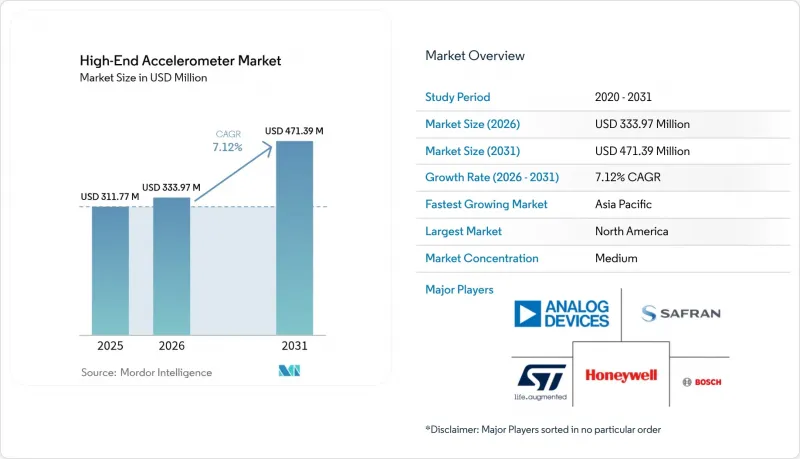
據 Mordor Intelligence 稱,2025 年高階加速計市值為 3.1177 億美元,預計到 2031 年將達到 4.7139 億美元,而 2026 年為 3.3397 億美元,預測期(2026-2031 年)的複合成長率為 7.12%。
本報告按技術(MEMS、壓電、壓阻、石英)、軸類型(單軸、雙軸、其他)、性能等級(工業、戰術、導航、戰略)、終端應用產業(國防與航太、汽車、工業機械、消費性電子、其他)和地區進行細分。市場預測以美元計價。
全球高階加速計市場趨勢及洞察
MEMS小型化降低了SWaP-C。
由於面積小於 2mm²,待機電流小於 2µA,五年前成本高昂的穿戴式裝置、無人機和電池監測等應用場景如今已成為可能。目前,封閉回路型Delta-Δ 核心在 ±16G 範圍內可達到 0.1% 的非線性,在許多中端應用中效能可與石英共振器媲美。雖然量產生產線上的單軸成本低於 0.50 美元,但由於需要較長的老化時間和溫度補償,用於戰術應用的密封式 MEMS 組件成本仍然在 200 至 500 美元之間。
國防和航太領域的現代化預算
美國國防部將2024會計年度的飛彈防禦支出增加至335億美元,比前一年增加12%,以確保未來多年對慣性子系統的需求。北約成員國即將達到國防費用GDP 2%的目標,目前正在升級火砲引信和無人機導引系統。印度技術發展基金累計100億印度盧比(約1.2億美元)用於高階加速計的在地化供應。
高昂的校準和包裝成本
導航級元件需要在-40 度C至+85 度C的溫度範圍內進行六向翻滾測試,每個元件的測試時間最長可達12小時。鈦合金氣密蓋會增加80至150美元的成本,但可以將10年內的偏差漂移限制在25 µg以內。由於缺乏ISO/IEC 17025認證的測量技術人員,短期內產能擴張受到限制。
細分市場分析
預計2026年至2031年間,晶體加速計的複合年成長率將達到8.74%,超過高階加速計市場的整體成長率。其小於10µg的偏置穩定性使其即使在沒有GPS訊號的潛水艇和飛機中也能保持數週的穩定運行,但目前全球僅有不到10家認證製造商提供此類產品。受消費品和汽車產品產量的推動,MEMS(微機電系統)加速度計在高階加速計市場中佔據了60.25%的佔有率,但其熱機械噪音使其偏壓穩定性低於50µg。壓電單元在10kHz以上的振動監測領域佔據主導地位,而壓電電阻堆則可承受高達200 度C的地下環境溫度。
霍尼韋爾QA-3000產品線中商用飛機參考系統的石英加速計需求激增11%。泰雷茲公司開發的一種新型封閉回路型電子電路可將佈線減少30%,並將電磁干擾抗擾度提高15 dB。新興自主水下航行器對25 µg漂移限值的要求進一步推動了石英加速計需求的成長。
到2025年,三軸設備將以60.65%的市場佔有率主導高階加速計市場,但隨著汽車行業一級供應商將加速計和陀螺儀整合到組件中以減輕線束重量和縮短校準時間,預計六軸慣性測量單元(IMU)將以8.95%的複合年成長率更快成長。 TDK的ICM-42688具有32kHz同步取樣能力,已被15個自動駕駛汽車平台採用。
博世的BMI323內部運作手勢姿態辨識演算法,可將始終開啟的運作裝置的功耗降低40%。在施工機械,對雙軸傾角儀的需求仍然強勁,如果僅需橫滾和俯仰數據,省略第三軸可將系統成本降低25%。
區域分析
到2025年,北美將佔據高階加速計市場37.80%的佔有率,這主要得益於美國國防部斥資18億美元累計慣性感測器。加拿大撥款12億加幣(約8.8億美元)用於升級CF-18戰鬥機的慣性系統。墨西哥瓜達拉哈拉的MEMS叢集在2024年擴大了25%,以支持北美1,550萬輛汽車的生產。
預計亞太地區將維持最高的成長率,到2031年複合年成長率將達到9.05%。這主要是因為中國預計2024年將生產950萬輛電動車,並計劃在2025年強制要求電動車配備電子穩定控制系統(ESC)。日本的MEMS晶圓代工舉措已投資150億日圓(約1億美元)用於擴大其8吋汽車級微機電系統(MEMS)的產能。印度也透過生產連結獎勵計畫計劃,吸引了4.5億美元的投資。
到2025年,其歐洲市佔率將達到24.00%。在德國,感測器銷售額達到32億歐元(34億美元),這得益於穩定性和輪胎壓力的強制性法規。歐盟的「晶片法」已撥款25億歐元用於意法半導體位於克羅爾工廠的MEMS代工業務擴建。由於ITAR(國際武器貿易條例)的核准程序,中東買家已將交貨週期延長至12個月,這促使沙烏地阿拉伯轉向國內採購。
其他好處
- Excel格式的市場預測(ME)表
- 3個月的分析師支持
目錄
第1章:引言
- 研究假設和市場定義
- 調查範圍
第2章:調查方法
第3章執行摘要
第4章 市場狀況
- 市場概覽
- 市場促進因素
- MEMS小型化降低了SWaP-C。
- 國防和航太領域的現代化預算
- 汽車ADAS和電動車的安全標準
- 對預測性維護感測器的需求日益成長
- 研究與開發對量子級偏壓穩定性的連鎖反應
- 低衛星星系的「高G」發射需要
- 市場限制因素
- 高昂的校準和包裝成本
- 專用ASIC供應鏈中的漏洞
- ITAR/EAR項下的出口許可證審核延誤
- 透過內建感測器的AI擴大網路安全攻擊面
- 產業價值鏈分析
- 宏觀經濟因素的影響
- 監理情勢
- 技術展望
- 波特五力分析
第5章 市場規模與成長預測
- 透過技術
- MEMS
- 壓電
- 壓阻式
- 水晶
- 按軸類型
- 單軸
- 2軸
- 3軸
- 6軸/IMU組合
- 表現等級
- 產業
- 戰術上的
- 導航
- 策略
- 按最終用途行業分類
- 國防/航太
- 車
- 工業機械
- 家用電子產品
- 衛生保健
- 其他終端用戶產業
- 按地區
- 北美洲
- 美國
- 加拿大
- 墨西哥
- 南美洲
- 巴西
- 阿根廷
- 其他南美國家
- 歐洲
- 德國
- 英國
- 法國
- 義大利
- 西班牙
- 俄羅斯
- 其他歐洲國家
- 亞太地區
- 中國
- 日本
- 印度
- 韓國
- 澳洲
- 其他亞太國家
- 中東和非洲
- 中東
- 沙烏地阿拉伯
- 阿拉伯聯合大公國
- 土耳其
- 其他中東國家
- 非洲
- 南非
- 奈及利亞
- 埃及
- 其他非洲地區
- 中東
- 北美洲
第6章 競爭情勢
- 市場集中度
- 策略趨勢
- 市佔率分析
- 公司簡介
- Analog Devices Inc.
- Robert Bosch GmbH
- Honeywell International Inc.
- STMicroelectronics NV
- Safran Colibrys SA
- Sensonor AS
- Physical Logic Ltd
- Innalabs Limited
- TE Connectivity Ltd
- Thales Group
- Northrop Grumman Corporation
- Kistler Group
- PCB Piezotronics Inc.
- Meggitt PLC
- Murata Manufacturing Co., Ltd.
- TDK Corporation(InvenSense)
- Dytran Instruments Inc.
- Silicon Sensing Systems Ltd.
- KVH Industries Inc.
- Tronics Microsystems SA
第7章 市場機會與未來展望
According to Mordor Intelligence, the high-end accelerometer market size was valued at USD 311.77 million in 2025 and estimated to grow from USD 333.97 million in 2026 to reach USD 471.39 million by 2031, at a CAGR of 7.12% during the forecast period (2026-2031).
This report is Segmented by Technology (MEMS, Piezoelectric, Piezoresistive, and Quartz), Axis Type (One-Axis, Two-Axis, and More), Performance Grade (Industrial, Tactical, Navigation, and Strategic), End-Use Industry (Defense and Aerospace, Automotive, Industrial Machinery, Consumer Electronics, and More), and Geography. The Market Forecasts are Provided in Terms of Value (USD).
Global High-End Accelerometer Market Trends and Insights
Rising MEMS Miniaturization Cuts SWaP-C
Areas below 2 mm2 and standby currents under 2 µA have unlocked wearable, drone, and battery-monitoring use cases that were previously cost-prohibitive five years ago. Closed-loop sigma-delta cores now deliver 0.1% nonlinearity across +-16 G ranges, rivaling quartz for many mid-grade missions. The cost per axis in high-volume lines has slipped below USD 0.5; yet, hermetic MEMS parts for tactical roles still command USD 200-500 due to the need for extended burn-in and temperature compensation.
Defense and Aerospace Modernization Budgets
The U.S. Department of Defense increased missile-defense outlays by 12% year over year to USD 33.5 billion in fiscal 2024, securing multi-year demand for inertial subsystems. NATO members reaching the 2% of GDP spending threshold are refreshing artillery fuzes and unmanned aircraft guidance systems. India's Technology Development Fund set aside INR 10 billion (USD 120 million) to localize high-end accelerometer supply.
High Calibration and Packaging Costs
Navigation-grade parts require six-position tumble tests across a temperature range of -40 °C to +85 °C, consuming up to 12 hours per unit. Titanium hermetic lids add USD 80-150, yet shield bias drift to within 25 µg over a decade. The scarcity of ISO/IEC 17025-certified metrologists limits short-term capacity additions.
Other drivers and restraints analyzed in the detailed report include:
- Automotive ADAS and EV Safety Mandates
- Growing Demand for Predictive-Maintenance Sensors
- ITAR/EAR Export-License Delays
For complete list of drivers and restraints, kindly check the Table Of Contents.
Segment Analysis
Quartz accelerometers are projected to outpace the overall High-end accelerometer market at a 8.74% CAGR during the 2026-2031 period. Their less than 10 µg bias stability keeps submarine and GPS-denied aircraft on course for weeks, supporting fewer than 10 qualified global producers. MEMS maintained a 60.25% High-end accelerometer market share in 2025, driven by consumer and automotive volumes, but it confronts a bias-stability floor near 50 µg due to thermo-mechanical noise. Piezoelectric units dominate vibration monitoring above 10 kHz, while piezoresistive stacks withstand 200 °C downhole environments.
Demand for quartz surged 11% in Honeywell's QA-3000 line supplying commercial-aircraft reference systems. New closed-loop electronics from Thales reduced wiring by 30% and improved EMI immunity by 15 dB. Emerging autonomous underwater vehicles specify 25 µg drift caps, reinforcing quartz momentum.
Three-axis devices led the High-end accelerometer market with a 60.65% share in 2025, but six-axis IMUs are expected to grow faster at a 8.95% CAGR, as automotive Tier-1s consolidate accelerometer-gyroscope packages to reduce harness weight and calibration time. TDK's ICM-42688 secured design wins on 15 autonomous-vehicle platforms for its 32 kHz synchronous sampling.
Bosch's BMI323 executes gesture-recognition algorithms internally, reducing the power consumption of always-on wearables by 40%. Two-axis tiltmeter demand persists in construction equipment, trading off the third axis to save 25% of the system cost when roll-pitch data suffice.
Complete Report Scope:
- By Technology
- MEMS
- Piezoelectric
- Piezoresistive
- Quartz
- By Axis Type
- One-Axis
- Two-Axis
- Three-Axis
- Six-Axis / IMU Combo
- By Performance Grade
- Industrial
- Tactical
- Navigation
- Strategic
- By End-Use Industry
- Defense and Aerospace
- Automotive
- Industrial Machinery
- Consumer Electronics
- Healthcare
- Other End-Use Industries
- By Geography
- North America
- United States
- Canada
- Mexico
- South America
- Brazil
- Argentina
- Rest of South America
- Europe
- Germany
- United Kingdom
- France
- Italy
- Spain
- Russia
- Rest of Europe
- Asia-Pacific
- China
- Japan
- India
- South Korea
- Australia
- Rest of Asia-Pacific
- Middle East and Africa
- Middle East
- Saudi Arabia
- United Arab Emirates
- Turkey
- Rest of Middle East
- Africa
- South Africa
- Nigeria
- Egypt
- Rest of Africa
- Middle East
- North America
Geography Analysis
North America retained 37.80% of the High-end accelerometer market revenue in 2025, buoyed by USD 1.8 billion in U.S. defense inertial-sensor procurement. Canada earmarked CAD 1.2 billion (USD 880 million) to update CF-18 inertial systems. Mexico's Guadalajara MEMS cluster expanded 25% in 2024 to support 15.5 million North American vehicle builds.
The Asia-Pacific is set for the fastest 9.05% CAGR through 2031, as China produced 9.5 million EVs in 2024 and is expected to implement mandatory electronic stability control by 2025. Japan's MEMS Foundry Initiative invested JPY 15 billion (USD 100 million) to lift 8-inch automotive-grade capacity. India attracted USD 450 million under its production-linked incentive scheme for MEMS fabs.
Europe held a 24.00% market share in 2025. German sensor sales reached EUR 3.2 billion (USD 3.4 billion), sustained by mandatory stability and tire-pressure rules. The EU Chips Act allocates EUR 2.5 billion for the expansion of MEMS foundries at STMicroelectronics' Crolles site. Middle East buyers lengthened delivery cycles to 12 months due to ITAR approvals, nudging Saudi Arabia toward indigenous sourcing.
- Analog Devices Inc.
- Robert Bosch GmbH
- Honeywell International Inc.
- STMicroelectronics NV
- Safran Colibrys SA
- Sensonor AS
- Physical Logic Ltd
- Innalabs Limited
- TE Connectivity Ltd
- Thales Group
- Northrop Grumman Corporation
- Kistler Group
- PCB Piezotronics Inc.
- Meggitt PLC
- Murata Manufacturing Co., Ltd.
- TDK Corporation (InvenSense)
- Dytran Instruments Inc.
- Silicon Sensing Systems Ltd.
- KVH Industries Inc.
- Tronics Microsystems SA
Additional Benefits:
- The market estimate (ME) sheet in Excel format
- 3 months of analyst support
TABLE OF CONTENTS
1 INTRODUCTION
- 1.1 Study Assumptions and Market Definition
- 1.2 Scope of the Study
2 RESEARCH METHODOLOGY
3 EXECUTIVE SUMMARY
4 MARKET LANDSCAPE
- 4.1 Market Overview
- 4.2 Market Drivers
- 4.2.1 Rising MEMS miniaturisation cuts SWaP-C
- 4.2.2 Defence and aerospace modernisation budgets
- 4.2.3 Automotive ADAS and EV safety mandates
- 4.2.4 Growing demand for predictive-maintenance sensors
- 4.2.5 Quantum-grade bias-stability R&D spill-over
- 4.2.6 LEO-satellite constellations' high-G launch needs
- 4.3 Market Restraints
- 4.3.1 High calibration and packaging costs
- 4.3.2 Supply-chain fragility for specialty ASICs
- 4.3.3 ITAR/EAR export-licence delays
- 4.3.4 In-sensor AI cybersecurity attack-surface growth
- 4.4 Industry Value Chain Analysis
- 4.5 Impact of Macroeconomic Factors
- 4.6 Regulatory Landscape
- 4.7 Technological Outlook
- 4.8 Porter's Five Forces Analysis
- 4.8.1 Threat of New Entrants
- 4.8.2 Bargaining Power of Buyers
- 4.8.3 Bargaining Power of Suppliers
- 4.8.4 Threat of Substitute Products
- 4.8.5 Intensity of Competitive Rivalry
5 MARKET SIZE AND GROWTH FORECASTS (VALUE)
- 5.1 By Technology
- 5.1.1 MEMS
- 5.1.2 Piezoelectric
- 5.1.3 Piezoresistive
- 5.1.4 Quartz
- 5.2 By Axis Type
- 5.2.1 One-Axis
- 5.2.2 Two-Axis
- 5.2.3 Three-Axis
- 5.2.4 Six-Axis / IMU Combo
- 5.3 By Performance Grade
- 5.3.1 Industrial
- 5.3.2 Tactical
- 5.3.3 Navigation
- 5.3.4 Strategic
- 5.4 By End-Use Industry
- 5.4.1 Defense and Aerospace
- 5.4.2 Automotive
- 5.4.3 Industrial Machinery
- 5.4.4 Consumer Electronics
- 5.4.5 Healthcare
- 5.4.6 Other End-Use Industries
- 5.5 By Geography
- 5.5.1 North America
- 5.5.1.1 United States
- 5.5.1.2 Canada
- 5.5.1.3 Mexico
- 5.5.2 South America
- 5.5.2.1 Brazil
- 5.5.2.2 Argentina
- 5.5.2.3 Rest of South America
- 5.5.3 Europe
- 5.5.3.1 Germany
- 5.5.3.2 United Kingdom
- 5.5.3.3 France
- 5.5.3.4 Italy
- 5.5.3.5 Spain
- 5.5.3.6 Russia
- 5.5.3.7 Rest of Europe
- 5.5.4 Asia-Pacific
- 5.5.4.1 China
- 5.5.4.2 Japan
- 5.5.4.3 India
- 5.5.4.4 South Korea
- 5.5.4.5 Australia
- 5.5.4.6 Rest of Asia-Pacific
- 5.5.5 Middle East and Africa
- 5.5.5.1 Middle East
- 5.5.5.1.1 Saudi Arabia
- 5.5.5.1.2 United Arab Emirates
- 5.5.5.1.3 Turkey
- 5.5.5.1.4 Rest of Middle East
- 5.5.5.2 Africa
- 5.5.5.2.1 South Africa
- 5.5.5.2.2 Nigeria
- 5.5.5.2.3 Egypt
- 5.5.5.2.4 Rest of Africa
- 5.5.5.1 Middle East
- 5.5.1 North America
6 COMPETITIVE LANDSCAPE
- 6.1 Market Concentration
- 6.2 Strategic Moves
- 6.3 Market Share Analysis
- 6.4 Company Profiles (includes Global level Overview, Market level overview, Core Segments, Financials as available, Strategic Information, Market Rank/Share for key companies, Products and Services, and Recent Developments)
- 6.4.1 Analog Devices Inc.
- 6.4.2 Robert Bosch GmbH
- 6.4.3 Honeywell International Inc.
- 6.4.4 STMicroelectronics NV
- 6.4.5 Safran Colibrys SA
- 6.4.6 Sensonor AS
- 6.4.7 Physical Logic Ltd
- 6.4.8 Innalabs Limited
- 6.4.9 TE Connectivity Ltd
- 6.4.10 Thales Group
- 6.4.11 Northrop Grumman Corporation
- 6.4.12 Kistler Group
- 6.4.13 PCB Piezotronics Inc.
- 6.4.14 Meggitt PLC
- 6.4.15 Murata Manufacturing Co., Ltd.
- 6.4.16 TDK Corporation (InvenSense)
- 6.4.17 Dytran Instruments Inc.
- 6.4.18 Silicon Sensing Systems Ltd.
- 6.4.19 KVH Industries Inc.
- 6.4.20 Tronics Microsystems SA
7 MARKET OPPORTUNITIES AND FUTURE OUTLOOK
- 7.1 White-Space and Unmet-Need Assessment

 2026-2030年全球加速計市場
 加速計:市場佔有率分析、產業趨勢與統計資料、成長預測(2026-2031)
 加速計市場:2026-2032年全球市場預測(依感測器技術、軸心、測量範圍、產出類型、最終用途產業及通路分類)加速感應器和偏航率感測器:市場佔有率分析、行業趨勢和統計數據、成長預測(2026-2031 年)
 2026年全球加速計和偏航速度感測器市場報告
 全球加速計市場規模、佔有率、趨勢和成長分析報告(2026-2034年)
 高階加速計市場報告:按類型、軸類型、應用和地區分類(2026-2034 年)加速計市場規模、佔有率、成長及全球產業分析:按類型、應用和地區分類的洞察,2026-2034 年預測2026年全球加速計市場報告石英伺服加速計市場:按產品類型、應用、終端用戶產業和銷售管道- 全球預測(2026-2032 年)