


 |
市場調查報告書
商品編碼
2065770
基於雲端的企業資源規劃(ERP):市場佔有率分析、產業趨勢和統計數據以及成長預測(2026-2031 年)Cloud Enterprise Resource Planning - Market Share Analysis, Industry Trends & Statistics, Growth Forecasts (2026 - 2031) |
||||||

※ 本網頁內容可能與最新版本有所差異。詳細情況請與我們聯繫。
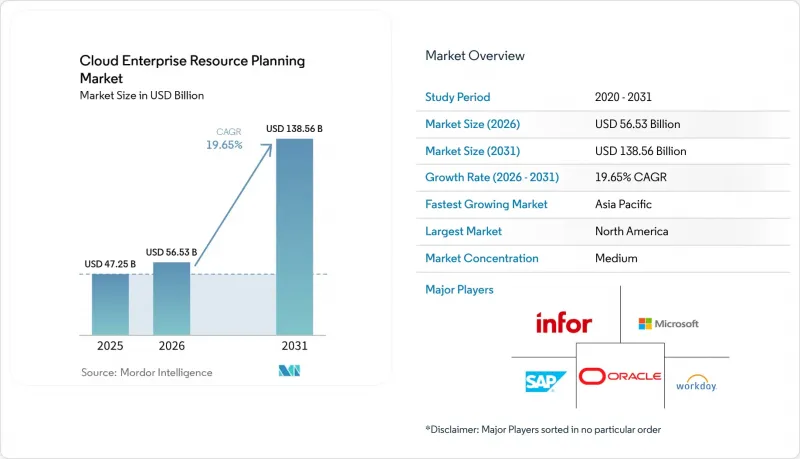
根據 Mordor Intelligence 預測,基於雲端的企業資源規劃 (ERP) 市場規模將從 2025 年的 472.5 億美元和 2026 年的 565.3 億美元成長到 2031 年的 1385.6 億美元,2026 年至 2031 年的年複合成長率(CAGR)為 19.6%。
本報告按組件(解決方案和服務)、部署模式(公共雲端和私有雲端)、最終用戶企業規模(大型企業和中小企業)、業務職能(財務和會計等)、最終用戶行業(銀行、金融服務和保險、IT和電信等)以及地區進行細分。市場預測以價值(美元)表示。
全球雲端企業資源規劃 (ERP) 市場趨勢與洞察
人工智慧驅動的預測分析的整合
人工智慧 (AI) 正在改變雲端 ERP 系統,使其從專注於回顧性報告的工具轉變為支援前瞻性決策的平台。已將 AI 整合到 ERP 系統中的公司報告稱,營運效率顯著提升,包括交付時間縮短 25%,營運成本降低 15%。這些改進得益於即時供應鏈演算法,這些演算法能夠最佳化流程並提高效率。 SAP 透露,2024 年第四季簽署的 ERP 合約中有一半包含 AI 功能,凸顯了市場對智慧 ERP 解決方案日益成長的需求。同樣, Oracle的 AI 整合多重雲端資料庫服務在 2025 年第四季實現了 115% 的環比成長,這印證了該公司致力於提供智慧工作流程和高階決策支援系統的決心。製造企業正在增加預算,以實施預測性維護和生產計畫,這表明 AI 不僅僅是一項附加功能,而是保持競爭力的關鍵要素。
為中小企業提供價格合理的訂閱費用
訂閱式定價模式消除了過去阻礙中小企業使用企業級軟體的資本投資障礙。這種轉變使得各種規模的企業都能採用先進的解決方案,而無需進行大量的前期投資。例如,NetSuite 的客戶群在 2024 年達到了 18,844 家公司,佔財務報告市場佔有率的 10.35%,這表明訂閱式 ERP 解決方案的普及率正在不斷提高。此外,Vista Equity Partners 以 20 億美元收購 Acumatica 也凸顯了可預測的月度費用對中小企業現金流需求的重要性日益凸顯。這種模式不僅有助於中小企業應對財務限制,還能為供應商提供穩定的收入來源,並促進其發展。因此,中小企業越來越依賴雲端 ERP 作為策略工具,以在無需組建大規模IT 團隊的情況下高效擴展業務。
整合傳統本地系統的複雜性
擁有數十年定製程式碼的公司在遷移過程中會面臨許多挑戰,往往導致工期延長。為了因應這些難題,SAP 已將其系統的主流支援期限延長至 2033 年,為公司提供更多時間來有效管理遷移工作。製造業公司尤其如此,由於其專業生產系統的複雜性以及嚴格的檢驗週期,專案工期往往更長。這些因素通常會導致公司投入額外資源以確保成功實施並符合營運要求,從而經常導致專案預算超出最初預算。
細分市場分析
至2025年,解決方案將佔據雲端企業資源規劃(ERP)市場67.10%的佔有率。這主要歸功於企業傾向於選擇整合套件,以便在單一環境中簡化財務、供應鏈和人力資源管理。這種主導地位源自於單一資料模型的吸引力,該模型打破了資料孤島,簡化了管治。同時,服務領域預計將以24.95%的複合年成長率(CAGR)實現最高成長,並且隨著企業依賴諮詢合作夥伴制定遷移藍圖和持續最佳化,其市場規模有望進一步擴大。由於傳統環境需要複雜的資料清理和流程重組,實施專案也不斷增加。此外,中小企業對託管服務的需求也不斷成長,他們傾向於將ERP維護外包,從而專注於產生收入活動。人工智慧能力的提升增加了對培訓和變更管理的需求,進一步增強了業務收益的穩定性。
解決方案領域也受益於供應商對預先配置的行業特定模板的投資,這些模板縮短了部署時間。供應商將分析和機器人流程自動化 (RPA) 等附加元件捆綁銷售,以提升訂閱價值。隨著人工智慧 (AI) 的普及,嵌入式機器學習在異常檢測領域的重要性日益凸顯,並在解決方案藍圖中越來越重視。這些創新使服務合作夥伴能夠透過生命週期支援來實現獲利,同時解決方案收入也持續保持主導地位。總而言之,平台整合持續影響著購買行為,並支撐著整個雲端 ERP 市場。
公共雲端憑藉著付費使用制、自動升級和全球分散式資料中心等優勢,預計2025年將佔63.78%的市場。其標準化配置降低了部署成本,並能快速存取新功能,滿足了那些優先考慮速度而非大規模客製化的企業的需求。私有雲端模式預計將以22.10%的複合年成長率成長,這反映了監管力度的加大,要求在不損害雲彈性的前提下,提供隔離的環境。銀行和醫療保健等行業對加密、審計追蹤和本地化等方面的控制要求更為嚴格。
混合策略正逐漸成為一種切實可行的折衷方案。企業透過將敏感工作負載保留在私人實例中,同時在公共區域部署監管較少的模組,從而有效管理風險並最佳化成本。這種柔軟性也符合「主權雲」的要求,即資料必須居住在特定國家/地區。供應商的藍圖現在包括跨公共和私人環境的自動化工作負載遷移和一致的策略引擎。這種部署方式的多樣化正在擴大雲端ERP市場的規模,因為它既緩解了對供應商鎖定的擔憂,也拓寬了買家群體。
區域分析
到2025年,北美將佔全球整體收入的35.10%,這得益於成熟的雲端基礎設施和強大的部署合作夥伴生態系統。企業正在利用基於雲端的企業資源規劃(ERP)市場來實現舊有系統的現代化、整合資料孤島並應對不斷變化的合規要求,例如美國證券交易委員會(SEC)的現代化法規。領先的超大規模資料中心業者供應商確保了低延遲存取和持續的功能性。此外,跨國營運的公司也重視能夠簡化跨國營運的全部區域資料隱私框架。
亞太地區以27.10%的複合年成長率領先,這主要得益於政府的數位化項目和經濟的加速成長。 2023年,中國在雲端基礎設施的支出達到92億美元,其中阿里雲佔39%,華為佔19%,騰訊佔15%,凸顯了該地區的投資規模。東南亞國家正透過戰略合作利用這項基礎設施,而日本則專注於實現製造業供應鏈的現代化。此外,領先的本土軟體公司為出口型中小企業提供產業專用的解決方案,進一步推動了雲端ERP市場的發展。
在歐洲,基於對《一般資料保護規則》(GDPR) 的遵守以及主權雲端藍圖,雲端運算市場呈現穩定成長態勢。企業正採用混合模式,將敏感資料保留在歐盟境內,同時利用海外區域處理監管較少的工作流程。超大規模資料中心業者服務商正與當地電信公司合作,建構可靠的雲端區域,並實現需要本地管理的公共部門專案。同時,在中東和非洲,隨著各國政府推出電子政府計畫並實現經濟多元化,擺脫對油氣資源的依賴,雲端運算的應用也不斷擴展。這些趨勢共同推動了市場規模的擴大,並促使供應商加強在地化。
其他好處:
- Excel格式的市場預測(ME)表
- 3個月的分析師支持
目錄
第1章:引言
- 研究假設和市場定義
- 調查範圍
第2章:調查方法
第3章執行摘要
第4章 市場狀況
- 市場概覽
- 市場促進因素
- 人工智慧驅動的預測分析的整合
- 中小企業訂閱費的可行性。
- 可配置微服務ERP架構
- 採用以資料主權為驅動的主權雲
- 面向微企業的市場整合式ERP API
- 市場限制因素
- 整合傳統本地系統的複雜性
- 多租戶環境下的安全性和合規性問題
- 超大規模資料中心業者正在推高總擁有成本(TCO)的出站費率。
- 低程式碼ERP擴展領域的人才短缺
- 產業價值鏈分析
- 監理情勢
- 技術展望
- 波特五力分析
第5章 市場規模與成長預測
- 按組件
- 解決方案
- 服務
- 按部署模式
- 公共雲端
- 私有雲端
- 按最終用戶公司規模分類
- 大公司
- 小型企業
- 業務職能
- 財會
- 人力資源
- 銷售與行銷
- 供應鍊和營運
- 其他業務職能
- 按最終用戶行業分類
- BFSI
- IT/通訊
- 製造業
- 政府
- 零售與電子商務
- 衛生保健
- 其他終端用戶產業
- 按地區
- 北美洲
- 美國
- 加拿大
- 墨西哥
- 南美洲
- 巴西
- 阿根廷
- 其他南美國家
- 歐洲
- 英國
- 德國
- 法國
- 義大利
- 西班牙
- 其他歐洲國家
- 亞太地區
- 中國
- 日本
- 印度
- 韓國
- 其他亞太國家
- 中東和非洲
- 中東
- 阿拉伯聯合大公國
- 沙烏地阿拉伯
- 其他中東國家
- 非洲
- 南非
- 埃及
- 其他非洲國家
- 中東
- 北美洲
第6章 競爭情勢
- 市場集中度
- 策略趨勢
- 市佔率分析
- 公司簡介
- SAP SE
- Oracle Corporation
- Microsoft Corporation
- Infor Global Solutions, Inc.
- Workday, Inc.
- NetSuite Inc.
- Acumatica, Inc.
- Epicor Software Corporation
- Sage Group plc
- Certinia Inc.
- IFS AB
- Unit4 NV
- Deltek, Inc.
- Ramco Systems Ltd.
- Plex Systems, Inc.
- Odoo SA
- Sage Intacct, Inc.
- QAD Inc.
- SYSPRO(Pty)Ltd.
- Kingdee International Software Group
第7章 市場機會與未來展望
According to Mordor Intelligence, the cloud enterprise resource planning market size is projected to expand from USD 47.25 billion in 2025 and USD 56.53 billion in 2026 to USD 138.56 billion by 2031, registering a CAGR of 19.65% between 2026 and 2031.
This report is Segmented by Component (Solutions and Services), Deployment Model (Public Cloud and Private Cloud), End-User Enterprise Size (Large Enterprises and Small and Medium Enterprises), Business Function (Finance and Accounting, and More), End-User Industry (BFSI, IT and Telecom, and More), and by Geography. The Market Forecasts are Provided in Terms of Value (USD).
Global Cloud Enterprise Resource Planning Market Trends and Insights
AI-driven predictive analytics integration
Artificial Intelligence transforms cloud ERP systems from tools focused on backward-looking reporting to platforms that enable forward-looking decision-making. Organizations that have integrated AI into their ERP systems have reported significant operational improvements, including a 25% reduction in delivery times and a 15% decrease in operational costs. These improvements are achieved through real-time supply chain algorithms that optimize processes and improve efficiency. SAP revealed that AI-powered features were included in half of all ERP deals closed in Q4 2024, highlighting the growing demand for intelligent ERP solutions. Similarly, Oracle experienced a 115% sequential growth in its multicloud database services with integrated AI capabilities in Q4 2025, underscoring the company's focus on delivering intelligent workflows and advanced decision-support systems. Manufacturing firms elevate budgets to embed predictive maintenance and production planning, reinforcing AI as a competitive necessity rather than a fringe add-on.
Subscription affordability for SMEs
Subscription pricing eliminates the capital-expenditure barrier that previously prevented smaller firms from accessing enterprise-grade software. This shift has enabled companies of all sizes to adopt advanced solutions without significant upfront investments. For instance, NetSuite's customer base of 18,844 in 2024 accounted for a 10.35% share of the financial-reporting market, showcasing the growing adoption of subscription-based ERP solutions. Additionally, Vista Equity Partners' USD 2 billion acquisition of Acumatica underscores the growing importance of predictable monthly fees, which align well with the cash-flow needs of small and medium enterprises (SMEs). This model not only supports SMEs in managing their financial constraints but also provides vendors with a steady revenue stream, fostering growth opportunities. As a result, SMEs increasingly view cloud ERP as a strategic tool for efficiently scaling their operations without the need to hire extensive IT teams.
Legacy on-premise integration complexity
Enterprises with decades-old custom code face significant challenges during migration processes, often resulting in extended timelines. To address these difficulties, SAP has extended mainstream support for its systems until 2033, providing organizations with additional time to manage these transitions effectively. Manufacturing firms, in particular, experience prolonged project durations due to the complexity of their specialized production systems and the need for rigorous validation cycles. These factors frequently lead to project budgets exceeding initial estimates, as companies allocate additional resources to ensure successful implementation and compliance with operational requirements.
Other drivers and restraints analyzed in the detailed report include:
- Composable micro-service ERP architectures
- Data-sovereignty-driven sovereign-cloud roll-outs
- Multi-tenant security and compliance concerns
For complete list of drivers and restraints, kindly check the Table Of Contents.
Segment Analysis
Solutions accounted for 67.10% of the cloud enterprise resource planning market share in 2025, as enterprises favored integrated suites that streamline finance, supply chain, and HR in a single environment. The dominance stems from the appeal of a single data model that eliminates silos and simplifies governance. Services, however, post the fastest 24.95% CAGR and will deepen the market size as organizations rely on consulting partners for migration roadmaps and continual optimization. Implementation engagements are expanding because legacy landscapes require complex data cleansing and process reengineering. Managed services are gaining further traction among SMEs that prefer to outsource ERP maintenance and focus on revenue-generating activities. The rise of AI features increases demand for training and change management, reinforcing service revenue resilience.
The solutions segment is also buoyed by vendor investments in preconfigured industry templates that shrink deployment timelines. Vendors bundle analytics and robotic process automation add-ons to increase subscription value. As AI adoption widens, solution roadmaps increasingly emphasize embedded machine learning for anomaly detection. These innovations keep solution revenue dominant while allowing services partners to monetize lifecycle support. Overall, platform consolidation continues to shape purchasing behavior and sustains the broader cloud ERP market.
Public cloud captured 63.78% of the market share in 2025, supported by consumption pricing, automated upgrades, and globally distributed data centers. Standardized configurations reduce implementation costs and enable rapid access to new features, resonating with firms seeking speed over heavy customization. The private cloud model, posting a 22.10% CAGR, reflects rising regulatory scrutiny that requires isolated environments without sacrificing cloud elasticity. Industries such as banking and healthcare require greater control over encryption, audit trails, and localization.
Hybrid strategies emerge as a pragmatic middle ground. Firms keep sensitive workloads within private instances while pushing less-regulated modules to public regions, thereby controlling risk and optimizing costs. This flexibility aligns with sovereign-cloud mandates that demand in-country data residency. Vendor roadmaps now include automated workload shuttling and consistent policy engines across public and private footprints. Collectively, deployment diversity reduces vendor lock-in fears and enlarges the cloud ERP market size by broadening buyer segments.
Geography Analysis
North America accounted for 35.10% of global revenue in 2025, driven by mature cloud infrastructure and a deep ecosystem of implementation partners. Enterprises use the cloud enterprise resource planning market to refresh legacy suites, consolidate data silos, and align with evolving compliance regimes such as the US SEC modernization rules. The presence of major hyperscalers ensures low-latency access and continuous feature delivery. In addition, cross-border entities appreciate region-wide data-privacy frameworks that simplify multinational rollouts.
Asia-Pacific delivers the fastest CAGR of 27.10%, driven by government digitalization programs and accelerated economic growth. China's USD 9.2 billion cloud infrastructure spend in 2023, with Alibaba Cloud at 39%, Huawei at 19%, and Tencent at 15%, frames the scale of regional investment. Southeast Asian countries tap this infrastructure through strategic alliances, while Japan emphasizes modernizing manufacturing supply chains. The cloud ERP market gains additional lift from local software champions that package industry-specific solutions for export-oriented SMEs.
Europe shows stable expansion, rooted in GDPR compliance and sovereign cloud roadmaps. Enterprises adopt hybrid models that keep sensitive data within EU borders while harnessing foreign regions for less-regulated workflows. Hyperscalers partner with local telecom firms to build trusted cloud zones, enabling public-sector projects that require local control. Meanwhile, Middle East and Africa observe emerging deployments as governments launch e-government programs and diversify economies away from hydrocarbons. These dynamics together enlarge the market size and deepen vendor localization efforts.
- SAP SE
- Oracle Corporation
- Microsoft Corporation
- Infor Global Solutions, Inc.
- Workday, Inc.
- NetSuite Inc.
- Acumatica, Inc.
- Epicor Software Corporation
- Sage Group plc
- Certinia Inc.
- IFS AB
- Unit4 NV
- Deltek, Inc.
- Ramco Systems Ltd.
- Plex Systems, Inc.
- Odoo SA
- Sage Intacct, Inc.
- QAD Inc.
- SYSPRO (Pty) Ltd.
- Kingdee International Software Group
Additional Benefits:
- The market estimate (ME) sheet in Excel format
- 3 months of analyst support
TABLE OF CONTENTS
1 INTRODUCTION
- 1.1 Study Assumptions and Market Definition
- 1.2 Scope of the Study
2 RESEARCH METHODOLOGY
3 EXECUTIVE SUMMARY
4 MARKET LANDSCAPE
- 4.1 Market Overview
- 4.2 Market Drivers
- 4.2.1 AI-Driven Predictive Analytics Integration
- 4.2.2 Subscription Affordability for SMEs
- 4.2.3 Composable Micro-Service ERP Architectures
- 4.2.4 Data-Sovereignty-Driven Sovereign-Cloud Roll-Outs
- 4.2.5 Marketplace-Embedded ERP APIs for Micro-Enterprises
- 4.3 Market Restraints
- 4.3.1 Legacy On-Premise Integration Complexity
- 4.3.2 Multi-Tenant Security and Compliance Concerns
- 4.3.3 Hyperscaler Egress-Fee Inflation of TCO
- 4.3.4 Low-Code ERP-Extension Talent Shortage
- 4.4 Industry Value Chain Analysis
- 4.5 Regulatory Landscape
- 4.6 Technological Outlook
- 4.7 Porter's Five Forces Analysis
- 4.7.1 Bargaining Power of Suppliers
- 4.7.2 Bargaining Power of Buyers
- 4.7.3 Threat of New Entrants
- 4.7.4 Threat of Substitutes
- 4.7.5 Intensity of Competitive Rivalry
5 MARKET SIZE AND GROWTH FORECASTS (VALUE)
- 5.1 By Component
- 5.1.1 Solutions
- 5.1.2 Services
- 5.2 By Deployment Model
- 5.2.1 Public Cloud
- 5.2.2 Private Cloud
- 5.3 By End-user Enterprise Size
- 5.3.1 Large Enterprises
- 5.3.2 Small and Medium Enterprises
- 5.4 By Business Function
- 5.4.1 Finance and Accounting
- 5.4.2 Human Resources
- 5.4.3 Sales and Marketing
- 5.4.4 Supply Chain and Operations
- 5.4.5 Other Business Functions
- 5.5 By End-User Industry
- 5.5.1 BFSI
- 5.5.2 IT and Telecom
- 5.5.3 Manufacturing
- 5.5.4 Government
- 5.5.5 Retail and E-commerce
- 5.5.6 Healthcare
- 5.5.7 Other End-User Industries
- 5.6 By Region
- 5.6.1 North America
- 5.6.1.1 United States
- 5.6.1.2 Canada
- 5.6.1.3 Mexico
- 5.6.2 South America
- 5.6.2.1 Brazil
- 5.6.2.2 Argentina
- 5.6.2.3 Rest of South America
- 5.6.3 Europe
- 5.6.3.1 United Kingdom
- 5.6.3.2 Germany
- 5.6.3.3 France
- 5.6.3.4 Italy
- 5.6.3.5 Spain
- 5.6.3.6 Rest of Europe
- 5.6.4 Asia-Pacific
- 5.6.4.1 China
- 5.6.4.2 Japan
- 5.6.4.3 India
- 5.6.4.4 South Korea
- 5.6.4.5 Rest of Asia-Pacific
- 5.6.5 Middle East and Africa
- 5.6.5.1 Middle East
- 5.6.5.1.1 United Arab Emirates
- 5.6.5.1.2 Saudi Arabia
- 5.6.5.1.3 Rest of Middle East
- 5.6.5.2 Africa
- 5.6.5.2.1 South Africa
- 5.6.5.2.2 Egypt
- 5.6.5.2.3 Rest of Africa
- 5.6.5.1 Middle East
- 5.6.1 North America
6 COMPETITIVE LANDSCAPE
- 6.1 Market Concentration
- 6.2 Strategic Moves
- 6.3 Market Share Analysis
- 6.4 Company Profiles (includes Global level Overview, Market level overview, Core Segments, Financials as available, Strategic Information, Market Rank/Share for key companies, Products and Services, and Recent Developments)
- 6.4.1 SAP SE
- 6.4.2 Oracle Corporation
- 6.4.3 Microsoft Corporation
- 6.4.4 Infor Global Solutions, Inc.
- 6.4.5 Workday, Inc.
- 6.4.6 NetSuite Inc.
- 6.4.7 Acumatica, Inc.
- 6.4.8 Epicor Software Corporation
- 6.4.9 Sage Group plc
- 6.4.10 Certinia Inc.
- 6.4.11 IFS AB
- 6.4.12 Unit4 NV
- 6.4.13 Deltek, Inc.
- 6.4.14 Ramco Systems Ltd.
- 6.4.15 Plex Systems, Inc.
- 6.4.16 Odoo SA
- 6.4.17 Sage Intacct, Inc.
- 6.4.18 QAD Inc.
- 6.4.19 SYSPRO (Pty) Ltd.
- 6.4.20 Kingdee International Software Group
7 MARKET OPPORTUNITIES AND FUTURE OUTLOOK
- 7.1 White-Space and Unmet-Need Assessment

 基於雲端的企業資源規劃市場:按組件、部署方式、組織規模、技術和產業分類 - 全球市場預測(2026-2032 年)
 CRM整合ERP:市場佔有率分析、產業趨勢與統計、成長預測(2026-2031)
 雲端ERP市場規模、佔有率和成長分析:按組件、部署類型、組織規模、業務職能、產業和地區分類-2026年至2033年產業預測中小企業的雲端ERP:市佔率分析、產業趨勢與統計及成長預測(2026-2031年)
 雲ERP市場規模、佔有率、成長率和全球產業分析:按類型、應用和地區分類的洞察,2026-2034年預測
 2026年全球雲端ERP市場報告2026年全球雲端ERP市場報告
 雲端ERP市場分析及預測(至2035年):依類型、產品類型、服務、技術、組件、應用、部署類型、最終用戶、模組及功能分類全球雲端ERP市場規模、佔有率、趨勢和成長分析報告(2026-2034年)2026 年至 2032 年雲端企業資源規劃市場(按組件、最終用戶和地區分類)