


 |
市場調查報告書
商品編碼
2065757
直播:市場佔有率分析、產業趨勢與統計、成長預測(2026-2031)Live Streaming - Market Share Analysis, Industry Trends & Statistics, Growth Forecasts (2026 - 2031) |
||||||

※ 本網頁內容可能與最新版本有所差異。詳細情況請與我們聯繫。
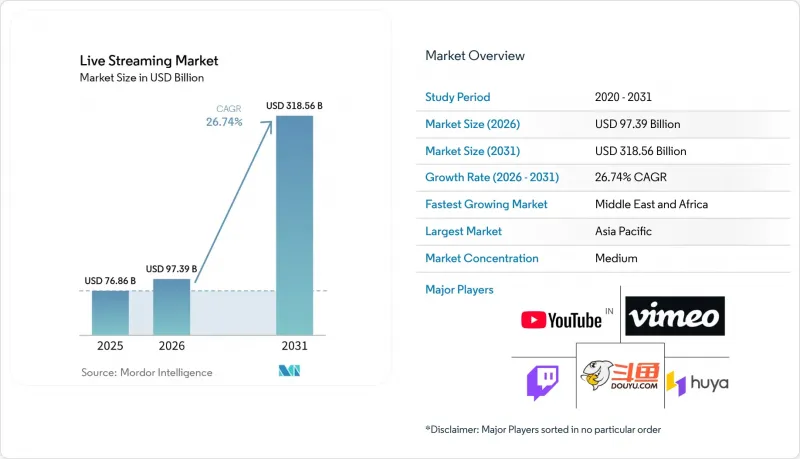
根據 Mordor Intelligence 預測,直播市場規模將從 2025 年的 768.6 億美元和 2026 年的 973.9 億美元成長到 2031 年的 3185.6 億美元,2026 年至 2031 年的年複合成長率(CAGR)為 26.74%。
本報告按組件(解決方案、服務)、類型(影片串流媒體、音訊/播客串流)、收入模式(廣告支援(AVOD/FVOD)、訂閱(SVOD)、按次付費、打賞)、平台(網路、行動應用程式、智慧電視/CTV 設備、遊戲機、VR)、終端用戶(遊戲/電子競技、媒體
全球直播市場趨勢及洞察
支援 5G 的行動串流媒體
首爾都會圈的通訊業者在部署高密度3.5GHz頻段的支援下,在2024年和2025年期間維持了超過160Mbps的平均下行速度。這種網路環境使得用戶無需額外Wi-Fi即可在演唱會和全城電競粉絲聚會上進行4K手持直播。每當遊戲發行商發布重大更新時,晚間高峰時段的流量都會明顯從固網轉移到行動網路,這表明直播影片正在推動行動電話網路容量的需求成長。當通訊業者在其高級套餐中加入特定直播應用程式的零流量優惠時,用戶解約率相比標準數據套餐有所下降,凸顯了影片對客戶維繫的強大作用。隨著千兆Gigabit5G網路覆蓋範圍的擴大,亞秒延遲使得互動問答節目、即時投票和多角度即時體育賽事直播成為可能。這些互動將內容和社群融合在同一行動裝置螢幕上,進一步提升了直播市場的價值提案。
電競聯合發行權
2024年,北美冠軍巡迴賽授權方發布了一套聯合直播工具包,其中包含即時統計數據疊加功能,允許創作者將自己的解說疊加到官方視訊串流上。這種方式擴大了受眾範圍,觸及了以往傳統說明所忽略的群體,並提高了平均同時在線觀看人數。贊助商現在購買的套餐包含主直播串流以及來自認證創作者的鏡像直播,使他們能夠衡量實際參與的觀眾,而不是僅限於單一頻道的曝光量。即使整體覆蓋範圍相當,以個性主導的直播在每位觀眾的參與度方面通常也優於官方直播。版權所有擁有者正透過將大量授權轉化為創作者生態系統,將參與度轉化為更快速、更多元化的收入來源。這種模式也加速了資料收集,因為每次聯合直播都成為一個資料節點,這些資料會被回饋到建議引擎中,從而在整個生態系統中擴大網路效應。
頻寬價格波動
東南亞部分地區批發傳輸費率的波動迫使多個內容創作平台在2024年節日限制自適應位元率,導致尖峰時段廣告庫存減少。而那些已經部署邊緣轉碼器的業者則能夠更平穩地應對這些波動,因為本地處理顯著降低了上行資料量,同時又能保持影像品質。這種對比表明,技術架構的選擇可以有效抵禦宏觀層面的成本衝擊。然而,小規模的服務提供者缺乏複製這種邊緣策略所需的資金投入,因此價格波動會直接影響到他們,導致影片品質下降、用戶參與度降低和收入減少。在區域通訊業者穩定價格之前,頻寬不穩定將繼續限制新興經濟體整體直播市場的成長。
細分市場分析
到2025年,該解決方案將佔據直播市場77.35%的佔有率。這是因為編碼、內容傳遞網路(CDN)和播放器SDK對於流暢播放仍然至關重要。服務供應商目前正在整合物件級人工智慧,以最佳化行動裝置用戶的觀看體驗,並透過自動將橫螢幕影片裁切為垂直螢幕影像來降低製作成本。採用這些功能的客戶正在加深對供應商的依賴,這表明功能深度如何增強競爭優勢。此外,多用途採集技術無需額外拍攝即可擴展內容庫,從而加速整個內容庫的變現。因此,即使市場成長擴展到輔助服務領域,對該解決方案的需求依然強勁。
隨著企業將互動式疊加層、選舉之夜視覺化和即時分析等業務外包,預計到2031年,託管和專業服務市場將以29.68%的複合年成長率成長。一家歐洲公共廣播公司公司在2024年大選期間將其整個地圖工作流程外包,與傳統的內部模式相比,交付時間縮短了一半。這種縮短的上市時間使新聞編輯室能夠將員工重新分配到能夠使其新聞脫穎而出的編輯工作中。類似的效率提昇在教育、政府和體育領域也越來越受歡迎,這不僅推動了服務領域的市場擴張,也補充了核心解決方案的收入。
到2025年,影片將佔直播市場規模的91.40%。這主要歸功於2025年橄欖球錦標賽平均觀看時間的增加,而這又得益於體育場館引入的多機位角度選擇功能。新型邊緣節點實現了亞秒延遲,使觀眾能夠幾乎無視延遲地投票選擇觀看角度,進一步凸顯了影片在互動性方面的主導地位。這種體驗的提升帶動了體育、新聞和娛樂等行業用戶平均收入的成長。同時,BytePlus正在進行的容量編碼測試證實,身臨其境型串流媒體的頻寬降低了50%,這預示著未來影像品質將大幅提升,從而進一步增強這一領域的體驗。
預計即時音訊和播客分發將以每年超過 28.62% 的速度成長。 2024 年 7 月,一位科幻小說作家進行了一場直播朗讀會,並與觀眾進行了問答互動,活動期間電子書銷量成長了六倍。由於製作成本低廉且耳機普及,即時音訊已成為作家、教育工作者和意見領袖可重複使用的互動工具。隨著平台整合打賞功能和購票Widgets,音訊正在將小型互動轉化為直接的收入來源,加速其從輔助功能向更廣泛生態系統中策略性領域的轉變。
區域分析
亞太地區在大規模的用戶群體和快速的5G部署的推動下,預計將在2025年保持約44.30%的直播市場佔有率。在韓國,政府主導的網路規劃已將全國平均延遲降至20毫秒以下,從而實現了全國互動的問答節目。體育場館早期部署的8K測試直播刺激了對相容顯示設備的需求,同時也推動了硬體和寬頻的升級。在日本、澳洲和新加坡,對電子競技的投資帶來了強勁的推動力,為跨境多語言直播奠定了基礎。東京的一項基於容量的音樂會平台實驗進一步凸顯了亞太地區作為高頻寬市場試驗場的地位。
中東和非洲地區預計到2031年將以31.35%的複合年成長率成長。 2025年2月舉行的泛阿拉伯音樂獎(Pan-Arab Music Awards)以阿拉伯語和英語播出,僅首晚的周邊商品銷售額就達到了420萬美元,促使主辦方決定將該活動改為每月舉辦一次。連接體育場館和城市資料中心的聯邦級光纖骨幹網路支援本地託管的廣播來源,從而降低了延遲和付款閘道故障率。得益於雲端轉碼器價格的下降,奈及利亞和肯亞的新創公司現在可以無需承擔衛星通訊成本即可直播高中體育賽事和當地活動,從而開拓了此前利潤微薄的超本地細分市場。這些發展共同推動了先前服務不足的細分市場直播市場的規模擴大。
北美在工具開發領域保持主導地位。雲端服務供應商在2024年工程高峰會上發布了亞秒級「端到端」工作流程,使體育聯盟能夠測試即時投注疊加功能。歐洲在直播電商領域處於領先地位。 2025年3月,一家法國奢侈品牌在直播銷售活動中,一款價值2,500歐元(約2,764美元)的手提包在不到15分鐘內售罄,這表明稀缺性行銷能夠推動直播銷售成長。拉丁美洲正以「行動優先」為導向發展。 2024年,巴西狂歡節的組織者透過利用打賞功能來支付街頭工作人員的成本,展現了大規模、社區主導獲利模式的潛力。透過這種方式,每個地區都在強化其獨特的價值提案,共同加速全球直播市場的擴張。
其他好處:
- Excel格式的市場預測(ME)表
- 3個月的分析師支持
目錄
第1章:引言
- 研究假設和市場定義
- 調查範圍
第2章:調查方法
第3章執行摘要
第4章 市場狀況
- 市場概覽
- 市場促進因素
- 5G行動串流媒體在亞太地區的普及。
- 電子競技比賽的轉播權正在推動北美遊戲直播的商業化。
- 即時電商從中國轉移到西方時尚零售商的
- 將直播 API 整合到美國中小企業的基於 SaaS 的行銷技術 (MarTech) 堆疊中
- 中東頂尖運動聯盟的直接面對消費者(D2C)模式
- 雲端轉碼成本的不斷降低,正鼓勵新創企業進入非洲市場。
- 市場限制因素
- 新興市場頻寬
- 跨國音樂串流版權的全球授權片段化
- 數位廣告詐欺會影響OTT直播的CPM價格。
- 例如,對延遲敏感度較高的應用場景會限制超低延遲的應用(例如,電子競技博彩)。
- 波特五力分析
- 監管和技術展望
- 影響即時評論流的隱私法規(GDPR、CPRA)
- AV1 和 VVC轉碼器的進展
- 宏觀經濟趨勢影響評估
- 投資分析
第5章 市場規模與成長預測
- 按組件
- 解決方案(編碼、轉碼、CDN、攝取、播放器)
- 服務(託管、專業、整合)
- 按類型
- 影片串流
- 音訊/播客串流媒體
- 按收入模式
- 廣告支持型(AVOD/FVOD)
- 訂閱式(SVOD)
- 按次付費和打賞系統
- 按平台
- Web
- 行動應用
- 智慧電視/CTV設備
- 遊戲主機和虛擬實境
- 按最終用戶行業分類
- 遊戲和電子競技
- 媒體娛樂工作室
- 體育聯合會和俱樂部
- 新聞和活動組織者
- 教育和教育技術(Ed-tech)提供商
- 企業和公司的溝通
- 按地區
- 北美洲
- 美國
- 加拿大
- 墨西哥
- 南美洲
- 巴西
- 阿根廷
- 其他南美國家
- 歐洲
- 德國
- 英國
- 法國
- 義大利
- 西班牙
- 其他歐洲國家
- 亞太地區
- 中國
- 日本
- 韓國
- 印度
- 其他亞太國家
- 中東和非洲
- 阿拉伯聯合大公國
- 沙烏地阿拉伯
- 南非
- 其他中東和非洲國家
- 北美洲
第6章 競爭情勢
- Strategic Developments
- Vendor Positioning Analysis
- 公司簡介
- Twitch Interactive, Inc.
- YouTube Live(Alphabet Inc.)
- Meta Platforms Inc.(Facebook Live, Instagram Live)
- Huya Inc.
- DouYu International Holdings Ltd.
- Vimeo Inc.(Livestream)
- Dacast Inc.
- Wowza Media Systems LLC
- Brightcove Inc.
- Akamai Technologies Inc.(Akamai Adaptive Media)
- Kaltura Inc.
- Mux, Inc.
- Stream Elements Ltd.
- Restream.io
- Streamlabs LLC
- Dacast
- Haivision
- Agora.io
- Tencent Cloud Live
- StreamYard
第7章 市場機會與未來展望
According to Mordor Intelligence, the live streaming market size is projected to expand from USD 76.86 billion in 2025 and USD 97.39 billion in 2026 to USD 318.56 billion by 2031, registering a CAGR of 26.74% between 2026 to 2031.
This report is Segmented by Component (Solutions, Services), by Type (Video Streaming, Audio / Podcast Streaming), Revenue Model (Advertising-Supported (AVOD/FVOD), Subscription-Based (SVOD), Pay-Per-View and Tipping), Platform (Web, Mobile Apps, Smart TV / CTV Devices, Gaming Consoles and VR), by End-User Vertical (Gaming and Esports, Media and Entertainment Studios, Sports Federations and Clubs, and More), Geography.
Global Live Streaming Market Trends and Insights
5G-Enabled Mobile Streaming
Mobile operators in metropolitan Seoul sustained median downlink speeds above 160 Mbps throughout 2024 and 2025, supported by dense 3.5 GHz deployments . These conditions allow 4K handheld live broadcasts from concerts and citywide e-sports fan gatherings without auxiliary Wi-Fi. Evening peak traffic has measurably shifted from fixed to mobile networks whenever game publishers unveil major updates, proving that live video diverts demand toward cellular capacity. When carriers wrap zero-rating for select live apps into premium plans, subscriber churn falls compared with standard data bundles, highlighting video's retention power. As multi-gigabit 5G coverage spreads, sub-second latency unlocks interactive trivia shows, live voting, and real-time multi-angle sports viewing. Together, these interactions reinforce the live streaming market's value proposition by merging content and community on the same handheld screen.
Esports Co-Streaming Rights
North American licensors of 2024 championship circuits issued co-streaming kits with real-time statistical overlays, allowing creators to layer personal narratives onto official video feeds. The approach widened reach into demographics overlooked by traditional commentary and lifted average concurrent viewership. Sponsors now buy packages that bundle primary feeds with verified creator mirrors, letting them measure activated audience rather than impressions confined to a single channel. Personality-led distribution often outperforms official streams on engagement per viewer, even when overall reach is similar. Rights holders are converting wholesale licences into creator ecosystems, therefore converting engagement into diversified revenue streams more quickly. The model also accelerates data capture, as every co-stream adds a data node that feeds back into recommendation engines, magnifying network effects across the broader ecosystem.
Bandwidth Price Volatility
Variable wholesale transit rates in parts of Southeast Asia forced several creator platforms to impose adaptive-bitrate caps during public holidays in 2024, undercutting ad inventory in peak windows. Operators that had already installed edge transcoders absorbed swings better because on-premise processing slashed upstream data volumes, preserving picture quality. The contrast shows that technical architecture choices can hedge against macro-level cost shocks. Yet smaller services lack capex headroom to replicate this edge strategy, so volatility passes through as lower video quality, weaker engagement, and reduced revenue. Until regional carriers smooth out pricing schedules, bandwidth instability will temper overall live streaming market growth in emerging economies.
Other drivers and restraints analyzed in the detailed report include:
- Live Commerce Adoption
- Live-Streaming API Integration in SaaS MarTech
- Fragmented Cross-Border Licensing
For complete list of drivers and restraints, kindly check the Table Of Contents.
Segment Analysis
Solutions commanded 77.35% of the live streaming market share in 2025 because encoding, content-delivery networks, and player SDKs remain essential for seamless playback. Providers now embed object-level AI that automatically crops vertical shots from landscape feeds, optimising streams for mobile viewers and reducing production overhead. Clients incorporating these features deepen vendor lock-in, illustrating how functional depth strengthens competitive moats. Multipurpose capture also expands content libraries without extra shoots, enhancing monetisation across archives. The result is resilient demand for solutions even as market growth broadens into ancillary services.
Managed and professional services are tracking a 29.68% CAGR through 2031 as enterprises outsource interactive overlays, election-night visualisations, and real-time analytics. A European public broadcaster that outsourced its entire map workflow during the 2024 election cycle cut delivery time in half compared with the previous in-house model. Faster time-to-market lets newsrooms redirect staff toward editorial tasks that differentiate coverage. Because similar efficiencies resonate across education, government, and sports, the services segment enlarges the market while complementing core solutions revenue.
Video represented 91.40% of the live streaming market size in 2025, anchored by stadium roll-outs of multi-camera angle selection that lengthened average session times during 2025 rugby tournaments. Sub-second latency on new edge nodes allowed viewers to vote on angles without perceptible delay, proving that interactivity reinforces video's dominance. Such experiential gains translate into higher average revenue per user across sports, news, and entertainment. Meanwhile, ongoing testing of volumetric encoding by BytePlus claims 50% bandwidth savings on immersive feeds , signaling future quality leaps that fortify the category.
Live audio and podcast streams are set to rise above 28.62% annually. A July 2024 science-fiction author hosted a live reading with audience Q and A and recorded a six-fold e-book sales spike during the event. Low production overhead and ubiquitous earbuds make live audio a repeatable engagement tool for authors, educators, and influencers. As platforms bake in tipping and ticketing widgets, audio converts intimate sessions into direct income streams, accelerating its shift from an ancillary feature to a strategic lane within the broader ecosystem.
Geography Analysis
Asia-Pacific retained roughly 44.30% of the live streaming market share in 2025, thanks to large user bases and rapid 5G deployment. South Korea's state-backed network plan drove nationwide average latency below 20 ms, enabling interactive trivia shows at a national scale. Early adoption of 8K trial streams at sporting venues spurred demand for compatible displays, nudging hardware and broadband upgrades together. Japan, Australia, and Singapore add tailwinds through esports investments that seed cross-border multi-language broadcasts. Platform experiments with volumetric concerts in Tokyo further illustrate Asia-Pacific's role as a test bed for high-bandwidth formats across the market.
The Middle East and Africa region is on a 31.35% CAGR path through 2031. A pan-Arab music awards ceremony in February 2025 streamed in Arabic and English and rang up USD 4.2 million in merchandise sales on opening night, prompting organisers to convert the event into a monthly series. Federation-wide fibre backbones linking stadiums to metro-edge data centres deliver locally hosted origins, cutting latency and payment-gateway failure rates. Nigerian and Kenyan start-ups, empowered by cloud-transcoder price drops, now cover high-school sports and community events without satellite overhead, unlocking hyper-local niches otherwise uneconomical. These developments collectively expand the live streaming market size across a previously underserved demographic base.
North America maintains a leadership position in tooling. Cloud providers revealed sub-second glass-to-glass workflows during 2024 engineering summits, letting sports leagues test real-time betting overlays. Europe champions live commerce; a March 2025 French luxury house sold out EUR 2500 (USD 2764) handbags within 15 minutes during a live drop, proving that scarcity marketing translates to livestream velocity. Latin America advances under a mobile-first paradigm: a Brazilian carnival organiser used tipping overlays in 2024 to fund street-crew costs, showing community-led monetisation at scale. Each region thus reinforces different value propositions, together accelerating global expansion of the live streaming market.
- Twitch Interactive, Inc.
- YouTube Live (Alphabet Inc.)
- Meta Platforms Inc. (Facebook Live, Instagram Live)
- Huya Inc.
- DouYu International Holdings Ltd.
- Vimeo Inc. (Livestream)
- Dacast Inc.
- Wowza Media Systems LLC
- Brightcove Inc.
- Akamai Technologies Inc. (Akamai Adaptive Media)
- Kaltura Inc.
- Mux, Inc.
- Stream Elements Ltd.
- Restream.io
- Streamlabs LLC
- Dacast
- Haivision
- Agora.io
- Tencent Cloud Live
- StreamYard
Additional Benefits:
- The market estimate (ME) sheet in Excel format
- 3 months of analyst support
TABLE OF CONTENTS
1 INTRODUCTION
- 1.1 Study Assumptions and Market Definition
- 1.2 Scope of the Study
2 RESEARCH METHODOLOGY
3 EXECUTIVE SUMMARY
4 MARKET LANDSCAPE
- 4.1 Market Overview
- 4.2 Market Drivers
- 4.2.1 Proliferation of 5G-Enabled Mobile Streaming in Asia Pacific
- 4.2.2 Esports Tournament Rights Driving Monetisation for Gaming Streams in North America
- 4.2.3 Shift of Live Commerce from China to Western Europe Fashion Retailers
- 4.2.4 Integration of Live-Streaming APIs into SaaS MarTech Stacks Among US SMEs
- 4.2.5 Premium Sport Leagues' Direct-to-Consumer (D2C) Models in Middle East
- 4.2.6 Cloud-based Transcoding Cost Decline Fueling Start-up Entrants in Africa
- 4.3 Market Restraints
- 4.3.1 Bandwidth Cost Volatility in Emerging Markets
- 4.3.2 Fragmented Global Licensing for Cross-Border Music Streaming Rights
- 4.3.3 Digital Ad-Fraud Affecting CPM Rates for Live OTT Streams
- 4.3.4 Latency Sensitivity Limiting Ultra-Low-Delay Use-Cases (e.g., E-sports Betting)
- 4.4 Porter's Five Forces Analysis
- 4.4.1 Bargaining Power of Suppliers
- 4.4.2 Bargaining Power of Buyers
- 4.4.3 Threat of New Entrants
- 4.4.4 Threat of Substitutes
- 4.4.5 Competitive Rivalry
- 4.5 Regulatory and Technological Outlook
- 4.5.1 Privacy Regulations Impacting Live Comment Feeds (GDPR, CPRA)
- 4.5.2 Progress of AV1 and VVC Codecs
- 4.6 Assessment of Impact of Macroeconomic Trends
- 4.7 Investment Analysis
5 MARKET SIZE AND GROWTH FORECASTS (VALUE)
- 5.1 By Component
- 5.1.1 Solutions (Encoding, Transcoding, CDN, Ingest, Player)
- 5.1.2 Services (Managed, Professional, Integration)
- 5.2 By Type
- 5.2.1 Video Streaming
- 5.2.2 Audio / Podcast Streaming
- 5.3 By Revenue Model
- 5.3.1 Advertising-Supported (AVOD/FVOD)
- 5.3.2 Subscription-Based (SVOD)
- 5.3.3 Pay-Per-View and Tipping
- 5.4 By Platform
- 5.4.1 Web
- 5.4.2 Mobile Apps
- 5.4.3 Smart TV / CTV Devices
- 5.4.4 Gaming Consoles and VR
- 5.5 By End-User Vertical
- 5.5.1 Gaming and Esports
- 5.5.2 Media and Entertainment Studios
- 5.5.3 Sports Federations and Clubs
- 5.5.4 News and Events Organisers
- 5.5.5 Education and Ed-tech Providers
- 5.5.6 Corporate and Enterprise Communications
- 5.6 By Geography
- 5.6.1 North America
- 5.6.1.1 United States
- 5.6.1.2 Canada
- 5.6.1.3 Mexico
- 5.6.2 South America
- 5.6.2.1 Brazil
- 5.6.2.2 Argentina
- 5.6.2.3 Rest of South America
- 5.6.3 Europe
- 5.6.3.1 Germany
- 5.6.3.2 United Kingdom
- 5.6.3.3 France
- 5.6.3.4 Italy
- 5.6.3.5 Spain
- 5.6.3.6 Rest of Europe
- 5.6.4 Asia Pacific
- 5.6.4.1 China
- 5.6.4.2 Japan
- 5.6.4.3 South Korea
- 5.6.4.4 India
- 5.6.4.5 Rest of Asia Pacific
- 5.6.5 Middle East and Africa
- 5.6.5.1 United Arab Emirates
- 5.6.5.2 Saudi Arabia
- 5.6.5.3 South Africa
- 5.6.5.4 Rest of Middle East and Africa
- 5.6.1 North America
6 COMPETITIVE LANDSCAPE
- 6.1 Strategic Developments
- 6.2 Vendor Positioning Analysis
- 6.3 Company Profiles (includes Global level Overview, Market level overview, Core Segments, Financials as available, Strategic Information, Products and Services, and Recent Developments)
- 6.3.1 Twitch Interactive, Inc.
- 6.3.2 YouTube Live (Alphabet Inc.)
- 6.3.3 Meta Platforms Inc. (Facebook Live, Instagram Live)
- 6.3.4 Huya Inc.
- 6.3.5 DouYu International Holdings Ltd.
- 6.3.6 Vimeo Inc. (Livestream)
- 6.3.7 Dacast Inc.
- 6.3.8 Wowza Media Systems LLC
- 6.3.9 Brightcove Inc.
- 6.3.10 Akamai Technologies Inc. (Akamai Adaptive Media)
- 6.3.11 Kaltura Inc.
- 6.3.12 Mux, Inc.
- 6.3.13 Stream Elements Ltd.
- 6.3.14 Restream.io
- 6.3.15 Streamlabs LLC
- 6.3.16 Dacast
- 6.3.17 Haivision
- 6.3.18 Agora.io
- 6.3.19 Tencent Cloud Live
- 6.3.20 StreamYard
7 MARKET OPPORTUNITIES AND FUTURE OUTLOOK
- 7.1 White-Space and Unmet-Need Assessment

 虛擬直播平台市場:全球市場預測,2026-2032年直播軟體市場:按組件、部署模式、平台、串流技術、定價模式和最終用途分類-2026-2032年全球市場預測
 線上電商平台:市場佔有率分析、產業趨勢與統計、成長預測(2025-2030)
 全球直播市場-產業規模、佔有率、趨勢、機會和預測:按直播類型、應用、地區和競爭格局分類,2021-2031年
 直播付費觀看市場規模、佔有率和成長分析:按內容類型、平台類型、收入模式、設備類型、最終用戶和地區分類-2026-2033年產業預測
 2026年全球薪資串流平台市場報告2026年全球直播電商平台市場報告2026年全球直播付費隨選市場報告2026年全球直播市場報告虛擬直播市場:按平台類型、應用程式、最終用戶、裝置類型和收入模式分類的全球預測,2026-2032年