


 |
市場調查報告書
商品編碼
2065750
新加坡戶外廣告 (OOH) 和數位戶外廣告 (DOOH):市場佔有率分析、行業趨勢和統計數據以及成長預測 (2026-2031)Singapore OOH And DOOH - Market Share Analysis, Industry Trends & Statistics, Growth Forecasts (2026 - 2031) |
||||||

※ 本網頁內容可能與最新版本有所差異。詳細情況請與我們聯繫。
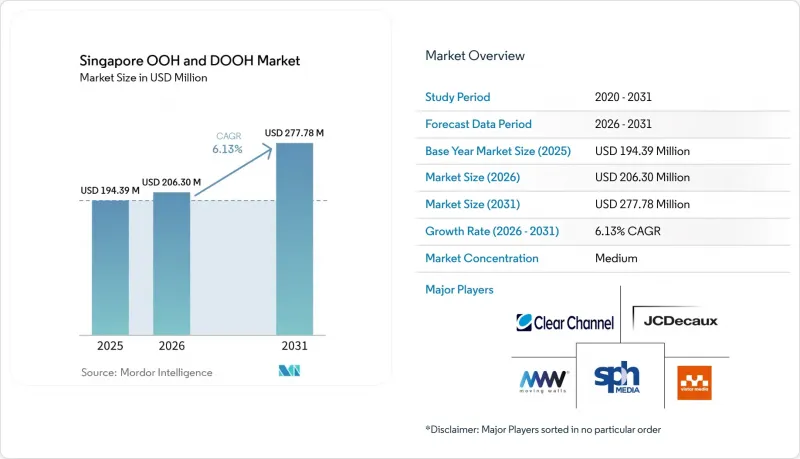
根據 Mordor Intelligence 的數據,2025 年新加坡戶外廣告和數位戶外廣告市場規模為 1.9439 億美元,預計到 2031 年將達到 2.7778 億美元,而 2026 年為 2.063 億美元,預測期(2026-2031 年)的複合年成長率為 6.3%。
本報告按類型(靜態戶外廣告、數位戶外廣告[程序化數位戶外廣告、互動式戶外廣告])、形式(廣告看板、交通廣告等)、安裝環境(室外、室內)和終端用戶行業(零售/消費品、汽車等)進行分類。市場預測以美元計價。
新加坡戶外及數位戶外市場趨勢與洞察
高階LED幕牆的迅速普及
烏節路正被重新定位為生活方式街區,業主們紛紛投資建造高解析度螢幕,將戲院級的畫質帶入街頭媒體。市區重建局(URA)的獎勵計畫鼓勵建築外觀維修,2025年起增設多個數位螢幕。濱海灣金沙正在新建一座塔樓和一個可容納15,000人的體育館,打造全新的室內外媒體區。這些地段人流量大,受眾群富裕,因此能帶來高額的CPM(每千次展示成本)。廣告主可以受益於動態排期、即時創新切換以及對觀眾的精準曝光。因此,數位戶外廣告(DOOH)的預算正穩步從靜態海報轉向這些數據豐富的優質螢幕,推動新加坡的戶外廣告和數位戶外廣告市場向更高的數位化滲透率邁進。
新加坡樟宜機場「星耀樟宜」及5號航廈擴建
樟宜機場星耀樟宜已發展成為一個集零售、景點和交通於一體的生活方式中心,為品牌提供了身臨其境型平台,觸及本地居民和旅客。預計未來十年內投入營運的5號航站樓,每年可接待5,000萬名旅客,屆時將迎來新一輪的交通廣告浪潮。德高集團已將其特許經營協議延長至2034年,確保廣告商能夠使用由100塊數位螢幕組成的機場廣告網路,其中包括一個14公尺高的「數位水晶燈」。樟宜機場擁有來自世界各地的穩定旅客群體,旅客停留時間更長,轉換率更高,是新加坡戶外廣告和數位戶外廣告市場的重要支柱。
市區重建局對大型廣告位實施嚴格監管
新加坡透過限制在保護區內設置廣告看板來保護其風景優美的走廊和歷史悠久的天際線。現行的廣告許可製度要求提交數位廣告方案,並限制任何有損建築美觀的廣告創新。這限制了廣告空間的成長,尤其是在牛車水和小印度等高人流量區域。供不應求可能會維持高價,同時也可能導致價格敏感型客戶流失,從而減緩新加坡戶外廣告和數位戶外廣告市場的擴張。
細分市場分析
在新加坡的戶外廣告(OOH)和數位戶外廣告(DOOH)市場中,數位戶外廣告市場預計將在2025年達到7,699萬美元,並在2031年之前以8.55%的複合年成長率成長。程式化廣告目前已佔數位螢幕收入的20%,德高集團預計到2025年這一比例將達到30%。動態創新最佳化技術使廣告主能夠即時調整訊息,以配合天氣、交通狀況和零售促銷活動。靜態廣告位在2025年仍將佔新加坡戶外廣告和數位戶外廣告市場佔有率的60.40%,但由於每千次展示成本(CPM)下降和預訂週期延長,其年成長率將僅為3.85%。儘管郊區城鎮中心的許多靜態廣告位仍然具有吸引力,是品牌長期曝光的理想場所,但業主正計分類階段升級為LED廣告,預計這將繼續推動收入轉移到數位廣告形式。
在新加坡的戶外廣告(OOH)和數位戶外廣告(DOOH)市場,媒體所有者提供分級套餐,將靜態海報和數位廣告看板相結合,既保護了傳統資產,又推動了高利潤螢幕的投放。日常消費品(FMCG)和娛樂品牌正積極採用全動態影片,與靜態圖片相比,動態影片可提升高達30%的品牌認知度。改進的衡量工具,例如經通訊業者位置資料檢驗的受眾印像模型,增強了廣告主對數位廣告覆蓋範圍的信心。這些進步進一步鞏固了數位戶外廣告在未來五年內作為廣告支出成長主要驅動力的地位。
預計到2025年,大眾運輸廣告收入將達到4,919萬美元,佔新加坡戶外廣告和數位戶外廣告市場規模的25.30%,並以9.12%的複合年成長率呈現最快成長動能。萊佛士坊和多美歌等地鐵站工作日客流量超過18萬人次,為通勤者提供了高密度的廣告曝光機會。根據《海峽時報》報道,陸路交通管理局(LTA)計劃於2025年指定一家巴士廣告獨家營運商,屆時將推出覆蓋5,800輛巴士和100個巴士總站的廣告套餐。如此規模的廣告投放將實現跨線路曝光和數據驅動的路線規劃,使公共交通媒體對全國性品牌更具吸引力。
廣告看板仍然是最大的單一廣告形式,佔據34.10%的市場佔有率,但由於安裝地點的限制,其成長速度正在放緩。隨著住宅發展局(HDB)數位螢幕在住宅日益普及,街道設施廣告正經歷著溫和成長,以適中的CPM實現了超本地化的覆蓋。機場媒體保持高價位,而德高集團的全球可編程機場網路允許廣告商在一個交易主機內對航班目的地進行地理圍欄投放。這些創新措施的結合,正在提升廣告主的興趣,並維持新加坡戶外廣告和數位戶外廣告市場的上升趨勢。
其他好處:
- Excel格式的市場預測(ME)表
- 3個月的分析師支持
目錄
第1章:引言
- 研究假設和市場定義
- 調查範圍
第2章:調查方法
第3章執行摘要
第4章 市場狀況
- 市場概覽
- 市場促進因素
- 烏節路和濱海灣金沙沿線豪華LED外牆的快速普及。
- 新加坡樟宜機場「星耀樟宜」和5號航站樓的擴建增加了轉機廣告庫存。
- 智慧國家計畫正在加速本地中小企業採用程式化數位戶外廣告。
- 新加坡金融管理局的開放銀行政策正在推動金融科技領域的戶外廣告支出。
- 從 SBS Transit/SMRT 行動應用程式取得的資料中提取出綜合通勤者洞察。
- 市場限制因素
- 市區重建局對大型零售商店的用地面積設定了嚴格的上限。
- 與該地區的其他城市(曼谷、吉隆坡)相比,媒體購買的 CPM 中位數較高。
- 歷史街區周圍的廣告禁區
- 監理展望
- 波特五力分析
- 產業生態系分析
第5章 市場規模與成長預測
- 按類型
- 靜態(傳統)戶外廣告
- 數位戶外廣告
- 程序化戶外廣告
- 其他類型的戶外數位廣告
- 按格式
- 廣告看板
- 街道家具
- 交通(公共交通)
- 飛機場
- 其他大眾運輸工具(地鐵、公車、計程車)
- 基於地點的媒體
- 透過安裝環境
- 戶外的
- 室內的
- 按最終用戶行業分類
- 車
- 零售和消費品
- 衛生保健
- BFSI
- 其他最終用戶
第6章 競爭情勢
- 策略趨勢
- Vendor Positioning Analysis
- 公司簡介
- JCDecaux Singapore Pte Ltd
- Clear Channel Singapore Pte Ltd
- Moving Walls Pte Ltd
- Talon Outdoor Ltd
- Moove Media
- Vistar Media
- Gleamedia
- SPH Media Ltd
- Hivestack Inc.
- Broadsign International LLC
- Asiaray Media Group Ltd
- Mediacorp Pte Ltd
- oOh!Media Singapore
- VGI Public Company Ltd(SG office)
- Stroer SE and Co. KGaA
- Pixel Media Mania Pte Ltd
- Ads On Cab Pte Ltd
- SY Media Advertising
- Scala Asia-Pacific Pte Ltd
- Stellar Ace
第7章 市場機會與未來展望
According to Mordor Intelligence, the singapore OOH And DOOH market size was valued at USD 194.39 million in 2025 and is estimated to grow from USD 206.30 million in 2026 to reach USD 277.78 million by 2031, at a CAGR of 6.13% during the forecast period (2026-2031).
This report is Segmented by Type (Static OOH, Digital OOH [Programmatic DOOH, Interactive OOH]), Format (Billboards, Transportation, and More), Location Environment (Outdoor, Indoor), End-User Industry (Retail and Consumer Goods, Automotive, and More). The Market Forecasts are Provided in Terms of Value (USD).
Singapore OOH And DOOH Market Trends and Insights
Rapid build-out of premium LED facades
Orchard Road is being repositioned as a lifestyle precinct, and property owners are investing in high-resolution screens that bring cinematic quality to street-level media. The URA's incentive scheme encourages facade upgrades that will add multiple digital canvases from 2025 onward. Marina Bay Sands will add a new tower and a 15,000-seat arena that together create fresh exterior and interior media zones. These sites attract premium CPMs because they marry high footfall with affluent audiences. Advertisers gain dynamic scheduling, real-time creative swaps, and audience impression guarantees. As a result, DOOH budgets move steadily from static posters into these data-rich premium screens, propelling the Singapore OOH and DOOH market toward higher digital penetration.
Singapore Changi Airport Jewel & T5 expansion
Jewel Changi Airport has matured into a lifestyle destination that blends retail, attractions, and transport, giving brands an immersive platform that reaches residents and travelers alike. Terminal 5, sized for 50 million annual passengers, will launch a wave of transit inventory when operations begin in the next decade. JCDecaux extended its concession through 2034, guaranteeing advertisers a coordinated airport network of 100 digital screens, including the 14-meter-tall Digital Chandelier. The consistent global traveler mix supports long dwell times and high conversion rates, making Changi a core pillar of the Singapore OOH and DOOH market.
Stringent URA cap on large-format sites
Singapore protects visual corridors and heritage skylines by limiting billboard approvals in conservation areas. The Advertising Licensing System now requires digital plan submissions and restricts creatives that impede building aesthetics. This curtails inventory growth, especially in high-traffic zones like Chinatown and Little India. Supply scarcity sustains price premiums and can deter price-sensitive sectors, slowing the expansion of the Singapore OOH and DOOH market.
Other drivers and restraints analyzed in the detailed report include:
- Smart-Nation push for programmatic DOOH
- MAS open-banking policy catalysing fintech OOH spend
- High median CPM versus regional peers
For complete list of drivers and restraints, kindly check the Table Of Contents.
Segment Analysis
The Singapore OOH and DOOH market size for Digital OOH reached USD 76.99 million in 2025 and is forecast to climb at an 8.55% CAGR through 2031. Programmatic trading already accounts for 20% of digital screen revenue, and JCDecaux expects that share to hit 30% by 2025. Dynamic creative optimization allows advertisers to align messaging with weather, traffic, and retail promotions in real time. Static inventory, while still holding 60.40% of the Singapore OOH and DOOH market share in 2025, sees slower 3.85% annual growth thanks to lower CPMs and longer booking cycles. Many static faces in suburban town centers remain attractive for long-term brand presence, yet landlords plan phased LED retrofits that will continue to tilt revenue toward digital formats.
In the Singapore OOH and DOOH market, media owners bundle static posters with digital panels to offer tiered packages that protect legacy assets while promoting high-margin screens. Brands in FMCG and entertainment embrace full-motion video because it yields recall uplifts of up to 30% compared with static. Improved measurement tools, such as audience impression modeling validated by telecom location data, provide advertisers with confidence in the incremental reach delivered by digital. These advances reinforce Digital OOH as the primary driver of incremental spend over the next five years.
Transit placements generated USD 49.19 million, equal to 25.30% of the Singapore OOH and DOOH market size in 2025, and exhibit the fastest trajectory at a 9.12% CAGR. MRT stations like Raffles Place and Dhoby Ghaut record weekday gate counts above 180,000, offering dense commuter impressions. The Straits Times reports that the Land Transport Authority will appoint a single concessionaire for bus advertising in 2025, allowing package sales across 5,800 buses and 100 terminals. This scale creates cross-line frequency and data-driven route planning, raising the appeal of transit media to national brands.
Billboards remain the largest individual format at 34.10% market share, yet growth lags due to site caps. Street furniture enjoys moderate expansion as Housing and Development Board (HDB) digital screens penetrate residential estates, delivering hyper-local reach at mid-range CPMs. Airport media enjoys premium pricing, and JCDecaux's global programmatic airport network lets advertisers geofence flight destinations inside one trading console. Collectively, these innovations intensify advertiser interest and sustain the upward curve of the Singapore OOH and DOOH market.
List of Companies Covered in this Report:
- JCDecaux Singapore Pte Ltd
- Clear Channel Singapore Pte Ltd
- Moving Walls Pte Ltd
- Talon Outdoor Ltd
- Moove Media
- Vistar Media
- Gleamedia
- SPH Media Ltd
- Hivestack Inc.
- Broadsign International LLC
- Asiaray Media Group Ltd
- Mediacorp Pte Ltd
- oOh!Media Singapore
- VGI Public Company Ltd (SG office)
- Stroer SE and Co. KGaA
- Pixel Media Mania Pte Ltd
- Ads On Cab Pte Ltd
- SY Media Advertising
- Scala Asia-Pacific Pte Ltd
- Stellar Ace
Additional Benefits:
- The market estimate (ME) sheet in Excel format
- 3 months of analyst support
TABLE OF CONTENTS
1 INTRODUCTION
- 1.1 Study Assumptions and Market Definition
- 1.2 Scope of the Study
2 RESEARCH METHODOLOGY
3 EXECUTIVE SUMMARY
4 MARKET LANDSCAPE
- 4.1 Market Overview
- 4.2 Market Drivers
- 4.2.1 Rapid build-out of premium LED facades along Orchard Road and Marina Bay Sands
- 4.2.2 Singapore Changi Airport's Jewel and T5 expansion boosting transit inventory
- 4.2.3 Smart-nation push accelerating programmatic-DOOH adoption by local SMEs
- 4.2.4 MAS open-banking policy catalysing fintech OOH spend
- 4.2.5 Data-mingled commuter insights from SBS Transit/SMRT mobile apps
- 4.3 Market Restraints
- 4.3.1 Stringent Urban Redevelopment Authority cap on large-format sites
- 4.3.2 High median media-buy CPM versus regional peers (Bangkok, Kuala Lumpur)
- 4.3.3 Advertising exclusion zones near heritage districts
- 4.4 Regulatory Outlook
- 4.5 Porter's Five Forces Analysis
- 4.5.1 Bargaining Power of Suppliers
- 4.5.2 Bargaining Power of Consumers
- 4.5.3 Threat of New Entrants
- 4.5.4 Competitive Rivalry within the Industry
- 4.5.5 Threat of Substitutes
- 4.6 Industry Ecosystem Analysis
5 MARKET SIZE AND GROWTH FORECASTS (VALUE)
- 5.1 By Type
- 5.1.1 Static (Traditional) OOH
- 5.1.2 Digital OOH
- 5.1.2.1 Programmatic-OOH
- 5.1.2.2 Other DOOH Types
- 5.2 By Format
- 5.2.1 Billboard
- 5.2.2 Street Furniture
- 5.2.3 Transportation (Transit)
- 5.2.3.1 Airports
- 5.2.3.2 Other Transit (MRT, buses, taxis)
- 5.2.4 Place-based Media
- 5.3 By Location Environment
- 5.3.1 Outdoor
- 5.3.2 Indoor
- 5.4 By End-User Industry
- 5.4.1 Automotive
- 5.4.2 Retail and Consumer Goods
- 5.4.3 Healthcare
- 5.4.4 BFSI
- 5.4.5 Other End Users
6 COMPETITIVE LANDSCAPE
- 6.1 Strategic Moves
- 6.2 Vendor Positioning Analysis
- 6.3 Company Profiles (includes Market-level Overview, Core Segments, Financials as available, Strategic Information, Products and Services, and Recent Developments)
- 6.3.1 JCDecaux Singapore Pte Ltd
- 6.3.2 Clear Channel Singapore Pte Ltd
- 6.3.3 Moving Walls Pte Ltd
- 6.3.4 Talon Outdoor Ltd
- 6.3.5 Moove Media
- 6.3.6 Vistar Media
- 6.3.7 Gleamedia
- 6.3.8 SPH Media Ltd
- 6.3.9 Hivestack Inc.
- 6.3.10 Broadsign International LLC
- 6.3.11 Asiaray Media Group Ltd
- 6.3.12 Mediacorp Pte Ltd
- 6.3.13 oOh!Media Singapore
- 6.3.14 VGI Public Company Ltd (SG office)
- 6.3.15 Stroer SE and Co. KGaA
- 6.3.16 Pixel Media Mania Pte Ltd
- 6.3.17 Ads On Cab Pte Ltd
- 6.3.18 SY Media Advertising
- 6.3.19 Scala Asia-Pacific Pte Ltd
- 6.3.20 Stellar Ace
7 MARKET OPPORTUNITIES AND FUTURE OUTLOOK
- 7.1 White-space and Unmet-Need Assessment

 法國數位戶外廣告 (DOOH):市場佔有率分析、行業趨勢和統計數據以及成長預測 (2026-2031)亞太地區戶外數位廣告:市場佔有率分析、產業趨勢與統計及成長預測(2026-2031)中東和非洲數位戶外(DOOH):市場佔有率分析、行業趨勢和統計數據以及成長預測 (2026-2031)
 全球數位戶外廣告市場規模、佔有率、趨勢和成長分析報告(2026-2034年)全球數位戶外廣告市場規模、佔有率、趨勢和成長分析報告(2026-2034年)數位戶外廣告:市場佔有率分析、產業趨勢與統計及成長預測(2026-2031 年)
 數位戶外(DOOH) 市場:按平台、媒體類型、螢幕尺寸、網路基礎設施、顯示類型和行業分類 - 全球預測,2026-2032 年英國戶外廣告和數位戶外廣告:市場佔有率分析、行業趨勢和統計數據以及成長預測(2026-2031 年)歐洲戶外廣告投放:市場佔有率分析、產業趨勢與統計及成長預測(2026-2031 年)
 全球數位戶外廣告 (DOOH) 市場:按格式類型、位置類型、顯示技術、內容格式、採購模式、應用程式和廣告主規模分類 - 市場規模、行業動態、機會分析和預測 (2026–2035)