


 |
市場調查報告書
商品編碼
2064509
多元化、股權和包容性 (DEI) 分析平台:市場佔有率分析、行業趨勢和統計數據、成長預測 (2026-2031)Diversity, Equity And Inclusion (DEI) Analytics Platform - Market Share Analysis, Industry Trends & Statistics, Growth Forecasts (2026 - 2031) |
||||||

※ 本網頁內容可能與最新版本有所差異。詳細情況請與我們聯繫。
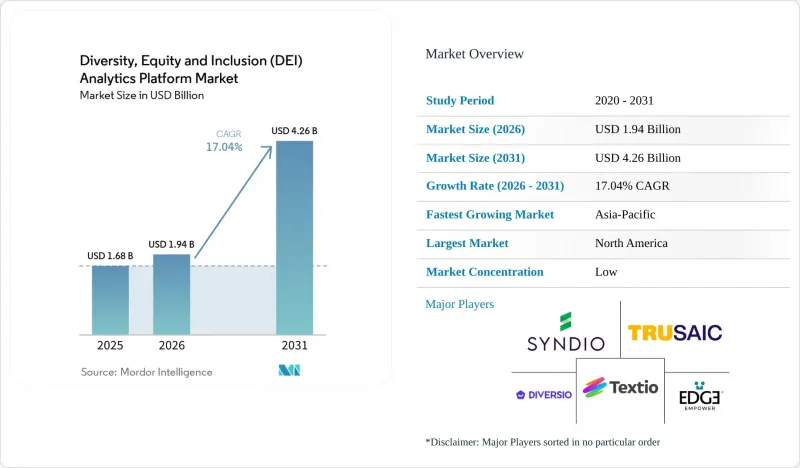
根據 Mordor Intelligence 預測,多元化、股權和包容性 (DEI) 分析平台的市場規模預計將在 2025 年達到 16.8 億美元,在 2026 年達到 19.4 億美元,並在 2031 年達到 42.6 億美元。
預計從 2026 年到 2031 年,其複合年成長率將達到 17.04%。
本報告按部署類型(雲端、本地部署、混合部署)、企業規模(大型企業等)、應用領域(薪酬差距和薪酬分析等)、最終用戶行業(銀行、金融服務和保險、醫療保健和生命科學、資訊科技和電信等)以及地區進行細分。市場預測以美元計價。
全球多元化、股權和包容性 (DEI) 分析平台市場趨勢與洞察
工資透明度合規期限的臨近正在加速推動相關需求。
工資透明度正從一項狹義的政策議題演變為擁有多地員工的雇主的一項廣泛營運要求。歐盟工資透明度指令要求成員國在2026年前將新規納入本國法律,這提升了能夠創建跨營業單位和跨職位級別工資差異一致記錄的工具的價值。當一個地點實施更嚴格的資訊揭露規則時,許多雇主會將這些標準視為公司範圍內的內部標準,因為每個地點採用不同的工資邏輯會帶來法律和行政風險。這種轉變促使分析工具的應用範圍超越合規團隊,擴展到薪酬方案、職位架構和經營團隊審查週期等領域。在多元化、公平和包容性(DEI)分析平台市場,擁有可審計工資工作流程的供應商佔據主導地位,因為雇主需要的不僅僅是匯總儀表板,他們還需要合理的解釋和可追溯的記錄。
在人才管理決策中使用人工智慧,增加了對偏見監控的需求。
人工智慧工具如今已被應用於招聘、績效評估、晉升和薪酬決策等領域,而偏見風險遠超傳統招聘軟體的範疇。紐約市第144號地方法律已強制要求對自動化招募決策工具進行年度偏見審計,紐約州審計長在2025年12月的一項調查顯示,獨立審計結果與正式執法結果之間存在明顯差異。在歐洲層面,與就業相關的人工智慧系統被人工智慧法律列為高風險領域,人才決策受到嚴格的合規性審查,儘管實施計畫仍在政策審查中。這意味著,在最終確定薪酬和招募決策之前,採購者越來越需要了解自動化建議的產生、測試和人工審核流程。在多元化、股權和包容性(DEI)分析平台市場,需求正從專業的DEI團隊擴展到任何在其核心人力資本工作流程中利用人工智慧的組織。
敏感員工資料的隱私和安全風險
多元化、公平和包容 (DEI) 分析依賴人口統計數據,而這些數據在許多司法管轄區被視為敏感個人數據,這直接限制了雇主可以收集的資訊及其使用方式。 2025 年的一篇報導指出,歐盟《人工智慧法案》第 10(5) 條僅允許在嚴格的合規框架內將敏感資料用於減少偏見。然而,許多中型企業仍然缺乏這樣的框架。此外,跨國營運的雇主還面臨另一個挑戰:美國常見的自我申報項目中的資料處理實務在其他地區可能更為嚴格。因此,許多分析團隊被迫使用不完整或自願提供的資料集,這降低了統計可靠性,並使一些報告難以作為可審計的證據。在多元化、股權和包容性 (DEI) 分析平台市場,這個問題是阻礙其在最受法律審查、社會課責和員工情緒影響的領域普及的最大障礙。
細分市場分析
到2025年,基於雲端的部署將佔據多元化、股權和包容性(DEI)分析平台68.73%的市場佔有率,使其成為需要在分散式人力資源系統中快速產生報告的組織的理想營運模式。這一優勢源於其易於部署、集中更新以及對快速變化的薪酬法規下多司法管轄區報告的卓越應對力。雲端工具還有助於整合薪資、招募和構成比數據,無需等待漫長的內部發布週期。這一點至關重要,因為DEI分析在資料持續流動而非透過年度手動擷取的情況下最為有效。在DEI分析平台產業,對於那些尋求更快合規性和更廣泛存取儀表板的公司而言,雲端仍然是首選。
預計到2031年,混合部署將以18.73%的複合年成長率成長,而針對這種模式的多元化、股權和包容性(DEI)分析平台市場也在不斷成長,因為跨國公司正在尋求在速度和數據居住管理之間取得平衡。這種模式適用於那些將可識別的人口統計資料保留在自身環境中,同時僅將有限的分析工作負載傳送到雲端的組織。 SAP SuccessFactors在2026年4月發布的版本中增加了薪資差距分析功能,以符合歐盟薪資透明度指令的要求。這表明,領先的人力資本管理(HCM)供應商正在將這些功能整合到其雲端套件中,而不是完全依賴外部工具。因此,儘管許多新的部署都以雲端或混合模式為中心,但本地部署系統在政府機構、受監管的金融部門和國防部門仍然發揮著至關重要的作用。
到2025年,大型企業將佔63.41%的市場佔有率,這反映出大型跨國雇主面臨最沉重的報告和管治負擔。這些公司通常管理更多的職位結構、更多的薪資層級和更多的本地合規規則,使得人工審核難以維持。歐盟的報告框架也促進了大型企業對平台的投資,因為員工資訊揭露現在更接近正式的永續發展報告。對於員工人數超過1,000人且收入超過4.5億歐元(5.08億美元)的組織閾值,實施一套綜合的員工報告系統已成為更為迫切的需求。因此,大型客戶仍然是多元化、股權和包容性(DEI)分析平台市場的商業性核心。
預計到2031年,中小企業(SME)將以19.62%的複合年成長率成長,隨著合規要求擴展到小規模的雇主,中小企業有望成為成長最快的買家群體。然而,各企業在實施準備方面仍有差距。一項2025年的調查顯示,許多企業尚未準備好應對歐盟關鍵的工資透明度要求,更遑論進行更廣泛的薪酬分析。這種差距催生了對輕量級實施方案、現成範本和引導式工作流程的需求,這些方案無需從一開始就配備完整的企業分析團隊。因此,多元化、公平和包容(DEI)分析平台產業的需求正在不斷擴大,從大型企業管治專案到需要更快、更系統化的合規性支援的中小企業,都對DEI分析平台的需求日益成長。
區域分析
到2025年,北美將佔據41.37%的市場佔有率,成為多元化、股權和包容性(DEI)分析平台市場最大的地區。該地區受益於對文件的高度重視,這使得雇主能夠證明其薪酬管治、招聘公平性和在複雜勞動力市場中的合法性。紐約市的自動化招聘審計法規仍然至關重要,因為它將偏見篩選從單純的政策辯論轉變為使用自動化決策工具的雇主的一項操作要求。政治壓力也改變了一些公司在2024年和2025年預算中的措辭,諸如“勞動力智慧”和“風險管理”之類的術語比明確的DEI術語更為常用。儘管如此,市場需求依然存在,因為對可審計的勞動力數據的根本需求並未消失。
歐洲是監管主導需求特徵最為顯著的地區之一,該地區多元化、公平和包容(DEI)分析平台的市場規模與正式的資訊揭露和報告要求密切相關。 ESRS S1 要求企業揭露可審計的薪資差距、歧視案例和董事會多元化情況,迫使企業為 2026 年的報告週期建立更完善的資料管道。歐盟的《工資透明指令》及相關的性別報告法規正在推動這項變革,它們要求在工資結構和員工權利方面實現更大的一致性。儘管英國仍在探索自己的發展道路,但性別薪資差距報告要求凸顯了歐洲大規模企業進行員工公平性分析的重要性。
預計到2031年,亞太地區將以21.12%的複合年成長率成長,成為預測期內成長最快的區域市場,並為多元化、股權和包容性(DEI)分析平台市場帶來重要的全新需求。日本已透過其上市公司性別資訊揭露法規奠定了堅實的基礎,而將多元化管理與企業競爭力聯繫起來的2025年框架正在推動經營團隊更廣泛地採用該平台。印度和中國仍處於平台應用的早期階段,而南美、中東和非洲市場則更為挑剔,其需求往往受到跨國公司在本地軟體生態系統成熟之前進行報告的需求驅動。因此,巴西、沙烏地阿拉伯、阿拉伯聯合大公國、南非和奈及利亞的重要性不在於其當前的市場規模,而在於隨著人們對數位化人力資源基礎設施和報告的期望不斷提高,這些市場將迎來長期成長。
其他好處:
- Excel格式的市場預測(ME)表
- 3個月的分析師支持
目錄
第1章:引言
- 研究假設和市場定義
- 調查範圍
第2章:調查方法
第3章執行摘要
第4章 市場狀況
- 市場概覽
- 市場促進因素
- 工資透明度合規期限的臨近正在加速推動相關需求。
- 人工智慧在員工決策中的應用日益廣泛,凸顯了偏見監控的必要性日益增強。
- 混合型勞動力管理模式使得人們越來越需要提高公平性的透明度。
- 董事會和投資者的審查力度加大,導致有關員工隊伍的資訊揭露要求也隨之提高。
- 歐洲永續發展報告的揭露需要可審計的包容性資料基礎設施。
- 就業演算法法規增加了對帶有偏見的審計和記錄保存的需求。
- 市場限制因素
- 敏感員工資料的隱私和安全風險
- 整合分散的人力資源資料堆疊的複雜性
- 美國的政治和法律阻力減緩了明確的多元化計畫的資金投入。
- 公司內部缺乏問責制以及投資回報評估的延遲導致採購決策被推遲。
- 產業價值與價值鏈分析
- 監理情勢
- 技術展望
- 宏觀經濟因素對市場的影響
- 波特五力分析
第5章 市場規模與成長預測
- 部署模式
- 基於雲端的
- 現場
- 混合
- 按最終用戶公司規模分類
- 大公司
- 小型企業
- 透過使用
- 薪資差距和薪資分析
- 招募、錄取和人才獲取中的股權分析。
- 晉升、績效和職業轉型分析
- 包容性、歸屬感與員工體驗分析
- 勞動力的人口統計和組成分析
- 合規性、ESG 和永續發展報告分析
- 偏見檢測和勞動力風險分析
- 多元化、公平與包容性基準測試與組織智慧
- 按最終用戶行業分類
- BFSI
- 醫療保健和生命科學
- 資訊科技/通訊
- 零售與電子商務
- 工業製造
- 政府/公共部門
- 按地區
- 北美洲
- 美國
- 加拿大
- 墨西哥
- 南美洲
- 巴西
- 阿根廷
- 其他南美國家
- 歐洲
- 德國
- 英國
- 法國
- 義大利
- 西班牙
- 俄羅斯
- 荷蘭
- 其他歐洲國家
- 亞太地區
- 中國
- 日本
- 印度
- 韓國
- 澳洲和紐西蘭
- 其他亞太國家
- 中東
- 沙烏地阿拉伯
- 阿拉伯聯合大公國
- 其他中東國家
- 非洲
- 南非
- 奈及利亞
- 其他非洲國家
- 北美洲
第6章 競爭情勢
- 市場集中度
- 策略趨勢
- 市佔率分析
- 公司簡介。
- Syndio
- First Capitol Consulting, Inc. dba Trusaic
- Diversio
- Textio, Inc.
- Mathison Technologies, Inc.
- Clusivity .
- EDGE Strategy AG
- Sysarb AB
- Aleria PBC
- TheDenominator, Inc.
- Visier Inc.
- Kanarys Inc
- Eskalera, Inc.
- Vault Platform Ltd.
- Be Applied Limited
- Ligilo Inc. d/b/a Inclusively
- Diversance, Inc.
- One Model Inc.
- Focus Orange Technology BV
- Aperian Global, Inc.
- Equalture BV
第7章 市場機會與未來展望
According to Mordor Intelligence, the diversity, equity, and Inclusion (DEI) Analytics Platform Market size is projected to be USD 1.68 billion in 2025, USD 1.94 billion in 2026, and reach USD 4.26 billion by 2031, growing at a CAGR of 17.04% from 2026 to 2031.
This report is Segmented by Deployment Mode (Cloud-Based, On-Premises, and Hybrid), Enterprise Size (Large Enterprises, and More), Application (Pay Equity and Compensation Analytics, and More), End-User Industry (BFSI, Healthcare and Life Sciences, Information Technology and Telecom, and More), and Geography. The Market Forecasts are Provided in Terms of Value (USD).
Global Diversity, Equity And Inclusion (DEI) Analytics Platform Market Trends and Insights
Pay Transparency Compliance Deadlines Accelerate Demand
Pay transparency has shifted from a narrow policy issue into a wider operating requirement for employers with multi-location workforces. The EU Pay Transparency Directive requires member states to transpose new rules by 2026, and that raises the value of tools that can create consistent pay gap records across entities and job levels. Once one location adopts a stricter disclosure rule, many employers treat that standard as the internal baseline across the whole company because separate pay logics by location create legal and administrative risk. That change pushes analytics procurement beyond compliance teams and into compensation planning, job architecture, and executive review cycles. In the DEI analytics platform market, vendors with auditable pay workflows benefit because employers need defensible explanations and traceable records, not just summary dashboards.
Artificial Intelligence-Enabled Workforce Decision-Making Expands Need for Bias Monitoring
AI tools are now used in hiring, evaluation, promotion, and compensation, extending bias risk well beyond older recruiting software. New York City's Local Law 144 already requires annual bias audits for automated employment decision tools, and a December 2025 review by the New York State Comptroller showed a clear gap between independent audit findings and formal enforcement outcomes. At the European level, employment-related AI systems fall into the high-risk category under the AI Act, which keeps workforce decision-making under close compliance scrutiny even as the implementation timeline remains under policy review. This means buyers increasingly need a record of how automated recommendations were generated, tested, and reviewed by humans before pay or hiring decisions are finalized. In the diversity, equity, and inclusion (DEI) analytics platform market, demand is broadening from specialist DEI teams to any organization using AI in core human capital workflows.
Sensitive Employee Data Privacy and Security Risks
DEI analytics depends on demographic fields that are treated as sensitive personal data in many jurisdictions, which immediately narrows what employers can collect and how they can use it. A 2025 article noted that Article 10(5) of the EU AI Act permits the use of sensitive data for bias mitigation only within a strict compliance framework, which many mid-sized organizations still lack. Cross-border employers then face another challenge: data practices common in U.S. self-identification programs may be more restricted elsewhere. That leaves many analytics teams working with partial or voluntary datasets, which weakens statistical confidence and makes some reports harder to treat as audit-grade evidence. In the diversity, equity, and inclusion (DEI) analytics platform market, this issue slows adoption most where legal review, public accountability, and workforce sensitivity are highest.
Other drivers and restraints analyzed in the detailed report include:
- Hybrid Workforce Management Increases Need for Equity Visibility
- Board and Investor Scrutiny Elevates Workforce Disclosure Requirements
- Integration Complexity Across Fragmented Human Resources Data Stacks
For complete list of drivers and restraints, kindly check the Table Of Contents.
Segment Analysis
Cloud-based deployment accounted for 68.73% of the diversity, equity, and inclusion (DEI) analytics platform market share in 2025, making it the clear operating model for organizations that need faster reporting across distributed HR systems. That lead came from easier deployment, centralized updates, and better support for multi-jurisdiction reporting when pay rules changed quickly. Cloud tools also help employers connect compensation, recruiting, and representation data without waiting for long internal release cycles. This matters because DEI analytics works best when data moves continuously rather than through yearly manual extracts. Within the DEI analytics platform industry, cloud remains the default choice for firms that want faster compliance execution and broader dashboard access.
Hybrid deployment is projected to expand at a 18.73% CAGR through 2031, and the diversity, equity, and inclusion (DEI) analytics platform market for this mode is growing as multinationals seek to balance speed with data residency controls. The pattern fits organizations that keep identifiable demographic records inside their own environments while sending limited analytics workloads to the cloud. SAP SuccessFactors added EU Pay Transparency Directive-ready pay gap analysis in its April 2026 release, which shows how major HCM vendors are building these capabilities into their cloud suites rather than leaving them fully to outside tools. On-premises systems, therefore, continue to play a durable role in government, regulated finance, and defense environments, even as most new deployments center on cloud or hybrid models.
Large enterprises held 63.41% share in 2025, reflecting the fact that large, multi-country employers face the highest reporting and governance burden. They usually manage more job structures, more pay bands, and more local compliance rules, which makes manual review hard to sustain. The EU reporting framework also favors platform spending by larger firms because workforce disclosures now sit closer to formal sustainability filings. Organizations above the revised threshold of more than 1,000 employees and EUR 450 million (USD 508 million) turnover face a clearer case for integrated workforce reporting systems. Large accounts, therefore, remain the commercial core of the diversity, equity, and inclusion (DEI) analytics platform market.
SMEs are projected to expand at a 19.62% CAGR through 2031, making them the fastest-growing buyer group as compliance expectations spread to smaller employer thresholds. Readiness remains uneven, and research in 2025 showed that many organizations were not prepared for core EU pay transparency requirements, with weaker readiness on wider compensation analysis. That gap creates space for lighter implementations, pre-built templates, and guided workflows that do not require a full enterprise analytics team from day one. The DEI analytics platform industry is therefore seeing demand widen from large enterprise governance programs toward smaller firms that need faster, more structured compliance support.
Geography Analysis
North America held a 41.37% share in 2025, making it the largest region in the diversity, equity, and inclusion (DEI) analytics platform market. The region benefits from strong employer focus on pay governance, hiring fairness, and defensible documentation across complex labor markets. New York City's automated hiring audit rule remains important because it turned bias review from a policy debate into an operating requirement for employers using automated decision tools. Political pressure also changed how some companies described budgets in 2024 and 2025, with workforce intelligence and risk management used more often than explicit DEI language. Even so, demand held because the underlying need for auditable workforce data did not disappear.
Europe has one of the most regulation-driven demand profiles, and the DEI analytics platform market size in the region is closely tied to formal disclosure and reporting requirements. ESRS S1 requires auditable disclosures on pay gaps, discrimination incidents, and board diversity, pushing companies toward stronger data pipelines for 2026 reporting cycles. The EU Pay Transparency Directive and related gender reporting rules are reinforcing that shift by requiring more consistency across pay structures and employee rights. The United Kingdom still follows its own path, but mandatory gender pay gap reporting keeps workforce equity analytics relevant for large employers across the wider European operating landscape.
Asia-Pacific is projected to grow at a 21.12% CAGR through 2031, making it the fastest-growing regional segment and an important source of new demand for the diversity, equity, and inclusion (DEI) analytics platform market over the forecast period. Japan has already set a meaningful baseline through listed-company gender disclosure rules, and its 2025 framework connected diversity management with corporate competitiveness, which supports wider executive adoption. India and China remain earlier in platform penetration, while South America, the Middle East, and Africa are still more selective markets where multinational reporting needs often lead demand before local software ecosystems deepen. Brazil, Saudi Arabia, the UAE, South Africa, and Nigeria, therefore, matter less for current scale than for long-run expansion once digital HR infrastructure and reporting expectations strengthen.
- Syndio
- First Capitol Consulting, Inc. dba Trusaic
- Diversio
- Textio, Inc.
- Mathison Technologies, Inc.
- Clusivity .
- EDGE Strategy AG
- Sysarb AB
- Aleria PBC
- TheDenominator, Inc.
- Visier Inc.
- Kanarys Inc
- Eskalera, Inc.
- Vault Platform Ltd.
- Be Applied Limited
- Ligilo Inc. d/b/a Inclusively
- Diversance, Inc.
- One Model Inc.
- Focus Orange Technology B.V.
- Aperian Global, Inc.
- Equalture B.V.
Additional Benefits:
- The market estimate (ME) sheet in Excel format
- 3 months of analyst support
TABLE OF CONTENTS
1 INTRODUCTION
- 1.1 Study Assumptions and Market Definition
- 1.2 Scope of the Study
2 RESEARCH METHODOLOGY
3 EXECUTIVE SUMMARY
4 MARKET LANDSCAPE
- 4.1 Market Overview
- 4.2 Market Drivers
- 4.2.1 Pay Transparency Compliance Deadlines Accelerate Demand
- 4.2.2 Artificial Intelligence-Enabled Workforce Decision-Making Expands Need for Bias Monitoring
- 4.2.3 Hybrid Workforce Management Increases Need for Equity Visibility
- 4.2.4 Board and Investor Scrutiny Elevates Workforce Disclosure Requirements
- 4.2.5 European Sustainability Reporting Disclosures Require Auditable Inclusion Data Infrastructure
- 4.2.6 Employment Algorithm Regulations Increase Bias Audit and Recordkeeping Demand
- 4.3 Market Restraints
- 4.3.1 Sensitive Employee Data Privacy and Security Risks
- 4.3.2 Integration Complexity Across Fragmented Human Resources Data Stacks
- 4.3.3 United States Political and Legal Backlash Slows Explicit Diversity Program Budgets
- 4.3.4 Weak Internal Ownership and Return on Investment Attribution Delay Buying Decisions
- 4.4 Industry Value and Supply-Chain Analysis
- 4.5 Regulatory Landscape
- 4.6 Technological Outlook
- 4.7 Impact of Macroeconomic Factors on the Market
- 4.8 Porter's Five Forces Analysis
- 4.8.1 Threat of New Entrants
- 4.8.2 Bargaining Power of Suppliers
- 4.8.3 Bargaining Power of Buyers
- 4.8.4 Threat of Substitutes
- 4.8.5 Intensity of Competitive Rivalry
5 MARKET SIZE AND GROWTH FORECASTS (VALUE)
- 5.1 By Deployment Mode
- 5.1.1 Cloud-Based
- 5.1.2 On-Premises
- 5.1.3 Hybrid
- 5.2 By End User Enterprise Size
- 5.2.1 Large Enterprises
- 5.2.2 Small and Medium-sized Enterprises
- 5.3 By Application
- 5.3.1 Pay Equity and Compensation Analytics
- 5.3.2 Hiring, Recruitment and Talent Acquisition Equity Analytics
- 5.3.3 Promotion, Performance and Career Mobility Analytics
- 5.3.4 Inclusion, Belonging and Employee Experience Analytics
- 5.3.5 Workforce Demographic and Representation Analytics
- 5.3.6 Compliance, ESG and Sustainability Reporting Analytics
- 5.3.7 Bias Detection and Workforce Risk Analytics
- 5.3.8 DEI Benchmarking and Organizational Intelligence
- 5.4 By End User Industry
- 5.4.1 BFSI
- 5.4.2 Healthcare and Life Sciences
- 5.4.3 Information Technology and Telecom
- 5.4.4 Retail and E-commerce
- 5.4.5 Industrial Manufacturing
- 5.4.6 Government and Public Sector
- 5.5 By Geography
- 5.5.1 North America
- 5.5.1.1 United States
- 5.5.1.2 Canada
- 5.5.1.3 Mexico
- 5.5.2 South America
- 5.5.2.1 Brazil
- 5.5.2.2 Argentina
- 5.5.2.3 Rest of South America
- 5.5.3 Europe
- 5.5.3.1 Germany
- 5.5.3.2 United Kingdom
- 5.5.3.3 France
- 5.5.3.4 Italy
- 5.5.3.5 Spain
- 5.5.3.6 Russia
- 5.5.3.7 Netherlands
- 5.5.3.8 Rest of Europe
- 5.5.4 Asia-Pacific
- 5.5.4.1 China
- 5.5.4.2 Japan
- 5.5.4.3 India
- 5.5.4.4 South Korea
- 5.5.4.5 Australia and New Zealand
- 5.5.4.6 Rest of Asia-Pacific
- 5.5.5 Middle East
- 5.5.5.1 Saudi Arabia
- 5.5.5.2 United Arab Emirates
- 5.5.5.3 Rest of Middle East
- 5.5.6 Africa
- 5.5.6.1 South Africa
- 5.5.6.2 Nigeria
- 5.5.6.3 Rest of Africa
- 5.5.1 North America
6 COMPETITIVE LANDSCAPE
- 6.1 Market Concentration
- 6.2 Strategic Moves
- 6.3 Market Share Analysis
- 6.4 Company Profiles (includes Global Level Overview, Market Level Overview, Core Segments, Financials as available, Strategic Information, Market Rank/Share, Products and Services, Recent Developments).
- 6.4.1 Syndio
- 6.4.2 First Capitol Consulting, Inc. dba Trusaic
- 6.4.3 Diversio
- 6.4.4 Textio, Inc.
- 6.4.5 Mathison Technologies, Inc.
- 6.4.6 Clusivity .
- 6.4.7 EDGE Strategy AG
- 6.4.8 Sysarb AB
- 6.4.9 Aleria PBC
- 6.4.10 TheDenominator, Inc.
- 6.4.11 Visier Inc.
- 6.4.12 Kanarys Inc
- 6.4.13 Eskalera, Inc.
- 6.4.14 Vault Platform Ltd.
- 6.4.15 Be Applied Limited
- 6.4.16 Ligilo Inc. d/b/a Inclusively
- 6.4.17 Diversance, Inc.
- 6.4.18 One Model Inc.
- 6.4.19 Focus Orange Technology B.V.
- 6.4.20 Aperian Global, Inc.
- 6.4.21 Equalture B.V.
7 MARKET OPPORTUNITIES AND FUTURE OUTLOOK
- 7.1 White-Space and Unmet-Need Assessment

 2026年全球多元化、股權和包容性(DEI)諮詢市場報告
 人力資源管理市場-2026-2032年全球市場預測
 人類潛能分析市場預測至2034年-按解決方案類型、部署模式、技術、應用、最終用戶和地區分類的全球分析人力資源分析市場:按組件、部署模式、組織規模和產業分類-2026-2032年全球市場預測
 薪資不平等分析平台:市場佔有率分析、產業趨勢與統計、成長預測(2026-2031)
 人力資源管理市場規模、佔有率和成長分析:按組件、部署模式、功能、組織規模、最終用戶產業和地區分類-2026-2033年產業預測人力資源資訊系統(HRIS):市場佔有率分析、產業趨勢與統計資料、成長預測(2026-2031)
 全球人力資源技術市場規模、佔有率、趨勢和成長分析報告(2026-2034)人力資源技術市場規模、佔有率、成長及全球產業分析:按類型、應用和地區的洞察,2026-2034年的預測
 勞動力管理系統市場:按應用和區域分類