


 |
市場調查報告書
商品編碼
2064021
中國高功率LED構裝:市佔率分析、產業趨勢與統計及成長預測(2026-2031年)China High-Power LED Package - Market Share Analysis, Industry Trends & Statistics, Growth Forecasts (2026 - 2031) |
||||||

※ 本網頁內容可能與最新版本有所差異。詳細情況請與我們聯繫。
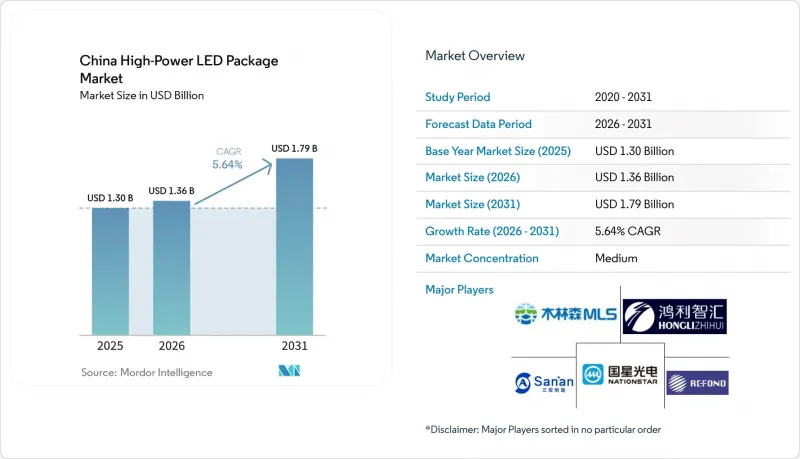
根據 Mordor Intelligence 預測,中國高功率LED構裝市場規模將從 2025 年的 13 億美元和 2026 年的 13.6 億美元成長到 2031 年的 17.9 億美元,2026 年至 2031 年的複合年成長率為 5.64%。
本報告依輸出功率範圍(1W–3W、3W–10W、10W以上)、封裝架構(單晶片封裝、多晶片封裝、COB等)及應用領域(通用照明、汽車照明、顯示器及背光、特殊及細分應用)進行分類。市場預測以美元(USD)計價。
中國高功率LED構裝市場趨勢與洞察
Mini-LED 和 Micro-LED 的快速普及需要更高的驅動電流。
目前,高階電視、平板電腦和汽車儀錶群均採用mini-LED和micro-LED背光,其單晶片LED數量是側入式背光系統的十倍。每塊面板上鍵合數千萬顆尺寸小於100微米的晶片,導致局部熱通量超過20 W/cm²,迫使封裝製造商重新設計散熱界面和擴散層,以應對汽車投影模組中超過1 A的晶片電流。國內供應商正在引入自動化傳質設備和銅芯基板來降低缺陷密度,但晶圓間發射波長的均勻性仍然是超高清顯示器實現無縫拼接的一大障礙。
新能源汽車廣泛採用自我調整矩陣式頭燈。
2024年,中國新能源汽車銷量達1,287萬輛,佔乘用車總銷量的40.9%。中階轎車每個頭燈至少配備100個可控像素,旗艦車型則整合超過25,000個像素,因此,符合AEC-Q101標準的板載晶片)或單晶片像素化LED的需求日益成長。垂直整合舉措,例如三安光電與Lumileds的合作,已使晶片成本降低了約30%,為中國晶片進入歐洲豪華車製造商的供應鏈鋪平了道路。
廣東、江西兩省產能過剩導致價格承壓
2022年至2024年間產能的大規模擴張導致供應過剩,使得平均售價下降了30%至40%。儘管2025年至2026年間,由於貴金屬價格飆升,價格出現短暫反彈,但由於通用照明產品的買家很容易推遲購買或降低驅動電流規格,利潤率的恢復仍然脆弱。資產出售和併購,例如近期對Pruy Optoelectronics的投資,顯示公司正在進行業務重組。
細分市場分析
即使到了2025年,中國1W-3W級高功率LED構裝市場仍將保持最大佔有率,這主要得益於改裝下照燈和路燈的需求。然而,晶片效率的提升使得照明製造商能夠用單一10W或更高發送器的發光體取代多個低功率封裝,從而減少驅動器數量和組裝工作。 10W或更高功率的封裝產品目前成長最為迅速,這主要得益於自適應驅動光束模組和1A或更高電流的工業高棚照明燈具的需求。熱阻低於1kW⁻¹的陶瓷基板和金錫晶片黏合技術正逐漸成為標準配置,雖然這推高了單位成本,但卻實現了先前無法實現的長期光通量維持。
熱設計創新也在改變中功率。銅芯金屬基板可將熱阻降低至約 1.3 kW⁻¹,成本僅為氮化鋁陶瓷的三分之一,但在 -40 度C至 125 度C的汽車級測試循環中,當功率超過 12 W 時,焊點會發生疲勞。因此,隨著熱問題的解決,設計人員將不再採用高電流節點,1 W 至 3 W 功率段的市佔率也將逐漸下降。這一趨勢進一步鞏固了中國主要封裝廠商的垂直整合優勢,這些廠商能夠自主完成基板壓制、磷光體配製和驅動電路等工序。
其他好處:
- Excel格式的市場預測(ME)表
- 3個月的分析師支持
目錄
第1章:引言
- 研究假設和市場定義
- 調查範圍
第2章:調查方法
第3章執行摘要
第4章 市場狀況
- 市場概覽
- 市場促進因素
- 逐步取消LED補貼將引導供應商採用更有效率的包裝方式。
- 微型/小型LED的快速普及對更高的驅動電流提出了需求。
- 更嚴格的公共照明裝置ERP標準
- 新能源汽車自我調整矩陣式頭燈的發展
- 智慧工廠維修需要高強度照明
- 半導體工廠中紫外線C波段殺菌模組的激增
- 市場限制因素
- 廣東和江西兩省產能過剩導致價格承壓
- 緊湊型外形尺寸中功耗超過 10 W 時的溫度控管限制
- 對覆晶金凸塊元件的高度依賴性
- PFAS法規導致封裝成本增加
- 技術分析
- 監理情勢
- 宏觀經濟因素的影響
- 波特五力分析
第5章 市場規模與成長預測
- 輸出範圍
- 1 W~3 W
- 3 W~10 W
- 超過10瓦
- 以建築學為例
- 單晶片封裝(SMD/分離式)
- 多晶片封裝(SMD)
- COB(板載晶片)
- 其他(CSP、覆晶、混合模組)
- 透過使用
- 一般照明
- 汽車照明
- 顯示器和背光
- 特殊/小眾
第6章 競爭情勢
- 市場集中度
- 策略趨勢
- 市佔率分析
- 公司簡介
- Sanan Optoelectronics Co., Ltd.
- Nationstar Optoelectronics Co., Ltd.
- MLS Co., Ltd.
- Hongli Zhihui Group Co., Ltd.
- Refond Optoelectronics Co., Ltd.
- Lextar Electronics Corp.
- Everlight Electronics Co., Ltd.
- Cree LED(Smart Global Holdings, Inc.)
- Nichia Corporation
- Seoul Semiconductor Co., Ltd.
- Osram Opto Semiconductors GmbH
- Lumileds Holding BV
- Dominant Opto Technologies Sdn. Bhd.
- Shenzhen Jufei Optoelectronics Co., Ltd.
- Kingsun Optoelectronic Co., Ltd.
- Sharp Corporation
- Samsung Electronics Co., Ltd.
- LG Innotek Co., Ltd.
- Lite-On Technology Corporation
- HC SemiTek Corporation
第7章 市場機會與未來展望
According to Mordor Intelligence, the china high-power LED package market size is projected to expand from USD 1.30 billion in 2025 and USD 1.36 billion in 2026 to USD 1.79 billion by 2031, registering a CAGR of 5.64% between 2026-2031.
This report is Segmented by Power Range (1W-3W, 3W-10W, and Above 10W), Architecture (Single-Die Packages, Multi-Die Packages, COB, and More), Application (General Lighting, Automotive Lighting, Display and Backlighting, and Specialty/Niche). The Market Forecasts are Provided in Terms of Value (USD).
China High-Power LED Package Market Trends and Insights
Rapid Mini and Micro-LED Adoption Demanding Higher Drive Currents
Mini and Micro-LED backlights now ship in premium televisions, tablets, and automotive instrument clusters, increasing per-unit LED counts ten-fold compared with edge-lit designs. Bonding tens of millions of sub-100-micrometer chips per panel pushes local heat flux above 20 W cm-2, so packagers are redesigning thermal interfaces and spreading layers to handle die currents that exceed 1 A in automotive projection modules. Domestic suppliers have installed automated mass-transfer tools and copper-core boards to cut defect density, yet wafer-to-wafer emission-wavelength uniformity remains a hurdle for seamless tiling in ultra-high-definition displays.
Growth of Adaptive Matrix Headlamps in New Energy Vehicles
China sold 12.87 million New Energy Vehicles in 2024, lifting NEV penetration to 40.9% of passenger-car sales. Each mid-range sedan already carries at least 100 controllable pixels per headlamp, and flagship models integrate more than 25,000, driving demand for chip-on-board or single-chip pixelated LEDs qualified to AEC-Q101. Vertical integration moves, such as the Sanan-Lumileds deal, trimmed chip cost nearly 30% and opened European luxury OEM supply chains to Chinese die.
Price Compression From Over-Capacity in Guangdong and Jiangxi
Large-scale capacity expansions between 2022-2024 created a supply glut that cut average selling prices 30-40%. Although precious-metal cost inflation triggered a brief price rebound in 2025-2026, margin recovery remains fragile as buyers in commodity lighting easily defer purchases or down-spec drive currents. Asset sales and mergers, such as a recent stake purchase in Purui Optoelectronics, illustrate ongoing rationalization.
Other drivers and restraints analyzed in the detailed report include:
- LED Subsidy Roll-Offs Steering Suppliers Toward High-Efficiency Packages
- ERP Standards Tightening for Public-Lighting Installations
- Thermal-Management Limits Above 10 W in Compact Form Factors
For complete list of drivers and restraints, kindly check the Table Of Contents.
Segment Analysis
The China high-power LED package market size for the 1 W-3 W tier remained the largest in 2025, buoyed by retrofit downlights and streetlighting. However, improved chip efficacy lets luminaire makers replace several low-watt packages with a single Above 10 W emitter, cutting driver count and assembly labor. Packages at or above 10 W already command the fastest growth, underpinned by adaptive driving-beam modules and industrial high-bay fixtures that operate above 1 A. Ceramic substrates delivering sub-1 K W-1 thermal resistance and gold-tin die attach are becoming standard, even though they raise unit cost, because they enable long-term lumen maintenance at currents that were once impractical.
Thermal innovations are also disrupting the mid-range. Copper-core metal-core boards lower thermal resistance to roughly 1.3 K W-1 at one-third the cost of aluminum-nitride ceramics, but solder-joint fatigue emerges above 12 W during the -40 °C to 125 °C automotive test cycle. The 1 W-3 W tier therefore faces gradual share erosion as designers opt for fewer high-current nodes once thermal hurdles are cleared. The trend amplifies vertical-integration advantages enjoyed by large Chinese packagers that control substrate pressing, phosphor compounding, and driver electronics in-house.
List of Companies Covered in this Report:
- Sanan Optoelectronics Co., Ltd.
- Nationstar Optoelectronics Co., Ltd.
- MLS Co., Ltd.
- Hongli Zhihui Group Co., Ltd.
- Refond Optoelectronics Co., Ltd.
- Lextar Electronics Corp.
- Everlight Electronics Co., Ltd.
- Cree LED (Smart Global Holdings, Inc.)
- Nichia Corporation
- Seoul Semiconductor Co., Ltd.
- Osram Opto Semiconductors GmbH
- Lumileds Holding B.V.
- Dominant Opto Technologies Sdn. Bhd.
- Shenzhen Jufei Optoelectronics Co., Ltd.
- Kingsun Optoelectronic Co., Ltd.
- Sharp Corporation
- Samsung Electronics Co., Ltd.
- LG Innotek Co., Ltd.
- Lite-On Technology Corporation
- HC SemiTek Corporation
Additional Benefits:
- The market estimate (ME) sheet in Excel format
- 3 months of analyst support
TABLE OF CONTENTS
1 INTRODUCTION
- 1.1 Study Assumptions and Market Definition
- 1.2 Scope of the Study
2 RESEARCH METHODOLOGY
3 EXECUTIVE SUMMARY
4 MARKET LANDSCAPE
- 4.1 Market Overview
- 4.2 Market Drivers
- 4.2.1 LED Subsidy Roll-offs Steering Suppliers Toward High-Efficiency Packages
- 4.2.2 Rapid Mini/Micro-LED Adoption Demanding Higher Drive Currents
- 4.2.3 ERP Standards Tightening for Public Lighting Installations
- 4.2.4 Growth of Adaptive Matrix Headlamps in New Energy Vehicles
- 4.2.5 Smart Factory Retrofits Requiring High-Lux Illumination
- 4.2.6 Surge in UV-C Disinfection Modules in Semiconductor Fabs
- 4.3 Market Restraints
- 4.3.1 Price Compression from Over-capacity in Guangdong and Jiangxi
- 4.3.2 Thermal-Management Limits Above 10 W in Compact Form-Factors
- 4.3.3 High Import Dependence for Flip-Chip Gold-Bump Equipment
- 4.3.4 PFAS Regulation Increasing Encapsulation Costs
- 4.4 Technology Analysis
- 4.5 Regulatory Landscape
- 4.6 Impact of Macroeconomic Factors
- 4.7 Porter's Five Forces Analysis
- 4.7.1 Bargaining Power of Suppliers
- 4.7.2 Bargaining Power of Buyers
- 4.7.3 Threat of New Entrants
- 4.7.4 Threat of Substitutes
- 4.7.5 Intensity of Competitive Rivalry
5 MARKET SIZE AND GROWTH FORECASTS (VALUE)
- 5.1 By Power Range
- 5.1.1 1 W - 3 W
- 5.1.2 3 W - 10 W
- 5.1.3 Above 10 W
- 5.2 By Architecture
- 5.2.1 Single-die Packages (SMD / Discrete)
- 5.2.2 Multi-die Packages (SMD)
- 5.2.3 COB (Chip-on-Board)
- 5.2.4 Others (CSP, Flip-chip, Hybrid Modules)
- 5.3 By Application
- 5.3.1 General Lighting
- 5.3.2 Automotive Lighting
- 5.3.3 Display and Backlighting
- 5.3.4 Specialty / Niche
6 COMPETITIVE LANDSCAPE
- 6.1 Market Concentration
- 6.2 Strategic Moves
- 6.3 Market Share Analysis
- 6.4 Company Profiles (includes Global Level Overview, Market Level Overview, Core Segments, Financials as available, Strategic Information, Market Rank/Share, Products and Services, Recent Developments)
- 6.4.1 Sanan Optoelectronics Co., Ltd.
- 6.4.2 Nationstar Optoelectronics Co., Ltd.
- 6.4.3 MLS Co., Ltd.
- 6.4.4 Hongli Zhihui Group Co., Ltd.
- 6.4.5 Refond Optoelectronics Co., Ltd.
- 6.4.6 Lextar Electronics Corp.
- 6.4.7 Everlight Electronics Co., Ltd.
- 6.4.8 Cree LED (Smart Global Holdings, Inc.)
- 6.4.9 Nichia Corporation
- 6.4.10 Seoul Semiconductor Co., Ltd.
- 6.4.11 Osram Opto Semiconductors GmbH
- 6.4.12 Lumileds Holding B.V.
- 6.4.13 Dominant Opto Technologies Sdn. Bhd.
- 6.4.14 Shenzhen Jufei Optoelectronics Co., Ltd.
- 6.4.15 Kingsun Optoelectronic Co., Ltd.
- 6.4.16 Sharp Corporation
- 6.4.17 Samsung Electronics Co., Ltd.
- 6.4.18 LG Innotek Co., Ltd.
- 6.4.19 Lite-On Technology Corporation
- 6.4.20 HC SemiTek Corporation
7 MARKET OPPORTUNITIES AND FUTURE OUTLOOK
- 7.1 White-Space and Unmet-Need Assessment


