


 |
市場調查報告書
商品編碼
2063737
南美洲平板玻璃市場:市場佔有率分析、產業趨勢與統計及成長預測(2026-2031 年)South America Flat Glass - Market Share Analysis, Industry Trends & Statistics, Growth Forecasts (2026 - 2031) |
||||||

※ 本網頁內容可能與最新版本有所差異。詳細情況請與我們聯繫。
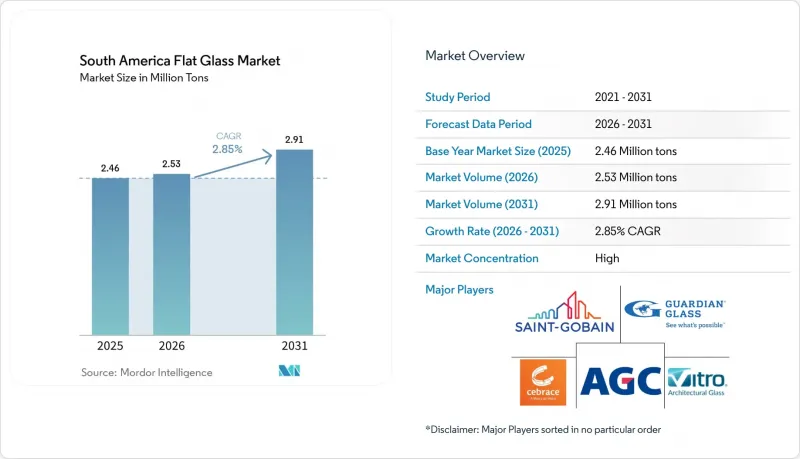
據 Mordor Intelligence 稱,南美平板玻璃市場預計將從 2025 年的 246 萬噸成長到 2026 年的 253 萬噸,到 2031 年達到 291 萬噸,2026 年至 2031 年的複合年成長率為 2.85%。
本報告按產品類型(無襯裡玻璃、鍍膜玻璃、加工玻璃、鏡面玻璃、壓花玻璃)、終端用戶行業(建築和施工、汽車、太陽能玻璃及其他終端用戶行業)和地區(巴西、阿根廷、哥倫比亞、智利、秘魯及其他南美國家)進行細分。市場預測以銷售量(噸)為單位。
南美洲平板玻璃市場的趨勢與洞察
巴西二線城市建設熱潮
在聖保羅和里約熱內盧以外的二線都會區,公共基礎建設投資和私人房地產資本流入速度較飽和的主要市場加快。預計到2025年,庫里蒂巴、貝洛奧裡藏特和累西腓的建築許可發放量將增加9%至14%,這將使建築立面面積增加約18萬平方公尺。儘管高階低輻射鍍膜在其他地區越來越受歡迎,但這些城市的開發商仍然優先考慮性價比高的退火玻璃和熱增強玻璃,從而穩定了浮法生產線的運轉率。需求的地理擴張迫使生產者建立區域服務中心,這增加了對營運資金的需求,但也提高了客戶維繫,尤其是在亞洲出口商面臨準時交貨挑戰的地區。建築需求的擴張支撐了對標準基板的穩定需求,同時也使加工商能夠擴展其磁控濺鍍和貼合加工能力。
該地區汽車製造業迅速擴張
作為其到2030年投資62.2億美元發展南美製造業藍圖的一部分,Stellantis已向其位於阿根廷科爾多瓦的工廠投資3.85億美元。此次升級將使年產能增加5萬台,並促進南方共同市場(Mercosur)對巴西、巴拉圭和烏拉圭的免稅貿易。巴西混合動力車的推出,結合了乙醇燃料和電動機,提高了對隔音性能的要求,並需要更大尺寸的多層擋風玻璃和側窗。預計每輛車的玻璃用量將成長8-12%,這將進一步擴大平板玻璃的需求,使其市佔率超過目前的10-12%。因此,汽車市場的成長正在推動製造業投資轉向強化玻璃、夾層玻璃和隔音夾層,即使在建築需求放緩的情況下,也能鞏固南美洲平板玻璃市場。
堿灰和液化天然氣價格波動
2025年第四季度,土耳其喀山蘇打電力公司實施的出口限制導致桑托斯地區的堿灰價格較去年同期上漲18%。同時,2026年1月,巴西石油公司(Petrobras)將液化天然氣(LNG)價格上調22%,以與歐洲基準價格接軌。這些成本上漲導致浮式生產線的營業利益率下降200-300個基點。開發商被迫在承擔這些成本或轉向鋁和聚碳酸酯等替代材料之間做出選擇,導致玻璃需求下降。缺乏對沖機制的小規模熔爐推遲了維修,而擁有長期堿灰和LNG互換協議的跨國公司加速了所有權整合。
細分市場分析
2025年,南美洲平板玻璃市場中,未襯裡玻璃佔總產量的79.32%。儘管目前仍佔據主導地位,但隨著加工玻璃預計到2031年將以3.65%的複合年成長率成長,其市場佔有率預計將會下降。夾層玻璃和強化玻璃符合巴西東北部的抗颶風標準,而低輻射鍍膜玻璃則符合智利的隔熱性能標準Decreto N05。 Guardian Glass和Saint-Gobain等製造商已引入三條銀濺鍍生產線,以滿足「Minha Casa Minha Vida」專案的要求,該專案要求太陽能熱增益係數低於0.35。加工玻璃利潤率高,能夠抵銷原物料價格波動的影響,並在銷售量逐步成長的情況下維持定價權。
Cebrace 的 Atmos 低碳系列產品可減少 50% 的隱含排放,將二氧化碳排放量限制在每平方公尺約 5 公斤。這符合哥倫比亞的 LEED 和 EDGE 能源與環境設計先鋒獎認證標準,根據哥倫比亞 2014 年第 1715 號法律,節能投資可享有 50% 的稅額扣抵。鏡面和圖案玻璃仍屬於小眾市場,主要用於裝飾和汽車後視鏡。隨著對加工產品的需求增加,退火玻璃的價格正在下降。聖戈班 2025 年的財務表現反映了這一點,其在拉丁美洲的銷售額成長了 13.5%,而銷售量僅成長了 8%,表明產品組合發生了顯著變化。這一趨勢正在使加工基板成為南美洲平板玻璃市場的主要驅動力。
其他好處:
- Excel格式的市場預測(ME)表
- 3個月的分析師支持
目錄
第1章:引言
- 研究假設和市場定義
- 調查範圍
第2章:調查方法
第3章執行摘要
第4章 市場狀況
- 市場概覽
- 市場促進因素
- 巴西中等城市建設熱潮
- 該地區汽車製造業迅速擴張
- 大型太陽能發電廠的擴建
- 政府對綠建築的稅收優惠
- 超薄顯示玻璃生產線回歸日本
- 市場限制因素
- 堿灰和液化天然氣價格波動
- 來自亞洲的低價進口商品增加
- 加強反應器排放法規
- 價值鏈分析
- 波特五力分析
第5章 市場規模與成長預測
- 依產品類型
- 退火玻璃
- 鍍膜玻璃
- 加工玻璃
- 鏡面玻璃
- 花紋玻璃
- 按最終用戶行業分類
- 建築/施工
- 車
- 太陽能玻璃
- 其他終端用戶產業
- 按地區
- 巴西
- 阿根廷
- 哥倫比亞
- 智利
- 秘魯
- 其他南美國家
第6章 競爭情勢
- 市場集中度
- 策略趨勢
- 市佔率和排名分析
- 公司簡介
- AGC Inc.
- AGP sGlass
- Cebrace Cristal Plano Ltda.
- Guardian Industries, LLC
- Nippon Sheet Glass Co. Ltd
- Saint-Gobain
- SCHOTT AG
- Sisecam
- Vitro
- VIVIX
第7章 市場機會與未來展望
According to Mordor Intelligence, the south america flat glass market size is expected to increase from 2.46 Million tons in 2025 to 2.53 Million tons in 2026 and reach 2.91 Million tons by 2031, growing at a CAGR of 2.85% over 2026-2031.
This report is Segmented by Product Type (Annealed Glass, Coated Glass, Processed Glass, Mirror Glass, and Patterned Glass), End-User Industry (Building and Construction, Automotive, Solar Glass, and Other End-User Industries), and Geography (Brazil, Argentina, Colombia, Chile, Peru, and Rest of South America). The Market Forecasts are Provided in Terms of Volume (Tons).
South America Flat Glass Market Trends and Insights
Construction Boom in Tier-2 Brazilian Cities
Secondary metropolitan areas outside Sao Paulo and Rio de Janeiro are receiving public infrastructure investments and private real estate funding at a faster pace compared to the saturated primary markets. Building permits issued in Curitiba, Belo Horizonte, and Recife increased by 9% to 14% in 2025, contributing an estimated 180,000 square meters of facade area. Developers in these cities continue to prioritize cost-effective annealed and heat-strengthened glass, ensuring consistent float-line utilization, even as premium low-E coatings gain popularity in other regions. The geographic spread of demand requires producers to establish regional service centers, increasing working capital needs but enhancing customer retention in areas where Asian exporters face challenges in providing just-in-time deliveries. This construction growth supports stable demand for standard substrates while allowing processors to expand magnetron-sputtering and laminating capabilities.
Rapid Scale-Up of Regional Automotive Output
Stellantis has allocated USD 385 million for its Cordoba, Argentina facility as part of its USD 6.22 billion South America manufacturing roadmap through 2030. This upgrade will boost capacity by 50,000 units annually, supporting Mercosur duty-free trade into Brazil, Paraguay, and Uruguay. Brazil's hybrid-flex vehicle rollout, which integrates ethanol capability with electric motors, is increasing acoustic requirements, necessitating larger, multi-layer windshields and side glazing. Glass content per vehicle is expected to grow by 8-12%, further driving flat-glass demand beyond its 10-12% volume share. Consequently, automotive growth is directing fabrication investments toward tempering, lamination, and acoustic interlayers, strengthening the South America flat glass market even during construction slowdowns.
Volatile Soda-Ash and LNG Prices
Soda-ash prices at Santos increased by 18% year-on-year in Q4 2025 due to export restrictions from Turkey's Kazan Soda Elektrik, while Petrobras raised liquefied natural gas tariffs by 22% in January 2026, aligning with European benchmarks. These cost increases reduced float-line operating margins by 200-300 basis points. Developers were forced to either absorb these costs or switch to alternative materials like aluminum and polycarbonate, reducing glass demand. Smaller furnaces without hedging mechanisms delayed rebuilds, accelerating ownership consolidation among multinationals with long-term soda-ash contracts and LNG swaps.
Other drivers and restraints analyzed in the detailed report include:
- Expansion of Utility-Scale Solar Farms
- Government Green-Building Tax Incentives
- Rising Low-Cost Imports from Asia
For complete list of drivers and restraints, kindly check the Table Of Contents.
Segment Analysis
The South America flat glass market size for annealed glass accounted for 79.32% of the total volume in 2025. Although still dominant, its share is expected to decline as processed glass is projected to grow at a 3.65% CAGR through 2031. Laminated and tempered glass meet hurricane code requirements in Brazil's Northeast, while low-E coatings comply with Chile's Decreto N05 thermal-performance standards. Producers like Guardian Glass and Saint-Gobain have installed triple-silver sputtering lines to cater to Minha Casa Minha Vida projects, which require solar heat-gain coefficients below 0.35. Processed glass offers higher margins, offsetting feedstock volatility and providing pricing power despite gradual volume increases.
Cebrace's Atmos low-carbon series reduces embedded emissions by 50% to approximately 5 kg CO2 per square meter, aligning with Leadership in Energy and Environmental Design (LEED) and Excellence in Design for Greater Efficiencies (EDGE) certifications in Colombia, where Law 1715/2014 allows 50% tax deductions for efficiency investments. Mirror and patterned glass remain niche, catering to decor and automotive rear-view mirrors. As processed products gain traction, annealed glass pricing softens, as seen in Saint-Gobain's 2025 results, where Latin America revenue increased by 13.5% against an 8% volume rise, indicating a significant product mix shift. This trend positions processed substrates as the primary growth driver for the South America flat glass market.
List of Companies Covered in this Report:
- AGC Inc.
- AGP sGlass
- Cebrace Cristal Plano Ltda.
- Guardian Industries, LLC
- Nippon Sheet Glass Co. Ltd
- Saint-Gobain
- SCHOTT AG
- Sisecam
- Vitro
- VIVIX
Additional Benefits:
- The market estimate (ME) sheet in Excel format
- 3 months of analyst support
TABLE OF CONTENTS
1 Introduction
- 1.1 Study Assumptions and Market Definition
- 1.2 Scope of the Study
2 Research Methodology
3 Executive Summary
4 Market Landscape
- 4.1 Market Overview
- 4.2 Market Drivers
- 4.2.1 Construction boom in Tier-2 Brazilian cities
- 4.2.2 Rapid scale-up of regional automotive output
- 4.2.3 Expansion of utility-scale solar farms
- 4.2.4 Government green-building tax incentives
- 4.2.5 On-shoring of ultra-thin display glass lines
- 4.3 Market Restraints
- 4.3.1 Volatile soda-ash and LNG prices
- 4.3.2 Rising low-cost imports from Asia
- 4.3.3 Stricter furnace-emission regulations
- 4.4 Value Chain Analysis
- 4.5 Porter's Five Forces Analysis
- 4.5.1 Bargaining Power of Suppliers
- 4.5.2 Bargaining Power of Consumers
- 4.5.3 Threat of New Entrants
- 4.5.4 Threat of Substitute Products and Services
- 4.5.5 Degree of Competition
5 Market Size and Growth Forecasts (Volume)
- 5.1 By Product Type
- 5.1.1 Annealed Glass
- 5.1.2 Coater Glass
- 5.1.3 Processed Glass
- 5.1.4 Mirror Glass
- 5.1.5 Patterned Glass
- 5.2 By End-user Industry
- 5.2.1 Building and Construction
- 5.2.2 Automotive
- 5.2.3 Solar Glass
- 5.2.4 Other End-user Industries
- 5.3 By Geography
- 5.3.1 Brazil
- 5.3.2 Argentina
- 5.3.3 Colombia
- 5.3.4 Chile
- 5.3.5 Peru
- 5.3.6 Rest of South America
6 Competitive Landscape
- 6.1 Market Concentration
- 6.2 Strategic Moves
- 6.3 Market Share (%)/Ranking Analysis
- 6.4 Company Profiles (includes Global level Overview, Market level overview, Core Segments, Financials as available, Strategic Information, Products and Services, and Recent Developments)
- 6.4.1 AGC Inc.
- 6.4.2 AGP sGlass
- 6.4.3 Cebrace Cristal Plano Ltda.
- 6.4.4 Guardian Industries, LLC
- 6.4.5 Nippon Sheet Glass Co. Ltd
- 6.4.6 Saint-Gobain
- 6.4.7 SCHOTT AG
- 6.4.8 Sisecam
- 6.4.9 Vitro
- 6.4.10 VIVIX
7 Market Opportunities and Future Outlook
- 7.1 White-space and Unmet-need Assessment

 平板玻璃市場:2026-2032年全球市場預測(依產品類型、鍍膜類型、應用、最終用途及通路分類)
 平板玻璃加工機械市場 - 全球產業規模、佔有率、趨勢、機會、預測:機器類型、終端用戶產業、玻璃類型、自動化程度、地區及競爭格局,2021-2031年
 平板玻璃市場規模、佔有率和趨勢分析報告:按產品、應用、地區和細分市場預測(2026-2033 年)平板玻璃市場-全球產業規模、佔有率、趨勢、機會和預測:按產品類型、技術、終端用戶產業、地區和競爭格局分類,2021-2031年
 平板玻璃市場:按產品、應用和地區分類
 2026年全球平板玻璃市場報告
 美國平板玻璃:市場佔有率分析、行業趨勢和統計數據、成長預測(2026-2031)平板玻璃製造機械市場:依產品類型、機器類型、技術、原料、產能和最終用途分類-全球預測,2026-2032年
 平板玻璃市場規模、佔有率、趨勢和預測:按技術、產品類型、原料、應用、類別、最終用途行業和地區分類,2026-2034年平板玻璃:市場佔有率分析、產業趨勢與統計、成長預測(2026-2031)