


 |
市場調查報告書
商品編碼
1939611
平板玻璃:市場佔有率分析、產業趨勢與統計、成長預測(2026-2031)Flat Glass - Market Share Analysis, Industry Trends & Statistics, Growth Forecasts (2026 - 2031) |
||||||

※ 本網頁內容可能與最新版本有所差異。詳細情況請與我們聯繫。
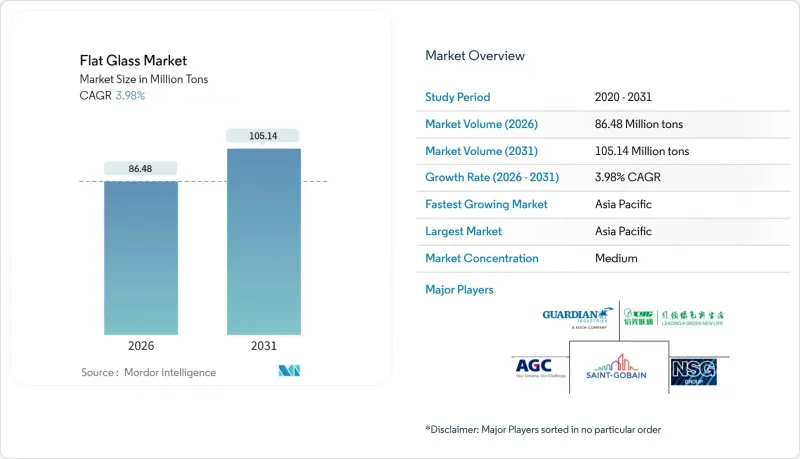
預計平板玻璃市場將從 2025 年的 8,317 萬噸成長到 2026 年的 8,648 萬噸,到 2031 年將達到 1.0514 億噸,2026 年至 2031 年的複合年成長率為 3.98%。
更嚴格的建築能源標準、太陽能光電發電裝置的快速擴張以及對先進玻璃產品需求旺盛的輕型車輛,共同推動了市場對玻璃的強勁需求。製造商正轉向低碳熔煉、綠氫能試點計畫以及氧電混合熔爐,以確保在永續性的競標中獲得溢價。用於光學模組的玻璃、用於醫療設施的抗菌塗層以及用於高層建築維修的超薄三層玻璃,都豐富了玻璃產品的收入來源。亞太地區是玻璃生產和消費的核心區域,而北美和歐洲則正在投資熔爐電氣化改造,以應對能源價格波動和即將到來的碳排放關稅。
全球平板玻璃市場趨勢及展望
加大對商業和住宅建築的投資
受借貸成本下降和開發商景氣增強的推動,全球建築支出預計將會增加。獨棟住宅價格上漲正推動多用戶住宅加速成長,從而持續刺激對採用Low-E低輻射鍍膜玻璃和三層中空玻璃的幕牆和窗戶系統的需求。開發商為獲得LEED認證而指定使用高性能玻璃,這進一步推高了對濺鍍膜和充氬氣隔熱產品的需求。建築規範中對窗牆比的限制鼓勵採用先進的玻璃解決方案,因此直接惠及平板玻璃市場。
由於電動車的安全性和輕量化,對汽車玻璃的需求增加。
電動車平台推動了對結構玻璃的需求,同時也促使人們採用輕質玻璃來抵消電池重量。福耀集團決定在2024年投資91億元人民幣(約12.6億美元)新建兩座工廠,以滿足新能源車的需求。超薄夾層擋風玻璃、全景天窗和抬頭顯示器擋風玻璃等產品正在推動加工玻璃的應用。感測器組件的整合提高了單車附加價值,在平板玻璃市場中形成了一個盈利的成長領域。更薄的玻璃帶來的空氣動力學性能提升也有助於最佳化續航里程,鞏固了玻璃在預測期內作為輕量化關鍵基材的地位。
聚合物、丙烯酸和聚碳酸酯替代品的興起
汽車製造商正在試用聚碳酸酯側窗和全景天窗,其重量比同類玻璃面板輕50%。雖然聚碳酸酯具有更高的光學清晰度和紫外線穩定性,但其耐刮擦性和耐熱性仍不如玻璃。嚴格的擋風玻璃法規限制了聚碳酸酯的應用,而替代風險主要集中在非承重玻璃領域。玻璃回收的優點以及更嚴格的報廢循環利用目標將進一步保障平板玻璃的市場規模。
細分市場分析
從2026年到2031年,加工玻璃將以4.65%的複合年成長率(CAGR)實現最快成長,超過整體平板玻璃市場。夾層玻璃和強化玻璃廣泛應用於對抗衝擊性要求極高的應用領域,例如汽車擋風玻璃、帷幕牆和安全建築幕牆。截至2025年,鋼化玻璃的產量仍將佔據主導地位,佔總產量的79.62%,因為它是下游加工的基礎。該細分市場的成本優勢將確保其在通用建築領域繼續保持核心地位,但隨著更嚴格的建築和安全規範增加對增值加工的需求,其市場佔有率預計將會放緩。
強制性隔熱標準正推動鍍膜玻璃、反射玻璃和Low-E低輻射鍍膜玻璃的同步發展。 AGC Glass Europe 的「5.5 kg CO2 eq/m2 低碳玻璃」便是產品差異化並獲得溢價的典範。在電動車 (EV) 中使用有色玻璃有助於車內降溫並提高電池效率。鏡面玻璃和圖案玻璃雖然仍屬於小眾市場,但在室內裝潢和隱私保護方面的需求正在不斷成長。總體而言,預計日益專業化的趨勢將推高平均售價,並使加工產品在預測期內擴大其在平板玻璃市場的佔有率。
平板玻璃市場報告按產品類型(冷加工玻璃、鍍膜玻璃、加工玻璃、鏡面玻璃、壓花玻璃)、終端用戶產業(建築、汽車、太陽能玻璃及其他終端用戶產業)和地區(亞太、北美、歐洲、南美、中東和非洲)進行細分。市場預測以噸為單位。
區域分析
到2025年,亞太地區將佔全球出貨量的63.88%,年複合成長率最高,達4.63%。在印度,根據旭硝子印度玻璃公司與INOX空氣產品公司簽署的為期20年的承購協議,一項新的浮法生產線擴建專案和綠色氫反應器測試正在進行中。
歐洲致力於引領脫碳進程。在歐盟創新基金的支持下,聖戈班和AGC已開始測試一種混合式爐,該爐採用50%的電氣化和富氧燃燒技術,可減少75%的二氧化碳排放。將於2026年生效的碳邊境調節機制(CBAM)附加稅有望鼓勵在地採購,並可能促進區域內銷售。北美製造商正在升級生產線,以增強其應對天然氣價格波動和環境、社會及公司治理(ESG)監管的能力,其中以Vitro公司1.8億美元的現代化計畫和Oi公司在英國的投資為代表。
南美洲和中東及非洲地區正經歷快速的都市化,但同時也面臨基礎設施短缺和亞洲進口產品的競爭。新的浮法玻璃計劃仍然受到嚴格篩選,但區域製造商越來越傾向於使用本地生產的面板以避免高昂的運費,預計這將推動產量逐步成長。總體而言,區域格局的轉變將使亞洲鞏固其在平板玻璃生產中的佔有率,而其他地區則繼續在平板玻璃市場追求更高價值的特殊產品。
其他福利:
- Excel格式的市場預測(ME)表
- 3個月的分析師支持
目錄
第1章 引言
- 研究假設和市場定義
- 調查範圍
第2章調查方法
第3章執行摘要
第4章 市場情勢
- 市場概覽
- 市場促進因素
- 擴大對商業和住宅建築領域的投資
- 由於電動車的安全性和輕量化要求,對汽車玻璃的需求增加。
- 光電模組用玻璃產能快速擴張
- 節能建築規範推動了對低輻射和三層玻璃的需求。
- 抗菌玻璃在醫療和酒店業的應用
- 市場限制
- 聚合物、丙烯酸和聚碳酸酯替代品的供應情況
- 堿灰和天然氣投入成本波動;
- 遵守歐盟碳邊境調節機制的成本
- 價值鏈分析
- 波特五力模型
- 供應商的議價能力
- 買方的議價能力
- 新進入者的威脅
- 替代產品和服務的威脅
- 競爭程度
第5章 市場規模與成長預測
- 依產品類型
- 強化玻璃
- 透明玻璃
- 有色玻璃
- 鍍膜玻璃
- 反射玻璃
- Low-E低輻射鍍膜玻璃
- 加工玻璃
- 夾層玻璃
- 強化玻璃
- 鏡面玻璃
- 花紋玻璃
- 強化玻璃
- 按最終用戶行業分類
- 建築/施工
- 車
- 太陽能玻璃
- 其他終端用戶產業
- 按地區
- 亞太地區
- 中國
- 印度
- 日本
- 韓國
- 馬來西亞
- 泰國
- 印尼
- 越南
- 亞太其他地區
- 北美洲
- 美國
- 加拿大
- 墨西哥
- 歐洲
- 德國
- 英國
- 義大利
- 法國
- 西班牙
- 北歐國家
- 土耳其
- 俄羅斯
- 其他歐洲地區
- 南美洲
- 巴西
- 阿根廷
- 哥倫比亞
- 其他南美洲
- 中東和非洲
- 沙烏地阿拉伯
- 卡達
- 阿拉伯聯合大公國
- 奈及利亞
- 埃及
- 南非
- 其他中東和非洲地區
- 亞太地區
第6章 競爭情勢
- 市場集中度
- 策略趨勢
- 市佔率(%)/排名分析
- 公司簡介
- Adamant Holding Company
- AGC Inc.
- Cardinal Glass Industries Inc.
- Central Glass Co., Ltd.
- China Glass Holdings Limited
- Euroglas
- Fuyao Group
- Guardian Industries
- Nippon Sheet Glass Co. Ltd
- Phoenicia
- Saint-Gobain
- SCHOTT
- Sisecam
- Taiwan Glass Industry Corporation
- Vitro
- Xinyi Glass Holdings Limited
第7章 市場機會與未來展望
The Flat Glass market is expected to grow from 83.17 Million tons in 2025 to 86.48 Million tons in 2026 and is forecast to reach 105.14 Million tons by 2031 at 3.98% CAGR over 2026-2031.
Demand resilience stems from stricter construction energy codes, rapid photovoltaic build-outs, and automotive lightweighting that favors advanced glazing. Manufacturers are shifting toward low-carbon melting, green hydrogen trials, and oxy-electric hybrid furnaces to secure price premiums in sustainability-conscious tenders. Solar module glass, antimicrobial coatings for healthcare facilities, and ultra-thin triple units for high-rise retrofits are expanding the revenue mix. Asia-Pacific anchors both production and consumption, while North America and Europe invest in furnace electrification to counter energy-price swings and looming carbon tariffs.
Global Flat Glass Market Trends and Insights
Growing Investments in Commercial and Residential Construction
Global construction outlays are forecast to climb, aided by lower borrowing costs and an uptick in developer sentiment. Multifamily starts accelerate in response to single-family affordability gaps, channeling sustained demand for curtain wall and window systems that integrate Low-E and triple-glazed units. Developers specify higher-performance glass to secure LEED credits, driving volume growth for sputter-coated and argon-filled insulating products. The flat glass market, therefore, benefits directly from code-driven window-to-wall ratios that favor advanced glazing solutions.
Rising Automotive Glazing Requirements for EV Safety and Lightweighting
Electric vehicle platforms intensify structural glazing needs while mandating lighter glass to offset battery mass. Fuyao committed CNY 9.1 billion (USD 1.26 billion) in 2024 for two new plants aimed at new-energy vehicle demand. Thin laminated windshields, panoramic roofs, and heads-up display-ready windscreens expand processed glass penetration. Embedded sensor packages elevate value per car, creating a lucrative growth pocket inside the broader flat glass market. Aerodynamic gains from slimmer profiles further align with range optimization, cementing glass as a critical lightweight substrate over the forecast horizon.
Availability of Polymer, Acrylic and Polycarbonate Substitutes
Automakers trial polycarbonate side windows and panoramic roofs that weigh up to 50% less than comparable glass panels. Optical clarity and UV stability have improved, yet scratch resistance and thermal tolerance still lag glass. Stringent windshield regulations keep polycarbonate use niche, confining substitution risk mostly to non-load-bearing glazing. Glass recycling advantages and tighter end-of-life circularity goals further insulate flat glass market volumes.
Other drivers and restraints analyzed in the detailed report include:
- Rapid Capacity Additions for Solar PV Module Glass
- Energy-Efficient Building Codes Boosting Low-E and Triple Glazing Demand
- Volatile Soda-Ash and Natural-Gas Input Costs
For complete list of drivers and restraints, kindly check the Table Of Contents.
Segment Analysis
Processed glass generated the fastest 4.65% CAGR between 2026 and 2031, outpacing the broader flat glass market. Laminated and tempered variants supply automotive windscreens, curtain walls, and security facades where impact resistance is critical. Annealed output still dominated in 2025 with 79.62% of volume because it serves as the base substrate for downstream upgrades. The segment's cost edge keeps it central to commodity construction, yet its share is set to moderate as codes and safety norms elevate demand for value-added treatments.
Coated, reflective, and Low-E sheets advance in parallel due to mandatory thermal standards. AGC Glass Europe's 5.5 kg CO2 eq/m2 Low-Carbon Glass exemplifies product differentiation that commands premium bids. Tinted glass usage in EVs supports cabin cooling and battery efficiency. Mirror and patterned glass remain niche but attractive for interior and privacy applications. Altogether, specialization raises average selling prices, widening the processed share in the flat glass market size over the forecast horizon.
The Flat Glass Report is Segmented by Product Type (Annealed Glass, Coated Glass, Processed Glass, Mirror Glass, and Patterned Glass), End-User Industry (Building and Construction, Automotive, Solar Glass, and Other End-User Industries), and Geography (Asia-Pacific, North America, Europe, South America, and Middle-East and Africa). The Market Forecasts are Provided in Terms of Volume (Tons).
Geography Analysis
The Asia-Pacific region secured 63.88% of 2025 shipments and is expanding at a 4.63% CAGR, the highest among regions. India is scaling new float lines while testing green hydrogen furnaces under a 20-year offtake pact between Asahi India Glass and INOX Air Products.
Europe focuses on decarbonization leadership. Saint-Gobain and AGC started trials of a hybrid furnace that cuts CO2 by 75% through 50% electrification and oxy-fuel combustion, supported by the EU Innovation Fund. Carbon Border Adjustment Mechanism fees, effective 2026 incentivize local sourcing, potentially boosting intra-regional sales. North American producers, led by Vitro's USD 180 million modernization and O-I's UK investment, upgrade lines to withstand gas-price volatility and ESG scrutiny.
South America, the Middle East, and Africa post rising urbanization but face infrastructure deficits and competition from Asian imports. Green-field float projects remain selective, though regional builders prefer local panes to avoid freight surcharges, supporting gradual volume growth. Altogether, geographic shifts keep Asia unchallenged in volume share while other regions chase value-added specialties within the flat glass market.
- Adamant Holding Company
- AGC Inc.
- Cardinal Glass Industries Inc.
- Central Glass Co., Ltd.
- China Glass Holdings Limited
- Euroglas
- Fuyao Group
- Guardian Industries
- Nippon Sheet Glass Co. Ltd
- Phoenicia
- Saint-Gobain
- SCHOTT
- Sisecam
- Taiwan Glass Industry Corporation
- Vitro
- Xinyi Glass Holdings Limited
Additional Benefits:
- The market estimate (ME) sheet in Excel format
- 3 months of analyst support
TABLE OF CONTENTS
1 Introduction
- 1.1 Study Assumptions and Market Definition
- 1.2 Scope of the Study
2 Research Methodology
3 Executive Summary
4 Market Landscape
- 4.1 Market Overview
- 4.2 Market Drivers
- 4.2.1 Growing Investments in Commercial and Residential Construction
- 4.2.2 Rising Automotive Glazing Requirements for EV Safety and Lightweighting
- 4.2.3 Rapid Capacity Additions for Solar PV Module Glass
- 4.2.4 Energy-Efficient Building Codes Boosting Low-E And Triple Glazing Demand
- 4.2.5 Uptake Of Antimicrobial Glass in Healthcare and Hospitality
- 4.3 Market Restraints
- 4.3.1 Availability of Polymer, Acrylic and Polycarbonate Substitutes
- 4.3.2 Volatile Soda-Ash and Natural-Gas Input Costs
- 4.3.3 EU Carbon Border Adjustment Mechanism Compliance Costs
- 4.4 Value Chain Analysis
- 4.5 Porter's Five Forces
- 4.5.1 Bargaining Power of Suppliers
- 4.5.2 Bargaining Power of Buyers
- 4.5.3 Threat of New Entrants
- 4.5.4 Threat of Substitute Products and Services
- 4.5.5 Degree of Competition
5 Market Size and Growth Forecasts (Volume)
- 5.1 By Product Type
- 5.1.1 Annealed Glass
- 5.1.1.1 Clear Glass
- 5.1.1.2 Tinted Glass
- 5.1.2 Coated Glass
- 5.1.2.1 Reflective Glass
- 5.1.2.2 Low-E Glass
- 5.1.3 Processed Glass
- 5.1.3.1 Laminated Glass
- 5.1.3.2 Tempered Glass
- 5.1.4 Mirror Glass
- 5.1.5 Patterned Glass
- 5.1.1 Annealed Glass
- 5.2 By End-user Industry
- 5.2.1 Building and Construction
- 5.2.2 Automotive
- 5.2.3 Solar Glass
- 5.2.4 Other End-user Industries
- 5.3 By Geography
- 5.3.1 Asia-Pacific
- 5.3.1.1 China
- 5.3.1.2 India
- 5.3.1.3 Japan
- 5.3.1.4 South Korea
- 5.3.1.5 Malaysia
- 5.3.1.6 Thailand
- 5.3.1.7 Indonesia
- 5.3.1.8 Vietnam
- 5.3.1.9 Rest of Asia-Pacific
- 5.3.2 North America
- 5.3.2.1 United States
- 5.3.2.2 Canada
- 5.3.2.3 Mexico
- 5.3.3 Europe
- 5.3.3.1 Germany
- 5.3.3.2 United Kingdom
- 5.3.3.3 Italy
- 5.3.3.4 France
- 5.3.3.5 Spain
- 5.3.3.6 Nordic Countries
- 5.3.3.7 Turkey
- 5.3.3.8 Russia
- 5.3.3.9 Rest of Europe
- 5.3.4 South America
- 5.3.4.1 Brazil
- 5.3.4.2 Argentina
- 5.3.4.3 Colombia
- 5.3.4.4 Rest of South America
- 5.3.5 Middle-East and Africa
- 5.3.5.1 Saudi Arabia
- 5.3.5.2 Qatar
- 5.3.5.3 United Arab Emirates
- 5.3.5.4 Nigeria
- 5.3.5.5 Egypt
- 5.3.5.6 South Africa
- 5.3.5.7 Rest of Middle-East and Africa
- 5.3.1 Asia-Pacific
6 Competitive Landscape
- 6.1 Market Concentration
- 6.2 Strategic Moves
- 6.3 Market Share (%)/Ranking Analysis
- 6.4 Company Profiles (includes Global level Overview, Market level overview, Core Segments, Financials as available, Strategic Information, Market Rank/Share, Products and Services, Recent Developments)
- 6.4.1 Adamant Holding Company
- 6.4.2 AGC Inc.
- 6.4.3 Cardinal Glass Industries Inc.
- 6.4.4 Central Glass Co., Ltd.
- 6.4.5 China Glass Holdings Limited
- 6.4.6 Euroglas
- 6.4.7 Fuyao Group
- 6.4.8 Guardian Industries
- 6.4.9 Nippon Sheet Glass Co. Ltd
- 6.4.10 Phoenicia
- 6.4.11 Saint-Gobain
- 6.4.12 SCHOTT
- 6.4.13 Sisecam
- 6.4.14 Taiwan Glass Industry Corporation
- 6.4.15 Vitro
- 6.4.16 Xinyi Glass Holdings Limited
7 Market Opportunities and Future Outlook
- 7.1 White-space and Unmet-need Assessment

 平板玻璃市場:2026-2032年全球市場預測(依產品類型、鍍膜類型、應用、最終用途及通路分類)
 平板玻璃加工機械市場 - 全球產業規模、佔有率、趨勢、機會、預測:機器類型、終端用戶產業、玻璃類型、自動化程度、地區及競爭格局,2021-2031年
 平板玻璃市場規模、佔有率和趨勢分析報告:按產品、應用、地區和細分市場預測(2026-2033 年)
 南美洲平板玻璃市場:市場佔有率分析、產業趨勢與統計及成長預測(2026-2031 年)平板玻璃市場-全球產業規模、佔有率、趨勢、機會和預測:按產品類型、技術、終端用戶產業、地區和競爭格局分類,2021-2031年
 平板玻璃市場:按產品、應用和地區分類
 2026年全球平板玻璃市場報告美國平板玻璃:市場佔有率分析、行業趨勢和統計數據、成長預測(2026-2031)平板玻璃製造機械市場:依產品類型、機器類型、技術、原料、產能和最終用途分類-全球預測,2026-2032年
 平板玻璃市場規模、佔有率、趨勢和預測:按技術、產品類型、原料、應用、類別、最終用途行業和地區分類,2026-2034年