


 |
市場調查報告書
商品編碼
2063421
企業級人工智慧勞動力平台:市場佔有率分析、產業趨勢與統計、成長預測(2026-2031)Enterprise AI Workforce Platforms - Market Share Analysis, Industry Trends & Statistics, Growth Forecasts (2026 - 2031) |
||||||

※ 本網頁內容可能與最新版本有所差異。詳細情況請與我們聯繫。
根據Mordor Intelligence預測,企業人工智慧勞動力平台市場規模預計將在2025年達到42.4億美元,2026年達到55.6億美元,到2031年達到231.2億美元。預計從2026年到2031年,該市場將以32.98%的複合年成長率成長。
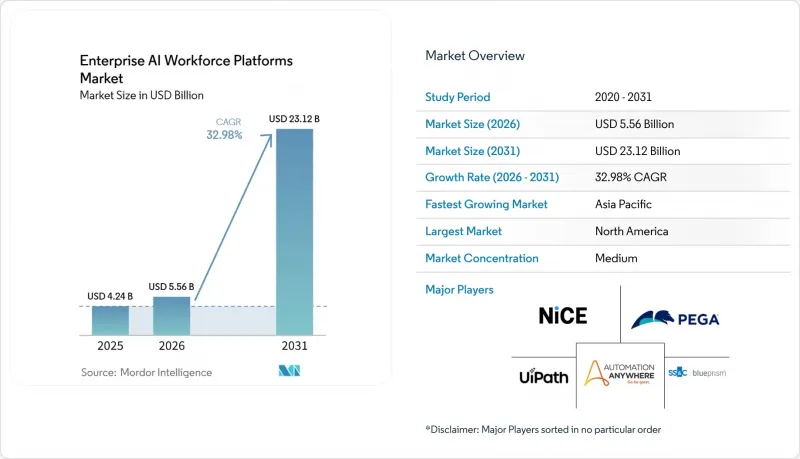
本報告按部署類型(本地部署、雲端部署、混合部署)、組件(軟體和服務)、最終用戶行業(IT與電信、醫療保健與生命科學、製造業、銀行、金融服務和保險、零售與電子商務、教育等)、組織規模(大型企業和中小企業)以及地區進行細分。市場預測以價值(美元)表示。
全球企業人工智慧勞動力平台市場趨勢與洞察
將生成式人工智慧助理整合到企業生產力套件中
透過將 Copilot 整合到常用的協作工具中,任務識別和自動化之間的手動操作得以消除,員工無需離開主應用程式即可呼叫代理。微軟報告稱,截至 2025 年 1 月,Copilot 的付費用戶已達 100 萬,文件建立和會議總結任務的耗時減少了 29%。 Salesforce 也推出了銷售團隊,使非技術人員能夠啟動自主客服代理,並在試點專案中將問題解決時間縮短了 40%。緊密整合增加了切換成本,因為企業更傾向於捆綁升級而非單獨採購。 ISO/IEC 42001 等合規框架正在推動供應商對嵌入式Copilot 進行認證,進一步鞏固了現有生產力套件提供者在採購名單上的地位。這些趨勢將加速第一波採用浪潮的需求,以支撐其高價策略。
人事費用上升正在加速自動化投資回報。
預計到2025年,印度IT服務業的薪資年增率將達到8-10%,菲律賓客服中心員工的薪資年增率將達到7-9%,人類勞動力與自動化代理之間的經濟差距正在縮小。自動化發票處理合約的收款週期預計將從2023年的24個月縮短至2025年的14個月。為此,越南政府設立了2億美元的激勵基金,用於推動工業人工智慧的應用,這顯示其政策與企業的自動化目標相符。因此,財務長們現在將對人工智慧人才的投資視為一種對沖通膨、穩定營業利潤率的手段。這種財務邏輯正在推動多年預算撥款,尤其是在後勤部門職能部門,因為重複性工作流程在成本結構中佔很大比例。
對資料居住和主權的強烈擔憂限制了跨境部署。
歐盟的《一般資料保護規則》(GDPR)、中國的《網路安全法》和印度的《數位個人資料保護法》都禁止不受限制的資料傳輸,迫使企業採用具有主權分區功能的混合拓撲結構。合規帶來的額外開銷,例如冗餘堆疊、合約保障措施和本地化支援團隊,推高了總體擁有成本 (TCO)。國際隱私專業人員協會 (IAPP) 的一項調查顯示,由於法律傳輸機制方面存在許多不不確定性,58% 的跨國公司正在推遲採用人工智慧驅動的維運輔助功能。供應商正在透過區域控制平面和邊緣運算方案來應對這項挑戰,但高昂的價格和複雜的維護成本抵消了雲端模式所承諾的部分成本節約。這種碎片化風險在處理敏感資料的產業(例如醫療保健、銀行和政府部門)中最為顯著。
細分市場分析
智慧自動化套件預計在2025年將佔總營收的41.37%,凸顯了其在大多數轉型藍圖中的第一步地位。企業重視整合到套件中的流程挖掘和文件智慧模組,這些模組能夠揭示高投資回報率的應用場景,並為處理異常情況的模型提供訓練資料。供應商正在將對話式人工智慧工作助理整合到同一技術堆疊中,這正在迅速擴大面向客戶的基於代理的聊天機器人企業級人工智慧勞動力平台的市場規模。同時,技能發展平台以33.98%的複合年成長率實現了最快成長,反映出企業正在策略性地轉向為因自動化而失業的員工提供技能再培訓。 Coursera預計,到2025年,其人工智慧課程的參與人數將激增180%。這一成長表明,企業致力於建立內部人才市場,將經過檢驗的技能與跨職能專案的需求相匹配。
如今,勞動力分析平台將預測建模與即時生產力遙測相結合,從而能夠在人員流動或績效下降發生之前進行主動干預。整合的人才市場將這些洞察與基於零工的任務相結合,以減少閒置時間並加速內部流動。微軟 Viva 的跨界成功(預計到 2025 年底將擁有 4,000 萬月有效用戶)表明,雇主需要一個能夠集中管理學習、互動和分析的統一平台。隨著套件的不斷融合,競爭日益激烈,因為買家更傾向於端到端的部署,而不是一系列零散的解決方案。隨著整合的深入,企業人工智慧人才平台市場中獨立零散產品的佔有率可能會縮小。
憑藉靈活的付費使用制和快速部署,雲端運算仍佔據主導地位,預計到2025年將保持63.52%的市場佔有率。然而,更嚴格的在地化法規和對即時推理的需求正促使企業轉向混合解決方案,預計該市場將以33.38%的複合年成長率成長。金融機構目前將敏感工作負載保留在本地,同時利用公共雲端進行不受其監管的分析。歐盟人工智慧法規中「高風險」的分類促使歐洲買家採用類似的碎片化架構,迫使供應商提供涵蓋邊緣和雲端的合規工具包。
製造業和醫院正在利用邊緣伺服器執行對延遲要求極高的測試和診斷任務,並將匿名資料傳輸到雲端叢集進行重新訓練。相當一部分招募人工智慧人才的組織傾向於採用混合方法,以平衡成本、合規性和效能。戴爾科技和HPE等基礎設施供應商正在將人工智慧最佳化的硬體和編配軟體捆綁銷售,從而在超大規模資料中心業者服務之外創造新的收入來源。隨著企業逐漸擺脫孤立的管理主機,提供跨部署類型單一螢幕策略管理的供應商有望進一步提高客戶留存率。
區域分析
到2025年,北美將佔全球整體收入的35.73%,並持續維持市場主導地位。這項優勢歸功於多面向因素,包括高工資推動了對自動化的需求、成熟完善的雲端生態系,以及生產力套件中輔助控制模組的快速普及。這些輔助控制模組能夠提升營運效率並簡化工作流程,因此在北美地區備受企業青睞。此外,北美還擁有強大的創業投資生態系統,積極支持專業編配附加元件的開發和供應。這些附加元件進一步增強了平台的功能和利用率,鞏固了該地區的市場領導地位。
亞太地區是成長最快的地區,預計2026年至2031年複合年成長率將達33.98%。傳統外包地點的薪資上漲正在削弱勞動成本優勢,促使印度、菲律賓和越南的企業實現後勤部門營運自動化。政府的支持措施也在提振需求。印度的「國家人工智慧戰略」累計12億美元用於特定產業的AI應用獎勵,而日本的補貼計畫則為中小型製造商提供高達50%的平台成本補貼。在中國,本土供應商正在將AI勞動力工具整合到國內協作套件中,以避免對外國雲端服務的監管。
歐洲面臨更為複雜的發展路徑。歐盟人工智慧法規要求對高風險部署進行符合性評估、文件編制和上市後監測,這導致6-12個月的前置作業時間和不斷膨脹的合規預算。儘管如此,大量公共資金湧入可靠的人工智慧研究,正促使企業將自動化視為「必然趨勢」而非「可選項」。南美洲的成長主要集中在巴西和阿根廷,貨幣波動促使財務長們透過提高生產力來對沖風險。中東的買家,尤其是沙烏地阿拉伯和阿拉伯聯合大公國(阿拉伯聯合大公國)的買家,正在將人工智慧代理商整合到電子政府服務中,以提高服務交付水準。非洲仍在發展中,但南非和肯亞透過與區域系統整合商的合作,已展現出初步的發展勢頭。
其他好處:
- Excel格式的市場預測(ME)表
- 3個月的分析師支持
目錄
第1章:引言
- 研究假設和市場定義
- 調查範圍
第2章:調查方法
第3章執行摘要
第4章 市場狀況
- 市場概覽
- 市場促進因素
- 將生成式人工智慧助理整合到企業生產力套件中
- 人事費用上升和通貨膨脹正在加速自動化帶來的投資回報。
- 公民開發者的低程式碼和無程式碼 AI編配平台迅速普及
- 獨立軟體開發商提供的現有AI人才技能庫
- 供應商轉向按使用量定價:與業務成果保持一致
- 人工智慧管治工具的出現,使得大規模勞動力部署成為可能。
- 市場限制因素
- 對資料居住和主權的強烈擔憂限制了跨境部署。
- 非英語知識工作領域缺乏特定領域的AI訓練資料。
- 員工抵制和工會反彈源自於對失業的恐懼。
- 推理工作負載的高能耗和碳足跡阻礙了 ESG 目標的實現。
- 宏觀經濟因素對市場的影響
- 產業價值鏈分析
- 監理情勢
- 技術展望
- 波特五力分析
第5章 市場規模與成長預測
- 按平台
- 智慧自動化套件
- 互動式人工智慧工作助手
- 人工智慧驅動的技能發展平台
- 勞動力分析與最佳化平台
- 整合人才市場平台
- 按部署模式
- 雲
- 現場
- 混合
- 按組織規模
- 大公司
- 小型企業
- 按最終用戶行業分類
- 資訊科技/通訊
- BFSI
- 醫療保健和生命科學
- 零售與電子商務
- 製造業
- 公部門
- 其他終端用戶產業
- 按地區
- 北美洲
- 美國
- 加拿大
- 墨西哥
- 南美洲
- 巴西
- 阿根廷
- 其他南美國家
- 歐洲
- 英國
- 德國
- 法國
- 義大利
- 西班牙
- 其他歐洲國家
- 亞太地區
- 中國
- 日本
- 印度
- 韓國
- 其他亞太國家
- 中東和非洲
- 中東
- 阿拉伯聯合大公國
- 沙烏地阿拉伯
- 其他中東國家
- 非洲
- 南非
- 埃及
- 其他非洲國家
- 中東
- 北美洲
第6章 競爭情勢
- 市場集中度
- 策略趨勢
- 市佔率分析
- 公司簡介
- UiPath Inc.
- Automation Anywhere, Inc.
- SS&C Blue Prism Group Ltd.
- WorkFusion, Inc.
- NICE Ltd.
- Pegasystems Inc.
- Kofax Inc.
- Appian Corporation
- AntWorks Pte Ltd.
- EdgeVerve Systems Limited
- IPsoft Inc.(d/b/a Amelia)
- Laiye Technology Ltd.
- Nintex Global Ltd.
- Cognigy GmbH
- Kore.ai, Inc.
- Aisera, Inc.
- Hyperscience Inc.
- Celonis SE
- Capacity LLC
- Soroco India Private Limited
第7章 市場機會與未來展望
According to Mordor Intelligence, the enterprise AI workforce platforms market size is projected to be USD 4.24 billion in 2025, USD 5.56 billion in 2026, and reach USD 23.12 billion by 2031, growing at a CAGR of 32.98% from 2026 to 2031.
This report is Segmented by Deployment Mode (On-Premise, Cloud, and Hybrid), Component (Software and Services), End-User Industry (IT and Telecom, Healthcare and Life Sciences, Manufacturing, BFSI, Retail and E-Commerce, Education, and More), Organization Size (Large Enterprises and Small and Medium Enterprises), and Geography. The Market Forecasts are Provided in Terms of Value (USD).
Global Enterprise AI Workforce Platforms Market Trends and Insights
Integration of Generative AI Co-Pilots into Enterprise Productivity Suites
Embedding co-pilots inside familiar collaboration tools removes the hand-off between task identification and automation, allowing workers to invoke agents without leaving the application of record. Microsoft reported 1 million paying Copilot subscribers by January 2025 and indicated 29% time savings on document creation and meeting summarization tasks. Salesforce followed up with Agentforce, enabling non-technical staff to launch autonomous customer service agents that shortened resolution time by 40% in pilots. Tight integration raises switching costs because enterprises prefer bundled upgrades over separate procurement cycles. Compliance frameworks such as ISO/IEC 42001 are pushing vendors to certify embedded co-pilots, further cementing incumbent productivity-suite providers on buyer shortlists. Collectively, these dynamics front-load demand and support premium pricing during the first wave of adoption.
Rising Labor Cost Inflation Accelerating Automation ROI
Annual wage growth of 8-10% in India's IT services sector and 7-9% in the Philippines' call-center workforce during 2025 shrank the economic spread between human labor and autonomous agents. Breakeven periods for invoice-processing automation contracts are projected to decrease from 24 months in 2023 to 14 months in 2025. Vietnam's government reacted by creating a USD 200 million incentive fund for industrial AI deployments, signifying policy alignment with enterprise automation goals. As a result, CFOs now frame AI workforce investments as inflation hedges that stabilize operating margins. The fiscal logic reinforces multi-year budget allocations, especially within back-office functions where repetitive workflows dominate cost structures.
Persistent Data Residency and Sovereignty Concerns Limiting Cross-Border Deployments
The EU General Data Protection Regulation, China's Cybersecurity Law, and India's Digital Personal Data Protection Act prohibit unrestricted data transfer, compelling enterprises to adopt hybrid topologies with sovereign partitions. Compliance overhead elevates the total cost of ownership by requiring redundant stacks, contractual safeguards, and localized support teams. An International Association of Privacy Professionals survey found that 58% of multinationals postponed AI workforce deployments due to lingering uncertainty over legal transfer mechanisms. Vendors have responded with regionalized control planes and edge options, but premium pricing and maintenance complexity neutralize some of the cost savings that cloud models promise. The fragmentation risk is greatest in sectors that hold sensitive data, such as healthcare, banking, and public administration.
Other drivers and restraints analyzed in the detailed report include:
- Rapid Adoption of Low-Code and No-Code AI Orchestration Platforms for Citizen Developers
- Availability of Pre-Built AI Workforce Skill Libraries from Independent ISVs
- Shortage of Domain-Specific AI Training Data for Non-English Knowledge Work
For complete list of drivers and restraints, kindly check the Table Of Contents.
Segment Analysis
Intelligent automation suites held 41.37% of 2025 revenue, confirming their role as the first step on most transformation roadmaps. Enterprises value the suites' integrated process mining and document intelligence modules, which surface high-ROI use cases and supply training data to models that handle exceptions. Vendors are folding conversational AI work assistants into the same stack, enabling the enterprise AI workforce platforms market size for agentic chatbots to climb rapidly in customer-facing scenarios. Skill development platforms, however, register the steepest climb at a 33.98% CAGR, reflecting a strategic pivot toward reskilling workers displaced by automation. Coursera logged a 180% enrollment jump in generative AI courses during 2025. That surge signals institutional commitment to internal talent marketplaces that match verified competencies with project needs across business lines.
Workforce analytics platforms now fuse predictive modeling with real-time productivity telemetry, encouraging proactive interventions before attrition or performance dips occur. Integrated talent marketplaces blend these insights with gig-style assignments, reducing idle time and improving internal mobility. Microsoft Viva's crossover success, 40 million monthly active users by late 2025, shows that employers want a unified pane of glass for learning, engagement, and analytics. Cross-suite convergence is intensifying competition,because buyers prefer end-to-end provisioning over stitching together point solutions. As convergence advances, the enterprise AI workforce platforms market share for standalone point products is likely to compress.
Cloud remained dominant at 63.52% in 2025 thanks to elastic consumption billing and rapid onboarding. Yet stricter localization laws and real-time inference needs are pushing organizations toward hybrid solutions, which are registering a 33.38% CAGR. Financial institutions now keep sensitive workloads on-premise while leveraging public clouds for analytics that fall outside supervisory scope. The EU AI Act's high-risk classification is catalyzing European buyers to enact similar split architectures, forcing vendors to offer compliance toolkits that span edge and cloud.
Manufacturers and hospitals are adopting edge servers for latency-critical inspection and diagnostic tasks, forwarding anonymized data to cloud clusters for retraining. A significant portion of AI workforce adopters prefer a hybrid approach to balance cost, compliance, and performance. Infrastructure vendors such as Dell Technologies and HPE are bundling AI-optimized hardware with orchestration software, opening a parallel revenue stream adjacent to hyperscaler services. Vendors that supply single-pane policy management across deployment types stand to gain incremental stickiness as enterprises avoid siloed admin consoles.
Geography Analysis
North America accounted for 35.73% of global revenue in 2025, maintaining its position as a leading region in the market. This dominance is attributed to several factors, including high wages that drive demand for automation, a well-established, mature cloud ecosystem, and the rapid adoption of productivity-suite co-pilots. These co-pilots enhance operational efficiency and streamline workflows, making them highly sought after by enterprises in the region. Additionally, North America benefits from a robust venture capital ecosystem that actively supports the development and supply of specialized orchestration add-ons. These add-ons further enhance platform functionality and utilization rates, solidifying the region's leadership in the market.
Asia-Pacific is the fastest-growing region, with a 33.98% CAGR projected for 2026-2031. Wage inflation in traditional outsourcing centers is shrinking the labor arbitrage cushion, prompting companies in India, the Philippines, and Vietnam to automate back-office tasks. Government programs reinforce demand. India's National Strategy for Artificial Intelligence earmarked USD 1.2 billion for sectoral AI adoption incentives, while Japan's subsidy program reimburses up to 50% of platform costs for small manufacturers. In China, local vendors integrate AI workforce tools into domestic collaboration suites, sidestepping foreign cloud restrictions.
Europe faces a more nuanced path. The EU AI Act imposes conformity assessments, documentation, and post-market monitoring for high-risk deployments, adding six-to-twelve-month lead times and inflating compliance budgets. Still, public funding for trustworthy AI research ensures that enterprises view automation as inevitable, not optional. South America's growth is concentrated in Brazil and Argentina, where currency volatility motivates CFOs to hedge with productivity gains. Middle East buyers, led by Saudi Arabia and the United Arab Emirates, embed AI agents in e-government services to raise service delivery standards. Africa remains nascent, although South Africa and Kenya display early momentum through partnerships with regional system integrators.
- UiPath Inc.
- Automation Anywhere, Inc.
- SS&C Blue Prism Group Ltd.
- WorkFusion, Inc.
- NICE Ltd.
- Pegasystems Inc.
- Kofax Inc.
- Appian Corporation
- AntWorks Pte Ltd.
- EdgeVerve Systems Limited
- IPsoft Inc. (d/b/a Amelia)
- Laiye Technology Ltd.
- Nintex Global Ltd.
- Cognigy GmbH
- Kore.ai, Inc.
- Aisera, Inc.
- Hyperscience Inc.
- Celonis SE
- Capacity LLC
- Soroco India Private Limited
Additional Benefits:
- The market estimate (ME) sheet in Excel format
- 3 months of analyst support
TABLE OF CONTENTS
1 INTRODUCTION
- 1.1 Study Assumptions and Market Definition
- 1.2 Scope of the Study
2 RESEARCH METHODOLOGY
3 EXECUTIVE SUMMARY
4 MARKET LANDSCAPE
- 4.1 Market Overview
- 4.2 Market Drivers
- 4.2.1 Integration of Generative AI Co-Pilots into Enterprise Productivity Suites
- 4.2.2 Rising Labor Cost Inflation Accelerating Automation ROI
- 4.2.3 Rapid Adoption of Low-Code and No-Code AI Orchestration Platforms for Citizen Developers
- 4.2.4 Availability of Pre-Built AI Workforce Skill Libraries from Independent ISVs
- 4.2.5 Vendor Transition to Consumption-Based Pricing Aligning with Business Outcomes
- 4.2.6 Emergence of AI Governance Tooling Enabling Large-Scale Workforce Deployment
- 4.3 Market Restraints
- 4.3.1 Persistent Data Residency and Sovereignty Concerns Limiting Cross-Border Deployments
- 4.3.2 Shortage of Domain-Specific AI Training Data for Non-English Knowledge Work
- 4.3.3 Employee Resistance due to Job Displacement Anxiety and Union Pushback
- 4.3.4 High Energy and Carbon Footprint of Inference Workloads Curtailing ESG Ambitions
- 4.4 Impact of Macroeconomic Factors on the Market
- 4.5 Industry Value Chain Analysis
- 4.6 Regulatory Landscape
- 4.7 Technological Outlook
- 4.8 Porter's Five Forces Analysis
- 4.8.1 Bargaining Power of Suppliers
- 4.8.2 Bargaining Power of Buyers
- 4.8.3 Threat of New Entrants
- 4.8.4 Threat of Substitutes
- 4.8.5 Intensity of Competitive Rivalry
5 MARKET SIZE AND GROWTH FORECASTS (VALUE)
- 5.1 By Platform
- 5.1.1 Intelligent Automation Suites
- 5.1.2 Conversational AI Work Assistants
- 5.1.3 AI-Driven Skill Development Platforms
- 5.1.4 Workforce Analytics and Optimization Platforms
- 5.1.5 Integrated Talent Marketplace Platforms
- 5.2 By Deployment Model
- 5.2.1 Cloud
- 5.2.2 On-Premise
- 5.2.3 Hybrid
- 5.3 By Organization Size
- 5.3.1 Large Enterprises
- 5.3.2 Small and Medium Enterprises
- 5.4 By End-User Industry
- 5.4.1 IT and Telecom
- 5.4.2 BFSI
- 5.4.3 Healthcare and Life Sciences
- 5.4.4 Retail and E-Commerce
- 5.4.5 Manufacturing
- 5.4.6 Public Sector
- 5.4.7 Other End-User Industries
- 5.5 By Geography
- 5.5.1 North America
- 5.5.1.1 United States
- 5.5.1.2 Canada
- 5.5.1.3 Mexico
- 5.5.2 South America
- 5.5.2.1 Brazil
- 5.5.2.2 Argentina
- 5.5.2.3 Rest of South America
- 5.5.3 Europe
- 5.5.3.1 United Kingdom
- 5.5.3.2 Germany
- 5.5.3.3 France
- 5.5.3.4 Italy
- 5.5.3.5 Spain
- 5.5.3.6 Rest of Europe
- 5.5.4 Asia-Pacific
- 5.5.4.1 China
- 5.5.4.2 Japan
- 5.5.4.3 India
- 5.5.4.4 South Korea
- 5.5.4.5 Rest of Asia-Pacific
- 5.5.5 Middle East and Africa
- 5.5.5.1 Middle East
- 5.5.5.1.1 United Arab Emirates
- 5.5.5.1.2 Saudi Arabia
- 5.5.5.1.3 Rest of Middle East
- 5.5.5.2 Africa
- 5.5.5.2.1 South Africa
- 5.5.5.2.2 Egypt
- 5.5.5.2.3 Rest of Africa
- 5.5.5.1 Middle East
- 5.5.1 North America
6 COMPETITIVE LANDSCAPE
- 6.1 Market Concentration
- 6.2 Strategic Moves
- 6.3 Market Share Analysis
- 6.4 Company Profiles (includes Global Level Overview, Market Level Overview, Core Segments, Financials as available, Strategic Information, Market Rank/Share, Products and Services, Recent Developments)
- 6.4.1 UiPath Inc.
- 6.4.2 Automation Anywhere, Inc.
- 6.4.3 SS&C Blue Prism Group Ltd.
- 6.4.4 WorkFusion, Inc.
- 6.4.5 NICE Ltd.
- 6.4.6 Pegasystems Inc.
- 6.4.7 Kofax Inc.
- 6.4.8 Appian Corporation
- 6.4.9 AntWorks Pte Ltd.
- 6.4.10 EdgeVerve Systems Limited
- 6.4.11 IPsoft Inc. (d/b/a Amelia)
- 6.4.12 Laiye Technology Ltd.
- 6.4.13 Nintex Global Ltd.
- 6.4.14 Cognigy GmbH
- 6.4.15 Kore.ai, Inc.
- 6.4.16 Aisera, Inc.
- 6.4.17 Hyperscience Inc.
- 6.4.18 Celonis SE
- 6.4.19 Capacity LLC
- 6.4.20 Soroco India Private Limited
7 MARKET OPPORTUNITIES AND FUTURE OUTLOOK
- 7.1 White-Space and Unmet-Need Assessment

 勞動力管理軟體市場:按組件、部署類型、組織規模和產業分類-2026-2032年全球市場預測
 2026年全球員工敬業度管理領域的成長機會
 2026-2030年全球人力資源管理軟體市場
 旅館業勞動力管理(WFM):市場佔有率分析、產業趨勢與統計、成長預測(2026-2031)臨時勞動力管理平台:市場佔有率分析、產業趨勢與統計、成長預測(2026-2031)
 勞動力管理市場報告:按解決方案、服務、部署類型、組織規模、產業和地區分類(2026-2034 年)
 勞動力管理市場:按部署類型、最終用戶、元件、應用程式和地區分類全球勞動力管理軟體市場規模、佔有率、趨勢和成長分析報告(2026-2034年)
 2026年全球行動工作人員管理市場報告行動工作人員解決方案市場:按解決方案類型、組織規模、設備類型、部署模式和產業分類 - 全球預測(2026-2032 年)