


 |
市場調查報告書
商品編碼
2063381
飼料飼料益生菌:市場佔有率分析、行業趨勢和統計數據以及成長預測(2026-2031 年)Feed Probiotics - Market Share Analysis, Industry Trends & Statistics, Growth Forecasts (2026 - 2031) |
||||||

※ 本網頁內容可能與最新版本有所差異。詳細情況請與我們聯繫。
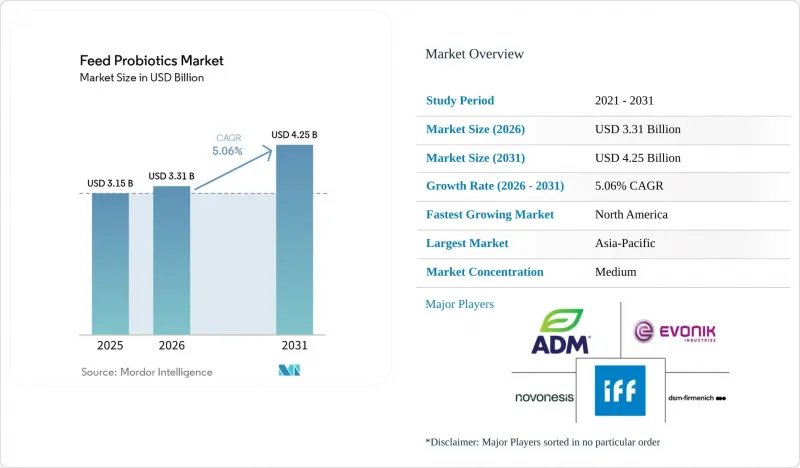
據 Mordor Intelligence 稱,2025 年飼料益生菌市場價值為 31.5 億美元,預計將從 2026 年的 33.1 億美元成長到 2031 年的 42.5 億美元,2026 年至 2031 年的年複合成長率(CAGR)為 5.06%。
本報告按產品類型(雙歧桿菌、腸球菌、乳酸桿菌、片球菌、鏈球菌及其他益生菌)、動物種類(水產養殖、家禽、反芻動物、豬及其他動物)和地區(北美、南美、歐洲、亞太、中東和非洲)進行細分。市場預測以價值(美元)和數量(噸)表示。
全球飼料益生菌市場趨勢及洞察
抗生素類生長促進劑的監管及無抗生素生產
由於對抗生素類生長促進劑的監管,飼料益生菌市場正在成長。這是因為畜牧養殖戶正在尋找抗生素的替代品,以維護腸道健康和提高生產力。印度食品安全標準局 (FSSAI) 已宣布將於 2025 年 4 月 1 日生效的新規,禁止在肉類動物中使用多種具有重要醫學價值的抗生素。這項監管變化正在加速益生菌飼料添加劑作為替代方案的普及。市場對基於芽孢桿菌屬和乳桿菌屬的益生菌的需求日益成長。這些產品無需依賴抗生素類生長促進劑,即可提高飼料轉換率、消化率和動物健康。
重點在於家禽生產規模和飼料效率
由於肉雞生產高度依賴飼料轉換率和生產最佳化,家禽生產的規模持續推動飼料益生菌市場的強勁需求。根據美國農業部海外農業局(FAS)預測,到2026年,全球雞肉產量預計將達到1.107億噸,年增3%。這一成長主要得益於中國、巴西和美國產量的增加。如此龐大的家禽產量推動了對益生菌飼料添加劑的需求成長,這些添加劑有助於維護腸道健康、提高營養利用效率,並確保集約化肉雞生產系統的穩定性。
田間細菌菌株性能的差異
飼料益生菌市場的一大挑戰是其在實際應用中的表現差異,因為益生菌的有效性會因商業性養殖環境的不同而產生顯著差異。智利聖地牙哥智利大學的研究人員於2025年在《動物科學前沿》(Frontiers in Animal Science)雜誌上發表的一項Meta分析表明,在測試條件下,芽孢桿菌益生菌可使肉雞平均增重152克,而乳桿菌益生菌則可使肉雞增重221.6克。這種因益生菌菌株和生產環境不同而導致的差異可能會削弱畜牧養殖戶的信心,從而限制其重複使用,並阻礙飼料益生菌產品的更廣泛商業化。
細分市場分析
到2025年,雙歧桿菌將佔飼料益生菌市場34.0%的最大佔有率。這一主導地位源自於雙歧桿菌在禽類、豬、牛和水產養殖飼料方案中的廣泛商業性應用,在這些領域,消化穩定性和早期腸道健康是重中之重。供應商正在加速開發將雙歧桿菌與乳酸桿菌和芽孢桿菌屬結合的多菌株益生菌配方,以提高各種動物系統的微生物穩定性和飼料性能。此外,該類別受益於主要畜牧生產國的完善法規核准,從而促進了全球一體化飼料生產商和大規模動物蛋白生產商的採用。
預計2026年至2031年間,雙歧桿菌飼料益生菌市場將以5.4%的複合年成長率(CAGR)高速成長。這一成長主要得益於人們對幼齡動物(尤其是牛幼畜飼料、仔豬飼料、孵化場營養計劃和水產飼料)微生物組管理的日益重視。生產商正致力於開發能夠提高消化率、減少抗生素使用且不影響生產效率的益生菌解決方案。競爭策略也正轉向採用經科學檢驗的菌株組合和耐熱配方,以滿足商業性飼料加工的要求。這些趨勢將進一步推動雙歧桿菌產品在全球成熟畜牧業和新興水產養殖業的應用。
區域分析
預計到2025年,亞太地區將佔飼料益生菌市場32.5%的佔有率,成為最大的區域市場佔有率。這一雙重領先地位源自於該地區在水產養殖和陸基畜牧業領域的主導地位。根據美國農業部(USDA)的數據顯示,中國仍然是該地區最大的單一國家益生菌需求中心,這得益於其作為世界第二大雞肉生產國的地位。預計到2026年,中國雞肉產量將達到1,730萬噸。在東南亞,泰國、越南、印尼和菲律賓等蝦類生產國正集中發展益生菌業務,其中芽孢桿菌和乳酸桿菌產品被用於水產養殖池塘的飼料和水質管理,作為預防急性肝胰腺壞死(AHPND)的生物安全措施的一部分。
預計北美將以5.5%的複合年成長率(CAGR)實現最高成長率,2026年至2031年期間的複合年成長率將達到5.5%,並被定位為技術先進、高附加價值的市場。美國擁有全球最大的單一國家家禽產量。這一成長得益於大規模商業化畜牧業、精準營養方案的廣泛應用以及對減少抗生素使用的畜牧系統日益成長的需求。根據美國農業部海外農業局預測,美國家禽產量預計將從2025年的2,170萬噸增加到2026年的2,220萬噸,這將為家禽生產中的益生菌飼料添加劑形成重要的商業基礎。此外,主要的飼料和畜牧一體化公司正在投資直接施用微生物製劑的項目,以提高飼料轉換率並最佳化腸道微生物群。
在南美洲,尤其是在巴西和阿根廷,以出口為導向的家禽和生豬生產體系持續產生顯著的商業需求。歐洲市場仍然成熟,這得益於其長期推行的抗菌藥物減量政策、先進的飼料生產標準以及對微生物產品的嚴格法律規範。同時,在中東和非洲,飼料益生菌的應用正在逐步增加,這主要受一些國家家禽養殖一體化程度的提高、水產養殖投資以及複合飼料產量成長的推動。該地區的主要需求中心包括沙烏地阿拉伯、土耳其、南非和埃及,這些國家的商業畜牧養殖戶正致力於提高飼料轉換率、消化率,並提供無抗生素的營養解決方案,以支持現代化的集約畜牧系統。
其他好處
- Excel格式的市場預測(ME)表
- 3個月的分析師支持
目錄
第1章:引言
- 研究假設和市場定義
- 調查範圍
- 調查方法
第2章:本報告的內容
第3章:執行摘要和主要發現
第4章 主要產業趨勢
- 飼養的動物數量
- 家禽
- 反芻動物
- 豬
- 飼料生產
- 水產養殖
- 家禽
- 反芻動物
- 豬
- 法律規範
- 澳洲
- 巴西
- 加拿大
- 中國
- 法國
- 德國
- 印度
- 印尼
- 義大利
- 日本
- 墨西哥
- 荷蘭
- 菲律賓
- 俄羅斯
- 南非
- 韓國
- 西班牙
- 泰國
- 土耳其
- 英國
- 美國
- 越南
- 價值鍊和通路分析
- 市場促進因素
- 限制使用抗生素類生長促進劑和無抗生素生產
- 重點在於家禽生產規模和飼料效率
- 亞太地區畜牧業和漁業的整合
- 具有優異耐熱性的芽孢桿菌乾製劑
- 動物性蛋白質碳排放強度降低和範圍 3 壓力
- 蝦類疾病管理與水質管理計劃
- 市場限制因素
- 田間應變性能的變化
- 多司法管轄區微生物登記的負擔
- 非產孢菌株在儲存過程中出現結塊和存活率降低
- 後生元和副益生菌的替代風險
- 波特五力分析
第5章 市場規模與成長預測
- 添加劑
- 雙歧桿菌
- 腸球菌
- 乳酸菌
- 片球菌
- 鏈球菌
- 其他益生菌
- 動物
- 水產養殖
- 魚
- 蝦
- 其他養殖物種
- 家禽
- 肉雞
- 產蛋母雞
- 其他家禽
- 反芻動物
- 牛
- 牛
- 其他反芻動物
- 豬
- 其他動物
- 水產養殖
- 按地區
- 北美洲
- 美國
- 加拿大
- 墨西哥
- 其他北美國家
- 南美洲
- 巴西
- 阿根廷
- 智利
- 其他南美國家
- 歐洲
- 德國
- 法國
- 義大利
- 荷蘭
- 俄羅斯
- 西班牙
- 英國
- 其他歐洲國家
- 亞太地區
- 中國
- 印度
- 日本
- 印尼
- 韓國
- 泰國
- 越南
- 澳洲
- 菲律賓
- 其他亞太國家
- 中東
- 伊朗
- 土耳其
- 沙烏地阿拉伯
- 其他中東國家
- 非洲
- 埃及
- 肯亞
- 南非
- 其他非洲地區
- 北美洲
第6章 競爭情勢
- 關鍵策略趨勢
- 市佔率分析
- 企業狀況
- 公司簡介
- Novonesis A/S
- DSM-Firmenich AG
- Evonik Industries AG
- International Flavors & Fragrances Inc.
- Archer Daniels Midland Company
- Cargill, Incorporated
- Lallemand Inc.
- Kemin Industries, Inc.
- Lesaffre International, SAS
- Adisseo France SAS(China National BlueStar(Group)Co., Ltd.)
- Phibro Animal Health Corporation
- Alltech, Inc.
- Huvepharma AD
- Qingdao Vland BIoTech Group Co., Ltd.
- Kerry Group plc
第7章 執行長需要思考的關鍵策略問題
According to Mordor Intelligence, the feed probiotics market size was valued at USD 3.15 billion in 2025 and is projected to grow from USD 3.31 billion in 2026 to USD 4.25 billion by 2031, with a CAGR of 5.06% during 2026 to 2031.
This report is Segmented by Sub Additive (Bifidobacteria, Enterococcus, Lactobacilli, Pediococcus, Streptococcus, and Other Probiotics), by Animal (Aquaculture, Poultry, Ruminants, Swine, and Other Animals), and by Geography (North America, South America, Europe, Asia-Pacific, Middle East, and Africa). The Market Forecasts are Provided in Terms of Value (USD) and Volume (Metric Tons).
Global Feed Probiotics Market Trends and Insights
Antibiotic-Growth-Promoter Restrictions and Antibiotic-Free Production
Restrictions on antibiotic growth promoters are driving increased demand in the feed probiotics market, as livestock producers seek non-antibiotic alternatives to support gut health and production performance. The Food Safety and Standards Authority of India (FSSAI) has announced restrictions, effective April 1, 2025, banning the use of several medically important antibiotics in food-producing animals. This regulatory change is encouraging the adoption of probiotic-based feed additives as replacement solutions. The demand for Bacillus- and Lactobacillus-based probiotics is rising, as these products enhance feed efficiency, digestive stability, and animal health without relying on antibiotic growth promoters.
Poultry Production Scale and Feed Efficiency Focus
The scale of poultry production continues to drive strong demand in the feed probiotics market, as broiler operations rely heavily on feed efficiency and production optimization. According to the United States Department of Agriculture (USDA) Foreign Agricultural Service (FAS), global chicken meat production is projected to reach 110.7 million metric tons by 2026, reflecting a 3% increase from the previous year. This growth is primarily attributed to expansions in China, Brazil, and the United States. The rising poultry output at this level is increasing the demand for probiotic feed additives, which support gut health, enhance nutrient utilization, and ensure production consistency in intensive broiler systems.
Field-Level Strain Performance Variability
Field-level performance variability poses a significant challenge for the feed probiotics market, as the efficacy of probiotics can vary widely across different commercial farming environments. A 2025 meta-analysis published in Frontiers in Animal Science by researchers from Universidad de Chile, Santiago, Chile, found that Bacillus-based probiotics increased broiler body weight gain by an average of 152 g, while Lactobacillus-based probiotics demonstrated an average improvement of 221.6 g under the analyzed trial conditions. These variations in results across probiotic strains and production environments can undermine confidence among livestock producers, limiting repeat usage and impeding the broader commercialization of feed probiotic products.
Other drivers and restraints analyzed in the detailed report include:
- Asia-Pacific Livestock and Aquaculture Intensification
- Better Heat-Stable Bacillus and Dry-Format Formulations
- Multi-Jurisdiction Microbial Registration Burden
For complete list of drivers and restraints, kindly check the Table Of Contents.
Segment Analysis
The feed probiotics market share for bifidobacteria held the largest 34.0% in 2025. This dominance is attributed to their extensive commercial application in poultry, swine, calf, and aquaculture nutrition programs, where digestive stability and early-life gut health are key priorities. Suppliers are increasingly developing multi-strain probiotic formulations that combine bifidobacteria with Lactobacillus and Bacillus species to enhance microbial stability and feed performance across various animal systems. Additionally, the category benefits from established regulatory acceptance in major livestock-producing countries, facilitating adoption by integrated feed manufacturers and large-scale animal protein producers globally.
The feed probiotics market size for bifidobacteria is forecast to grow at the fastest 5.4% CAGR from 2026 to 2031. This growth is driven by an increasing emphasis on microbiome management in young animals, particularly in calf starters, nursery pig diets, hatchery nutrition programs, and aquaculture feeds. Producers are focusing on probiotic solutions that enhance digestive efficiency and support antibiotic-reduced production systems without compromising productivity. Competitive strategies are shifting toward scientifically validated strain combinations and heat-stable formulations that align with commercial feed processing requirements. These developments are promoting broader adoption of bifidobacteria-based products across established livestock industries and emerging aquaculture sectors worldwide.
Geography Analysis
Asia-Pacific accounted for the largest geographic share of the feed probiotics market, holding 32.5% in 2025. This dual leadership is attributed to the region's dominance in both aquaculture and terrestrial livestock categories. According to the United States Department of Agriculture (USDA), China remains the largest single-country demand center for probiotics in the region, driven by its position as the world's second-largest chicken meat producer, forecasted at 17.3 million metric tons in 2026. In Southeast Asia, shrimp-producing nations such as Thailand, Vietnam, Indonesia, and the Philippines represent a concentrated demand for probiotics, with acute hepatopancreatic necrosis disease (AHPND) biosecurity programs driving the use of Bacillus and Lactobacillus solutions in feed and pond-water applications.
North America is projected to grow at the fastest 5.5% CAGR from 2026 to 2031 and ranks as a technically advanced and high-value market, with the United States accounting for the world's largest single-country chicken meat production. This growth is supported by large commercial livestock operations, widespread adoption of precision nutrition programs, and rising demand for antibiotic-reduced animal production systems. According to the United States Department of Agriculture Foreign Agricultural Service, United States chicken meat production is forecast to increase from 21.7 million metric tons in 2025 to 22.2 million metric tons in 2026, creating a significant commercial base for probiotic feed additives in poultry production. Additionally, large integrated feed and livestock companies are investing in direct-fed microbial programs to improve feed efficiency and optimize gut health.
South America continues to contribute meaningful commercial demand through export-oriented poultry and swine production systems, particularly in Brazil and Argentina. Europe remains a mature region supported by long-standing antimicrobial reduction policies, advanced feed manufacturing standards, and strong regulatory oversight for microbial products. Meanwhile, the Middle East and Africa are gradually increasing their adoption of feed probiotics, driven by expanding poultry integration, aquaculture investments, and compound feed production in selected countries. Key demand centers in this region include Saudi Arabia, Turkey, South Africa, and Egypt, where commercial livestock operators are focusing on feed efficiency, digestive stability, and non-antibiotic nutritional solutions to support modern intensive animal production systems.
- Novonesis A/S
- DSM-Firmenich AG
- Evonik Industries AG
- International Flavors & Fragrances Inc.
- Archer Daniels Midland Company
- Cargill, Incorporated
- Lallemand Inc.
- Kemin Industries, Inc.
- Lesaffre International, SAS
- Adisseo France SAS (China National BlueStar (Group) Co., Ltd.)
- Phibro Animal Health Corporation
- Alltech, Inc.
- Huvepharma AD
- Qingdao Vland Biotech Group Co., Ltd.
- Kerry Group plc
Additional Benefits:
- The market estimate (ME) sheet in Excel format
- 3 months of analyst support
TABLE OF CONTENTS
1 INTRODUCTION
- 1.1 Study Assumptions and Market Definition
- 1.2 Scope of the Study
- 1.3 Research Methodology
2 REPORT OFFERS
3 EXECUTIVE SUMMARY AND KEY FINDINGS
4 KEY INDUSTRY TRENDS
- 4.1 Animal Headcount
- 4.1.1 Poultry
- 4.1.2 Ruminants
- 4.1.3 Swine
- 4.2 Feed Production
- 4.2.1 Aquaculture
- 4.2.2 Poultry
- 4.2.3 Ruminants
- 4.2.4 Swine
- 4.3 Regulatory Framework
- 4.3.1 Australia
- 4.3.2 Brazil
- 4.3.3 Canada
- 4.3.4 China
- 4.3.5 France
- 4.3.6 Germany
- 4.3.7 India
- 4.3.8 Indonesia
- 4.3.9 Italy
- 4.3.10 Japan
- 4.3.11 Mexico
- 4.3.12 Netherlands
- 4.3.13 Philippines
- 4.3.14 Russia
- 4.3.15 South Africa
- 4.3.16 South Korea
- 4.3.17 Spain
- 4.3.18 Thailand
- 4.3.19 Turkey
- 4.3.20 United Kingdom
- 4.3.21 United States
- 4.3.22 Vietnam
- 4.4 Value Chain and Distribution Channel Analysis
- 4.5 Market Drivers
- 4.5.1 Antibiotic-growth-promoter restrictions and antibiotic-free production
- 4.5.2 Poultry production scale and feed efficiency focus
- 4.5.3 Asia-Pacific livestock and aquaculture intensification
- 4.5.4 Better heat-stable Bacillus and dry-format formulations
- 4.5.5 Carbon-intensity reduction and Scope 3 pressure in animal protein
- 4.5.6 Shrimp disease management and water-quality programs
- 4.6 Market Restraints
- 4.6.1 Field-level strain performance variability
- 4.6.2 Multi-jurisdiction microbial registration burden
- 4.6.3 Pelleting and storage viability losses for non-spore strains
- 4.6.4 Postbiotic and paraprobiotic substitution risk
- 4.7 Porter's Five Forces Analysis
- 4.7.1 Threat of New Entrants
- 4.7.2 Bargaining Power of Buyers
- 4.7.3 Bargaining Power of Suppliers
- 4.7.4 Threat of Substitute Products
- 4.7.5 Intensity of Competitive Rivalry
5 Market Size and Growth Forecasts (Value and Volume)
- 5.1 By Sub Additive
- 5.1.1 Bifidobacteria
- 5.1.2 Enterococcus
- 5.1.3 Lactobacilli
- 5.1.4 Pediococcus
- 5.1.5 Streptococcus
- 5.1.6 Other Probiotics
- 5.2 By Animal
- 5.2.1 Aquaculture
- 5.2.1.1 Fish
- 5.2.1.2 Shrimp
- 5.2.1.3 Other Aquaculture Species
- 5.2.2 Poultry
- 5.2.2.1 Broiler
- 5.2.2.2 Layer
- 5.2.2.3 Other Poultry Birds
- 5.2.3 Ruminants
- 5.2.3.1 Beef Cattle
- 5.2.3.2 Dairy Cattle
- 5.2.3.3 Other Ruminants
- 5.2.4 Swine
- 5.2.5 Other Animals
- 5.2.1 Aquaculture
- 5.3 By Geography
- 5.3.1 North America
- 5.3.1.1 United States
- 5.3.1.2 Canada
- 5.3.1.3 Mexico
- 5.3.1.4 Rest of North America
- 5.3.2 South America
- 5.3.2.1 Brazil
- 5.3.2.2 Argentina
- 5.3.2.3 Chile
- 5.3.2.4 Rest of South America
- 5.3.3 Europe
- 5.3.3.1 Germany
- 5.3.3.2 France
- 5.3.3.3 Italy
- 5.3.3.4 Netherlands
- 5.3.3.5 Russia
- 5.3.3.6 Spain
- 5.3.3.7 United Kingdom
- 5.3.3.8 Rest of Europe
- 5.3.4 Asia-Pacific
- 5.3.4.1 China
- 5.3.4.2 India
- 5.3.4.3 Japan
- 5.3.4.4 Indonesia
- 5.3.4.5 South Korea
- 5.3.4.6 Thailand
- 5.3.4.7 Vietnam
- 5.3.4.8 Australia
- 5.3.4.9 Philippines
- 5.3.4.10 Rest of Asia-Pacific
- 5.3.5 Middle East
- 5.3.5.1 Iran
- 5.3.5.2 Turkey
- 5.3.5.3 Saudi Arabia
- 5.3.5.4 Rest of Middle East
- 5.3.6 Africa
- 5.3.6.1 Egypt
- 5.3.6.2 Kenya
- 5.3.6.3 South Africa
- 5.3.6.4 Rest of Africa
- 5.3.1 North America
6 COMPETITIVE LANDSCAPE
- 6.1 Key Strategic Moves
- 6.2 Market Share Analysis
- 6.3 Company Landscape
- 6.4 Company Profiles (Includes Global Level Overview, Market Level Overview, Core Business Segments, Financials, Headcount, Key Information, Market Rank, Market Share, Products and Services, and Analysis of Recent Developments)
- 6.4.1 Novonesis A/S
- 6.4.2 DSM-Firmenich AG
- 6.4.3 Evonik Industries AG
- 6.4.4 International Flavors & Fragrances Inc.
- 6.4.5 Archer Daniels Midland Company
- 6.4.6 Cargill, Incorporated
- 6.4.7 Lallemand Inc.
- 6.4.8 Kemin Industries, Inc.
- 6.4.9 Lesaffre International, SAS
- 6.4.10 Adisseo France SAS (China National BlueStar (Group) Co., Ltd.)
- 6.4.11 Phibro Animal Health Corporation
- 6.4.12 Alltech, Inc.
- 6.4.13 Huvepharma AD
- 6.4.14 Qingdao Vland Biotech Group Co., Ltd.
- 6.4.15 Kerry Group plc


