


 |
市場調查報告書
商品編碼
2062420
戶外照明:市場佔有率分析、產業趨勢與統計、成長預測(2026-2031)Outdoor Lighting - Market Share Analysis, Industry Trends & Statistics, Growth Forecasts (2026 - 2031) |
||||||

※ 本網頁內容可能與最新版本有所差異。詳細情況請與我們聯繫。
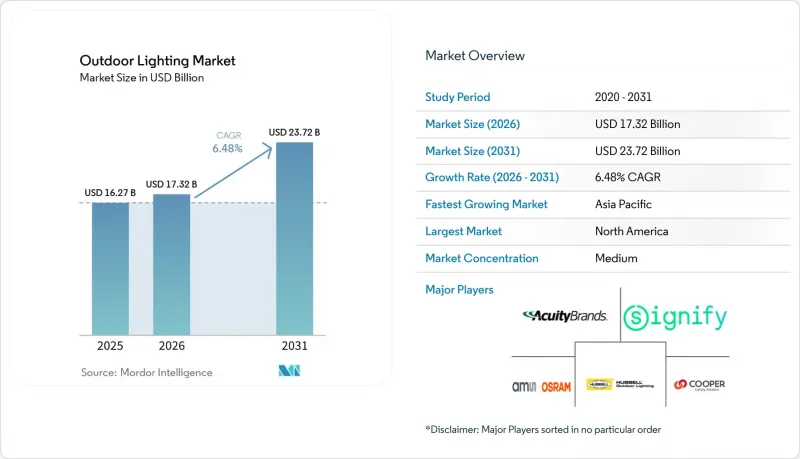
根據 Mordor Intelligence 預測,戶外照明市場規模將從 2025 年的 162.7 億美元和 2026 年的 173.2 億美元成長到 2031 年的 237.2 億美元,2026 年至 2031 年的年複合成長率(CAGR)為 6.48%。
本報告按產品類型(裝飾燈、桿式燈、壁掛式燈、住宅/螢光燈、維修市場預測以美元計價。
全球戶外照明市場趨勢與洞察
快速的都市化和基礎建設
城市正從固定式併網照明系統轉向模組化、軟體定義的照明系統,這種系統能夠隨著城市發展而擴展,並提供更完善的資產管理。 2026年3月,洛杉磯市批准了一項為期兩年的計劃,安裝多達6萬盞太陽能路燈和區域照明燈,以解決3.2萬個未處理的維修請求以及猖獗的電纜盜竊問題,這些問題曾令維護預算捉襟見肘。這將是該市迄今為止最大的單筆照明投資。印度海得拉巴批准了一項1340萬盧比(約1.614億美元)的項目,用於對76萬盞路燈進行現代化改造,配備集中控制和監控系統、基於績效的處罰機制以及設備級追蹤功能,以確保運轉率和課責。匹茲堡市則將紓困資金與債券發行收入結合,升級了超過3.5萬盞路燈,使其具備無線管理和照明分析功能,從而降低能耗和漏光。這些措施為快速都市化的地區提供了一條切實可行的路徑,這些地區必須在擴大覆蓋範圍、降低生命週期成本和可衡量的服務水準之間取得平衡。根據香港貿易發展局的市場情緒數據,印度、東協和中東正成為短期內最有潛力的需求來源,這些需求來源與參與公共基礎設施規劃的供應商密切相關。亞洲LED元件製造的集中度也持續支撐著這些項目的擴展。
對節能型LED解決方案的需求日益成長
最低能源效率標準和快速的投資回報使LED成為各類戶外照明的標準選擇。紐約市2025年能源保護條例將於2026年3月生效,該條例提高了照明的功率密度要求,使高效LED系統成為大多數非住宅室內外照明合規的實際途徑。加州2026年通過的第24號修正案擴大了自然光響應型LED的應用範圍,並強制要求採用連續調光實現多層控制。這加速了設施和停車場照明應用向具有精細控制功能的聯網LED的過渡。 LED系統通常每瓦可提供100-150流明的光通量,與傳統燈具相比,能耗降低75-80%。此外,智慧控制透過定時控制、人員感應和自然光利用進一步提升了性能。西薩塞克斯郡的一項全郡升級計畫將用LED燈替換64,000盞路燈,並將其連接到遠端監控平台。預計這將每年減少1070萬千瓦時的電力消耗和1633噸的二氧化碳排放。對現有住宅進行維修利用,既能實現節能,又能節省資金。大規模推廣使用可更換燈座的LED燈就證明了這一點,節能效果高達45%至51%。
高昂的初始安裝和維修成本
由於控制器、閘道器和中央管理軟體成本高昂,大規模智慧照明專案可能會對市政預算造成巨大壓力。即使是簡單的更換項目,規模也相當龐大。例如,西薩塞克斯郡正在進行一項為期四年的項目,更換6.4萬盞路燈,預計耗資3,070萬美元。一些市政當局透過政策工具和獎勵來抵消這些成本,例如波特蘭市為高事故區域提供的專項資金,以及美國179D扣除額,該政策可以縮短大型校園和商業設施的投資回收期。然而,對於財政拮据的市政當局而言,全連網系統的較長投資回收期和限制項目規模的津貼可能會減緩其普及速度。住宅在購買具有智慧功能和太陽能儲能的高階戶外照明設備時也面臨類似的障礙,這可能會降低價格敏感型群體的接受度。交易摩擦也會增加成本,因為許多城市在簽訂合約之前必須明確互通性需求並審查來自多家供應商的控制方案。
細分市場分析
到2025年,裝飾照明將以38.82%的市場佔有率領先照明品類,這主要得益於酒店、校園和住宅環境採用設計師設計和裝飾來拓展戶外體驗的趨勢不斷成長。成長最快的露台和庭院照明市場正以8.47%的複合年成長率快速擴張,這得益於住宅維修透過多層次組合的功能照明(包括工作照明、環境照明和重點照明)來提升戶外生活品質。立柱燈和壁燈不僅可以作為建築裝飾,還可以作為路徑照明。同時,飯店、餐廳和咖啡館(HoReCa)設施指定使用IP防護等級的照明燈具,以兼顧視覺美觀和耐候性。安防照明因其具備運動感應控制功能和低眩光光學設計而備受青睞,這些功能可根據活動情況調節光照強度,同時保持視覺舒適度。暖色調的庭院燈和柱燈在住宅項目中仍然很受歡迎,因為人們希望在夜間使用時獲得更高的舒適度和美觀度。
此細分市場的需求反映了戶外照明市場的發展趨勢,即追求高度互聯、易於維護且美觀的解決方案,從而提升安全性和資產價值。公共部門買家優先考慮人行道和樓梯間的照明方案是否符合破壞性和無障礙要求,以減少事故和法律責任。在高階應用中,高顯色指數 (CRI) 照明有助於保持酒店和公共場所建築立面、景觀和藝術品的色彩真實性。戶外照明市場也採用能夠加快安裝和維護速度的方案,在最大限度減少對場地影響的情況下,實現專案提前完工。在資料可用的情況下,設計師會根據「暗夜天空」原則,在不影響氛圍的前提下控制向上照射的光線。
至2025年,LED技術將佔光源總量的68.36%。這反映了其卓越的光通量效率、長壽命和成熟的定價策略,這些優勢使其持續取代傳統燈具。預計2026年至2031年間,其他光源將以7.39%的複合年成長率成長,首先從小小規模市場入手,並在LED技術或美學受限的特定細分市場中找到一席之地。儘管監管逐步淘汰正在加速螢光的衰落,但能夠模擬暖白熾燈色溫的新型LED產品的出現,進一步降低了對白熾燈和鹵素燈的需求。在體育場館和遠距離照明等需要高流明的應用領域,隨著光學設計、溫度控管和流明密度的提升,LED的市場佔有率持續擴大。由於成本和可靠性方面的限制,OLED和雷射照明解決方案在戶外環境中仍受限於特定的設計和性能要求。
隨著控制系統採用可互通協議實現標準化,規劃人員現在可以將不同品牌的LED照明燈具組合在一起,同時保持統一的管理層,以支援報告和最佳化。在戶外照明市場,照明燈具與感測器的整合度不斷提高,用於收集交通、佔用和環境數據,以供市政分析。可現場維修的零件和模組化驅動器使大規模設施業主能夠減少停機時間和備件庫存。隨著能源法規日益嚴格,照明燈具的效率和可控性仍將是LED技術持續主導的關鍵因素。隨著LED生態系統的成熟,買家和整合商都能獲得一致的效能和支援。
區域分析
預計到2025年,北美將以37.85%的市佔率引領全球。這得益於聯邦政府獎勵支撐的穩定需求、健全的市政部署計劃以及成熟的分銷網路。洛杉磯批准了有史以來規模最大的照明投資項目,計劃安裝多達6萬盞太陽能路燈,以解決盜竊和維護延誤問題。匹茲堡累計1500萬美元,用於管理超過3.5萬盞燈具,這些燈具配備了無線控制和增強的報告功能。波特蘭從一項由選民支持的基金中撥款3,700萬美元,用於在事故多發地區安裝由可再生能源供電的LED路燈。商業維修符合179D稅額扣抵的條件,多種獎勵的結合可以縮短大型專案的投資回收期。在該地區建立製造地可以降低關稅風險,並穩定銷往美國的產品的物流。
亞太地區是成長最快的地區,複合年成長率達8.92%,主要得益於智慧城市建設、都市區遷移和住宅投資的成長。海德拉巴市的76萬盞燈改造項目結合了集中監控、運作罰款和完整的資產可追溯性,以確保完善的服務水準。遍布亞洲的製造和包裝基地為企業在全球專案的競標中提供了成本和數量優勢。市場趨勢調查顯示,印度、東協和中東是供應商拓展業務的優先目的地。沿岸地區的市政當局正在橋樑和門戶區域部署遠端系統管理系統和多色照明系統,同時實現永續性目標。像安曼這樣的城市正在用具備遠端照明控制和故障報告功能的智慧LED燈替換數千盞舊燈。
在歐洲,在能源效率法規和循環經濟計劃的推動下,LED和可再製造燈具的採購正穩步推進。西薩塞克斯郡為期四年的計畫包括更換64,000個燈具並整合監控系統,預計將帶來長期的維護和能源效益。在丹麥,一項嵌入式維修專案透過重複利用鋁製外殼,實現了良好的投資回報,同時降低了能源消耗和生產排放。舊燈具的逐步淘汰正在加速商業和工業領域的轉型,這些領域的控制系統已準備就緒。一些供應商正在將組裝流程本地化,以縮短前置作業時間並降低關稅風險,但上游零件仍然依賴全球採購。
在中東和非洲地區,先進的智慧城市正在蓬勃發展,大規模的太陽能發電計畫也正在推動電氣化進程。阿布達比市政府升級了橋樑照明系統,使其符合永續性標準,同時融入了遠端系統管理功能和可程式設計的公共活動燈光色調。在阿曼,Muscat山莊將LED照明與射頻網狀控制器和中央平台相結合,提高了可靠性並實現了節能。在加納,一項旨在安裝數萬盞太陽能路燈的計畫旨在降低尖峰負載,減輕電網負擔。在撒哈拉以南非洲市場,離網和混合系統正日益普及,以避免鑽探並減少對柴油的依賴。相較之下,海灣合作理事會(GCC)市場則更傾向於採用全球最佳實踐的標準和準則。南非計畫性停電帶來的挑戰,催生了對具備本地維護能力的離網公共照明系統的新需求。
在南美洲,資金籌措和經濟穩定的地區正在推動都市區維修,並逐步實現成長。在巴西城市,國家計畫和多邊貸款正被用於擴大高犯罪率地區LED路燈的部署。在智利,太陽能路燈正在陽光充足的偏遠地區和礦區周邊社區推廣。儘管宏觀經濟波動減緩了部分市場市政採購的步伐,但商業區的局部私人需求仍然存在。標準和在地採購政策的差異使跨境供應鏈和規範制定變得複雜。戶外照明市場仍蘊藏著許多機遇,如果資金籌措到位,可望在安全性、能源成本和可靠性方面取得顯著提升。
其他好處:
- Excel格式的市場預測(ME)表
- 3個月的分析師支持
目錄
第1章:引言
- 研究假設和市場定義
- 調查範圍
第2章:調查方法
第3章執行摘要
第4章 市場狀況
- 市場概覽
- 市場促進因素
- 快速的都市化和基礎建設
- 對節能型LED解決方案的需求日益成長
- 智慧城市計劃和物聯網整合
- 人們越來越關注安全問題
- 政府支持和強制性能效
- LED價格下降和技術進步
- 市場限制因素
- 較高的初始安裝和維修成本
- 光害與環境問題
- 遵守法規的壓力
- 供應鏈脆弱性(例如,原物料價格波動)
- 產業價值鏈分析
- 波特五力分析
- 洞察最新市場趨勢與創新
- 洞察近期市場趨勢(新產品發布、策略性舉措、投資、合作、合資、業務擴張、併購等)
- 主要地區戶外照明法規結構研究。
第5章 市場規模與成長預測
- 依產品類型
- 裝飾照明
- 柱燈
- 壁燈
- 吊燈
- 水晶燈
- 其他(嵌入式安裝等)
- 通道/樓梯照明
- 露台和庭院照明
- 花園燈
- 安全照明
- 泛光和聚光燈
- 繫船柱
- 其他(繩燈、串燈等)
- 透過光源
- LED
- 螢光
- 白熾燈
- 鹵素
- 其他光源(HID、OLED、雷射等)
- 按安裝類型
- 新安裝
- 維修/更新
- 透過使用
- 住宅
- 商業設施(餐飲旅館業、運動設施、醫療設施、零售商店、公共設施、其他(美術館、博物館、企業設施等))
- 透過分銷管道
- 直接銷售(B2B/競標)
- 線上/D2C
- 授權經銷商和零售商
- 按地區
- 北美洲
- 加拿大
- 美國
- 墨西哥
- 南美洲
- 巴西
- 秘魯
- 智利
- 阿根廷
- 其他南美國家
- 歐洲
- 英國
- 德國
- 法國
- 西班牙
- 義大利
- 比荷盧經濟聯盟(比利時、荷蘭、盧森堡)
- 北歐國家(丹麥、芬蘭、冰島、挪威、瑞典)
- 其他歐洲國家
- 亞太地區
- 印度
- 中國
- 日本
- 澳洲
- 韓國
- 東南亞
- 其他亞太國家
- 中東和非洲
- 阿拉伯聯合大公國
- 沙烏地阿拉伯
- 南非
- 奈及利亞
- 其他中東和非洲國家
- 北美洲
第6章 競爭情勢
- 市場集中度
- 策略趨勢
- 市佔率分析
- 公司簡介
- Signify(Philips Lighting)
- Nichia Corporation
- Leotek
- LSI Industries
- Pemco Lighting
- Seoul Semiconductor
- Musco Lighting
- Kichler Lighting
- Volt Lighting
- Eaton Lighting(Cooper Lighting Solutions)
- RAB Lighting
- Acuity Brands
- Fagerhult Group
- LIGMAN Lighting
- Siteco GmbH
- Kenall Manufacturing
- HE Williams
- Kingspan Light+Air
- Cree Lighting
- ams OSRAM
第7章 市場機會與未來展望
According to Mordor Intelligence, the outdoor lighting market size is projected to expand from USD 16.27 billion in 2025 and USD 17.32 billion in 2026 to USD 23.72 billion by 2031, registering a CAGR of 6.48% between 2026 and 2031.
This report is Segmented by Product Type (Decorative, Post, Wall, Path and Step, Deck and Patio, Garden, Security, Flood and Spot, Bollard, Others), Light Source (LED, Fluorescent, Incandescent, Halogen, Others), Installation Type (New, Retrofit), Application (Residential, Commercial), Distribution Channel (Direct B2B, Online D2C, Distributors), and Geography. Market Forecasts in Value (USD).
Global Outdoor Lighting Market Trends and Insights
Rapid Urbanization and Infrastructure Development
Cities are shifting from static grid-tied systems to modular, software-defined lighting that scales with growth and strengthens asset control. In March 2026, Los Angeles approved a two-year plan to deploy up to 60,000 solar roadway and area lights, the city's largest single lighting investment, to address a backlog of 32,000 service requests and rampant wire theft that strained maintenance budgets. Hyderabad, India authorized an INR 1,340 crore (USD 161.4 million) program to modernize 760,000 streetlights with a Centralized Control and Monitoring System, performance-based penalties, and device-level tracking to lock in uptime and accountability. Pittsburgh combined Rescue Plan funds and bond proceeds to upgrade more than 35,000 fixtures with wireless management and illuminance analytics to cut energy use and reduce light spill. These actions reflect a pragmatic path for rapidly urbanizing regions that must combine new coverage, lifecycle savings, and measurable service levels. Hong Kong Trade Development Council sentiment data highlights India, ASEAN, and the Middle East as among the most promising near-term demand pools for suppliers aligned with public-infrastructure pipelines. Concentration of LED component manufacturing in Asia continues to underpin the scaling of such projects.
Growing Demand for Energy-Efficient LED Solutions
Minimum-efficacy rules and fast paybacks make LED the default across exterior categories. New York City's 2025 Energy Conservation Code, effective March 2026, tightened lighting power density and made high-efficacy LED systems the practical path to compliance for most nonresidential interiors and exterior lighting. California's Title 24 updates in 2026 widened daylight-responsive coverage and required continuous dimming for multilevel control, pushing site and parking applications to networked LEDs with granular control. LED systems typically deliver 100-150 lumens per watt and can reduce energy use by 75-80% compared with legacy lamps, with smart controls further improving performance through scheduling, occupancy, and daylighting. A county-wide upgrade in West Sussex will convert 64,000 streetlights to LED and connect them to a remote monitoring platform, with annual savings projected at 10.7 million kWh and 1,633 tons of CO2. Retrofit programs that reuse existing housing can preserve capital while harvesting energy savings, as shown by insert-based LED upgrades that recorded 45-51% reductions at scale.
High Initial Installation and Retrofit Costs
Full smart-lighting projects can carry premium costs for controllers, gateways, and central software, stretching municipal budgets. Even straightforward conversions show the scale at play, such as a four-year West Sussex upgrade of 64,000 roadway fixtures for an estimated USD 30.7 million. Some owners offset this with policy tools and incentives, such as Portland's dedicated funding for high-crash corridors and the U.S. 179D tax deduction, which compresses paybacks for large campuses and commercial properties. Nonetheless, long payback periods on fully networked systems and grant caps that limit project size can slow adoption in cash-constrained municipalities. Residential buyers face a similar hurdle for premium outdoor packages with smart features and solar storage, which can delay uptake in price-sensitive segments. Transaction frictions also increase costs, as many cities must define interoperability requirements and vet multi-vendor control stacks before awarding contracts.
Other drivers and restraints analyzed in the detailed report include:
- Smart City Initiatives and IoT Integration
- Rising Focus on Safety and Security
- Light Pollution and Environmental Concerns
For complete list of drivers and restraints, kindly check the Table Of Contents.
Segment Analysis
Decorative lighting led the category with 38.82% in 2025 as hospitality, campuses, and residential settings used designer forms and finishes to extend exterior experiences. The fastest-growing deck and patio segment is advancing at 8.47% CAGR, supported by residential upgrades where layered task, ambient, and accent lighting elevate outdoor living. Post and wall lights serve as both architectural accents and pathway illumination, while HoReCa venues specify IP-rated fixtures that balance visual appeal with weather resilience. Security lighting benefits from motion-activated controls and low-glare optics that tune output to activity while maintaining visual comfort. Warm-color garden and bollard fixtures continue to win in residential projects due to comfort and curb appeal requirements for evening use.
Demand in this segment reflects the outdoor lighting market's trend toward connected, low-maintenance, and curb-appeal solutions that enhance perceived safety and property value. Institutional buyers focus on vandal resistance and compliance with accessibility requirements in pathways and steps to reduce incidents and liability. In premium applications, high-CRI options help hospitality and public spaces maintain color fidelity for facades, landscaping, and art. The outdoor lighting market is also adopting formats for faster installation and serviceability, enabling projects to close faster with fewer site disruptions. Where data points are available, designers are aligning with dark-sky principles to control uplight while preserving ambiance.
LED technology captured 68.36% of the light source mix in 2025, reflecting superior efficacy, long life, and mature price points that continue to displace legacy lamps. Other light sources posted a 7.39% CAGR through 2026-2031 outlook from a smaller base, finding roles in specialty niches where LEDs have technical or aesthetic constraints. Regulatory phase-outs have accelerated the decline of fluorescent lamps, while new LED forms that emulate warm filament tones have further reduced demand for incandescent and halogen. In high-lumen stadium and long-throw applications, LEDs continue to expand their share as optical design, thermal management, and lumen density improve. OLED and laser-based solutions remain limited to specific design or performance briefs due to cost and reliability constraints in exterior settings.
With controls standardizing on interoperable protocols, planners can mix LED luminaires across brands while maintaining unified management layers that support reporting and optimization. The outdoor lighting market is also seeing better integration between luminaires and sensors to capture traffic, occupancy, and environmental data for municipal analytics. Field-serviceable components and modular drivers are helping large owners reduce downtime and carry fewer spares. As energy codes ratchet up, fixture efficacy and controllability will remain the main reasons LED technology maintains its dominance. Continued maturity in the LED ecosystem provides both buyers and integrators with stable performance and support baselines.
Geography Analysis
North America led with 37.85% in 2025 as federal incentives, strong municipal pipelines, and mature distribution supported steady demand. Los Angeles approved the largest lighting investment in its history to deploy up to 60,000 solar streetlights that tackle theft and service backlogs. Pittsburgh set aside USD 15 million to manage more than 35,000 fixtures with wireless controls and enhanced reporting. Portland dedicated USD 37 million from a voter-backed fund specifically for LED streetlighting on high-crash corridors and powers the load with renewable energy. Commercial retrofits benefit from the 179D deduction, which has enabled large projects to pass payback hurdles through stacked incentives. Regional manufacturing footprints reduce tariff exposure and buffer logistics for United States-bound products.
Asia-Pacific is the fastest-growing region, with a 8.92% CAGR driven by smart-city spending, urban migration, and expanding residential investment. Hyderabad's 760,000-light program couples centralized monitoring, fines for downtime, and complete asset traceability to enforce service levels. Manufacturing and packaging bases across Asia underpin cost and volume advantages for global projects during competitive tenders. Market sentiment surveys identify India, ASEAN, and the Middle East as priority destinations for suppliers growing footprints beyond incumbent regions. Municipalities in the Gulf are implementing remote management and multi-color systems for bridges and gateways while meeting sustainability targets. Cities like Amman are replacing thousands of lights with smart LEDs that support remote intensity control and fault reporting.
Europe shows steady activity as energy-efficiency rules and circularity ambitions steer procurement to LEDs and remanufacturable designs. West Sussex's four-year program will replace 64,000 fixtures and integrate a monitoring system with expected long-term maintenance and energy benefits. Insert-based retrofits in Denmark reuse aluminum housings to cut both energy and embodied emissions at favorable returns. Phase-outs of legacy lamps accelerate commercial and industrial conversions that improve controls readiness. Some vendors are localizing assembly to shorten times and limit tariff exposure while upstream components remain globally sourced.
Middle East and Africa (MEA) spans advanced smart-city deployments and large-scale solar programs that improve electrification. Abu Dhabi City Municipality upgraded bridge lighting with remote management and programmable color for civic events, while meeting sustainability criteria. In Oman, Muscat Hills combined LED performance with RF mesh controllers and a central platform to improve reliability and save energy. Ghana's program to deploy tens of thousands of solar streetlights aims to reduce peak loads and relieve grid pressure. Sub-Saharan markets often emphasize off-grid and hybrid systems to avoid trenching and reduce reliance on diesel. In contrast, GCC markets align more closely with codes and standards adopted from global best practice. South Africa's load-shedding challenges are creating niches for off-grid public lighting with local maintenance capacity.
South America shows modest growth as urban retrofits progress where funding and stability allow. Brazilian cities leverage national programs and multilateral finance to expand LED streetlighting in high-crime districts. Chile integrates solar streetlights for remote and mining-adjacent communities with high solar resources. Macroeconomic volatility in some markets has slowed municipal procurement, though pockets of private demand persist in commercial districts. Fragmented standards and local-content policies complicate cross-border supply chains and specifications. The outdoor lighting market remains opportunity-rich, with safety, power costs, and reliability gains aligning with access to funding.
- Signify (Philips Lighting)
- Nichia Corporation
- Leotek
- LSI Industries
- Pemco Lighting
- Seoul Semiconductor
- Musco Lighting
- Kichler Lighting
- Volt Lighting
- Eaton Lighting (Cooper Lighting Solutions)
- RAB Lighting
- Acuity Brands
- Fagerhult Group
- LIGMAN Lighting
- Siteco GmbH
- Kenall Manufacturing
- H. E. Williams
- Kingspan Light + Air
- Cree Lighting
- ams OSRAM
Additional Benefits:
- The market estimate (ME) sheet in Excel format
- 3 months of analyst support
TABLE OF CONTENTS
1 Introduction
- 1.1 Study Assumptions & Market Definition
- 1.2 Scope of the Study
2 Research Methodology
3 Executive Summary
4 Market Landscape
- 4.1 Market Overview
- 4.2 Market Drivers
- 4.2.1 Rapid Urbanization and Infrastructure Development
- 4.2.2 Growing Demand for Energy-Efficient Led Solutions
- 4.2.3 Smart City Initiatives and Iot Integration
- 4.2.4 Rising Focus on Safety and Security
- 4.2.5 Government Support and Energy Efficiency Mandates
- 4.2.6 Declining Led Prices and Technological Advancements
- 4.3 Market Restraints
- 4.3.1 High Initial Installation and Retrofit Costs
- 4.3.2 Light Pollution and Environmental Concerns
- 4.3.3 Regulatory Compliance Pressures
- 4.3.4 Supply Chain Vulnerabilities (E.G., Raw Material Price Fluctuations)
- 4.4 Industry Value Chain Analysis
- 4.5 Porter's Five Forces Analysis
- 4.5.1 Threat of New Entrants
- 4.5.2 Bargaining Power of Suppliers
- 4.5.3 Bargaining Power of Buyers
- 4.5.4 Threat of Substitutes
- 4.5.5 Competitive Rivalry
- 4.6 Insights into the Latest Trends and Innovations in the Market
- 4.7 Insights on Recent Developments (New Product Launches, Strategic Initiatives, Investments, Partnerships, JVs, Expansion, M&As, etc.) in the Market
- 4.8 Insights on the Regulatory Framework for Outdoor Lighting in Key Geographies
5 Market Size & Growth Forecasts (Value)
- 5.1 By Product Type
- 5.1.1 Decorative lighting
- 5.1.2 Post lights
- 5.1.3 Wall lights
- 5.1.3.1 Hanging lights
- 5.1.3.2 Chandeliers
- 5.1.3.3 Others (flush mounts, etc.)
- 5.1.4 Path & step lights
- 5.1.5 Deck & patio lights
- 5.1.6 Garden lights
- 5.1.7 Security lighting
- 5.1.8 Flood & spotlights
- 5.1.9 Bollard
- 5.1.10 Others (rope lights, string lights, etc.)
- 5.2 By Light Source
- 5.2.1 LED
- 5.2.2 Fluorescent
- 5.2.3 Incandescent
- 5.2.4 Halogen
- 5.2.5 Other Light Sources (HID, OLED, laser, etc.)
- 5.3 By Installation Type
- 5.3.1 New Installations
- 5.3.2 Retrofit / Replacement
- 5.4 By Application
- 5.4.1 Residential
- 5.4.2 Commercial (HoReCa, Sports centers, Healthcare, Retail, Institutional, and Others (galleries/museums, corporates, etc.))
- 5.5 By Distribution Channel
- 5.5.1 Direct Sales (B2B / Tenders)
- 5.5.2 Online / D2C
- 5.5.3 Authorized Distributors & Retailers
- 5.6 By Geography
- 5.6.1 North America
- 5.6.1.1 Canada
- 5.6.1.2 United States
- 5.6.1.3 Mexico
- 5.6.2 South America
- 5.6.2.1 Brazil
- 5.6.2.2 Peru
- 5.6.2.3 Chile
- 5.6.2.4 Argentina
- 5.6.2.5 Rest of South America
- 5.6.3 Europe
- 5.6.3.1 United Kingdom
- 5.6.3.2 Germany
- 5.6.3.3 France
- 5.6.3.4 Spain
- 5.6.3.5 Italy
- 5.6.3.6 BENELUX (Belgium, Netherlands, Luxembourg)
- 5.6.3.7 NORDICS (Denmark, Finland, Iceland, Norway, Sweden)
- 5.6.3.8 Rest of Europe
- 5.6.4 Asia-Pacific
- 5.6.4.1 India
- 5.6.4.2 China
- 5.6.4.3 Japan
- 5.6.4.4 Australia
- 5.6.4.5 South Korea
- 5.6.4.6 South East Asia
- 5.6.4.7 Rest of Asia Pacific
- 5.6.5 Middle East and Africa
- 5.6.5.1 United Arab Emirates
- 5.6.5.2 Saudi Arabia
- 5.6.5.3 South Africa
- 5.6.5.4 Nigeria
- 5.6.5.5 Rest of Middle East And Africa
- 5.6.1 North America
6 Competitive Landscape
- 6.1 Market Concentration
- 6.2 Strategic Moves
- 6.3 Market Share Analysis
- 6.4 Company Profiles (includes Global level Overview, Market level overview, Core Segments, Financials as available, Strategic Information, Market Rank/Share for key companies, Products & Services, and Recent Developments)
- 6.4.1 Signify (Philips Lighting)
- 6.4.2 Nichia Corporation
- 6.4.3 Leotek
- 6.4.4 LSI Industries
- 6.4.5 Pemco Lighting
- 6.4.6 Seoul Semiconductor
- 6.4.7 Musco Lighting
- 6.4.8 Kichler Lighting
- 6.4.9 Volt Lighting
- 6.4.10 Eaton Lighting (Cooper Lighting Solutions)
- 6.4.11 RAB Lighting
- 6.4.12 Acuity Brands
- 6.4.13 Fagerhult Group
- 6.4.14 LIGMAN Lighting
- 6.4.15 Siteco GmbH
- 6.4.16 Kenall Manufacturing
- 6.4.17 H. E. Williams
- 6.4.18 Kingspan Light + Air
- 6.4.19 Cree Lighting
- 6.4.20 ams OSRAM
7 Market Opportunities & Future Outlook
- 7.1 Smart and Connected Lighting (IoT Integration)
- 7.2 Solar-Powered and Energy-Efficient LED Lighting

 北美戶外照明:市場佔有率分析、產業趨勢與統計及成長預測(2026-2031 年)
 2026-2030年全球戶外景觀照明市場
 2026年全球戶外照明市場報告
 戶外照明市場-全球產業規模、佔有率、趨勢、機會、預測:按類型、光源、最終用戶、地區和競爭格局分類,2021-2031年
 全球耐候型戶外照明市場(依產品類型、光源技術、功率範圍、安裝方式、通路、應用及最終用戶分類)-2026-2032年預測
 戶外照明市場規模、佔有率及成長分析(按光源、應用、通路及地區分類)-2026-2033年產業預測
 戶外照明市場機會、成長動力、產業趨勢分析及 2025 - 2034 年預測
 全球戶外照明市場:市場規模、佔有率和趨勢分析(按類型、應用、分銷管道、地區和細分,2025-2030 年)
 室外照明的全球市場