


 |
市場調查報告書
商品編碼
2119624
北美戶外照明:市場佔有率分析、產業趨勢與統計及成長預測(2026-2031 年)North America Outdoor Lighting - Market Share Analysis, Industry Trends & Statistics, Growth Forecasts (2026 - 2031) |
||||||

※ 本網頁內容可能與最新版本有所差異。詳細情況請與我們聯繫。
根據 Mordor Intelligence 預測,北美戶外照明市場規模將從 2025 年的 59.3 億美元成長到 2026 年的 62.8 億美元,然後在 2031 年達到 83.6 億美元,2026 年至 2031 年的複合年成長率為 5.91%。
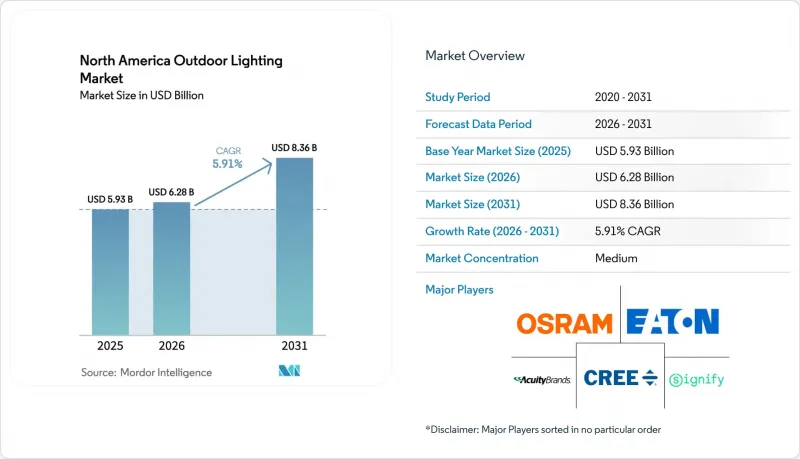
本報告按應用領域(住宅戶外照明、商業戶外照明、公共及街道照明等)、照明類型(傳統照明和LED照明)、安裝方式(傳統獨立式和連網/智慧式)以及國家/地區(美國、加拿大、墨西哥)進行細分。市場預測以美元(USD)計價。
北美戶外照明市場趨勢與洞察
地方政府對路燈進行節能維修
大規模的LED改造計畫正在該地區的各個城市實現50%至70%的節能,並帶來快速的投資回報。普拉森西亞市的LED改造工程涉及3,400盞燈具,每年可節省1,58,120美元,預計終身收益將達到310萬美元。埃德蒙頓市已完成46,000盞燈具的LED維修,減少了5,500噸溫室氣體排放,並節省了120萬美元的年度營運成本。能源效率與經濟委員會(ACEEE)估計,如果將美國所有路燈都更換為LED燈,每年可節省20200吉瓦時(GWh)的能源,並減少市政支出10億美元。能源服務合約和批量採購聯盟正在縮短小規模市政當局的投資回收期,而斯普林斯的一項先進調光試點項目已證明,透過自適應調度,可逐步降低1%至51%的能源消耗。這些切實的結果證實,LED維修將成為2020年代中期推動市場成長的最大引擎。
聯邦和州政府的補貼計畫旨在加速LED的普及應用。
電力公司和州政府的補貼計畫可以抵消初始投資,使市政當局即使在預算週期有限的情況下也能部署LED照明專案。美國約77%的郵遞區號區域符合某種形式的照明補貼資格,降低了專案的實際成本,並通常將投資回收期縮短至五年以內。馬裡蘭州在2024財政年度為其街道和戶外照明效率舉措津貼100萬美元,而紐約州和馬薩諸塞州則為其清潔能源社區的參與者提供分級獎勵。國家電網公司透過「透過公用事業帳單償還」的機制為LED照明改造提供資金,該機制將債務償還與實際實現的節能效果掛鉤。奧勒岡州更新了獎勵計劃,強調其持續的政策支持。這些金融工具加速了採購決策,尤其是在那些面臨資本預算限制的中小型城市。
高額初始資本支出(CAPEX)和預算週期
儘管整體擁有成本 (TCO) 指標表現良好,但如果市政年度預算無法承擔巨額資本支出,LED 路燈專案仍可能停滯不前。美國能源局指出,資金籌措是全面推廣 LED 路燈的最大障礙,尤其是在人口不到 25,000 人的城鎮。由於等候核准,將付款與節能掛鉤的績效合約和供應商擔保租賃合約常常被延誤。公共事業公司提供低利率貸款,但根據財政年度的時間表,這也可能導致專案推出延遲。雖然大量採購聯盟可以將照明設備的價格降低高達 15%,但各州的採購規則各不相同,這加重了本已人手過剩的行政人員的負擔。儘管 LED 路燈的生命週期經濟效益依然誘人,但這些不利因素正在減緩其短期推廣速度。
細分市場分析
到2025年,住宅領域將成為北美戶外照明市場的主要驅動力,佔總銷售額的35.12%。這主要得益於住宅對運動感測器安防照明、景觀重點照明和建築物向上照明的投資。同時,商業設施的擴張速度最快,預計到2031年將維持7.32%的複合年成長率。零售商、飯店和綜合用途開發商正利用動態立面照明來提升品牌吸引力和顧客安全。零售連鎖店正在停車場安裝連網照明設備,以監視錄影機和車牌辨識器;飯店業則正在升級泳池平台和人行道的照明設備,以滿足不斷提升的賓客體驗標準。工業設施正在採用能夠承受振動和極端溫度的高功率LED燈,從而減少連續運作環境下的維護停機時間。體育場館和大型場館正在安裝可調色溫的白色泛光燈,以滿足廣播需求,並為音樂會和特別活動打造色彩主題的燈光效果。
需求多元化是北美戶外照明市場的基礎,促使供應商最佳化配光和控制協議,以滿足特定產業的需求。景觀設計師傾向於使用低壓LED燈柱來襯託本地植物,而物流設施則需要配備防眩光罩的高桿燈以符合當地法規。隨著商業房地產所有者尋求永續發展認證,提供能源管理儀錶板的網路控制系統正成為採購中的差異化因素。可互通的D4i標準允許資產管理人員在跨多個地點的投資組合中自由組合驅動器和節點,從而簡化備件的物流。預計到2030年,自適應調光和人體感應技術在商業領域的應用將樹立新的標準,並逐步擴展到目前仍佔據主導地位的住宅領域。
其他好處:
- Excel格式的市場預測(ME)表
- 3個月的分析師支持
目錄
第1章:引言
- 研究假設和市場定義
- 調查範圍
第2章:調查方法
第3章執行摘要
第4章 市場狀況
- 市場概覽
- 市場促進因素
- 地方政府對路燈進行節能維修
- 聯邦和州政府的補貼計畫正在加速LED的普及。
- 智慧城市推廣政策及照明燈具工業物聯網整合
- 戶外電動車充電基礎設施快速擴張
- 氣候變遷脆弱地區的微電網和韌性項目
- 採用人工智慧驅動的自適應照明,確保符合暗夜保護法規
- 市場限制因素
- 較大的初始資本投資和預算週期
- 驅動晶片的供應鏈波動仍在持續。
- 當地居民因光害而反對
- 連網路燈的網路安全風險
- 宏觀經濟因素對市場的影響
- 技術進步
- 產業價值鏈分析
- 監理情勢
- 波特五力分析
第5章 市場規模與成長預測
- 透過使用
- 住宅戶外
- 商業戶外
- 零售和酒店
- 辦公大樓和商業園區
- 工業與物流
- 停車位
- 公共照明和街道照明
- 體育和廣域照明
- 其他用途(建築/景觀設計、活動、畫廊)
- 依照明類型
- 傳統的
- LED
- 透過安裝模式
- 傳統獨立式
- 互聯/智慧
- 國家
- 美國
- 加拿大
- 墨西哥
第6章 競爭情勢
- 市場集中度
- 策略趨勢
- 市佔率分析
- 公司簡介
- Signify NV
- Acuity Brands Lighting Inc.
- Cree LED Lighting Solutions
- Eaton Intelligent Lighting(Cooper)
- Zumtobel Group AG
- OSRAM GmbH
- Dialight plc
- Ideal Industries Inc.
- TCP International Holdings Ltd.
- Circadian Light Inc.
- SLV Lighting Group
- Schreder Group GIE
- Valmont Industries Inc.
- LSI Industries Inc.
- Kenall Manufacturing
- Nichia Corporation
- Seoul Semiconductor Co. Ltd.
- Leotek Electronics USA Corp.
- Flashnet SA
- DimOnOff Inc.
- Echelon(by Adesto)
- Telensa Ltd.
- Cimcon Lighting Inc.
- Fagerhult AB
第7章 市場機會與未來展望
According to Mordor Intelligence, the North America outdoor lighting market size is expected to grow from USD 5.93 billion in 2025 to USD 6.28 billion in 2026 and is forecast to reach USD 8.36 billion by 2031 at 5.91% CAGR over 2026-2031.
This report is Segmented by Type of Application (Residential Outdoor, Commercial Outdoor, Public and Street Lighting, and More), Type of Lighting (Traditional and LED), Installation Mode (Conventional Stand-Alone and Connected/Smart), and Country (United States, Canada, Mexico). The Market Forecasts are Provided in Terms of Value (USD).
North America Outdoor Lighting Market Trends and Insights
Energy-efficient retrofits in municipal streetlighting
Large-scale LED conversions deliver 50-70% energy savings and swift paybacks for cities across the region. The City of Placentia saves USD 158,120 each year from a 3,400-fixture project and expects USD 3.1 million in lifetime benefits. Edmonton completed 46,000 LED retrofits that cut greenhouse-gas emissions by 5,500 tonnes and reduced annual operating costs by USD 1.2 million. The American Council for an Energy-Efficient Economy estimates that nationwide conversion of U.S. streetlights could save 20,200 GWh annually and reduce municipal spending by USD 1 billion.Energy-service contracts and volume-purchase alliances shorten payback windows for smaller jurisdictions, while advanced dimming pilots in Colorado Springs reveal incremental energy reductions of 1-51% through adaptive scheduling. These robust outcomes reinforce LED retrofits as the market's strongest growth engine through mid-decade.
Federal and state rebates accelerating LED adoption
Utility and state rebate programs offset upfront capital, enabling municipalities to deploy LED projects within constrained budget cycles. Roughly 77% of U.S. zip codes qualify for some form of lighting rebate, which lowers effective project costs and compresses payback periods to below five years in many cases. Maryland directed USD 1 million in FY 2024 grants to its Streetlight and Outdoor Lighting Efficiency initiative, while New York and Massachusetts offer tiered incentives for Clean-Energy-Community participants. National Grid finances conversions through on-bill repayment mechanisms that align debt service with realized energy savings. Oregon updated its incentive schedules in 2025, underscoring the state's continued policy support. These financial levers expedite procurement decisions, particularly in small and mid-sized cities that struggle with capital budget constraints.
High upfront CAPEX versus budget cycles
Despite favorable total-cost-of-ownership metrics, LED streetlight projects can stall when annual municipal budgets are unable to absorb large capital outlays. The U.S. Department of Energy identifies financing gaps as the top hurdle to comprehensive conversions, especially in towns with populations under 25,000. Performance contracts and vendor-backed leases align payments with energy savings, yet council approvals often prolong deal closures. Public-power utilities offer low-interest loans, though fiscal-year timing may still delay project mobilization. Volume-purchase alliances reduce fixture prices by as much as 15%, but procurement rules vary by state, adding complexity to already stretched administrative staff. These headwinds slow short-term uptake even when life-cycle economics remain compelling.
Other drivers and restraints analyzed in the detailed report include:
- Smart-city mandates and IIoT integration of luminaires
- Surge in outdoor e-mobility charging-infrastructure lighting
- Persistent supply-chain volatility in driver ICs
For complete list of drivers and restraints, kindly check the Table Of Contents.
Segment Analysis
The residential segment led the North America outdoor lighting market with 35.12% revenue share in 2025 as homeowners invested in motion-sensing security lights, landscape accents, and architectural uplighting. Commercial venues, however, are scaling fastest and are projected to register a 7.32% CAGR through 2031, as retailers, hotels, and mixed-use developers utilize dynamic facade lighting to enhance brand appeal and customer safety. Retail chains are installing connected luminaires in parking lots to integrate surveillance cameras and license-plate readers, while hospitality operators are upgrading pool-deck and pathway fixtures to meet evolving guest-experience standards. Industrial facilities embrace high-output LEDs that resist vibration and extreme temperatures, reducing maintenance downtime in continuous-operation environments. Stadiums and large arenas are adopting tunable-white floodlights that meet broadcasting requirements and enable color-themed spectacles for concerts and special events.
Demand diversification underpins the North America outdoor lighting market, encouraging suppliers to tailor photometric distributions and control protocols for specific verticals. Landscape designers favor low-voltage LED bollards to accent native flora, whereas logistics campuses require high-mast poles with glare shields to comply with local ordinances. As commercial property owners pursue sustainability certifications, networked controls that provide energy dashboards become procurement differentiators. The interoperable D4i standard enables asset managers to mix and match drivers and nodes across multi-site portfolios, thereby simplifying spare parts logistics. By 2030, commercial adoption of adaptive dimming and occupancy sensing is expected to set new benchmarks that spill over into the still-dominant residential category.
Complete Report Scope:
- By Type of Application
- Residential Outdoor
- Commercial Outdoor
- Retail and Hospitality
- Offices and Business Parks
- Industrial and Logistics
- Parking Spaces
- Public and Street Lighting
- Sports and Large Area Lighting
- Other Type of Applications (Architectural and Landscape, Events, Galleries)
- By Type of Lighting
- Traditional
- LED
- By Installation Mode
- Conventional Stand-alone
- Connected / Smart
- By Country
- United States
- Canada
- Mexico
List of Companies Covered in this Report:
- Signify N.V.
- Acuity Brands Lighting Inc.
- Cree LED Lighting Solutions
- Eaton Intelligent Lighting (Cooper)
- Zumtobel Group AG
- OSRAM GmbH
- Dialight plc
- Ideal Industries Inc.
- TCP International Holdings Ltd.
- Circadian Light Inc.
- SLV Lighting Group
- Schreder Group GIE
- Valmont Industries Inc.
- LSI Industries Inc.
- Kenall Manufacturing
- Nichia Corporation
- Seoul Semiconductor Co. Ltd.
- Leotek Electronics USA Corp.
- Flashnet S.A.
- DimOnOff Inc.
- Echelon (by Adesto)
- Telensa Ltd.
- Cimcon Lighting Inc.
- Fagerhult AB
Additional Benefits:
- The market estimate (ME) sheet in Excel format
- 3 months of analyst support
TABLE OF CONTENTS
1 INTRODUCTION
- 1.1 Study Assumptions and Market Definition
- 1.2 Scope of the Study
2 RESEARCH METHODOLOGY
3 EXECUTIVE SUMMARY
4 MARKET LANDSCAPE
- 4.1 Market Overview
- 4.2 Market Drivers
- 4.2.1 Energy-efficient retrofits in municipal streetlighting
- 4.2.2 Federal and state rebates accelerating LED adoption
- 4.2.3 Smart-city mandates and IIoT integration of luminaires
- 4.2.4 Surge in outdoor e-mobility charging infrastructure lighting
- 4.2.5 Micro-grid and resilience projects in climate-vulnerable zones
- 4.2.6 AI-enabled adaptive dimming for dark-sky compliance
- 4.3 Market Restraints
- 4.3.1 High upfront CAPEX vs. budget cycles
- 4.3.2 Persistent supply-chain volatility in driver ICs
- 4.3.3 Community opposition on light-pollution grounds
- 4.3.4 Cyber-security risks in connected street-lights
- 4.4 Impact of Macroeconomic Factors on the Market
- 4.5 Technological Advances
- 4.6 Industry Value Chain Analysis
- 4.7 Regulatory Landscape
- 4.8 Porter's Five Forces Analysis
- 4.8.1 Bargaining Power of Suppliers
- 4.8.2 Bargaining Power of Consumers
- 4.8.3 Threat of New Entrants
- 4.8.4 Threat of Substitute Products
- 4.8.5 Intensity of Competitive Rivalry
5 MARKET SIZE AND GROWTH FORECASTS (VALUE)
- 5.1 By Type of Application
- 5.1.1 Residential Outdoor
- 5.1.2 Commercial Outdoor
- 5.1.2.1 Retail and Hospitality
- 5.1.2.2 Offices and Business Parks
- 5.1.2.3 Industrial and Logistics
- 5.1.2.4 Parking Spaces
- 5.1.3 Public and Street Lighting
- 5.1.4 Sports and Large Area Lighting
- 5.1.5 Other Type of Applications (Architectural and Landscape, Events, Galleries)
- 5.2 By Type of Lighting
- 5.2.1 Traditional
- 5.2.2 LED
- 5.3 By Installation Mode
- 5.3.1 Conventional Stand-alone
- 5.3.2 Connected / Smart
- 5.4 By Country
- 5.4.1 United States
- 5.4.2 Canada
- 5.4.3 Mexico
6 COMPETITIVE LANDSCAPE
- 6.1 Market Concentration
- 6.2 Strategic Moves
- 6.3 Market Share Analysis
- 6.4 Company Profiles (includes Global level Overview, Market level overview, Core Segments, Financials as available, Strategic Information, Market Rank/Share for key companies, Products and Services, and Recent Developments)
- 6.4.1 Signify N.V.
- 6.4.2 Acuity Brands Lighting Inc.
- 6.4.3 Cree LED Lighting Solutions
- 6.4.4 Eaton Intelligent Lighting (Cooper)
- 6.4.5 Zumtobel Group AG
- 6.4.6 OSRAM GmbH
- 6.4.7 Dialight plc
- 6.4.8 Ideal Industries Inc.
- 6.4.9 TCP International Holdings Ltd.
- 6.4.10 Circadian Light Inc.
- 6.4.11 SLV Lighting Group
- 6.4.12 Schreder Group GIE
- 6.4.13 Valmont Industries Inc.
- 6.4.14 LSI Industries Inc.
- 6.4.15 Kenall Manufacturing
- 6.4.16 Nichia Corporation
- 6.4.17 Seoul Semiconductor Co. Ltd.
- 6.4.18 Leotek Electronics USA Corp.
- 6.4.19 Flashnet S.A.
- 6.4.20 DimOnOff Inc.
- 6.4.21 Echelon (by Adesto)
- 6.4.22 Telensa Ltd.
- 6.4.23 Cimcon Lighting Inc.
- 6.4.24 Fagerhult AB
7 MARKET OPPORTUNITIES AND FUTURE OUTLOOK
- 7.1 White-space and Unmet-need Assessment

 戶外照明:市場佔有率分析、產業趨勢與統計、成長預測(2026-2031)
 2026-2030年全球戶外景觀照明市場
 2026年全球戶外照明市場報告
 戶外照明市場-全球產業規模、佔有率、趨勢、機會、預測:按類型、光源、最終用戶、地區和競爭格局分類,2021-2031年
 全球耐候型戶外照明市場(依產品類型、光源技術、功率範圍、安裝方式、通路、應用及最終用戶分類)-2026-2032年預測
 戶外照明市場規模、佔有率及成長分析(按光源、應用、通路及地區分類)-2026-2033年產業預測
 戶外照明市場機會、成長動力、產業趨勢分析及 2025 - 2034 年預測
 全球戶外照明市場:市場規模、佔有率和趨勢分析(按類型、應用、分銷管道、地區和細分,2025-2030 年)
 室外照明的全球市場