


 |
市場調查報告書
商品編碼
2062403
近眼顯示器:市佔率分析、產業趨勢與統計及成長預測(2026-2031 年)Near-Eye Display - Market Share Analysis, Industry Trends & Statistics, Growth Forecasts (2026 - 2031) |
||||||

※ 本網頁內容可能與最新版本有所差異。詳細情況請與我們聯繫。
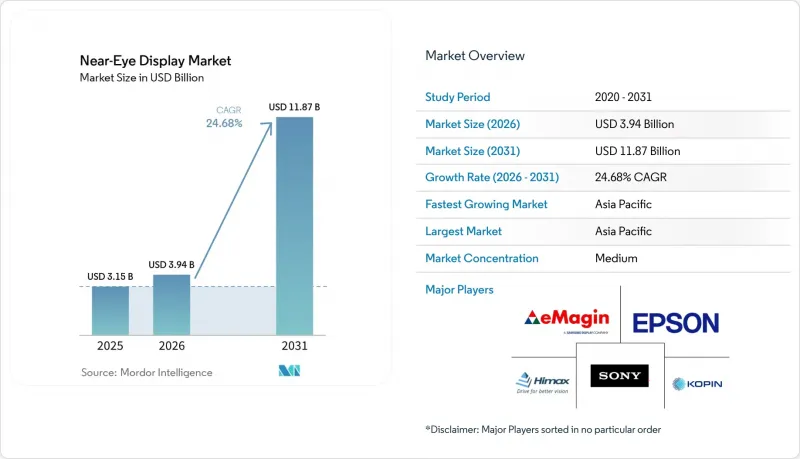
根據 Mordor Intelligence 預測,近眼顯示市場規模將從 2025 年的 31.5 億美元和 2026 年的 39.4 億美元成長到 2031 年的 118.7 億美元,2026 年至 2031 年的年複合成長率(CAGR)為 24.68%。
本報告按技術(微型OLED、LCOS、微型LED、DLP、雷射光束掃描)、應用(虛擬實境頭戴式顯示器、擴增實境智慧眼鏡、混合實境頭戴式顯示器、汽車抬頭顯示器、武器瞄準器和士兵頭戴式顯示器)、終端用戶產業(消費性電子等)、原生解析度(1K或更低等)和地區進行細分。市場預測以美元計價。
全球近眼顯示市場趨勢與洞察
微型OLED製造成本降低的主流趨勢
微型OLED晶圓代工廠正從200毫米晶圓過渡到300毫米晶圓,晶片良率每年可提高20%,單位成本每年可降低高達20%,這為中端頭戴式顯示器市場打開了大門,此前OLED微型顯示器的成本一直高不可攀。索尼半導體解決方案公司於2025年擴建了其熊本工廠的生產線,使其4K產能翻番,並將前置作業時間縮短至八週。中國競爭對手西亞科技宣布將於2025年推出一款1.03吋、4000 PPI的面板,其成本績效實現了飛躍,比現有日本製造商的產品低約15%。採用溶液法製程的聚合物OLED可望透過省去真空沉澱製程進一步降低成本,但其可靠性數據目前仍在檢驗。如果到2028年,成本低於100美元的模組能夠面世,那麼售價低於500美元的大規模生產的AR眼鏡將首次實現經濟可行性。
VR/MR頭顯中扁平光學元件的廣泛應用
餅狀透鏡通過彎曲光路,可將頭戴裝置的厚度減少約 40%,但透光率會降低高達 80%,因此顯示器亮度需要超過 1500 尼特。 Meta 在 2023 年發布的 Quest 3 上標準化了這項技術,並在 2025 年仍然保持著銷量領先地位。 Kopi 的 2.6K x 2.6K 微型 LED 原型車在 2025 年初就突破了 10000 尼特,證明無機 LED 可以滿足極高的亮度需求。由於反射式 LCOS 面板的光損耗較低,Seiko Epson 等供應商暫時獲得了優勢,為 OEM 廠商提供了一種低成本的過渡方案,直到微型 LED 的良率成熟。
高亮度奈米電子溫度控管方面持續存在的挑戰。
Meta公司的Quest Pro採用了均熱板,但即便如此,連續使用約一小時後仍會導致使用者不適。 AR眼鏡內部空間有限,無法安裝風扇,而Vuzix的原型機在3000尼特亮度下使用10分鐘後效能便開始下降。 Kopin和應用材料公司正在試驗類金剛石碳(DLC)背板,可將導熱係數提高30%。將這些材料與低功耗驅動器結合使用,是實現商業化部署的關鍵。否則,近眼顯示市場在戶外視覺領域將面臨停滯的風險。
細分市場分析
到2025年,由於成熟的生產生態系統和穩定的良率,microOLED將佔據近眼顯示市場45.94%的收入佔有率。然而,microLED預計到2031年將以25.21%的複合年成長率成長,成為成長最快的架構。 microLED在近眼顯示市場的佔有率將取決於其能否克服良率轉移問題,但其超過5000尼特的亮度優勢已經吸引了AR眼鏡OEM廠商的注意。 LCOS在企業工具領域仍然很受歡迎,因為「足夠」的亮度和低成本是該領域的關鍵因素。
DLP技術正被應用於堅固耐用的武器瞄準器中,Kopin公司在2025年訂單了一份價值2050萬美元的美國軍方契約,這為其發展提供了有力支撐。同時,雷射光束掃描技術在低光照室內眼鏡產品領域仍處於小眾市場。廣東玉鳥顯示器(Guangdong Jade Bird Display)的4μm像素間距技術展示了亞洲代工廠如何降低成本並加速技術普及。如果到2028年,商用MicroLED模組的價格降至150美元以下,那麼該技術層級的近眼顯示器市場規模可能會超過AR眼鏡領域的Micro-OLED市場。
到 2025 年,受遊戲需求的推動,VR 頭戴式顯示器將佔銷售額的 63.42%,而 AR 智慧眼鏡的成長軌跡最為迅猛,到 2031 年的複合年成長率將達到 25.53%。 Meta 公司到 2025 年底售出了超過 700 萬副 Ray-Ban 智慧眼鏡,向社會證明,眼鏡產品這種外形規格可以被主流接受,而不會被貼上「小玩意」的標籤。
Xreal 的「Air 2 Pro」已在 DHL 的物流營運中部署,這表明該產品已獲得企業級認可,而不僅限於先導計畫。混合實境(MR) 頭顯正被建築師和外科醫生使用,以滿足他們對透明性和沈浸感的雙重需求。採用 LCOS 面板的汽車抬頭顯示器正在使 Lucid 的“Gravity” SUV 等高階電動車脫穎而出。軍用瞄準鏡雖然產量較小,但利潤率高,並支持整個近眼顯示市場的創新週期。
區域分析
預計到2025年,亞太地區將佔近眼顯示器銷售額的46.81%,並將在2031年之前以25.06%的複合年成長率持續成長。這主要得益於中國擴大其用於矽基基板的OLED製造工廠規模,以及日本推進其精密塗層技術的發展。京東方成都工廠計畫在2027年實現年產100萬塊OLED微顯示器,預計將降低其對中國進口零件的依賴。索尼和精工愛普生持續引領像素密度標桿,成為全球OEM廠商競相效仿的對象,進一步鞏固了日本的市場影響力。韓國的MicroLED先導計畫預示著下一代AR眼鏡產品將實現在地採購,而印度的網咖則正在推動VR技術的普及。
北美市場的成長主要依靠兩大支柱:民用和國防需求。 Meta 的 Quest 生態系統正在推動零售市場的發展,而 Ray-Ban 的智慧眼鏡則在時尚界樹立了良好的口碑。 Kopin 公司價值 2,050 萬美元的武器瞄準器訂單及其頭盔先導計畫凸顯了軍方預算對研發投入的重要性,這與民用消費支出波動較大形成了鮮明對比。加拿大和墨西哥分別提供設計人才和最終組裝,從而形成了垂直多元化的區域供應鏈。
歐洲正利用其嚴格的法規結構作為競爭優勢。歐盟已於2025年採納IEC 62471和IEC TS 60825-20作為雷射安全標準,這可能會延緩產品上市,但有助於提升其品質聲譽。 BMW的全景影像系統(道路抬頭顯示)和梅賽德斯-奔馳在乘客側擴增實境娛樂系統方面的試驗,都清楚地表明了汽車行業的需求。英國和法國正在為其國防項目採購耐環境影響的頭戴式顯示器,而中東、非洲和南美洲則正經歷著與智慧型手機普及率上升和政府主導的智慧城市計劃相關的早期成長。
其他好處:
- Excel格式的市場預測(ME)表
- 3個月的分析師支持
目錄
第1章:引言
- 研究假設和市場定義
- 調查範圍
第2章:調查方法
第3章執行摘要
第4章 市場狀況
- 市場概覽
- 市場促進因素
- 微型OLED製造成本降低的主流化
- VR/MR頭顯中扁平光學元件的廣泛應用
- 遊戲和娛樂內容生態系統的快速發展。
- 矽基微型LED試點工廠的出現
- AI驅動的動態中心凹渲染演算法
- 美國國防部「穿戴式駕駛座」採購計劃
- 市場限制因素
- 高亮度NED的溫度控管仍面臨挑戰。
- OLEDOS面板中藍光發光元件壽命短
- 高PPI背板供應鏈脆弱性
- 歐盟監管機構審查XR眼部安全標準。
- 產業價值鏈分析
- 監理情勢
- 技術展望
- 波特五力分析
第5章 市場規模與成長預測
- 透過技術
- Micro-OLED
- LCOS
- MicroLED
- DLP
- 雷射光束掃描
- 透過使用
- 虛擬實境頭戴式顯示器
- 擴增實境(AR)智慧眼鏡
- 混合實境頭戴式裝置
- 汽車抬頭顯示器
- 武器瞄準器和士兵頭戴式顯示器
- 按最終用戶行業分類
- 消費性電子產品
- 公司和行業
- 衛生保健
- 國防與安全
- 按原生解析度
- 最大像素1000(高清或更低)
- 1K 至 2K(全高清等級)
- 2K~4K
- 4K 或更高
- 按地區
- 北美洲
- 美國
- 加拿大
- 墨西哥
- 歐洲
- 德國
- 英國
- 法國
- 俄羅斯
- 其他歐洲國家
- 亞太地區
- 中國
- 日本
- 印度
- 韓國
- 澳洲
- 其他亞太國家
- 中東和非洲
- 中東
- 沙烏地阿拉伯
- 阿拉伯聯合大公國
- 其他中東國家
- 非洲
- 南非
- 埃及
- 其他非洲國家
- 中東
- 南美洲
- 巴西
- 阿根廷
- 其他南美國家
- 北美洲
第6章 競爭情勢
- 市場集中度
- 策略趨勢
- 市佔率分析
- 公司簡介
- Sony Semiconductor Solutions Corporation
- Seiko Epson Corporation
- eMagin Corporation
- Kopin Corporation
- Himax Display Incorporated
- BOE Technology Group Co., Ltd.
- SeeYA Technology Co., Ltd.
- Guangdong Jade Bird Display Technology Co., Ltd.
- MicroOLED SAS
- Plessey Semiconductors Ltd.
- VueReal Inc.
- Mojo Vision Inc.
- Jasper Display Corporation
- RaonTech Inc.
- Lakeside Optronics Technology Co., Ltd.
- Lumiode Inc.
- SiliconCore Technology Inc.
- MicroVision Inc.
- Texas Instruments Incorporated(DLP Products)
- TCL CSOT-TCL China Star Optoelectronics Technology Co., Ltd.
第7章 市場機會與未來展望
According to Mordor Intelligence, the near-eye display market size is projected to expand from USD 3.15 billion in 2025 and USD 3.94 billion in 2026 to USD 11.87 billion by 2031, registering a CAGR of 24.68% between 2026 to 2031.
This report is Segmented by Technology (Micro-OLED, LCOS, Microled, DLP, and Laser Beam Scanning), Application (Virtual-Reality HMDs, Augmented-Reality Smart Glasses, Mixed-Reality Headsets, Automotive HUDs, Weapon Sights and Soldier HMDs), End-User Industry (Consumer Electronics, and More), Native Resolution (Up To 1K, and More), and Geography. Market Forecasts are Provided in Terms of Value (USD).
Global Near-Eye Display Market Trends and Insights
Mainstream Cost-Down of Micro-OLED Manufacturing
Micro-OLED foundries shifting from 200 mm to 300 mm wafers are pushing die yields higher and slicing unit costs by as much as 20% each year, opening the near-eye display market to mid-tier headsets that once priced out OLED micro displays. Sony Semiconductor Solutions expanded its Kumamoto line in 2025, doubling 4K-capable output and shrinking lead times to eight weeks. Chinese rival SeeYA Technology unveiled a 1.03-inch panel with 4,000 PPI in 2025, signaling a cost-performance leap that undercuts Japanese incumbents by nearly 15%. Solution-processed polymer OLEDs promise additional savings because they avoid vacuum evaporation, though reliability data remains under validation. If sub-USD 100 modules materialize before 2028, mass-market AR glasses retailing below USD 500 become financially viable for the first time.
Widespread Adoption of Pancake Optics in VR/MR Headsets
Pancake lenses fold the light path, reducing headset depth by roughly 40% yet sacrificing up to 80% of light throughput, which forces displays past 1,500 nits. Meta standardized the approach in Quest 3, released in 2023, and is still the volume leader in 2025. Kopin's 2.6K X 2.6K MicroLED prototype surpassed 10,000 nits in early 2025, proving that inorganic LEDs meet extreme brightness demand. Reflective LCOS suppliers such as Seiko Epson gain an interim advantage because their panels waste less light, giving OEMs a lower-cost bridge until MicroLED yields mature.
Persistent Thermal Management Challenges in High-Brightness NEDs
Meta's Quest Pro used vapor chambers but still triggered user discomfort after about one hour of continuous play. AR glasses lack space for fans, and prototypes from Vuzix throttled after 10 minutes at 3,000 nits. Kopin and Applied Materials are experimenting with diamond-like carbon backplanes that raise thermal conductivity by 30%. Commercial rollout depends on pairing these materials with low-power drivers, or the near-eye display market risks stagnation in outdoor-readable segments.
Other drivers and restraints analyzed in the detailed report include:
- Surge in Gaming/Entertainment Content Ecosystems
- Restraint (~) % Impact on CAGR Forecast Geographic Relevance Impact Timeline Persistent Thermal Management Challenges in High-Brightness NEDs -3.70% Global, acute in compact AR glasses Short term (<= 2 years) Limited Lifetime of Blue Emitters in OLEDoS Panels -2.90% Global, particularly Japan and South Korea manufacturing Medium term (2-4 years) Supply-Chain Fragility for High-PPI Backplanes -2.30% Asia-Pacific and North America Medium term (2-4 years) EU Regulatory Scrutiny on Ocular Safety Limits for XR -1.80% Europe, with global compliance ripple effects Long term (>= 4 years)
- Limited Lifetime of Blue Emitters in OLEDoS Panels
For complete list of drivers and restraints, kindly check the Table Of Contents.
Segment Analysis
Micro-OLED delivered 45.94% of revenue for the near-eye display market in 2025 as its production ecosystem remains mature and yields stable. However, MicroLED's 25.21% CAGR expectation through 2031 positions it as the fastest rising architecture. The near-eye display market share for MicroLED hinges on solving mass-transfer yields, but brightness advantages above 5,000 nits already attract AR-glass OEMs. LCOS maintains traction in enterprise tools where "good enough" brightness and low-cost rule.
DLP serves rugged weapon sights, supported by Kopin's USD 20.5 million U.S. military order in 2025, while laser beam scanning stays niche for low-light indoor eyewear. Guangdong Jade Bird Display's 4 µm pixel pitch exemplifies how Asian foundries compress costs and accelerate adoption. If commercial MicroLED modules fall below USD 150 by 2028, the near-eye display market size for this technology tier could surpass Micro-OLED in AR glasses.
VR head-mounted displays controlled 63.42% revenue in 2025, sustained by gaming demand, but AR smart glasses are on track for the fastest 25.53% CAGR to 2031. Meta sold over 7 million Ray-Ban smart glasses by late 2025, providing social validation that eyewear form factors can achieve mainstream uptake without "tech-toy" stigma.
Xreal's Air 2 Pro found logistic deployments at DHL, revealing enterprise acceptance beyond pilot projects. Mixed-reality headsets serve architects and surgeons needing transparency plus immersion. Automotive head-up displays using LCOS panels now differentiate premium EVs like Lucid's Gravity SUV. Military weapon sights, though smaller in units, deliver high margins that subsidize innovation cycles across the wider near-eye display market.
Geography Analysis
Asia-Pacific delivered 46.81% of near-eye display revenue in 2025 and should expand at 25.06% CAGR through 2031 as China ramps OLED-on-silicon fabs and Japan advances precision coatings. BOE's Chengdu line aims for 1 million OLED micro displays annually by 2027, trimming Chinese reliance on imported parts. Sony and Seiko Epson continue to set pixel-density benchmarks that global OEMs chase, reinforcing Japan's influence. South Korea's pilot MicroLED initiatives forecast localized supply for next-gen AR eyewear, while India's gaming cafes seed grassroots VR uptake.
North America rides on dual poles of consumer and defense demand. Meta's Quest ecosystem anchors retail momentum, and Ray-Ban smart glasses cement fashion credibility. Kopin's USD 20.5 million weapon-sight award plus its pilot helmet project underscore military budgets that cushion R&D against cyclical consumer spending. Canada and Mexico contribute design talent and final assembly, respectively, rounding out a vertically diverse regional chain.
Europe leverages strict regulatory frameworks as a competitive moat. The EU adopted IEC 62471 and IEC TS 60825-20 for laser safety in 2025, delaying launches but elevating perceived quality. BMW's Panoramic Vision roadway HUD and Mercedes-Benz experiments in passenger-side AR entertainment illustrate automotive demand. Defense programs in the United Kingdom and France procure hardened head-mounted displays, while the Middle East and Africa and South America record early-stage growth linked to rising smartphone penetration and government smart-city initiatives.
- Sony Semiconductor Solutions Corporation
- Seiko Epson Corporation
- eMagin Corporation
- Kopin Corporation
- Himax Display Incorporated
- BOE Technology Group Co., Ltd.
- SeeYA Technology Co., Ltd.
- Guangdong Jade Bird Display Technology Co., Ltd.
- MicroOLED S.A.S.
- Plessey Semiconductors Ltd.
- VueReal Inc.
- Mojo Vision Inc.
- Jasper Display Corporation
- RaonTech Inc.
- Lakeside Optronics Technology Co., Ltd.
- Lumiode Inc.
- SiliconCore Technology Inc.
- MicroVision Inc.
- Texas Instruments Incorporated (DLP Products)
- TCL CSOT - TCL China Star Optoelectronics Technology Co., Ltd.
Additional Benefits:
- The market estimate (ME) sheet in Excel format
- 3 months of analyst support
TABLE OF CONTENTS
1 INTRODUCTION
- 1.1 Study Assumptions and Market Definition
- 1.2 Scope of the Study
2 RESEARCH METHODOLOGY
3 EXECUTIVE SUMMARY
4 MARKET LANDSCAPE
- 4.1 Market Overview
- 4.2 Market Drivers
- 4.2.1 Mainstream cost-down of Micro-OLED manufacturing
- 4.2.2 Widespread adoption of pancake optics in VR/MR headsets
- 4.2.3 Surge in gaming/entertainment content ecosystems
- 4.2.4 Emergence of MicroLED-on-silicon pilot fabs
- 4.2.5 AI-generated dynamic foveated rendering algorithms
- 4.2.6 U.S. DoD "Wearable Cockpit" procurement program
- 4.3 Market Restraints
- 4.3.1 Persistent thermal management challenges in high-brightness NEDs
- 4.3.2 Limited lifetime of blue emitters in OLEDoS panels
- 4.3.3 Supply-chain fragility for high-PPI backplanes
- 4.3.4 EU regulatory scrutiny on ocular safety limits for XR
- 4.4 Industry Value Chain Analysis
- 4.5 Regulatory Landscape
- 4.6 Technological Outlook
- 4.7 Porter's Five Forces Analysis
- 4.7.1 Bargaining Power of Suppliers
- 4.7.2 Bargaining Power of Buyers
- 4.7.3 Threat of New Entrants
- 4.7.4 Threat of Substitutes
- 4.7.5 Competitive Rivalry
5 MARKET SIZE AND GROWTH FORECASTS (VALUE)
- 5.1 By Technology
- 5.1.1 Micro-OLED
- 5.1.2 LCOS
- 5.1.3 MicroLED
- 5.1.4 DLP
- 5.1.5 Laser Beam Scanning
- 5.2 By Application
- 5.2.1 Virtual-Reality Head-Mounted Displays
- 5.2.2 Augmented-Reality Smart Glasses
- 5.2.3 Mixed-Reality Headsets
- 5.2.4 Automotive Head-Up Displays
- 5.2.5 Weapon Sights and Soldier HMDs
- 5.3 By End-User Industry
- 5.3.1 Consumer Electronics
- 5.3.2 Enterprise and Industrial
- 5.3.3 Healthcare
- 5.3.4 Defense and Security
- 5.4 By Native Resolution
- 5.4.1 Up to 1 K (HD and below)
- 5.4.2 Between 1 K-2 K (FHD class)
- 5.4.3 Between 2 K-4 K
- 5.4.4 Above 4 K
- 5.5 By Geography
- 5.5.1 North America
- 5.5.1.1 United States
- 5.5.1.2 Canada
- 5.5.1.3 Mexico
- 5.5.2 Europe
- 5.5.2.1 Germany
- 5.5.2.2 United Kingdom
- 5.5.2.3 France
- 5.5.2.4 Russia
- 5.5.2.5 Rest of Europe
- 5.5.3 Asia-Pacific
- 5.5.3.1 China
- 5.5.3.2 Japan
- 5.5.3.3 India
- 5.5.3.4 South Korea
- 5.5.3.5 Australia
- 5.5.3.6 Rest of Asia-Pacific
- 5.5.4 Middle East and Africa
- 5.5.4.1 Middle East
- 5.5.4.1.1 Saudi Arabia
- 5.5.4.1.2 United Arab Emirates
- 5.5.4.1.3 Rest of Middle East
- 5.5.4.2 Africa
- 5.5.4.2.1 South Africa
- 5.5.4.2.2 Egypt
- 5.5.4.2.3 Rest of Africa
- 5.5.4.1 Middle East
- 5.5.5 South America
- 5.5.5.1 Brazil
- 5.5.5.2 Argentina
- 5.5.5.3 Rest of South America
- 5.5.1 North America
6 COMPETITIVE LANDSCAPE
- 6.1 Market Concentration
- 6.2 Strategic Moves
- 6.3 Market Share Analysis
- 6.4 Company Profiles (includes Global level Overview, Market level overview, Core Segments, Financials as available, Strategic Information, Market Rank/Share for key companies, Products and Services, and Recent Developments)
- 6.4.1 Sony Semiconductor Solutions Corporation
- 6.4.2 Seiko Epson Corporation
- 6.4.3 eMagin Corporation
- 6.4.4 Kopin Corporation
- 6.4.5 Himax Display Incorporated
- 6.4.6 BOE Technology Group Co., Ltd.
- 6.4.7 SeeYA Technology Co., Ltd.
- 6.4.8 Guangdong Jade Bird Display Technology Co., Ltd.
- 6.4.9 MicroOLED S.A.S.
- 6.4.10 Plessey Semiconductors Ltd.
- 6.4.11 VueReal Inc.
- 6.4.12 Mojo Vision Inc.
- 6.4.13 Jasper Display Corporation
- 6.4.14 RaonTech Inc.
- 6.4.15 Lakeside Optronics Technology Co., Ltd.
- 6.4.16 Lumiode Inc.
- 6.4.17 SiliconCore Technology Inc.
- 6.4.18 MicroVision Inc.
- 6.4.19 Texas Instruments Incorporated (DLP Products)
- 6.4.20 TCL CSOT - TCL China Star Optoelectronics Technology Co., Ltd.
7 MARKET OPPORTUNITIES AND FUTURE OUTLOOK
- 7.1 White-space and Unmet-Need Assessment

 近眼顯示市場-2026-2032年全球市場預測
 2026年全球近眼顯示市場報告
 全球近眼顯示器市場規模、佔有率、趨勢和成長分析報告(2026-2034)
 近眼顯示市場 - 全球產業規模、佔有率、趨勢、機會及預測(按組件、設備類型、技術、最終用戶、地區和競爭格局分類,2021-2031年)
 近眼顯示市場趨勢與技術分析(2025年)
 全球近眼顯示器市場
 近眼顯示市場規模、佔有率及趨勢分析報告(按顯示技術、設備類型、最終用途、地區及細分市場預測,2025 年至 2033 年)全球近眼設備 Micro LED 市場
 近眼顯示器市場(按技術、設備類型、解析度、垂直領域和地區)- 預測至 2030 年
 近眼顯示器市場報告:趨勢、預測和競爭分析(至 2031 年)