


 |
市場調查報告書
商品編碼
2062343
低鐵玻璃:市場佔有率分析、產業趨勢與統計、成長預測(2026-2031 年)Low Iron Glass - Market Share Analysis, Industry Trends & Statistics, Growth Forecasts (2026 - 2031) |
||||||

※ 本網頁內容可能與最新版本有所差異。詳細情況請與我們聯繫。
根據 Mordor Intelligence 預測,低鐵玻璃市場規模預計在 2025 年達到 51.3 億美元,在 2026 年達到 54.8 億美元,在 2031 年達到 76 億美元。
預計從 2026 年到 2031 年,其複合年成長率將達到 6.78%。
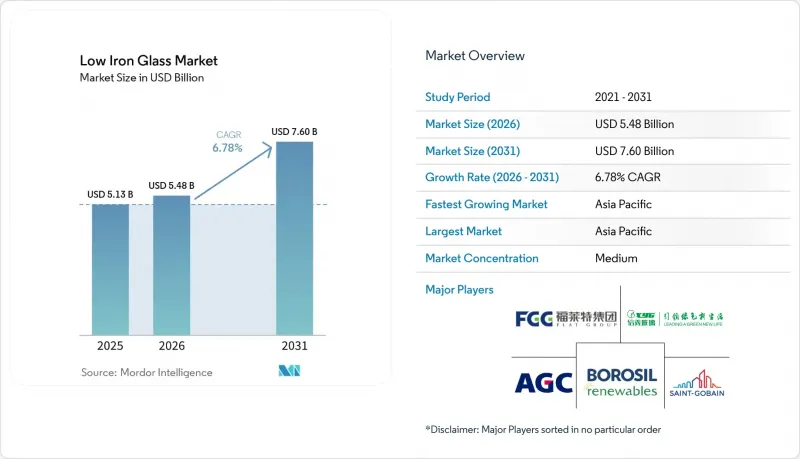
本報告按產品類型(例如,透明低鐵玻璃、著色低鐵玻璃)、應用領域(例如,建築外觀、太陽能組件和建築整合太陽能)、終端用戶行業(例如,可再生能源和太陽能發電)以及地區(例如,亞太地區、北美地區、歐洲地區、南美地區以及中東和非洲地區)進行細分。市場預測以美元計價。
全球低鐵玻璃市場趨勢及洞察
建築玻璃具有優異的透明度和透光性
為了滿足LEED(能源與環境設計先鋒獎)第五版和BREEAM(英國建築研究院環境評估方法)2024的採光標準,開發商要求可見光透過率達到91%或更高,這推動了低鐵玻璃市場的需求。例如,在倫敦62樓的「8 Bishopsgate」大樓中,使用了Sedak公司的Isopure低鐵玻璃單元,實現了72%的透光率和0.7 W/m²-K的U值,從而使年度供暖、通風和空調(HVAC)成本降低了18%。同樣,低鐵玻璃也被應用於中高層建築的維修工程。 Vitro公司的「Solarban Acuity」系列產品擁有73%的透光率和0.23的太陽能熱增益係數,在北美使用該產品的專案有資格獲得公共產業公司的補貼。 AGC公司生產的Clearvision玻璃被應用於西雅圖的「The Jack」大廈,其透光率高達68%,熱增益係數僅為0.28,充分展現了超高透明度基板如何提升居住者的舒適度。隨著綠建築標準的日益嚴格,建築師擴大在帷幕牆、天窗和中庭中使用低鐵玻璃,進一步推動了全球市場對低鐵玻璃的需求。
擴大光伏(PV)和建築整合光伏(BIPV)組件的應用。
雙面和串聯鈣鈦礦矽太陽能電池需要正面玻璃透光率達到91.5%或更高,而標準鈉鈣浮法玻璃無法達到這一要求,這進一步鞏固了低鐵玻璃在可再生能源應用中的地位。 PURE Solar公司於2024年推出的BIPV組件,其轉換效率為25%,透過使用低鐵基板,發電量提高了3-4個百分點。弗勞恩霍夫太陽能系統研究所(ISE)的MorphoColor塗層在彩色低鐵玻璃上保持了90-96%的效率,與黑色電池相當,證明美觀並不會影響性能。到2025年,中國將生產3,274.1萬噸太陽能玻璃,此後,除非熔爐升級為低鐵配方,否則中國將限制新建熔爐。同時,印度對太陽能玻璃徵收為期五年的反傾銷稅,促使 Borosil Renewables 將產能擴大到每天 600 噸,凸顯了政策措施如何加強國內生產能力。
與普通浮法玻璃相比,生產成本更高。
由於低鐵玻璃的鐵矽含量低於60ppm,熔煉週期更長,且需要更嚴格的成分控制,因此其價格比標準浮法玻璃高出25%至40%。這種價格溢價限制了低鐵玻璃在對成本敏感的窗戶玻璃應用中的使用。例如,台灣玻璃公司累計到2025年將虧損9.6億新台幣(約3021萬美元),並將業務重心轉向電子玻璃纖維布,以應對平板玻璃利潤率下降的問題。用於博物館展櫃和水族館等應用的Pilkington Optiwhite玻璃,小批量售價為每平方公尺120美元,而標準浮法玻璃的售價為每平方公尺50美元,這限制了其在對透明度要求較高的項目中的應用。此外,由於低鐵玻璃的太陽熱吸收率較低,其強化和夾層製程需要調整爐工安排,這會使加工成本增加10%至15%。
細分市場分析
預計到2031年,鍍膜低鐵玻璃的複合年成長率將達到7.38%,超過無色玻璃的成長率(2025年無色玻璃的銷售額佔比為43.78%)。抗反射(AR)和透明導電氧化物(TCO)塗層可將組件輸出功率提高2-3個百分點。光子學研究所(ICFO)和康寧公司共同開發的無光刻AR製程實現了低於99%的透射率,並於2024年進入試生產階段。層壓產品應用於抬頭顯示器(HUD)和擴增實境(AR)波導,伊士曼公司的「Saflex Horizon Vision」中間層與低鐵玻璃基板結合使用,已成功將鬼影分離距離縮小至0.3毫米以內。由於顏色越深層穿透率越低,彩色玻璃的應用受到限制。然而,將MorphoColor薄膜應用於低鐵玻璃後,其黑色玻璃的透光率仍能保持在90-96%,為幕牆應用提供了美觀的選擇。雖然透明玻璃仍然是注重成本的窗戶應用的首選,但隨著與鍍膜玻璃的價格差距縮小,以及低鐵玻璃市場內部替代趨勢的推進,透明玻璃的市場佔有率正在下降。
研發工作主要集中在奈米結構塗層領域。中國製造商已將二氧化矽(SiO2)溶膠-凝膠薄膜商業化,其透光率可達94-96%,價格僅比未塗覆基板高出不到15%,這促進了其在大規模太陽能發電應用中的普及。採用卷對卷(R2R)紫外線(UV)奈米壓印技術生產的蛾眼結構,反射率僅0.1%,透光率高達94%,如果到2028年其生產良率能超過95%,則有望得到更廣泛的應用。這些技術進步提升了終端用戶的價值提案,並有助於製造商維持利潤率。
區域分析
預計亞太地區將繼續保持其在低鐵玻璃市場的地位,到2025年將佔據48.02%的市場佔有率,並以7.32%的複合年成長率成長。在中國,根據產能交換規定,窯爐正在升級改造,以適應低鐵配方;而印度的反傾銷稅正在推動Borosil和Visakha等公司的業務擴張。印尼巴塘自由貿易區已吸引了包括新義玻璃和KCC在內的多家公司超過118億美元的投資,使其成為區域出口中心。日本和韓國正致力於鍍膜玻璃和顯示器玻璃的技術創新,以支援擴增實境(AR)和有機發光二極體(OLED)光學應用。
在北美,生產回流正在穩步推進。 NSG位於俄亥俄州的工廠和康寧公司投資3.15億美元的坎頓工廠擴建項目,正在為First Solar公司和極紫外線(EUV)光刻供應鏈提供支援。福耀公司投資4億美元的伊利諾州計畫和SolarCycle公司喬治亞的回收設施,正在加強循環供應鏈。墨西哥正利用《美國-墨西哥-加拿大協定》(USMCA)市場進入,而Vitro公司的夥伴關係項目則在促進功能性玻璃產品的共同開發。然而,為了確保資訊來源的可靠性,本文排除了來自私人研究機構的資料。
在歐洲,不斷上漲的能源成本和歐盟排放交易體系(ETS)第四階段帶來的碳排放成本,正迫使玻璃製造商探索混合熔爐技術。捷克共和國AGC和聖戈班的「Volta」先導計畫旨在2028年展示50%電力和50%氧氣燃料混合的熔煉過程。 Sisekam已在土耳其、義大利和保加利亞投資總計3.89億美元,而NSG在波蘭新建的塗層生產線計劃於2027年運作,將服務於汽車和建築市場。回收仍然是一個挑戰,目前只有5%的建築平板玻璃被回收為熔爐中可重複使用的碎玻璃屑。然而,荷蘭的回收率已達75%,凸顯了低鐵玻璃產業存在的巨大差距和策略缺口。中東地區的初級生產能力正在不斷擴大。信義在沙烏地阿拉伯投資 3.86 億美元的生產線和 Guardian 的 Coater Plus Float 擴建項目預計將於 2028 年前為沿岸地區的電致變色和建築一體化光伏 (BIPV) 項目提供產品。在南美洲,儘管市場規模仍然較小,但隨著巴西和智利推出對太陽能板成分的要求,新的機會正在湧現。
其他好處:
- Excel格式的市場預測(ME)表
- 3個月的分析師支持
目錄
第1章:引言
- 研究假設和市場定義
- 調查範圍
第2章:調查方法
第3章執行摘要
第4章 市場狀況
- 市場概覽
- 市場促進因素
- 建築玻璃具有優異的透明度和透光性
- 擴大太陽能發電組件和建築整合太陽能組件的應用
- 與電致變色和智慧幕牆系統的整合
- AR/VR 對高解析度顯示器和蓋板玻璃的需求日益成長。
- 國內採購義務正在促進本地太陽能玻璃製造業的發展。
- 市場限制因素
- 與普通浮法玻璃相比,製造成本更高。
- 高純度矽砂的供應和價格波動
- 特種玻璃回收基礎設施不足
- 能源強度對碳定價體系的風險
- 價值鏈分析
- 波特五力模型
第5章 市場規模與成長預測
- 依產品類型
- 無色低鐵玻璃
- 有色低鐵玻璃
- 鍍膜低鐵玻璃
- 夾層低鐵玻璃
- 透過使用
- 建築立面
- 太陽能發電組件和建築整合太陽能(BIPV)。
- 顯示玻璃(電視、顯示器、智慧型手機、AR/VR)
- 家具和室內設計
- 汽車光學玻璃
- 水族箱和花園照明
- 按最終用戶行業分類
- 可再生能源和太陽能
- 建築和商業建築
- 電子和顯示器製造
- 家具和室內設計
- 汽車和運輸業
- 按地區
- 亞太地區
- 中國
- 印度
- 日本
- 韓國
- 東南亞國協
- 其他亞太國家
- 北美洲
- 美國
- 加拿大
- 墨西哥
- 歐洲
- 德國
- 英國
- 法國
- 義大利
- 西班牙
- 俄羅斯
- 北歐國家
- 其他歐洲國家
- 南美洲
- 巴西
- 阿根廷
- 其他南美國家
- 中東和非洲
- 沙烏地阿拉伯
- 阿拉伯聯合大公國
- 南非
- 其他中東和非洲國家
- 亞太地區
第6章 競爭情勢
- 市場集中度
- 策略趨勢
- 市佔率和排名分析
- 公司簡介
- AGC Inc.
- borosilrenewables
- Corning Incorporated
- CSG Holding Co., Ltd.
- Flat Glass Group Co., Ltd.
- Fuyao Glass Industry Group
- Guardian Industries Holdings
- HORN Glass Industries AG
- Huihua Glass Co.,Limited.
- Jinjing(Group)Co., Ltd.
- Lumon Group
- Nippon Sheet Glass Co., Ltd.
- Saint-Gobain Glass
- Sisecam
- Taiwan Glass Ind. Corp.
- Trakya Glass and Aluminum Industry & Trade Inc.
- Vitro Architectural Glass
- Xinyi Glass Holdings Limited
- Zibo Huaxing Chemical Equipment Factory
第7章 市場機會與未來展望
According to Mordor Intelligence, the low iron glass market size is projected to be USD 5.13 billion in 2025, USD 5.48 billion in 2026, and reach USD 7.60 billion by 2031, growing at a CAGR of 6.78% from 2026 to 2031.
This report is Segmented by Product Type (Clear Low-Iron Glass, Tinted Low-Iron Glass, and More), Application (Architectural Facades, Solar PV Modules and BIPV, and More), End-User Industry (Renewable Energy and Solar and More), and Geography (Asia-Pacific, North America, Europe, South America, and Middle-East and Africa). The Market Forecasts are Provided in Terms of Value (USD).
Global Low Iron Glass Market Trends and Insights
Superior Clarity and Light Transmission in Architectural Glazing
Developers are specifying visible-light transmission above 91% to meet Leadership in Energy and Environmental Design (LEED) version 5 and Building Research Establishment Environmental Assessment Method (BREEAM) 2024 daylighting standards, driving demand in the low-iron glass market. For example, the 62-story 8 Bishopsgate tower in London utilized Sedak isopure low-iron glass units, achieving 72% light transmission and a U-value of 0.7 W/m2-K, which reduced annual heating, ventilation, and air conditioning (HVAC) costs by 18%. Similarly, mid-rise retrofits are adopting low-iron glass; Vitro's Solarban Acuity line offers 73% transmission and a 0.23 solar heat-gain coefficient, qualifying projects in North America for utility rebates. AGC Inc. Clearvision glazing, used in The Jack building in Seattle, achieved 68% transmission and a 0.28 heat-gain coefficient, demonstrating how ultra-clear substrates enhance occupant comfort. As green building codes become stricter, architects are increasingly incorporating low-iron glass in curtain walls, skylights, and atria, further driving global demand.
Growing Adoption in Solar PV and BIPV Modules
Bifacial and tandem perovskite-silicon solar cells require front-glass transmittance of greater than or equal to 91.5%, which standard soda-lime float glass cannot achieve, solidifying the role of low-iron glass in renewable energy applications. PURE Solar's 25% efficient BIPV panel, launched in 2024, demonstrated a 3-4 percentage-point yield improvement using low-iron substrates. Fraunhofer Institute for Solar Energy Systems (ISE)'s MorphoColor coatings maintain 90-96% of black-cell efficiency on colored low-iron glass, proving that aesthetics do not compromise performance. In 2025, China produced 32.741 million tons of photovoltaic glass and has since imposed restrictions on new kilns unless they upgrade to low-iron formulations. Meanwhile, India's five-year anti-dumping duties on solar glass have accelerated Borosil Renewables' expansion to 600 tons per day, highlighting how policy measures are bolstering domestic production capacity.
Higher Production Cost Versus Standard Float Glass
Low-iron glass units are priced 25-40% higher than standard float glass due to the use of sub-60 parts per million (ppm) iron silica, extended melting cycles, and stricter composition controls. This price premium limits the adoption of low-iron glass in cost-sensitive fenestration applications. For example, Taiwan Glass reported a TWD 960 million (USD 30.21 million) loss in 2025 and shifted its focus to electronic-grade fiberglass cloth to address declining flat-glass margins. Pilkington Optiwhite, used in applications such as museum cases and aquariums, is priced at USD 120 per square meter (m2) in small quantities, compared to USD 50 per m2 for standard float glass, restricting its use to projects requiring high clarity. Additionally, tempering and laminating processes for low-iron glass require recalibrated furnace schedules due to reduced solar absorption, which increases processing costs by 10-15%.
Other drivers and restraints analyzed in the detailed report include:
- Integration with Electrochromic and Smart-Facade Systems
- Emerging Demand from High-Resolution Display and AR/VR Cover Glass
- Volatile High-Purity Silica-Sand Supply and Pricing
For complete list of drivers and restraints, kindly check the Table Of Contents.
Segment Analysis
Coated low-iron glass is expected to grow at a CAGR of 7.38% through 2031, surpassing the growth of clear formulations, which accounted for 43.78% of revenue in 2025. Anti-reflective (AR) and transparent conductive oxide (TCO) coatings improve module output by 2-3 percentage points. The Institute of Photonic Sciences (ICFO) and Corning's lithography-free AR process achieved transmittance levels below 99% and entered pilot production in 2024. Laminated products are used in heads-up displays (HUDs) and augmented reality (AR) waveguides, with Eastman's Saflex Horizon Vision interlayer achieving ghost-image separations of less than 0.3 millimeters when combined with low-iron substrates. Tinted glass has limited adoption due to reduced transmission with deeper colors. However, MorphoColor films on low-iron glass maintained 90-96% of black-cell efficiency, offering aesthetic options for facade applications. Clear glass continues to dominate cost-sensitive fenestration applications but is losing market share as coated glass narrows price gaps, encouraging substitution within the low-iron glass market.
Research and development efforts are focused on nanostructured coatings. Chinese manufacturers have commercialized silicon dioxide (SiO2) sol-gel films that deliver 94-96% transmission at premiums of less than 15% compared to uncoated substrates, driving adoption in utility-scale solar applications. Roll-to-roll ultraviolet (UV) nanoimprint moth-eye structures, which promise 0.1% reflectance and 94% transmission, could gain adoption if production yields exceed 95% by 2028. These technological advancements enhance value propositions for end-users and support manufacturers in maintaining profit margins.
Geography Analysis
Asia-Pacific is expected to hold 48.02% market value in 2025, with a CAGR of 7.32%, maintaining its position in the low iron glass market. China is upgrading kilns to low-iron formulations under capacity-swap regulations, while India's anti-dumping duties are driving expansions by Borosil and Vishakha. Indonesia's Batang free-trade zone has attracted investments from Xinyi and KCC, exceeding USD 11.8 billion, establishing a regional export hub. Japan and South Korea are focusing on coated and display-grade innovations to support augmented reality (AR) and organic light-emitting diode (OLED) optics applications.
North America is advancing reshoring efforts. NSG's Ohio plant and Corning's USD 315 million Canton extension are supporting First Solar and extreme ultraviolet (EUV) lithography supply chains. Fuyao's USD 400 million Illinois project and Solarcycle's recycling facility in Georgia are strengthening circular supply chains. Mexico is leveraging the United States-Mexico-Canada Agreement (USMCA) access, with Vitro's partnership program encouraging the co-development of functional glazing. However, data from commercial research firms has been excluded to maintain source integrity.
Europe is addressing high energy tariffs and European Union Emissions Trading System (ETS) Phase 4 carbon costs, prompting glassmakers to explore hybrid furnace technologies. AGC and Saint-Gobain's Volta pilot project in the Czech Republic aims to test a 50% electric and 50% oxyfuel melting process by 2028. Sisecam has invested USD 389 million across Turkey, Italy, and Bulgaria, while NSG's new coating line in Poland, set to launch in 2027, will cater to automotive and architectural markets. Recycling remains a challenge, with only 5% of construction flat glass being returned as furnace-ready cullet. However, the Netherlands achieves a 75% collection rate, highlighting a significant disparity and a strategic gap in the low-iron glass industry. The Middle East is increasing primary production capacity. Xinyi's USD 386 million Saudi Arabia line and Guardian's coater-plus-float expansion are expected to supply Gulf electrochromic and building-integrated photovoltaic (BIPV) projects by 2028. In South America, while the market remains smaller, opportunities are emerging as Brazil and Chile introduce solar-content requirements.
- AGC Inc.
- borosilrenewables
- Corning Incorporated
- CSG Holding Co., Ltd.
- Flat Glass Group Co., Ltd.
- Fuyao Glass Industry Group
- Guardian Industries Holdings
- HORN Glass Industries AG
- Huihua Glass Co.,Limited.
- Jinjing (Group) Co., Ltd.
- Lumon Group
- Nippon Sheet Glass Co., Ltd.
- Saint-Gobain Glass
- Sisecam
- Taiwan Glass Ind. Corp.
- Trakya Glass and Aluminum Industry & Trade Inc.
- Vitro Architectural Glass
- Xinyi Glass Holdings Limited
- Zibo Huaxing Chemical Equipment Factory
Additional Benefits:
- The market estimate (ME) sheet in Excel format
- 3 months of analyst support
TABLE OF CONTENTS
1 Introduction
- 1.1 Study Assumptions and Market Definition
- 1.2 Scope of the Study
2 Research Methodology
3 Executive Summary
4 Market Landscape
- 4.1 Market Overview
- 4.2 Market Drivers
- 4.2.1 Superior clarity and light-transmission in architectural glazing
- 4.2.2 Growing adoption in solar PV and BIPV modules
- 4.2.3 Integration with electrochromic and smart-facade systems
- 4.2.4 Emerging demand from high-resolution display and AR/VR cover glass
- 4.2.5 Domestic content mandates fueling regional solar-glass manufacturing
- 4.3 Market Restraints
- 4.3.1 Higher production cost vs. standard float glass
- 4.3.2 Volatile high-purity silica-sand supply and pricing
- 4.3.3 Limited specialty-glass recycling infrastructure
- 4.3.4 Energy-intensity exposure to carbon pricing schemes
- 4.4 ValueChain Analysis
- 4.5 Porter's Five Forces
- 4.5.1 Bargaining Power of Suppliers
- 4.5.2 Bargaining Power of Buyers
- 4.5.3 Threat of New Entrants
- 4.5.4 Threat of Substitutes
- 4.5.5 Competitive Rivalry
5 Market Size and Growth Forecasts (Value)
- 5.1 By Product Type
- 5.1.1 Clear Low-Iron Glass
- 5.1.2 Tinted Low-Iron Glass
- 5.1.3 Coated Low-Iron Glass
- 5.1.4 Laminated Low-Iron Glass
- 5.2 By Application
- 5.2.1 Architectural and Building Facades
- 5.2.2 Solar PV Modules and BIPV
- 5.2.3 Display Glass (TV, Monitor, Smartphone, AR/VR)
- 5.2.4 Furniture and Interior Decoration
- 5.2.5 Automotive Optical Glass
- 5.2.6 Aquarium and Horticulture Lighting
- 5.3 By End-user Industry
- 5.3.1 Renewable Energy and Solar
- 5.3.2 Construction and Commercial Buildings
- 5.3.3 Electronics and Display Manufacturing
- 5.3.4 Furniture and Interior Design
- 5.3.5 Automotive and Transportation
- 5.4 By Geography
- 5.4.1 Asia-Pacific
- 5.4.1.1 China
- 5.4.1.2 India
- 5.4.1.3 Japan
- 5.4.1.4 South Korea
- 5.4.1.5 ASEAN Countries
- 5.4.1.6 Rest of Asia-Pacific
- 5.4.2 North America
- 5.4.2.1 United States
- 5.4.2.2 Canada
- 5.4.2.3 Mexico
- 5.4.3 Europe
- 5.4.3.1 Germany
- 5.4.3.2 United Kingdom
- 5.4.3.3 France
- 5.4.3.4 Italy
- 5.4.3.5 Spain
- 5.4.3.6 Russia
- 5.4.3.7 Nordic Countries
- 5.4.3.8 Rest of Europe
- 5.4.4 South America
- 5.4.4.1 Brazil
- 5.4.4.2 Argentina
- 5.4.4.3 Rest of South America
- 5.4.5 Middle East and Africa
- 5.4.5.1 Saudi Arabia
- 5.4.5.2 United Arab Emirates
- 5.4.5.3 South Africa
- 5.4.5.4 Rest of Middle East and Africa
- 5.4.1 Asia-Pacific
6 Competitive Landscape
- 6.1 Market Concentration
- 6.2 Strategic Moves
- 6.3 Market Share(%)/Ranking Analysis
- 6.4 Company Profiles {(includes Global level Overview, Market level overview, Core Segments, Financials as available, Strategic Information, Products and Services, and Recent Developments)}
- 6.4.1 AGC Inc.
- 6.4.2 borosilrenewables
- 6.4.3 Corning Incorporated
- 6.4.4 CSG Holding Co., Ltd.
- 6.4.5 Flat Glass Group Co., Ltd.
- 6.4.6 Fuyao Glass Industry Group
- 6.4.7 Guardian Industries Holdings
- 6.4.8 HORN Glass Industries AG
- 6.4.9 Huihua Glass Co.,Limited.
- 6.4.10 Jinjing (Group) Co., Ltd.
- 6.4.11 Lumon Group
- 6.4.12 Nippon Sheet Glass Co., Ltd.
- 6.4.13 Saint-Gobain Glass
- 6.4.14 Sisecam
- 6.4.15 Taiwan Glass Ind. Corp.
- 6.4.16 Trakya Glass and Aluminum Industry & Trade Inc.
- 6.4.17 Vitro Architectural Glass
- 6.4.18 Xinyi Glass Holdings Limited
- 6.4.19 Zibo Huaxing Chemical Equipment Factory
7 Market Opportunities and Future Outlook
- 7.1 White-space and Unmet-need Assessment

 浮法玻璃:市場佔有率分析、產業趨勢與統計、成長預測(2026-2031)
 全球低鐵玻璃市場:市場規模、佔有率、趨勢和成長分析(2026-2034)
 2026年全球建築用透明浮法玻璃市場報告2026年全球浮法玻璃市場報告
 全球浮法玻璃市場:按厚度、產品、終端用途產業和地區分類的市場規模-預測至2030年
 浮法玻璃市場按產品類型、厚度、塗層類型、應用和分銷管道分類-2025-2030 年全球預測
 浮法玻璃的全球市場的評估:各類型,各用途,各地區,機會,預測(2018年~2032年)浮法玻璃的印度市場評估:各類型,各用途,各地區,機會,預測(2019年度~2033年度)
 浮法玻璃機械市場、佔有率、規模、趨勢、行業分析報告(按類型、應用和地區)- 市場預測,2025-2034 年