


 |
市場調查報告書
商品編碼
2062262
企業社交軟體:市場佔有率分析、產業趨勢與統計及成長預測(2026-2031)Enterprise Social Software - Market Share Analysis, Industry Trends & Statistics, Growth Forecasts (2026 - 2031) |
||||||

※ 本網頁內容可能與最新版本有所差異。詳細情況請與我們聯繫。
根據 Mordor Intelligence 預測,企業社群軟體市場規模預計在 2025 年達到 188 億美元,在 2026 年達到 221.5 億美元,在 2031 年達到 502.4 億美元。
預計從 2026 年到 2031 年,其複合年成長率將達到 17.8%。
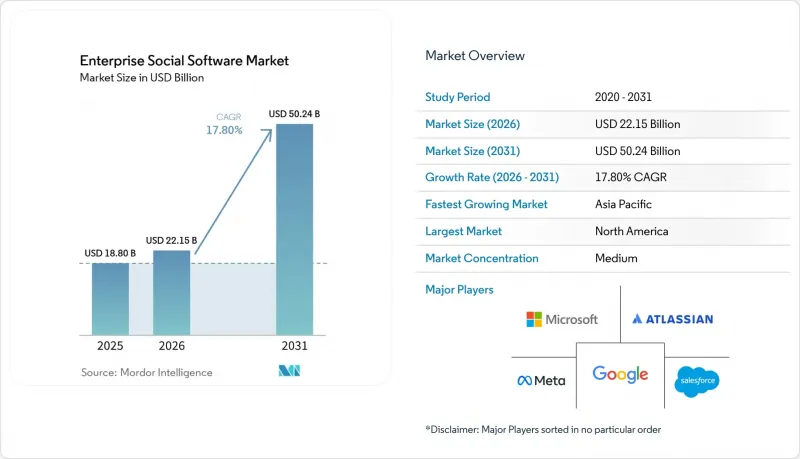
本報告按功能模組(內部溝通、員工評估與福利、其他)、組織規模(中小企業、大型企業)、交付管道(行動優先、網頁瀏覽器、其他)、行業(醫療保健、IT與電信、零售與電子商務、其他)以及地區(北美、其他)進行細分。市場預測以美元計價。
全球企業社交軟體市場趨勢與洞察
一種永久性的混合工作文化
混合辦公模式已成為標準營運模式,四分之三的公司都保留了正式的分散辦公地點。這種模式的普及暴露了以電子郵件和會議為中心的協作方式的局限性,導致2024年至2025年間非同步工具預算增加了91%。 IT和電信等知識密集型行業加速採用了這種模式,因為事件回應和程式碼審查需要持續且搜尋的討論帖。微軟決定在2026年將Viva Engage社群直接整合到Teams中,凸顯了該公司意識到上下文切換會阻礙用戶參與。如果企業無法將聊天、內容和任務整合到一個由人工智慧驅動的中心平台,員工可能會將60%的時間花在「工作相關任務」上。因此,預計到2031年,平台整合將進一步加強。
擴大SaaS應用以降低整體擁有成本
雲端遷移最初承諾降低資本支出,但人工智慧附加元件的高昂定價卻導致營運預算大幅膨脹。 Salesforce 和微軟目前對生成式人工智慧功能收取每位用戶每月 30 至 60 美元的費用,迫使投資者重新評估訂閱的生命週期成本。像 Zoho 這樣的供應商透過將人工智慧整合到基礎套餐中,並為中小企業提供具有吸引力且可預測的定價,吸引了對成本敏感的客戶。亞太地區的許多公司從未部署過本地環境,它們正直接遷移到 SaaS,並傾向於選擇以行動優先、以消費者為中心的套件。然而,與代幣消耗掛鉤的付費使用制模式帶來了可預測的波動性,負責人核算將其納入 2027 年和 2028 年的預算中。
資料主權和隱私風險
GDPR及類似法規強制規定了嚴格的資料居住規則,這使得全球部署變得更加複雜。越來越多的歐洲公司投資於主權雲端區域,以避免觸發跨境資料傳輸,但這推高了託管成本並延長了採購週期。跨國公司需要按司法管轄區分類用戶流量,這增加了架構的複雜性,並可能延遲部署。平台供應商正透過本地資料中心和細粒度加密金鑰來解決這個問題,但一些買家在獲得合規性證明之前會推遲購買。這些趨勢正在減緩對隱私高度敏感行業的企業社交軟體市場的成長速度。
細分市場分析
知識發現領域的生成式人工智慧正以21.20%的複合年成長率(CAGR)實現顯著成長。這一成長速度超過了企業社交軟體市場的整體成長速度,凸顯了其日益成長的重要性。預計到2025年,內部溝通將佔據企業社交軟體市場40.70%的佔有率。然而,隨著企業將預算轉向更高級的模組,其主導地位預計將會下降。這些模組專注於自動提取專業知識並彙總海量文件庫,以滿足知識管理效率日益成長的需求。這種轉變反映了一個更廣泛的趨勢,即企業優先考慮能夠提高生產力並簡化關鍵資訊存取的工具。
目前,組織內部缺乏結構化的記憶,導致效率低下,平均每位員工每天需要花費1.8小時搜尋。企業正積極投資於能夠將這些浪費的時間轉化為可執行洞察並提高生產力的解決方案。獎勵和健康相關的模組也因其與環境、社會和管治(ESG) 優先事項的契合而備受關注。同時,創意生成中心仍主要應用於研發密集型產業。此外,將專案協作和文件共用功能整合到生產力套件中的趨勢日益成長,迫使獨立供應商尋求差異化優勢。這些供應商正致力於特定產業的工作流程和人工智慧的可解釋性,以在快速變化的市場環境中保持競爭力。
儘管預計到2025年大型企業將佔據56.60%的收入佔有率,但中小企業(SME)正以18.60%的複合年成長率成長,縮小了使用率方面的差距。隨著小型企業逐步淘汰本地部署的舊有系統,轉而採用具備行動管理功能的雲端套件,面向小規模的企業社交軟體市場預計將加速發展。這一趨勢表明,中小企業越來越傾向於選擇能夠滿足其營運敏捷性的現代化、靈活解決方案。推動這一轉變的關鍵因素是中小企業需要經濟高效、可擴展的技術,以適應其動態且不斷變化的需求。此外,功能強大的雲端工具的日益普及也促使中小企業擺脫傳統系統。預期這一發展趨勢將對企業社交軟體市場的競爭格局產生重大影響。
中小企業越來越傾向於可預測的按使用者收費系統和簡化的上線流程,以降低部署的複雜性。這些定價模式和精簡的流程使中小企業能夠採用企業級社交軟體,而無需承擔高昂的前期成本或技術難題。 Zoho 和 MangoApps 等供應商透過包裝和提供客製化的行業特定模板來滿足這些特定需求,確保快速部署和易用性。同時,大型企業正在洽談包含人工智慧、安全和分析功能的企業級契約,以利用超大規模資料中心業者生態系統中的綜合服務。供應商的這兩種做法反映了中小企業和大型企業的不同需求。 Atlassian 的模組化定價策略體現了這種適應性,無需平台遷移即可實現從小規模團隊部署到全球部署的無縫擴展。
區域分析
預計到2025年,北美將佔全球收入的37.70%,並持續維持人工智慧驅動協作的標竿市場地位。美國企業正主導知識整合代理的全球試點部署,旨在提高生產力並簡化工作流程。隨著Meta退出Workplace平台,供應商整合正在加速,凸顯了整合生產力雲端平台日益成長的重要性。此外,監管壓力要求企業揭露基於ESG框架的員工敬業度指標,也推動了平台更新。該地區強大的技術基礎設施和對先進解決方案的早期採用,進一步鞏固了其作為企業社交軟體市場創新和應用關鍵中心的地位。
亞太地區是成長最快的區域,預計到2025年,數位化工作場所成熟度將達到66.35%,複合年成長率(CAGR)為18.70%。印度、日本和澳洲等主要市場正在推動對企業社交軟體的投資,而中國的在地化法規則促使企業優先採用騰訊和阿里巴巴的基礎設施。該地區的中小企業正在快速採用雲端套件,顯著推動了用戶成長,儘管每用戶平均收入仍低於北美基準。該地區的成長也得益於不斷推進的數位轉型(DX)計劃、政府鼓勵雲端採用的政策以及中小企業對可擴展且經濟高效的解決方案日益成長的需求。
在歐洲,由於GDPR的複雜性和宏觀經濟的不確定性,企業社交軟體的普及速度有所放緩,但它仍然是企業社交軟體的策略市場。歐洲展現的數據主權能力正成為其他地區的基本要求,使其成為合規主導創新的試驗場。在德國、英國和法國,企業關注與ESG相關的參與度指標,這正在影響平台的開發和應用。同時,南美、中東和非洲正在湧現新的行動主導市場機會。然而,這些地區面臨匯率外匯、基礎設施落後和數位轉型緩慢等挑戰,儘管市場擴張潛力巨大,但這些挑戰可能會抑製成長。
其他好處:
- Excel格式的市場預測(ME)表
- 3個月的分析師支持
目錄
第1章:引言
- 研究假設和市場定義
- 調查範圍
第2章:調查方法
第3章執行摘要
第4章 市場狀況
- 市場概覽
- 市場促進因素
- 一種永久性的混合工作文化
- 擴大SaaS應用以降低整體擁有成本
- 與生產力套件整合
- 與ESG相關的員工敬業度需求
- 利用生成式人工智慧進行知識發現
- 業界專用企業內網模板
- 市場限制因素
- 與資料主權和隱私相關的風險
- 對開放共用的文化阻力
- 協作工具帶來的疲勞
- 對LLM整合中鎖定效應的擔憂
- 產業價值/價值鏈分析
- 宏觀經濟因素對市場的影響
- 技術展望
- 波特五力分析
第5章 市場規模與成長預測
- 按功能模組
- 內部溝通
- 知識管理
- 員工獎勵與福利
- 創意生成與創新中心
- 其他功能模組
- 按組織規模
- 中小企業
- 大公司
- 透過分銷管道
- 行動優先
- 網路瀏覽器
- 桌面客戶端
- 按行業分類
- BFSI
- 衛生保健
- 資訊科技/通訊
- 零售與電子商務
- 政府/公共部門
- 製造業
- 其他工業部門
- 按地區
- 北美洲
- 美國
- 加拿大
- 墨西哥
- 歐洲
- 德國
- 英國
- 法國
- 義大利
- 西班牙
- 其他歐洲國家
- 亞太地區
- 中國
- 日本
- 印度
- 韓國
- 澳洲
- 其他亞太國家
- 南美洲
- 巴西
- 阿根廷
- 其他南美國家
- 中東和非洲
- 中東
- 沙烏地阿拉伯
- 阿拉伯聯合大公國
- 其他中東國家
- 非洲
- 南非
- 埃及
- 其他非洲國家
- 中東
- 北美洲
第6章 競爭情勢
- 市場集中度
- 策略趨勢
- 市佔率分析
- 公司簡介
- Microsoft Corporation
- Salesforce Inc
- Google LLC
- Atlassian Corporation
- International Business Machines Corporation
- Meta Platforms Inc
- SAP SE
- Oracle Corporation
- Zoho Corporation Pvt Ltd
- Aurea Inc Jive Software
- LumApps SAS
- MangoApps Inc
- Igloo Software Inc
- Limeade Inc incl Sitrion
- Axero Solutions LLC
- Simpplr Inc
- Happeo Oy
- Staffbase GmbH
- Firstup Inc
- Unily Ltd
第7章 市場機會與未來展望
According to Mordor Intelligence, the enterprise social software market size is expected to be USD 18.8 billion in 2025, USD 22.15 billion in 2026, and reach USD 50.24 billion by 2031, growing at a CAGR of 17.8% from 2026 to 2031.
This report is Segmented by Feature Module (Internal Communications, Employee Recognition and Wellness, and More), Organization Size (SMEs, and Large Enterprises), Delivery Channel (Mobile-First, Web Browser, and More), Industry Vertical (Healthcare, IT and Telecom, Retail and ECommerce, and More), and Geography (North America, and More). The Market Forecasts are Provided in Terms of Value (USD).
Global Enterprise Social Software Market Trends and Insights
Permanent Hybrid-Work Culture
Hybrid arrangements have become the default operating model, with three out of four enterprises retaining formal split-location policies. This permanence has exposed the limits of email and meeting-centric collaboration, prompting a 91% increase in asynchronous tool budgets between 2024 and 2025. Knowledge-intensive sectors such as IT and telecom accelerated adoption because incident response and code reviews demand persistent, searchable discussion threads. Microsoft's 2026 decision to surface Viva Engage communities directly inside Teams highlights the vendor's recognition that context switching suppresses engagement. Organizations that fail to converge chat, content, and tasks into a single AI-powered hub risk locking 60% of employee time into "work about work," which is why platform consolidation is expected to intensify through 2031.
Rising SaaS Adoption for Lower TCO
Cloud migration originally promised capital-expense relief, yet premium pricing for AI add-ons is inflating operating budgets. Salesforce and Microsoft now charge USD 30-USD 60 per user each month for generative functionality, pushing finance teams to reassess lifetime subscription costs. Vendors such as Zoho are winning cost-sensitive customers by embedding AI in base tiers, delivering predictable pricing that appeals to small businesses. Asia-Pacific enterprises, many of which never owned on-premises stacks, are leapfrogging directly to SaaS and favoring mobile-first suites that mirror consumer experiences. Even so, usage-based billing tied to token consumption is introducing forecast volatility that controllers must model into 2027 and 2028 budgets.
Data-Sovereignty and Privacy Risks
GDPR and similar statutes mandate strict residency rules that complicate global roll-outs. A growing share of European enterprises invest in sovereign-cloud zones to avoid cross-border transfer triggers, which raises hosting costs and lengthens procurement cycles. Multinationals must segment user traffic by jurisdiction, adding architectural complexity that can slow adoption. Platform vendors address the issue with in-region data centres and granular encryption keys, yet some buyers still delay purchases until compliance evidence matures. These dynamics temper the growth curve of the enterprise social software market in privacy-sensitive sectors.
Other drivers and restraints analyzed in the detailed report include:
- Productivity-Suite Integrations
- ESG-Linked Employee-Engagement Needs
- Cultural Resistance to Open Sharing
For complete list of drivers and restraints, kindly check the Table Of Contents.
Segment Analysis
Generative AI in knowledge discovery is experiencing significant growth, with a compound annual growth rate (CAGR) of 21.20%. This growth rate surpasses that of the broader enterprise social software market, highlighting its increasing importance. By 2025, internal communications are projected to account for 40.70% of the enterprise social software market share. However, its dominance is expected to decline as organizations shift their budgets toward advanced modules. These modules focus on automatically surfacing expertise and summarizing extensive document repositories, addressing the growing need for efficiency in knowledge management. The shift reflects a broader trend of enterprises prioritizing tools that enhance productivity and streamline access to critical information.
Unstructured institutional memory currently leads to an average of 1.8 hours of daily search time per employee, creating inefficiencies. Enterprises are actively investing in solutions to transform this lost time into actionable insights, driving productivity. Recognition and wellness modules are gaining traction due to their alignment with environmental, social, and governance (ESG) priorities. Meanwhile, ideation hubs remain predominantly utilized in research and development (R&D)-intensive sectors. Additionally, project collaboration and file-sharing functionalities are increasingly integrated into productivity suites, compelling standalone vendors to differentiate themselves. These vendors are focusing on vertical-specific workflows or enhancing AI explainability to remain competitive in a rapidly evolving market landscape.
Large enterprises commanded 56.60% of the 2025 revenue pool, yet SMEs are advancing at an 18.60% CAGR, narrowing the usage divide. The enterprise social software market size for SME deployments is projected to accelerate as smaller firms bypass on-premises legacies and adopt cloud suites with mobile administration. This trend highlights the growing preference among SMEs for modern, flexible solutions that align with their operational agility. The shift is primarily driven by the need for cost-effective and scalable technologies that can adapt to the dynamic and evolving requirements of smaller businesses. Additionally, the increasing availability of cloud-based tools with enhanced features is further encouraging SMEs to transition away from traditional systems. This evolution is expected to significantly impact the competitive landscape of the enterprise social software market.
SMEs are increasingly drawn to predictable per-user fees and simplified onboarding processes, which reduce implementation complexities. These pricing models and streamlined processes enable smaller businesses to adopt enterprise social software without the burden of high upfront costs or technical challenges. Vendors like Zoho and MangoApps are addressing these specific needs by offering packaged industry templates tailored for SMEs, ensuring faster deployment and usability. Meanwhile, large organizations negotiate enterprise agreements that bundle AI, security, and analytics, leveraging hyperscaler ecosystems for their comprehensive offerings. This dual approach by vendors reflects the diverse needs of SMEs and large enterprises. Atlassian's modular pricing strategy exemplifies this adaptability, allowing businesses to scale from small team deployments to global rollouts seamlessly, without requiring platform migration.
Geography Analysis
North America held 37.70% of 2025 revenue and remains the reference market for AI-infused collaboration. U.S. enterprises are leading global pilots of knowledge-synthesis agents, which are designed to enhance productivity and streamline workflows. Vendor consolidation has intensified following Meta's exit from Workplace, highlighting the growing importance of integrated productivity clouds. Additionally, regulatory pressures to disclose employee-engagement metrics under ESG frameworks are driving platform renewals. The region's strong technological infrastructure and early adoption of advanced solutions further solidify its position as a critical hub for innovation and adoption in the enterprise social software market.
Asia-Pacific is the fastest-growing region, with an 18.70% CAGR, as digital workplace maturity reached 66.35% in 2025. Key markets such as India, Japan, and Australia are anchoring investments in enterprise social software, while China's localization rules are fostering separate domestic deployments, favoring Tencent and Alibaba infrastructure. SMEs across the region are rapidly adopting cloud suites, significantly contributing to user-count growth, even though the average revenue per user remains lower compared to North American benchmarks. The region's growth is further supported by increasing digital transformation initiatives, government policies promoting cloud adoption, and the rising demand for scalable and cost-effective solutions among smaller businesses.
Europe faces slower uptake due to GDPR complexities and macroeconomic uncertainties, yet it remains a strategic market for enterprise social software. Data-sovereignty capabilities proven in Europe are becoming baseline expectations in other regions, making it a testing ground for compliance-driven innovations. Germany, the United Kingdom, and France are focusing on ESG-linked engagement metrics, which are influencing platform development and adoption. Meanwhile, South America and the Middle East and Africa present mobile-led greenfield opportunities. However, these regions face challenges such as currency volatility, limited infrastructure, and slower digital transformation, which could temper growth despite their potential for market expansion.
- Microsoft Corporation
- Salesforce Inc
- Google LLC
- Atlassian Corporation
- International Business Machines Corporation
- Meta Platforms Inc
- SAP SE
- Oracle Corporation
- Zoho Corporation Pvt Ltd
- Aurea Inc Jive Software
- LumApps SAS
- MangoApps Inc
- Igloo Software Inc
- Limeade Inc incl Sitrion
- Axero Solutions LLC
- Simpplr Inc
- Happeo Oy
- Staffbase GmbH
- Firstup Inc
- Unily Ltd
Additional Benefits:
- The market estimate (ME) sheet in Excel format
- 3 months of analyst support
TABLE OF CONTENTS
1 INTRODUCTION
- 1.1 Study Assumptions and Market Definition
- 1.2 Scope of the Study
2 RESEARCH METHODOLOGY
3 EXECUTIVE SUMMARY
4 MARKET LANDSCAPE
- 4.1 Market Overview
- 4.2 Market Drivers
- 4.2.1 Permanent Hybrid-Work Culture
- 4.2.2 Rising SaaS Adoption for Lower TCO
- 4.2.3 Productivity-Suite Integrations
- 4.2.4 ESG-Linked Employee-Engagement Needs
- 4.2.5 Gen-AI Powered Knowledge Discovery
- 4.2.6 Verticalised Intranet Templates
- 4.3 Market Restraints
- 4.3.1 Data-Sovereignty and Privacy Risks
- 4.3.2 Cultural Resistance to Open Sharing
- 4.3.3 Collaboration-Tool Fatigue
- 4.3.4 LLM-Integration Lock-In Concerns
- 4.4 Industry Value / Supply-Chain Analysis
- 4.5 Impact of Macroeconomic Factors on the Market
- 4.6 Technological Outlook
- 4.7 Porter's Five Forces Analysis
- 4.7.1 Threat of New Entrants
- 4.7.2 Bargaining Power of Suppliers
- 4.7.3 Bargaining Power of Buyers
- 4.7.4 Threat of Substitutes
- 4.7.5 Competitive Rivalry
5 MARKET SIZE AND GROWTH FORECASTS VALUE
- 5.1 By Feature Module
- 5.1.1 Internal Communications
- 5.1.2 Knowledge Management
- 5.1.3 Employee Recognition and Wellness
- 5.1.4 Ideation Innovation Hubs
- 5.1.5 Others Feature Module
- 5.2 By Organization Size
- 5.2.1 Small and Medium Enterprises SMEs
- 5.2.2 Large Enterprises
- 5.3 By Delivery Channel
- 5.3.1 Mobile First
- 5.3.2 Web Browser
- 5.3.3 Desktop Client
- 5.4 By Industry Vertical
- 5.4.1 BFSI
- 5.4.2 Healthcare
- 5.4.3 IT and Telecom
- 5.4.4 Retail and eCommerce
- 5.4.5 Government and Public Sector
- 5.4.6 Manufacturing
- 5.4.7 Other Industry Verticals
- 5.5 By Geography
- 5.5.1 North America
- 5.5.1.1 United States
- 5.5.1.2 Canada
- 5.5.1.3 Mexico
- 5.5.2 Europe
- 5.5.2.1 Germany
- 5.5.2.2 United Kingdom
- 5.5.2.3 France
- 5.5.2.4 Italy
- 5.5.2.5 Spain
- 5.5.2.6 Rest of Europe
- 5.5.3 Asia Pacific
- 5.5.3.1 China
- 5.5.3.2 Japan
- 5.5.3.3 India
- 5.5.3.4 South Korea
- 5.5.3.5 Australia
- 5.5.3.6 Rest of Asia Pacific
- 5.5.4 South America
- 5.5.4.1 Brazil
- 5.5.4.2 Argentina
- 5.5.4.3 Rest of South America
- 5.5.5 Middle East and Africa
- 5.5.5.1 Middle East
- 5.5.5.1.1 Saudi Arabia
- 5.5.5.1.2 United Arab Emirates
- 5.5.5.1.3 Rest of Middle East
- 5.5.5.2 Africa
- 5.5.5.2.1 South Africa
- 5.5.5.2.2 Egypt
- 5.5.5.2.3 Rest of Africa
- 5.5.5.1 Middle East
- 5.5.1 North America
6 COMPETITIVE LANDSCAPE
- 6.1 Market Concentration
- 6.2 Strategic Moves
- 6.3 Market Share Analysis
- 6.4 Company Profiles
- 6.4.1 Microsoft Corporation
- 6.4.2 Salesforce Inc
- 6.4.3 Google LLC
- 6.4.4 Atlassian Corporation
- 6.4.5 International Business Machines Corporation
- 6.4.6 Meta Platforms Inc
- 6.4.7 SAP SE
- 6.4.8 Oracle Corporation
- 6.4.9 Zoho Corporation Pvt Ltd
- 6.4.10 Aurea Inc Jive Software
- 6.4.11 LumApps SAS
- 6.4.12 MangoApps Inc
- 6.4.13 Igloo Software Inc
- 6.4.14 Limeade Inc incl Sitrion
- 6.4.15 Axero Solutions LLC
- 6.4.16 Simpplr Inc
- 6.4.17 Happeo Oy
- 6.4.18 Staffbase GmbH
- 6.4.19 Firstup Inc
- 6.4.20 Unily Ltd
7 MARKET OPPORTUNITIES AND FUTURE OUTLOOK
- 7.1 White Space and Unmet Need Assessment

 企業系統整合服務:10家通訊業者的案例研究與分析
 企業軟體市場預測至2034年-按組件、部署模式、組織規模、軟體類型、最終用戶和地區分類的全球分析
 企業軟體市場:依產品、平台、功能、部署模式、企業規模及最終用戶分類-2026-2032年全球市場預測
 結果即服務軟體:市場佔有率分析、產業趨勢與統計、成長預測(2026-2031 年)
 企業軟體市場規模、佔有率和趨勢分析報告:按軟體、部署類型、企業規模、應用、地區和細分市場預測(2026-2033 年)企業社交軟體市場:按組件、部署模式、組織規模和產業分類-2026-2032年全球市場預測
 2026-2030年全球企業軟體市場多企業協作網路市場:產業垂直領域、市場部署模式、公司規模、應用、最終用戶功能、服務類型與技術-全球預測,2026-2032年
 企業軟體市場-全球產業規模、佔有率、趨勢、機會和預測,按部署模式、服務類型、最終用戶產業、地區和競爭格局細分,2021-2031年預測
 企業軟體市場規模、佔有率和成長分析(按部署類型、軟體、最終用途和地區分類)-2026-2033年產業預測