


 |
市場調查報告書
商品編碼
2062150
耐磨鋼板:市場佔有率分析、產業趨勢與統計、成長預測(2026-2031年)Wear Resistant Steel Plate - Market Share Analysis, Industry Trends & Statistics, Growth Forecasts (2026 - 2031) |
||||||

※ 本網頁內容可能與最新版本有所差異。詳細情況請與我們聯繫。
根據 Mordor Intelligence 預測,耐磨鋼板的市場規模預計將在 2025 年達到 328 萬噸,2026 年達到 340 萬噸,到 2031 年達到 406 萬噸,2026 年至 2031 年的複合年成長率為 3.62%。
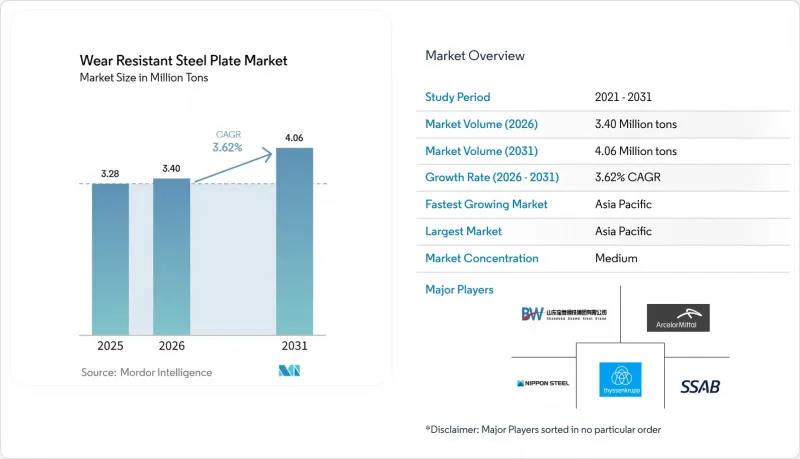
本報告按產品類型(耐磨鋼板、高強度耐磨鋼板等)、厚度(小於10毫米、10-30毫米、30毫米及以上)、應用領域(採礦、建築、重型機械等)和地區(亞太地區、北美地區、歐洲地區、南美地區、中東和非洲地區)進行細分。市場預測以噸為單位。
全球耐磨鋼板市場趨勢及洞察
基礎建設與都市化進程
美國聯邦政府的資金投入推動了對挖土機鏟鬥、裝載機鏟刃和拆除剪的需求。這些設備目前採用500 HBW鋼板以提高運作,雖然每個專案的噸位都在增加,但整體成長仍然較為溫和。在印度,一項累計資本支出達1.4兆美元的國家基礎建設項目支撐了對400-500 HBW級破碎機襯板和輸送機溜槽的需求。在越南、印尼和泰國,對公路和港口的投資推動了對厚度超過40毫米的耐磨鋼板的需求,特別是用於樁頭和疏浚零件。亞洲二線城市的建築商正在採用ISO 6301-1硬度公差標準,並將採購材料從本地低碳鋼轉向全球認證的耐磨鋼。這些土木工程項目正在影響規範標準,要求每噸混凝土加工使用更厚、更硬的材料。
工業機械和重型設備行業的成長
日本小松公司980E自動卸貨卡車面板的硬度要求現已超過400 HBW。這項變化使得傳統的高強度低合金鋼(HSLA)替代品不再必要,並推動了對淬硬回火鋼板的需求成長。破碎機製造商若要達到每小時1000噸的處理能力,則正在採用疊層襯板。這種襯板將低碳鋼基材與馬氏體表面結合,在保持使用壽命的同時,重量減輕了25%。 2010年至2015年高價時期在北美和歐洲推出的車輛正接近使用壽命終點。這造成了可預測的更換需求浪潮,而這些需求基本上不受新礦開發波動的影響。服務中心正透過提高其增值率來應對這一趨勢。他們提供雷射切割的成套組件,以減少現場工作並最大限度地減少停機時間。因此,耐磨鋼板市場不僅受噸位成長的驅動,也受成套組件製造需求和現場服務效率提升的推動。
替代材料(硬塗層、陶瓷、聚合物)的可用性
藥芯硬面堆焊材料透過在磨損部位精確沉積碳化鉻,可減少70%的鋼材用量,無需拆卸零件即可進行現場維修。在一些煤炭和穀物加工設施中,超高分子量聚乙烯(UHMW-PE)襯裡可減少低衝擊溜槽中的沉積物,從而完全取代鋼材。用於泥漿泵的陶瓷瓦片組件的硬度現已達到1000 HV,超過了600 HV硬面鋼板的使用壽命,並衝擊著高利潤的細分市場。 SSAB公司的Duroxite技術將碳化物焊接在結構基材上,結合了陶瓷的耐磨性和可焊接性,提供了一種針對市場上其他替代方案的混合防護方案。然而,由於聚合物和陶瓷都缺乏斷裂韌性,尤其是在衝擊區域,因此耐磨鋼板市場的核心仍保持穩定。
細分市場分析
2025年,耐磨鋼板的市佔率達到46.61%。這主要得益於其在持續磨損環境中的應用,例如運輸卡車的底板和傳送帶裙板,這些應用需要400-500 HBW的硬度。預計到2031年,抗衝擊鋼板市場將以4.12%的複合年成長率成長。這一成長主要歸功於拆除和回收場所採用在-40 度C下夏比衝擊韌性達到27 J或更高的鋼板,以減少脆性斷裂。在低碳鋼基板上覆以4-8 mm碳化物層的堆焊和雙金屬解決方案,與實心鋼板相比,可減輕30%的重量。這種重量減輕對成本敏感的中型礦業公司來說極具吸引力。屈服強度達1000 MPa的高強度耐磨鋼專為移動式起重機和加長型堆高機設計,在這些應用中,結構強度比耐磨性更為重要。
標準400和500 HBW牌號的市場競爭異常激烈,全球有超過20家鋼廠在耐磨鋼板市場運作。混合堆焊層以全厚度鋼板約60%的成本提供局部硬度,並提高了市場准入度。這種成本效益促使採石場營運商和骨材生產商考慮採用更高硬度的牌號。該領域正從通用型商品鋼板轉向應用專用套件,這些套件現在整合了數位化磨損追蹤功能。
區域分析
預計到2025年,亞太地區將佔全球鋼鐵產量的47.72%,並在2031年之前維持4.66%的複合年成長率,成長率超過其他所有地區。中國仍是該地區鋼鐵生產的主要貢獻者,寶武鋼鐵和河鋼集團的耐磨鋼板產能均超過700萬噸。然而,由於實施雙軌制限產政策,鋼廠正日益將重心轉向高附加價值鋼板的生產,而非大規模生產。在印度,國家基礎建設規劃推動了對破碎機襯板和輸送機溜槽的需求,促進了400-500號重型鋼板的穩定成長。在東南亞,公共投資完成率超過95%,受公路和港口投資的推動,厚度超過40毫米的厚鋼板正被廣泛應用於樁頭和疏浚零件。
在北美,美國《基礎設施投資與就業法案》正在推動500 HBW鏟鬥邊緣的升級。這項措施降低了專案停工的罰款,並鼓勵原始設備製造商(OEM)保持厚鋼板庫存。加拿大鐵礦石和鉀礦開採業務持續穩定地推動對耐磨鋼板的需求,而墨西哥汽車供應鏈的近岸外包也增加了對物料搬運設備襯板的需求。隨著礦用和工程車輛更換週期的趨於一致,預計北美耐磨鋼板市場將以3.5%的複合年成長率成長。
在歐洲,西方國家正著力環保措施,而東歐國家則面臨成本壓力。德國和斯堪地那維亞國家正朝向不依賴石化燃料的供應鏈轉型。 SSAB公司生產的符合CBAM競標要求的氫鋼板,以約7%的溢價贏得了OEM合約。相較之下,依賴高爐煉鋼製程的東歐鋼廠則面臨每噸50至80歐元的CBAM課稅,這影響了它們的市場佔有率。該地區更依賴替換需求而非新增生產,但低碳採購規則使合格的供應商能夠維持利潤率。
在南美洲、中東和非洲,巴西淡水河谷公司使用鋼板製造卡車車身和破碎機。在沙烏地阿拉伯,「2030願景」舉措正在加速進口用於拆除剪板機的重型鋼板。在南非和阿根廷,能源價格和外匯的波動限制了經濟成長,但磷酸鹽和金礦等利基市場支撐著需求。
其他好處:
- Excel格式的市場預測(ME)表
- 3個月的分析師支持
目錄
第1章:引言
- 研究假設和市場定義
- 調查範圍
第2章:調查方法
第3章執行摘要
第4章 市場狀況
- 市場概覽
- 市場促進因素
- 基礎建設進展與都市化進展
- 工業機械和重型設備行業的成長
- 延長設備使用壽命和降低維護成本的需求。
- 實施數位化磨損監測和預測性維護
- 製造適用於氫環境的「綠色鋼」的工藝,需要超潔淨、耐磨的鋼材。
- 市場限制因素
- 替代方案(硬塗層、陶瓷、聚合物)
- 鐵礦石和合金元素價格的波動
- 供應鏈中排放排放正在加劇鋼坯廢金屬供應的緊張。
- 價值鏈分析
- 波特五力模型
第5章 市場規模與成長預測
- 依產品類型
- 耐磨板
- 高強度耐磨板
- 抗衝擊板
- 疊層和雙金屬板
- 按厚度
- 小於10毫米
- 10~30 mm
- 30毫米或以上
- 透過使用
- 礦業
- 建造
- 重型機械
- 鋼鐵和鑄造
- 運輸
- 其他用途(農業、回收、水泥和骨材產業)
- 按地區
- 亞太地區
- 中國
- 日本
- 印度
- 韓國
- 東南亞國協
- 其他亞太國家
- 北美洲
- 美國
- 加拿大
- 墨西哥
- 歐洲
- 德國
- 英國
- 法國
- 義大利
- 西班牙
- 俄羅斯
- 北歐國家
- 其他歐洲國家
- 南美洲
- 巴西
- 阿根廷
- 其他南美國家
- 中東和非洲
- 沙烏地阿拉伯
- 南非
- 其他中東和非洲國家
- 亞太地區
第6章 競爭情勢
- 市場集中度
- 策略趨勢
- 市佔率和排名分析
- 公司簡介
- AG der Dillinger Huttenwerke
- ArcelorMittal
- Bisalloy
- EVRAZ
- HYUNDAI STEEL
- JFE Steel Corporation
- Nippon Steel Corporation
- NLMK
- Nucor Corporation
- Outokumpu
- POSCO
- China BaoWu Steel Group Corporation Limited
- SSAB
- thyssenkrupp AG
- voestalpine Stahl GmbH
- Yieh Corp.
第7章 市場機會與未來展望
According to Mordor Intelligence, the wear resistant steel plate market size is projected to be 3.28 Million tons in 2025, 3.40 Million tons in 2026, and reach 4.06 Million tons by 2031, growing at a CAGR of 3.62% from 2026 to 2031.
This report is Segmented by Product Type (Abrasion-Resistant Plates, High-Strength Wear-Resistant Plates, and More), Thickness (Below 10 Mm, 10-30 Mm, and Above 30 Mm), Application (Mining, Construction, Heavy Machinery, and More), and Geography (Asia-Pacific, North America, Europe, South America, and Middle-East and Africa). The Market Forecasts are Provided in Terms of Volume (Tons).
Global Wear Resistant Steel Plate Market Trends and Insights
Increasing Infrastructure Development and Urbanization
U.S. federal funding is driving demand for excavator buckets, loader edges, and demolition shears. These now use 500 HBW plates to improve uptime, increasing per-project tonnage while overall growth remains moderate. In India, the National Infrastructure Pipeline, with a cumulative capital outlay of USD 1.4 trillion, is supporting demand for crusher-liners and conveyor-chutes in the 400 to 500 HBW grade range. In Vietnam, Indonesia, and Thailand, investments in highways and ports are increasing the need for thick (> 40 mm) wear plates, particularly for piling shoes and dredge components. Contractors in tier-2 Asian cities are adopting ISO 6301-1 hardness tolerances, shifting sourcing from local soft steels to globally certified abrasion-resistant grades. These civil-works programs are influencing the specification baseline, requiring greater thickness and hardness for each tonne of concrete handled.
Growth in Industrial Machinery and Heavy Equipment Sectors
Body panels for the Komatsu 980E haul truck now require a hardness of over 400 HBW. This change eliminates conventional HSLA alternatives and highlights the demand for quenched-and-tempered plates. Crusher manufacturers targeting a throughput of 1,000 ton/hour are adopting overlay liners. These liners incorporate martensitic skins on a mild-steel backing, achieving a 25% reduction in weight while maintaining service life. Fleets in North America and Europe, acquired during the commodity boom from 2010 to 2015, have reached their end-of-life. This creates a predictable wave of replacements, largely unaffected by fluctuations in new mine activity. Service centers are responding to this trend by increasing their value-added share. They are supplying laser-profiled, kit-ready sets, which reduce on-site labor and minimize downtime. Consequently, the wear-resistant steel plate market is driven not only by raw tonnage but also by the demand for kit fabrication and field service efficiency.
Availability of substitutes (hard-facing, ceramics, polymers)
Flux-cored hard-facing deposits place chromium-carbide precisely where wear occurs, reducing steel usage by 70% and enabling in-situ refurbishments that eliminate the need for component removal. In some coal and grain installations, UHMW-PE liners reduce material build-up in low-impact chutes, leading to a complete replacement of steel. Ceramic tile packages in slurry pumps have now achieved a hardness of 1,000 HV, exceeding the 600 HBW plate life and affecting high-margin niches. SSAB's Duroxite overlay welds carbide onto a structural backing, combining the wear life of ceramics with their weldability, creating a hybrid defense against market substitution. However, the lack of fracture toughness in both polymers and ceramics, particularly in impact zones, ensures the core of the wear-resistant steel plate market remains stable.
Other drivers and restraints analyzed in the detailed report include:
- Need for Longer Equipment Life and Lower Maintenance Costs
- Digital Wear-Monitoring and Predictive-Maintenance Adoption
- Supply-Chain Emissions Caps Tightening Scrap-to-Billet Availability
For complete list of drivers and restraints, kindly check the Table Of Contents.
Segment Analysis
In 2025, abrasion-resistant plates accounted for 46.61% of the market share, supported by their use in continuous-wear environments such as haul-truck floors and conveyor skirts, which require a hardness of 400-500 HBW. The impact-resistant plate segment is anticipated to grow at a CAGR of 4.12% through 2031. This growth is driven by the adoption of plates with a Charpy toughness of 27 J or higher at -40 °C in demolition and recycling yards to mitigate brittle fractures. Overlay and bimetallic solutions, featuring 4-8 mm carbide layers on mild-steel backings, reduce weight by 30% compared to solid plates. This weight reduction appeals to cost-sensitive mid-tier mining budgets. High-strength wear-resistant grades with a 1,000 MPa yield are designed for mobile cranes and tele-handlers, where structural strength is prioritized over abrasion resistance.
The standard 400 and 500 HBW grades experience significant competition, with more than 20 active mills operating globally in the wear-resistant steel plate market. Hybrid overlays are increasing market accessibility by offering localized hardness at approximately 60% of the cost of full-thickness plates. This cost efficiency is encouraging quarry operators and aggregate producers to explore higher hardness classes. The segment is shifting from generic commodity sheets to application-specific kits, which are now integrated with digital wear tracking features.
Geography Analysis
In 2025, Asia-Pacific accounted for 47.72% of the global volume and is expected to grow at a 4.66% CAGR through 2031, surpassing all other regions. China, supported by Baowu and HBIS capacities each exceeding 7 million tons for wear grades, remains a key contributor to the region's volume. However, with dual-control output caps in place, mills are shifting focus toward value-added plates instead of bulk production. In India, the National Infrastructure Pipeline is driving demand for crusher-liners and conveyor-chute replacements, contributing to consistent growth for the 400-500 HBW grades. In Southeast Asia, public-investment completion rates exceeding 95% are directing thicker plates (> 40 mm) into piling shoes and dredge components, driven by investments in highways and ports.
In North America, the U.S. Infrastructure Investment and Jobs Act has prompted upgrades to 500 HBW bucket edges. This initiative reduces mid-project downtime fines and encourages OEMs to maintain inventories of thicker plates. Canada's iron-ore and potash operations continue to generate steady demand for wear plates, while Mexico's near-shoring of automotive supply chains is increasing the need for material-handling equipment liners. As replacement cycles align across mining and construction fleets, the wear-resistant steel plate market in North America is projected to grow at a 3.5% CAGR.
In Europe, western countries are focusing on green initiatives, while eastern countries face cost pressures. Germany and Scandinavia are transitioning to fossil-free supplies. SSAB's hydrogen plate, which complies with CBAM tenders, has secured OEM contracts with premiums of approximately 7%. In contrast, eastern mills that rely on blast-furnace routes are dealing with EUR 50-80/ton CBAM levies, which are affecting their market share. The region primarily relies on replacement demand rather than new tonnage, but low-carbon procurement rules are helping qualified suppliers maintain margins.
In South America and the Middle East-Africa, Brazil's Vale is utilizing plates for truck bodies and crushers. In Saudi Arabia, the Vision 2030 initiative is driving imports of thicker gauges for demolition shears. Although energy volatility and currency fluctuations are limiting growth in South Africa and Argentina, niche markets in phosphate and gold mining are sustaining demand.
- AG der Dillinger Huttenwerke
- ArcelorMittal
- Bisalloy
- EVRAZ
- HYUNDAI STEEL
- JFE Steel Corporation
- Nippon Steel Corporation
- NLMK
- Nucor Corporation
- Outokumpu
- POSCO
- China BaoWu Steel Group Corporation Limited
- SSAB
- thyssenkrupp AG
- voestalpine Stahl GmbH
- Yieh Corp.
Additional Benefits:
- The market estimate (ME) sheet in Excel format
- 3 months of analyst support
TABLE OF CONTENTS
1 Introduction
- 1.1 Study Assumptions and Market Definition
- 1.2 Scope of the Study
2 Research Methodology
3 Executive Summary
4 Market Landscape
- 4.1 Market Overview
- 4.2 Market Drivers
- 4.2.1 Increasing infrastructure development and urbanisation
- 4.2.2 Growth in industrial machinery and heavy equipment sectors
- 4.2.3 Need for longer equipment life and lower maintenance costs
- 4.2.4 Digital wear-monitoring and predictive-maintenance adoption
- 4.2.5 Hydrogen-ready "green steel" routes requiring ultra-clean wear grades
- 4.3 Market Restraints
- 4.3.1 Availability of substitutes (hard-facing, ceramics, polymers)
- 4.3.2 Volatility in iron-ore and alloying-element prices
- 4.3.3 Supply-chain emissions caps tightening scrap-to-billet availability
- 4.4 Value Chain Analysis
- 4.5 Porter's Five Forces
- 4.5.1 Threat of New Entrants
- 4.5.2 Bargaining Power of Buyers
- 4.5.3 Bargaining Power of Suppliers
- 4.5.4 Threat of Substitutes
- 4.5.5 Competitive Rivalry
5 Market Size and Growth Forecasts (Volume)
- 5.1 By Product Type
- 5.1.1 Abrasion-resistant plates
- 5.1.2 High-strength wear-resistant plates
- 5.1.3 Impact-resistant plates
- 5.1.4 Overlay and bimetallic plates
- 5.2 By Thickness
- 5.2.1 Below 10 mm
- 5.2.2 10 to 30 mm
- 5.2.3 Above 30 mm
- 5.3 By Application
- 5.3.1 Mining
- 5.3.2 Construction
- 5.3.3 Heavy machinery
- 5.3.4 Steel and foundry
- 5.3.5 Transportation
- 5.3.6 Other Applications (Agriculture, Recycling, Cement and aggregate industry)
- 5.4 By Geography
- 5.4.1 Asia-Pacific
- 5.4.1.1 China
- 5.4.1.2 Japan
- 5.4.1.3 India
- 5.4.1.4 South Korea
- 5.4.1.5 ASEAN Countries
- 5.4.1.6 Rest of Asia-Pacific
- 5.4.2 North America
- 5.4.2.1 United States
- 5.4.2.2 Canada
- 5.4.2.3 Mexico
- 5.4.3 Europe
- 5.4.3.1 Germany
- 5.4.3.2 United Kingdom
- 5.4.3.3 France
- 5.4.3.4 Italy
- 5.4.3.5 Spain
- 5.4.3.6 Russia
- 5.4.3.7 NORDIC Countries
- 5.4.3.8 Rest of Europe
- 5.4.4 South America
- 5.4.4.1 Brazil
- 5.4.4.2 Argentina
- 5.4.4.3 Rest of South America
- 5.4.5 Middle-East and Africa
- 5.4.5.1 Saudi Arabia
- 5.4.5.2 South Africa
- 5.4.5.3 Rest of Middle-East and Africa
- 5.4.1 Asia-Pacific
6 Competitive Landscape
- 6.1 Market Concentration
- 6.2 Strategic Moves
- 6.3 Market Share (%)/Ranking Analysis
- 6.4 Company Profiles (includes Global Overview, Market Overview, Core Segments, Financials, Strategic Information, Products and Services, and Recent Developments)
- 6.4.1 AG der Dillinger Huttenwerke
- 6.4.2 ArcelorMittal
- 6.4.3 Bisalloy
- 6.4.4 EVRAZ
- 6.4.5 HYUNDAI STEEL
- 6.4.6 JFE Steel Corporation
- 6.4.7 Nippon Steel Corporation
- 6.4.8 NLMK
- 6.4.9 Nucor Corporation
- 6.4.10 Outokumpu
- 6.4.11 POSCO
- 6.4.12 China BaoWu Steel Group Corporation Limited
- 6.4.13 SSAB
- 6.4.14 thyssenkrupp AG
- 6.4.15 voestalpine Stahl GmbH
- 6.4.16 Yieh Corp.
7 Market Opportunities and Future Outlook
- 7.1 White-space and unmet-need assessment

 粗鋼市場-2026-2032年全球市場預測
 2026年全球高磁感應強度定向矽鋼市場報告
 液壓鋼骨加工機械市場規模、佔有率和成長分析:按噸位、工作站配置、工作站類型、驅動系統、最終用途產業和地區分類-2026-2033年產業預測
 耐磨鋼板:市場佔有率分析、產業趨勢與統計、成長預測(2026-2031年)
 粗鋼市場規模、佔有率和成長分析:按製造流程、產品類型、最終用途產業和地區分類-2026-2033年產業預測
 層壓鋼板市場:依產品、終端用途產業及地區分類合金鋼市場:依產品類型、應用和地區分類
 全球馬氏體時效鋼市場規模、佔有率、趨勢和成長分析報告(2026-2034年)粗鋼:市場佔有率分析、產業趨勢與統計、成長預測(2026-2031)
 2026-2030年全球鋼鐵製造市場