


 |
市場調查報告書
商品編碼
2044281
金屬精密車削產品製造:市場佔有率分析、產業趨勢與統計、成長預測(2026-2031)Metal Precision Turned Product Manufacturing - Market Share Analysis, Industry Trends & Statistics, Growth Forecasts (2026 - 2031) |
||||||

※ 本網頁內容可能與最新版本有所差異。詳細情況請與我們聯繫。
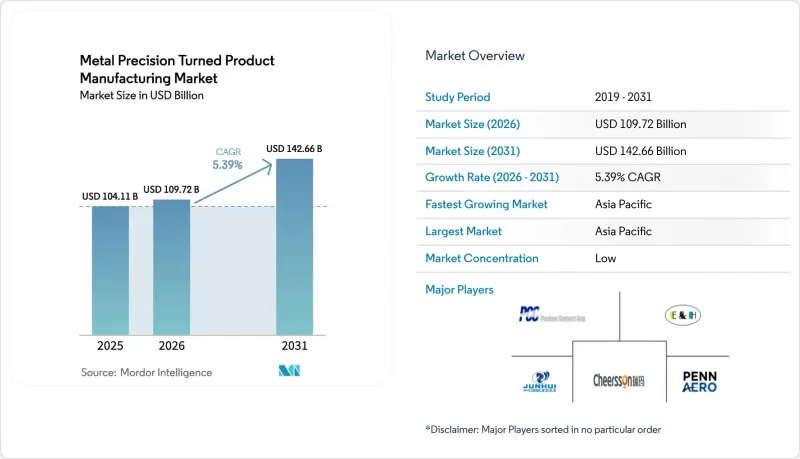
預計精密金屬車削產品的市場規模將從 2025 年的 1,041.1 億美元成長到 2026 年的 1,097.2 億美元,到 2031 年將達到 1,426.6 億美元,2026 年至 2031 年的複合年成長率為 5.39%。
汽車電氣化的推進、民航機生產的復甦以及整形外科和牙科植入的微型化,都促使整個金屬精密車削市場對更嚴格的公差和更短的加工週期提出了更高的要求。隨著電池式電動車平台取代傳統的鋼煞車力傳動系統部件,對輕質鋁合金和銅合金的需求也不斷成長。同時,大型航太公司正在重啟先前閒置的生產線,並開始青睞鎳合金和鈦合金。醫院對小型植入螺絲的需求增加,迫使供應商從標準夾頭車床轉向能夠處理極高精度公差的精密瑞士車床。自動化和進程內測量正成為金屬精密車削製造領域競爭力的標桿,縮小了頂級精密製造商與小規模區域製造商之間的性能差距。
全球金屬精密車削產品製造市場的趨勢與見解。
電動車動力傳動系統輕量化需求增加,對精密加工的需求上升
隨著歐盟汽車製造商致力於滿足更嚴格的二氧化碳排放標準,輕型車輛中鋁材的使用量顯著增加。同時,中國電池式電動車和插電式混合動力汽車的產量大幅成長,帶動了對鋁製散熱片和銅匯流排的需求。特斯拉的Gigacasting製程減少了零件數量,但同時也使得精密加工集中在少數大型鋁製零件上,因此鑄造後需要進行高精度鏜孔。為了應對有色合金加工中刀具磨損加劇的問題,二級加工供應商擴大採用陶瓷刀頭和主軸內冷卻系統來顯著延長刀具壽命。這些趨勢共同推動了金屬精密車削產品製造領域對高速數控加工單元的需求。
引進符合工業4.0標準的多軸CNC工具機
Yamazaki Mazak透露,其出貨產品中有相當一部分配備了自動化機器人介面。這些介面實現了夜間“無人運行”,有效延長了主軸的正常運作。同時,一家德國動力傳動系統供應商透過將數位雙胞胎與預測性維護軸承分析相結合,成功減少了意外停機時間。能夠進行多軸同步加工的多軸車削中心現在可以在一次裝夾中完成渦輪葉片根部和整形外科關節柄部的加工,從而消除了累積公差。數控車床在日本的生產量中取得了顯著的普及,顯示加工平台正向近乎全可程式設計的方向發展。此外,能夠即時調整進給速度和轉速的自適應CAM軟體顯著縮短了Inconel 718和Ti-6Al-4V合金的加工週期。
鋼鐵和黃銅價格波動
在此期間,鋁價上漲,預計近期將保持穩定,原因是歐盟能源成本高企以及中國生產限制導致供應柔軟性降低。受電動汽車電纜需求成長的推動,銅價飆升,預計將繼續上漲。美國對部分銅進口產品徵收高額關稅,迫使中西部一些工廠必須以更高的價格從加拿大購買。在金屬精密車削市場,由於銅和鋅價上漲給營運資金帶來壓力並降低利潤率,僅使用黃銅且無價格轉嫁條款的代工製造商正面臨挑戰。
細分市場分析
到2025年,軸類產品將佔金屬精密車削產品市場佔有率的37.11%。轉速高達15,000至20,000轉/分的高速馬達設計需要超精細的表面光潔度以防止軸承故障,因此製造商採用鑽石搪光石和機內平衡技術。雖然聯軸器絕對銷量較小,但隨著倉庫自動化和協作機器人對零背隙扭矩傳輸的需求,預計其收入基礎將以7.81%的複合年成長率成長。供應商透過採用整合振動特性感測器的聯軸器來獲得溢價。
通用螺母、螺栓和襯套的價格容易波動,而採用A286不銹鋼和Inconel合金製造的航太緊固件則憑藉NADCAP認證的可靠性,保持了較高的利潤率。多螺桿機床在汽車螺母的大批量訂單中佔據主導地位。同時,在中等批量生產中,高度柔軟性的CNC平台正在取代老舊的凸輪驅動設備。在精密金屬車削產品的製造中,軸和聯軸器仍然具有重要的戰略意義,因為它們負責在馬達和最終減速器之間傳遞扭矩,即使由於電動車動力傳動系統的普及,零件數量有所減少。
截至2025年,鋼材將佔據精密車削金屬製品市場43.22%的佔有率,而鋁材則以6.78%的複合年成長率成為生產擴張最快的領域。鋁材在電池式電動車(BEV)中的應用正逐年顯著成長。 304和316L等不銹鋼牌號因其優異的耐腐蝕性,在植入、食品加工和船舶應用等細分市場佔據主導地位,並因此能夠以高價出售。儘管大宗商品價格波動,黃銅憑藉其優異的加工性能和導電性,在低壓連接器領域依然保持領先地位。鈦、因科鎳合金和聚醚醚酮(PEEK)等特殊合金雖然在總噸位中所佔比例較小,但卻佔了相當大的市場價值。這凸顯了精密車削金屬製品製造市場單位重量收入的高水平,而航太和醫療產業的推動作用更是顯著。
加工成本差異顯著。例如,Ti-6Al-4V 的加工速度遠低於鋁,且需要大量水冷以防止加工硬化,增加了生產成本。同樣,PEEK 聚合物螺絲的轉速也有限制以防止熔化,導致生產時間延長。然而,這些螺絲的價格遠高於同等規格的不銹鋼螺絲。
區域分析
預計到2025年,亞太地區將佔金屬精密車削產品製造市場46.34%的佔有率,並在2031年之前以7.89%的複合年成長率成長。這主要得益於中國作為主要汽車生產國的地位,以及印度精密加工能力的持續顯著成長。津上在清奈的工廠體現了日本將鑄造和精加工工序集中於同一地點以滿足印度國內需求的策略。韓國向三星和現代的供應確保了印度對批量生產的連接器和緊固件的穩定需求。同時,大量外商直接投資湧入越南,為全球電子品牌提供黃銅和不鏽鋼車削產品。泰國和印尼正在崛起為「中國+1」的輔助樞紐,以應對中國人事費用上升所帶來的過剩需求。
北美和歐洲市場持續穩定成長,保持主導地位,尤其是在航太和醫療領域,擁有絕大多數的NADCAP和ISO認證。大量外國直接投資湧入墨西哥,正在加強巴希奧地區的工業園區建設,確保按照美墨加協定(USMCA)的規定及時向美國組裝廠出貨。用於航太和自動化應用的精密車床在德國工具機出口中佔據相當大的佔有率。總部位於英國的Viking Precision公司最佳化了一個新的生產單元,用於連續生產鈦合金MRO零件。
南美洲、中東和非洲正在崛起,儘管規模較小,尤其是在採礦和能源領域。巴西聖保羅叢集為當地的原始設備製造商 (OEM) 提供支援。在中東,阿拉伯聯合大公國和沙烏地阿拉伯都在發展航太維修、修理和大修 (MRO) 中心,但目前依賴從歐洲進口。南非的採礦業需要大直徑鋼軸,目前正在地採購,與進口相比,前置作業時間顯著縮短。土耳其利用其與歐盟的關稅同盟,專注於汽車和家電零件,同時受益於其在伊斯坦堡和布爾薩建立的成熟的分包網路。這種生產集中於亞太地區、附加價值集中於歐洲和美洲的結構,預計將在金屬精密車削產品製造市場繼續保持。
其他好處:
- Excel格式的市場預測(ME)表
- 3個月的分析師支持
目錄
第1章:引言
- 研究假設和市場定義
- 調查範圍
第2章:調查方法
第3章執行摘要
第4章 市場狀況
- 市場概覽
- 市場促進因素
- 電動車動力傳動系統對輕量化、高精度零件的需求
- 推出符合工業4.0標準的多軸CNC工具機。
- 航太產業的生產速度和維護、修理和大修 (MRO) 正在激增。
- 瑞士車床植入加工熱潮
- 按地區分類的OEM供應商基地位置
- 機器即時測量和自適應控制的引入
- 市場限制因素
- 鋼鐵和黃銅價格波動
- 熟練的CNC工具機員短缺
- 特殊合金的認證費用
- 高速加工中不斷上漲的電力價格
- 價值/供應鏈分析
- 監理情勢
- 技術展望
- 波特五力模型
- 新進入者的威脅
- 買方的議價能力
- 供應商的議價能力
- 替代品的威脅
- 競爭公司之間的競爭
第5章 市場規模及成長預測(價值(美元))
- 依產品類型
- 軸
- 主軸
- 襯套
- 緊固件
- 耦合
- 螺帽和螺栓
- 其他(接腳、連接器)
- 材料
- 鋼
- 不銹鋼
- 黃銅
- 鋁
- 銅
- 其他(合金、特殊金屬)
- 透過流程
- CNC車削
- 自動車床加工
- 瑞士型車床
- 多軸車床
- 透過使用
- 車
- 航太/國防
- 工業機械
- 電氣和電子
- 醫療設備
- 施工機械
- 其他
- 按銷售管道
- OEM
- 售後市場
- 按地區
- 北美洲
- 美國
- 加拿大
- 北美其他地區
- 南美洲
- 巴西
- 阿根廷
- 南美洲其他地區
- 歐洲
- 德國
- 英國
- 法國
- 義大利
- 西班牙
- 其他歐洲地區
- 亞太地區
- 中國
- 印度
- 日本
- 韓國
- 亞太其他地區
- 中東和非洲
- 阿拉伯聯合大公國
- 沙烏地阿拉伯
- 南非
- 土耳其
- 其他中東和非洲地區
- 北美洲
第6章 競爭情勢
- 市場集中度
- 策略趨勢
- 市佔率分析
- 公司簡介
- Precision Castparts Corp.
- E&H Precision(Thailand)Co., Ltd.
- NINGBO JH Metal Technology Co.,Ltd.
- Pioneer Service Inc.
- US Swiss, Inc.
- PennAero
- A&B Torneria Automatica Srl
- Forster Tool and Mfg.
- Sheldon Precision
- Davturn Ltd
- Orange1 Precision
- Star Micronics
- Citizen Machinery
- Tsugami Corp.
- DMG Mori
- Yamazaki Mazak
- Okuma Corp.
- Haas Automation
第7章 市場機會與未來展望
The metal precision turned product manufacturing market size is projected to grow from USD 104.11 billion in 2025 to USD 109.72 billion in 2026 and is forecast to reach USD 142.66 billion by 2031, registering a CAGR of 5.39% between 2026 and 2031.
Rising vehicle electrification, recovering commercial-aircraft build rates, and the miniaturization of orthopedic and dental implants are together tightening tolerance bands and shortening cycle-time expectations across the metal-precision-turned product manufacturing market. As battery-electric platforms replace traditional ferrous power-train components, the demand for lightweight aluminum and copper alloys is increasing. Concurrently, aerospace giants are reviving previously dormant production lines, now favoring nickel- and titanium-based alloys. Hospitals are expanding orders for small implant screws, pushing suppliers to transition from standard chucking lathes to precision Swiss-type machines capable of holding extremely tight tolerances. In the metal precision turned product manufacturing arena, automation and in-process metrology have become the benchmarks of competitiveness, narrowing the performance divide between Tier-1 precision shops and their smaller regional counterparts.
Global Metal Precision Turned Product Manufacturing Market Trends and Insights
EV Power-Train Lightweight Precision Demand
As automakers in the European Union aimed to meet stricter CO2 emission thresholds, the aluminum content in light vehicles increased significantly . In the same period, China experienced a substantial rise in the production of battery-electric and plug-in hybrid vehicles, driving higher demand for aluminum heat-sink pins and copper busbars. Tesla's giga-casting approach reduced the number of parts but concentrated precision machining on fewer, larger aluminum nodes, requiring post-cast boring with high precision. Accelerated tool wear on non-ferrous alloys is prompting Tier-2 shops to adopt ceramic inserts and through-spindle coolant, which significantly extends tool life. These trends are collectively boosting demand for high-speed CNC cells in the metal-precision-turned product manufacturing sector.
Industry 4.0-Enabled Multi-Axis CNC Adoption
Yamazaki Mazak revealed that a significant portion of its shipments featured automation-ready robot interfaces. These interfaces facilitate overnight "lights-out" operations, effectively doubling the spindle hours. Meanwhile, a German power-train supplier successfully reduced its unplanned downtime by integrating digital twins with predictive bearing analytics. Multi-axis turning centers, now capable of simultaneous multi-axis operation, can finish turbine-blade roots or orthopedic hip stems in a single setup, thereby eliminating cumulative tolerance stack-up. Japan's machine-tool output in NC lathes achieved a notable penetration rate, indicating a near-total shift to programmable platforms. Furthermore, adaptive CAM software, which adjusts feeds and speeds in real-time, is achieving a significant reduction in cycle times for Inconel 718 and Ti-6Al-4V programs.
Volatile Steel and Brass Pricing
Aluminum prices increased over the period and are expected to remain steady in the near future, constrained by limited supply flexibility amid high energy costs in the EU and production restrictions in China. Copper prices have risen sharply and are expected to continue rising, driven by increasing demand for electric vehicle cables. The United States imposed substantial tariffs on certain copper imports, prompting Midwest shops to source from Canada at a premium. In the metal-precision turned product manufacturing market, brass-focused job shops without pass-through clauses are facing challenges as rising copper and zinc prices strain working capital and reduce profit margins.
Other drivers and restraints analyzed in the detailed report include:
- Aerospace Build-Rate and MRO Surge
- Micro-Implant Swiss-Turning Boom
- Skilled CNC Machinist Shortage
For complete list of drivers and restraints, kindly check the Table Of Contents.
Segment Analysis
Shafts accounted for 37.11% of the metal-precision turned product manufacturing market share in 2025. High-rpm electric-motor designs spinning 15,000-20,000 rpm now demand ultra-fine surface finishes to avert bearing failures, pushing shops toward diamond-impregnated honing stones and in-machine balancing. Couplings, although smaller in absolute volume, are forecast to expand their revenue base at a 7.81% CAGR as warehouse automation and collaborative robots require zero-backlash torque transmission. Suppliers command price premiums by using sensor-embedded couplings that report vibrational signatures.
While commoditized nuts, bolts, and bushings are sensitive to price fluctuations, aerospace fasteners made from A286 stainless steel or Inconel maintain their margins, thanks to their NADCAP pedigree. Multi-spindle screw machines dominate high-volume contracts for automotive nuts. Meanwhile, flexible CNC platforms are replacing cam-driven legacy assets for medium-volume runs. In the realm of metal precision turned product manufacturing, as EV powertrains reduce part counts, shafts and couplings remain strategically important because they transmit torque between electric motors and final-drive reducers.
Steel accounted for 43.22% of the metal-precision turned product manufacturing market share in 2025, yet aluminum's 6.78% CAGR is the fastest path to volume accretion. The aluminum content of battery-electric cars has increased significantly over time. Stainless steel grades, such as 304 and 316L, dominate niches like implants, food processing, and marine applications due to their corrosion resistance, which enables them to command premium pricing. Brass continues to hold its position in low-voltage connectors due to its excellent machinability and electrical conductivity, despite fluctuations in commodity prices. Exotic alloys, including titanium, Inconel, and PEEK, account for a small share of total tonnage but represent a substantial share of market value. This emphasizes the high revenue per unit weight driven by the aerospace and medical sectors within the metal precision turned product manufacturing market.
Machining economics vary significantly. For example, Ti-6Al-4V is machined at a much slower speed compared to aluminum and requires flood coolant to prevent work hardening, which increases production costs. Similarly, PEEK polymer screws have a rotational speed limit to avoid melting, which extends production times. However, these screws command significantly higher prices than their stainless steel counterparts.
The Metal Precision Turned Product Manufacturing Market Report is Segmented by Product Type (Shafts, Spindles, Bushings, Fasteners, and More), Material (Steel, Stainless Steel, and More), Process (CNC Turning, and More), Application (Automotive, Aerospace and Defense, Industrial Machinery, and More), Sales Channel (OEMs and Aftermarket), and Geography. The Market Forecasts are Provided in Terms of Value (USD).
Geography Analysis
Asia-Pacific captured 46.34% of the metal-precision turned product manufacturing market share in 2025 and is projected to grow at a 7.89% CAGR through 2031, as China remains a leading producer of vehicles, while India continues to experience significant annual growth in precision-machining capacity . In Chennai, Tsugami's complex highlights Japan's approach of co-locating foundry and finish-machining operations to meet India's domestic demand. South Korea's supply to Samsung and Hyundai ensures steady local demand for high-volume connectors and fasteners. Meanwhile, Vietnam's substantial FDI inflow is channeling brass and stainless steel turnings to global electronics brands. Thailand and Indonesia are emerging as auxiliary "China+1" nodes to address excess demand driven by rising labor costs in China.
North America and Europe, while growing steadily, maintain dominance, holding the majority of NADCAP and ISO certifications, particularly in the aerospace and medical sectors. Mexico's significant FDI investments are strengthening Bajio parks, ensuring timely shipments to U.S. assembly plants in line with USMCA regulations. Germany's machine tool exports include a notable share of precision turning centers for aerospace and automation applications. The U.K.'s Viking Precision has optimized a new production cell for the continuous manufacturing of titanium MRO parts.
Although South America, the Middle East, and Africa are smaller players, they are gaining momentum, particularly in mining and energy. Brazil's Sao Paulo cluster supports local OEMs. In the Middle East, both the UAE and Saudi Arabia are developing aerospace MRO hubs, though they currently rely on European imports. South Africa's mining sector, requiring large-diameter steel shafts, is sourcing them locally, significantly reducing lead times compared to imports. Turkey is leveraging its customs-union access to the EU, focusing on automotive and appliance parts, and benefiting from the established subcontractor networks in Istanbul and Bursa. This division-volume concentrated in Asia-Pacific and value in the West-appears set to continue in the metal-precision-turned-product manufacturing market.
- Precision Castparts Corp.
- E&H Precision (Thailand) Co., Ltd.
- NINGBO JH Metal Technology Co.,Ltd.
- Pioneer Service Inc.
- U.S. Swiss, Inc.
- PennAero
- A&B Torneria Automatica Srl
- Forster Tool and Mfg.
- Sheldon Precision
- Davturn Ltd
- Orange1 Precision
- Star Micronics
- Citizen Machinery
- Tsugami Corp.
- DMG Mori
- Yamazaki Mazak
- Okuma Corp.
- Haas Automation
Additional Benefits:
- The market estimate (ME) sheet in Excel format
- 3 months of analyst support
TABLE OF CONTENTS
1 Introduction
- 1.1 Study Assumptions and Market Definition
- 1.2 Scope of the Study
2 Research Methodology
3 Executive Summary
4 Market Landscape
- 4.1 Market Overview
- 4.2 Market Drivers
- 4.2.1 EV Power-Train Lightweight Precision Demand
- 4.2.2 Industry 4.0-Enabled Multi-Axis CNC Adoption
- 4.2.3 Aerospace Build-Rate and MRO Surge
- 4.2.4 Micro-Implant Swiss-Turning Boom
- 4.2.5 OEM Regional Supplier-Park Localisation
- 4.2.6 On-Machine Real-Time Metrology and Adaptive Control Adoption
- 4.3 Market Restraints
- 4.3.1 Volatile Steel and Brass Pricing
- 4.3.2 Skilled CNC Machinist Shortage
- 4.3.3 Qualification Costs For Exotic Alloys
- 4.3.4 Rising Electricity Prices For High-Speed Machining Operations
- 4.4 Value / Supply-Chain Analysis
- 4.5 Regulatory Landscape
- 4.6 Technological Outlook
- 4.7 Porter's Five Forces
- 4.7.1 Threat of New Entrants
- 4.7.2 Bargaining Power of Buyers
- 4.7.3 Bargaining Power of Suppliers
- 4.7.4 Threat of Substitutes
- 4.7.5 Competitive Rivalry
5 Market Size and Growth Forecasts (Value (USD))
- 5.1 By Product Type
- 5.1.1 Shafts
- 5.1.2 Spindles
- 5.1.3 Bushings
- 5.1.4 Fasteners
- 5.1.5 Couplings
- 5.1.6 Nuts and Bolts
- 5.1.7 Others (Pins, Connectors)
- 5.2 By Material
- 5.2.1 Steel
- 5.2.2 Stainless Steel
- 5.2.3 Brass
- 5.2.4 Aluminum
- 5.2.5 Copper
- 5.2.6 Others (Alloys, Specialty Metals)
- 5.3 By Process
- 5.3.1 CNC Turning
- 5.3.2 Automatic Turning
- 5.3.3 Swiss-Type Turning
- 5.3.4 Multi-Spindle Turning
- 5.4 By Application
- 5.4.1 Automotive
- 5.4.2 Aerospace and Defense
- 5.4.3 Industrial Machinery
- 5.4.4 Electrical and Electronics
- 5.4.5 Medical Devices
- 5.4.6 Construction Equipment
- 5.4.7 Others
- 5.5 By Sales Channel
- 5.5.1 Original Equipment Manufacturer (OEM)
- 5.5.2 Aftermarket
- 5.6 By Geography
- 5.6.1 North America
- 5.6.1.1 United States
- 5.6.1.2 Canada
- 5.6.1.3 Rest of North America
- 5.6.2 South America
- 5.6.2.1 Brazil
- 5.6.2.2 Argentina
- 5.6.2.3 Rest of South America
- 5.6.3 Europe
- 5.6.3.1 Germany
- 5.6.3.2 United Kingdom
- 5.6.3.3 France
- 5.6.3.4 Italy
- 5.6.3.5 Spain
- 5.6.3.6 Rest of Europe
- 5.6.4 Asia-Pacific
- 5.6.4.1 China
- 5.6.4.2 India
- 5.6.4.3 Japan
- 5.6.4.4 South Korea
- 5.6.4.5 Rest of Asia-Pacific
- 5.6.5 Middle East and Africa
- 5.6.5.1 United Arab Emirates
- 5.6.5.2 Saudi Arabia
- 5.6.5.3 South Africa
- 5.6.5.4 Turkey
- 5.6.5.5 Rest of Middle East and Africa
- 5.6.1 North America
6 Competitive Landscape
- 6.1 Market Concentration
- 6.2 Strategic Moves
- 6.3 Market Share Analysis
- 6.4 Company Profiles (Includes Global level Overview, Market level overview, Core Segments, Financials as available, Strategic Information, Market Rank/Share for key companies, Products and Services, and Recent Developments)
- 6.4.1 Precision Castparts Corp.
- 6.4.2 E&H Precision (Thailand) Co., Ltd.
- 6.4.3 NINGBO JH Metal Technology Co.,Ltd.
- 6.4.4 Pioneer Service Inc.
- 6.4.5 U.S. Swiss, Inc.
- 6.4.6 PennAero
- 6.4.7 A&B Torneria Automatica Srl
- 6.4.8 Forster Tool and Mfg.
- 6.4.9 Sheldon Precision
- 6.4.10 Davturn Ltd
- 6.4.11 Orange1 Precision
- 6.4.12 Star Micronics
- 6.4.13 Citizen Machinery
- 6.4.14 Tsugami Corp.
- 6.4.15 DMG Mori
- 6.4.16 Yamazaki Mazak
- 6.4.17 Okuma Corp.
- 6.4.18 Haas Automation
7 Market Opportunities and Future Outlook
- 7.1 White-space and Unmet-Need Assessment

 全球製造業ESG市場規模、佔有率、趨勢和成長分析報告(2026-2034年)
 工業和製造業資訊通訊技術:市場佔有率分析、行業趨勢和統計數據、成長預測(2026-2031 年)製造業客戶體驗成長機會:2025-2026 年
 光伏電池雷射加工設備市場規模、佔有率和成長分析:按雷射技術、機器配置、晶圓類型、應用、自動化程度、最終用戶產業和地區分類-2026-2033年產業預測
 製造業調查回顧:2025 年
 全球製造業市場:按產業、技術和地區分類
 混凝土管材和砌塊製造市場:2026-2032年全球市場預測(按產品類型、應用、最終用戶、製造流程和尺寸分類)
 永續製造設備市場機會、成長要素、產業趨勢分析及預測(2026年至2035年)
 製造業資訊通訊技術市場-全球產業規模、佔有率、趨勢、機會和預測:按組件、應用、部署類型、地區和競爭對手分類,2021-2031年
 「工業製造業預測」市場數據概況(2025 年第四季)