


 |
市場調查報告書
商品編碼
2044031
光纖行動回程系統:市場佔有率分析、產業趨勢與統計、成長預測(2026-2031)Fiber Mobile Backhaul System - Market Share Analysis, Industry Trends & Statistics, Growth Forecasts (2026 - 2031) |
||||||

※ 本網頁內容可能與最新版本有所差異。詳細情況請與我們聯繫。
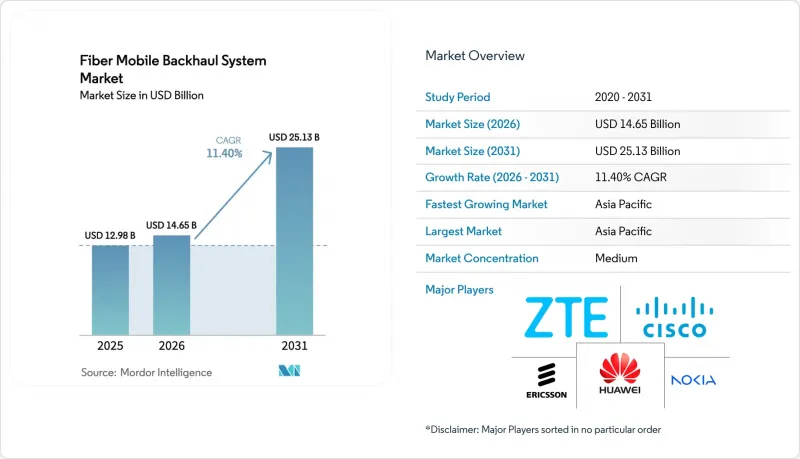
光纖行動回程傳輸系統市場預計將從 2025 年的 129.8 億美元和 2026 年的 146.5 億美元成長到 2031 年的 251.3 億美元,2026 年至 2031 年的年複合成長率(CAGR)為 11.40%。
隨著通訊業者將容量有限的微波鏈路升級為能夠聚合來自高密度5G叢集的多Terabit流量的光纖線路,市場發展勢頭正在加速。亞太地區的通訊業者。連貫光元件(CPOP)正在重塑光纖移動行動回程傳輸系統市場,它將IP層和光層整合在單一底盤內,將功耗降低一半以上,並將服務啟動週期縮短至幾分鐘。鐵塔公司和中立主機供應商現在直接購買暗纖,這給現有供應商的託管服務利潤率帶來了壓力。此外,電信基礎設施專案(TIP)發布的開放式傳輸規範正在加速多供應商的採用。
全球光纖行動回程傳輸系統市場趨勢與洞察
5G網路密度增加和數據流量快速成長
預計到2025年,行動數據流量將年增28%,5G用戶的月均數據消耗量已達42GB,是4G用戶基準值的3倍。都市區通訊業者通常在每個城區部署8到12個小型基地台,每個基地台需要超過10Gbps的尖峰時段吞吐量。一旦總容量超過25Gbps,微波鏈路將難以應付如此大的負載。 Verizon報告稱,在人口密集的都市區地區將擁塞的微波鏈路遷移到光纖後,延遲降低了34%,上行鏈路吞吐量提高了19%。中國移動在其2025年預算中已累計82億美元用於光纖傳輸,這反映了回程傳輸在5G經濟中的戰略優先地位。通訊業者目前已將 100 Gbps 波長作為新建宏基地台的標準配置,並規劃在 2028 年使每個站點的頻寬超過 50 Gbps。因此,流量的持續成長確保了未來幾年行動回程系統市場的穩定需求。
採用連貫可插拔光元件(400G/800G ZR/ZR+)
連貫可插拔收發器(例如 400G ZR 和 ZR+)可降低長距離傳輸的成本和面積。思科的路由光網路平台與單一轉發器相比,每傳輸Terabit的功耗降低了 62%。此光學模組無需放大即可將城域DWDM鏈路延長 120 公里,並透過消除對再生站點的需求,將權利包成本降低約 30%。據瞻博網路 (Juniper) 稱,該公司 2026 年第一季出貨的路由器中,已有 18% 整合了 ZR+光學模組,高於去年同期的 4%。 Lumentum 在 2025 年第四季出貨了超過 5 萬個連貫模組,訂單積壓已排至 2026 年下半年。這些進步將使通訊業者能夠整合 IP 層和光層,在 10 分鐘內自動啟動波長,並透過更換光學模組而不是更換整個機架來擴展容量。這種模式轉移正在推動光纖行動回程系統市場實現兩位數成長。
光纖部署面臨高資本投資和土地徵用障礙
在都市區部署光纖通常每公里成本高達 8 萬至 15 萬美元,其中授權採集費用佔總成本的一半之多。美國許多城市以每英尺 2.5 美元至 6 美元收費,並要求在開工前提供超過 50 萬美元的性能保證金,這些負擔導致中立方的建設進度被延誤。 AT&T 透露,主要州的光纖塔專案核准週期平均長達 24 個月,迫使企業依賴臨時微波鏈路。聯邦環境評估可能會將工期延長至三年以上,而到 2025 年安裝人事費用將增加 18%,這進一步擠壓了專案的獲利能力。這些摩擦正在減緩光纖行動回程傳輸系統市場的成長,而該市場原本有望實現強勁成長。
細分市場分析
透過將數百個行動通訊基地台波長聚合為一對波長,DWDM技術預計到2025年將佔據行動回程傳光纖市場43.78%的佔有率。該領域正從10x10 Gbps網格轉向可插入QSFP-DD插槽的400 Gbps ZR+插件模組,將相當於三個機架傳統轉發器的功能整合到單一模組中。 Ciena的WaveLogic 6 Extreme在城域網段每個波長可傳輸1.6 Tbps的速率,無需鋪設新光纖即可將容量提升四倍。透過在多年前購買的暗纖上疊加新的DWDM層,通訊業者可以推遲成本高的鑽孔和光纖拉線,從而擴大連貫光平台行動回程系統的市場規模。
以XGS-PON和NG-PON2為主導的被動光纖網路解決方案,到2031年將以12.01%的年均成長率成長,並在農村部署中利用高達1:64的分光比,最大限度地減少閒置資本投資。諾基亞的Lightspan公司根據一份價值1.2億美元的契約,為東南亞8,000座農村基地台提供了25 Gbps的對稱PON網路。對於企業專用5G網路,由於確定性延遲比頻譜效率更為重要,光纖乙太網路仍佔據主導地位,而CWDM技術在光纖資源豐富的郊區正逐漸獲得應用。儘管由於免許可頻段的存在,監管負擔較低,但獲得新線路的許可仍然是區域性的障礙。連貫DWDM和PON之間的競爭清晰地展現了推動更廣泛的光纖行動回程系統市場需求兩極化的趨勢。
區域分析
預計到2025年,亞太地區將佔全球收入的29.67%,並將成為成長最快的地區,到2031年複合年成長率將達到13.32%。中國移動將於2025年在交通運輸領域投資184億美元,為二、三線城市的58萬個基地台升級100Gbps連貫回程傳輸。 Bharti Airtel將投資21億美元,在BharatNet III計畫下為12萬個本地基地台進行光纖化改造,並透過與各州政府的合資企業擴大服務範圍。 NTT Docomo將於2025年3月完成全國範圍內的100Gbps光纖部署,並於2026年開展800Gbps ZR+光子技術的試點運營,以支援對延遲敏感的XR服務。韓國通訊業者正在試行全像通話,每位用戶需要 1Gbps 的頻寬,將提振該地區光行動回程市場的長期需求。
預計到2025年,北美將佔總營收的26%,成長率為10.8%。 Verizon和AT&T計劃在2025年聯合投資47億美元用於光纖回程傳輸,重點是峰值流量超過30 Gbps的C頻段站點。 Rogers和Tellus已在安大略省和不列顛哥倫比亞省的光纖塔建設上投入超過10億加元(約7.4億美元)。鐵塔建造專家American Tower和Crown Castle已將光纖線路里程增加了兩位數,為小型營運商提供中立託管傳輸服務,以加速5G網路的部署。這些發展鞏固了美國和加拿大光纖行動回程傳輸系統市場的重要佔有率。
預計到2025年,歐洲將佔全球收入的23%,並以10.2%的成長率持續成長,這主要得益於永續發展政策和開放式傳輸技術的推動。德國電信已確認,光纖回程傳輸每傳輸Terabit的能耗比微波回程傳輸傳低58%,有助於該公司實現淨零排放承諾。橘子正在英國和德國的2500個地點部署開放式無線存取網(Open RAN),並採用Ciena和ADVA的解耦傳輸方案以避免廠商鎖定。 Orange已投資12億歐元,計畫到2025年將45,000個基地台升級到100Gbps連貫鏈路。包括STC在內的中東通訊業者已訂購價值2.8億美元的DWDM設備,用於利雅德和吉達的智慧城市走廊。非洲的部署仍然不均衡。雖然南非和奈及利亞在城市中心的光纖部署方面處於主導,但微波在其他地區仍佔據主導地位,這些地區的行動回程光纖系統產業仍處於發展初期。
其他好處:
- Excel格式的市場預測(ME)表
- 3個月的分析師支持
目錄
第1章:引言
- 研究假設和市場定義
- 調查範圍
第2章:調查方法
第3章執行摘要
第4章 市場狀況
- 市場概覽
- 市場促進因素
- 5G網路密度增加和數據流量呈指數級成長
- 小型基地台和C-RAN架構的普及
- 政府資助的本地光纖電纜開發項目
- 採用連貫可插拔光元件(400G/800G ZR/ZR+)
- 開放且去中心化的交通生態系(TIP OOPT、OpenZR+)
- 永續發展掛鉤金融:以節能光纖取代微波
- 市場限制因素
- 光纖部署面臨高資本支出 (CAPEX) 和土地徵用障礙。
- 偏遠地區支援無線替代方案的地形限制
- 特種光纖和連貫訊號處理器的供應鏈波動
- 關鍵光纖網路面臨的網路和實體威脅日益加劇
- 產業價值鏈分析
- 監理情勢
- 技術展望
- 波特五力分析
- 競爭公司之間的競爭
- 新進入者的威脅
- 替代品的威脅
- 供應商的議價能力
- 買方的議價能力
- 回程傳輸架構分析
- 點對點(P2P)
- 戒指
- 菊鏈
- 其他
第5章 市場規模與成長預測
- 光纖技術
- DWDM
- CWDM
- 光纖以太網
- 無源光纖網路(XGS-PON、NG-PON 2)
- 其他光纖技術
- 頻寬容量層
- ≤10 Gbps
- 10–25 Gbps
- 25~100 Gbps
- 超過 100 Gbps
- 按最終用戶行業分類
- 行動網路營運商
- 中立主機和塔樓企業
- 企業與專用 5G 網路
- 政府和公共安全
- 雲端和OTT提供者
- 其他終端用戶產業
- 按地區
- 北美洲
- 美國
- 加拿大
- 墨西哥
- 南美洲
- 巴西
- 阿根廷
- 南美洲其他地區
- 歐洲
- 德國
- 英國
- 法國
- 俄羅斯
- 其他歐洲地區
- 亞太地區
- 中國
- 日本
- 印度
- 韓國
- 亞太其他地區
- 中東和非洲
- 中東
- 沙烏地阿拉伯
- 阿拉伯聯合大公國
- 其他中東國家
- 非洲
- 南非
- 奈及利亞
- 其他非洲地區
- 中東
- 北美洲
第6章 競爭情勢
- 市場集中度
- 策略趨勢
- 市佔率分析
- 公司簡介
- Huawei Technologies Co., Ltd.
- Telefonaktiebolaget LM Ericsson(Ericsson)
- Nokia Corporation
- Cisco Systems, Inc.
- ZTE Corporation
- Ciena Corporation
- Infinera Corporation
- ADTRAN Holdings, Inc.
- Fujitsu Limited
- NEC Corporation
- Ribbon Communications Inc.
- Corning Incorporated
- Prysmian SpA
- Sterlite Technologies Limited
- CommScope Holding Company, Inc.(Amphenol Corporation)
- Juniper Networks, Inc.
- Tejas Networks Limited
- FiberHome Telecommunication Technologies Co., Ltd.
- VIAVI Solutions Inc.
- Coherent Corp.
- Lumentum Holdings Inc.
- Broadcom Inc.
- Accelink Technologies Co., Ltd.
- AFL Telecommunications LLC
- Calix, Inc.
第7章 市場機會與未來展望
The Fiber Mobile Backhaul System Market size is projected to expand from USD 12.98 billion in 2025 and USD 14.65 billion in 2026 to USD 25.13 billion by 2031, registering a CAGR of 11.40% between 2026 to 2031.
Momentum is accelerating because operators are upgrading constrained microwave links to fiber routes that can aggregate multi-terabit traffic generated by dense 5G clusters. Asia-Pacific carriers now budget more for transport than for radio, a reversal of the 4G era, while North American tier-1s are standardizing 100 Gbps wavelengths for every new macro site. The fiber mobile backhaul system market is also being reshaped by coherent pluggable optics that merge IP and optical layers inside a single chassis, trimming power bills by more than half and shortening service-activation cycles to minutes. Tower companies and neutral-host providers are buying dark fiber directly, eroding incumbent vendors' managed-service margins, and open transport specifications published by the Telecom Infra Project are accelerating multi-vendor deployments.
Global Fiber Mobile Backhaul System Market Trends and Insights
5G Densification and Exponential Data Traffic Growth
Mobile data traffic jumped 28% year-on-year in 2025, and 5G subscribers are already consuming a median of 42 GB monthly, triple the 4G baseline. Urban operators routinely deploy 8-12 small cells per city block, each demanding peak-hour throughput above 10 Gbps, a load that microwave cannot support once aggregate capacity tops 25 Gbps. Verizon reported 34% lower latency and 19% higher uplink throughput after migrating congested microwave links to fiber in dense metros. China Mobile earmarked USD 8.2 billion for fiber transport in its 2025 budget, reflecting the strategic primacy of backhaul within 5G economics. Operators now default to 100 Gbps wavelengths for new macro sites and plan to exceed 50 Gbps per site by 2028. Continuous traffic growth, therefore, locks in multi-year demand for the fiber mobile backhaul system market.
Adoption of Coherent Pluggable Optics (400G/800G ZR/ZR+)
Coherent pluggable transceivers, such as 400 G ZR and ZR+, reduce the cost and footprint of long-haul transport. Cisco's Routed Optical Networking platforms recorded a 62% reduction in power consumption per transported terabit compared with separate transponders. The optics extend metro DWDM links by 120 km without amplification, eliminating regeneration sites and reducing right-of-way costs by roughly 30%. Juniper said 18% of its routers shipped in Q1 2026 already carry embedded ZR+ optics, up from 4% a year earlier. Lumentum shipped more than 50,000 coherent modules in Q4 2025 and faces a backlog into late 2026. These advances allow operators to converge IP and optical layers, automate wavelength activation in under 10 minutes, and scale capacity by swapping optics rather than overhauling shelves, a paradigm that sustains double-digit growth for the fiber mobile backhaul system market.
High CAPEX and Right-of-Way Hurdles for Fiber Deployment
Deploying urban fiber often costs USD 80,000-150,000 per route-kilometer, with permitting accounting for up to half of that total. Many U.S. cities levy linear-foot fees of USD 2.50-6.00 and require performance bonds of USD 500,000 or more before trenching, a burden that delays neutral-host builds. AT&T disclosed 24-month average approval cycles for tower-fiber projects in key states, forcing reliance on interim microwave links. Environmental reviews under national statutes can push timelines past 3 years, while an 18% rise in installation labor costs in 2025 squeezed project margins. Such frictions temper the otherwise robust expansion of the fiber mobile backhaul system market.
Other drivers and restraints analyzed in the detailed report include:
- Proliferation of Small-Cell and C-RAN Architectures
- Government-Funded Rural Fiber Initiatives
- Supply-Chain Volatility for Specialty Fiber and Coherent DSPs
For complete list of drivers and restraints, kindly check the Table Of Contents.
Segment Analysis
DWDM secured 43.78% of the fiber mobile backhaul market share in 2025 by aggregating hundreds of cell-site wavelengths on a single pair. The segment is migrating from 10X10 Gbps grids to 400 Gbps ZR+ pluggables that fit into QSFP-DD slots, collapsing three rack units of legacy transponders into a single module. Ciena's WaveLogic 6 Extreme pushes 1.6 Tbps per wavelength over metro spans, quadrupling capacity without laying new fiber. Operators overlay fresh DWDM layers on dark fiber acquired years earlier, deferring costly trenching and lifting the fiber, and boosting the mobile backhaul system market size for coherent optics platforms.
Passive optical network solutions, led by XGS-PON and NG-PON2, are growing at 12.01% through 2031 as rural builds exploit split ratios of up to 1:64 to minimize stranded capex. Nokia's Lightspan delivered 25 Gbps symmetrical PON to 8,000 rural towers in Southeast Asia under a USD 120 million deal. Ethernet over fiber stays dominant in enterprise private 5G because deterministic latency matters more than spectral efficiency, and CWDM persists in fiber-abundant suburbs. Regulatory overhead is low because the spectrum is unlicensed, but obtaining permits for new routes remains a local hurdle. The competition between coherent DWDM and PON illustrates the bifurcated demand profile that propels the broader fiber mobile backhaul system market.
The Fiber Mobile Backhaul System Market Report is Segmented by Fiber Technology (DWDM, CWDM, Ethernet Over Fiber, and More), Bandwidth Capacity Tier (<=10 Gbps, 10-25 Gbps, 25-100 Gbps, >100 Gbps), End-User Industries (Mobile Network Operators, Neutral Host and TowerCos, Enterprises and Private 5G Networks, and More), and Geography. The Market Forecasts are Provided in Terms of Value (USD).
Geography Analysis
Asia-Pacific generated 29.67% of 2025 global revenue and will post a 13.32% CAGR to 2031, the fastest of any region. China Mobile spent USD 18.4 billion on transport in 2025, upgrading 580,000 base stations in tier-2 and tier-3 cities with 100 Gbps coherent backhaul. Bharti Airtel committed USD 2.1 billion to fiberize 120,000 rural towers under BharatNet III, leveraging state co-funding to extend reach. NTT Docomo finished a nationwide 100 Gbps rollout in March 2025 and is trialing 800 Gbps ZR+ optics to support latency-sensitive XR services in 2026. South Korean carriers are testing holographic calling that requires 1 Gbps per user, reinforcing the long-term pull on the fiber mobile backhaul market in the region.
North America captured 26% of 2025 revenue and is forecast to expand at 10.8%. Verizon and AT&T invested USD 4.7 billion combined in fiber backhaul during 2025, focusing on C-band sites that exceed 30 Gbps peak traffic. Rogers and Telus earmarked more than CAD 1 billion (USD 740 million) to fiberize towers across Ontario and British Columbia. Tower specialists American Tower and Crown Castle boosted fiber route-miles by double digits, offering neutral-host transport that accelerates 5G densification for smaller carriers. These moves sustain a sizable share of the fiber mobile backhaul system market in the United States and Canada.
Europe represented 23% of 2025 revenue and is expanding at 10.2% on the back of sustainability mandates and open transport. Deutsche Telekom found that fiber backhaul consumes 58% less energy per transported terabit than microwave backhaul, helping it meet its net-zero pledge. Vodafone is rolling out Open RAN across 2,500 sites in the UK and Germany with disaggregated Ciena and ADVA transport to curb vendor lock-in. Orange devoted EUR 1.2 billion in 2025 to upgrade 45,000 cell sites with 100 Gbps coherent links. Middle Eastern carriers such as STC ordered USD 280 million in DWDM gear for Riyadh and Jeddah smart-city corridors. African rollouts remain uneven; South Africa and Nigeria lead with fiberized urban cores, while microwave endures elsewhere, keeping the regional fiber mobile backhaul system industry at an earlier stage of maturity.
- Huawei Technologies Co., Ltd.
- Telefonaktiebolaget LM Ericsson (Ericsson)
- Nokia Corporation
- Cisco Systems, Inc.
- ZTE Corporation
- Ciena Corporation
- Infinera Corporation
- ADTRAN Holdings, Inc.
- Fujitsu Limited
- NEC Corporation
- Ribbon Communications Inc.
- Corning Incorporated
- Prysmian S.p.A.
- Sterlite Technologies Limited
- CommScope Holding Company, Inc. (Amphenol Corporation)
- Juniper Networks, Inc.
- Tejas Networks Limited
- FiberHome Telecommunication Technologies Co., Ltd.
- VIAVI Solutions Inc.
- Coherent Corp.
- Lumentum Holdings Inc.
- Broadcom Inc.
- Accelink Technologies Co., Ltd.
- AFL Telecommunications LLC
- Calix, Inc.
Additional Benefits:
- The market estimate (ME) sheet in Excel format
- 3 months of analyst support
TABLE OF CONTENTS
1 INTRODUCTION
- 1.1 Study Assumptions and Market Definition
- 1.2 Scope of the Study
2 RESEARCH METHODOLOGY
3 EXECUTIVE SUMMARY
4 MARKET LANDSCAPE
- 4.1 Market Overview
- 4.2 Market Drivers
- 4.2.1 5G Densification and Exponential Data Traffic Growth
- 4.2.2 Proliferation of Small-Cell and C-RAN Architectures
- 4.2.3 Government-Funded Rural Fiber Initiatives
- 4.2.4 Adoption of Coherent Pluggable Optics (400 G/800 G ZR/ZR+)
- 4.2.5 Open and Disaggregated Transport Ecosystems (TIP OOPT, OpenZR+)
- 4.2.6 Sustainability-Linked Financing Replacing Microwave with Energy-Efficient Fiber
- 4.3 Market Restraints
- 4.3.1 High CAPEX and Right-of-Way Hurdles for Fiber Deployment
- 4.3.2 Terrain Constraints Favoring Wireless Alternatives in Remote Areas
- 4.3.3 Supply-Chain Volatility for Specialty Fiber and Coherent DSPs
- 4.3.4 Escalating Cyber-Physical Threats to Critical Fiber Routes
- 4.4 Industry Value Chain Analysis
- 4.5 Regulatory Landscape
- 4.6 Technological Outlook
- 4.7 Porter's Five Forces Analysis
- 4.7.1 Competitive Rivalry
- 4.7.2 Threat of New Entrants
- 4.7.3 Threat of Substitutes
- 4.7.4 Bargaining Power of Suppliers
- 4.7.5 Bargaining Power of Buyers
- 4.8 Backhaul Architecture Analysis
- 4.8.1 Point-to-Point (P2P)
- 4.8.2 Ring
- 4.8.3 Daisy Chain
- 4.8.4 Others
5 MARKET SIZE AND GROWTH FORECASTS (VALUE)
- 5.1 By Fiber Technology
- 5.1.1 DWDM
- 5.1.2 CWDM
- 5.1.3 Ethernet over Fiber
- 5.1.4 Passive Optical Network (XGS-PON, NG-PON 2)
- 5.1.5 Other Fiber Technologies
- 5.2 By Bandwidth Capacity Tier
- 5.2.1 <=10 Gbps
- 5.2.2 10-25 Gbps
- 5.2.3 25-100 Gbps
- 5.2.4 >100 Gbps
- 5.3 By End-user Industry
- 5.3.1 Mobile Network Operators
- 5.3.2 Neutral Host and TowerCos
- 5.3.3 Enterprises and Private 5G Networks
- 5.3.4 Government and Public Safety
- 5.3.5 Cloud and OTT Providers
- 5.3.6 Other End-user Industries
- 5.4 By Geography
- 5.4.1 North America
- 5.4.1.1 United States
- 5.4.1.2 Canada
- 5.4.1.3 Mexico
- 5.4.2 South America
- 5.4.2.1 Brazil
- 5.4.2.2 Argentina
- 5.4.2.3 Rest of South America
- 5.4.3 Europe
- 5.4.3.1 Germany
- 5.4.3.2 United Kingdom
- 5.4.3.3 France
- 5.4.3.4 Russia
- 5.4.3.5 Rest of Europe
- 5.4.4 Asia-Pacific
- 5.4.4.1 China
- 5.4.4.2 Japan
- 5.4.4.3 India
- 5.4.4.4 South Korea
- 5.4.4.5 Rest of Asia-Pacific
- 5.4.5 Middle East and Africa
- 5.4.5.1 Middle East
- 5.4.5.1.1 Saudi Arabia
- 5.4.5.1.2 United Arab Emirates
- 5.4.5.1.3 Rest of the Middle East
- 5.4.5.2 Africa
- 5.4.5.2.1 South Africa
- 5.4.5.2.2 Nigeria
- 5.4.5.2.3 Rest of Africa
- 5.4.5.1 Middle East
- 5.4.1 North America
6 COMPETITIVE LANDSCAPE
- 6.1 Market Concentration
- 6.2 Strategic Moves
- 6.3 Market Share Analysis
- 6.4 Company Profiles (includes Global level Overview, Market level overview, Core Segments, Financials, Strategic Information, Market Rank/Share, Products and Services, Recent Developments)
- 6.4.1 Huawei Technologies Co., Ltd.
- 6.4.2 Telefonaktiebolaget LM Ericsson (Ericsson)
- 6.4.3 Nokia Corporation
- 6.4.4 Cisco Systems, Inc.
- 6.4.5 ZTE Corporation
- 6.4.6 Ciena Corporation
- 6.4.7 Infinera Corporation
- 6.4.8 ADTRAN Holdings, Inc.
- 6.4.9 Fujitsu Limited
- 6.4.10 NEC Corporation
- 6.4.11 Ribbon Communications Inc.
- 6.4.12 Corning Incorporated
- 6.4.13 Prysmian S.p.A.
- 6.4.14 Sterlite Technologies Limited
- 6.4.15 CommScope Holding Company, Inc. (Amphenol Corporation)
- 6.4.16 Juniper Networks, Inc.
- 6.4.17 Tejas Networks Limited
- 6.4.18 FiberHome Telecommunication Technologies Co., Ltd.
- 6.4.19 VIAVI Solutions Inc.
- 6.4.20 Coherent Corp.
- 6.4.21 Lumentum Holdings Inc.
- 6.4.22 Broadcom Inc.
- 6.4.23 Accelink Technologies Co., Ltd.
- 6.4.24 AFL Telecommunications LLC
- 6.4.25 Calix, Inc.
7 MARKET OPPORTUNITIES AND FUTURE OUTLOOK
- 7.1 White-Space and Unmet-Need Assessment
- 7.2 Analyst Recommendations and Suggestions

 行動回程:市場佔有率分析、產業趨勢與統計、成長預測(2026-2031)
 全球低地球軌道(LEO)衛星回程傳輸市場:按產品、應用、頻段和最終用戶分類-市場規模、產業動態、機會分析和預測(2026-2035 年)衛星回程傳輸和乾線傳輸:2025-2035 年的趨勢和預測
 智慧無線回程傳輸市場預測至2034年-全球分析(按組件、網路類型、頻段、部署模式、技術、應用、最終用戶和地區分類)行動回程市場預測至2034年-全球分析(按組件、網路世代、技術、應用、最終用戶和區域分類)
 2026年全球回程傳輸市場報告2026年全球衛星回程傳輸市場報告2026年5G去程傳輸全球市場報告2026年全球5G去程傳輸與回程傳輸設備市場報告2026年全球無線和行動回程設備市場報告