


 |
市場調查報告書
商品編碼
2035131
歐洲暖通空調設備:市場佔有率分析、產業趨勢與統計、成長預測(2026-2031)Europe Air Conditioning Equipment - Market Share Analysis, Industry Trends & Statistics, Growth Forecasts (2026 - 2031) |
||||||

※ 本網頁內容可能與最新版本有所差異。詳細情況請與我們聯繫。
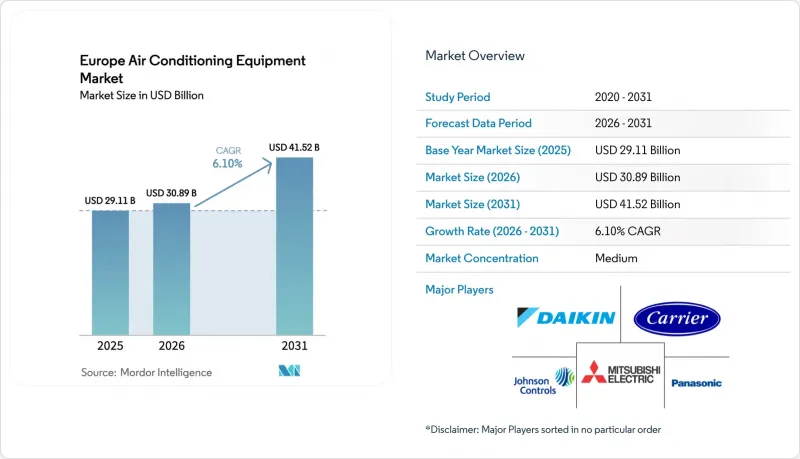
歐洲空調設備市場預計到 2026 年價值 308.9 億美元,高於 2025 年的 291.1 億美元,預計到 2031 年將達到 415.2 億美元。
預計從 2026 年到 2031 年,其複合年成長率將達到 6.1%。
政策與歐盟綠色交易的快速協調一致、更嚴格的氟化氣體配額以及REPowerEU提出的到2030年安裝6000萬台熱泵的目標,共同營造了歐洲暖通空調市場對節能、低全球變暖潛值(GWP)技術的持續重視環境。那些在2024年擴展了天然冷媒產品線並確保了變頻壓縮機產能的製造商,如今正受益於更短的前置作業時間、在公開競標中獲得的競爭優勢以及更高的平均售價。此外,FLAP-D區域資料中心建設的蓬勃發展、南歐大都市地區的城市熱島緩解計劃以及企業設施管理人員對「暖通空調即服務」(HVACaaS)合約日益成長的需求,也推動了歐洲暖通空調市場的發展。隨著大規模商業買家尋求獲得符合未來SEER標準且無需在專案進行中途更改設計的規格方案,直接面向關鍵客戶的銷售正在加速成長。
歐洲空調設備市場趨勢與洞察
歐盟的再生能源目標正在推動熱泵的加速普及。
各成員國的法規正趨同於將熱泵作為石化燃料鍋爐的主要替代方案,預計到2025年後,年安裝量將接近600萬台。在德國,2024年已核准76%的新建住宅安裝熱泵。法國計劃在2030年將國內產能擴大到每年100萬台,並為此提供增值稅、補貼和簡化核准程序的支持。歐盟委員會的「熱泵加速平台」正在調整獎勵機制,使製造商能夠以前所未有的方式了解市場需求,並為多年資本投資決策奠定基礎。隨著歐洲暖通空調市場轉型為冷暖一體系統,垂直整合壓縮機和控制設備生產的供應商將獲得最大優勢。
氟化氣體法規修訂後,對低全球暖化潛勢(GWP)冷媒的需求增加。
歐盟第2024/573號法規將自2025年起禁止在新熱泵系統中使用全球暖化潛勢(GWP)超過750的冷媒。製造商迅速做出回應,大金推出了針對零售店的CO2 VRV系列產品,三菱重工則部署了GWP為675的R-32系統。該法規旨在將二氧化碳當量排放量從2025年的4,290萬噸減少到2032年的900萬噸,這將導致氫氟碳化合物(HFCs)供應緊張,並加速丙烷和二氧化碳等替代冷媒的普及。目前,服務供應商網路正在投資提昇技術人員處理易燃A3類冷媒的技能,進一步推動售後服務市場的專業化,並增強歐洲暖通空調(HVAC)市場的品牌忠誠度。
嚴格的季節能源效率比(SEER)最低標準推高了成本。
生態設計法規現在要求在實際環境而非靜態實驗室環境下進行能源效率測試,這項變更導致系統開發成本增加了7%至10%。中小型原始設備製造商(OEM)難以承擔額外的研發和認證採集費用,這可能導致產業整合,並縮小歐洲暖通空調市場入門級產品的選擇範圍。更嚴格的建築規範進一步縮短了投資回收期,導致一些對價格敏感的住宅推遲更換設備的決定。
細分市場分析
預計到2025年,室內空調將維持在歐洲暖通空調市場27.48%的佔有率,持續推動小規模住宅和商業設施的更換需求。 VRF系統雖然基礎成本小規模,但預計到2031年將實現9.15%的複合年成長率,因為它們能夠在部分負載下高效地同時進行製冷和製熱,幫助建築業主達到能源性能指令(EPBD)的目標。零售連鎖店正在採用多聯式設計來最佳化有限的立面空間,而屋頂式一體機仍然是郊區零售和物流設施的首選。製造商透過使其VRF產品線相容於丙烷和二氧化碳,從而減少對氟化氣體配額的影響,以在永續性方面脫穎而出。
該領域的競爭重點正轉向控制系統的互通性和遠距離診斷。整合式建築管理系統 (BMS) 功能使能源管理人員能夠可視化租戶的使用情況並微調設置,從而有助於提高暖通空調即服務 (HVAC-as-a-Service) 協議的續約率。可攜式局部冷卻器正在滿足緊急應變和活動場所等特定需求,尤其是在南部大都市地區遭遇嚴重熱浪期間。增加蓄熱可再生可以將夜間多餘的再生能源用於尖峰時段的製冷,這凸顯了歐洲暖通空調市場如何與平衡整個電網的目標保持一致。
到2025年,非變頻機組將佔據歐洲暖通空調市場67.95%的佔有率,這主要得益於價格較低的住宅通路。然而,隨著零件成本的下降和初始價格差距的縮小,變頻解決方案正以8.85%的複合年成長率快速成長。變頻驅動器能夠降低啟動電流消耗,從而減少電氣安裝規模,並為供電能力有限的歷史建築維修創造機會。電力公司基於季節性能的補貼計畫也進一步推動了變頻設計的採購。
製造商正在整合基於人工智慧的預測演算法,以便根據使用情況和天氣預報調整壓縮機轉速。這套軟體層正在改變歐洲暖通空調市場的價值提案,使其從單純的硬體轉向數據驅動型服務。曾經阻礙變頻器普及的可靠性問題正在緩解,因為冷媒冷卻的電力電子設備在現場測試中已展現出5萬小時的平均故障間隔時間(MTBF)。
其他好處:
- Excel格式的市場預測(ME)表
- 3個月的分析師支持
目錄
第1章:引言
- 研究假設和市場定義
- 調查範圍
第2章:調查方法
第3章執行摘要
第4章 市場狀況
- 市場概覽
- 市場促進因素
- 歐盟的再生能源目標正在加速熱泵的普及應用。
- 氟化氣體法規修訂後,對低全球暖化潛值冷媒的需求增加。
- 南歐城市熱島緩解項目
- FLAP-D 城市資料中心的擴張正在推動精密冷卻技術的進步。
- 一波基於歐盟綠色交易的節能維修
- HVAC即服務合約在設施管理人員中越來越普遍。
- 市場限制因素
- 嚴格的季節能源效率比(SEER)最低標準推高了成本。
- 壓縮機和微晶片供應鏈中斷
- 缺乏技術純熟勞工來處理低全球暖化潛值冷媒
- 對能源消耗反彈的擔憂限制了補貼的範圍。
- 價值/供應鏈分析
- 監管和技術前景
- 歐盟生態設計與能源標章框架
- 分階段減少氟化氣體和全氟烷基物質的排放法規
- 智慧物聯網預測性維護平台
- 熱驅動和混合式空調技術
- 波特五力分析
- 新進入者的威脅
- 買方的議價能力
- 供應商的議價能力
- 替代品的威脅
- 競爭公司之間的競爭
- 價格分析
- 投資分析
- 新冠疫情與能源價格衝擊的影響評估
第5章 市場規模與成長預測
- 依產品類型
- 室內空調
- 窗式/壁掛式機組
- 可攜式/局部冷卻器
- 單分離式系統
- 多聯式系統
- 可變冷媒流量(VRF)系統
- 屋頂安裝式組合單元
- 空調(AHU)
- 冷卻器
- 離心式
- 擰緊
- 捲動
- 風扇和通風設備
- 其他(蒸發式冷卻器、蓄熱式空調等)
- 室內空調
- 按冷氣量(kW)
- 小於 8 千瓦
- 8~15 kW
- 15~20 kW
- 超過20千瓦
- 依冷媒類型
- R-32
- R-410A
- R-290/丙烷
- CO2(R-744)
- 氫氟烯烴(HFO-1234yf/ze)
- 透過技術
- 逆變器
- 非逆變器
- 最終用戶
- 住宅
- 商業的
- 辦公室和共享辦公空間
- 飯店業(飯店、度假村)
- 醫療設施
- 零售和購物中心
- 資料中心
- 工業的
- 食品/飲料加工
- 製藥及無塵室
- 透過分銷管道
- 直接(從製造商到大客戶)
- 間接(銷售代理商/安裝商/電子商務)
- 國家
- 德國
- 英國
- 法國
- 義大利
- 西班牙
- 荷蘭
- 北歐國家(瑞典、丹麥、挪威、芬蘭)
- 其他歐洲地區
第6章 競爭情勢
- 市場集中度
- 策略性舉措(併購、合資、許可)
- 市佔率分析
- 公司簡介
- Daikin Industries Ltd.
- Mitsubishi Electric Corp.
- Carrier Global Corp.
- Johnson Controls-Hitachi Air Conditioning
- Panasonic Corp.
- LG Electronics Inc.
- Trane Technologies plc
- Lennox International Inc.
- Danfoss A/S
- Bosch Thermotechnology GmbH
- Emerson Electric Co.
- Samsung Electronics Co. Ltd.
- Gree Electric Appliances Inc. of Zhuhai
- Midea Group Co. Ltd.
- CIAT Group(United Technologies)
- Vertiv Holdings Co.
- Grundfos Holding A/S
- Systemair AB
- FlaktGroup Holding GmbH
- Glen Dimplex Group
第7章 市場機會與未來展望
Europe Air Conditioning Equipment Market size in 2026 is estimated at USD 30.89 billion, growing from 2025 value of USD 29.11 billion with 2031 projections showing USD 41.52 billion, growing at 6.1% CAGR over 2026-2031.
Rapid policy alignment with the EU Green Deal, stricter F-Gas quotas, and the REPowerEU goal of 60 million installed heat pumps by 2030 are creating an environment in which the Europe air conditioning equipment market consistently rewards energy-efficient, low-GWP technologies. Manufacturers that scaled natural-refrigerant product lines and secured inverter compressor capacity during 2024 now enjoy shorter lead-times, a competitive edge in public tenders, and higher average selling prices. The Europe air conditioning equipment market also benefits from a data-center construction wave in FLAP-D hubs, municipal heat-island programs in Southern capitals, and the growing popularity of HVAC-as-a-Service contracts among corporate facility managers. Direct-to-key-account sales are accelerating as large commercial buyers look to lock in specification packages that meet upcoming SEER thresholds without mid-project redesigns.
Europe Air Conditioning Equipment Market Trends and Insights
Accelerated Heat-Pump Uptake Driven by EU REPower Targets
Member-state mandates are converging on heat pumps as the primary replacement for fossil-fuel boilers, pushing annual installations toward 6 million units from 2025. Germany already approved heat pumps in 76% of new residential buildings in 2024. France is ramping domestic capacity to 1 million units per year by 2030, supported by reduced VAT, grant finance, and fast-track permitting. The European Commission's Heat Pump Accelerator Platform is synchronizing incentive structures, giving manufacturers unprecedented demand visibility that anchors multi-year capex decisions. As the Europe air conditioning equipment market pivots toward hybrid heating-cooling equipment, suppliers with vertically integrated compressor and controls production gain the most leverage.
Rising Demand for Low-GWP Refrigerants Post F-Gas Revision
Regulation (EU) 2024/573 bans refrigerants with GWP > 750 in new heat-pump systems from 2025. Manufacturers have responded swiftly: Daikin debuted CO2 VRV lines for retail formats, and Mitsubishi Heavy Industries rolled out R-32 systems with 675 GWP. The quota cut from 42.9 million t CO2-eq in 2025 to 9 million t by 2032 tightens HFC supply, accelerating adoption of propane and CO2 alternatives. Service-provider networks now invest in technician up-skilling to handle flammable A3 refrigerants, further professionalizing after-sales markets and reinforcing brand loyalty across the Europe air conditioning equipment market.
Stringent Seasonal Energy-Efficiency Ratio (SEER) Minimums Raising Costs
Ecodesign rules now require real-life efficiency testing rather than static lab values, a change that adds 7-10% to system development costs. Smaller OEMs struggle to finance additional R&D and certification, prompting consolidation and potentially reducing model choice in entry-level tiers of the Europe air conditioning equipment market. Tougher building codes further compress payback windows, delaying some replacement decisions among price-sensitive homeowners.
Other drivers and restraints analyzed in the detailed report include:
- Urban Heat-Island Mitigation Projects in Southern Europe
- Data-Centre Expansion in FLAP-D Cities Boosting Precision Cooling
- Supply-Chain Disruptions in Compressors & Micro-chips
For complete list of drivers and restraints, kindly check the Table Of Contents.
Segment Analysis
Room Air Conditioners maintained 27.48% share of the Europe air conditioning equipment market in 2025 and continue to dominate replacement demand in small residential and light commercial spaces. VRF configurations, though starting from a lower base, post a 9.15% CAGR through 2031 by offering simultaneous heating and cooling with partial-load efficiencies that help building owners meet EPBD targets. Retail chains adopt multi-split designs to optimize limited facade space, while rooftop packaged units remain favored in out-of-town retail and logistics. Manufacturers adapt VRF lines to propane and CO2, mitigating F-Gas quota exposure and differentiating on sustainability credentials.
The segment's competitive focus is shifting toward controls interoperability and remote diagnostics. Integrated BMS features allow energy managers to visualize tenant usage and fine-tune setpoints, a capability that raises retention rates in HVAC-as-a-Service contracts. Portable spot coolers serve niche requirements such as emergency response and event venues, especially during severe heat waves in Southern capitals. Thermal storage add-ons extend nighttime renewable surplus into peak daytime cooling, underlining the Europe air conditioning equipment market's alignment with broader grid-balancing objectives.
Non-Inverter units retained 67.95% Europe air conditioning equipment market share in 2025, mainly in low-ticket residential channels. However, inverter solutions expand at 8.85% CAGR as falling component costs close the upfront-price gap. Variable-frequency drives reduce start-up current draw, enabling smaller electrical infrastructure and opening retrofit opportunities in heritage buildings with limited supply capacity. Utility rebate programs that reward seasonal efficiency further skew procurement toward inverter designs.
Manufacturers are integrating AI-based predictive algorithms that adjust compressor speed based on occupancy and weather forecasts. This software layer enhances the Europe air conditioning equipment market value proposition from pure hardware to data-driven services. Reliability concerns that once hindered inverter adoption are dissipating as refrigerant-cooled power electronics demonstrate 50,000-hour MTBF performance in field trials.
The Europe Air Conditioning Equipment Market Report is Segmented by Product Type (Room AC, VRF, Chillers, and More), Cooling Capacity (less Than 8kW, 8-15kW, 15-20kW, Greater Than 20kW), Refrigerant Type (R-32, R-410A, R-290, CO2, and More), Technology (Inverter, Non-Inverter), End User (Residential, Commercial, Industrial), Distribution Channel, and Geography. The Market Forecasts are Provided in Terms of Value (USD).
List of Companies Covered in this Report:
- Daikin Industries Ltd.
- Mitsubishi Electric Corp.
- Carrier Global Corp.
- Johnson Controls-Hitachi Air Conditioning
- Panasonic Corp.
- LG Electronics Inc.
- Trane Technologies plc
- Lennox International Inc.
- Danfoss A/S
- Bosch Thermotechnology GmbH
- Emerson Electric Co.
- Samsung Electronics Co. Ltd.
- Gree Electric Appliances Inc. of Zhuhai
- Midea Group Co. Ltd.
- CIAT Group (United Technologies)
- Vertiv Holdings Co.
- Grundfos Holding A/S
- Systemair AB
- FlaktGroup Holding GmbH
- Glen Dimplex Group
Additional Benefits:
- The market estimate (ME) sheet in Excel format
- 3 months of analyst support
TABLE OF CONTENTS
1 INTRODUCTION
- 1.1 Study Assumptions and Market Definition
- 1.2 Scope of the Study
2 RESEARCH METHODOLOGY
3 EXECUTIVE SUMMARY
4 MARKET LANDSCAPE
- 4.1 Market Overview
- 4.2 Market Drivers
- 4.2.1 Accelerated Heat-Pump Uptake Driven by EU REPower Targets
- 4.2.2 Rising Demand for Low-GWP Refrigerants Post F-Gas Revision
- 4.2.3 Urban Heat-Island Mitigation Projects in Southern Europe
- 4.2.4 Data-Centre Expansion in FLAP-D Cities Boosting Precision Cooling
- 4.2.5 Energy-Efficiency Renovation Wave Under EU Green Deal
- 4.2.6 HVAC-as-a-Service Contracts Gaining Traction Among Facility Managers
- 4.3 Market Restraints
- 4.3.1 Stringent Seasonal Energy-Efficiency Ratio (SEER) Minimums Raising Costs
- 4.3.2 Supply-Chain Disruptions in Compressors and Micro-chips
- 4.3.3 Skilled-Labour Shortage for Low-GWP Refrigerant Handling
- 4.3.4 Rebound Energy-Consumption Concerns Limiting Subsidy Scope
- 4.4 Value / Supply-Chain Analysis
- 4.5 Regulatory and Technological Outlook
- 4.5.1 EU Ecodesign and Energy-Labelling Framework
- 4.5.2 F-Gas Phase-Down and PFAS Restrictions
- 4.5.3 Smart, IoT-Enabled Predictive Maintenance Platforms
- 4.5.4 Thermally-Driven and Hybrid AC Technologies
- 4.6 Porter's Five Forces Analysis
- 4.6.1 Threat of New Entrants
- 4.6.2 Bargaining Power of Buyers
- 4.6.3 Bargaining Power of Suppliers
- 4.6.4 Threat of Substitutes
- 4.6.5 Intensity of Competitive Rivalry
- 4.7 Pricing Analysis
- 4.8 Investments Analysis
- 4.9 Impact Assessment of COVID-19 and Energy-Price Shock
5 MARKET SIZE AND GROWTH FORECASTS (VALUE)
- 5.1 By Product Type
- 5.1.1 Room Air Conditioners
- 5.1.1.1 Window / Wall-Mounted Units
- 5.1.1.2 Portable / Spot Coolers
- 5.1.1.3 Single-Split Systems
- 5.1.1.4 Multi-Split Systems
- 5.1.2 Variable Refrigerant Flow (VRF) Systems
- 5.1.3 Rooftop Packaged Units
- 5.1.4 Air Handling Units (AHU)
- 5.1.5 Chillers
- 5.1.5.1 Centrifugal
- 5.1.5.2 Screw
- 5.1.5.3 Scroll
- 5.1.6 Fans and Ventilation Equipment
- 5.1.7 Others (Evaporative Coolers, Thermal Storage, Etc.)
- 5.1.1 Room Air Conditioners
- 5.2 By Cooling Capacity (kW)
- 5.2.1 Less than 8 kW
- 5.2.2 8 - 15 kW
- 5.2.3 15 - 20 kW
- 5.2.4 Greater than 20 kW
- 5.3 By Refrigerant Type
- 5.3.1 R-32
- 5.3.2 R-410A
- 5.3.3 R-290 / Propane
- 5.3.4 CO2 (R-744)
- 5.3.5 Hydro-Fluoro-Olefin (HFO-1234yf/ze)
- 5.4 By Technology
- 5.4.1 Inverter
- 5.4.2 Non-Inverter
- 5.5 By End User
- 5.5.1 Residential
- 5.5.2 Commercial
- 5.5.2.1 Offices and Co-Working Spaces
- 5.5.2.2 Hospitality (Hotels, Resorts)
- 5.5.2.3 Healthcare Facilities
- 5.5.2.4 Retail and Shopping Centres
- 5.5.2.5 Data Centres
- 5.5.3 Industrial
- 5.5.3.1 Food and Beverage Processing
- 5.5.3.2 Pharmaceuticals and Cleanrooms
- 5.6 By Distribution Channel
- 5.6.1 Direct (Manufacturer to Key Accounts)
- 5.6.2 Indirect (Distributors / Installers / E-Commerce)
- 5.7 By Country
- 5.7.1 Germany
- 5.7.2 United Kingdom
- 5.7.3 France
- 5.7.4 Italy
- 5.7.5 Spain
- 5.7.6 Netherlands
- 5.7.7 Nordics (Sweden, Denmark, Norway, Finland)
- 5.7.8 Rest of Europe
6 COMPETITIVE LANDSCAPE
- 6.1 Market Concentration
- 6.2 Strategic Moves (MandA, JVs, Licensing)
- 6.3 Market Share Analysis
- 6.4 Company Profiles (includes Global level Overview, Market level overview, Core Segments, Financials as available, Strategic Information, Market Rank/Share for key companies, Products and Services, and Recent Developments)
- 6.4.1 Daikin Industries Ltd.
- 6.4.2 Mitsubishi Electric Corp.
- 6.4.3 Carrier Global Corp.
- 6.4.4 Johnson Controls-Hitachi Air Conditioning
- 6.4.5 Panasonic Corp.
- 6.4.6 LG Electronics Inc.
- 6.4.7 Trane Technologies plc
- 6.4.8 Lennox International Inc.
- 6.4.9 Danfoss A/S
- 6.4.10 Bosch Thermotechnology GmbH
- 6.4.11 Emerson Electric Co.
- 6.4.12 Samsung Electronics Co. Ltd.
- 6.4.13 Gree Electric Appliances Inc. of Zhuhai
- 6.4.14 Midea Group Co. Ltd.
- 6.4.15 CIAT Group (United Technologies)
- 6.4.16 Vertiv Holdings Co.
- 6.4.17 Grundfos Holding A/S
- 6.4.18 Systemair AB
- 6.4.19 FlaktGroup Holding GmbH
- 6.4.20 Glen Dimplex Group
7 MARKET OPPORTUNITIES AND FUTURE OUTLOOK
- 7.1 White-Space and Unmet-Need Assessment

 空調系統市場:2026-2032年全球市場預測(依產品類型、技術、冷氣、組件、冷媒類型、能源效率、應用和銷售管道)
 北美暖通空調市場:市佔率分析、產業趨勢與統計及成長預測(2026-2031 年)
 空調系統市場規模、佔有率和趨勢分析報告:按類型、技術、應用、地區和細分市場預測(2026-2033 年)
 空調系統市場機會、成長要素、產業趨勢分析及2026-2035年預測。空調市場:2026-2032年全球市場預測(依銷售管道、技術、冷氣量、產品類型及最終用戶分類)
 全球空調系統市場規模、佔有率、趨勢和成長分析報告(2026-2034年)
 空調系統市場:按類型、技術、最終用戶和地區分類空調設備市場:2026年至2032年全球預測(依產品類型、技術、容量、組件、最終用戶及通路分類)
 2026年全球蒸氣和空調供應市場報告氟泵空調市場:按類型、容量、技術、應用、最終用途和分銷管道分類,全球預測,2026-2032年