


 |
市場調查報告書
商品編碼
1940742
美國電氣機殼:市場佔有率分析、產業趨勢與統計、成長預測(2026-2031)United States Electrical Enclosures - Market Share Analysis, Industry Trends & Statistics, Growth Forecasts (2026 - 2031) |
||||||

※ 本網頁內容可能與最新版本有所差異。詳細情況請與我們聯繫。
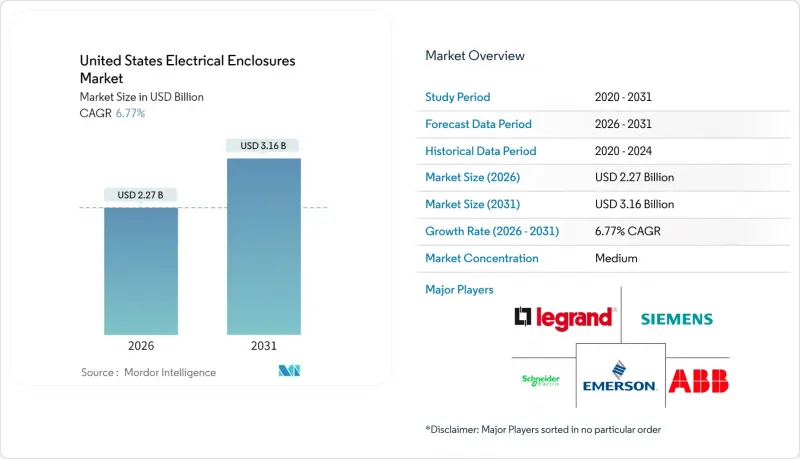
美國電氣機殼市場預計將從 2025 年的 21.3 億美元成長到 2026 年的 22.7 億美元,預計到 2031 年將達到 31.6 億美元,2026 年至 2031 年的複合年成長率為 6.77%。
對電網韌性、大型太陽能發電工程和電動卡車充電站的大力資本投資預計將推動兩位數以上的持續需求成長。光是公用事業公司就已為輸配電設備在2024年前撥款1,790億美元,其中一部分資金直接用於購買防風雨和網路安全型機櫃。每年299.9億美元的資料中心建設投資正在改變對適用於高密度配電的自主型大容量機櫃的需求結構。加州要求在2030年安裝15.7萬個中大型充電樁,這推動了對兆瓦級新型機殼的需求。這些基礎設施發展趨勢正在推動美國公共產業、可再生能源、交通運輸和數位基礎設施等領域的電氣機殼市場潛力成長。
美國電氣機殼市場趨勢與洞察
美國電網加固計劃資本投資激增
電力公司正在將五年資本計畫增加235億美元,其中光是PPL一家公司的預算就增加了40%,達到200億美元。配電變電站的支出將在2023年達到61億美元,是2003年以來的三倍多。每項維修都指定使用NEMA 4X或IP66防護等級的機櫃,這些機櫃既能保護智慧繼電器,又能抵禦風沙和水的侵蝕。增強的溫度控管和電磁干擾屏蔽正成為基本要求,推高了平均售價。日益頻繁的極端天氣事件促使公共產業簽訂多年期機殼契約,從而為美國電氣機殼市場提供了持續的訂單。
公用事業規模太陽能發電廠和儲能設施的快速擴張
美國國防部指南規範強制要求使用 NEMA 3R 匯流箱和 NEMA 4X 控制櫃,額定溫度範圍為 -25°C 至 +57°C。儲能陣列的要求更為嚴格,包括通風氣體管理部分和密封電子設備艙,例如 Solar Electric Supply 的 Class I Div 2 系統。 1 兆瓦以上計劃的激增推動了更大面積和模組化、可堆疊機殼的普及。德克薩斯州和佛羅裡達州在採購方面處於領先地位,通常每吉瓦太陽能發電容量需要 15,000 至 20,000 個新外殼。這正推動美國電氣機殼市場轉向更大、預製組件和更高 IP 防護等級的方向。
鋼鐵和鋁商品價格波動
對加拿大和墨西哥進口商品加徵25%的新關稅,導致鋼製導管的平均成本在2025年3月前上漲了14%,而鋁材短缺則推高了面板價格22%。中國4,500萬噸的產量上限以及受旱災影響的冶煉廠,導致全球溢價上漲,世界銀行預測供應緊張的局面將持續到2025年。美國製造商面臨的電價約為加拿大的兩倍,並推高了加工成本。製造商正在合約中加入價格上漲條款,並增加原料庫存,這給營運資金帶來了壓力,預計短期內將限制美國電氣機殼市場的成長。
細分市場分析
到2025年,金屬機櫃將佔據美國電氣機殼市場70.54%的佔有率,這主要得益於鋼材的機械強度和鋁材的電磁屏蔽性能。 316L等不銹鋼牌號在船舶和食品加工行業的訂單很大,而碳鋼主導著大批量需求。非金屬產品類別正以7.33%的複合年成長率成長,其中聚碳酸酯和玻璃纖維增強聚合物(GRP)機殼因其輕量化和防腐蝕性能而備受青睞。新興的無線測量設備採用GRP來維持2.4 GHz訊號的保真度,從而拓展了其在工業物聯網(IIoT)部署中的應用。
符合 NEMA 4X 和 IP68 防護等級的聚碳酸酯外殼正被廣泛應用於沿海太陽能匯流陣列,其重量僅為鋼製外殼的一半,卻具備優異的紫外線穩定性和矽膠密封性能。原始設備製造商 (OEM) 非常重視其與 UL 508A 面板結構的兼容性,從而最大限度地減少設計變更過程中的摩擦。隨著關稅推高金屬原料成本,價格競爭力日益增強,可應用領域也不斷擴展。複合材料的持續多元化發展有望提高非金屬產品的市場滲透率,並改變美國電氣機殼市場未來的材料結構。
通用型或全尺寸(超過50公升)系統的出貨量佔總出貨量的33.01%,這反映了分散式PLC和感測器在工廠中的重要角色。模組化或可配置系統的市場預計將以7.55%的複合年成長率成長,主要受變電站維修和資料中心配電盤需求成長的推動。人工智慧工作負載的不斷成長將推動機架功率密度接近600kW,從而需要800V高壓直流配電,這需要更大、溫度控管的機殼。
在電力領域,整合繼電器、電池和通訊設備的步入式控制室正被廣泛採用,從而縮短了現場佈線時間。模組化機櫃系統允許隨著負載的增加而安裝額外的隔間,從而控制了資金預算。這種可擴展性鞏固了大型產品的戰略價值,推動了其在美國電氣機殼市場收入佔有率的成長。
其他福利:
- Excel格式的市場預測(ME)表
- 分析師支持(3個月)
目錄
第1章 引言
- 研究假設和市場定義
- 調查範圍
第2章調查方法
第3章執行摘要
第4章 市場情勢
- 市場概覽
- 市場促進因素
- 美國電網加固計劃資本投資激增
- 公用事業規模太陽能發電廠和儲能設施的快速擴張
- 商用車輛停車場的電氣化
- 聯邦政府對國內面板製造的稅收優惠
- 人工智慧驅動的預測性維護機殼
- 具備網路安全功能的工業物聯網機殼的需求日益成長
- 市場限制
- 鋼鐵和鋁等大宗商品價格波動
- 2024-2025年非住宅建築成長放緩
- UL 508A/NEMA 4X智慧型機殼認證成本高昂
- 金屬機櫃內無線感測器的互通性標準有限
- 產業價值鏈分析
- 監管環境
- 電氣機殼標準
- 技術展望
- 波特五力分析
- 供應商的議價能力
- 消費者議價能力
- 新進入者的威脅
- 競爭對手之間的競爭
- 替代品的威脅
- 投資分析
第5章 市場規模與成長預測
- 依材料類型
- 由金屬製成(碳鋼、不銹鋼、鋁)
- 非金屬材質(聚碳酸酯、玻璃纖維增強塑膠、聚酯、ABS樹脂)
- 按外形規格
- 小型(小於10公升)
- 緊湊型(10-50公升)
- 均碼/大尺寸(50公升或以上)
- 模組化/可配置系統
- 按安裝類型
- 壁掛式
- 落地式/獨立式
- 地下/基礎類型
- 桿式安裝
- 按最終用戶行業分類
- 能源與電力
- 石油和天然氣
- 工業製造與機器人
- 金屬和採礦
- 交通運輸(鐵路、公路、航空、電動車充電)
- 資料中心和電信
- 食品、飲料和藥品
第6章 競爭情勢
- 市場集中度
- 策略趨勢
- 市佔率分析
- 公司簡介
- Schneider Electric SE
- ABB Ltd
- Eaton Corporation plc
- Hubbell Inc.
- nVent Electric plc
- Rittal GmbH and Co. KG
- Legrand SA
- Siemens AG
- Emerson Electric Co.
- Hammond Manufacturing Ltd.
- AZZ Inc.
- Adalet(Scott Fetzer Co.)
- Austin Electrical Enclosures, LLC
- Bison ProFab, Inc.
- Saginaw Control and Engineering, Inc.
- Stahlin Enclosures(Atkore Inc.)
- Allied Moulded Products, Inc.
- Pentair plc(Schroff)
- Integra Enclosures, LLC
- Fibox USA, LLC
第7章 市場機會與未來展望
The United States Electrical Enclosures Market is expected to grow from USD 2.13 billion in 2025 to USD 2.27 billion in 2026 and is forecast to reach USD 3.16 billion by 2031 at 6.77% CAGR over 2026-2031.
Robust capital outlays for grid resilience, utility-scale solar projects, and electric truck charging depots are converging to sustain double-digit unit demand. Utilities alone budgeted USD 179 billion in 2024 for transmission and distribution hardware, a spending pool that directly specifies weather-sealed, cyber-secure cabinets. Data center construction running at a USD 29.99 billion annual rate is shifting the mix toward free-standing, large-volume housings suited for high-density power distribution. California's mandate for 157,000 medium- and heavy-duty chargers by 2030 underpins a new class of megawatt-rated enclosures. These infrastructure themes collectively expand the addressable market for US electrical enclosures across utilities, renewables, transportation, and digital infrastructure.
United States Electrical Enclosures Market Trends and Insights
Surging CAPEX in U.S. Grid-Hardening Programs
Utility owners are boosting five-year capital plans by USD 23.5 billion, with PPL alone lifting its budget 40% to USD 20 billion. Distribution substation spend hit USD 6.1 billion in 2023, more than tripling 2003 levels. Each retrofit specifies NEMA 4X or IP66 cabinets able to endure wind-borne debris and flood exposure while sheltering smart relays. Enhanced thermal management and EMI shielding now form baseline requirements, pushing average selling prices higher. As extreme-weather events intensify, utilities are locking in multi-year enclosure contracts, giving the US electrical enclosures market durable order visibility.
Rapid Build-Out of Utility-Scale Solar and Storage Farms
Department of Defense guide specs obligate NEMA 3R combiner boxes and NEMA 4X control cabinets that tolerate -25 °C to +57 °C ranges. Storage arrays impose stricter demands, including vented gas management sections and sealed electronics bays, as illustrated by Class I Div 2 systems from Solar Electric Supply. The boom in projects above 1 MW is enlarging physical footprints, spurring uptake of modular, stackable enclosures. Texas and Florida are setting procurement pace, and each gigawatt of solar capacity typically translates to 15,000-20,000 new cabinets. Consequently, the US electrical enclosures market is pivoting toward larger, pre-engineered assemblies with higher ingress-protection ratings.
Commodity Price Volatility for Steel and Aluminum
New 25% tariffs on Canadian and Mexican inputs drove average steel conduit costs up 14% by March 2025, while aluminum shortages pushed panel prices 22% higher. China's output cap at 45 million tonnes and drought-hit smelters lift global premiums, and the World Bank expects tightness to persist through 2025. U.S. producers face power rates almost double those in Canada, inflating conversion costs. Manufacturers are inserting escalation clauses and carrying larger raw-material inventories, which strains working capital and tempers the US electrical enclosures market expansion over the near term.
Other drivers and restraints analyzed in the detailed report include:
- Electrification of Commercial Vehicle Depots
- Federal Tax Incentives for Domestic Panel Manufacturing
- Sluggish Non-Residential Construction in 2024-2025
For complete list of drivers and restraints, kindly check the Table Of Contents.
Segment Analysis
Metallic cabinets retained 70.54% command of the US electrical enclosures market in 2025, underpinned by steel's mechanical resilience and aluminum's EMI shielding. Stainless grades such as 316L headline offshore and food-processing orders, whereas carbon steel dominates volume buyers. The non-metallic cohort, expanding at 7.33% CAGR, features polycarbonate and glass-reinforced polymer housings that slash weight and eliminate corrosion. Emerging wireless instrumentation uses GRP to preserve 2.4 GHz signal fidelity, broadening utility in IIoT rollouts.
Polycarbonate boxes rated NEMA 4X and IP68 now serve coastal PV combiner arrays, delivering UV stability and silicone-gasket sealing at half the weight of steel. OEMs appreciate drop-in compatibility with UL 508A panel builds, minimizing redesign friction. As tariffs inflate metal input costs, price parity is approaching, expanding addressable applications. Continued diversification into composites promises to lift non-metallic penetration and reshape future material splits within the US electrical enclosures market.
Free-size or full-size (above 50 L) accounted for 33.01% of the shipments, mirroring distributed PLC and sensor duties in factories. Modular or configurable systems are projected to grow at a 7.55% CAGR, propelled by substation retrofits and data-center switchboards. AI workloads push rack power densities toward 600 kW, obliging 800 V HVDC distribution that demands bigger, thermally managed housings.
Utility segments adopt walk-in control shelters that bundle relays, batteries, and communications inside one structure, cutting field wiring time. Modular cabinet ecosystems let operators bolt incremental bays as loads grow, safeguarding capital budgets. This scalability theme cements the strategic value of large-format offerings and increases their revenue mix inside the US electrical enclosures market.
The United States Electrical Enclosures Market Report is Segmented by Material Type (Metallic, and Non-Metallic), Form Factor (Small, Compact, Free-Size, and Modular), Mounting Type (Wall-Mounted, Floor-Mounted, Underground, and Pole-Mounted), End-User Industry (Energy and Power, Oil and Gas, Industrial Manufacturing and Robotics, Data Centers and Telecom, and More). The Market Forecasts are Provided in Terms of Value (USD).
List of Companies Covered in this Report:
- Schneider Electric SE
- ABB Ltd
- Eaton Corporation plc
- Hubbell Inc.
- nVent Electric plc
- Rittal GmbH and Co. KG
- Legrand SA
- Siemens AG
- Emerson Electric Co.
- Hammond Manufacturing Ltd.
- AZZ Inc.
- Adalet (Scott Fetzer Co.)
- Austin Electrical Enclosures, LLC
- Bison ProFab, Inc.
- Saginaw Control and Engineering, Inc.
- Stahlin Enclosures (Atkore Inc.)
- Allied Moulded Products, Inc.
- Pentair plc (Schroff)
- Integra Enclosures, LLC
- Fibox USA, LLC
Additional Benefits:
- The market estimate (ME) sheet in Excel format
- 3 months of analyst support
TABLE OF CONTENTS
1 INTRODUCTION
- 1.1 Study Assumptions and Market Definition
- 1.2 Scope of the Study
2 RESEARCH METHODOLOGY
3 EXECUTIVE SUMMARY
4 MARKET LANDSCAPE
- 4.1 Market Overview
- 4.2 Market Drivers
- 4.2.1 Surging CAPEX in U.S. grid-hardening programs
- 4.2.2 Rapid build-out of utility-scale solar and storage farms
- 4.2.3 Electrification of commercial vehicle depots
- 4.2.4 Federal tax incentives for domestic panel manufacturing
- 4.2.5 AI-enabled predictive maintenance enclosures
- 4.2.6 Growing demand for cyber-secure IIoT ready enclosures
- 4.3 Market Restraints
- 4.3.1 Commodity price volatility for steel and aluminum
- 4.3.2 Sluggish non-residential construction in 2024-2025
- 4.3.3 High certification costs for UL 508A/NEMA 4X smart enclosures
- 4.3.4 Limited interoperability standards for wireless sensors inside metal cabinets
- 4.4 Industry Value Chain Analysis
- 4.5 Regulatory Landscape
- 4.6 Electrical Enclosure Standards
- 4.7 Technological Outlook
- 4.8 Porter's Five Forces Analysis
- 4.8.1 Bargaining Power of Suppliers
- 4.8.2 Bargaining Power of Consumers
- 4.8.3 Threat of New Entrants
- 4.8.4 Intensity of Competitive Rivalry
- 4.8.5 Threat of Substitutes
- 4.9 Investment Analysis
5 MARKET SIZE AND GROWTH FORECASTS (VALUE)
- 5.1 By Material Type
- 5.1.1 Metallic (Carbon Steel, Stainless Steel, Aluminum)
- 5.1.2 Non-metallic (Polycarbonate, Fiberglass, Polyester, ABS)
- 5.2 By Form Factor
- 5.2.1 Small (less than or equal to 10 L)
- 5.2.2 Compact (10-50 L)
- 5.2.3 Free-size / Full-size (above 50 L)
- 5.2.4 Modular / Configurable systems
- 5.3 By Mounting Type
- 5.3.1 Wall-mounted
- 5.3.2 Floor-mounted / Free-standing
- 5.3.3 Underground / Pad-mounted
- 5.3.4 Pole-mounted
- 5.4 By End-user Industry
- 5.4.1 Energy and Power
- 5.4.2 Oil and Gas
- 5.4.3 Industrial Manufacturing and Robotics
- 5.4.4 Metals and Mining
- 5.4.5 Transportation (Rail, Road, Air, EV-charging)
- 5.4.6 Data Centres and Telecom
- 5.4.7 Food and Beverage and Pharmaceuticals
6 COMPETITIVE LANDSCAPE
- 6.1 Market Concentration
- 6.2 Strategic Moves
- 6.3 Market Share Analysis
- 6.4 Company Profiles (includes Global level Overview, Market level overview, Core Segments, Financials as available, Strategic Information, Market Rank/Share for key companies, Products and Services, and Recent Developments)
- 6.4.1 Schneider Electric SE
- 6.4.2 ABB Ltd
- 6.4.3 Eaton Corporation plc
- 6.4.4 Hubbell Inc.
- 6.4.5 nVent Electric plc
- 6.4.6 Rittal GmbH and Co. KG
- 6.4.7 Legrand SA
- 6.4.8 Siemens AG
- 6.4.9 Emerson Electric Co.
- 6.4.10 Hammond Manufacturing Ltd.
- 6.4.11 AZZ Inc.
- 6.4.12 Adalet (Scott Fetzer Co.)
- 6.4.13 Austin Electrical Enclosures, LLC
- 6.4.14 Bison ProFab, Inc.
- 6.4.15 Saginaw Control and Engineering, Inc.
- 6.4.16 Stahlin Enclosures (Atkore Inc.)
- 6.4.17 Allied Moulded Products, Inc.
- 6.4.18 Pentair plc (Schroff)
- 6.4.19 Integra Enclosures, LLC
- 6.4.20 Fibox USA, LLC
7 MARKET OPPORTUNITIES AND FUTURE OUTLOOK
- 7.1 White-Space and Unmet-Need Assessment

 印度電氣外殼市場:市場佔有率分析、產業趨勢與統計及成長預測(2026-2031)
 電氣外殼市場-全球市場預測(2026-2032年)電氣外殼:市場佔有率分析、行業趨勢和統計數據、成長預測(2026-2031)
 電氣外殼市場:按產品類型、應用、最終用戶產業和地區分類電氣櫃及外殼市場:依材質、防護等級、額定電壓、產品類型及最終用戶產業分類-2026-2032年全球市場預測全球機櫃冷卻器市場按類型、冷卻能力、機櫃類型、安裝方式、最終用途產業和分銷管道分類,2026-2032年預測
 電氣外殼市場規模、佔有率、成長及全球產業分析:按類型、應用和地區的洞察,2026-2034年預測
 2026年全球電氣外殼市場報告不銹鋼烘乾櫃市場按產品類型、材質等級、容量、價格範圍、應用、終端用戶產業和分銷管道分類-2026-2032年全球預測電池外殼及機櫃市場(依產品類型、安裝類型、材料、電池類型、最終用戶和應用分類)-全球預測,2026-2032年