


 |
市場調查報告書
商品編碼
1934885
印度電氣外殼市場:市場佔有率分析、產業趨勢與統計、成長預測(2026-2031)India Electrical Enclosures - Market Share Analysis, Industry Trends & Statistics, Growth Forecasts (2026 - 2031) |
||||||

※ 本網頁內容可能與最新版本有所差異。詳細情況請與我們聯繫。
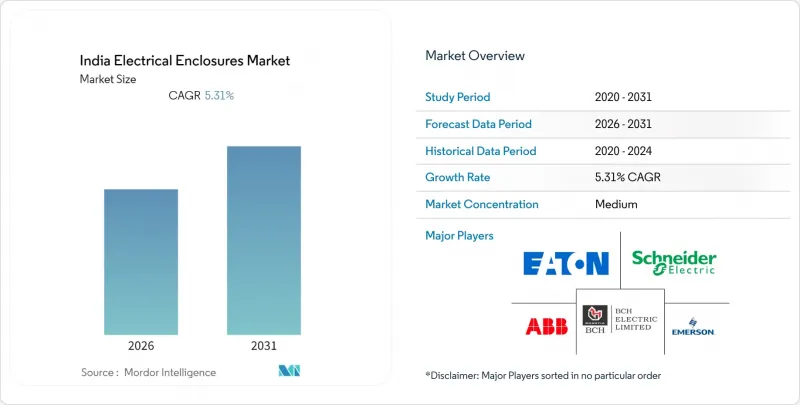
預計在預測期內,印度電氣外殼市場將實現 5.31% 的複合年成長率。
快速的電網現代化改造項目、超大規模資料中心的擴張以及日益嚴格的消防安全法規正在加速對堅固耐用、智慧化且耐候性強的機櫃的採購。國有電力公司不斷增加的資本支出(CAPEX)超過1兆印度盧比,尤其是在765千伏輸電線路建設方面,推動了機櫃銷量的成長,而產品構成比向高規格金屬設計的轉變則支撐了價值的成長。預計超大規模設施的容量將從2024年的1150兆瓦增加到2027年的2100兆瓦,這將帶動對IP54+防護等級和溫度控管機櫃的新需求,尤其是在孟買、清奈和海得拉巴等城市。 2016年國家建築規範的實施推動了醫院、學校和公共機構的維修需求,而印度鐵路98%的電網電氣化率也支持了持續的維護需求。這些因素,加上適度的競爭和不斷增加的在地化獎勵,為印度電氣機櫃市場未來的多年成長奠定了基礎。
印度電氣櫃市場趨勢與洞察
國有公用事業公司正在快速投資,以實現電網現代化。
各邦電力公司正大力投資高壓輸電線路,中央政府僅跨邦輸電網路就撥款1兆盧比。古吉拉突邦1500億盧比的升級計劃就是一個典型例子,該計劃要求在新765千伏輸電線路沿線安裝大型IP65防護等級的保護繼電器機殼。市場對具備先進溫控功能的鍍鋅鋼和鋁製機櫃的需求不斷成長,推動了印度電氣外殼市場的銷售和平均售價。擁有BIS IS 2147標準認證並具備整合智慧電網感測器能力的供應商有望提高競標率。隨著安裝地點從室內變電站轉向節省空間的室外場地,耐腐蝕塗層和雙層門封正成為關鍵的差異化因素。中期影響顯著,有助於維持與主要原始設備製造商(OEM)的穩定訂單。
超大規模資料中心建置的擴展
預計到2027年,全球IT總裝置容量將從2024年的1,150兆瓦成長到2,100兆瓦,將使高密度配電單元、母線槽和電池備用配電盤的需求翻倍。超大規模資料中心正在採用具有整合隔熱層和線纜管理系統的模組化鋼框架,以適應超過10千瓦的機架密度。採購週期正在加快,這有利於那些能夠保持本地組裝柔軟性和庫存緩衝的供應商。由於運轉率要求超過99.999%,業者強制要求機殼具備IP54或更高的密封等級、雙冗餘冷卻風扇以及預先整合的數位跳脫斷路器。雖然主要城市仍然是部署中心,但區域城市的邊緣節點正在推動增量需求。隨著預先簽訂合約的超大規模容量過渡到土木工程和電氣施工,近期需求成長顯而易見。
鋼鐵和鋁價格波動
2024年,受中國進口熱軋鋼反傾銷稅和煉焦煤價格波動的影響,熱軋鋼價格每噸波動幅度達3000印度盧比。鋁溢價則與倫敦金屬交易所(LME)鋁價的飆升密切相關,而LME鋁價的飆升又受到能源價格波動的驅動。按季度簽訂合約的小規模機殼製造商發現避險十分困難,迫使他們重新評估利潤率並縮小零件尺寸。一些原始設備製造商(OEM)已將側板厚度從2毫米減至1.6毫米,但這存在降低大型機櫃剛性的風險。原物料價格風險的增加抑制了長期固定價格競標的積極性,並導致與國有電力公司合作競標的合約授予延遲。儘管預計從2026年起波動性將有所緩解,但由於短期不利因素,複合年成長率(CAGR)預測已下調80個基點。
細分市場分析
到2025年,金屬機殼將佔印度電氣外殼市場70.85%的佔有率,其中鍍鋅鋼板在牽引變電站和大電流開關設備中佔據主導地位。預計到2025年,金屬產品市場規模將達到1.8639億美元,到2031年將以4.78%的複合年成長率成長。鋁材因其重量優勢,成為屋頂太陽能匯流箱的首選材料。不斷上漲的防腐蝕塗漆營運成本(OPEX)正促使沿海電力公司轉向玻璃纖維增強塑膠(FRP)和聚碳酸酯產品,這些產品的複合年成長率將達到7.42%。非金屬機櫃發熱量較低,因此非常適合用於資料中心走廊的封閉。Schneider Electric位於加爾各答的樹脂工廠和ABB位於瓦多達拉的FRP生產線表明,供應商正致力於複合材料業務的成長。儘管由於進口樹脂的成本和 BIS IS 14772 測試費用,單價仍然高出 15-20%,但總體擁有成本分析仍然顯示,一些規範制定者建議在鹽鹼和化學環境中選擇這種聚合物。
第二代工程塑膠現已符合垂直火焰和紫外線老化測試標準,顯示已準備好應用於電力設施。聚碳酸酯模具具有符合人體工學的鎖扣整合和透明門設計,便於快速目視檢查,從而增強了職業安全審核。同時,在存在高故障電流匯流排和敏感SCADA繼電器的環境中,金屬機櫃在電磁屏蔽性能方面仍然無可匹敵。儘管從應用案例來看,金屬材料仍將繼續佔據主導地位,但複合材料在沿海地區和資料基礎設施領域逐漸找到新的應用空間。
到2025年,壁掛式產品將佔出貨量的36.25%,是商業建築和地鐵站配電盤維修的必備之選。其緊湊的面積、鉸鏈門和後部電纜入口簡化了租戶的室內安裝。同時,模組化通道式系統正以6.98%的複合年成長率快速成長,因為超大規模業者會在異地預組裝包含塑殼斷路器、變壓器和監控PLC的異地設備。雖然其價格比同類產品高出25%,但運作時間縮短了35%,這對於尋求滿足運轉率協定(SLA)的託管營運商而言至關重要。
在變電站、鋼鐵廠和污水處理廠等設施中,由於重型設備和大截面匯流排需要底部電纜入口和底座安裝,自主型落地櫃正被廣泛採用。屋頂太陽能發電的日益普及,尤其是在拉賈斯坦邦和古吉拉突邦,推動了對接線盒的需求。對於原始設備製造商 (OEM) 而言,多樣化的外形規格為交叉銷售奠定了基礎。Schneider Electric的 Prisma-Plus 在壁掛式接線盒領域處於領先地位,而 SM AirSeT 則佔據了落地式接線盒市場。系統整合商擴大在框架競標中捆綁多種外形規格,並對擁有豐富產品目錄和標準化內部安裝網格的供應商進行評估。
其他福利:
- Excel格式的市場預測(ME)表
- 3個月的分析師支持
目錄
第1章 引言
- 研究假設和市場定義
- 調查範圍
第2章調查方法
第3章執行摘要
第4章 市場情勢
- 市場概覽
- 市場促進因素
- 國營電力企業為實現電網現代化而迅速增加資本支出
- 超大規模資料中心建置的擴展
- 公共建築強制消防安全標準(NBC-2016)
- 印度鐵路快速電氣化
- 透過「生產連結獎勵計畫」(PLI)促進開關設備的本地化生產
- 屋頂光電維生態系的發展
- 市場限制
- 鋼鐵和鋁價格波動
- 假冒知識產權合規產品的氾濫
- 州級認證體系碎片化
- 矽膠墊片供應鏈中的瓶頸
- 產業價值鏈分析
- 監管環境
- 技術展望
- 波特五力分析
- 供應商的議價能力
- 買方的議價能力
- 新進入者的威脅
- 替代品的威脅
- 競爭對手之間的競爭
第5章 市場規模與成長預測
- 依材料類型
- 由金屬製成
- 非金屬
- 按外形規格
- 壁掛式
- 落地式/自主型
- 接線盒/端子盒
- 模組化/客製化
- 按安裝類型
- 室內的
- 戶外
- 透過使用
- 發電和配電
- 交通運輸(鐵路、地鐵、機場)
- 石油和天然氣
- 商業建築和資料中心
- 加工工業(食品飲料、製藥、化學)
- 其他用途
第6章 競爭情勢
- 市場集中度
- 策略趨勢
- 市佔率分析
- 公司簡介
- Schneider Electric SE
- ABB Ltd.
- Siemens AG
- Eaton Corporation plc
- Emerson Electric Co.
- Legrand SA
- Hubbell Incorporated
- Rittal GmbH and Co. KG
- BCH Electric Ltd.
- Larsen and Toubro Limited
- Trinity Touch Pvt. Ltd.
- Fibox India Pvt. Ltd.
- Boxco Industries Ltd.
- Adswitch Limited
- Pentair Technical Solutions India Pvt. Ltd.
- VSM Plast
- GE TandD India Limited
- Panel Builders India Pvt. Ltd.
- Admac Systems
- Ensto India Pvt. Ltd.
第7章 市場機會與未來展望
India electrical enclosures market is expected to register a CAGR of 5.31% during the forecast period.
Rapid grid-modernization programs, hyperscale data-center expansion, and stringent fire-safety regulations are accelerating procurement of robust, smart, and weather-resistant enclosures. Accelerating state-utility CAPEX exceeding INR 1 lakh crore, particularly for 765 kV transmission corridors, is lifting unit volumes, while mix shifts toward higher-spec metallic designs sustains value growth. Hyperscale facilities scaling from 1,150 MW in 2024 to an expected 2,100 MW by 2027 are driving fresh demand for IP54-plus, thermally managed cabinets, especially in Mumbai, Chennai, and Hyderabad. Compliance with the National Building Code 2016 is stimulating retrofit orders across hospitals, schools, and public offices, and Indian Railways' 98% network electrification milestone is underpinning recurring maintenance demand. Together, these vectors create a multi-year runway for the India electrical enclosures market amid moderate competitive intensity and increasing localization incentives.
India Electrical Enclosures Market Trends and Insights
Surging Grid-Modernization CAPEX by State Utilities
State electricity boards are channelling record investments into high-voltage corridors, with the central allocation of INR 1 lakh crore for inter-state transmission alone. Gujarat's INR 15,000 crore upgrade plan typifies the scale, necessitating larger IP65-rated housings for protection relays along new 765 kV lines. Demand rises for galvanized steel and aluminium cabinets with advanced climate controls, propelling both volumes and average selling prices within the India electrical enclosures market. Vendors able to certify products under BIS IS 2147 and integrate smart-grid sensors see heightened tender success. As installations shift from indoor substations to space-saving outdoor yards, corrosion-resistant coatings and dual-door sealing emerge as key differentiators. The medium-term impact is significant, sustaining a solid order pipeline for principal OEMs.
Rising Hyperscale Data-Centre Buildouts
Total installed IT load is projected to grow from 1,150 MW in 2024 to 2,100 MW by 2027, doubling enclosure demand for high-density power distribution units, bus-ducts, and battery-backup switchboards. Hyperscale specifies modular steel frames with integrated thermal barriers and cable management to handle rack densities above 10 kW. Procurement cycles are rapid, favouring suppliers that keep local assembly lines agile and inventory buffered. Because uptime requirements exceed 99.999%, operators insist on IP54-plus sealing, dual-redundant cooling fans, and digital trip breakers pre-fitted into enclosures. Tier-1 cities remain the launch pads, but edge nodes in Tier-2 markets now drive incremental volumes. Short-term uplift is pronounced as pre-committed hyperscale capacity converts to civil works and electrical fitouts.
Steel and Aluminium Price Volatility
HRC steel swung by INR 3,000 per tonne during 2024 as anti-dumping duties on Chinese supply intersected with fluctuating coking-coal costs. Aluminium premiums tracked LME spikes driven by energy-price volatility. Smaller enclosure shops operating on quarterly rate contracts struggle to hedge, forcing margin resets or component downsizing. Some OEMs responded by redesigning side-panels at 1.6 mm thickness versus 2 mm, a trade-off that risks stiffness in larger cabinets. Elevated raw-material risk deters long-duration fixed-price bids, delaying awards on state-utility tenders. Although volatility should moderate past 2026, near-term headwinds shave 80 basis points off CAGR forecasts.
Other drivers and restraints analyzed in the detailed report include:
- Mandatory Fire-Safety Upgrades in Public Buildings (NBC-2016)
- Rapid Electrification of Indian Railways
- Proliferation of Counterfeit IP-Rated Products
For complete list of drivers and restraints, kindly check the Table Of Contents.
Segment Analysis
Metallic housings held 70.85% India electrical enclosures market share in 2025, with galvanized steel dominating traction substations and high-current switchboards. The India electrical enclosures market size for metallic products was USD 186.39 million in 2025 and is projected to expand at 4.78% CAGR to 2031. Aluminium earns favour in rooftop solar combiner boxes where weight matters. Rising OPEX on anti-corrosion repainting is nudging coastal utilities toward fiberglass and polycarbonate alternatives that clock a 7.42% CAGR. Non-metallic cabinets also absorb less heat, benefitting data-hall aisle containment. Schneider's Kolkata polymer plant and ABB's Vadodara FRP line illustrate supplier bets on composite growth. Imported resin costs and BIS IS 14772 testing fees keep unit prices at a 15-20% premium, yet total-cost-of-ownership analyses still tilt some specifiers toward polymer choices in saline or chemical environments.
Second-generation engineering plastics are now meeting vertical-flame and UV-aging standards, underscoring their readiness for utility deployments. Polycarbonate molds allow ergonomic latch integration and transparent doors for quick visual inspection, perks that bolster occupational safety audits. Conversely, metallic cabinets remain unrivalled for electromagnetic shielding when sensitive SCADA relays share space with high-fault-current busbars. The balance of use-cases points to sustained metallic dominance but with growing composite niches in coastal and data infrastructure.
Wall-mount products accounted for 36.25% of 2025 shipments and remain indispensable for distribution-panel retrofits in commercial towers and metro stations. Their compact footprint, hinged doors, and rear cable entry simplify tenant fit-outs. Meanwhile, modular aisle-based systems are surging at 6.98% CAGR as hyperscale operators pre-fabricate skids populated with MCCBs, transformers, and monitoring PLCs off-site. Like-for-like price premiums of 25% are offset by 35% faster go-live timelines, a metric valued by colocation providers chasing occupancy SLAs.
Free-standing floor cabinets service substations, steel mills, and wastewater plants where heavy gear and large-cross-section busbars require bottom cable entry and plinth-mount anchoring. Junction-box volumes track rooftop solar rollouts, especially in Rajasthan and Gujarat. For OEMs, form-factor diversification underpins cross-selling: Schneider's Prisma-Plus lends wall-mount segments while the SM AirSeT draws floor-mount demand. System integrators increasingly issue framework bids bundling multiple form factors, rewarding suppliers with broad catalogues and standardized internal mounting grids.
The India Electrical Enclosures Market Report is Segmented by Material Type (Metallic, Non-Metallic), Form Factor (Wall-Mount, Floor-mount/Free-standing, Junction/Terminal Boxes, Modular/Custom), Mounting Type (Indoor, Outdoor), Application (Power Generation and Distribution, Transportation, Oil and Gas, Commercial Buildings and Data Centres, and More), and Geography. The Market Forecasts are Provided in Terms of Value (USD).
List of Companies Covered in this Report:
- Schneider Electric SE
- ABB Ltd.
- Siemens AG
- Eaton Corporation plc
- Emerson Electric Co.
- Legrand SA
- Hubbell Incorporated
- Rittal GmbH and Co. KG
- BCH Electric Ltd.
- Larsen and Toubro Limited
- Trinity Touch Pvt. Ltd.
- Fibox India Pvt. Ltd.
- Boxco Industries Ltd.
- Adswitch Limited
- Pentair Technical Solutions India Pvt. Ltd.
- VSM Plast
- GE TandD India Limited
- Panel Builders India Pvt. Ltd.
- Admac Systems
- Ensto India Pvt. Ltd.
Additional Benefits:
- The market estimate (ME) sheet in Excel format
- 3 months of analyst support
TABLE OF CONTENTS
1 INTRODUCTION
- 1.1 Study Assumptions and Market Definition
- 1.2 Scope of the Study
2 RESEARCH METHODOLOGY
3 EXECUTIVE SUMMARY
4 MARKET LANDSCAPE
- 4.1 Market Overview
- 4.2 Market Drivers
- 4.2.1 Surging grid-modernization CAPEX by state utilities
- 4.2.2 Rising hyperscale data-centre build-outs
- 4.2.3 Mandatory fire-safety upgrades in public buildings (NBC-2016)
- 4.2.4 Rapid electrification of Indian Railways
- 4.2.5 'Production-Linked Incentive' (PLI) push for switch-gear localisation
- 4.2.6 Growth of rooftop-solar OandM ecosystem
- 4.3 Market Restraints
- 4.3.1 Steel and aluminium price volatility
- 4.3.2 Proliferation of counterfeit IP-rated products
- 4.3.3 Fragmented state-level certification regimes
- 4.3.4 Supply-chain bottlenecks for silicone gaskets
- 4.4 Industry Value-Chain Analysis
- 4.5 Regulatory Landscape
- 4.6 Technological Outlook
- 4.7 Porter's Five Forces Analysis
- 4.7.1 Bargaining Power of Suppliers
- 4.7.2 Bargaining Power of Buyers
- 4.7.3 Threat of New Entrants
- 4.7.4 Threat of Substitutes
- 4.7.5 Intensity of Competitive Rivalry
5 MARKET SIZE AND GROWTH FORECASTS (VALUE)
- 5.1 By Material Type
- 5.1.1 Metallic
- 5.1.2 Non-metallic
- 5.2 By Form Factor
- 5.2.1 Wall-mount
- 5.2.2 Floor-mount / Free-standing
- 5.2.3 Junction / Terminal boxes
- 5.2.4 Modular / Custom
- 5.3 By Mounting Type
- 5.3.1 Indoor
- 5.3.2 Outdoor
- 5.4 By Application
- 5.4.1 Power Generation and Distribution
- 5.4.2 Transportation (Rail, Metro, Airports)
- 5.4.3 Oil and Gas
- 5.4.4 Commercial Buildings and Data Centres
- 5.4.5 Process Industries (FandB, Pharma, Chemicals)
- 5.4.6 Others Applications
6 COMPETITIVE LANDSCAPE
- 6.1 Market Concentration
- 6.2 Strategic Moves
- 6.3 Market Share Analysis
- 6.4 Company Profiles (includes Global level Overview, Market level overview, Core Segments, Financials as available, Strategic Information, Market Rank/Share for key companies, Products and Services, and Recent Developments)
- 6.4.1 Schneider Electric SE
- 6.4.2 ABB Ltd.
- 6.4.3 Siemens AG
- 6.4.4 Eaton Corporation plc
- 6.4.5 Emerson Electric Co.
- 6.4.6 Legrand SA
- 6.4.7 Hubbell Incorporated
- 6.4.8 Rittal GmbH and Co. KG
- 6.4.9 BCH Electric Ltd.
- 6.4.10 Larsen and Toubro Limited
- 6.4.11 Trinity Touch Pvt. Ltd.
- 6.4.12 Fibox India Pvt. Ltd.
- 6.4.13 Boxco Industries Ltd.
- 6.4.14 Adswitch Limited
- 6.4.15 Pentair Technical Solutions India Pvt. Ltd.
- 6.4.16 VSM Plast
- 6.4.17 GE TandD India Limited
- 6.4.18 Panel Builders India Pvt. Ltd.
- 6.4.19 Admac Systems
- 6.4.20 Ensto India Pvt. Ltd.
7 MARKET OPPORTUNITIES AND FUTURE OUTLOOK
- 7.1 White-space and Unmet-need Assessment

 電氣外殼市場:按類型、安裝配置、材質、最終用途產業和應用分類-2026-2032年全球市場預測電氣櫃及外殼市場:依材質、防護等級、額定電壓、產品類型及最終用戶產業分類-2026-2032年全球市場預測全球機櫃冷卻器市場按類型、冷卻能力、機櫃類型、安裝方式、最終用途產業和分銷管道分類,2026-2032年預測
 美國電氣機殼:市場佔有率分析、產業趨勢與統計、成長預測(2026-2031)
 電氣外殼市場規模、佔有率、成長及全球產業分析:按類型、應用和地區的洞察,2026-2034年預測
 2026年全球電氣外殼市場報告不銹鋼烘乾櫃市場按產品類型、材質等級、容量、價格範圍、應用、終端用戶產業和分銷管道分類-2026-2032年全球預測電池外殼及機櫃市場(依產品類型、安裝類型、材料、電池類型、最終用戶和應用分類)-全球預測,2026-2032年電氣外殼:市場佔有率分析、行業趨勢和統計數據、成長預測(2026-2031)
 塑膠外殼市場規模、佔有率和成長分析(按應用、最終用途產業、材質、配置類型、產業標準和地區分類)-2026-2033年產業預測