


 |
市場調查報告書
商品編碼
1940645
英國地板覆蓋材料:市場佔有率分析、產業趨勢與統計、成長預測(2026-2031)United Kingdom Floor Covering - Market Share Analysis, Industry Trends & Statistics, Growth Forecasts (2026 - 2031) |
||||||

※ 本網頁內容可能與最新版本有所差異。詳細情況請與我們聯繫。
據估計,英國地板覆蓋材料市場到 2026 年的價值將達到 46.3 億美元,高於 2025 年的 44.6 億美元。
預計到 2031 年將達到 55.5 億美元,2026 年至 2031 年的複合年成長率為 3.71%。
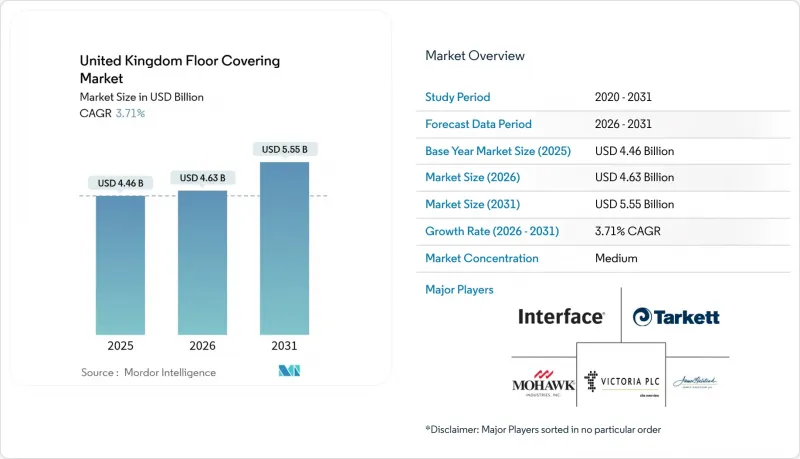
這一穩步成長凸顯了該行業已從疫情後的波動期過渡到穩步成長期,這主要得益於建設業的複工復產以及消費者對高階地面覆蓋材料需求的轉變。包括住宅維修、商業室內裝修和政府主導的維修項目在內的廣泛需求基礎,支撐了市場的韌性。混合辦公模式的興起推動了模組化地毯磚的新訂單成長,而以逼真紋理和低維護成本為特點的豪華乙烯基瓷磚(LVT)的需求在各個細分市場均加速成長。通路向線上和大型零售商的轉移提高了產品認知度和價格透明度,加劇了競爭,同時也給利潤率帶來了壓力,而原料成本的波動和通貨膨脹則進一步加劇了這種競爭。
英國地板覆蓋材料市場趨勢及分析
疫情後住宅維修熱潮推動住宅需求
疫情後住宅維修活動的激增持續改變住宅地面覆蓋材料的需求。住宅在兼具多種功能的空間中,更加重視舒適性和美觀。這一趨勢已從疫情初期的維修演變為對高階地面覆蓋材料解決方案的持續投資,以提升視覺吸引力和功能性。地毯在2025年展現出復甦的跡象,設計師們偏好色彩豐富、圖案大膽的地毯,尤其適用於臥室和客廳等注重舒適性的空間。同一空間內複合地面覆蓋材料的普及,為製造商提供了機遇,使其能夠提供和諧統一的產品系列,實現不同區域之間的無縫過渡。這種行為轉變反映了人們對住宅空間的構想和使用方式的根本性重新調整,從而推動了對各類地面覆蓋材料材料的持續需求。
大規模公共部門維修計畫會創造持續的需求。
政府在醫療、教育和公共基礎設施領域的維修項目,透過多年計劃週期創造對地板覆蓋材料的持續需求,從而穩定市場。這些多年計劃週期透過確保穩定的採購量來支撐市場穩定。諸如英國國家醫療服務體系(NHS)新建醫院計畫和全國學校重組計畫等舉措,為供應商提供了可預測的商機。專注於醫療和教育領域地板覆蓋材料的公司尤其能夠從中受益。例如,James Halstead PLC旗下的Polyflor品牌在醫療和教育彈性地板覆蓋材料領域創下了1.26億英鎊(1.6億美元)的銷售紀錄。
高通膨會抑制消費者的購買力。
持續的通膨壓力迫使消費者推遲非必要的住宅維修,儘管潛在需求強勁,但地板覆蓋材料的非必需品購買卻面臨阻力。英國建築材料價格指數持續波動,其對地板覆蓋材料材料的具體影響波及整個計劃的經濟效益。注重預算的消費者越來越傾向於選擇提案而非高階功能的產品,這可能會擠壓高階製造商的利潤空間。這一趨勢對住宅維修市場的影響尤其顯著,計劃延期可能會波及整個供應鏈,並影響零售商的庫存管理。然而,這一趨勢也為那些能夠提供既滿足價格敏感型需求又能維持品質標準的具成本效益解決方案的製造商創造了機會。
細分市場分析
在英國地板覆蓋材料市場,彈性地板覆蓋材料預計到2025年將以5.93%的複合年成長率成長,而非彈性地板覆蓋材料將維持42.95%的市場佔有率。豪華乙烯基瓷磚(LVT)尤其引領市場成長,憑藉其逼真的紋理、對潮濕環境的適應性以及快速施工等優勢,在住宅和商業場所都廣受歡迎。捲材乙烯基和複合乙烯基地磚(VCT)在醫療保健和教育領域保持著領先地位,而軟木和橡膠等小眾材料也正在崛起,尤其是在注重環保的永續發展計劃中。地毯和地墊正在復興,其大膽的圖案和環保再生紗線迎合了消費者對美觀和永續性的雙重偏好。瓷磚和工程木地板等硬質地板覆蓋材料依然保持著其奢華魅力,而中等價位的複合覆蓋材料則因消費者越來越傾向於選擇更耐用、設計更靈活的硬芯LVT而逐漸失去市場佔有率。
市場需求正變得日益兩極化。一方面,高階專案提供客製化的天然材料,營造專屬奢華感;另一方面,高性能合成材料迎合注重性價比的買家,兼具價值和耐用性。供應商同時提供這兩種價位的產品,有助於降低市場波動風險,並在計劃中佔據更廣泛的市場佔有率,從而增強其在競爭激烈的市場環境中的韌性。
預計到2031年,維修改造市場將以4.86%的複合年成長率成長,縮小與新建建築市場的差距(2025年新建建築市場佔總銷售額的53.78%)。這一成長主要由老舊住宅和商業物業的業主推動,他們致力於改善隔音和防潮性能,以提升空間的整體品質。快速安裝也日益受到重視,免膠鋪裝和浮動系統因其便利性、高效性和對不同環境的適應性而備受青睞。同時,租賃型住宅(BTR)的租戶周轉率高、使用強度大,因此對耐用、易清潔且能經受高強度使用並長期保持功能性和美觀性的飾面材料的需求也隨之成長。
同時,開發商在新住宅計劃和物流設施中指定使用耐用材料,但利率上升限制了這一發展速度,影響了計劃的整體可行性和財務規劃。為了解決維修的經濟性問題,產品工程師正在開發針對現有地面直接施工最佳化的產品,這些產品只需極少的基層處理,從而確保維修計劃經濟高效且省時。
其他福利:
- Excel格式的市場預測(ME)表
- 3個月的分析師支持
目錄
第1章 引言
- 研究假設和市場定義
- 調查範圍
第2章調查方法
第3章執行摘要
第4章 市場情勢
- 市場概覽
- 市場促進因素
- 疫情後住宅維修熱潮
- 規劃大規模公共部門維修計劃
- 人們對豪華乙烯基瓷磚(LVT)的偏好日益成長
- 辦公室對模組化地毯磚的需求不斷成長
- 政府對再生木地板的激勵措施
- 擴大租賃住宅計劃
- 市場限制
- 高通膨抑制了可自由支配支出。
- 原油衍生原料價格波動
- 專業安裝工人短缺
- 由於商業租賃期限延長,導致室內裝修工程延誤
- 產業價值鏈分析
- 波特五力分析
- 新進入者的威脅
- 供應商的議價能力
- 買方的議價能力
- 替代品的威脅
- 競爭對手之間的競爭
- 洞察市場最新趨勢與創新
- 深入了解市場近期發展動態(新產品發表、策略性舉措、投資、合作、合資、擴張、併購等)
第5章 市場規模及成長預測(金額:美元)
- 依產品類型
- 地毯和毛毯
- 彈性地板覆蓋材料
- 乙烯基片材和乙烯基複合磁磚
- 豪華乙烯基瓷磚(LVT)
- 油布
- 橡膠地板材料
- 軟木地板材料
- 非彈性地板覆蓋材料
- 陶瓷和陶瓷瓷磚
- 天然石材
- 硬木
- 工程木材
- 層壓板
- 依建築類型
- 新建工程
- 維修和更換
- 最終用戶
- 住宅
- 商業
- 工業和公共基礎設施
- 透過分銷管道
- B2C/零售通路
- 家居建材商店
- 專賣店
- 線上
- 其他分銷管道
- B2B/承包商/經銷商
- B2C/零售通路
- 按地區
- 英格蘭
- 蘇格蘭
- 威爾斯
- 北愛爾蘭
第6章 競爭情勢
- 市場集中度
- 策略趨勢
- 市佔率分析
- 公司簡介
- Victoria PLC
- Interface Inc.
- Tarkett SA
- James Halstead PLC(Polyflor)
- Mohawk Industries
- Shaw Industries Group
- Forbo Flooring Systems
- Gerflor Group
- Milliken & Company
- Amtico International
- Karndean Designflooring
- Cormar Carpets
- Brintons Carpets
- Balta Group
- BerryAlloc(Beaulieu)
- Moduleo(IVC Group)
- Armstrong Flooring
- BSW Timber Group
- Junckers Flooring
- Johnson Tiles
第7章 市場機會與未來展望
United Kingdom floor covering market size in 2026 is estimated at USD 4.63 billion, growing from 2025 value of USD 4.46 billion with 2031 projections showing USD 5.55 billion, growing at 3.71% CAGR over 2026-2031.
This measured rise highlights a sector moving from post-pandemic volatility to steady growth as construction resumes and consumers trade up to premium surfaces. A broad demand base spanning residential renovation, commercial fit-outs, and government refurbishment programs underpins the market's resilience. Hybrid work patterns generate fresh orders for modular carpet tiles, while luxury vinyl tile (LVT) accelerates across segments due to realistic aesthetics and low upkeep requirements. Distribution shifts toward online and big-box retail channels are widening product visibility and price transparency, reinforcing competitive intensity even as raw-material cost swings and inflation challenge margins.
United Kingdom Floor Covering Market Trends and Insights
Post-pandemic home-improvement boom drives residential demand
The post-pandemic surge in home improvement activity continues to reshape residential flooring demand, with homeowners prioritizing comfort and aesthetics in spaces that now serve multiple functions. This trend extends beyond initial lockdown-driven renovations, evolving into sustained investment in premium flooring solutions that enhance both visual appeal and functional performance. Carpets are seeing a resurgence in 2025, with designers favoring rich colors and bold patterns for comfort-focused spaces such as bedrooms and living rooms. The shift toward mixed flooring materials within single spaces creates opportunities for manufacturers offering coordinated product lines that enable seamless transitions between different zones. This behavioral change reflects a fundamental recalibration of how residential spaces are conceived and utilized, driving sustained demand for diverse flooring categories.
Large-scale public-sector refurbishment pipeline creates sustained demand
Government refurbishment programs in healthcare, education, and public infrastructure create sustained flooring demand through multi-year project cycles that stabilize the market. These multi-year project cycles support market stability by ensuring steady procurement flows. Initiatives such as the NHS New Hospital Programme and national school rebuilding efforts provide predictable revenue opportunities for suppliers. Companies specializing in healthcare-compliant and education-grade flooring are particularly well-positioned to benefit. For example, James Halstead PLC's Polyflor brand reported record revenues of GBP 126 million (USD 160 million) from its healthcare and education resilient flooring segment.
High inflation constrains consumer spending power
Persistent inflation pressures force consumers to defer non-essential home improvements, creating headwinds for discretionary flooring purchases despite underlying demand strength. The United Kingdom construction material price indices show continued volatility, with specific impacts on flooring-adjacent materials affecting overall project economics. Budget-conscious consumers increasingly prioritize value propositions over premium features, potentially compressing margins for manufacturers positioned in higher-end segments. This dynamic particularly affects the residential renovation market, where project deferrals can cascade through the supply chain and impact retailer inventory management. However, the trend also creates opportunities for manufacturers offering cost-effective solutions that maintain quality standards while addressing price-sensitive demand.
Other drivers and restraints analyzed in the detailed report include:
- Growing preference for luxury vinyl tile transforms product mix
- Rising demand for modular carpet tiles reshapes commercial spaces
- Volatile raw-material prices pressure manufacturing economics
For complete list of drivers and restraints, kindly check the Table Of Contents.
Segment Analysis
In 2025, the United Kingdom market for floor coverings is witnessing a 5.93% CAGR growth in resilient surfaces, while non-resilient options command a 42.95% market share. Leading the charge, LVT (Luxury Vinyl Tile) captivates with its lifelike visuals, adaptability to wet areas, and swift installation, making it a preferred choice for both residential and commercial applications. Sheet vinyl and VCT (Vinyl Composition Tile) maintain their foothold in healthcare and education sectors, alongside niche players like cork and rubber, especially in sustainability-driven projects where eco-conscious materials are prioritized. Carpets and rugs are making a comeback, spotlighting bold patterns and eco-friendly recycled yarns, which cater to evolving consumer preferences for both aesthetics and sustainability. While hard surfaces such as porcelain and engineered wood retain their premium appeal, mid-tier laminates are losing market share as consumers increasingly opt for rigid-core LVT, which offers enhanced durability and design versatility.
A bifurcated demand map is emerging. On one side, bespoke natural materials cater to luxury developments, offering exclusivity and high-end appeal; on the other, high-performance synthetics address value and durability, meeting the needs of cost-conscious buyers. Vendors positioned across both price ladders mitigate volatility and capture a broader wallet share within projects, ensuring resilience in a competitive market landscape.
By 2031, the replacement and retrofit market is projected to grow at a rate of 4.86%, narrowing the gap with the new-build segment, which commanded 53.78% of the revenue in 2025. This growth is primarily driven by the increasing focus of owners of aging residential and commercial properties on enhancing acoustic comfort and moisture control to improve the overall quality of their spaces. They are also prioritizing quicker installations, gravitating towards loose-lay formats and floating systems that offer convenience, efficiency, and adaptability to various environments. Meanwhile, build-to-rent schemes are driving a demand for durable, easy-to-clean finishes, which are essential for properties experiencing high tenant turnover and frequent use, ensuring these properties remain functional and visually appealing over time.
While developers are specifying high-capacity materials for new residential projects and logistics parks, the pace of these developments is tempered by rising interest rates, which impact overall project feasibility and financial planning. In response to renovation economics, product engineers are now crafting SKUs that are optimized for direct installation over existing floors and require less subfloor preparation, ensuring cost-effectiveness and time efficiency in retrofit projects.
The United Kingdom Floor Covering Market Report is Segmented by Product Type (Carpet and Rugs, Resilient Floor Covering, Non-Resilient Floor Covering), Construction Type (New Construction, Renovation & Replacement), End User (Residential, Commercial, Industrial & Public Infrastructure), Distribution Channel (B2C/Retail Channels, B2B/Contractors/Dealers), and Geography. The Market Forecasts are Provided in Terms of Value (USD).
List of Companies Covered in this Report:
- Victoria PLC
- Interface Inc.
- Tarkett SA
- James Halstead PLC (Polyflor)
- Mohawk Industries
- Shaw Industries Group
- Forbo Flooring Systems
- Gerflor Group
- Milliken & Company
- Amtico International
- Karndean Designflooring
- Cormar Carpets
- Brintons Carpets
- Balta Group
- BerryAlloc (Beaulieu)
- Moduleo (IVC Group)
- Armstrong Flooring
- BSW Timber Group
- Junckers Flooring
- Johnson Tiles
Additional Benefits:
- The market estimate (ME) sheet in Excel format
- 3 months of analyst support
TABLE OF CONTENTS
1 Introduction
- 1.1 Study Assumptions & Market Definition
- 1.2 Scope of the Study
2 Research Methodology
3 Executive Summary
4 Market Landscape
- 4.1 Market Overview
- 4.2 Market Drivers
- 4.2.1 Post-Pandemic Home-Improvement Boom
- 4.2.2 Large-Scale Public-Sector Refurbishment Pipeline
- 4.2.3 Growing Preference for Luxury Vinyl Tile (Lvt)
- 4.2.4 Rising Demand for Modular Carpet Tiles In Offices
- 4.2.5 Government Incentives For Recycled Content Flooring
- 4.2.6 Expansion of Build-To-Rent Housing Projects
- 4.3 Market Restraints
- 4.3.1 High Inflation Dampening Discretionary Spend
- 4.3.2 Volatile Crude-Derived Raw-Material Prices
- 4.3.3 Skills Shortage In Specialist Installation Labour
- 4.3.4 Extended Commercial Leasing Cycles Delaying Fit-Outs
- 4.4 Industry Value Chain Analysis
- 4.5 Porter's Five Forces Analysis
- 4.5.1 Threat of New Entrants
- 4.5.2 Bargaining Power of Suppliers
- 4.5.3 Bargaining Power of Buyers
- 4.5.4 Threat of Substitutes
- 4.5.5 Competitive Rivalry
- 4.6 Insights into the Latest Trends and Innovations in the Market
- 4.7 Insights on Recent Developments (New Product Launches, Strategic Initiatives, Investments, Partnerships, JVs, Expansion, M&As, etc.) in the Market
5 Market Size & Growth Forecasts (Value in USD)
- 5.1 By Product Type
- 5.1.1 Carpet and Rugs
- 5.1.2 Resilient Floor Covering
- 5.1.2.1 Vinyl Sheets & VCT
- 5.1.2.2 Luxury Vinyl Tiles (LVT)
- 5.1.2.3 Linoleum
- 5.1.2.4 Rubber Flooring
- 5.1.2.5 Cork Flooring
- 5.1.3 Non-Resilient Floor Covering
- 5.1.3.1 Ceramic & Porcelain Tile
- 5.1.3.2 Natural Stone
- 5.1.3.3 Hardwood
- 5.1.3.4 Engineered Wood
- 5.1.3.5 Laminate
- 5.2 By Construction Type
- 5.2.1 New Construction
- 5.2.2 Renovation & Replacement
- 5.3 By End User
- 5.3.1 Residential
- 5.3.2 Commercial
- 5.3.3 Industrial & Public Infrastructure
- 5.4 By Distribution Channel
- 5.4.1 B2C/Retail Channels
- 5.4.1.1 Home Centers
- 5.4.1.2 Specialty Stores
- 5.4.1.3 Online
- 5.4.1.4 Other Distribution Channels
- 5.4.2 B2B/Contractors/Dealers
- 5.4.1 B2C/Retail Channels
- 5.5 By Geography
- 5.5.1 England
- 5.5.2 Scotland
- 5.5.3 Wales
- 5.5.4 Northern Ireland
6 Competitive Landscape
- 6.1 Market Concentration
- 6.2 Strategic Moves
- 6.3 Market Share Analysis
- 6.4 Company Profiles (includes Global level Overview, Market level overview, Core Segments, Financials as available, Strategic Information, Market Rank/Share for key companies, Products & Services, and Recent Developments)
- 6.4.1 Victoria PLC
- 6.4.2 Interface Inc.
- 6.4.3 Tarkett SA
- 6.4.4 James Halstead PLC (Polyflor)
- 6.4.5 Mohawk Industries
- 6.4.6 Shaw Industries Group
- 6.4.7 Forbo Flooring Systems
- 6.4.8 Gerflor Group
- 6.4.9 Milliken & Company
- 6.4.10 Amtico International
- 6.4.11 Karndean Designflooring
- 6.4.12 Cormar Carpets
- 6.4.13 Brintons Carpets
- 6.4.14 Balta Group
- 6.4.15 BerryAlloc (Beaulieu)
- 6.4.16 Moduleo (IVC Group)
- 6.4.17 Armstrong Flooring
- 6.4.18 BSW Timber Group
- 6.4.19 Junckers Flooring
- 6.4.20 Johnson Tiles
7 Market Opportunities & Future Outlook
- 7.1 White-space & Unmet-Need Assessment
- 7.2 Rising Preference for Underfloor Heating-Compatible Floors
- 7.3 Increased Adoption of Waterproof And Spill-Resistant Flooring

 全球地板材料市場規模、佔有率、趨勢和成長分析報告(2026-2034年)
 地板材料市場規模、佔有率和成長分析:按產品類型、應用、分銷管道和地區分類-2026-2033年產業預測
 地板材料市場:2026-2032年全球市場預測(依產品類型、安裝方式、銷售管道及最終用戶分類)
 美國地板材料:市場佔有率分析、產業趨勢與統計、成長預測(2026-2031)
 2026年全球家居佈置和地板覆蓋材料市場報告地板材料:市場佔有率分析、產業趨勢與統計、成長預測(2026-2031)
 日本地面鋪裝材料市場報告(按材料、配銷通路、最終用戶和地區分類,2026-2034年)
 地板覆蓋市場-全球產業規模、佔有率、趨勢、機會和預測,按材料(彈性、非彈性、軟地板覆蓋)、按應用(住宅、商業、工業)、按地區、按競爭細分,2020-2030 年預測彈性地板材料:市場佔有率分析、產業趨勢、統計數據和成長預測(2025-2030 年)印尼地板樹脂:市場佔有率分析、行業趨勢和統計、成長預測(2025-2030 年)