


 |
市場調查報告書
商品編碼
1939700
汽車人工智慧:市場佔有率分析、產業趨勢與統計、成長預測(2026-2031)Automotive Artificial Intelligence - Market Share Analysis, Industry Trends & Statistics, Growth Forecasts (2026 - 2031) |
||||||

※ 本網頁內容可能與最新版本有所差異。詳細情況請與我們聯繫。
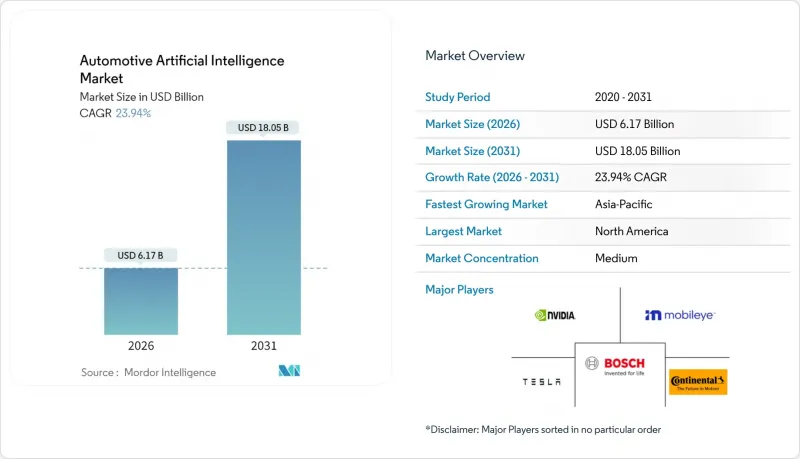
預計汽車人工智慧市場將從 2025 年的 49.8 億美元成長到 2026 年的 61.7 億美元,到 2031 年達到 180.5 億美元,2026 年至 2031 年的複合年成長率為 23.94%。
軟體定義車輛的快速普及、歐盟和美國強制二級高級駕駛輔助系統(ADAS)法規的實施,以及車用人工智慧運算成本的下降,正將競爭優勢從機械設計轉向演算法性能。汽車製造商正在擴展空中下載(OTA)更新平台,將每輛交付的車輛轉變為能夠創造收益的邊緣節點。同時,基於晶片組的系統晶片(SoC)使得即使是中階車型也能負擔得起高性能處理器。特斯拉首創的車隊學習框架已被中國主要汽車製造商採用,其辨識準確率的提升速度是閉合迴路檢驗所無法比擬的。在此背景下,汽車製造商、一級供應商、超大規模資料中心業者和人工智慧Start-Ups之間的策略聯盟正在取代垂直整合,並創建一個模組化的創新生態系統,從而促進專業領域的差異化發展。
全球汽車人工智慧市場趨勢與洞察
2級及以上ADAS安全功能的監理要求
歐盟第二版通用安全法規(GSE II)於2024年7月生效,要求所有在歐洲銷售的新車必須配備自動緊急煞車、緊急車道維持和智慧速度輔助系統。美國和日本也正在推行類似的法規,迫使全球汽車製造商採用「一次設計,全球認證」的設計理念。這項合規要求將曾經的高階附加功能轉變為基本設計要素,推動了一級供應商訂單系統訂單的成長。聯合國歐洲經濟委員會第171號法規(駕駛輔助系統法規)透過制定人工智慧功能的詳細虛擬測試規則,進一步加速了這項變革。因此,曾經依靠機械技術差異化競爭的汽車製造商如今在軟體成熟度方面展開競爭,清晰的規則手冊正在取代分散的區域性要求,降低了新進入者的市場准入門檻。
人工智慧運算能力和汽車SoC中TOPS的快速下降
英偉達的Thor處理器承諾達到2000 TOPS的運算能力,而特斯拉正在研發的AI5晶片則目標為2500 TOPS。這比目前的車載技術性能提升了10倍,從2022年起,每TOPS的成本每年可降低約40%。成本降低得益於共用資料中心規模、先進的晶圓代工廠製程以及晶片組分類技術,後者以模組化晶片取代了光罩大小的單片式晶片。 Imec的汽車晶片組專案與博世和寶馬等先鋒企業合作,建立了可互通的晶粒間通訊協定,從而縮短了開發週期,並實現了跨車型平台的複用。隨著矽材料的日益稀缺,差異化正在轉向軟體,這迫使傳統半導體供應商整合工具鏈、中間件和參考堆棧,以支援汽車製造商的大規模部署。
功能安全法規管轄權分散
ISO 26262、ISO/IEC 5469:2024 以及即將發布的 ISO/TS 5083:2025 分別針對自動駕駛技術堆疊的不同領域定義了安全流程,迫使原始設備製造商 (OEM) 協調重疊且不一致的標準。歐洲的 GSR II 標準與美國聯邦指南和中國的 GB/T 標準之間存在差異,導致全球平台必須為每個地區分別維護單獨的合格認證。規模較小的供應商難以應對多軌檢驗的負擔,這往往會導致產品發布延遲和地理覆蓋範圍縮小。行業組織一直倡導“安全案例交換”,旨在實現不同認證機構之間審核結果的互通性,但目前尚未達成共識。在實現統一之前,這種拼湊式的標準將繼續增加非重複性工程成本,並阻礙汽車人工智慧市場的發展。
細分市場分析
到2025年,軟體將佔汽車人工智慧市場收入的64.78%,這是由於汽車價值創造方式從鋼鐵轉向程式碼所致。如今,汽車製造商提供神經網路升級服務,即使在購車數年後也能增加新功能,使每輛聯網汽車都成為一個鮮活的、收費的服務節點。硬體部分在預測期間內將以13.84%的複合年成長率成長,但隨著晶片生態系統的普及,TOPS(終端處理器)的商品化,利潤率將會下降。因此,汽車人工智慧市場將青睞那些能夠提供程式碼、工具鏈和生命週期支援等全方位服務的公司,而不是那些只銷售晶片的公司。
諸如 Cerence CaLLM Edge 之類的邊緣駐留語言模型展現了軟體在無需網路費用且符合歐洲和中國隱私準則的情況下提升智慧的強大能力。監管機構對持續改進煞車和車道維持系統的要求,要求向整個運作(而不僅僅是新車)推送合規性更新,這進一步鞏固了軟體收入。因此,汽車人工智慧市場的頂級公司正在 DevOps 人才和空中網路安全方面投入數十億美元,將軟體確立為關鍵的競爭優勢。
到2025年,機器學習將佔據汽車人工智慧市場41.12%的佔有率,因為其透明的決定架構符合ISO 26262審核要求。然而,深度學習15.86%的複合年成長率表明,製造商正在轉向傳統演算法無法分析的多感測器融合技術。電腦視覺、自然語言處理和情境察覺技術,以及駕駛座使用者體驗,正在將汽車人工智慧市場拓展到安全領域之外。
特斯拉計劃推出的AI5晶片表明,只有深度卷積模型才能處理4D雷達、雷射雷達和高清攝影機的數據,從而實現高速公路車輛的融合。中國供應商也紛紛效仿,將變壓器網路整合到泊車輔助模組中,使曾經小眾的AI技術成為展示室中的差異化優勢。因此,供應鏈合作夥伴正在競相提供標註資料、可擴展的訓練基礎設施和檢驗工具,以應對複雜多變的神經網路潛在空間。
區域分析
到2025年,北美將佔據汽車人工智慧市場35.89%的收入佔有率,這主要得益於特斯拉的數據優勢、德克薩斯州州寬鬆的測試法規以及英偉達矽谷總部周邊的本土人工智慧計算叢集。同時,通用汽車、福特和Waymo正在將其無人駕駛業務從鳳凰城擴展到奧斯汀,不僅展現了其盈利能力,也凸顯了車隊級遠程輔助監管法規的不足。
亞太地區年複合成長率高達22.98%,位居全球之冠。中國憑藉出口導向電動車領先地位和相對統一的監管環境,奇瑞汽車承諾在30款車型中引入人工智慧技術,華為的目標是到2025年實現50萬輛自動駕駛汽車的交付量。日本的豐田、日產和本田已成立半導體聯盟,以應對該國人工智慧人才短缺的問題。同時,韓國現代汽車正投資7兆韓元,建造連接其工業園區和港口的自動化物流走廊。本土電池和LiDAR供應商正在降低區域汽車製造商的零件成本,從而推動中檔車型採用人工智慧技術。
歐洲在嚴格遵守資料隱私法規的同時,強制要求車輛配備基於GSR II的AI安全功能,並在所有生產平台上建立合規標準。 BMW計畫於2025年在中國整合DeepSeek AI,凸顯了其本土化策略;大眾汽車則正在歐洲向數百萬輛汽車推送Cerence Chat Pro OTA更新。 GDPR的限制推動了對邊緣推理的需求,促使供應商設計出能夠保護隱私的模型更新流程。儘管歐洲市場的絕對成長率落後於亞洲,但其每輛車的高附加價值仍使其對專注於駕駛員監控和網路安全OTA技術堆疊的專業供應商而言盈利。
其他福利:
- Excel格式的市場預測(ME)表
- 分析師支持(3個月)
目錄
第1章 引言
- 研究假設和市場定義
- 調查範圍
第2章調查方法
第3章執行摘要
第4章 市場情勢
- 市場概覽
- 市場促進因素
- 二級及以上ADAS安全功能的監理要求
- 人工智慧運算能力和汽車SoC所需TOPS的快速下降
- 空中軟體更新(OTA)的普及使得人工智慧功能的商業化成為可能
- 利用艦隊學習架構加速感知模型準確率
- 設備內多模態基礎設施模型降低了對雲端的依賴性
- 新興的基於晶片組的ECU降低了大規模生產車輛的零件成本。
- 市場限制
- 功能安全法規管轄權分散
- 在極端情況下檢驗人工智慧模型的成本很高
- 一級企業持續缺乏汽車級人工智慧人才
- 供應鏈對先進節點代晶圓代工廠能的依賴
- 價值/供應鏈分析
- 監管環境
- 技術展望
- 波特五力分析
- 新進入者的威脅
- 買方的議價能力
- 供應商的議價能力
- 替代品的威脅
- 競爭對手之間的競爭
第5章 市場規模與成長預測
- 報價
- 硬體
- 軟體
- 透過技術
- 機器學習
- 深度學習
- 電腦視覺
- 自然語言處理
- 情境察覺
- 透過流程
- 資料探勘
- 影像識別
- 訊號識別
- 透過使用
- 自動駕駛
- ADAS(進階駕駛輔助系統)
- 人機介面
- 預測性維護和診斷
- 按車輛類型
- 搭乘用車
- 輕型商用車
- 大型商用車輛
- 按地區
- 北美洲
- 美國
- 加拿大
- 北美其他地區
- 南美洲
- 巴西
- 阿根廷
- 其他南美洲
- 歐洲
- 德國
- 英國
- 法國
- 西班牙
- 義大利
- 俄羅斯
- 其他歐洲地區
- 亞太地區
- 中國
- 日本
- 韓國
- 印度
- 印尼
- 菲律賓
- 越南
- 澳洲
- 亞太其他地區
- 中東和非洲
- 阿拉伯聯合大公國
- 沙烏地阿拉伯
- 土耳其
- 南非
- 奈及利亞
- 埃及
- 其他中東和非洲地區
- 北美洲
第6章 競爭情勢
- 市場集中度
- 策略趨勢
- 市佔率分析
- 公司簡介
- Tesla Inc.
- Waymo LLC(Alphabet)
- NVIDIA Corporation
- Intel Corporation/Mobileye
- Horizon Robotics Inc.
- Aptiv PLC
- Continental AG
- Robert Bosch GmbH
- Qualcomm Incorporated
- Huawei Technologies Co.
- Microsoft Corporation
- Amazon Web Services Inc.
- Mercedes-Benz Group AG
- ZF Friedrichshafen AG
- BMW AG
- Toyota Motor Corporation
- Uber Technologies Inc.
- Hyundai Motor Company
- Hyundai Mobis Co. Ltd.
- Magna International Inc.
第7章 市場機會與未來展望
The Automotive AI market is expected to grow from USD 4.98 billion in 2025 to USD 6.17 billion in 2026 and is forecast to reach USD 18.05 billion by 2031 at 23.94% CAGR over 2026-2031.
Rapid software-defined vehicle adoption, mandatory Level-2 ADAS regulations in the EU and the United States, and falling costs of automotive-grade AI compute are shifting competitive advantage from mechanical engineering to algorithm performance. Automakers are scaling over-the-air (OTA) update platforms that turn every delivered vehicle into a revenue-generating edge node, while chiplet-based system-on-chips (SoCs) make high TOPS performance affordable for mid-range models. Fleet-learning frameworks pioneered by Tesla and replicated by leading Chinese OEMs raise perception accuracy at a pace no closed-loop validation can match. Against this backdrop, strategic partnerships between carmakers, Tier-1s, hyperscalers, and AI start-ups are replacing vertical integration, creating a modular innovation ecosystem that encourages specialist differentiation.
Global Automotive Artificial Intelligence Market Trends and Insights
Regulatory Mandates For Level-2+ ADAS Safety Features
The EU General Safety Regulation II, which came into force in July 2024, obliges every new car sold in Europe to include automatic emergency braking, emergency lane-keeping, and intelligent speed assistance. Comparable requirements are gaining traction in the United States and Japan, nudging global automakers to design once and certify everywhere. Compliance needs have therefore transformed what used to be premium add-ons into baseline design elements, stimulating larger order volumes for perception stacks from Tier-1 suppliers. The United Nations ECE Regulation 171 on Driver Control Assistance Systems reinforces this shift by detailing virtual-testing rules for AI functions. As a result, OEMs that once differentiated through mechanical refinement now compete on software maturity timelines, and market entry barriers for newcomers fall when a clear rulebook replaces fragmented local requirements.
Rapid Decline In AI Compute And TOPS For Automotive SoCs
NVIDIA's Thor processor promises 2,000 TOPS, and Tesla's forthcoming AI5 chip targets 2,500 TOPS-ten times today's in-car performance while cutting cost per TOPS by roughly 40% every year since 2022. Cost deflation comes from shared data-center volumes, advanced foundry nodes, and chiplet partitioning that substitutes reticle-size monoliths with modular tiles. Imec's Automotive Chiplet Programme unites Bosch, BMW, and other pioneers around interoperable die-to-die protocols that compress development cycles and enable platform reuse across vehicle lines. As silicon ceases to be scarce, differentiation migrates to software, forcing traditional semiconductor suppliers to embed toolchains, middleware, and reference stacks that help automakers deploy at scale.
Fragmented Functional-Safety Regulations Across Jurisdictions
ISO 26262, ISO/IEC 5469:2024, and forthcoming ISO/TS 5083:2025 each define safety processes for different slices of the autonomy stack, leaving OEMs to reconcile overlaps and contradictions. Europe's GSR II departs from emerging US federal guidelines and China's GB/T standards, forcing global platforms to maintain separate compliance evidence for each region. Smaller suppliers struggle with the overhead of multi-track validation, often delaying launches or narrowing geographic scope. Industry consortia advocate a "safety case exchange" where audit artefacts could be ported between homologation authorities, but consensus remains distant. Until unification arrives, the patchwork saps the Automotive AI market growth by raising non-recurring engineering costs.
Other drivers and restraints analyzed in the detailed report include:
- Explosion of Over-the-Air SW Updates Enabling AI Feature Monetisation
- Fleet-Learning Architectures Accelerating Perception Model Accuracy
- High Validation Cost Of AI Models For Edge-Case Scenarios
For complete list of drivers and restraints, kindly check the Table Of Contents.
Segment Analysis
Software generated 64.78% of the automotive artificial intelligence market revenue in 2025 as vehicle value creation migrated from iron and steel to lines of code. Automakers now ship neural-network upgrades that add features years after purchase, turning every connected car into a living, billed service node. Hardware segment grows at a CAGR of 13.84% during the forecast period, yet its margin compresses when chiplet ecosystems commoditise TOPS. The Automotive AI market, therefore, rewards companies able to bundle code, toolchains, and life-cycle support rather than those selling silicon alone.
Edge-resident language models like Cerence CaLLM Edge illustrate how software can boost perceived intelligence without network fees, meeting privacy guidelines in Europe and China. Regulatory mandates that require continuous improvement of braking or lane-keeping further lock in software revenues, because compliance updates must reach every in-use unit, not just fresh builds. As a result, the Automotive AI market sees Tier-1s investing billions in DevOps talent and OTA cybersecurity, cementing software as the primary moat.
Machine learning owns 41.12% of the automotive artificial intelligence market share in 2025 because its transparent decision trees satisfy ISO 26262 audit needs. Still, deep learning's 15.86% CAGR indicates manufacturers' migration toward multi-sensor fusion that classic algorithms cannot parse. Computer vision, natural language processing, and context awareness tie into cockpit user experience, widening the Automotive AI market beyond safety alone.
Tesla's planned AI5 chip demonstrates that only deep convolutional models can manage 4D radar, LiDAR, and HD-camera fusion at freeway speed. Chinese suppliers follow by embedding transformer networks inside parking-assist modules, making once-exotic AI a showroom differentiator. Consequently, supply-chain partners race to supply annotated data, scalable training infrastructure, and verification tools that handle opaque neural latent spaces.
The Automotive Artificial Intelligence Market is Segmented by Offering (Hardware and Software), Technology (Machine Learning, Deep Learning, and More), Process (Data Mining, Image Recognition, and More), Application (Autonomous Driving, and More), Vehicle Type (Passenger Cars, and More), and Geography. The Market Forecasts are Provided in Terms of Value (USD).
Geography Analysis
North America generated 35.89% of the automotive artificial intelligence market in 2025 revenue, anchored by Tesla's data advantage, Texas's permissive testing statutes, and a domestic AI-compute cluster around NVIDIA's Silicon Valley headquarters. In the meantime, General Motors, Ford, and Waymo are scaling driverless operations from Phoenix to Austin, validating monetisation and spotlighting gaps in fleet-wide remote assistance regulation.
Asia-Pacific records a 22.98% CAGR, the fastest worldwide. China combines export-oriented EV leadership with a comparatively unified regulatory sandbox, letting Chery pledge AI rollout across 30 models and Huawei target 500,000 autonomous-capable vehicles by 2025. Japan's Toyota, Nissan, and Honda have formed a semiconductor consortium to address domestic AI shortages. In contrast, South Korea's Hyundai invests KRW 7 trillion in self-driving logistics corridors linking factory zones with ports. Local battery and lidar suppliers reduce the bill of materials for regional OEMs, boosting the Automotive AI market adoption in mid-segment vehicles.
Europe maintains strict data-privacy rules yet mandates AI safety functions under GSR II, creating a compliance-driven baseline for every volume platform. BMW's 2025 integration of DeepSeek AI in China underscores its localisation strategy, while Volkswagen rolls out Cerence Chat Pro OTA to millions of European vehicles. GDPR constraints amplify demand for edge inference, spurring suppliers to design privacy-preserving model-update pipelines. Although the market trails Asia in absolute growth, high per-vehicle content keeps Europe profitable for specialist vendors focusing on driver-monitoring and cyber-secure OTA stacks.
- Tesla Inc.
- Waymo LLC (Alphabet)
- NVIDIA Corporation
- Intel Corporation / Mobileye
- Horizon Robotics Inc.
- Aptiv PLC
- Continental AG
- Robert Bosch GmbH
- Qualcomm Incorporated
- Huawei Technologies Co.
- Microsoft Corporation
- Amazon Web Services Inc.
- Mercedes-Benz Group AG
- ZF Friedrichshafen AG
- BMW AG
- Toyota Motor Corporation
- Uber Technologies Inc.
- Hyundai Motor Company
- Hyundai Mobis Co. Ltd.
- Magna International Inc.
Additional Benefits:
- The market estimate (ME) sheet in Excel format
- 3 months of analyst support
TABLE OF CONTENTS
1 Introduction
- 1.1 Study Assumptions & Market Definition
- 1.2 Scope of the Study
2 Research Methodology
3 Executive Summary
4 Market Landscape
- 4.1 Market Overview
- 4.2 Market Drivers
- 4.2.1 Regulatory Mandates for Level-2+ ADAS Safety Features
- 4.2.2 Rapid Decline in AI-compute and TOPS for Automotive SoCs
- 4.2.3 Explosion of Over-the-air (OTA) SW Updates Enabling AI Feature Monetization
- 4.2.4 Fleet-learning Architectures Accelerating Perception Model Accuracy
- 4.2.5 On-device Multimodal Foundation Models Reducing Cloud Dependency
- 4.2.6 Emerging Chiplet-Based ECUs Lowering BOM for Mass-market Vehicles
- 4.3 Market Restraints
- 4.3.1 Fragmented Functional-Safety Regulations Across Jurisdictions
- 4.3.2 High Validation Cost of AI Models for Edge-case Scenarios
- 4.3.3 Persistent Scarcity of Automotive-grade AI Talent in Tier-1s
- 4.3.4 Supply-chain Exposure to Advanced-node Foundry Capacity
- 4.4 Value / Supply-Chain Analysis
- 4.5 Regulatory Landscape
- 4.6 Technological Outlook
- 4.7 Porter's Five Forces Analysis
- 4.7.1 Threat of New Entrants
- 4.7.2 Bargaining Power of Buyers
- 4.7.3 Bargaining Power of Suppliers
- 4.7.4 Threat of Substitutes
- 4.7.5 Intensity of Competitive Rivalry
5 Market Size & Growth Forecasts (Value, USD)
- 5.1 By Offering
- 5.1.1 Hardware
- 5.1.2 Software
- 5.2 By Technology
- 5.2.1 Machine Learning
- 5.2.2 Deep Learning
- 5.2.3 Computer Vision
- 5.2.4 Natural Language Processing
- 5.2.5 Context Awareness
- 5.3 By Process
- 5.3.1 Data Mining
- 5.3.2 Image Recognition
- 5.3.3 Signal Recognition
- 5.4 By Application
- 5.4.1 Autonomous Driving
- 5.4.2 Advanced Driver-Assistance Systems (ADAS)
- 5.4.3 Human-Machine Interface
- 5.4.4 Predictive Maintenance & Diagnostics
- 5.5 By Vehicle Type
- 5.5.1 Passenger Cars
- 5.5.2 Light Commercial Vehicles
- 5.5.3 Heavy Commercial Vehicles
- 5.6 By Geography
- 5.6.1 North America
- 5.6.1.1 United States
- 5.6.1.2 Canada
- 5.6.1.3 Rest of North America
- 5.6.2 South America
- 5.6.2.1 Brazil
- 5.6.2.2 Argentina
- 5.6.2.3 Rest of South America
- 5.6.3 Europe
- 5.6.3.1 Germany
- 5.6.3.2 United Kingdom
- 5.6.3.3 France
- 5.6.3.4 Spain
- 5.6.3.5 Italy
- 5.6.3.6 Russia
- 5.6.3.7 Rest of Europe
- 5.6.4 Asia-Pacific
- 5.6.4.1 China
- 5.6.4.2 Japan
- 5.6.4.3 South Korea
- 5.6.4.4 India
- 5.6.4.5 Indonesia
- 5.6.4.6 Philippines
- 5.6.4.7 Vietnam
- 5.6.4.8 Australia
- 5.6.4.9 Rest of Asia-Pacific
- 5.6.5 Middle East and Africa
- 5.6.5.1 United Arab Emirates
- 5.6.5.2 Saudi Arabia
- 5.6.5.3 Turkey
- 5.6.5.4 South Africa
- 5.6.5.5 Nigeria
- 5.6.5.6 Egypt
- 5.6.5.7 Rest of Middle East and Africa
- 5.6.1 North America
6 Competitive Landscape
- 6.1 Market Concentration
- 6.2 Strategic Moves
- 6.3 Market Share Analysis
- 6.4 Company Profiles (includes Global Level Overview, Market Level Overview, Core Segments, Financials as Available, Strategic Information, Market Rank/Share for Key Companies, Products and Services, SWOT Analysis, and Recent Developments)
- 6.4.1 Tesla Inc.
- 6.4.2 Waymo LLC (Alphabet)
- 6.4.3 NVIDIA Corporation
- 6.4.4 Intel Corporation / Mobileye
- 6.4.5 Horizon Robotics Inc.
- 6.4.6 Aptiv PLC
- 6.4.7 Continental AG
- 6.4.8 Robert Bosch GmbH
- 6.4.9 Qualcomm Incorporated
- 6.4.10 Huawei Technologies Co.
- 6.4.11 Microsoft Corporation
- 6.4.12 Amazon Web Services Inc.
- 6.4.13 Mercedes-Benz Group AG
- 6.4.14 ZF Friedrichshafen AG
- 6.4.15 BMW AG
- 6.4.16 Toyota Motor Corporation
- 6.4.17 Uber Technologies Inc.
- 6.4.18 Hyundai Motor Company
- 6.4.19 Hyundai Mobis Co. Ltd.
- 6.4.20 Magna International Inc.
7 Market Opportunities & Future Outlook

 汽車人工智慧 (AI) 軟體市場分析及預測(至 2035 年):按類型、產品、服務、技術、組件、應用、部署、最終用戶、功能和解決方案分類
 2026年全球遙感探測設備(RSD)與車輛智慧系統市場報告2026年汽車量子計算全球市場報告
 汽車人工智慧市場:按組件、技術、部署模式、應用、車輛類型和最終用戶分類-2026-2032年全球市場預測2026年全球汽車人工智慧市場報告
 汽車人工智慧市場規模、佔有率、趨勢和預測:按產品、應用和地區分類,2026-2034年
 2026-2030年全球汽車技術市場
 2026-2034年全球汽車人工智慧市場規模、佔有率、趨勢和成長分析報告
 汽車人工智慧(AI)市場-全球產業規模、佔有率、趨勢、機會及預測(按組件、技術、工藝、應用、車輛類型、需求類別、地區和競爭格局分類,2021-2031)車輛智慧系統市場-全球產業規模、佔有率、趨勢、機會與預測:按道路場景理解、車輛類型、進階駕駛輔助與監控、地區和競爭格局分類,2021-2031年