


 |
市場調查報告書
商品編碼
1939679
UV固化黏合劑:市場佔有率分析、產業趨勢與統計、成長預測(2026-2031年)UV-Curable Adhesives - Market Share Analysis, Industry Trends & Statistics, Growth Forecasts (2026 - 2031) |
||||||

※ 本網頁內容可能與最新版本有所差異。詳細情況請與我們聯繫。
預計紫外線固化黏合劑市場將從 2025 年的 50.5 億美元成長到 2026 年的 53.2 億美元,到 2031 年將達到 69.3 億美元,2026 年至 2031 年的複合年成長率為 5.4%。
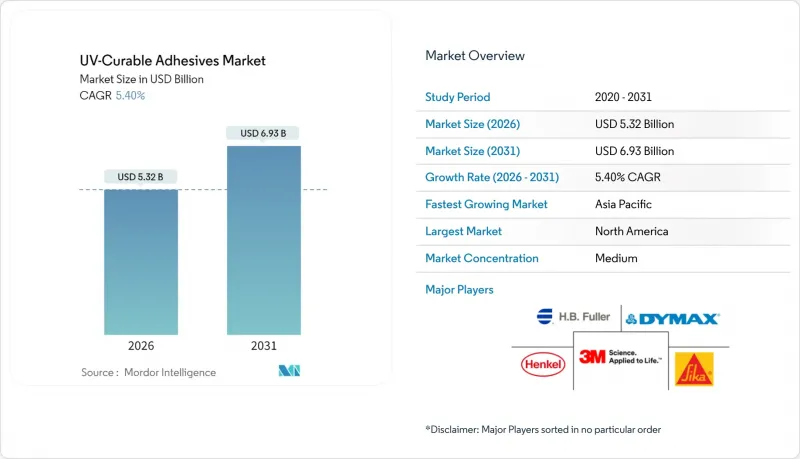
紫外光固化黏合劑市場正從利基應用發展成為各大終端應用領域(包括醫療設備、家用電子電器、汽車複合材料和包裝)不可或缺的生產投入品。這主要歸功於其即時固化的特性,無需烘箱固化,減少了揮發性有機化合物 (VOC) 的排放,並有助於實現輕量化複合材料組件。半導體規模的縮小、歐美嚴格的 VOC 法規(推動了無溶劑化學的發展)以及確保光光引發劑穩定供應的垂直整合供應鏈也促進了市場成長。北美憑藉先進的醫療設備製造技術和汽車產業對光固化結構黏合劑的早期應用,保持著技術優勢;而亞太地區則受益於半導體封裝產能的提升,正在加速成長。在這種競爭激烈的市場環境中,擁有產品創新和法規專業知識的公司,尤其是那些擁有符合 ISO 10993 和 REACH 法規的配方技術的公司,正在獲得競爭優勢。
全球紫外光固化黏合劑市場趨勢及洞察
UV固化黏合劑在汽車和航太領域的應用
隨著電動車產量的成長,汽車製造商面臨著在不發生熱變形的情況下黏合不同基材(例如鋁和碳纖維)的壓力。紫外光固化黏合劑市場提供可在數秒內完全固化並保持高搭接剪切強度的配方。 Polestar 1 和倫敦的 TX5 計程車平台已證明該方法在大規模生產中的可行性,實現了減重和車內噪音控制的雙重目標。航太生產也呈現類似的趨勢,因為紫外光固化技術縮短了高壓釜製程時間並降低了複合材料層壓板的能耗。隨著全球電池組產量的擴大,相關人員預測,到 2030 年,對耐高溫紫外固化環氧樹脂的需求將進一步成長。
更嚴格的VOC/REACH法規推動了無溶劑化學品的發展。
歐盟於2023年8月生效的二異氰酸酯含量上限(超過0.1%)迫使加工商轉向零排放解決方案,這為紫外光固化黏合劑市場帶來了即時的監管推動作用。加拿大將於2024年1月生效的VOC(揮發性有機化合物)排放上限也將反映這一趨勢,並進一步促進北美軟包裝生產線採用此技術。隨著生命週期評估指標逐漸成為採購標準,無溶劑固化技術可望獲得更優的環保認證,並提升品牌的ESG(環境、社會和治理)聲譽。漢高等主要供應商目前正在將二氧化碳回收原料製程商業化,降低成品黏合劑的碳含量。亞太地區也考慮類似的VOC指令,這有望在兩年內實現全球無溶劑標準的統一,從而加速紫外光固化技術在競爭激烈的雙組分環氧樹脂市場中的普及。
UV LED固化系統高昂的購置成本
工業LED陣列的成本在5萬至50萬美元之間。雖然大批量生產可以透過降低電力成本來收回投資,但中小企業難以獲得設備升級所需的資金籌措,從而延緩了整個生產線的改造。波長變更的製程檢驗有停機風險,而快速的技術創新週期也令人擔憂LED會在投資收回之前就被淘汰。儘管供應商正在透過租賃模式和模組化組件來應對,但全球融資仍然不平衡。歐盟和美國的能源效率補貼獎勵或許有助於彌合這一差距,但在LED得到廣泛應用之前,資本成本可能仍會繼續抑制某些黏合劑的需求。
細分市場分析
到2025年,丙烯酸類配方將佔據紫外光固化黏合劑市場47.10%的佔有率,這得益於其成熟的供應鍊和在各種基材上的廣泛適用性。丙烯酸類產品的市場規模得益於大宗商品規模的原料供應,這確保了價格穩定和全球採購。然而,預計到2031年將以5.55%的複合年成長率成長的環氧基產品,正在蠶食丙烯酸類產品在汽車結構連接和半導體底部填充等領域的市場主導地位,這些領域對高模量和耐熱循環性能的要求極高。
陽離子光引發劑的最新創新使得環氧樹脂的固化時間從幾分鐘縮短到幾秒鐘,且不影響玻璃化轉變溫度,從而提高了生產線速度。矽酮和聚氨酯在一些細分市場中仍然佔有一席之地,在這些市場中,極端溫度波動和高柔軟性比拉伸強度更為重要。在預測期內,REACH法規對某些丙烯酸酯單體的持續審查可能會降低丙烯酸樹脂的成本優勢。這可能會進一步推動特種環氧樹脂在紫外光固化黏合劑市場中進入主流應用領域。
這份紫外光固化黏合劑報告按樹脂類型(矽酮、丙烯酸酯、聚氨酯、環氧樹脂及其他樹脂類型)、終端用戶行業(醫療、電氣電子、交通運輸、包裝、家具及其他終端用戶行業)和地區(亞太地區、北美、歐洲、南美以及中東和非洲)進行細分。市場預測以美元計價。
區域分析
到2025年,北美將佔全球收入的42.80%,這主要得益於明尼蘇達州、加利福尼亞州和安大略省的原始設備製造商(OEM)採用經FDA批准的導管和診斷感測器材料,以及底特律的電動汽車工廠引入用於電池組的紫外線結構黏合劑。此外,該地區還受益於透明的監管路徑,縮短了新化學產品的上市時間,從而鼓勵供應商加強研發投入。
亞太地區預計將以5.65%的複合年成長率實現最快成長,主要得益於中國大陸、台灣和韓國半導體封裝產能的快速擴張。長虹聚合物投資16億美元的丙烯酸聯合裝置以及杜邦在新潟的光阻劑擴建項目,都為該地區的原料和先進材料生態系統提供了支撐。隨著日本和中國汽車製造商加大複合材料底盤的應用,汽車產業對高模量UV環氧樹脂的需求不斷成長,從而創造了新的市場需求。
在歐洲,由於嚴格的REACH法規淘汰了溶劑型競爭對手並增加了合規成本,導致市場平衡正在擴大。對永續性的需求推動了循環設計的應用,例如漢高塞拉尼斯公司提供的二氧化碳衍生原料以及採用Saperatec技術的黏合劑回收。中東、非洲和南美洲雖然仍處於起步階段,但食品出口所需的軟包裝產能建設正蓬勃發展,這為紫外光固化黏合劑市場帶來了額外的需求。
其他福利:
- Excel格式的市場預測(ME)表
- 3個月的分析師支持
目錄
第1章 引言
- 研究假設和市場定義
- 調查範圍
第2章調查方法
第3章執行摘要
第4章 市場情勢
- 市場概覽
- 市場促進因素
- 汽車和航太工業中的紫外光固化黏合劑
- 更嚴格的VOC/REACH法規有利於無溶劑化學品
- 家用電子電器的微型化
- 穿戴式醫療設備的快速普及
- 在線連續數位包裝印刷生產線對即時黏合的需求
- 市場限制
- UV LED固化系統高昂的購置成本
- 替代性雙組分環氧樹脂和氰基丙烯酸酯的可用性
- 關鍵光引發劑供應的不確定性
- 價值鏈分析
- 波特五力模型
- 供應商的議價能力
- 消費者議價能力
- 新進入者的威脅
- 替代品的威脅
- 競爭程度
第5章 市場規模與成長預測
- 依樹脂類型
- 矽
- 丙烯酸纖維
- 聚氨酯
- 環氧樹脂
- 其他樹脂類型
- 按最終用戶行業分類
- 醫療保健
- 電氣和電子設備
- 運輸
- 包裝
- 家具
- 其他終端用戶產業
- 按地區
- 亞太地區
- 中國
- 日本
- 韓國
- 印度
- 印尼
- 馬來西亞
- 泰國
- 越南
- 亞太其他地區
- 北美洲
- 美國
- 加拿大
- 墨西哥
- 歐洲
- 德國
- 英國
- 法國
- 義大利
- 西班牙
- 北歐國家
- 土耳其
- 俄羅斯
- 其他歐洲地區
- 南美洲
- 巴西
- 阿根廷
- 哥倫比亞
- 南美洲其他地區
- 中東和非洲
- 沙烏地阿拉伯
- 阿拉伯聯合大公國
- 卡達
- 埃及
- 奈及利亞
- 南非
- 其他中東和非洲地區
- 亞太地區
第6章 競爭情勢
- 市場集中度
- 策略趨勢
- 市佔率(%)/排名分析
- 公司簡介
- 3M
- Arkema
- artience Co., Ltd.
- AVERY DENNISON CORPORATION
- DELO Industrie Klebstoffe GmbH & Co. KGaA
- Dymax
- HB Fuller Company
- Henkel AG & Co. KGaA
- Master Bond Inc.
- Panacol-Elosol GmbH
- Parson Adhesives, Inc.
- Permabond LLC
- Sika AG
第7章 市場機會與未來展望
The UV-Curable Adhesives Market is expected to grow from USD 5.05 billion in 2025 to USD 5.32 billion in 2026 and is forecast to reach USD 6.93 billion by 2031 at 5.4% CAGR over 2026-2031.
Across every major end-use domain, such as medical devices, consumer electronics, automotive composites, and packaging, the UV-curable adhesives market is evolving from niche usage to an essential production input, primarily because instant on-demand curing eliminates oven dwell time, removes volatile organic compound emissions, and supports lightweight mixed-material assemblies. Growth momentum also benefits from semiconductor miniaturization, stricter VOC caps in Europe and North America that favor solvent-free chemistries, and vertically integrated supply chains that secure photoinitiator availability. North America keeps its technological edge through advanced medical manufacturing and early automotive adoption of light-curing structural bonds, while Asia-Pacific accelerates on the back of semiconductor packaging capacity additions. Competitive dynamics reward firms that pair product innovation with regulatory expertise, especially in formulations meeting ISO 10993 and REACH guidelines.
Global UV-Curable Adhesives Market Trends and Insights
UV-Curable Adhesives Adoption in Automotive and Aerospace
Rising electric-vehicle production pushes automakers to bond dissimilar substrates such as aluminum and carbon fiber without inducing thermal distortion, and the UV-curable adhesives market supplies formulations that fully cure in seconds while retaining high lap-shear strength. Polestar 1 and London's TX5 taxi platforms demonstrate the mass-manufacturing viability of this approach, achieving both weight reduction and cabin noise management. Aerospace production mirrors automotive trends as UV-curing shortens autoclave schedules and lowers energy consumption for composite laminates. With global battery-pack production ramping, stakeholders expect demand for high-temperature-tolerant UV-curable epoxies to intensify through 2030.
Stricter VOC/REACH Regulations Favor Solvent-Free Chemistries
The August 2023 EU restriction on diisocyanates above 0.1% content forces converters to shift toward zero-emission solutions, giving the UV-curable adhesives market an immediate regulatory tailwind. Canada's January 2024 VOC limits mirror these caps and further raise adoption in North American flexible-packaging lines. As life-cycle-assessment metrics become procurement criteria, zero-solvent curing scores superior eco-labels, and enhance brand ESG credentials. Leading suppliers like Henkel now commercialize CO2-captured raw-material routes, lowering the embedded carbon of finished adhesives. Because similar VOC directives are under review in APAC, global alignment on solvent-free standards is likely within two years, accelerating UV penetration ahead of competing two-part epoxies.
High Capital Cost of UV-LED Curing Systems
Industrial LED arrays cost USD 50,000-500,000, and although electricity savings recover cash over high-volume runs, small firms struggle to finance upgrades, slowing full-line conversions. Process re-validation for wavelength changes adds downtime risk, and fast innovation cycles create perceived obsolescence before payback concludes. Vendors respond with leasing models and modular head units, yet credit access remains uneven worldwide. Incentives linked to energy-efficiency grants in the EU and U.S. can close gaps, but until uptake broadens, equipment expense will restrain some adhesives volumes.
Other drivers and restraints analyzed in the detailed report include:
- Miniaturization in Consumer Electronics
- Rapid Uptake in Wearable Medical Devices
- Supply Volatility of Key Photoinitiators
For complete list of drivers and restraints, kindly check the Table Of Contents.
Segment Analysis
Acrylic formulations captured 47.10% of the UV-curable adhesives market share in 2025, owing to mature supply chains and multi-substrate compatibility. The UV-curable adhesives market size for acrylic grades benefits from commodity-scale raw materials that steady pricing and facilitate global sourcing. Yet epoxies, forecast to compound at 5.55% through 2031, are eroding acrylic headroom in automotive structural joints and semiconductor under-fills where high modulus and thermal cycling endurance are non-negotiable.
Recent innovations in cationic photoinitiators shorten epoxy cure from minutes to seconds without compromising glass-transition temperature, enabling high-speed line takt. Silicone and polyurethane niches persist where extreme temperature swing or high flexibility outweigh tensile strength needs. Over the forecast horizon, ongoing REACH scrutiny of certain acrylate monomers may narrow the acrylic cost advantage, potentially pushing specialty epoxies further into mainstream applications of the UV-curable adhesives market.
The UV-Curable Adhesives Report is Segmented by Resin Type (Silicon, Acrylic, Polyurethane, Epoxy, and Other Resin Types), End-User Industry (Medical, Electrical and Electronics, Transportation, Packaging, Furniture, and Other End-User Industries), and Geography (Asia-Pacific, North America, Europe, South America, and Middle-East and Africa). The Market Forecasts are Provided in Terms of Value (USD).
Geography Analysis
North America retained 42.80% of global revenue in 2025 as OEMs in Minnesota, California, and Ontario relied on FDA-cleared grades for catheters and diagnostic sensors, while Detroit electric-vehicle plants adopted UV structural bonds for battery packs. The region also benefits from transparent regulatory pathways that shorten time-to-market for new chemistries, reinforcing supplier research and development investment.
Asia-Pacific delivers the fastest 5.65% CAGR on the back of surging semiconductor packaging capacity in China, Taiwan, and South Korea. Changhong Polymer's USD 1.6 billion acrylic-acid complex and DuPont's photoresist expansion in Niigata shore up regional raw-material and advanced-material ecosystems. Automotive demand rises as Japanese and Chinese OEMs scale mixed-material chassis, creating fresh pull for high-modulus UV epoxies.
Europe's balance grows under the weight of stringent REACH rules that both eliminate solvent competitors and add compliance costs. Sustainability mandates drive the adoption of Henkel-Celanese CO2-derived feedstocks and circular designs like Saperatec-enabled adhesive recycling. Middle East and Africa and South America remain emerging but show momentum in flexible-packaging installations targeting food exports, adding incremental volume to the UV-curable adhesives market
- 3M
- Arkema
- artience Co., Ltd.
- AVERY DENNISON CORPORATION
- DELO Industrie Klebstoffe GmbH & Co. KGaA
- Dymax
- H.B. Fuller Company
- Henkel AG & Co. KGaA
- Master Bond Inc.
- Panacol-Elosol GmbH
- Parson Adhesives, Inc.
- Permabond LLC
- Sika AG
Additional Benefits:
- The market estimate (ME) sheet in Excel format
- 3 months of analyst support
TABLE OF CONTENTS
1 Introduction
- 1.1 Study Assumptions and Market Definition
- 1.2 Scope of the Study
2 Research Methodology
3 Executive Summary
4 Market Landscape
- 4.1 Market Overview
- 4.2 Market Drivers
- 4.2.1 UV-Curable Adhesives Adoption in Automotive and Aerospace
- 4.2.2 Stricter VOC/REACH Regulations Favor Solvent-Free Chemistries
- 4.2.3 Miniaturisation in Consumer Electronics
- 4.2.4 Rapid Uptake in Wearable Medical Devices
- 4.2.5 In-Line Digital Packaging Print Lines Demanding Instant Bonding
- 4.3 Market Restraints
- 4.3.1 High Capital Cost of UV-LED Curing Systems
- 4.3.2 Availability of Alternative 2-Part Epoxies and Cyanoacrylates
- 4.3.3 Supply Volatility of Key Photoinitiators
- 4.4 Value Chain Analysis
- 4.5 Porter's Five Forces
- 4.5.1 Bargaining Power of Suppliers
- 4.5.2 Bargaining Power of Consumers
- 4.5.3 Threat of New Entrants
- 4.5.4 Threat of Substitutes
- 4.5.5 Degree of Competition
5 Market Size and Growth Forecasts (Value)
- 5.1 By Resin Type
- 5.1.1 Silicon
- 5.1.2 Acrylic
- 5.1.3 Polyurethane
- 5.1.4 Epoxy
- 5.1.5 Other Resin Types
- 5.2 By End-user Industry
- 5.2.1 Medical
- 5.2.2 Electrical and Electronics
- 5.2.3 Transportation
- 5.2.4 Packaging
- 5.2.5 Furniture
- 5.2.6 Other End-user Industries
- 5.3 By Geography
- 5.3.1 Asia-Pacific
- 5.3.1.1 China
- 5.3.1.2 Japan
- 5.3.1.3 South Korea
- 5.3.1.4 India
- 5.3.1.5 Indonesia
- 5.3.1.6 Malaysia
- 5.3.1.7 Thailand
- 5.3.1.8 Vietnam
- 5.3.1.9 Rest of Asia-Pacific
- 5.3.2 North America
- 5.3.2.1 United States
- 5.3.2.2 Canada
- 5.3.2.3 Mexico
- 5.3.3 Europe
- 5.3.3.1 Germany
- 5.3.3.2 United Kingdom
- 5.3.3.3 France
- 5.3.3.4 Italy
- 5.3.3.5 Spain
- 5.3.3.6 Nordic Countries
- 5.3.3.7 Turkey
- 5.3.3.8 Russia
- 5.3.3.9 Rest of Europe
- 5.3.4 South America
- 5.3.4.1 Brazil
- 5.3.4.2 Argentina
- 5.3.4.3 Colombia
- 5.3.4.4 Rest of South America
- 5.3.5 Middle-East and Africa
- 5.3.5.1 Saudi Arabia
- 5.3.5.2 United Arab Emirates
- 5.3.5.3 Qatar
- 5.3.5.4 Egypt
- 5.3.5.5 Nigeria
- 5.3.5.6 South Africa
- 5.3.5.7 Rest of Middle-East and Africa
- 5.3.1 Asia-Pacific
6 Competitive Landscape
- 6.1 Market Concentration
- 6.2 Strategic Moves
- 6.3 Market Share (%)/Ranking Analysis
- 6.4 Company Profiles (includes Global level Overview, Market level overview, Core Segments, Financials as available, Strategic Information, Market Rank/Share, Products and Services, Recent Developments)
- 6.4.1 3M
- 6.4.2 Arkema
- 6.4.3 artience Co., Ltd.
- 6.4.4 AVERY DENNISON CORPORATION
- 6.4.5 DELO Industrie Klebstoffe GmbH & Co. KGaA
- 6.4.6 Dymax
- 6.4.7 H.B. Fuller Company
- 6.4.8 Henkel AG & Co. KGaA
- 6.4.9 Master Bond Inc.
- 6.4.10 Panacol-Elosol GmbH
- 6.4.11 Parson Adhesives, Inc.
- 6.4.12 Permabond LLC
- 6.4.13 Sika AG
7 Market Opportunities and Future Outlook
- 7.1 White-space and Unmet-Need Assessment

 UV固化黏合劑市場:依樹脂類型、配方、應用和最終用戶分類-2026-2032年全球預測
 UV黏合劑市場機會、成長要素、產業趨勢分析及2026年至2035年預測。
 2026年全球UV固化黏合劑市場報告2026年全球紫外線黏合劑市場報告
 2026-2030年全球紫外光固化黏合劑市場
 UV黏合劑市場規模、佔有率及成長分析(按產品類型、應用和地區分類)-2026-2033年產業預測
 紫外線固化膠合劑市場-全球產業規模、佔有率、趨勢、機會和預測,按樹脂類型、應用、地區和競爭情況細分,2020-2030 年
 紫外線黏合劑市場 - 預測 2025-2030
 紫外線黏合劑市場(按產品類型、應用和地區)
 UV硬化型黏劑的全球市場:樹脂類型·基材·終端用戶·不同地區的預測 (~2032年)