


 |
市場調查報告書
商品編碼
1939084
亞太地區矽砂:市佔率分析、產業趨勢與統計、成長預測(2026-2031年)Asia-Pacific Silica Sand - Market Share Analysis, Industry Trends & Statistics, Growth Forecasts (2026 - 2031) |
||||||

※ 本網頁內容可能與最新版本有所差異。詳細情況請與我們聯繫。
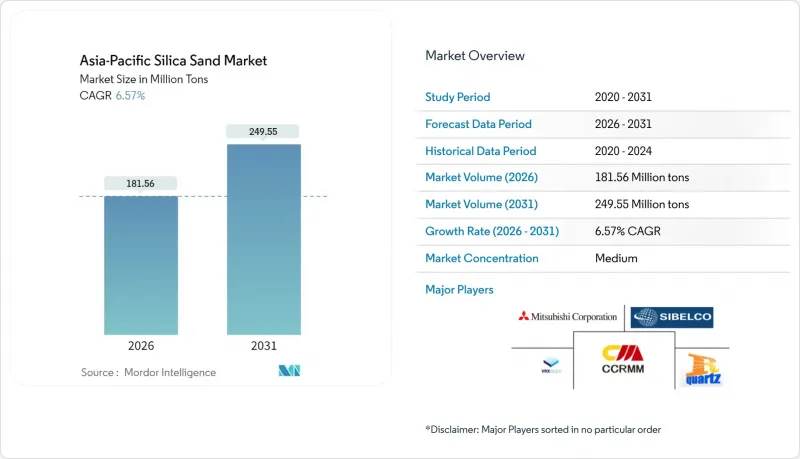
預計到 2026 年,亞太地區的矽砂市場規模將達到 1.8156 億噸。
這意味著產量將從 2025 年的 1.7037 億噸增加到 2031 年的 2.4955 億噸,2026 年至 2031 年的年複合成長率(CAGR)為 6.57%。
這項擴張得益於多種需求來源的共同支撐,包括玻璃製造、電子產品、鑄造應用和建築材料。玻璃砂仍然是關鍵產品,因為平板玻璃和玻璃容器的生產與該地區的快速都市化和汽車生產息息相關。同時,隨著半導體製造商追求3奈米以下的設計標準,超高純度石英(HPQ)正從利基市場走向主流市場。競爭日趨激烈。大規模綜合礦業公司正在加速自動化和遵守環保法規,以確保獲得高額契約,而小規模營運商則在努力應對日益嚴格的法規。中期機會集中在太陽能玻璃、先進電子產品和跨境計劃,這些項目能夠確保東南亞地區的長途供應合約。
亞太地區矽砂市場趨勢及展望
建築業主導平板玻璃和玻璃容器需求激增
預計到2026年,泰國東部經濟走廊(EEC)將推動建築業每年成長3-4%,從而提振公共工程、商業建築和住宅大樓對平板玻璃和玻璃容器的需求。玻璃製造商將矽砂視為關鍵成本,佔原料成本的60%以上,訂單積壓直接推高了砂價。去庫存化曾擠壓了2024年的利潤空間,但目前已出現逆轉,東協地區許多主要生產商報告稱,2025年的訂單有所增加。東協互聯互通計劃下的跨境基礎設施走廊正在增加從馬來西亞和澳洲到中國內陸浮法玻璃工廠的長途運輸,加劇了主要航線的運輸壓力。由於玻璃生產對經濟活動的滯後性為6-12個月,此次復甦表明,至少到2027年,生產成長空間依然充足。節能型低鐵玻璃由於能夠滿足綠建築標準中較薄的玻璃規格要求,因此價格更高。
電動車和風力發電鑄件的復興
電動車鑄造技術對熱膨脹係數的要求越來越低,迫使鑄造廠轉向使用粒徑分佈更均勻的已調整的矽砂混合物。中國的清潔能源主導預計到2024年將佔全球需求的70%,這推動了對鋁和球墨鑄鐵鑄件的需求,全部區域去年消耗了約910萬噸鑄造砂。日本和韓國憑藉其先進的鑄造設備,正向泰國和越南出口承包鑄造生產線,從而推動了當地對高品質砂的需求。這種影響也波及到風力發電機輪轂產業,該產業集中在福建省、濟州島和宿霧島,這些地區大量使用高矽砂來製造最終鑄件的機艙殼體和輪轂組件。一項到2024年投資2,350億美元的清潔能源製造業計畫正在進行中,這將推動到2030年之前對砂的需求持續成長。擁有經認證的熱衝擊性能和尺寸精度的生產商已與電池製造商和渦輪機原始設備製造商簽訂了多年供應合約。
遏制非法和無序採砂
加強執法力度減少了河砂礦床的非法開採。特別是印度,由於估計有5,200萬工人暴露於二氧化矽粉塵中,該國正在大力推動健康和安全改革。新的暴露限值(可吸收結晶質二氧化矽50微克/立方米)的實施,強制要求對設備進行升級,例如採用濕式洗滌和封閉式輸送機,這使得合規運營商的採礦成本增加了4%至6%。在中國,當局吊銷了數千份小規模採礦許可證,集中配額制度將預計2025年的供應缺口從63%縮小到4%。這些打擊行動消除了低成本競爭,收緊了區域供應,並強化了亞太地區二氧化矽砂市場對合規高成本生產的依賴。非官方現貨和合約級供應的價格波動已經加劇。
細分市場分析
到2025年,玻璃級石英砂的出貨量將佔亞太地區石英砂市場總出貨量的63.88%,凸顯其作為亞太地區石英砂市場支柱的地位。目前市佔率較小的超高純石英砂(Hyper HPQ)預計將以11.12%的複合年成長率成長,並從2026年起逐步擴大其在亞太地區石英砂市場中的佔有率。
供應穩定取決於自動化選礦生產線、光學分選和符合環保標準的清潔能源窯爐的轉型。能夠提供核能級純度認證的生產商將進入半導體供應鏈,而中型供應商則將目標瞄準太陽能和光學領域。一種混合策略正在興起,即利用日本化學浸出法對中等純度的印尼原料進行提純,這展示了一種無需新開發即可透過合作確保利潤的途徑。
亞太地區矽砂市場報告按等級(鑄造/冶煉級、玻璃級、光學玻璃級等)、終端用戶產業(玻璃製造、鑄造、化學生產、建築等)和地區(中國、印度、日本、韓國、印尼、泰國、馬來西亞、新加坡、菲律賓、越南及亞太其他地區)進行細分。市場預測以百萬噸為單位。
其他福利:
- Excel格式的市場預測(ME)表
- 3個月的分析師支持
目錄
第1章 引言
- 研究假設和市場定義
- 調查範圍
第2章調查方法
第3章執行摘要
第4章 市場情勢
- 市場概覽
- 市場促進因素
- 建築業主導平板玻璃和容器玻璃需求激增
- 由於電動車和風力發電對鑄件的需求增加,鑄造業正在復甦。
- 東協地區基礎建設投資快速成長
- 過渡到節能型低鐵太陽能玻璃
- 印尼半導體用二氧化矽下游加工
- 市場限制
- 遏制非法和無序採砂
- 無沙人造建築材料
- 政府推動小規模礦山整合(吊銷許可證)
- 價值鏈分析
- 波特五力分析
- 供應商的議價能力
- 買方的議價能力
- 新進入者的威脅
- 替代品的威脅
- 競爭程度
第5章 市場規模與成長預測
- 按年級
- 鑄造級和冶煉級
- 玻璃級砂
- 光學玻璃級
- 中級 HPQ
- 超高純度HPQ
- Hyper HPQ
- 按最終用戶行業分類
- 玻璃製造
- 鑄件
- 化學產品製造
- 建造
- 油漆和塗料
- 陶瓷和耐火材料
- 過濾
- 石油和天然氣
- 其他終端用戶產業
- 按地區
- 中國
- 印度
- 日本
- 韓國
- 印尼
- 泰國
- 馬來西亞
- 新加坡
- 菲律賓
- 越南
- 亞太其他地區
第6章 競爭情勢
- 市場集中度
- 策略性舉措(併購、合資、產能擴張)
- 市佔率(%)/排名分析
- 公司簡介
- Chongqing Changjiang River Moulding Material Group Co., Ltd.
- Covia Holdings LLC
- Diatreme Resources Limited
- Imerys
- JFE Mineral & Alloy Company,Ltd
- Mangal Minerals
- Mitsubishi Corporation
- Raghav Productivity Enhancers Limited
- Sibelco
- Tochu Corporation
- Tosoh Silica Corporation
- VRX Silica
- Xinyi Golden Ruite Quartz Materials Co., Ltd
- Xinyi Solar Holdings Limited
第7章 市場機會與未來展望
Asia-Pacific Silica Sand Market size in 2026 is estimated at 181.56 million tons, growing from 2025 value of 170.37 million tons with 2031 projections showing 249.55 million tons, growing at 6.57% CAGR over 2026-2031.
Multiple demand centers, including glass manufacturing, electronics, foundry applications, and construction materials, are converging to sustain this expansion. Glass grade sand remains the workhorse because flat and container glass output tracks the region's rapid urbanization and vehicle production. At the same time, hyper-purity quartz (HPQ) grades are transitioning from a niche toward mainstream status as semiconductor manufacturers push below the 3-nanometer design rule. Competitive intensity is rising as large, integrated miners accelerate automation and environmental compliance to lock in premium contracts while smaller operators struggle to meet tightening regulations. Mid-term opportunities cluster around solar glass, advanced electronics, and cross-border infrastructure projects that lock in long-haul supply contracts across Southeast Asia.
Asia-Pacific Silica Sand Market Trends and Insights
Construction-Led Flat and Container Glass Demand Surge
Thailand's Eastern Economic Corridor is driving 3-4% annual construction growth through 2026, lifting demand for flat and container glass across public works, commercial complexes, and residential towers. Glass manufactures treat silica sand as an essential cost component, often exceeding 60% of raw-material expenses, so rising project backlogs translate directly into higher sand uplift. Inventory corrections that hurt 2024 margins have already reversed, with most ASEAN producers reporting fuller order books for 2025 delivery. Cross-border infrastructure corridors under the ASEAN Connectivity vision are boosting long-distance shipments from Malaysia and Australia to inland Chinese float-glass lines, tightening freight capacity on favored routes. Given that glass output trails economic activity with a 6- to 12-month lag, the rebound indicates a clear volume runway through at least 2027. Energy-efficient low-iron variants secure additional premiums because they enable thinner glazing standards in green-building codes.
Foundry Revival for EV and Wind-Power Castings
Electric-vehicle casting technology increasingly specifies narrow thermal-expansion bands, pushing foundries toward calibrated silica sand blends with tighter grain-size distributions. China's clean-energy leadership, 70% of global output in 2024, created a lift in aluminum and ductile-iron casting that consumed roughly 9.1 million tons of foundry sand region-wide last year. Japan and South Korea, home to advanced molding machinery, are exporting turnkey foundry lines into Thailand and Vietnam, prompting localized demand for premium sand grades. The effect cascades through wind-turbine hubs clustered in Fujian, Jeju, and Cebu, where final-machined castings absorb high silica volumes for nacelle housings and hub assemblies. Investment pipelines worth USD 235 billion in 2024 targeted clean-energy manufacturing, signalling durable sand flows into 2030. Producers that certify thermal-shock performance and dimensional accuracy are capturing multiyear supply contracts from battery and turbine OEMs.
Illegal and Unregulated Sand Mining Curbs
Rising enforcement is shrinking unregistered output across riverine deposits, especially in India, where the estimated 52 million-worker cohort exposed to silica dust has spurred sweeping health-and-safety reforms. New exposure limits - 50 µg/m3 for respirable crystalline silica mandate capital upgrades like wet-scrubbing and enclosed conveyors, adding 4-6% to mining opex for compliant operators. In China, authorities canceled thousands of small-scale licenses, reducing projected 2025 supply gaps from 63% to 4% through centrally managed quotas. Such crackdowns eliminate low-cost competition but tighten local availability, reinforcing the Asia-Pacific silica sand market's reliance on compliant, higher-cost output. Price volatility has already widened between informal spot cargoes and contract-grade supplies.
Other drivers and restraints analyzed in the detailed report include:
- Rapid Infrastructure Spending Across ASEAN
- Indonesia's Silica Downstreaming for Semiconductors
- Substitution by Engineered, Sand-Free Building Materials
For complete list of drivers and restraints, kindly check the Table Of Contents.
Segment Analysis
The glass grade segment captured 63.88% of 2025 shipments, underscoring its role as the backbone of the Asia-Pacific silica sand market. Hyper HPQ, though only a sliver of volume today, is projected to post an 11.12% CAGR, raising its stake in the Asia-Pacific silica sand market size from 2026 onward.
Supply security hinges on automated beneficiation lines, optical sorting, and clean-energy kiln conversions that meet environmental benchmarks. Producers able to certify nuclear-level purity enter the semiconductor chain, while mid-tier suppliers target solar and optics. Blending strategies are emerging, where moderate-purity Indonesian feedstock is upgraded via Japanese chemical leaching, showing how collaboration can capture margin without greenfield development.
The Asia-Pacific Silica Sand Report is Segmented by Grade (Foundry/Smelter Grade, Glass Grade Sand, Optical Glass Grade, and More), End-User Industry (Glass Manufacturing, Foundry, Chemical Production, Construction, and More), and Geography (China, India, Japan, South Korea, Indonesia, Thailand, Malaysia, Singapore, Philippines, Vietnam, and Rest of Asia-Pacific). The Market Forecasts are Provided in Terms of Volume (Million Tons).
List of Companies Covered in this Report:
- Chongqing Changjiang River Moulding Material Group Co., Ltd.
- Covia Holdings LLC
- Diatreme Resources Limited
- Imerys
- JFE Mineral & Alloy Company,Ltd
- Mangal Minerals
- Mitsubishi Corporation
- Raghav Productivity Enhancers Limited
- Sibelco
- Tochu Corporation
- Tosoh Silica Corporation
- VRX Silica
- Xinyi Golden Ruite Quartz Materials Co., Ltd
- Xinyi Solar Holdings Limited
Additional Benefits:
- The market estimate (ME) sheet in Excel format
- 3 months of analyst support
TABLE OF CONTENTS
1 Introduction
- 1.1 Study Assumptions and Market Definition
- 1.2 Scope of the Study
2 Research Methodology
3 Executive Summary
4 Market Landscape
- 4.1 Market Overview
- 4.2 Market Drivers
- 4.2.1 Construction-led flat and container glass demand surge
- 4.2.2 Foundry revival for EV and wind-power castings
- 4.2.3 Rapid infrastructure spending across ASEAN
- 4.2.4 Shift to energy-efficient low-iron solar glass
- 4.2.5 Indonesia's silica downstreaming for semiconductors
- 4.3 Market Restraints
- 4.3.1 Illegal and unregulated sand mining curbs
- 4.3.2 Substitution by engineered, sand-free building materials
- 4.3.3 Government drive to consolidate small mines (license cancellations)
- 4.4 Value Chain Analysis
- 4.5 Porter's Five Forces Analysis
- 4.5.1 Bargaining Power of Suppliers
- 4.5.2 Bargaining Power of Buyers
- 4.5.3 Threat of New Entrants
- 4.5.4 Threat of Substitutes
- 4.5.5 Degree of Competition
5 Market Size and Growth Forecasts (Volume)
- 5.1 By Grade
- 5.1.1 Foundry/Smelter Grade
- 5.1.2 Glass Grade Sand
- 5.1.3 Optical Glass Grade
- 5.1.4 Intermediate HPQ
- 5.1.5 Ultra High HPQ
- 5.1.6 Hyper HPQ
- 5.2 By End-user Industry
- 5.2.1 Glass Manufacturing
- 5.2.2 Foundry
- 5.2.3 Chemical Production
- 5.2.4 Construction
- 5.2.5 Paints and Coatings
- 5.2.6 Ceramics and Refractories
- 5.2.7 Filtration
- 5.2.8 Oil and Gas
- 5.2.9 Other End-user Industries
- 5.3 By Geography
- 5.3.1 China
- 5.3.2 India
- 5.3.3 Japan
- 5.3.4 South Korea
- 5.3.5 Indonesia
- 5.3.6 Thailand
- 5.3.7 Malaysia
- 5.3.8 Singapore
- 5.3.9 Philippines
- 5.3.10 Vietnam
- 5.3.11 Rest of Asia-Pacific
6 Competitive Landscape
- 6.1 Market Concentration
- 6.2 Strategic Moves (Mergers and Acquisitions, JVs, Capacity Expansions)
- 6.3 Market Share (%)**/Ranking Analysis
- 6.4 Company Profiles (includes Global level Overview, Market level overview, Core Segments, Financials as available, Strategic Information, Market Rank/Share for key companies, Products and Services, and Recent Developments)
- 6.4.1 Chongqing Changjiang River Moulding Material Group Co., Ltd.
- 6.4.2 Covia Holdings LLC
- 6.4.3 Diatreme Resources Limited
- 6.4.4 Imerys
- 6.4.5 JFE Mineral & Alloy Company,Ltd
- 6.4.6 Mangal Minerals
- 6.4.7 Mitsubishi Corporation
- 6.4.8 Raghav Productivity Enhancers Limited
- 6.4.9 Sibelco
- 6.4.10 Tochu Corporation
- 6.4.11 Tosoh Silica Corporation
- 6.4.12 VRX Silica
- 6.4.13 Xinyi Golden Ruite Quartz Materials Co., Ltd
- 6.4.14 Xinyi Solar Holdings Limited
7 Market Opportunities and Future Outlook
- 7.1 White-space and Unmet-need Assessment

 矽砂:市佔率分析、產業趨勢與統計、成長預測(2026-2031)
 2026-2034年依最終用途及地區分類的矽砂市場日本矽砂市場規模、佔有率、趨勢和預測:按最終用途和地區分類,2026-2034年
 2026年全球矽砂市場報告
 全球矽砂市場按類型、純度、粒徑、應用、銷售管道和終端用戶產業分類,2026-2032年預測
 矽砂市場規模、佔有率和成長分析(按類型、粒度、純度、等級、應用和地區分類)—產業預測(2026-2033 年)
 工業矽砂:全球市佔率及排名、總收入及需求預測(2025-2031年)
 矽砂市場-全球產業規模、佔有率、趨勢、機會及預測(按等級、應用、區域及競爭細分,2020-2030 年)
 全球矽砂市場:預測(2025-2030)北美矽砂:市場佔有率分析、產業趨勢與成長預測(2025-2030 年)