


 |
市場調查報告書
商品編碼
1934893
新加坡資料中心建置:市場佔有率分析、產業趨勢與統計、成長預測(2026-2031)Singapore Data Center Construction - Market Share Analysis, Industry Trends & Statistics, Growth Forecasts (2026 - 2031) |
||||||

※ 本網頁內容可能與最新版本有所差異。詳細情況請與我們聯繫。
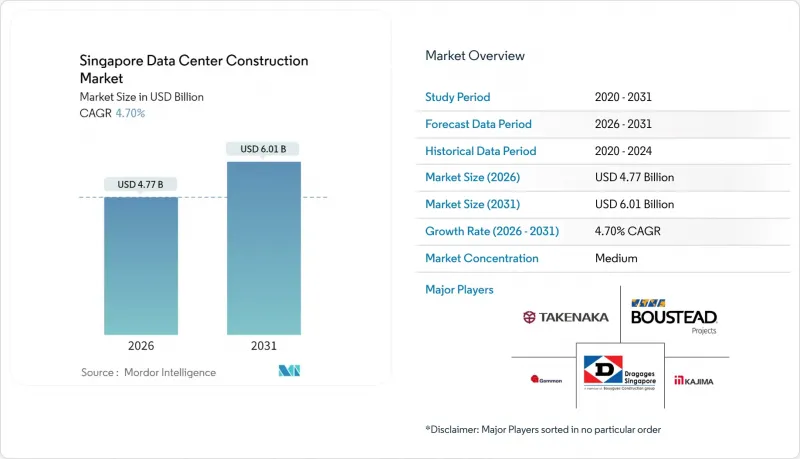
預計新加坡資料中心建設市場規模將從 2025 年的 45.6 億美元成長到 2026 年的 47.7 億美元,到 2031 年將達到 60.1 億美元,2026 年至 2031 年的複合年成長率為 4.70%。
新加坡嚴格的電力分配政策、強大的海底光纜連接以及作為金融中心的地位,為持續投資提供了支撐。然而,營運商面臨土地短缺和高昂的建設成本。綠色資料中心藍圖下不斷完善的法規正在推動設計方案實現更高的電源使用效率 (PUE),達到 1.3 或更高,這改變了競標規範和設備選擇。超大規模資料中心業者持續部署高密度 GPU 基礎設施,平均機架功耗超過 50kW,刺激了對先進開關設備、液冷技術和模組化預製件的需求。同時,連接新加坡和柔佛的雙樞紐策略透過提供過剩容量並保持核心工作負載低於 5 毫秒的延遲,緩解了當地的資源限制。投資者對資料中心房地產投資信託基金 (REITs) 的興趣支撐著健康的企劃案融資管道,幫助開發商抵消新加坡高昂的土地和人事費用。
新加坡資料中心建置市場趨勢與洞察
根據綠色直流藍圖公佈電力分配方案
新加坡修訂後的綠色資料中心藍圖承諾,在資料中心PUE值低於1.3的前提下,至少分配300兆瓦的新增IT負荷,這正推動新加坡資料中心建設市場轉型為高效節能設計。其中三分之二的配額將用於整合可再生能源和替代備用燃料的計劃,促使開發商採用氫能發電機和熱回收冷卻器。領先正在部署人工智慧驅動的冷卻控制系統,將能耗降低高達30%。有限的兆瓦電力資源競標日益激烈,帶動了對設計諮詢服務的需求,並使擁有成熟永續性經驗的公司更具優勢。中期來看,該政策將加速市場向液冷和現場太陽能+儲能混合系統的轉型。這些因素共同為新加坡資料中心建設市場的專業承包商和設備供應商拓展了潛在機會。
AI/GPU密集型工作負載的快速成長對新的建築規範提出了要求。
生成式人工智慧的浪潮正推動機架密度突破50kW,迫使新加坡資料中心建設市場轉向採用浸沒式冷卻和晶片級直接冷卻技術來冷卻機械和電氣設備。這種轉變在大型園區維修計劃中尤其明顯,這些工程正採用設定溫度為27°C的冷凍水循環系統和液冷迴路。高密度部署需要更長的佈線距離和更大的母線槽,這會增加材料成本,並將試運行時間延長15-20%。為了應對這項挑戰,開發商正在採用後門式熱交換器和中壓(22kV)配電系統來減少銅線用量。隨著人工智慧推理在金融、醫療保健和公共部門工作負載中日益普及,建設計劃擴大預留閒置頻段用於放置GPU模組。儘管國家電力供應受到限制,新加坡的資料中心建設市場仍保持著兩位數的計劃成長率。
嚴格的300兆瓦年度電力配額和暫停令的影響
新加坡的電力配額上限在暫停三年後於2024年恢復實施,但其增速落後於區域需求成長,導致許多計畫中的超大規模資料中心建設項目停滯不前。開發商被迫參與競爭性招標,而招標過程側重於電力使用效率(PUE)和碳排放強度,從而推高了前期諮詢成本。兆瓦級電力短缺促使一些營運商將部分產能轉移到巴淡島和柔佛州,限制了新加坡資料中心建設市場的收入潛力。長期不確定性也使變壓器和發電機的訂購週期更加複雜,由於全球供應限制,前置作業時間已延長。預計這些因素將共同導致預測的複合年成長率下降約1.4個百分點。
細分市場分析
到2025年,電氣設備包將佔新加坡資料中心建設市場總支出的37.38%,反映出超大規模資料中心業者資料中心營運商對22kV電源、智慧開關設備和專為50kW及以上GPU機架運作的大容量母線槽的偏好。雖然液冷仍屬於機械設備的一個子類別,但它是成長最快的組件,預計到2031年將為新加坡資料中心建設市場貢獻6.285億美元。浸沒式水箱和後門式熱交換器的應用減少了面積機架的閒置頻段,使託管業者能夠實現更高的收入密度。由於業主尋求PUE目標的承包檢驗,設計建造整合和試運行等服務的單價可能會更高。在預測期內,隨著人工智慧驅動的最佳化平台需要電力和冷卻迴路的即時遙測數據,電氣設備和控制系統的整合將進一步加深。這種組合將提升能夠透過單一合約涵蓋電氣和機械方面的公司的策略價值,從而鞏固其在新加坡資料中心建立市場的競爭優勢。
在機械設備領域,傳統冷卻器正被泵送式冷媒系統和介質浸沒式冷卻系統所取代,後者能夠為每個晶片散發1200瓦的熱量。一項聯合工程將冷卻能耗降低了29%,每個機架每年可節省約2.5萬美元,為其他業者樹立了成本節約的標竿。由於新加坡嚴格的建築規範要求採用多層外殼、抗震加強和防爆建築幕牆一般建築工程保持著穩定的貢獻。隨著高密度佈局需要更粗的光纖主幹和人工智慧最佳化的拓撲結構, IT基礎設施設施(機架、網路架構和線纜管理)的支出也不斷增加。總而言之,這些變化凸顯了隨著工作負載複雜性的增加,專業分包商在新加坡資料中心建設市場中佔據更大市場佔有率的趨勢。
到2025年,Tier III級資料中心憑藉其均衡的提案和99.982%的運轉率保證,佔據了新加坡資料中心建設市場佔有率的53.22%。企業和雲端服務供應商優先考慮可同時維護的基礎設施,這種基礎設施支援在運作中升級,無需像2N系統那樣進行重複的資本投資。然而,在金融科技、交易平台和需要99.995%可用性的主權雲端工作負載的推動下,Tier IV級資料中心正以5.03%的複合年成長率快速成長。這些高可靠性資料中心通常部署2N UPS、雙燃料機房和獨立的冷水機組,其機電設備(MEP)規模是Tier III級的兩倍,從而推動了新加坡高階資料中心建設市場規模的成長。
Iron Mountain位於新加坡的資料中心具備Tier IV級標準,設有三個地理位置分散的會議室和一個生物安全通道。 Tier I和Tier II級計劃仍在繼續,主要面向邊緣運算和通訊業者應用,但其收入貢獻仍然有限。展望未來,監管機構和客戶對資料中心彈性需求的不斷成長預計將推動Tier III級標準向Tier IV級靠攏,模糊兩者之間的界限。這將推動新加坡資料中心建設市場每兆瓦的基準支出水準上升。
其他福利:
- Excel格式的市場預測(ME)表
- 分析師支持(3個月)
目錄
第1章 引言
- 研究假設和市場定義
- 調查範圍
第2章調查方法
第3章執行摘要
第4章 市場情勢
- 市場概覽
- 市場促進因素
- 根據綠色直流藍圖(2024年起)釋放電力配額
- AI/GPU密集型工作負載的激增需要新的建築規範。
- 超大規模資料中心業者的「新加坡+柔佛」雙樞紐建設策略
- 加速主權雲端和新加坡金融管理局本地化監管
- 投資者對資料中心房地產投資信託基金(DC-REIT)轉換的興趣(吉寶資料中心、NTT資料中心REIT)
- 在土地使用限制條件下,採用模組化預製構件縮短施工時間
- 市場限制
- 更嚴格的300兆瓦年度電力配額和暫停令的遺留問題
- 亞太地區最高建設成本:1,170萬美元/兆瓦,收費系統19美分/度
- 棕地地短缺;地下/高層建築施工的可行性仍有檢驗
- 熟練機電工人短缺導致計劃工期延長
- 價值/供應鏈分析
- 監管環境
- 技術展望
- 波特五力模型
- 供應商的議價能力
- 買方的議價能力
- 新進入者的威脅
- 替代品的威脅
- 競爭對手之間的競爭
- 新加坡主要資料中心建置統計數據
- 新加坡2023年及2024年裝置容量(兆瓦)
- 新加坡在建IT總負荷(兆瓦),2025-2030年
- 在新加坡建造資料中心的平均資本支出和營運支出
- 新加坡資料中心基礎設施領域的主要資本支出者
第5章 市場規模與成長預測
- 透過基礎設施
- 電氣設備
- 配電解決方案
- 配電單元
- 開關設備
- 其他
- 備用電源解決方案
- UPS
- 發電機
- 配電解決方案
- 機械和設備
- 冷卻系統
- 液冷法
- 空氣冷卻法
- 機架和機櫃
- 其他機械和設備
- 冷卻系統
- IT基礎設施
- 伺服器
- 貯存
- 其他IT基礎設施
- 一般建築
- 服務
- 設計與諮詢
- 一體化
- 支援與維護
- 電氣設備
- 按層級標準
- 一級和二級
- 三級
- 四級
- 按最終用戶行業分類
- 銀行、金融服務和保險
- 資訊科技/通訊
- 政府/國防
- 衛生保健
- 其他最終用戶
- 依資料中心類型
- 託管設施
- 超大規模/內部建設
- 企業/邊緣/模組化
第6章 競爭情勢
- 市佔率分析
- 公司簡介
- Boustead Projects
- Dragages Singapore(Bouygues)
- Takenaka Corp.
- Gammon Pte Ltd(Balfour Beatty)
- Sato Kogyo
- Kajima Overseas Asia
- Woh Hup(Private)Ltd
- China Construction(South Pacific)Dev.
- SsangYong Engineering and Construction
- Hyundai Engineering and Construction
- Obayashi Singapore
- Lendlease Singapore
- Keppel Data Centre Development
- ST Telemedia Global DC
- Equinix Construction Services
- Digital Realty(Digital Singapore)
- AIMS APAC REIT(DC builder arm)
- NTT Global DC Singapore
- M1 Net/Keppel DC and M1 JV
- AirTrunk(Blackstone)
- EdgeConneX
- Princeton Digital Group
- Microsoft(self-build campus)
- Amazon Web Services-Construction Ops
- Google Singapore DC Projects
第7章 市場機會與未來展望
The Singapore data center construction market is expected to grow from USD 4.56 billion in 2025 to USD 4.77 billion in 2026 and is forecast to reach USD 6.01 billion by 2031 at 4.70% CAGR over 2026-2031.
Singapore's tightly managed power-allocation policy, robust subsea connectivity, and status as a financial hub anchor sustained investment even as operators confront land scarcity and high build costs. Regulatory momentum under the Green Data Centre Roadmap encourages designs that achieve Power Usage Effectiveness (PUE) of 1.3 or better, reshaping tender specifications and equipment choices. Hyperscalers continue to deploy GPU-dense infrastructure that pushes average rack power beyond 50 kW, accelerating demand for advanced switchgear, liquid cooling, and modular prefabrication. Meanwhile, the twin-hub strategy that links Singapore with Johor mitigates local constraints by allowing capacity spill-over while preserving sub-5 ms latency to core workloads. Investor appetite for data-center REITs supports a healthy project finance pipeline, helping developers offset the city-state's premium land and labor costs.
Singapore Data Center Construction Market Trends and Insights
Power-Allocation Release Under Green DC Roadmap
Singapore's revised Green Data Centre Roadmap commits at least 300 MW of new IT load on the condition that facilities demonstrate PUE of 1.3 or lower, pivoting the Singapore data center construction market toward highly efficient designs. Two-thirds of the quota rewards projects that integrate renewables or alternative backup fuels, prompting developers to specify hydrogen-ready generators and heat-recovery chillers. Early movers have implemented AI-driven cooling control to reduce energy use by up to 30%. Competitive bidding for scarce megawatts intensifies, raising design consultancy demand and favoring firms with a proven sustainability track record. Over the medium term, the policy accelerates the market's migration toward liquid cooling and on-site solar plus energy-storage hybrids. These elements together enlarge the addressable opportunity for specialist contractors and equipment vendors within the Singapore data center construction market.
Surge in AI/GPU-Dense Workloads Requiring New Build Specs
The generative-AI wave lifts rack densities above 50 kW, forcing mechanical and electrical packages in the Singapore data center construction market to pivot toward immersion and direct-to-chip cooling. A major campus upgrade showcases this shift, featuring chilled-water and liquid-cooling loops designed for 27 °C set-points. High-density deployment elongates cable runs and upsizes busways, which increases bill-of-materials value yet lengthens commissioning time by 15-20%. Developers respond by adopting rear-door heat exchangers and medium-voltage (22 kV) power distribution to reduce copper usage. As AI inferencing proliferates across finance, healthcare, and public-sector workloads, construction pipelines increasingly bundle specialized white space for GPU pods, helping the Singapore data center construction market sustain double-digit project count growth despite the national power cap.
Tight 300 MW Annual Power Quota and Moratorium Legacy
Singapore's power-allocation ceiling, reinstated in 2024 after a three-year moratorium, falls below regional demand growth, stalling many planned hyperscale builds. Developers must compete in a Call-for-Application process whose scoring heavily weights PUE and carbon intensity, inflating pre-construction consultancy fees. The scarcity of megawatts drove some operators to shift incremental capacity to Batam or Johor, dampening the full revenue potential of the Singapore data center construction market. Long-term uncertainty also complicates transformer and generator ordering cycles, with lead times already stretched by global supply constraints. Together, these factors shave an estimated 1.4 percentage points from forecast CAGR.
Other drivers and restraints analyzed in the detailed report include:
- Hyperscaler "Singapore-plus-Johor" Twin-Hub Build Strategies
- Accelerating Sovereign-Cloud and MAS FSI Localization Rules
- Highest APAC Construction Cost and Premium Power Tariffs
For complete list of drivers and restraints, kindly check the Table Of Contents.
Segment Analysis
The electrical package accounted for 37.38% of overall spend within the Singapore data center construction market in 2025, reflecting hyperscaler preference for 22 kV feeds, intelligent switchgear, and high-capacity busways designed for GPU racks running at 50 kW and above. Liquid-based cooling, though still a subset of mechanical infrastructure, is the fastest-growing line item and will contribute USD 628.5 million to the Singapore data center construction market size by 2031. Adoption of immersion tanks and rear-door heat exchangers reduces white-space real estate per rack, enabling higher revenue density for colocation operators. Services such as design-build integration and commissioning enjoy premium billing rates because owners demand turnkey validation of PUE targets. Over the forecast window, integration between electrics and controls will deepen as AI-driven optimization platforms require real-time telemetry from both power and cooling loops. This convergence elevates the strategic value of firms that can span electrical and mechanical scopes in a single contract, cementing their competitive position within the Singapore data center construction market.
The mechanical segment is evolving from traditional chillers toward pumped refrigerant and dielectric immersion systems capable of dissipating 1,200 W per chip. A joint program cut cooling energy by 29%, saving roughly USD 25,000 per rack annually and setting a cost-avoidance benchmark other operators now target. General construction remains a steady contributor driven by multi-story shells, seismic reinforcement, and blast-resistant facades required under Singapore's stringent codes. IT infrastructure-racks, network fabric, and cable management-captures incremental spend as high-density layouts demand thicker fiber trunks and AI-optimized topologies. Collectively, these shifts underscore how rising workload complexity expands wallet share for specialized subcontractors in the Singapore data center construction market.
Tier III facilities delivered 53.22% of the Singapore data center construction market share in 2025 thanks to their balanced cost-reliability proposition and 99.982% uptime guarantee. Enterprises and cloud providers value concurrently maintainable infrastructure that supports live upgrades without the doubled capex of 2N systems. Nevertheless, Tier IV pipelines are expanding at 5.03% CAGR, fueled by fintech, trading desks, and sovereign-cloud workloads that demand 99.995% availability. These fault-tolerant sites typically deploy 2N UPS, dual fuel farms, and independent chilled-water plants, doubling MEP scope relative to Tier III and lifting the Singapore data center construction market size for high-tier builds.
Iron Mountain's Singapore facility typifies Tier IV attributes with three geographically diverse meet-me-rooms and bio-protected access corridors. Although Tier I and II projects persist in edge or telco applications, their contribution to revenue remains marginal. Over time, regulatory and customer pressure for resilience is expected to pull Tier III specifications closer to Tier IV, blurring distinctions and increasing the baseline spend per megawatt across the Singapore data center construction market.
The Singapore Data Center Construction Market is Segmented by Infrastructure (Electrical Infrastructure, Mechanical Infrastructure, and More), Tier Standard (Tier I and II, Tier III, and More), Data Center Type (Colocation, Hyperscale, and More), End User Industry (Banking, Financial Services, Insurance, IT and Telecommunications, and More). The Market Forecasts are Provided in Terms of Value (USD).
List of Companies Covered in this Report:
- Boustead Projects
- Dragages Singapore (Bouygues)
- Takenaka Corp.
- Gammon Pte Ltd (Balfour Beatty)
- Sato Kogyo
- Kajima Overseas Asia
- Woh Hup (Private) Ltd
- China Construction (South Pacific) Dev.
- SsangYong Engineering and Construction
- Hyundai Engineering and Construction
- Obayashi Singapore
- Lendlease Singapore
- Keppel Data Centre Development
- ST Telemedia Global DC
- Equinix Construction Services
- Digital Realty (Digital Singapore)
- AIMS APAC REIT (DC builder arm)
- NTT Global DC Singapore
- M1 Net / Keppel DC and M1 JV
- AirTrunk (Blackstone)
- EdgeConneX
- Princeton Digital Group
- Microsoft (self-build campus)
- Amazon Web Services - Construction Ops
- Google Singapore DC Projects
Additional Benefits:
- The market estimate (ME) sheet in Excel format
- 3 months of analyst support
TABLE OF CONTENTS
1 INTRODUCTION
- 1.1 Study Assumptions and Market Definition
- 1.2 Scope of the Study
2 RESEARCH METHODOLOGY
3 EXECUTIVE SUMMARY
4 MARKET LANDSCAPE
- 4.1 Market Overview
- 4.2 Market Drivers
- 4.2.1 Power-allocation release under Green DC Roadmap (2024-)
- 4.2.2 Surge in AI / GPU-dense workloads requiring new build specs
- 4.2.3 Hyperscaler "Singapore-plus-Johor" twin-hub build strategies
- 4.2.4 Accelerating sovereign-cloud and MAS FSI localization rules
- 4.2.5 Investor appetite for DC-REIT conversions (Keppel DC, NTT DC REIT)
- 4.2.6 Modular prefabrication to compress build-times amid land caps
- 4.3 Market Restraints
- 4.3.1 Tight 300 MW annual power quota and moratorium legacy
- 4.3.2 Highest APAC construction cost US USD 11.7 m/MW and 19¢/kWh tariffs
- 4.3.3 Scarce brown-field plots; feasibility of underground / high-rise still unproven
- 4.3.4 Skilled MEP labour crunch inflating project timelines
- 4.4 Value / Supply-Chain Analysis
- 4.5 Regulatory Landscape
- 4.6 Technological Outlook
- 4.7 Porter's Five Forces
- 4.7.1 Bargaining Power of Suppliers
- 4.7.2 Bargaining Power of Buyers
- 4.7.3 Threat of New Entrants
- 4.7.4 Threat of Substitutes
- 4.7.5 Intensity of Competitive Rivalry
- 4.8 Key Singapore Data-Center Construction Statistics
- 4.8.1 Data Centers Total Installed Capacity (MW) in the Singapore , 2023 and 2024
- 4.8.2 Total IT Load Under Construction in the Singapore, MW, 2025 - 2030
- 4.8.3 Average Capex and Opex for the Singapore Data Center Construction
- 4.8.4 Top Capex Spenders on Data Center Infrastructure in the Singapore
5 MARKET SIZE AND GROWTH FORECASTS
- 5.1 By Infrastructure
- 5.1.1 Electrical Infrastructure
- 5.1.1.1 Power Distribution Solutions
- 5.1.1.1.1 Power Distribution Units
- 5.1.1.1.2 Switchgears
- 5.1.1.1.3 Others
- 5.1.1.2 Power Backup Solutions
- 5.1.1.2.1 UPS
- 5.1.1.2.2 Generators
- 5.1.1.1 Power Distribution Solutions
- 5.1.2 Mechanical Infrastructure
- 5.1.2.1 Cooling Systems
- 5.1.2.1.1 Liquid-based Cooling
- 5.1.2.1.2 Air-based Cooling
- 5.1.2.2 Racks and Cabinets
- 5.1.2.3 Other Mechanical Infrastructure
- 5.1.2.1 Cooling Systems
- 5.1.3 IT Infrastructure
- 5.1.3.1 Servers
- 5.1.3.2 Storage
- 5.1.3.3 Other IT Infrastructure
- 5.1.4 General Construction
- 5.1.5 Services
- 5.1.5.1 Design and Consulting
- 5.1.5.2 Integration
- 5.1.5.3 Support and Maintenance
- 5.1.1 Electrical Infrastructure
- 5.2 By Tier Standard
- 5.2.1 Tier I and II
- 5.2.2 Tier III
- 5.2.3 Tier IV
- 5.3 By End-User Industry
- 5.3.1 Banking, Financial Services and Insurance
- 5.3.2 IT and Telecommunications
- 5.3.3 Government and Defense
- 5.3.4 Healthcare
- 5.3.5 Other End Users
- 5.4 By Data Center Type
- 5.4.1 Colocation Facilities
- 5.4.2 Hyperscale / Self-built
- 5.4.3 Enterprise / Edge / Modular
6 COMPETITIVE LANDSCAPE
- 6.1 Market Share Analysis
- 6.2 Company Profiles (includes Global-level Overview, Market-level Overview, Core Segments, Financials as available, Strategic Information, Market Rank/Share for key companies, Products and Services, and Recent Developments)
- 6.2.1 Boustead Projects
- 6.2.2 Dragages Singapore (Bouygues)
- 6.2.3 Takenaka Corp.
- 6.2.4 Gammon Pte Ltd (Balfour Beatty)
- 6.2.5 Sato Kogyo
- 6.2.6 Kajima Overseas Asia
- 6.2.7 Woh Hup (Private) Ltd
- 6.2.8 China Construction (South Pacific) Dev.
- 6.2.9 SsangYong Engineering and Construction
- 6.2.10 Hyundai Engineering and Construction
- 6.2.11 Obayashi Singapore
- 6.2.12 Lendlease Singapore
- 6.2.13 Keppel Data Centre Development
- 6.2.14 ST Telemedia Global DC
- 6.2.15 Equinix Construction Services
- 6.2.16 Digital Realty (Digital Singapore)
- 6.2.17 AIMS APAC REIT (DC builder arm)
- 6.2.18 NTT Global DC Singapore
- 6.2.19 M1 Net / Keppel DC and M1 JV
- 6.2.20 AirTrunk (Blackstone)
- 6.2.21 EdgeConneX
- 6.2.22 Princeton Digital Group
- 6.2.23 Microsoft (self-build campus)
- 6.2.24 Amazon Web Services - Construction Ops
- 6.2.25 Google Singapore DC Projects
7 MARKET OPPORTUNITIES AND FUTURE OUTLOOK
- 7.1 White-space and Unmet-Need Assessment

 資料中心建置市場:2026-2032年全球市場預測(按資料中心類型、基礎設施組件、建置類型、等級、電力容量區域和最終用戶分類)
 印尼資料中心建置:市場佔有率分析、產業趨勢與統計及成長預測(2026-2031)資料中心建置:市場佔有率分析、產業趨勢與統計、成長預測(2026-2031)
 2026年全球資料中心建置市場報告
 全球資料中心建設市場規模、佔有率、趨勢和成長分析報告(2026-2034)
 資料中心建置市場:依層級、建設類型、企業規模、應用與地區分類北美資料中心建置:市場佔有率分析、產業趨勢與統計及成長預測(2026-2031 年)
 資料中心建置市場規模、佔有率和趨勢分析報告:按基礎設施、層級、最終用途、地區和細分市場預測(2026-2033 年)
 2026-2030年全球資料中心建置市場
 資料中心建置市場報告:按建設類型、資料中心類型、等級標準、產業垂直領域和地區分類(2026-2034 年)