


 |
市場調查報告書
商品編碼
1910908
拉丁美洲資料中心建置:市場佔有率分析、產業趨勢與統計、成長預測(2026-2031 年)Latin America Data Center Construction - Market Share Analysis, Industry Trends & Statistics, Growth Forecasts (2026 - 2031) |
||||||

※ 本網頁內容可能與最新版本有所差異。詳細情況請與我們聯繫。
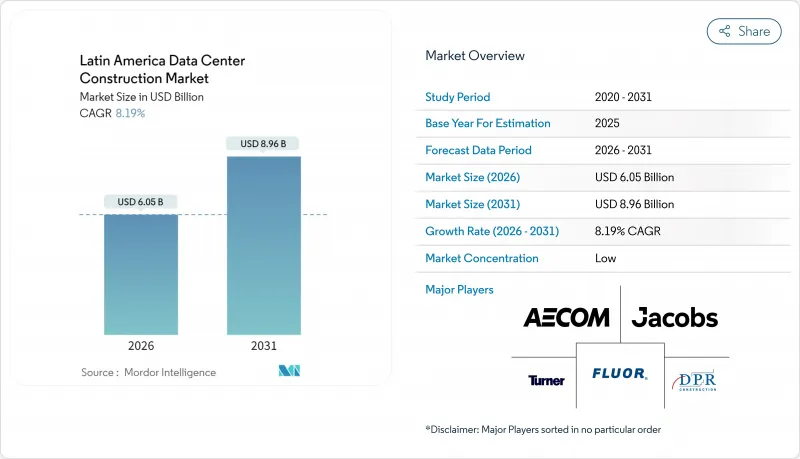
預計拉丁美洲資料中心建設市場將從 2025 年的 55.9 億美元成長到 2026 年的 60.5 億美元,到 2031 年達到 89.6 億美元,2026 年至 2031 年的複合年成長率為 8.19%。
強勁的投資趨勢主要受政府主導的雲端運算政策、美國雲端巨頭超大規模園區擴張以及人工智慧工作負載對專業化、高密度設施的需求成長所驅動。巴西將引領區域投資,預計到2024年將佔總投資的40%,而墨西哥的克雷塔羅走廊則因其接近性美國市場以及州政府的激勵措施而吸引新的資本。受熱帶氣候帶來的高冷卻需求驅動,機械設備在2024年將佔總投資的38%。同時, IT基礎設施將實現最快成長,到2030年將以8.52%的複合年成長率成長。到2024年,三級設施將佔據62%的市場佔有率,但隨著超大規模資料中心業者對穩定運行時間的需求不斷成長,四級計劃正以8.90%的複合運作穩步推進。供應鏈瓶頸和電網限制將延長計劃週期,但智利正在進行的放鬆管制以及巴西、智利和哥倫比亞豐富的可再生能源機會為良好的投資前景提供了支持。
拉丁美洲資料中心建設市場趨勢與洞察
加速雲端運算、人工智慧和巨量資料工作負載
人工智慧應用所需的功率密度是傳統運算的三到五倍,迫使營運商重新設計散熱架構和電氣佈線拓撲結構。微軟在巴西投資27億美元,Scala公司斥資500億美元打造“人工智慧之城”,都體現了新需求的規模。液冷技術正在加速普及,本地生產的Delta系統降低了ODATA站點的能耗。區域政策制定者正將人工智慧基礎設施定位為提升數位競爭力的支柱,推動加快核准流程並提供有針對性的稅收優惠。承包商報告稱,高密度機電一體化(MEP)封裝的競標激增,母線槽、泵浦和板式熱交換器的供應商也在擴大其區域生產規模。
美國雲端運算巨頭建置超大規模園區
亞馬遜網路服務 (AWS)、微軟 Azure 和谷歌雲端計畫到 2030 年在拉丁美洲投資超過 100 億美元。位於聖保羅、克雷塔羅和波哥大的千兆瓦級園區將需要冗餘的 400kV 電源、先進的消防系統和預製配電室,這將使試運行時間縮短至 12 至 18 個月。僅區域光纖聯盟 V.tal 就已撥款 10 億美元,用於在巴西提供超大規模資料中心所需的機房。這種客製化建設模式有利於那些擅長整合設計和施工的工程總承包 (EPC) 公司,隨著主要城市的電力供應日益緊張,需求正向二線都會區蔓延。
電網瓶頸和電價飆漲
在墨西哥,長達18個月的公用設施接入等待時間迫使開發商購買柴油發電設備,導致計劃資本支出增加高達25%,並推高營運成本。阿根廷的宏觀經濟波動加劇了價格風險,而聖保羅州局部電網擁塞則促使開發商將目光轉向坎皮納斯和阿雷格里港。人工智慧工作負載的增加提高了電力密度,使原本為商業辦公負載設計的電網不堪負荷。為了確保價格可預測,公用事業公司擴大簽署15年期的可再生能源購電協議(PPA),但中小企業缺乏簽訂此類協議的財力,從而減緩了中端市場對再生能源的接受度。
細分市場分析
至2025年,機械設備將佔拉丁美洲資料中心建設市場規模的37.35%。巴西、秘魯和哥倫比亞炎熱潮濕的環境要求配備強大的冷水循環系統、蒸發冷卻系統和客製化的封閉系統。電力設施內的配電盤、開關設備和UPS陣列對於滿足銀行和電信產業的運作要求至關重要。一般建築領域的主要支出用於建造堅固的殼體結構,包括抗震改造和抗颶風外牆,以保護關鍵任務機房。
IT基礎設施是成長最快的類別,複合年成長率 (CAGR) 達到 8.16%,這主要得益於對 AI 推理最佳化伺服器、NVMe 儲存陣列和 400Gbps 網路架構日益成長的需求。超大規模客戶正在將高密度機架作為標準配置,而高密度機架需要直接冷卻歧管,從而推動了對不銹鋼管道和冗餘冷卻泵的需求。諮詢、試運行和設施管理等服務透過確保合規性和最佳化 PUE 值來增加價值。由於拉丁美洲證券交易所加強了碳排放揭露標準,能源效率諮詢在拉丁美洲資料中心建設市場中的佔有率正在上升。
截至2025年,Tier III級資料中心將佔拉丁美洲資料中心建置市場的61.10%,其可用性高達99.982%,且資本支出可控。銀行、保險公司和公共雲端選擇此級別資料中心來運行能夠容忍較短維護視窗的關鍵業務工作負載,而內容傳遞網路和區域邊緣節點則通常採用Tier II級資料中心,以控制成本並接近性使用者。
預計到2031年,Tier IV級資料中心的建設將以8.55%的複合年成長率成長,這主要得益於超大規模資料中心業者和金融科技平台為滿足99.995%的服務水準保證而做出的努力。多條獨立的配電通道、高可靠性的冷卻設備以及可同時維護的發電機組會使資本預算增加高達60%,但客戶為了滿足與運作相關的收入條款,願意承擔這部分額外成本。建造者在設計階段早期就與認證機構接洽,從而避免了新進入者在後期維修時面臨的高昂成本。
拉丁美洲資料中心建設市場按基礎設施(電力基礎設施、機械基礎設施及其他)、等級標準(Tier I 和 II、Tier III 及其他)、最終用戶(銀行和金融服務、保險、IT 和電信及其他)、資料中心類型(託管、超大規模及其他)和地區(巴西、墨西哥及其他)進行細分。預測數據以美元計價。
其他福利
- Excel格式的市場預測(ME)表
- 3個月的分析師支持
目錄
第1章 引言
- 研究假設和市場定義
- 調查範圍
第2章調查方法
第3章執行摘要
第4章 市場情勢
- 市場概覽
- 市場促進因素
- 加速雲端運算、人工智慧和巨量資料工作負載
- 美國雲端運算巨頭擴建超大規模園區
- 由於5G的推廣,二線都會區對邊緣資料中心的需求不斷成長。
- 主權雲端和資料居住監管
- 可再生能源購電協議(PPA)的供應狀況
- 採用模組化和預製建築
- 市場限制
- 電網瓶頸和電價飆漲
- 三級/四級認證機電技術人員短缺
- 水資源壓力抑制了液體冷卻技術的應用。
- 環境許可核准流程漫長,並遭到當地居民的反對。
- 價值/供應鏈分析
- 監管環境
- 技術展望
- 波特五力模型
- 供應商的議價能力
- 消費者議價能力
- 新進入者的威脅
- 替代品的威脅
- 競爭對手之間的競爭
- 拉丁美洲資料中心建置關鍵統計數據
- 拉丁美洲資料中心總裝置容量(兆瓦),2023 年和 2024 年
- 2025-2030年拉丁美洲在建IT總裝置容量(兆瓦)
- 拉丁美洲資料中心建設的平均資本支出(Capex)和營運支出(Opex)
- 拉丁美洲頂尖公司正在加大對資料中心基礎設施的投資
第5章 市場規模與成長預測
- 透過基礎設施
- 透過電力基礎設施
- 配電解決方案
- 配電單元
- 開關設備
- 其他電力基礎設施
- 備用電源解決方案
- UPS
- 發電機
- 配電解決方案
- 透過機械基礎設施
- 冷卻系統
- 液冷法
- 空氣冷卻法
- 機架和機櫃
- 其他機械和設備
- 冷卻系統
- 透過IT基礎設施
- 伺服器
- 貯存
- 其他IT基礎設施
- 一般建築
- 服務
- 設計諮詢
- 一體化
- 支援與維護
- 透過電力基礎設施
- 按層級標準
- 一級和二級
- 三級
- 四級
- 按最終用戶行業分類
- 銀行、金融服務和保險
- 資訊科技/通訊
- 政府和國防機構
- 衛生保健
- 其他
- 依資料中心類型
- 託管資料中心
- 超大規模/自建資料中心
- 其他(適用於企業/邊緣運算/模組化)
- 按地區
- 巴西
- 智利
- 阿根廷
- 其他拉丁美洲
第6章 競爭情勢
- 市佔率分析
- 公司簡介
- AECOM
- Turner Construction Company
- DPR Construction
- Jacobs Solutions Inc.
- Fluor Corporation
- Skanska AB(Latin America)
- Ferrovial SA
- Grupo ACS(Dragados)
- ACCIONA Construccion
- Andrade Gutierrez Engenharia
- Camargo Correa Infra
- Novonor(Odebrecht Engenharia)
- Queiroz Galvao SA
- Techint EandC
- Sacyr Ingenieria e Infraestructuras
- Mota-Engil LATAM
- Constructora Norberto Odebrecht LatAm
- Grupo Carso Infraestructura
- COSAPI Ingenieria y Construccion
- Constructora Colpatria
- Grupo Marhnos
- Constructora Sudamericana
- Ghella SpA
- Besix Watpac
第7章 市場機會與未來展望
The Latin America Data Center Construction market is expected to grow from USD 5.59 billion in 2025 to USD 6.05 billion in 2026 and is forecast to reach USD 8.96 billion by 2031 at 8.19% CAGR over 2026-2031.
Robust investment momentum stems from sovereign-cloud mandates, hyperscale campus build-outs by United States cloud majors, and mounting artificial-intelligence workloads that require specialized, high-density facilities. Brazil leads regional spending with 40% of total 2024 investments, while Mexico's Queretaro corridor attracts fresh capital thanks to proximity to U.S. demand and state incentives. Mechanical infrastructure dominated 2024 spending at 38% because tropical heat loads elevate cooling requirements, yet IT infrastructure posts the quickest gains at an 8.52% CAGR through 2030. Tier III sites prevailed with 62% share in 2024, but Tier IV projects advance at an 8.90% CAGR as hyperscalers insist on fault-tolerant uptime. Supply-chain bottlenecks and grid constraints lengthen project cycles; however, sweeping deregulation in Chile and abundant renewable-energy opportunities across Brazil, Chile, and Colombia sustain a positive investment outlook.
Latin America Data Center Construction Market Trends and Insights
Accelerating cloud, AI and big-data workloads
Artificial-intelligence applications now demand three to five times the power density of legacy computing, compelling operators to redesign thermal architectures and electrical topologies. Microsoft's USD 2.7 billion Brazil investment and Scala's USD 50 billion AI City illustrate the scale of new requirements. Liquid-cooling adoption accelerates, with locally manufactured Delta Cube systems reducing energy usage in ODATA sites. Regional policy makers regard AI infrastructure as a pillar of digital competitiveness, prompting expedited permits and targeted tax breaks. Contractors report surging bids for high-density MEP packages, and suppliers of busway, pumps, and plate-heat exchangers scale up regional production footprints.
Hyperscale campus build-outs by U.S. cloud majors
Amazon Web Services, Microsoft Azure, and Google Cloud collectively earmark more than USD 10 billion for Latin America by 2030. Multi-gigawatt campuses in Sao Paulo, Queretaro, and Bogota require redundant 400 kV utility feeds, advanced fire suppression, and prefabricated power rooms that cut commissioning cycles to 12-18 months. Regional fiber conglomerate V.tal alone budgets USD 1 billion to deliver hyperscale-ready shells in Brazil. The build-to-suit model favors EPC firms proficient in integrated design-build, and demand spills into secondary metros as power availability tightens in first-tier cities.
Grid-power bottlenecks and surging electricity tariffs
Mexico struggles with 18-month utility-interconnection queues, pushing developers to procure diesel generation that adds up to 25% to project CAPEX and inflates operating expenses. Argentina's macro-economic volatility amplifies tariff risk, while localized transmission congestion in Sao Paulo forces developers toward Campinas and Porto Alegre. AI workloads multiply power density, stressing grids originally designed for commercial office loads. Operators increasingly sign 15-year renewable PPAs to secure predictable pricing, but smaller enterprises lack the balance-sheet to pursue such deals, slowing adoption in mid-market segments.
Other drivers and restraints analyzed in the detailed report include:
- 5G-driven edge-DC demand in secondary LATAM metros
- Sovereign-cloud and data-residency regulations
- Scarcity of Tier-III/IV-certified MEP labor
For complete list of drivers and restraints, kindly check the Table Of Contents.
Segment Analysis
Mechanical infrastructure contributed 37.35% to the Latin America Data Center Construction market size in 2025, as hot-humid conditions across Brazil, Peru, and Colombia require robust chilled-water loops, evaporative cooling, and custom containment systems. Power distribution units, switchgear, and UPS arrays within electrical infrastructure stay essential for banking and telecom uptime mandates. General construction captures resilient shell-and-core outlays, including seismic bracing and hurricane-rated envelopes that safeguard mission-critical halls.
IT infrastructure is the fastest-growing category with an 8.16% CAGR, driven by servers optimized for AI inference, NVMe storage arrays, and 400 Gbps networking fabric. Hyperscale clients standardize on high-density racks requiring direct-to-chip liquid manifolds, which boosts demand for stainless-steel piping and redundant coolant pumps. Services such as consulting, commissioning, and facility management add value by ensuring regulation compliance and PUE optimization. The Latin America Data Center Construction market share within energy-efficiency consulting rises as carbon disclosure norms tighten in stock exchanges across the region.
Tier III sites held 61.10% of the Latin America Data Center Construction market share in 2025, balancing 99.982% availability against manageable capex. Banks, insurers, and public clouds select this level for core workloads that tolerate brief maintenance windows. Conversely, content-delivery networks and regional edge nodes often deploy Tier II to limit cost while placing nodes closer to users.
Tier IV construction will grow 8.55% CAGR through 2031 on the back of hyperscalers and fintech platforms seeking 99.995% service-level commitments. Multiple independent distribution paths, fault-tolerant chillers, and concurrently maintainable generators inflate capital budgets by up to 60%, yet clients accept the premium to satisfy uptime-linked revenue clauses. Builders partner with certification bodies early in design to avoid late-stage retrofit costs that have plagued first-time entrants.
The Latin America Data Center Construction Market is Segmented by Infrastructure (Electrical Infrastructure, Mechanical Infrastructure, and More), Tier Standard (Tier I and II, Tier III, and More), End User (Banking Financial Services & Insurance, IT & Telecommunications, and More), Data Center Type (Colocation, Hyperscale, and More), and Geography (Brazil, Mexico, and More). Forecasts are in USD.
List of Companies Covered in this Report:
- AECOM
- Turner Construction Company
- DPR Construction
- Jacobs Solutions Inc.
- Fluor Corporation
- Skanska AB (Latin America)
- Ferrovial S.A.
- Grupo ACS (Dragados)
- ACCIONA Construccion
- Andrade Gutierrez Engenharia
- Camargo Correa Infra
- Novonor (Odebrecht Engenharia)
- Queiroz Galvao S.A.
- Techint EandC
- Sacyr Ingenieria e Infraestructuras
- Mota-Engil LATAM
- Constructora Norberto Odebrecht LatAm
- Grupo Carso Infraestructura
- COSAPI Ingenieria y Construccion
- Constructora Colpatria
- Grupo Marhnos
- Constructora Sudamericana
- Ghella S.p.A.
- Besix Watpac
Additional Benefits:
- The market estimate (ME) sheet in Excel format
- 3 months of analyst support
TABLE OF CONTENTS
1 INTRODUCTION
- 1.1 Study Assumptions and Market Definition
- 1.2 Scope of the Study
2 RESEARCH METHODOLOGY
3 EXECUTIVE SUMMARY
4 MARKET LANDSCAPE
- 4.1 Market Overview
- 4.2 Market Drivers
- 4.2.1 Accelerating cloud, AI and big-data workloads
- 4.2.2 Hyperscale campus build-outs by US cloud majors
- 4.2.3 5G-driven edge-DC demand in secondary LATAM metros
- 4.2.4 Sovereign-cloud and data-residency regulations
- 4.2.5 Power-purchase-agreement (PPA) availability for renewables
- 4.2.6 Modular and prefabricated construction adoption
- 4.3 Market Restraints
- 4.3.1 Grid-power bottlenecks and surging electricity tariffs
- 4.3.2 Scarcity of Tier-III/IV-certified MEP labour
- 4.3.3 Water-stress curbing liquid-cooling deployments
- 4.3.4 Lengthy environmental licensing and community opposition
- 4.4 Value / Supply-Chain Analysis
- 4.5 Regulatory Landscape
- 4.6 Technological Outlook
- 4.7 Porter's Five Forces
- 4.7.1 Bargaining Power of Suppliers
- 4.7.2 Bargaining Power of Consumers
- 4.7.3 Threat of New Entrants
- 4.7.4 Threat of Substitutes
- 4.7.5 Intensity of Competitive Rivalry
- 4.8 Key Latin America Data Center Construction Statistics
- 4.8.1 Data Centers Total Installed Capacity (MW) in the Latin America, 2023 and 2024
- 4.8.2 Total IT Load Under Construction in the Latin America, MW, 2025 - 2030
- 4.8.3 Average Capex and Opex for the Latin America Data Center Construction
- 4.8.4 Top Capex Spenders on Data Center Infrastructure in Latin America
5 MARKET SIZE AND GROWTH FORECASTS
- 5.1 By Infrastructure
- 5.1.1 By Electrical Infrastructure
- 5.1.1.1 Power Distribution Solutions
- 5.1.1.1.1 Power Distribution Unit
- 5.1.1.1.2 Switchgears
- 5.1.1.1.3 Others Electrical Infrastructure
- 5.1.1.2 Power Backup Solutions
- 5.1.1.2.1 UPS
- 5.1.1.2.2 Generators
- 5.1.1.1 Power Distribution Solutions
- 5.1.2 By Mechanical Infrastructure
- 5.1.2.1 Cooling Systems
- 5.1.2.1.1 Liquid-based Cooling
- 5.1.2.1.2 Air-based Cooling
- 5.1.2.2 Racks and Cabinets
- 5.1.2.3 Other Mechanical Infrastructure
- 5.1.2.1 Cooling Systems
- 5.1.3 By IT Infrastructure
- 5.1.3.1 Servers
- 5.1.3.2 Storage
- 5.1.3.3 Other IT Infrastructure
- 5.1.4 General Construction
- 5.1.5 Services
- 5.1.5.1 Design and Consulting
- 5.1.5.2 Integration
- 5.1.5.3 Support and Maintenance
- 5.1.1 By Electrical Infrastructure
- 5.2 By Tier Standard
- 5.2.1 Tier I and II
- 5.2.2 Tier III
- 5.2.3 Tier IV
- 5.3 By End-User Industry
- 5.3.1 Banking, Financial Services and Insurance
- 5.3.2 IT and Telecommunications
- 5.3.3 Government and Defense
- 5.3.4 Healthcare
- 5.3.5 Other End Users
- 5.4 By Data Center Type
- 5.4.1 Colocation Data Centers
- 5.4.2 Hyperscale / Self-built Data Centers
- 5.4.3 Others (Enterprise / Edge / Modular)
- 5.5 By Geography
- 5.5.1 Brazil
- 5.5.2 Chile
- 5.5.3 Argentina
- 5.5.4 Rest of Latin America
6 COMPETITIVE LANDSCAPE
- 6.1 Market Share Analysis
- 6.2 Company Profiles (includes Global-level Overview, Market-level Overview, Core Segments, Financials as available, Strategic Information, Market Rank/Share for key companies, Products and Services, and Recent Developments)
- 6.2.1 AECOM
- 6.2.2 Turner Construction Company
- 6.2.3 DPR Construction
- 6.2.4 Jacobs Solutions Inc.
- 6.2.5 Fluor Corporation
- 6.2.6 Skanska AB (Latin America)
- 6.2.7 Ferrovial S.A.
- 6.2.8 Grupo ACS (Dragados)
- 6.2.9 ACCIONA Construccion
- 6.2.10 Andrade Gutierrez Engenharia
- 6.2.11 Camargo Correa Infra
- 6.2.12 Novonor (Odebrecht Engenharia)
- 6.2.13 Queiroz Galvao S.A.
- 6.2.14 Techint EandC
- 6.2.15 Sacyr Ingenieria e Infraestructuras
- 6.2.16 Mota-Engil LATAM
- 6.2.17 Constructora Norberto Odebrecht LatAm
- 6.2.18 Grupo Carso Infraestructura
- 6.2.19 COSAPI Ingenieria y Construccion
- 6.2.20 Constructora Colpatria
- 6.2.21 Grupo Marhnos
- 6.2.22 Constructora Sudamericana
- 6.2.23 Ghella S.p.A.
- 6.2.24 Besix Watpac
7 MARKET OPPORTUNITIES AND FUTURE OUTLOOK
- 7.1 White-space and Unmet-Need Assessment

 資料中心建商市場分析及預測(至2035年):類型、產品、服務、技術、組件、應用、材料類型、部署模式、最終用戶、設備
 資料中心建置市場:2026-2032年全球市場預測(按資料中心類型、基礎設施組件、建置類型、等級、電力容量區域和最終用戶分類)資料中心建設市場分析及預測(至2035年):依類型、產品類型、服務、最終用戶、設備、基礎設施及層級細分
 印尼資料中心建置:市場佔有率分析、產業趨勢與統計及成長預測(2026-2031)資料中心建置:市場佔有率分析、產業趨勢與統計、成長預測(2026-2031)
 2026年全球資料中心建置市場報告
 全球資料中心建設市場規模、佔有率、趨勢和成長分析報告(2026-2034)
 資料中心建置市場:依層級、建設類型、企業規模、應用與地區分類北美資料中心建置:市場佔有率分析、產業趨勢與統計及成長預測(2026-2031 年)
 資料中心建置市場規模、佔有率和趨勢分析報告:按基礎設施、層級、最終用途、地區和細分市場預測(2026-2033 年)