


 |
市場調查報告書
商品編碼
1934730
歐洲豪華車市場-佔有率分析、產業趨勢、統計和成長預測(2026-2031)Europe Luxury Car - Market Share Analysis, Industry Trends & Statistics, Growth Forecasts (2026 - 2031) |
||||||

※ 本網頁內容可能與最新版本有所差異。詳細情況請與我們聯繫。
2025年歐洲豪華車市場價值1,702.1億美元,預計到2031年將達到2,231.7億美元,高於2026年的1,780.6億美元。
預計在預測期(2026-2031 年)內,複合年成長率將達到 4.61%。
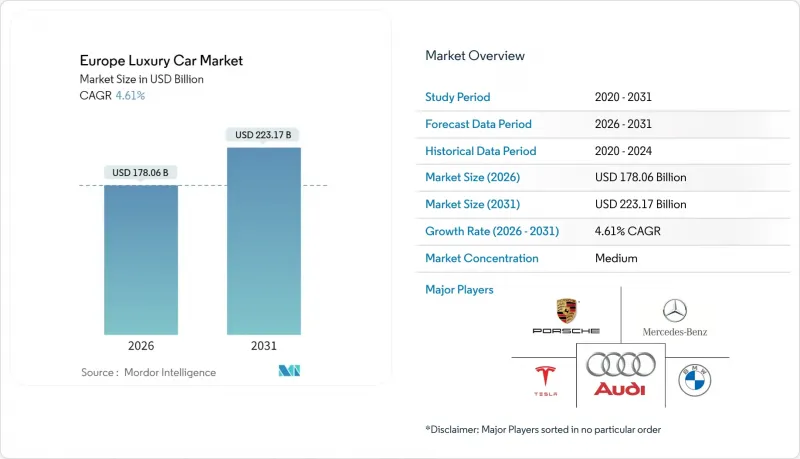
需求韌性歸功於富裕家庭持續的資產累積、老牌製造商強大的品牌資產,以及加速推廣電動車款的扶持性政策框架。運動型多用途車(SUV)依然擁有最大的基本客群,但人們對小轎車和敞篷車的興趣日益濃厚,預示著對體驗式駕駛的新需求。儘管向純電動動力傳動系統的轉型正在加速,但內燃機汽車仍佔據市場主導地位,迫使製造商在規模經濟和監管合規之間尋求平衡。訂閱和其他靈活的出行模式成長最為迅速,反映了消費者出行方式向服務型出行方式的轉變,並創造了與車載數位化功能相關的新收入來源。
歐洲豪華車市場趨勢與洞察
超高淨值人士(UHNWI)和高淨值人士(HNWI)的數量不斷成長
歐洲富裕階層持續累積金融資產,支撐著不斷成長的潛在豪華車買家群體。儘管宏觀經濟不確定性日益加劇,但財富調查證實,超級富豪階級(UHNWI)的數量穩步成長,尤其是在瑞士和德國。這些消費者對專屬客製化、最尖端科技和品牌傳承的追求,即使在大眾市場疲軟的情況下,也支撐著市場需求。由於這一消費群體偏好客製化配置,製造商得以享受更高的毛利率。隨著經濟實力日益集中於高收入群體,高購買力使高階汽車製造商免受週期性經濟衰退的影響,並增強了其定價權。
豪華車領域的快速電氣化
將於2026年11月生效的歐盟7排放氣體標準將迫使汽車製造商逐步淘汰高排放引擎,並加速推廣純電動車(BEV)。豪華車客戶通常是先進技術的早期使用者,只要性能標準得到滿足,他們越來越願意駕駛電動車。汽車製造商正在大力投資於專用電動車平台、固態電池研發以及全歐洲範圍內的充電基礎設施合作。監管政策的利好,加上各地零排放區政策的實施,正推動著展示室中電動車的比例不斷成長。從長遠來看,電氣化有望重塑競爭格局,使那些掌控電池供應鏈和軟體定義架構的公司佔優勢。
宏觀經濟不確定性與通貨膨脹
持續的通貨膨脹會削弱實際購買力,而地緣政治緊張局勢和供應鏈中斷則會動搖消費者信心。景氣衰退風險和股市動盪的消息甚至會讓高所得家庭推遲非必要支出。製造商還面臨從電池礦物到半導體等不斷上漲的投入成本,這將擠壓利潤空間或迫使他們調整售價。在貨幣政策穩定、通膨預期穩定之前,豪華車的需求可能仍將呈現季度間波動。
細分市場分析
到2025年,SUV將佔據歐洲豪華車市場52.05%的佔有率,這反映出其憑藉較高的駕駛位置、靈活的載物空間和全天候的可靠性,持續受到富裕家庭和高管的青睞。儘管銷量有所下降,但受休閒旅行復甦和消費者對激情駕駛體驗需求成長的推動,預計到2031年,小轎車和敞篷車的年複合成長率將達到6.09%。這些極具個性的細分市場的成長表明,高階市場的需求既注重實用性,也注重生活方式的表達。製造商正在拓展產品線,將旗艦SUV與限量版運動車型結合,以增強品牌吸引力。在高階轎小轎車中首次亮相的設計元素和技術經常被應用於銷售量較高的跨界車,從而提升產品陣容的一致性並保持定價優勢。
儘管轎車仍然是豪華車的經典之選,但隨著消費者轉向更實用的運動型多用途車(SUV),轎車的市場佔有率正逐漸受到擠壓。汽車製造商透過在轎車中引入先進的駕駛輔助系統和身臨其境型資訊娛樂系統來維持其市場地位。多用途車(MPV)仍然是一個小眾市場,主要限於大都會圈的專車服務,在這些地區,車內空間比外觀更為重要。掀背車雖然在其細分市場中並不常見,但在停車位有限的擁擠都市區卻找到了自己的市場定位。車型多樣化使歐洲豪華車市場能夠滿足不同的生活方式需求,同時透過差異化的車身造型來維持利潤率。
目前,內燃機汽車的出貨量佔比高達75.62%,反映了現有產能的慣性和消費者對其的熟悉程度。然而,隨著基礎設施的不斷改善和監管期限的臨近,電池式電動車的年複合成長率預計到2031年將達到9.87%。插電混合動力汽車作為一種過渡技術,為消費者提供了一種無需擔心里程的純電動駕駛模式,這對於長途通勤者來說尤其重要。汽車製造商正在透過開發多能源平台來分散研發成本,從而降低投資風險,這些平台可以將研發成本分攤到汽油、混合動力汽車和純電動車的各種車型上。
純電動車在歐洲豪華車市場的佔有率逐年成長,這主要得益於高功率充電網路的普及以及高階品牌推出續航里程高達600公里的GT跑車。透過軟體調校的底盤配置,旗艦電動車能夠複製以往只有V8引擎才能實現的動態特性。然而,仍有一部分車迷珍惜高性能動力傳動系統帶來的聲浪和觸感回饋,這確保了在排放氣體法規全面實施之前,兩者能夠長期共存。這種雙軌策略使得製造商能夠在投資下一代電池技術的同時,保留內燃機資產的攤銷期。
其他福利:
- Excel格式的市場預測(ME)表
- 分析師支持(3個月)
目錄
第1章 引言
- 研究假設和市場定義
- 調查範圍
第2章調查方法
第3章執行摘要
第4章 市場情勢
- 市場概覽
- 市場促進因素
- 超高淨值人士 (UHNWIS) 和高淨值人士 (HNWIS) 人口成長
- 豪華車領域的快速電氣化
- 車載數位化體驗的需求
- 某些市場提供電動車購買獎勵
- 聯網汽車數據流貨幣化
- 訂閱模式與產權模式
- 市場限制
- 採購成本上升和信貸緊縮
- 宏觀經濟不確定性與通貨膨脹
- 豪華電動車殘值波動
- 標靶化碳強度稅
- 價值/供應鏈分析
- 監管環境
- 技術展望
- 波特五力模型
- 新進入者的威脅
- 買方和消費者的議價能力
- 供應商的議價能力
- 替代品的威脅
- 競爭對手之間的競爭
第5章 市場規模及成長預測(價值(美元)及銷售量(單位))
- 按車輛類型
- 掀背車
- 轎車
- 運動型多用途車(SUV)
- 多用途汽車(MPV)
- 小轎車與敞篷車
- 依動力傳動系統類型
- 內燃機
- 混合動力電動車(HEV)
- 插電式混合動力電動車(PHEV)
- 電池式電動車(BEV)
- 按價格範圍
- 45,000 美元至 100,000 美元
- 100,001美元至200,000美元
- 超過20萬美元
- 依所有權類型
- 大量購買
- 融資/租賃
- 訂閱
- 公寓和俱樂部所有權
- 按國家/地區
- 德國
- 英國
- 法國
- 義大利
- 西班牙
- 荷蘭
- 瑞典
- 丹麥
- 比利時
- 瑞士
- 奧地利
- 挪威
- 俄羅斯
- 其他歐洲地區
第6章 競爭情勢
- 市場集中度
- 策略趨勢
- 市佔率分析
- 公司簡介
- Mercedes-Benz Group AG
- BMW AG
- Audi AG
- Porsche AG
- Tesla Inc.
- Volvo Car AB
- Jaguar Land Rover Automotive plc
- Bentley Motors Ltd
- Rolls-Royce Motor Cars Ltd
- Aston Martin Lagonda Global Holdings plc
- Ferrari NV
- Automobili Lamborghini SpA
- Maserati SpA
- Lucid Group Inc.
- Polestar Automotive Holding UK plc
- Genesis Motor Europe(Hyundai)
- Rivian Automotive Inc.
- BYD Auto Co., Ltd.
第7章 市場機會與未來展望
The European luxury car market was valued at USD 170.21 billion in 2025 and estimated to grow from USD 178.06 billion in 2026 to reach USD 223.17 billion by 2031, at a CAGR of 4.61% during the forecast period (2026-2031).
Demand resilience stems from sustained wealth creation among affluent households, robust brand equity built by long-established manufacturers, and supportive policy frameworks accelerating electrified model launches. Sport utility vehicles (SUVs) continue to draw the largest customer base, while rising interest in coupe and convertible body styles reveals a renewed appetite for experiential driving. The transition toward battery-electric powertrains is gaining momentum, yet internal-combustion vehicles still dominate volumes, forcing producers to balance scale economics with regulatory compliance. Subscription and other flexible access models are expanding fastest, reflecting a generational shift toward service-based mobility and creating fresh revenue avenues tied to in-car digital features.
Europe Luxury Car Market Trends and Insights
Rising Population of UHNWIs and HNWIs
Affluent Europeans continue to accumulate financial assets, underpinning the addressable pool of potential luxury-car buyers. Despite broader macroeconomic uncertainty, wealth surveys show steady growth in ultra-high-net-worth cohorts, especially in Switzerland and Germany. These consumers seek exclusive personalization, state-of-the-art technology, and branded heritage, reinforcing demand even when mass-market segments soften. Manufacturers benefit from higher gross margins on bespoke trims that this clientele favors. As economic power concentrates further in the top income brackets, the purchasing buffer shields premium automakers from cyclical downturns and supports pricing power.
Rapid Electrification of Luxury Segment
Euro 7 emissions limits, effective in November 2026, compel producers to phase out high-emitting engines and accelerate battery-electric launches. Luxury customers, often early adopters of advanced technology, are increasingly open to driving electric vehicles, provided performance benchmarks remain intact. Carmakers invest heavily in dedicated EV platforms, solid-state battery research, and pan-European charging alliances. The regulatory tailwind combines with municipal zero-emission zones to elevate electric models within showroom mixes. Over time, electrification is expected to reshape the competitive hierarchy by rewarding firms that master battery supply chains and software-defined architectures.
Macroeconomic Uncertainty and Inflation
Persistent inflation erodes real purchasing power, while geopolitical tensions and supply-chain disruptions unsettle consumer sentiment. Even high-income households delay discretionary outlays when headlines signal recession risk or stock-market turbulence. Manufacturers also contend with higher input costs-ranging from battery minerals to semiconductors-that squeeze margins or require sticker-price adjustments. Premium car demand may progress unevenly across quarters until monetary policy stabilizes and inflation expectations anchor.
Other drivers and restraints analyzed in the detailed report include:
- Digitally Enabled In-Car Experience Demand
- Micro-Market-Specific BEV Purchase Incentives
- Luxury-EV Residual-Value Volatility
For complete list of drivers and restraints, kindly check the Table Of Contents.
Segment Analysis
SUVs represented 52.05% of the European luxury car market share in 2025, reflecting an enduring appeal for elevated seating, flexible cargo capacity, and all-weather confidence that resonates with affluent families and executives. Coupe and convertible nameplates, although smaller in volume, are enrolling a 6.09% CAGR to 2031 as leisure travel rebounds and consumers seek more emotive driving experiences. Growth in these expressive segments underscores that demand at the top encompasses practicality and lifestyle identity. Manufacturers expand portfolio breadth, pairing flagship SUVs with limited-run sports models that reinforce brand desirability. Design cues and technology debuted on halo coupes frequently cascade to high-volume crossovers, strengthening coherence across lineups and sustaining pricing power.
The sedan's archetypal luxury status endures yet faces incremental share pressure as buyers migrate toward sport-utility practicality. Automakers respond by injecting sedans with advanced driver assistance and immersive infotainment to preserve relevance. Multi-purpose vehicles remain a niche, mostly confined to chauffeur-driven use in select metropolitan areas where interior space overrides exterior presence. Although uncommon in this echelon, Hatchbacks find pockets of demand in congested cities that restrict parking footprints. Vehicle-type diversification ensures that the European luxury car market meets heterogeneous lifestyle needs while safeguarding margins through differentiated body styles.
Internal-combustion engines account for 75.62% of deliveries today, illustrating the inertia of legacy production capacity and consumer familiarity. However, battery-electric vehicles are pacing at a 9.87% CAGR through 2031 as infrastructure expands and regulatory deadlines near. Plug-in hybrids serve as a bridge technology, giving buyers an electric driving mode without range anxiety-especially valuable for rural long-distance commuters. Automakers hedge investments by deriving multi-energy platforms that spread R&D costs across gasoline, hybrid, and full-electric variants.
The European luxury car market size attributable to BEVs grows each year as high-capacity charging corridors become ubiquitous and luxury marques introduce grand-touring EVs boasting 600 km real-world range. Software-adjustable chassis settings allow electric flagships to replicate the dynamic character traditionally delivered by bespoke V-8 engines. Nevertheless, some connoisseurs still cherish the aural and tactile feedback of performance combustion powertrains, ensuring a prolonged coexistence until emission bans fully materialize. This twin-track strategy affords manufacturers time to amortize ICE assets while funding next-generation battery programs.
The European Luxury Car Market Report is Segmented by Vehicle Type (Hatchback, Sedan, and More), Powertrain Type (ICE, and More), Price Range (USD 45, 000-100, 000, USD 100, 001-200, 000, and Above USD 200, 000), Ownership Model (Outright Purchase, Finance/Lease, and More), and Country. The Market Forecasts are Provided in Terms of Value (USD) and Volume (Units).
List of Companies Covered in this Report:
- Mercedes-Benz Group AG
- BMW AG
- Audi AG
- Porsche AG
- Tesla Inc.
- Volvo Car AB
- Jaguar Land Rover Automotive plc
- Bentley Motors Ltd
- Rolls-Royce Motor Cars Ltd
- Aston Martin Lagonda Global Holdings plc
- Ferrari N.V.
- Automobili Lamborghini S.p.A.
- Maserati S.p.A.
- Lucid Group Inc.
- Polestar Automotive Holding UK plc
- Genesis Motor Europe (Hyundai)
- Rivian Automotive Inc.
- BYD Auto Co., Ltd.
Additional Benefits:
- The market estimate (ME) sheet in Excel format
- 3 months of analyst support
TABLE OF CONTENTS
1 Introduction
- 1.1 Study Assumptions and Market Definition
- 1.2 Scope of the Study
2 Research Methodology
3 Executive Summary
4 Market Landscape
- 4.1 Market Overview
- 4.2 Market Drivers
- 4.2.1 Rising Population of UHNWIS and HNWIS
- 4.2.2 Rapid Electrification of Luxury Segment
- 4.2.3 Digitally Enabled In-Car Experience Demand
- 4.2.4 Micro market-Specific BEV Purchase Incentives
- 4.2.5 Monetization of Connected-Vehicle Data Streams
- 4.2.6 Subscription and Fractional-Ownership Models
- 4.3 Market Restraints
- 4.3.1 High Purchase Cost and Tightening Credit
- 4.3.2 Macroeconomic Uncertainty and Inflation
- 4.3.3 Luxury-EV Residual-Value Volatility
- 4.3.4 Carbon-Intensity Taxes Targeting
- 4.4 Value / Supply-Chain Analysis
- 4.5 Regulatory Landscape
- 4.6 Technological Outlook
- 4.7 Porter's Five Forces
- 4.7.1 Threat of New Entrants
- 4.7.2 Bargaining Power of Buyers/Consumers
- 4.7.3 Bargaining Power of Suppliers
- 4.7.4 Threat of Substitute Products
- 4.7.5 Intensity of Competitive Rivalry
5 Market Size and Growth Forecasts (Value (USD) and Volume (Units))
- 5.1 By Vehicle Type
- 5.1.1 Hatchback
- 5.1.2 Sedan
- 5.1.3 Sport Utility Vehicle (SUV)
- 5.1.4 Multi-purpose Vehicle (MPV)
- 5.1.5 Coupe and Convertible
- 5.2 By Powertrain Type
- 5.2.1 Internal-Combustion Engine
- 5.2.2 Hybrid Electric Vehicle (HEV)
- 5.2.3 Plug-in Hybrid Electric Vehicle (PHEV)
- 5.2.4 Battery Electric Vehicle (BEV)
- 5.3 By Price Range
- 5.3.1 USD 45,000 - USD 100,000
- 5.3.2 USD 100,001 - USD 200,000
- 5.3.3 Above USD 200,000
- 5.4 By Ownership Model
- 5.4.1 Outright Purchase
- 5.4.2 Finance/Lease
- 5.4.3 Subscription
- 5.4.4 Fractional and Club Ownership
- 5.5 By Country
- 5.5.1 Germany
- 5.5.2 United Kingdom
- 5.5.3 France
- 5.5.4 Italy
- 5.5.5 Spain
- 5.5.6 Netherlands
- 5.5.7 Sweden
- 5.5.8 Denmark
- 5.5.9 Belgium
- 5.5.10 Switzerland
- 5.5.11 Austria
- 5.5.12 Norway
- 5.5.13 Russia
- 5.5.14 Rest of Europe
6 Competitive Landscape
- 6.1 Market Concentration
- 6.2 Strategic Moves
- 6.3 Market Share Analysis
- 6.4 Company Profiles (Includes Global Level Overview, Market Level Overview, Core Segments, Financials as Available, Strategic Information, Market Rank/Share for Key Companies, Products & Services, and Recent Developments)
- 6.4.1 Mercedes-Benz Group AG
- 6.4.2 BMW AG
- 6.4.3 Audi AG
- 6.4.4 Porsche AG
- 6.4.5 Tesla Inc.
- 6.4.6 Volvo Car AB
- 6.4.7 Jaguar Land Rover Automotive plc
- 6.4.8 Bentley Motors Ltd
- 6.4.9 Rolls-Royce Motor Cars Ltd
- 6.4.10 Aston Martin Lagonda Global Holdings plc
- 6.4.11 Ferrari N.V.
- 6.4.12 Automobili Lamborghini S.p.A.
- 6.4.13 Maserati S.p.A.
- 6.4.14 Lucid Group Inc.
- 6.4.15 Polestar Automotive Holding UK plc
- 6.4.16 Genesis Motor Europe (Hyundai)
- 6.4.17 Rivian Automotive Inc.
- 6.4.18 BYD Auto Co., Ltd.
7 Market Opportunities & Future Outlook

 2026年全球豪華車軟管市場報告
 2026-2030年全球豪華車市場2026年全球豪華穹頂車旅遊市場報告2026年全球豪華車市場報告
 豪華車市場規模、佔有率和趨勢分析報告:按車輛類型、驅動方式、地區和細分市場分類的預測(2026-2033 年)
 豪華車市場規模、佔有率、趨勢及報告:按車型、燃料類型、價格範圍和地區分類(2026-2034 年)
 豪華車市場分析及預測(至2035年):依類型、產品類型、服務、技術、零件、應用、材質、最終用戶、安裝類型、解決方案分類
 中國豪華車市場:市場佔有率分析、產業趨勢與統計及成長預測(2026-2031年)
 2026-2034年全球豪華車市場規模、佔有率、趨勢及成長分析報告豪華車:市場佔有率分析、產業趨勢與統計、成長預測(2026-2031)