


 |
市場調查報告書
商品編碼
1928899
豪華車市場機會、成長要素、產業趨勢分析及預測(2026-2035)Luxury Car Market Opportunity, Growth Drivers, Industry Trend Analysis, and Forecast 2026 - 2035 |
||||||

預計到 2025 年,全球豪華車市場價值將達到 5,938 億美元,並以 6.3% 的複合年成長率成長,到 2035 年達到 1.09 兆美元。
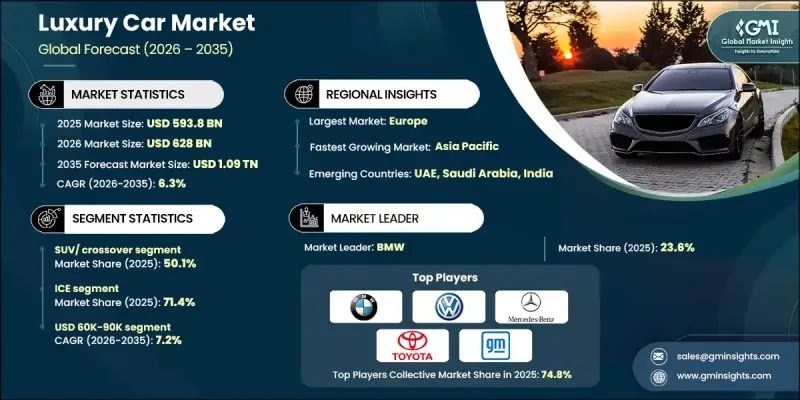
全球富裕人口的成長和可支配收入的增加推動了豪華汽車市場的發展,使更多消費者能夠負擔得起豪華汽車產品。此外,超級富豪階級人群的不斷壯大以及消費者對舒適性、性能和品牌獨特性的期望不斷提高,也促進了市場需求。豪華汽車日益被視為一種生活方式的象徵,融合了先進技術、精湛工藝和個人化。汽車製造商正在多個地區擴大產能,以改善市場進入並降低成本壁壘,進一步增強銷售潛力。電氣化策略也正在重塑競爭格局,豪華品牌正在加速開發兼具高性能和永續性目標的優質電動車型。率先採用先進動力傳動系統和數位化功能持續吸引追求身分認同和創新體驗的富裕買家。隨著全球出行偏好的轉變,豪華汽車製造商憑藉多元化的產品系列和卓越的用車體驗,將繼續佔據有利地位,滿足長期需求。
| 市場覆蓋範圍 | |
|---|---|
| 開始年份 | 2025 |
| 預測年份 | 2026-2035 |
| 起始值 | 5938億美元 |
| 預測金額 | 1.09兆美元 |
| 複合年成長率 | 6.3% |
到2025年,豪華SUV和跨界車細分市場將佔據50.1%的市場。該細分市場引領市場,因為消費者越來越傾向於選擇兼具高級內裝、多功能性、高坐姿和強大氣場的車款。寬敞的座艙佈局和靈活的儲物空間配置進一步提升了其對高階消費者的吸引力。
預計到2025年,內燃機汽車市佔率將達到71.4%,到2035年市場規模將達到7,508億美元。儘管汽車產業正朝著電氣化方向發展,但許多豪華車買家仍然優先考慮傳統內燃機平台所具備的駕駛性能、聲學性能和機械精細度。這些動力傳動系統豐富的客製化選項也支撐了市場對內燃機汽車的持續需求。
預計到2025年,美國豪華車市場規模將達到1,623億美元。美國仍然是全球最大的豪華車市場,這主要得益於其強大的購買力、極高的品牌認知度以及消費者對高階出行方式的持續關注。不斷變化的車輛所有權模式以及消費者對更佳客戶體驗的需求,也持續為市場成長創造機會。
目錄
第1章調查方法
第2章執行摘要
第3章業界考察
- 生態系分析
- 供應商情況
- 利潤率
- 成本結構
- 每個階段的附加價值
- 影響價值鏈的因素
- 中斷
- 產業影響因素
- 促進要素
- 高淨資產人士(HNWI)族群日益成長
- 消費者對優質舒適性和功能性的偏好日益成長
- 豪華電動車的電氣化和擴張
- 社會地位和生活風格品牌具有強大的影響力。
- 產業潛在風險與挑戰
- 高額的車輛購置和擁有成本
- 在價格敏感的新興市場,採用率有限
- 市場機遇
- 擴大高階電動和混合動力汽車的產品陣容
- 亞洲和中東等新興市場的需求不斷成長
- 自動駕駛和半自動駕駛功能的整合
- 以緊湊型豪華車型進軍二、三線城市地區
- 促進要素
- 成長潛力分析
- 監管環境
- 北美洲
- 聯邦機動車輛安全標準(FMVSS)
- 美國環保署排放氣體標準(第三階段)
- CAFE(企業平均燃油經濟性)
- 美國清潔空氣法
- 歐洲
- 聯合國歐洲經濟委員會條例(ECE R)
- 歐洲新車安全評鑑協會(Euro NCAP)
- 通用安全法規(歐盟)
- 亞太地區
- ASEAN NCAP
- 日本安全排放氣體標準(JAMA/國土交通省)
- 中國第六號排放氣體標準(CN6)
- 拉丁美洲
- 南方共同市場規章
- 墨西哥NOM標準
- 巴西 PROCONVE
- 中東和非洲
- GSO/GCC技術規程
- GCC NCAP
- 阿拉伯聯合大公國車輛標準(ESMA)
- 北美洲
- 波特分析
- PESTEL 分析
- 科技與創新趨勢
- 當前技術趨勢
- 新興技術
- 價格趨勢
- 按地區
- 依產品
- 生產統計
- 生產基地
- 消費基礎
- 出口和進口
- 成本細分分析
- 永續性和環境影響
- 環境影響評估
- 社會影響力和社區服務
- 公司管治與企業社會責任
- 永續金融與投資趨勢
- 經銷商網路和分銷基礎設施
- 比較特許經營和獨立經銷商的經濟效益
- 豪華展示室設計與客戶體驗
- 按市場分類的地理覆蓋範圍和經銷商密度
- 售後服務網路與授權服務中心
- 電氣化轉型和充電基礎設施
- 消費者接受豪華電動車的障礙
- 開發私人和公共充電基礎設施
- 家用充電解決方案和智慧電網整合
- 專為豪華車領域設計的電池技術進步
- 案例研究
- 未來前景與機遇
第4章 競爭情勢
- 介紹
- 公司市佔率分析
- 北美洲
- 歐洲
- 亞太地區
- 拉丁美洲
- 中東和非洲
- 主要市場公司的競爭分析
- 競爭定位矩陣
- 戰略展望矩陣
- 重大進展
- 併購
- 夥伴關係與合作
- 新產品發布
- 企業擴張計畫和資金籌措
第5章 依車輛類型分類的市場估計與預測,2022-2035年
- 掀背車
- 轎車
- SUV/跨界車
- 小轎車
- 旅行車/旅行車
- 敞篷車
- 其他
第6章 依類別分類的市場估計與預測,2022-2035年
- 入門豪華車
- 中產階級奢侈品
- 超級奢侈品
第7章動力傳動系統市場估算與預測,2022-2035年
- 內燃機(ICE)
- 汽油
- 柴油引擎
- 電動/混合動力汽車
- 電池式電動車(BEV)
- HEV
- PHEV
第8章 2022-2035年按價格分類的市場估算與預測
- 40,000 美元至 60,000 美元
- 60,000 美元至 90,000 美元
- 90,000 美元至 120,000 美元
- 超過12萬美元
第9章 依銷售管道分類的市場估計與預測,2022-2035年
- 特許經銷商
- 獨立零售商
第10章 2022-2035年各地區市場估計與預測
- 北美洲
- 美國
- 加拿大
- 歐洲
- 德國
- 英國
- 法國
- 義大利
- 西班牙
- 俄羅斯
- 北歐國家
- 比荷盧經濟聯盟
- 亞太地區
- 中國
- 印度
- 日本
- 韓國
- ANZ
- 新加坡
- 馬來西亞
- 印尼
- 越南
- 泰國
- 拉丁美洲
- 巴西
- 墨西哥
- 阿根廷
- 哥倫比亞
- 中東和非洲
- 南非
- 沙烏地阿拉伯
- 阿拉伯聯合大公國
第11章 公司簡介
- 世界公司
- BMW
- Volkswagen
- Mercedes-Benz
- Toyota Motor(Lexus)
- General Motors
- Tata Motors
- Ferrari
- Volvo
- Aston Martin
- Ford Motor
- Tesla
- Stellantis
- Pagani Automobili
- Koenigsegg Automotive
- 當地公司
- Hyundai Motor
- McLaren Automotive
- Geely
- FAW
- BYD Auto
- SAIC Motor
- 新興企業
- VinFast
- Lucid
- Rivian Automotive
- Xpeng Motors
The Global Luxury Car Market was valued at USD 593.8 billion in 2025 and is estimated to grow at a CAGR of 6.3% to reach USD 1.09 trillion by 2035.
Growth is supported by rising global wealth levels and increasing disposable incomes, which are enabling more consumers to access premium automotive offerings. Demand is also fueled by the growing population of ultra-high-net-worth individuals and evolving consumer expectations around comfort, performance, and brand exclusivity. Luxury vehicles are increasingly positioned as lifestyle assets that combine advanced technology, superior craftsmanship, and personalization. Automakers are expanding manufacturing capabilities across multiple regions to improve market access and reduce cost barriers, which further strengthens sales potential. Electrification strategies are also reshaping the competitive landscape, as luxury brands accelerate the development of premium electric models to align with sustainability goals while preserving performance standards. Early adoption of advanced powertrains and digital features continues to attract affluent buyers seeking innovation alongside status. As global mobility preferences evolve, luxury car manufacturers remain well-positioned to capture long-term demand through diversified product portfolios and enhanced ownership experiences.
| Market Scope | |
|---|---|
| Start Year | 2025 |
| Forecast Year | 2026-2035 |
| Start Value | $593.8 Billion |
| Forecast Value | $1.09 Trillion |
| CAGR | 6.3% |
The luxury SUVs and crossovers segment accounted for 50.1% share in 2025. This segment leads the market as buyers increasingly favor vehicles that combine upscale interiors with versatility, elevated seating positions, and strong visual presence. Spacious cabin layouts and adaptable storage configurations further enhance appeal among affluent consumers.
The internal combustion engine vehicles segment held 71.4% share in 2025 and is forecast to reach USD 750.8 billion by 2035. Despite the shift toward electrification, many luxury buyers continue to prioritize driving dynamics, acoustic performance, and mechanical refinement traditionally associated with ICE platforms. Extensive customization options linked to these powertrains also support sustained demand.
United States Luxury Car Market reached USD 162.3 billion in 2025. The country remains the largest global market due to strong purchasing power, high brand awareness, and sustained interest in premium mobility. Changing ownership models and demand for enhanced customer experiences continue to create expansion opportunities.
Key companies operating in the Global Luxury Car Market include Mercedes-Benz, BMW, Volkswagen, Toyota Motor (Lexus), General Motors, Ferrari, Tata Motors, Volvo, Aston Martin, and McLaren. Companies in the Global Luxury Car Market strengthen their market position through continuous innovation and strategic expansion. Manufacturers invest heavily in advanced powertrain technologies, digital connectivity, and autonomous features to enhance vehicle differentiation. Expanding electric and hybrid portfolios allows brands to address sustainability expectations without compromising performance. Strategic localization of production facilities improves cost efficiency and market responsiveness. Personalized design options and exclusive ownership programs help deepen customer loyalty. Strong branding, immersive retail experiences, and premium after-sales services further elevate value perception.
Table of Contents
Chapter 1 Methodology
- 1.1 Research approach
- 1.2 Quality commitments
- 1.2.1 GMI AI policy & data integrity commitment
- 1.3 Research trail & confidence scoring
- 1.3.1 Research trail components
- 1.3.2 Scoring components
- 1.4 Data collection
- 1.4.1 Partial list of primary sources
- 1.5 Data mining sources
- 1.5.1 Paid sources
- 1.6 Base estimates and calculations
- 1.6.1 Base year calculation
- 1.7 Forecast model
- 1.8 Research transparency addendum
Chapter 2 Executive Summary
- 2.1 Industry 360° synopsis
- 2.2 Key market trends
- 2.2.1 Regional
- 2.2.2 Vehicle
- 2.2.3 Class
- 2.2.4 Powertrain
- 2.2.5 Price
- 2.2.6 Sales Channel
- 2.3 TAM analysis, 2026-2035
- 2.4 CXO perspectives: Strategic imperatives
- 2.4.1 Executive decision points
- 2.4.2 Critical success factors
- 2.5 Future outlook and recommendations
Chapter 3 Industry Insights
- 3.1 Industry ecosystem analysis
- 3.1.1 Supplier landscape
- 3.1.2 Profit margin
- 3.1.3 Cost structure
- 3.1.4 Value addition at each stage
- 3.1.5 Factor affecting the value chain
- 3.1.6 Disruptions
- 3.2 Industry impact forces
- 3.2.1 Growth drivers
- 3.2.1.1 Rising high-net-worth individual (HNWI) population
- 3.2.1.2 Increasing consumer preference for premium comfort and features
- 3.2.1.3 Electrification and expansion of luxury electric vehicles (EVs)
- 3.2.1.4 Strong influence of social status and lifestyle branding
- 3.2.2 Industry pitfalls and challenges
- 3.2.2.1 High vehicle acquisition and ownership costs
- 3.2.2.2 Limited penetration in price-sensitive emerging markets
- 3.2.3 Market opportunities
- 3.2.3.1 Expansion of luxury electric and hybrid vehicle portfolios
- 3.2.3.2 Growing demand in emerging markets such as Asia and Middle East
- 3.2.3.3 Integration of autonomous and semi-autonomous driving features
- 3.2.3.4 Entry into tier-2 and tier-3 cities with compact luxury models
- 3.2.1 Growth drivers
- 3.3 Growth potential analysis
- 3.4 Regulatory landscape
- 3.4.1 North America
- 3.4.1.1 Federal Motor Vehicle Safety Standards (FMVSS)
- 3.4.1.2 EPA Emission Standards (Tier 3)
- 3.4.1.3 CAFE (Corporate Average Fuel Economy)
- 3.4.1.4 U.S. Clean Air Act
- 3.4.2 Europe
- 3.4.2.1 UN/ECE Regulations (ECE R)
- 3.4.2.2 Euro NCAP (European New Car Assessment Programme)
- 3.4.2.3 General Safety Regulation (EU )
- 3.4.3 Asia Pacific
- 3.4.3.1 ASEAN NCAP
- 3.4.3.2 Japan Safety & Emission Standards (JAMA / MLIT)
- 3.4.3.3 China 6 Emission Standard (CN6)
- 3.4.4 Latin America
- 3.4.4.1 Mercosur Regulations
- 3.4.4.2 Mexico NOM Standards
- 3.4.4.3 Brazil PROCONVE
- 3.4.5 Middle East & Africa
- 3.4.5.1 GSO / GCC Technical Regulations
- 3.4.5.2 GCC NCAP
- 3.4.5.3 UAE Vehicle Standards (ESMA)
- 3.4.1 North America
- 3.5 Porter';s analysis
- 3.6 PESTEL analysis
- 3.7 Technology and innovation landscape
- 3.7.1 Current technological trends
- 3.7.2 Emerging technologies
- 3.8 Price trends
- 3.8.1 By region
- 3.8.2 By product
- 3.9 Production statistics
- 3.9.1 Production hubs
- 3.9.2 Consumption hubs
- 3.9.3 Export and import
- 3.10 Cost breakdown analysis
- 3.11 Sustainability and environmental impact
- 3.11.1 Environmental impact assessment
- 3.11.2 Social impact & community benefits
- 3.11.3 Governance & corporate responsibility
- 3.11.4 Sustainable finance & investment trends
- 3.12 Dealer network & distribution infrastructure
- 3.12.1 Franchise vs. Independent dealer economics
- 3.12.2 Luxury showroom design and customer experience
- 3.12.3 Geographic coverage and dealership density by market
- 3.12.4 After-sales service network and certified service centers
- 3.13 Electrification transition & charging infrastructure
- 3.13.1 Consumer adoption barriers for luxury EVs
- 3.13.2 Private and public charging infrastructure development
- 3.13.3 Home charging solutions and smart grid integration
- 3.13.4 Battery technology advancements specific to luxury segment
- 3.14 Case studies
- 3.15 Future outlook & opportunities
Chapter 4 Competitive Landscape, 2025
- 4.1 Introduction
- 4.2 Company market share analysis
- 4.2.1 North America
- 4.2.2 Europe
- 4.2.3 Asia Pacific
- 4.2.4 LATAM
- 4.2.5 MEA
- 4.3 Competitive analysis of major market players
- 4.4 Competitive positioning matrix
- 4.5 Strategic outlook matrix
- 4.6 Key developments
- 4.6.1 Mergers & acquisitions
- 4.6.2 Partnerships & collaborations
- 4.6.3 New product launches
- 4.6.4 Expansion plans and funding
Chapter 5 Market Estimates & Forecast, By Vehicle, 2022 - 2035 ($Bn, Units)
- 5.1 Key trends
- 5.2 Hatchback
- 5.3 Sedan
- 5.4 SUV/ Crossover
- 5.5 Coupe
- 5.6 Wagon / Estate
- 5.7 Convertible
- 5.8 Others
Chapter 6 Market Estimates & Forecast, By Class, 2022 - 2035 ($Bn, Units)
- 6.1 Key trends
- 6.2 Entry-Level Luxury
- 6.3 Mid-Level Luxury
- 6.4 Ultra Luxury
Chapter 7 Market Estimates & Forecast, By Powertrain, 2022 - 2035 ($Bn, Units)
- 7.1 Key trends
- 7.2 ICE
- 7.2.1 Gasoline
- 7.2.2 Diesel
- 7.3 Electric/Hybrid
- 7.3.1 BEV
- 7.3.2 HEV
- 7.3.3 PHEV
Chapter 8 Market Estimates & Forecast, By Price, 2022 - 2035 ($Bn, Units)
- 8.1 Key trends
- 8.2 USD 40K-60K
- 8.3 USD 60K-90K
- 8.4 USD 90K-120K
- 8.5 Over USD 120K
Chapter 9 Market Estimates & Forecast, By Sales Channel, 2022 - 2035 ($Bn, Units)
- 9.1 Key trends
- 9.2 Franchised dealer
- 9.3 Independent dealer
Chapter 10 Market Estimates & Forecast, By Region, 2022 - 2035 ($Bn, Units)
- 10.1 Key trends
- 10.2 North America
- 10.2.1 US
- 10.2.2 Canada
- 10.3 Europe
- 10.3.1 Germany
- 10.3.2 UK
- 10.3.3 France
- 10.3.4 Italy
- 10.3.5 Spain
- 10.3.6 Russia
- 10.3.7 Nordics
- 10.3.8 Benelux
- 10.4 Asia Pacific
- 10.4.1 China
- 10.4.2 India
- 10.4.3 Japan
- 10.4.4 South Korea
- 10.4.5 ANZ
- 10.4.6 Singapore
- 10.4.7 Malaysia
- 10.4.8 Indonesia
- 10.4.9 Vietnam
- 10.4.10 Thailand
- 10.5 Latin America
- 10.5.1 Brazil
- 10.5.2 Mexico
- 10.5.3 Argentina
- 10.5.4 Colombia
- 10.6 MEA
- 10.6.1 South Africa
- 10.6.2 Saudi Arabia
- 10.6.3 UAE
Chapter 11 Company Profiles
- 11.1 Global companies
- 11.1.1 BMW
- 11.1.2 Volkswagen
- 11.1.3 Mercedes-Benz
- 11.1.4 Toyota Motor (Lexus)
- 11.1.5 General Motors
- 11.1.6 Tata Motors
- 11.1.7 Ferrari
- 11.1.8 Volvo
- 11.1.9 Aston Martin
- 11.1.10 Ford Motor
- 11.1.11 Tesla
- 11.1.12 Stellantis
- 11.1.13 Pagani Automobili
- 11.1.14 Koenigsegg Automotive
- 11.2 Regional companies
- 11.2.1 Hyundai Motor
- 11.2.2 McLaren Automotive
- 11.2.3 Geely
- 11.2.4 FAW
- 11.2.5 BYD Auto
- 11.2.6 SAIC Motor
- 11.3 Emerging companies
- 11.3.1 VinFast
- 11.3.2 Lucid
- 11.3.3 Rivian Automotive
- 11.3.4 Xpeng Motors

 2026年全球豪華穹頂車旅遊市場報告
 全球豪華汽車車體打造市場2026年全球豪華車市場報告
 豪華車市場規模、佔有率和趨勢分析報告:按車輛類型、驅動方式、地區和細分市場分類的預測(2026-2033 年)
 豪華車市場規模、佔有率、趨勢及報告:按車型、燃料類型、價格範圍和地區分類(2026-2034 年)
 豪華車市場分析及預測(至2035年):依類型、產品類型、服務、技術、零件、應用、材質、最終用戶、安裝類型、解決方案分類
 中國豪華車市場:市場佔有率分析、產業趨勢與統計及成長預測(2026-2031年)歐洲豪華車市場-佔有率分析、產業趨勢、統計和成長預測(2026-2031)
 2026-2034年全球豪華車市場規模、佔有率、趨勢及成長分析報告豪華車:市場佔有率分析、產業趨勢與統計、成長預測(2026-2031)