


 |
市場調查報告書
商品編碼
1911320
靈活燃料汽車:市場佔有率分析、行業趨勢和統計數據、成長預測(2026-2031 年)Flex-fuel Vehicle - Market Share Analysis, Industry Trends & Statistics, Growth Forecasts (2026 - 2031) |
||||||

※ 本網頁內容可能與最新版本有所差異。詳細情況請與我們聯繫。
預計到 2026 年,靈活燃料汽車市場規模將達到 11,028.8 億美元,高於 2025 年的 11,300 億美元。預計到 2031 年,該市場規模將達到 9,761.2 億美元,2026 年至 2031 年的複合年成長率為 -2.4%。
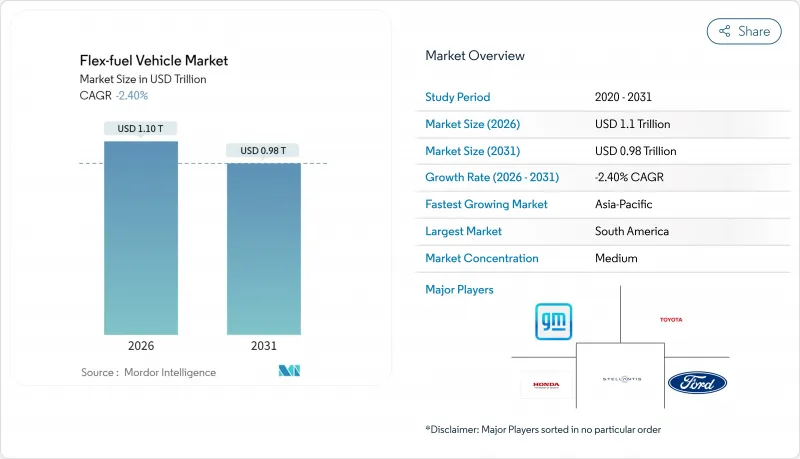
這一下滑趨勢反映了汽車產業加速向純電動驅動系統轉型,以及日益嚴格的法規優先考慮零排放解決方案而非生質燃料混合燃料。由於電動平台佔據了新車投資的大部分,整車製造商正在重新評估資本配置,而歐盟在2035年逐步淘汰內燃機以及中國新能源汽車配額等政策措施加劇了結構性阻力。南美洲仍然是靈活燃料汽車市場的重鎮,這得益於巴西政府的碳權激勵計劃RenovaBio。然而,隨著混合動力汽車的普及,該地區的車隊更新速度也正在放緩。雖然乘用車由於規模優勢,銷售不會大幅下滑,但商用車車隊的銷售成長正在加快,因為總擁有成本(TCO)模型越來越傾向於電氣化。整體而言,在優先考慮直接電氣化的脫碳議程中,市場的戰略意義正從成長機會轉向對沖轉型風險。
全球靈活燃料汽車市場趨勢與洞察
開發中國家E-10/E-15的全球發展
印度、印尼和菲律賓不斷擴大的乙醇摻混比例正在提振乙醇需求,因為政策制定者正致力於保障能源安全和實現農業收入多元化。印度力爭在2026年實現五分之一的乙醇摻混比例,這將使印度從玉米出口國轉變為淨進口國,最終加劇全球原料供應緊張。日本的2030年E-10和2040年E-20推廣藍圖凸顯了亞洲在擴大電動車基礎設施的同時,維持內燃機汽車選擇的協調策略。與家禽和畜牧業的原料競爭推高了投入價格,暴露了燃料政策與糧食安全之間的微妙平衡。作為物流和定價的關鍵推動者,國家石油公司正在幫助緩解區域分銷瓶頸。儘管這些措施共同幫助減少了廢氣二氧化碳排放,但即便電動車的普及仍在持續,它們也未能阻止靈活燃料汽車市場的下滑趨勢。
巴西Renova生物碳權溢價
RenovaBio 制定了一項基於生命週期的排碳權標準,該標準對乙醇供應鏈效率的提升進行經濟估值。低碳 CBIO 認證價格溢價將在 2025 年初達到每噸 115 美元(二氧化碳當量),為甘蔗和玉米乙醇工廠帶來盈利的收入來源。巴西中西部地區的擴張意味著目前已有 25 家玉米乙醇工廠運作,另有 15 家正在建設中,預計 2024/25 年度的總產量將達到 82 億公升。該政策的技術中立框架有利於一流生產商,並鼓勵採用精密農業投入和餘熱回收系統。巴西石油公司 (Petrobras) 根據《未來燃料法》認可高濃度乙醇混合燃料,顯示該州對此發展路徑的持續支持。雖然 RenovaBio 緩解了與糖價相關的收入波動,但它無法完全抵消宏觀經濟轉型為電動車帶來的影響。
加速歐洲和中國電動車普及目標的實現
歐盟2035年內燃機汽車禁令以及中國不斷擴大的新能源汽車配額,正促使汽車製造商的投資轉向全面電氣化。 2023年,中國品牌佔歐盟純電動車銷量的7.9%,預計2027年將達到20%,加劇了市場競爭。歐洲電動車市場預計到2030年將快速成長,並像磁石一樣吸引來自生質燃料平台的資本。中國的成本優勢使得彈性燃料策略顯得不那麼經濟,進而強化了政策、基礎建設和消費者偏好之間的回饋循環。隨著公共充電網路的擴展,里程焦慮的緩解進一步削弱了靈活燃料的優勢。此限制因素導致彈性燃料汽車市場複合年成長率下降幅度最大。
細分市場分析
2025年,E-25至E-85類別佔彈性燃料汽車市場的48.55%,但預計到2031年將以-2.30%的複合年成長率萎縮。中等濃度的混合燃料可與現有加油站的油泵和引擎標定系統相容,避免了昂貴的硬體改造。巴西的E30汽油標準恰好符合此理想狀態,其2,000萬輛汽車能夠無縫適應各種乙醇含量。加州E85零售的快速成長表明,在經濟條件允許的情況下,地方課稅和價格激勵措施可以吸引駕駛員使用更高比例的生質燃料燃料。然而,研究表明,E30在低速預燃控制方面已接近臨界點,增加乙醇含量會增加引擎標定的複雜性和冷啟動風險。這項實際上限指導原始設備製造商(OEM)的設計選擇,在過渡期內,中等濃度的混合燃料仍將作為行業預設選項。
高於 E85 的高濃度燃料混合物能最大限度地提高可再生能源含量,但需要專用燃料網路,並且由於能量密度較低,續航里程會受到限制。低濃度燃料混合物,如 E10 和 E15,在低度開發市場較為適用,但減量排放有限,在嚴格的排放目標下,其策略價值也較低。即使電氣化進程不斷推進,目前的燃料混合物等級體係也體現了永續性和基礎設施實際情況之間的一種權衡。總體而言,只要在高產地區,乙醇與汽油的價格差異保持吸引力,25% 至 85% 的乙醇混合物仍將在 2031 年前繼續主導靈活燃料的普及。
到2025年,乘用車將佔總收入的64.52%,其年複合成長率(CAGR)為-2.18%,低於商用車的下降速度。消費者對燃料選擇的偏好支撐著基準需求,尤其是在乙醇價格較低的地區。在巴西的緊湊型轎車市場,靈活燃料仍然是主流,而印度的塔塔Panch靈活燃料車型則展現了即使在成本敏感型市場中,創新依然具有潛力。輕型商用車則處於中間市場,需要在有效載荷需求和日益收緊內燃機限制的都市區法規之間負載容量。相比之下,重型卡車和巴士的銷量下滑速度最快,因為車隊營運商正將資金轉向電池電動和氫燃料電池車型,這些車型有望降低長期營運成本。
乘用車市場的韌性源自於其分散的加油網路和個體價格套利行為,而這些特徵在集中式車隊採購中並不存在。摩托車正在崛起為一個新的細分市場,本田推出了可靈活使用多種燃料的引擎,能夠利用東南亞地區的國內乙醇供應。然而,都市區更嚴格的空氣污染法規和堵塞收費的實施預計將加速向電動Scooter和小型電動車的轉型。因此,儘管乘用車在靈活燃料汽車市場仍將保持其銷售主導地位,但預計未來十年該細分市場的戰略重要性將會下降。
區域分析
南美洲在2025年將佔據全球42.10%的市場佔有率,領先全球。這主要得益於巴西完善的乙醇生態系統,包括超過4萬個零售加油站和強大的CBIO碳權市場。巴西的《未來燃料法案》將強制摻混比例提高到35%,推動了強勁的國內需求,而玉米乙醇的擴張有助於分散原料風險。 Stellantis公司56億歐元的生物混合投資凸顯了該地區作為「活實驗室」的作用,展現了乙醇和電力之間的協同效應。阿根廷和巴拉圭正在發展成為區域貿易中心,透過進口甘蔗乙醇來補充需求,並穩定供應鏈經濟。
儘管採取了積極的燃料結構政策,亞太地區仍將是萎縮最快的地區,到2031年年複合成長率(CAGR)將為-2.23%。中國大力發展新能源車,並對純電動卡車提供地方補貼,限制了對靈活燃料汽車的投資。印度的乙醇計畫由於玉米進口增加而面臨原料採購挑戰,降低了成本競爭力。日本的E-10承諾提供了政策確定性,但國內汽車製造商優先研發固態電池,限制了靈活燃料汽車的生產,使其僅限於小眾運動車型。東南亞國家正在進行B40生物柴油和乙醇的試點項目,同時電動車的誘因也開始吸引都市區消費者。
在北美,45Z稅額扣抵維持了乙醇的大規模生產能力,但隨著汽車製造商將新產品研發重心轉向電動車平台,乙醇的市場滲透率已趨於平穩。加州的零排放車輛法規正在加速這項轉變。歐洲也出現了類似的趨勢:儘管德國提倡在2035年及以後對電動燃料實施豁免,但現行的監管方案仍然明顯偏向純電動車(BEV)。
在非洲,與糧食安全和經濟多元化相關的燃料多元化策略提供了一個短暫的機會窗口,但基礎設施的缺乏和購買力的有限阻礙了其推廣。
其他福利:
- Excel格式的市場預測(ME)表
- 3個月的分析師支持
目錄
第1章 引言
- 調查先決條件
- 調查範圍
第2章調查方法
第3章執行摘要
第4章 市場情勢
- 市場概覽
- 市場促進因素
- E-10/E-15開發中國家的全球發展
- 巴西 Renovabio 碳權溢價
- 美國45Z稅額扣抵後,纖維素乙醇價格出現轉捩點。
- 原始設備製造商的靈活策略旨在對沖電動車政策的不確定性
- 適用於傳統車輛的新一代端口燃油噴射套件
- 乙醇相容型後處理成本通貨緊縮
- 市場限制
- 歐洲和中國加速電動車普及目標
- 將原始設備製造商(OEM)的資本支出(Cap-Ex)重新分配到純電動車(BEV)平台
- 乾旱地區乙醇原料供應受限
- 零度以下天氣冷啟動排放激增
- 價值/供應鏈分析
- 監管環境
- 技術展望
- 波特五力模型
- 供應商的議價能力
- 消費者議價能力
- 新進入者的威脅
- 替代品的威脅
- 競爭對手之間的競爭
第5章 市場規模及成長預測(價值(美元))
- 依乙醇混合比例
- E-10 至 E-25
- E-25 至 E-85
- E-85 以上
- 按車輛類型
- 搭乘用車
- 輕型商用車
- 大型商用車輛
- 按燃料類型
- 汽油
- 柴油相容雙燃料
- 按銷售管道
- 原廠正品設備
- 售後改裝套件
- 按地區
- 北美洲
- 美國
- 加拿大
- 北美其他地區
- 南美洲
- 巴西
- 阿根廷
- 南美洲其他地區
- 歐洲
- 德國
- 法國
- 英國
- 西班牙
- 其他歐洲地區
- 亞太地區
- 中國
- 印度
- 日本
- 韓國
- 亞太其他地區
- 中東和非洲
- 阿拉伯聯合大公國
- 沙烏地阿拉伯
- 土耳其
- 埃及
- 南非
- 其他中東和非洲地區
- 北美洲
第6章 競爭情勢
- 市場集中度
- 策略趨勢
- 市佔率分析
- 公司簡介
- Stellantis NV
- Volkswagen AG
- General Motors Co.
- Ford Motor Co.
- Toyota Motor Corp.
- Honda Motor Co.
- Hyundai Motor Co.
- Kia Corp.
- Nissan Motor Co.
- Renault SA
- Subaru Corp.
- BMW AG
- Volvo Car Corp.
- Tata Motors Ltd.
- Mahindra & Mahindra Ltd.
- SAIC Motor Corp.
- Great Wall Motor Co.
- Geely Automobile Holdings
- JAC Motors
- Changan Automobile
第7章 市場機會與未來展望
Flex-fuel Vehicle market size in 2026 is estimated at USD 1102.88 billion, growing from 2025 value of USD 1130 billion with 2031 projections showing USD 976.12 billion, growing at -2.4% CAGR over 2026-2031.
The downturn mirrors the auto sector's accelerated pivot toward battery-electric drivetrains and tightening regulations that favor zero-tailpipe-emission solutions over biofuel blending. OEMs are reassessing capital allocation as electric platforms capture the bulk of new-model investment, while policy instruments such as the European Union's 2035 combustion-engine phase-out and China's NEV quotas deepen the structural headwinds. South America remains the stronghold for the flex-fuel vehicle market, anchored by Brazil's RenovaBio carbon-credit incentives, yet even this region faces slower fleet renewals as hybrid-electric penetration rises. Passenger cars retain scale advantages that shield the segment from steeper volume loss, but commercial fleets are decelerating faster because total cost-of-ownership models increasingly favor electrification. Overall, the market's strategic relevance is shifting from growth opportunity to transition hedge amid a decarbonization agenda that prioritizes direct electrification.
Global Flex-fuel Vehicle Market Trends and Insights
E-10/E-15 global roll-outs in developing nations
Expanding blend mandates across India, Indonesia, and the Philippines are elevating ethanol demand as policymakers seek energy security and farm-income diversification. India's push toward one-fifth blending by 2026 is turning the country from a corn exporter into a net importer, thereby tightening global feedstock supply. Japan's roadmap for E-10 by 2030 and E-20 by 2040 underscores a coordinated Asian strategy that preserves internal-combustion options while EV infrastructure scales. Feedstock competition with poultry and livestock sectors is lifting input prices, exposing the delicate balance between fuel policy and food security. National oil companies remain critical facilitators of logistics and pricing, helping mitigate regional distribution constraints. Collectively, these programs deliver incremental tail-pipe CO2 cuts but struggle to reverse the flex-fuel vehicle market contraction amid simultaneous EV incentives.
Brazilian RenovaBio carbon-credit premiums
RenovaBio sets life-cycle-based carbon-credit benchmarks that monetize every incremental efficiency gain along the ethanol supply chain. Premiums for low-carbon CBIO certificates reached USD 115 per tonne-CO2e in early 2025, adding profitable revenue streams to sugarcane and corn ethanol plants. Expansion in Brazil's Center-West has already spawned 25 operating corn-ethanol mills with another 15 under construction, lifting total output to 8.2 billion liters for the 2024/25 harvest. The policy's technology-neutral framework favors best-in-class producers, incentivizing precision-agriculture inputs and waste-heat recovery systems. Petrobras' endorsement of higher ethanol blends under the "Fuel of the Future" law signals sustained state-backed support for the pathway. While RenovaBio softens revenue volatility tied to sugar prices, it cannot fully offset the macro shift toward electric alternatives.
Accelerated EV adoption targets in Europe & China
The European Union's 2035 combustion ban and China's escalating NEV quotas are redirecting automaker investment toward full electrification. Chinese brands already occupied 7.9% of EU battery-electric sales in 2023 and may capture 20% by 2027, amplifying competitive pressure. The European EV market is forecast to grow exponentially by 2030, a financial magnet that drains capital from biofuel platforms. China's cost advantage makes flex-fuel strategies appear economically inferior, reinforcing a feedback loop of policy, infrastructure, and consumer preference. As public charging networks expand, range anxiety wanes, further eroding flex-fuel defensibility. The restraint subtracts the largest single share from the flex-fuel vehicle market CAGR.
Other drivers and restraints analyzed in the detailed report include:
- Cellulosic-ethanol price inflection after U.S. 45Z credit
- OEM flex-strategy to hedge EV policy uncertainty
- OEM cap-ex re-allocation toward BEV platforms
For complete list of drivers and restraints, kindly check the Table Of Contents.
Segment Analysis
The E-25 to E-85 category held 48.55% of flex-fuel vehicle market size in 2025 and is forecast to slip at a -2.30% CAGR to 2031. Moderate blends thrive on existing filling-station pumps and engine calibrations that avoid costly hardware changes. Brazil's evaluation of E30 gasoline aligns with this sweet spot, leveraging a 20-million-vehicle fleet that seamlessly adapts to varying ethanol content. California's rapid E85 retail sales underscore how regional taxation and price incentives can nudge drivers toward higher biofuel mixes when economics allow. Yet research indicates E30 sits at the inflection point for low-speed pre-ignition control, where further ethanol raises engine-mapping complexity and cold-start risk. This practical ceiling guides OEM design choices and keeps mid-range blends the industry's default during the transition period.
High blends above E85, while showcasing maximum renewable content, demand dedicated fuel networks and carry energy-density penalties that erode driving range. Entry-level blends such as E10 or E15 aid markets that are still developing supply chains, but they deliver limited carbon reduction, reducing their strategic appeal under stringent emissions goals. The current hierarchy signals a pragmatic compromise between sustainability and infrastructural reality, even as electrification gains traction. Overall, ethanol blends between 25% and 85% will continue to dominate flex-fuel adoption through 2031, provided price differentials against gasoline remain attractive in high-production regions.
Passenger cars generated 64.52% of 2025 revenue and will taper at a slower -2.18% CAGR than commercial segments. Consumer preference for fuel choice, especially where ethanol trades at a discount, sustains baseline demand. Brazil's compact-car segment still counts flex-fuels as the default configuration, while India's Tata Punch Flex Fuel showcases innovation potential even in cost-sensitive markets. Light-commercial vans occupy an intermediate position, balancing payload needs with urban-zone regulations that are starting to penalize combustion engines. In contrast, heavy-duty trucks and buses are declining fastest as fleet operators shift capital toward battery-electric and hydrogen models that promise long-term operating savings.
The resilience of the passenger car cohort stems from decentralized refueling and individual price arbitrage behavior, both absent in centralized fleet procurement. Motorcycles offer an emerging niche, with Honda introducing flex-compatible engines that can utilize domestic ethanol streams in Southeast Asia. Still, rising urban clean-air rules and congestion charges are likely to accelerate the migration toward electric scooters and compact EVs. Consequently, passenger cars will preserve volume leadership in the flex-fuel vehicle market, yet the segment's strategic importance is expected to diminish over the next decade.
The Flex-Fuel Vehicle Market is Segmented by Ethanol Blend Type (E-10 To E-25, E-25 To E-85, E-85 and Above), Vehicle Type (Passenger Cars, Light Commercial Vehicles, and Heavy Commercial Vehicles), Fuel Type (Gasoline and Diesel-Compatible Dual-Fuel), Sales Channel (OEM-Fitted and Aftermarket Conversion Kits), and Geography. The Market Forecasts are Provided in Terms of Value (USD).
Geography Analysis
South America led with 42.10% share in 2025, powered by Brazil's integrated ethanol ecosystem, which includes more than 40,000 retail pumps and a robust CBIO carbon-credit market. The country's "Fuel of the Future" law raising mandatory blends to 35% keeps domestic demand buoyant, while corn-ethanol expansion diversifies feedstock risk. Stellantis' EUR 5.6 billion Bio-Hybrid investment underscores the region's role as a living laboratory for ethanol-electric synergy. Argentina and Paraguay supplement demand by importing sugarcane ethanol, anchoring a regional trade hub that stabilizes supply-chain economics.
Asia-Pacific, despite active blending policies, is the fastest-declining bloc at -2.23% CAGR through 2031. China's national focus on NEV roll-outs, coupled with provincial subsidies for battery-electric trucks, constrains flex-fuel investments. India's ethanol program faces feedstock headwinds as corn imports grow, dampening cost competitiveness. Japan's E-10 pledge provides policy certainty, but domestic automakers are channeling R&D into solid-state batteries, limiting flex-fuel output beyond niche sports models. Southeast Asian nations are exploring B40 biodiesel and ethanol pilots, yet EV incentives are starting to capture the urban consumer segment.
North America retains large ethanol production capacity supported by the 45Z credit, yet market penetration is flat because OEMs aim new product pipelines at electric platforms. California's zero-emission vehicle mandate accelerates this swing. Europe shows similar patterns: notwithstanding Germany's push for e-fuels carve-outs post-2035, the regulatory package overwhelmingly steers buyers toward BEVs.
In the Middle East and Africa, fuel diversification strategies tied to food-security and economic diversification provide modest openings, but infrastructure gaps and limited purchasing power restrain widespread uptake.
- Stellantis NV
- Volkswagen AG
- General Motors Co.
- Ford Motor Co.
- Toyota Motor Corp.
- Honda Motor Co.
- Hyundai Motor Co.
- Kia Corp.
- Nissan Motor Co.
- Renault SA
- Subaru Corp.
- BMW AG
- Volvo Car Corp.
- Tata Motors Ltd.
- Mahindra & Mahindra Ltd.
- SAIC Motor Corp.
- Great Wall Motor Co.
- Geely Automobile Holdings
- JAC Motors
- Changan Automobile
Additional Benefits:
- The market estimate (ME) sheet in Excel format
- 3 months of analyst support
TABLE OF CONTENTS
1 Introduction
- 1.1 Study Assumptions
- 1.2 Scope of the Study
2 Research Methodology
3 Executive Summary
4 Market Landscape
- 4.1 Market Overview
- 4.2 Market Drivers
- 4.2.1 E-10/E-15 Global Roll-Outs In Developing Nations
- 4.2.2 Brazilian Renovabio Carbon-Credit Premiums
- 4.2.3 Cellulosic-Ethanol Price Inflection After U.S. 45Z Credit
- 4.2.4 OEM Flex-Strategy To Hedge EV Policy Uncertainty
- 4.2.5 Next-Gen Port-Fuel-Injection Kits For Legacy Fleets
- 4.2.6 Ethanol-Compatible After-Treatment Cost Deflation
- 4.3 Market Restraints
- 4.3.1 Accelerated EV Adoption Targets In Europe & China
- 4.3.2 OEM Cap-Ex Re-Allocation Toward BEV Platforms
- 4.3.3 Limited Ethanol Feed-Stock In Drought-Prone Geographies
- 4.3.4 Cold-Start Emission Spikes In Sub-Zero Climates
- 4.4 Value / Supply-Chain Analysis
- 4.5 Regulatory Landscape
- 4.6 Technological Outlook
- 4.7 Porter's Five Forces
- 4.7.1 Bargaining Power of Suppliers
- 4.7.2 Bargaining Power of Consumers
- 4.7.3 Threat of New Entrants
- 4.7.4 Threat of Substitutes
- 4.7.5 Intensity of Competitive Rivalry
5 Market Size & Growth Forecasts (Value (USD))
- 5.1 By Ethanol Blend Type
- 5.1.1 E-10 to E-25
- 5.1.2 E-25 to E-85
- 5.1.3 E-85 and Above
- 5.2 By Vehicle Type
- 5.2.1 Passenger Cars
- 5.2.2 Light Commercial Vehicles
- 5.2.3 Heavy Commercial Vehicles
- 5.3 By Fuel Type
- 5.3.1 Gasoline
- 5.3.2 Diesel-compatible Dual-Fuel
- 5.4 By Sales Channel
- 5.4.1 OEM-fitted
- 5.4.2 Aftermarket Conversion Kits
- 5.5 By Geography
- 5.5.1 North America
- 5.5.1.1 United States
- 5.5.1.2 Canada
- 5.5.1.3 Rest of North America
- 5.5.2 South America
- 5.5.2.1 Brazil
- 5.5.2.2 Argentina
- 5.5.2.3 Rest of South America
- 5.5.3 Europe
- 5.5.3.1 Germany
- 5.5.3.2 France
- 5.5.3.3 United Kingdom
- 5.5.3.4 Spain
- 5.5.3.5 Rest of Europe
- 5.5.4 Asia-Pacific
- 5.5.4.1 China
- 5.5.4.2 India
- 5.5.4.3 Japan
- 5.5.4.4 South Korea
- 5.5.4.5 Rest of Asia-Pacific
- 5.5.5 Middle East and Africa
- 5.5.5.1 United Arab Emirates
- 5.5.5.2 Saudi Arabia
- 5.5.5.3 Turkey
- 5.5.5.4 Egypt
- 5.5.5.5 South Africa
- 5.5.5.6 Rest of Middle East and Africa
- 5.5.1 North America
6 Competitive Landscape
- 6.1 Market Concentration
- 6.2 Strategic Moves
- 6.3 Market Share Analysis
- 6.4 Company Profiles (includes Global Level Overview, Market Level Overview, Core Segments, Financials as Available, Strategic Information, Market Rank/Share for Key Companies, Products and Services, SWOT Analysis, and Recent Developments)
- 6.4.1 Stellantis NV
- 6.4.2 Volkswagen AG
- 6.4.3 General Motors Co.
- 6.4.4 Ford Motor Co.
- 6.4.5 Toyota Motor Corp.
- 6.4.6 Honda Motor Co.
- 6.4.7 Hyundai Motor Co.
- 6.4.8 Kia Corp.
- 6.4.9 Nissan Motor Co.
- 6.4.10 Renault SA
- 6.4.11 Subaru Corp.
- 6.4.12 BMW AG
- 6.4.13 Volvo Car Corp.
- 6.4.14 Tata Motors Ltd.
- 6.4.15 Mahindra & Mahindra Ltd.
- 6.4.16 SAIC Motor Corp.
- 6.4.17 Great Wall Motor Co.
- 6.4.18 Geely Automobile Holdings
- 6.4.19 JAC Motors
- 6.4.20 Changan Automobile
7 Market Opportunities & Future Outlook
- 7.1 White-space & Unmet-need Assessment

 汽車軟性燃料引擎市場-全球產業規模、佔有率、趨勢、機會、預測:按引擎排氣量、燃料類型、車輛類型、地區和競爭格局分類,2021-2031年
 彈性燃料引擎市場:2026-2032年全球市場預測(按燃料類型、混合比、排氣量、車輛類型、應用、最終用戶和銷售管道)
 全球彈性燃料市場
 靈活燃料引擎市場,按組件類型、燃料類型、技術、應用、國家和地區分類 - 2025 年至 2032 年全球產業分析、市場規模、市場佔有率及預測
 全球靈活燃料汽車市場按燃料類型、車輛類型、引擎容量和地區分類全球彈性燃料市場依燃料結構、應用、原料來源、燃料種類及地區分類靈活燃料引擎市場,按類型、車輛類型、混合類型、國家和地區 - 2024-2032 年行業分析、市場規模、市場佔有率和預測