


 |
市場調查報告書
商品編碼
1910847
電子商務塑膠包裝:市場佔有率分析、產業趨勢與統計、成長預測(2026-2031)E-commerce Plastic Packaging - Market Share Analysis, Industry Trends & Statistics, Growth Forecasts (2026 - 2031) |
||||||

※ 本網頁內容可能與最新版本有所差異。詳細情況請與我們聯繫。
預計到2026年,電子商務塑膠包裝市場規模將達到346.6億美元,高於2025年的306億美元。預計到2031年,該市場規模將達到644.3億美元,2026年至2031年的複合年成長率為13.23%。
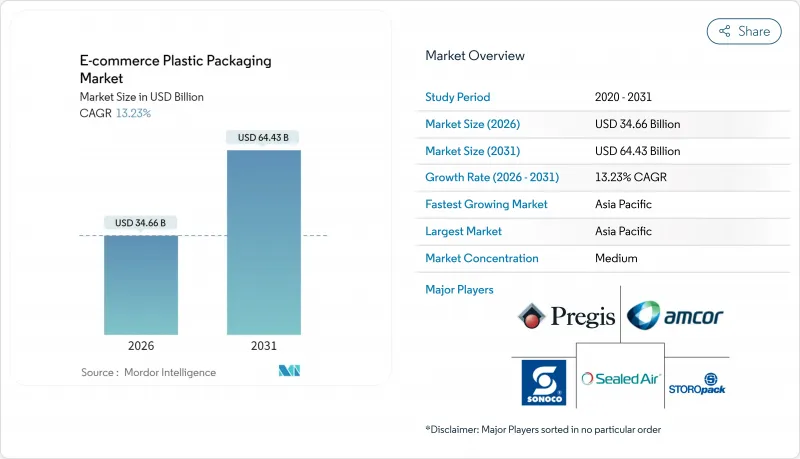
線上零售的快速成長、消費者對優質開箱體驗日益成長的期望以及日益嚴格的永續性法規正在塑造中短期市場前景。輕巧靈活的薄膜、單一材質阻隔結構和時尚的基材有助於品牌降低運輸成本、遵守回收法規並提升視覺吸引力。製造商正抓住智慧標籤、自動化填充線和溫控解決方案帶來的機遇,以保護透過密集都市區配送網路運輸的食品雜貨和化妝品。隨著一體化加工商收購利基市場專家、申請新型樹脂專利並擴大化學回收以確保供應安全,競爭日益激烈。
全球電子商務塑膠包裝市場趨勢與洞察
線上零售滲透率不斷提高
電子商務的持續成長推動了對能夠承受自動化分類、多式聯運和直接面對消費者開啟的包裝的需求。日本的訂閱式美妝服務就是一個典型的例子,高階設計和防篡改密封正在取代商店體驗。不斷成長的小包裹量促使倉庫採用標準化的包裝尺寸,以最大限度地提高機器人處理能力和儲存密度。
輕質軟性包裝的成長
茂金屬聚乙烯薄膜可在-40°C至120°C的溫度範圍內維持密封性能,同時厚度減少30%,進而降低運輸排放和原料成本。奈米添加劑可增強阻隔強度,使電子產品包裝袋更加輕薄。加工商正在用充氣緩衝材料取代硬質襯墊,顯著降低體積重量,並符合單一材料回收法規。
對一次性塑膠製品的禁令和課稅
加州SB54法案強制規定到2032年產品中必須使用65%的再生材料,而歐盟新規也要求採用循環設計。雖然合規負擔迫使企業進行高成本的生產線升級和產品系列精簡,但也推動了單一材料複合材料的創新,從而簡化了消費後塑膠的回收利用。各大品牌紛紛延後產品推出,等待相關指南更加穩定,但先行者憑藉其環保意識,已佔了市場優勢。
細分市場分析
到2025年,聚乙烯將佔據電商塑膠包裝市場42.12%的佔有率,這主要得益於其優異的密封性能以及在自動化成型-填充-封口生產線上的高產能。茂金屬聚乙烯等級能夠達到壁厚大幅減薄,從而在不犧牲抗穿刺性的前提下減輕運輸重量。受大眾市場郵袋和拉伸套的推動,聚乙烯基電商塑膠包裝的市場規模預計將穩定成長。聚對苯二甲酸乙二醇酯(PET)預計將以14.42%的複合年成長率成長,其優異的氧氣和水分阻隔性彌補了樹脂成本較高的不足,因此在溫控食品包裝領域備受青睞。化學回收可以生產出100%由消費後材料製成的PET,同時維持其食品接觸認證。聚丙烯(PP)正在確保可重複使用托特包和鉸鏈蓋盒的需求,而生質塑膠正在高階化妝品領域站穩腳跟,其可堆肥性為品牌提供了強大的價值。
第二波聚乙烯創新浪潮聚焦於單一材料結構,此結構無需金屬化層即可達到類似的香氣保留效果,簡化了回收流程。在PET薄膜中,奈米黏土分散體可將氧氣透過率降低15-20%,並可製成更薄的複合材料,減少小包裹運送過程中的體積。這些材料技術的進步正在鞏固電子商務塑膠包裝市場作為高性能、永續聚合物試驗場的地位。
預計到2025年,包裝袋和包裝袋將佔總收入的37.95%,這主要得益於它們在服裝、家居用品和個人保健產品運輸方面的多功能性。然而,受易碎消費電子產品出貨量成長的推動,包括充氣墊和模塑紙漿襯墊在內的保護性包裝預計將以14.55%的複合年成長率(CAGR)在2031年之前實現最快成長。 VTT公司以摺紙技術為基礎的紙板墊片可形成與塑膠氣泡膜類似的減震空腔,同時還能減少廢棄物。收縮膜和拉伸膜對於區域配送中心的托盤保護至關重要,但其成長速度落後於其他領先產品。隨著食品雜貨電商零售商對低溫運輸相容性認證的需求不斷成長,特種保溫郵袋正在開闢新的成長空間。
如今,防護解決方案中融入了生物基熱塑性樹脂轉注不織布,這種材料能夠保護產品免受跌落和震動的影響,同時可在工業堆肥中分解。這些進步符合歐洲的塑膠稅收制度和企業淨零排放承諾,確保永續的緩衝性能成為標準配置,而非額外付費項目。
區域分析
到2031年,亞太地區將以14.75%的複合年成長率引領成長,這主要得益於中國成熟的線上零售生態系統將先進的包裝標準推廣全部區域。本地加工商大規模生產適用於高速分類傳送帶的輕質郵袋,降低成本並縮短週期。日本的訂閱模式推動了對優質阻隔複合材料的需求,這種材料能夠保護化妝品免受潮濕夏季和嚴寒冬季的侵襲。韓國的行動商務市場青睞便於放入宅配櫃的緊湊型品牌包裝。同時,快速成長的印度市場則以超經濟的單層壁包裝袋為主導,這種包裝袋既能承受粗暴搬運,又能保持成本效益。
在北美,先進的倉儲機器人技術和高階拆箱體驗文化(尤其是在美妝和電子產品行業)為大規模分銷提供了支援。加州強制要求使用再生材料,推動了化學回收PET郵寄袋的早期應用。在加拿大,Mondi以500萬美元收購了Hinton造紙廠,新增了牛皮紙產能,為結合纖維和聚合物的混合電商解決方案開闢了可能性。墨西哥一家近岸造紙廠為尋求更短前置作業時間的美國零售商供應Polymail包裝袋。
更嚴格的一次性用品法規正在歐洲引領潮流,促使加工商轉向單一材料和紙基替代品。德國的回收商實現了很高的PET回收率,從而建造了從瓶到袋的循環供應鏈。英國在脫歐後正在製定自己的框架,但與歐盟的再生材料含量目標保持一致,並繼續推動原生樹脂的使用。 Mondi推出的紙質郵袋表明,纖維基材既能滿足運輸所需的耐用性標準,又能實現塑膠減量目標。
其他福利:
- Excel格式的市場預測(ME)表
- 3個月的分析師支持
目錄
第1章 引言
- 研究假設和市場定義
- 調查範圍
第2章調查方法
第3章執行摘要
第4章 市場情勢
- 市場概覽
- 市場促進因素
- 線上零售滲透率不斷提高
- 輕質軟性包裝的成長
- 擴大全通路履約地點
- 品牌對可印刷、可設計塑膠的需求
- 溫控食品配送激增
- 可重複使用包裝循環的快速擴展
- 市場限制
- 對一次性塑膠製品實施監管禁令和課稅
- 原生聚合物價格波動
- 電子商務逆向物流的損壞率
- 品牌擁有者對紡織材料的ESG承諾
- 產業價值鏈分析
- 監管環境
- 技術展望
- 宏觀經濟因素如何影響市場
- 波特五力分析
- 供應商的議價能力
- 買方和消費者的議價能力
- 新進入者的威脅
- 替代品的威脅
- 競爭對手之間的競爭
第5章 市場規模與成長預測
- 依材料類型
- 聚乙烯(PE)
- 聚丙烯
- 聚對苯二甲酸乙二醇酯(PET)
- 生質塑膠
- 其他材料類型
- 依產品類型
- 小袋和袋子
- 信封和郵寄袋
- 收縮拉伸膜
- 保護性包裝
- 其他產品類型
- 按最終用戶行業分類
- 家用電子電器與媒體
- 食品/飲料
- 個人護理和化妝品
- 時尚與服裝
- 居家護理和家具
- 其他終端用戶產業
- 透過包裝功能
- 初級包裝
- 二級包裝
- 填充材和緩衝材料
- 托盤裝載/拉伸纏繞
- 按地區
- 北美洲
- 美國
- 加拿大
- 墨西哥
- 南美洲
- 巴西
- 阿根廷
- 智利
- 南美洲其他地區
- 歐洲
- 德國
- 英國
- 法國
- 義大利
- 西班牙
- 其他歐洲地區
- 亞太地區
- 中國
- 日本
- 印度
- 韓國
- 澳洲
- 亞太其他地區
- 中東和非洲
- 中東
- 沙烏地阿拉伯
- 阿拉伯聯合大公國
- 土耳其
- 其他中東地區
- 非洲
- 南非
- 奈及利亞
- 肯亞
- 其他非洲地區
- 中東
- 北美洲
第6章 競爭情勢
- 市場集中度
- 策略趨勢
- 市佔率分析
- 公司簡介
- Amcor plc
- Sealed Air Corporation
- Pregis LLC
- Sonoco Products Company
- Storopack Hans Reichenecker GmbH
- Huhtamaki Oyj
- CCL Industries Inc.
- ProAmpac LLC
- Clondalkin Group Holdings BV
- Smurfit WestRock
- Mondi plc
- International Paper Company
- Intertape Polymer Group Inc.
- Constantia Flexibles GmbH
- Klockner Pentaplast GmbH & Co. KG
- TransPak Corporation
- ProMach Inc.
- FlexiPack Group Ltd.
第7章 市場機會與未來展望
E-commerce plastic packaging market size in 2026 is estimated at USD 34.66 billion, growing from 2025 value of USD 30.60 billion with 2031 projections showing USD 64.43 billion, growing at 13.23% CAGR over 2026-2031.
Rapid online retail growth, rising consumer expectations for premium unboxing and mounting sustainability mandates shape the near-to-mid-term outlook. Lightweight flexible films, mono-material barrier constructions and design-rich substrates help brands cut freight costs, comply with recycling rules and enhance visual appeal. Manufacturers seize opportunities in smart labels, automated filling lines and temperature-controlled solutions that protect groceries and cosmetics shipped through dense urban fulfillment networks. Competitive intensity grows as integrated converters acquire niche specialists, patent novel resins and scale chemical recycling that safeguards supply security.
Global E-commerce Plastic Packaging Market Trends and Insights
Rising penetration of online retail
Uninterrupted growth in e-commerce drives demand for packaging that endures automated sortation, multi-modal transport and direct-to-consumer unboxing. Subscription beauty services in Japan highlight how premium designs and tamper-evident seals substitute for in-store experience. Higher parcel volumes push warehouses to adopt standard pack dimensions that maximize robotic throughput and storage density.
Growth in lightweight flexible formats
Metallocene polyethylene films cut thickness by 30% yet keep seals intact between -40 °C and 120 °C, reducing freight emissions and raw-material spend. Nano-additives bolster barrier strength, enabling thinner walls for electronics pouches. Converters replace rigid inserts with inflatable cushioning to slash dimensional weight and comply with mono-material recycling rules.
Regulatory bans and taxes on single-use plastics
California SB 54 demands 65% recycled content by 2032 while forthcoming EU rules insist on circular design. The compliance burden triggers costly line upgrades and portfolio rationalization, yet it spurs innovation in mono-material laminates that streamline post-consumer recovery. Brands delay launches until guidelines stabilize, though early adopters secure green-branding advantages.
Other drivers and restraints analyzed in the detailed report include:
- Proliferation of omnichannel fulfillment nodes
- Brand demand for printable design-rich plastics
- Volatility in virgin polymer prices
For complete list of drivers and restraints, kindly check the Table Of Contents.
Segment Analysis
Polyethylene contributed 42.12% to the e-commerce plastic packaging market share in 2025, supported by favorable sealability and high throughput on automated form-fill-seal lines. Metallocene grades permit aggressive downgauging that curbs shipping mass without compromising puncture resistance. The e-commerce plastic packaging market size derived from polyethylene is projected to climb steadily on the back of mass accessible mailers and stretch sleeves. Polyethylene terephthalate, expanding at 14.42% CAGR, finds favor in temperature-sensitive grocery packs where superior oxygen and moisture barriers outweigh higher resin cost. Chemical recycling yields PET with 100% post-consumer content that retains food-contact clearance. Polypropylene secures demand in reusable totes and hingelid boxes, while bioplastics gain a foothold in premium cosmetics where compostability carries strong brand equity.
A second wave of polyethylene innovation centers on mono-material structures that eliminate metallized layers yet deliver equal aroma retention, smoothing passage through recycling streams. In PET films, nano-clay dispersions cut oxygen ingress by 15-20% and permit thinner laminates that reduce cube size during parcel transit. Such material advances reinforce the e-commerce plastic packaging market as a proving ground for high-performance sustainable polymers.
Pouches and bags controlled 37.95% of 2025 revenue thanks to versatility across apparel, home and personal care shipments. Yet protective packaging, including inflatable cushions and molded pulp liners, will record the fastest 14.55% CAGR through 2031 as fragile consumer electronics volumes swell. Origami-engineered paperboard pads from VTT create shock-absorbing hollows that rival plastic bubble wrap while trimming waste. Shrink and stretch films stay essential for pallet integrity within regional fulfillment centers, though gains trail segment leaders. Specialty thermal mailers carve niche growth as grocery e-tailers demand certified cold-chain compliance.
Protective solutions now integrate bio-based thermoplastic-impregnated nonwovens that break down in industrial composters yet shield products from drops and vibration. Such advances align with European plastic-tax regimes and corporate net-zero pledges, ensuring sustainable cushioning becomes a standard rather than a premium upsell.
The E-Commerce Plastic Packaging Market Report is Segmented by Material Type (Polyethylene, Polypropylene, and More), Product Type (Pouches and Bags, Mailers and Envelopes, and More), End-User Industry (Consumer Electronics and Media, Food and Beverage, and More), Packaging Function (Primary, Secondary, and More), and Geography (North America, South America, and More). The Market Forecasts are Provided in Terms of Value (USD).
Geography Analysis
Asia-Pacific leads growth with a 14.75% CAGR to 2031 as China's mature online retail ecosystem spreads sophisticated packaging standards across the region. Domestic converters mass-produce lightweight mailers tailored to high-speed sortation belts, keeping costs low and cycle times short. Japan's subscription culture drives demand for premium barrier laminates that preserve cosmetics in humid summers and sub-zero winters. South Korea's handheld commerce favors compact, brand-heavy packs that fit parcel lockers, while India's burgeoning volume tilts toward ultra-economical mono-layer bags that tolerate rough handling yet remain cost effective.
North America sustains large volumes through advanced warehouse robotics and a culture of premium unboxing, particularly in beauty and electronics. California's recycled-content mandate boosts early adoption of chemically recycled PET mailers. Canada benefits from new kraft paper capacity after Mondi's USD 5 million Hinton mill purchase, opening opportunities to blend fiber and polymer in hybrid e-commerce solutions. Mexico's near-shore plants supply poly mailers to U.S. retailers seeking shorter lead times.
Europe sets regulatory tone with stringent single-use rules, pushing converters toward mono-material and paper-based alternatives. German recyclers achieve high PET recovery rates that feed bottle-to-pouch loops. The United Kingdom shapes an independent framework after Brexit, yet still mirrors EU recyclate targets, keeping pressure on virgin resin use. Mondi's paper mailer launch shows how fiber substrates can meet durability thresholds for parcel journeys while satisfying plastic-reduction targets.
- Amcor plc
- Sealed Air Corporation
- Pregis LLC
- Sonoco Products Company
- Storopack Hans Reichenecker GmbH
- Huhtamaki Oyj
- CCL Industries Inc.
- ProAmpac LLC
- Clondalkin Group Holdings BV
- Smurfit WestRock
- Mondi plc
- International Paper Company
- Intertape Polymer Group Inc.
- Constantia Flexibles GmbH
- Klockner Pentaplast GmbH & Co. KG
- TransPak Corporation
- ProMach Inc.
- FlexiPack Group Ltd.
Additional Benefits:
- The market estimate (ME) sheet in Excel format
- 3 months of analyst support
TABLE OF CONTENTS
1 INTRODUCTION
- 1.1 Study Assumptions and Market Definition
- 1.2 Scope of the Study
2 RESEARCH METHODOLOGY
3 EXECUTIVE SUMMARY
4 MARKET LANDSCAPE
- 4.1 Market Overview
- 4.2 Market Drivers
- 4.2.1 Rising penetration of online retail
- 4.2.2 Growth in lightweight flexible formats
- 4.2.3 Proliferation of omnichannel fulfilment nodes
- 4.2.4 Brand demand for printable, design-rich plastics
- 4.2.5 Surge in temperature-controlled grocery delivery
- 4.2.6 Rapid scaling of reusable packaging loops
- 4.3 Market Restraints
- 4.3.1 Regulatory bans and taxes on single-use plastics
- 4.3.2 Volatility in virgin polymer prices
- 4.3.3 E-commerce reverse-logistics damage rates
- 4.3.4 Brand-owner ESG pledges favouring fibre formats
- 4.4 Industry Value Chain Analysis
- 4.5 Regulatory Landscape
- 4.6 Technological Outlook
- 4.7 Impact of Macroeconomic Factors on the Market
- 4.8 Porter's Five Forces Analysis
- 4.8.1 Bargaining Power of Suppliers
- 4.8.2 Bargaining Power of Buyers/Consumers
- 4.8.3 Threat of New Entrants
- 4.8.4 Threat of Substitutes
- 4.8.5 Intensity of Competitive Rivalry
5 MARKET SIZE AND GROWTH FORECASTS (VALUE)
- 5.1 By Material Type
- 5.1.1 Polyethylene (PE)
- 5.1.2 Polypropylene
- 5.1.3 Polyethylene Terephthalate (PET)
- 5.1.4 Bioplastics
- 5.1.5 Other Material Types
- 5.2 By Product Type
- 5.2.1 Pouches and Bags
- 5.2.2 Mailers and Envelopes
- 5.2.3 Shrink and Stretch Films
- 5.2.4 Protective Packaging
- 5.2.5 Other Product Types
- 5.3 By End-user Industry
- 5.3.1 Consumer Electronics and Media
- 5.3.2 Food and Beverage
- 5.3.3 Personal Care and Cosmetics
- 5.3.4 Fashion and Apparel
- 5.3.5 Home Care and Furnishing
- 5.3.6 Other End-user Industries
- 5.4 By Packaging Function
- 5.4.1 Primary Packaging
- 5.4.2 Secondary Packaging
- 5.4.3 Void-Fill and Cushioning
- 5.4.4 Palletization/Stretch Wrap
- 5.5 By Geography
- 5.5.1 North America
- 5.5.1.1 United States
- 5.5.1.2 Canada
- 5.5.1.3 Mexico
- 5.5.2 South America
- 5.5.2.1 Brazil
- 5.5.2.2 Argentina
- 5.5.2.3 Chile
- 5.5.2.4 Rest of South America
- 5.5.3 Europe
- 5.5.3.1 Germany
- 5.5.3.2 United Kingdom
- 5.5.3.3 France
- 5.5.3.4 Italy
- 5.5.3.5 Spain
- 5.5.3.6 Rest of Europe
- 5.5.4 Asia-Pacific
- 5.5.4.1 China
- 5.5.4.2 Japan
- 5.5.4.3 India
- 5.5.4.4 South Korea
- 5.5.4.5 Australia
- 5.5.4.6 Rest of Asia-Pacific
- 5.5.5 Middle East and Africa
- 5.5.5.1 Middle East
- 5.5.5.1.1 Saudi Arabia
- 5.5.5.1.2 United Arab Emirates
- 5.5.5.1.3 Turkey
- 5.5.5.1.4 Rest of Middle East
- 5.5.5.2 Africa
- 5.5.5.2.1 South Africa
- 5.5.5.2.2 Nigeria
- 5.5.5.2.3 Kenya
- 5.5.5.2.4 Rest of Africa
- 5.5.5.1 Middle East
- 5.5.1 North America
6 COMPETITIVE LANDSCAPE
- 6.1 Market Concentration
- 6.2 Strategic Moves
- 6.3 Market Share Analysis
- 6.4 Company Profiles (includes Global level Overview, Market level Overview, Core Segments, Financials, Strategic Information, Market Rank/Share, Products and Services, Recent Developments)
- 6.4.1 Amcor plc
- 6.4.2 Sealed Air Corporation
- 6.4.3 Pregis LLC
- 6.4.4 Sonoco Products Company
- 6.4.5 Storopack Hans Reichenecker GmbH
- 6.4.6 Huhtamaki Oyj
- 6.4.7 CCL Industries Inc.
- 6.4.8 ProAmpac LLC
- 6.4.9 Clondalkin Group Holdings BV
- 6.4.10 Smurfit WestRock
- 6.4.11 Mondi plc
- 6.4.12 International Paper Company
- 6.4.13 Intertape Polymer Group Inc.
- 6.4.14 Constantia Flexibles GmbH
- 6.4.15 Klockner Pentaplast GmbH & Co. KG
- 6.4.16 TransPak Corporation
- 6.4.17 ProMach Inc.
- 6.4.18 FlexiPack Group Ltd.
7 MARKET OPPORTUNITIES AND FUTURE OUTLOOK
- 7.1 White-space and Unmet-need Assessment

 電子商務包裝市場:按材料類型、包裝形式、應用和分銷管道分類-全球市場預測(2026-2032 年)
 電子商務包裝市場:按產品類型、材料、應用和地區分類電子商務塑膠包裝市場:2026-2032年全球市場預測(依包裝樣式、材料、產品類型及最終用途產業分類)
 電子商務包裝市場規模、佔有率、成長及全球產業分析:按類型和應用、地區的洞察,2026-2034年的預測全球電子商務包裝市場規模、佔有率、趨勢和成長分析報告(2026-2034)
 2026年全球零售與電子商務包裝市場報告
 2031年之前電子商務包裝的未來發展趨勢全球電子商務包裝市場:規模、趨勢與預測(2034 年)物聯網賦能包裝市場規模、佔有率、成長及全球產業分析:按類型、應用和地區分類的洞察,以及 2026-2034 年的預測。2026年全球電子商務包裝市場報告