


 |
市場調查報告書
商品編碼
1910616
印尼自動化與控制系統:市場佔有率分析、產業趨勢、統計及成長預測(2026-2031)Indonesia Automation And Control System - Market Share Analysis, Industry Trends & Statistics, Growth Forecasts (2026 - 2031) |
||||||

※ 本網頁內容可能與最新版本有所差異。詳細情況請與我們聯繫。
2025年印尼自動化和控制系統市值為1,193.4億美元,預計到2031年將達到1,945.7億美元,而2026年為1,294.6億美元。
預計在預測期(2026-2031 年)內,複合年成長率將達到 8.49%。
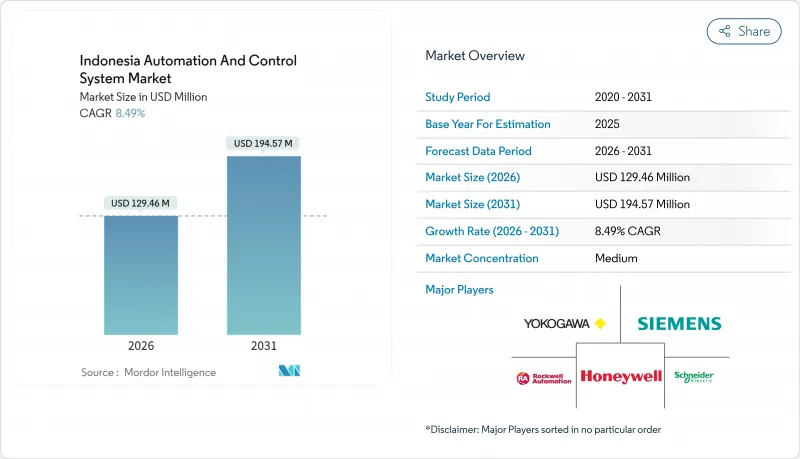
這項擴張反映了雅加達致力於將自身打造為東南亞製造地的努力、數位基礎設施與工業產能擴張的融合,以及支持節能生產的監管利多。政府的「印尼製造4.0」等項目、對電力產業的大規模資本投資、電動車投資的激增以及放寬的在地採購要求,都助力本土整合商擴大規模,同時也為全球供應商開闢了採購管道。跨國供應商正透過預測性維護軟體、網路安全架構和雲端對應平臺等優勢脫穎而出,而本土服務公司則憑藉具有成本競爭力的整合和全生命週期支援服務獲得市場認可。這些發展使印尼的自動化和控制系統市場成為更廣泛的工業現代化議程的核心,該議程旨在提升能源安全和出口競爭力。
印尼自動化與控制系統市場趨勢及洞察
電力產業產能擴張進展
總投資達51兆印尼幣(約32億美元)的大規模發電和輸電計劃正在推動對監控與數據採集(SCADA)和分散式控制系統(DCS)的需求,以整合可再生和火力發電設施。隨著可再生能源滲透率的提高,國有電力公司PLN正在對其水力發電廠和燃煤發電廠的勵磁系統進行升級改造,並部署SCADA系統以穩定頻率。 2024年7月,印尼將在在地採購要求放寬至30%以下,這擴大了供應商群體,促使跨國公司與印尼製造商合作以完成其採購配額。例如,橫河電機在峇里島的水處理SCADA系統項目以及PLN在南加里曼丹的多套勵磁系統維修項目,都顯示印尼自動化和控制系統市場正穩步發展。
無線感測器網路和通訊協定演進
5G部署與低成本感測器的結合,使得工廠無需改動現有線路即可連接輸送機、壓縮機和空調系統。阿斯特拉大發汽車公司將PLC控制的馬達連接到無線邊緣設備,使風扇能耗降低了20%,每年節省122.66千瓦時電力,減少10.67噸二氧化碳排放。目前,該製造商正逐步在邊緣端部署分析功能,用於即時預警並將模式發現任務排放至雲端控制面板。這種配置方案非常適合印尼這個島國的地理特徵。
現有設施維修的初始資本投資負擔
老舊的水泥廠、鋼鐵廠和石化廠在採用先進的分散式控制系統(DCS)之前,需要對控制迴路進行重新佈線並培訓操作人員。 PT Rainbow Tubulars Manufacture公司正在投資3000億印尼幣(約1890萬美元)對其無縫管道進行現代化改造,這凸顯了高昂的資本投入,也正是這些投入阻礙了中型企業進行類似的升級改造。模擬I/O與現代以乙太網路為基礎系統之間的整合難題,往往會導致預算超支和停機時間延長。
細分市場分析
到2025年,PLC將佔總收入的26.66%,證實了其在包裝、物料輸送和批量處理生產線中的普及程度。這一主導地位鞏固了印尼工廠車間自動化和控制系統市場的規模。然而,受新型汽車噴漆車間和電子表面黏著技術生產線對微米級重複精度需求的推動,預計到2031年,工業機器人將以9.74%的複合年成長率成長。 SCADA平台正穩步贏得電力公司的青睞,這些訂單致力於實現分散式資產可視性;而DCS正在滲透到化學、食品和飲料工廠,在這些工廠中,配方完整性至關重要。人機介面(HMI)設計正轉向電容式觸控和移動鏡像,在印尼這個地域分散的群島國家,主管人員能夠從遠端站點查看關鍵績效指標(KPI)至關重要。
隨著保險公司和監管機構要求配備SIL-3級緊急停機迴路,對安全系統的需求日益成長,推動了對三模組冗餘PLC和火焰探測陣列的需求。對效率的追求促使馬達從IE1級向IE3級遷移,後者與變頻驅動器配合使用,可降低能源成本並利用數據建立性能儀錶板。這些趨勢表明硬體現代化和軟體整合正在融合,從而增強了印尼自動化和控制系統市場的規模和深度。
到2025年,硬體將佔總收入的61.12%,其中包括控制器、感測器、致動器和安全交換機,這些構成了任何自動化架構的基礎。印尼自動化和控制系統市場的大部分資本支出最初都用於這一基礎層,這些支出來自汽車、電動車和日常消費品(FMCG)行業的生產線建設者,他們正在建造新的生產設施。軟體需求正從基本的人機介面(HMI)發展到高級分析、歷史數據整合和異常檢測,但就總收入而言,軟體仍然落後於硬體。
預計到2031年,服務領域將以9.48%的複合年成長率成長,這主要得益於製造商將系統整合、網路重構和預測性維護專案外包給專業公司(例如,PT Dycom Engineering,該公司2025年營收達580萬美元)。涵蓋備件、韌體、網路安全修補程式和操作員培訓的生命週期合約對那些沒有先進內部工程部門的公司尤其具有吸引力。隨著已安裝系統的老化,服務公司預計將提高其在印尼自動化和控制系統市場的佔有率,並實現收入來源多元化,獲得更多經常性收入。
其他福利:
- Excel格式的市場預測(ME)表
- 分析師支持(3個月)
目錄
第1章 引言
- 研究假設和市場定義
- 調查範圍
第2章調查方法
第3章執行摘要
第4章 市場情勢
- 市場概覽
- 市場促進因素
- 電力產業裝置容量成長取得顯著進展
- 無線感測器網路和通訊協定的演進
- 國內「印尼製造4.0」獎勵
- 業界強制性能效標準
- 電動車和電池製造領域的投資激增
- 利用人工智慧進行預測性維護的需求日益成長
- 市場限制
- 現有設施維修需要較高的初始資本投資成本。
- 進階自動化工程技能差距
- 商品價格波動影響石油、天然氣和採礦業;
- OT網路中的網路安全問題
- 產業價值鏈分析
- 監管環境
- 技術展望
- 波特五力分析
- 供應商的議價能力
- 買方的議價能力
- 新進入者的威脅
- 替代品的威脅
- 競爭對手之間的競爭
第5章 市場規模與成長預測
- 依產品
- 可程式邏輯控制器(PLC)
- 監控與數據採集(SCADA)
- 分散式控制系統(DCS)
- 人機介面(HMI)
- 安全系統
- 工業機器人
- 電動馬達(交流、直流、EC、伺服、步進)
- 驅動器(交流、直流、伺服)
- 按組件
- 硬體
- 軟體
- 服務
- 透過部署模式
- 本地部署
- 雲/工業物聯網邊緣
- 按最終用戶行業分類
- 石油和天然氣
- 發電
- 化工/石油化工
- 食品/飲料
- 金屬和採礦
- 水和污水處理
- 其他終端用戶產業
第6章 競爭情勢
- 市場集中度
- 策略趨勢
- 市佔率分析
- 公司簡介
- Yokogawa Electric Corporation
- Siemens AG
- Honeywell International Inc.
- Rockwell Automation Inc.
- Schneider Electric SE
- ABB Ltd.
- Emerson Electric Co.
- PT FANUC Indonesia
- Mitsubishi Electric Corporation
- Omron Corporation
- Delta Electronics Inc.
- Beckhoff Automation GmbH and Co. KG
- Advantech Co. Ltd.
- Bosch Rexroth AG
- Schneider Toshiba Inverter(STI)
- Fuji Electric Co. Ltd.
- Panasonic Industry Co. Ltd.
- Lenze SE
- Hitachi Industrial Equipment Systems Co. Ltd.
- Yokogawa Indonesia PT
- PT Omron Manufacturing of Indonesia
第7章 市場機會與未來展望
The Indonesia automation and control system market was valued at USD 119.34 billion in 2025 and estimated to grow from USD 129.46 billion in 2026 to reach USD 194.57 billion by 2031, at a CAGR of 8.49% during the forecast period (2026-2031).
The expansion reflects Jakarta's drive to position the country as Southeast Asia's manufacturing hub, the convergence of digital infrastructure with industrial capacity additions, and regulatory tailwinds that favour energy-efficient production. Government programs such as Making Indonesia 4.0, sizable power-sector capital expenditures, surging electric-vehicle investments, and relaxed local-content thresholds are opening procurement channels for global vendors even as domestic integrators scale up. Multinational suppliers are differentiating on predictive-maintenance software, cyber-secure architectures, and cloud-enabled platforms, while local service firms gain traction through cost-competitive integration and lifecycle support. These dynamics place the Indonesia automation and control system market at the center of a broader industrial modernization agenda that also improves energy security and export competitiveness.
Indonesia Automation And Control System Market Trends and Insights
Flourishing Power-Sector Capacity Additions
Massive generation and grid projects valued at IDR 51 trillion (USD 3.2 billion) are scaling demand for supervisory control and distributed control systems that coordinate renewable and thermal assets. State utility PLN is retrofitting excitation systems and deploying SCADA across hydro and coal plants to stabilize frequency as renewable penetration rises. The July 2024 decision to lower local-content rules below 30% widened the supplier pool and prompted multinationals to partner with Indonesian fabricators to meet sourcing quotas. Yokogawa's water-treatment SCADA in Bali and multiple PLN excitation retrofits in South Kalimantan illustrate the steady pipeline that supports the Indonesia automation and control system market.
Evolution of Wireless Sensor Networks and Protocols
5G rollout combined with lower-cost sensors is allowing factories to link conveyors, compressors, and HVAC systems without rewiring. PT Astra Daihatsu Motor cut fan energy use by 20% after connecting PLC-controlled motors to a wireless edge device, saving 122.66 kWh annually and avoiding 10.67 tCO2 emissions. Manufacturers now stage analytics at the edge for real-time alarms while offloading pattern discovery to cloud dashboards, a configuration well suited to Indonesia's archipelagic geography.
High Upfront CAPEX for Brown-Field Retrofits
Older cement, steel, and petrochemical complexes must rewire control loops and train operators before installing advanced DCS. PT Rainbow Tubulars Manufacture is investing IDR 300 billion (USD 18.9 million) to modernize seamless pipelines, revealing the cash requirements that deter midsize firms from similar upgrades. Integration surprises between analog I/O and modern Ethernet-based systems often inflate budgets and extend shutdown windows.
Other drivers and restraints analyzed in the detailed report include:
- Domestic Making Indonesia 4.0 Incentives
- Mandatory Energy-Efficiency Standards
- Skills Gap in Advanced Automation Engineering
For complete list of drivers and restraints, kindly check the Table Of Contents.
Segment Analysis
In 2025, PLCs generated 26.66% of revenue, confirming their ubiquity in packaging, material-handling, and batch-process lines. That domination secures a resilient base for the Indonesia automation and control system market size at the plant-floor level. However, Industrial Robotics is set to grow at a 9.74% CAGR through 2031, amplified by new automotive paint shops and electronics surface-mount lines that need micron-level repeatability. SCADA platforms gain steady orders from power utilities interested in distributed asset visualization, while DCS penetrates chemical and F&B plants where recipe integrity is mission-critical. HMI design is shifting toward capacitive touch and mobile mirroring, allowing supervisors to view KPIs from remote stations, an essential feature across Indonesia's dispersed archipelago.
The safety-system niche is widening as insurers and regulators insist on SIL-3 emergency-shutdown loops, boosting demand for triple-modular-redundant PLCs and flame-scanner arrays. Efficiency mandates are pushing a shift from IE1 to IE3 motors, and the pairing of these units with variable-speed drives slashes energy bills and unlocks data for performance dashboards. Together, these trends underscore how hardware modernization and software orchestration are converging, reinforcing both the scale and the depth of the Indonesia automation and control system market.
Hardware produced 61.12% of 2025 sales, encompassing controllers, sensors, actuators, and secure switches that underpin every automation architecture. Much of the capital spending in the Indonesia automation and control system market flows first into this stack as line builders outfit new capacities across automotive, EV, and FMCG verticals. Software demand is maturing from basic HMI to advanced analytics, historian integration, and anomaly detection, though it still trails hardware in total receipts.
Services will expand at a 9.48% CAGR through 2031 because manufacturers are outsourcing system integration, network re-engineering, and predictive-maintenance programs to specialists like PT Dycom Engineering, which reported USD 5.8 million revenue in 2025. Lifecycle contracts that bundle spares, firmware, cybersecurity patching, and operator training are particularly attractive to firms lacking deep in-house engineering benches. As installed bases age, the Indonesia automation and control system market share for service firms is poised to rise, diversifying revenue toward more recurring streams.
The Indonesia Automation and Control System Market Report is Segmented by Product (PLC, SCADA, DCS, HMI, Safety Systems, Industrial Robotics, Electric Motors, and Drives), Component (Hardware, Software, and Services), Deployment Mode (On-Premise, and Cloud/IIoT-Edge), End-User Industry (Oil and Gas, Power Generation, Chemical and Petrochemical, and More), and Geography. The Market Forecasts are Provided in Terms of Value (USD).
List of Companies Covered in this Report:
- Yokogawa Electric Corporation
- Siemens AG
- Honeywell International Inc.
- Rockwell Automation Inc.
- Schneider Electric SE
- ABB Ltd.
- Emerson Electric Co.
- PT FANUC Indonesia
- Mitsubishi Electric Corporation
- Omron Corporation
- Delta Electronics Inc.
- Beckhoff Automation GmbH and Co. KG
- Advantech Co. Ltd.
- Bosch Rexroth AG
- Schneider Toshiba Inverter (STI)
- Fuji Electric Co. Ltd.
- Panasonic Industry Co. Ltd.
- Lenze SE
- Hitachi Industrial Equipment Systems Co. Ltd.
- Yokogawa Indonesia PT
- PT Omron Manufacturing of Indonesia
Additional Benefits:
- The market estimate (ME) sheet in Excel format
- 3 months of analyst support
TABLE OF CONTENTS
1 INTRODUCTION
- 1.1 Study Assumptions and Market Definition
- 1.2 Scope of the Study
2 RESEARCH METHODOLOGY
3 EXECUTIVE SUMMARY
4 MARKET LANDSCAPE
- 4.1 Market Overview
- 4.2 Market Drivers
- 4.2.1 Flourishing power-sector capacity additions
- 4.2.2 Evolution of wireless sensor networks and protocols
- 4.2.3 Domestic "Making Indonesia 4.0" incentives
- 4.2.4 Mandatory energy-efficiency standards for industry
- 4.2.5 Surge in EV and battery manufacturing investments
- 4.2.6 AI-enabled predictive-maintenance demand
- 4.3 Market Restraints
- 4.3.1 High upfront CAPEX for brown-field retrofits
- 4.3.2 Skills gap in advanced automation engineering
- 4.3.3 Volatile commodity pricing impacting OandG, mining
- 4.3.4 Cyber-security concerns in OT networks
- 4.4 Industry Value Chain Analysis
- 4.5 Regulatory Landscape
- 4.6 Technological Outlook
- 4.7 Porter's Five Forces Analysis
- 4.7.1 Bargaining Power of Suppliers
- 4.7.2 Bargaining Power of Buyers
- 4.7.3 Threat of New Entrants
- 4.7.4 Threat of Substitutes
- 4.7.5 Intensity of Competitive Rivalry
5 MARKET SIZE AND GROWTH FORECASTS (VALUE)
- 5.1 By Product
- 5.1.1 Programmable Logic Controller (PLC)
- 5.1.2 Supervisory Control and Data Acquisition (SCADA)
- 5.1.3 Distributed Control System (DCS)
- 5.1.4 Human-Machine Interface (HMI)
- 5.1.5 Safety Systems
- 5.1.6 Industrial Robotics
- 5.1.7 Electric Motors (AC, DC, EC, Servo, Stepper)
- 5.1.8 Drives (AC, DC, Servo)
- 5.2 By Component
- 5.2.1 Hardware
- 5.2.2 Software
- 5.2.3 Services
- 5.3 By Deployment Mode
- 5.3.1 On-premise
- 5.3.2 Cloud / IIoT-Edge
- 5.4 By End-User Industry
- 5.4.1 Oil and Gas
- 5.4.2 Power Generation
- 5.4.3 Chemical and Petrochemical
- 5.4.4 Food and Beverage
- 5.4.5 Metals and Mining
- 5.4.6 Water and Wastewater
- 5.4.7 Other End-User Industries
6 COMPETITIVE LANDSCAPE
- 6.1 Market Concentration
- 6.2 Strategic Moves
- 6.3 Market Share Analysis
- 6.4 Company Profiles (includes Global Level Overview, Market Level Overview, Core Segments, Financials as available, Strategic Information, Market Rank/Share for key companies, Products and Services, and Recent Developments)
- 6.4.1 Yokogawa Electric Corporation
- 6.4.2 Siemens AG
- 6.4.3 Honeywell International Inc.
- 6.4.4 Rockwell Automation Inc.
- 6.4.5 Schneider Electric SE
- 6.4.6 ABB Ltd.
- 6.4.7 Emerson Electric Co.
- 6.4.8 PT FANUC Indonesia
- 6.4.9 Mitsubishi Electric Corporation
- 6.4.10 Omron Corporation
- 6.4.11 Delta Electronics Inc.
- 6.4.12 Beckhoff Automation GmbH and Co. KG
- 6.4.13 Advantech Co. Ltd.
- 6.4.14 Bosch Rexroth AG
- 6.4.15 Schneider Toshiba Inverter (STI)
- 6.4.16 Fuji Electric Co. Ltd.
- 6.4.17 Panasonic Industry Co. Ltd.
- 6.4.18 Lenze SE
- 6.4.19 Hitachi Industrial Equipment Systems Co. Ltd.
- 6.4.20 Yokogawa Indonesia PT
- 6.4.21 PT Omron Manufacturing of Indonesia
7 MARKET OPPORTUNITIES AND FUTURE OUTLOOK
- 7.1 White-space and Unmet-Need Assessment

 2026年全球數位化工作指導平台市場報告
 奶油生產線市場規模、佔有率和成長分析:按設備類型、產能、自動化程度、奶油類型、最終用戶和地區分類-2026-2033年產業預測
 高速計數機市場規模、佔有率和成長分析:按產品類型、技術、應用、最終用戶和地區分類-2026-2033年產業預測
 智慧包裝自動化市場預測(2034 年)—按包裝類型、自動化解決方案、組件、硬體類型、技術、應用、最終用戶和地區分類的全球分析2026年全球箱體自動化系統市場報告
 2026-2030年全球紡織業自動化市場
 水產養殖監測和自動化系統市場:商業機會、成長要素、產業趨勢分析以及 2026-2035 年預測。2034年航太航太機器人與自動化市場預測—全球機器人類型、自動化類型、飛機類型、技術、應用、最終用戶和區域分析人工智慧驅動的工業自動化市場預測至2034年——按組件、技術、產業、應用、最終用戶和地區分類的全球分析2026年全球舞台升降機自動化市場報告