


 |
市場調查報告書
商品編碼
1910578
中國包裝市場:市場佔有率分析、產業趨勢與統計、成長預測(2026-2031年)China Packaging - Market Share Analysis, Industry Trends & Statistics, Growth Forecasts (2026 - 2031) |
||||||

※ 本網頁內容可能與最新版本有所差異。詳細情況請與我們聯繫。
預計到2026年,中國包裝市場規模將達到2,290.5億美元,較2025年的2,183.7億美元持續成長。預計到2031年,該市場規模將達到2,907.4億美元,2026年至2031年的複合年成長率為4.89%。
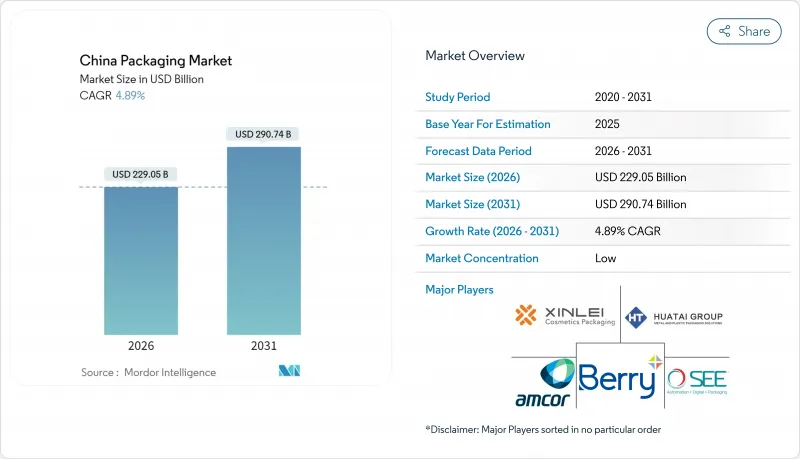
在全球最大的電子商務生態系統的推動下,中國包裝市場持續擴張。預計到2024年,小包裹量將達到1750億件,這將推動對耐用、易於自動化處理的包裝的需求。此外,強制宅配包裝標準(GB 43352-2023)正在推動中國包裝市場轉型為低毒材料和標準化尺寸。同時,九龍紙業等國內領先製造商和安姆科等全球企業正利用規模經濟、智慧工廠投資和生物開發平臺來增強自身競爭力。針對一次性塑膠的監管壓力,以及2025年PET飲料容器回收率達到96.48%的目標,正在加速再生材料和纖維性包裝的轉型。
中國包裝市場趨勢與洞察
電子商務小包裹量爆炸性成長
中國包裝市場與小包裹量密切相關,預計到2024年,包裹量將達到1,750億件。這給緩衝材料、防篡改封條和自動化分類能力帶來了前所未有的壓力。主要城市的履約中心正在部署人工智慧路線規劃系統,將從倉庫到目的地的運輸前置作業時間縮短了35%,迫使加工商在不影響結構完整性的前提下減少批量。瓦楞紙板加工商正在投資高速數位印刷生產線,將條碼和QR碼與物流平台整合,以實現最後一公里追蹤。採用模組化紙箱設計的市場參與企業報告稱,空隙率降低了兩位數,這在宅配業者轉向按體積收費的情況下尤其重要。這些發展正在推動中國包裝市場的成長,同時也使那些能夠將資料載體功能直接整合到包裝基材中的加工商受益。
人們越來越傾向於選擇永續的紙質形式
中國的政策議程優先考慮可回收原料,鼓勵品牌商在飲料、個人護理和電商物流包裝中優先選擇纖維基解決方案。國務院的《綠色運輸條例》要求零售商提供商店回收設施並公開包裝減量指標。箱板紙廠正在向高性能、輕質紙板轉型,這得益於塗佈技術的創新,這些創新可以減少水分滲入。產能擴張的一個例子是維美德公司位於安徽省臨平市的OptiConcept M紙板生產線,該生產線計劃於2025年底運作(投資額為4,000萬至6,000萬歐元/4,300萬至6,400萬美元)。纖維基包裝的普及也推動了消費者意識的提高:一項全國性調查發現,如果性能相當,68%的消費者會選擇紙質包裝來包裝網上生鮮食品。
塑膠禁令和生產者延伸責任
在中國,零售和宅配領域一次性塑膠製品的禁令正在擴大,這增加了合規成本,並加速了材料替代的進程。生產者延伸責任制(EPR)要求生產者為回收系統資金籌措,而各省缺乏統一的執法標準,使得成本轉嫁策略的發展變得複雜。品牌商不確定性透過建構閉合迴路紙製品系統來規避風險,而其他企業則尋求與廢棄物管理公司成立合資企業以確保原料供應。在標準穩定之前,預計中國包裝市場的資金配置將更傾向於現有設施的維修,而非新建聚合物計劃。
細分市場分析
到2025年,紙和紙板產業將佔中國包裝市場佔有率的42.65%,這主要得益於瓦楞紙箱對電商物流的支持以及消費者對紡織品回收利用的持續高漲信心。此外,中國PET飲料瓶回收率達到96.48%這一里程碑式的成就也推動了該行業的發展,使大眾更加關注纖維素回收系統。造紙廠的維修傾向於生產高強度、輕質紙板,使承運商能夠滿足中國國家標準GB 43352-2023的尺寸和負載測試要求。同時,預計到2031年,隨著瓦楞紙包裝出口需求以每年略低於5%的速度成長,中國紙和紙板包裝市場將持續擴張。
其他材料(生物基聚合物、黃麻混紡薄膜和木質素複合材料)儘管增速較慢,但仍以7.09%的複合年成長率實現了最快成長。學術突破表明,黃麻混紡可使纖維產量提高24.42%,從而加速防潮澱粉黃麻內襯的大規模生產。木質素生物複合材料具有抗氧化性能,適用於糖果甜點包裝,滿足了不含合成添加劑的活性包裝的需求。儘管確保生物聚合物的成本競爭力仍然是一項挑戰,但主要的快速消費品公司正在利用生產者責任延伸(EPR)費用返還政策來試行這些材料。
初級包裝形式(紙盒、瓶裝和泡殼包裝)佔中國包裝市場規模的69.20%,對產品保護和展示效果仍然至關重要。食品安全要求和QR碼追蹤法規促使企業持續投資高速填充線和裝飾技術。此外,法規環境也要求膳食補充劑必須使用防篡改密封,從而維持了對多層複合材料的需求。
受履約中心自動化堆疊和跨境電商帶來的承重需求三倍成長的推動,三級包裝市場正以5.93%的複合年成長率快速擴張。出口宅配業者指定使用耐壓且具備RFID功能的托盤,這些托盤能夠向倉庫管理系統提供即時數據,使其成為極具吸引力的獲利來源。新興參與企業提供由再生纖維和生物樹脂製成的複合托盤,縮短了線上零售商的前置作業時間,並進一步鞏固了中國包裝市場的成長動能。
其他福利:
- Excel格式的市場預測(ME)表
- 3個月的分析師支持
目錄
第1章 引言
- 研究假設和市場定義
- 調查範圍
第2章調查方法
第3章執行摘要
第4章 市場情勢
- 市場概覽
- 市場促進因素
- 電子商務小包裹量爆炸性成長
- 人們越來越偏好永續的紙質形式
- 對便利性的需求/對即食食品包裝的需求
- 擴大藥品低溫運輸
- 智慧物流(物聯網)賦能的可追溯包裝
- 超低溫生物製藥包裝衝擊
- 市場限制
- 塑膠禁令法規和生產者延伸責任制
- 紙漿和聚合物原料成本波動;
- 各地區的回收基礎設施狀況不盡相同。
- 都市區可重複使用托特包的試點計畫削弱了對紙板的需求
- 價值鏈分析
- 監管環境
- 技術展望
- 波特五力分析
- 新進入者的威脅
- 供應商的議價能力
- 買方的議價能力
- 替代品的威脅
- 競爭對手之間的競爭
- 市場宏觀經濟趨勢的評估
第5章 市場規模與成長預測
- 透過包裝材料
- 塑膠
- 紙和紙板
- 玻璃
- 金屬
- 其他材料
- 按包裝類型
- 初級包裝
- 二級包裝
- 三級包裝
- 按包裝類型
- 硬包裝
- 軟包裝
- 按最終用戶行業分類
- 食品/飲料
- 醫療和藥品
- 美容及個人護理
- 工業的
- 其他終端用戶產業
第6章 競爭情勢
- 市場集中度
- 策略趨勢
- 市佔率分析
- 公司簡介
- Nine Dragons Paper(Holdings)Ltd.
- Lee and Man Paper Manufacturing Ltd.
- Shanying International Holdings Co., Ltd.
- Hexing Packaging Co., Ltd.
- Greatview Aseptic Packaging Co., Ltd.
- Wuxi Huatai Co.,Ltd
- Shanghai Zijiang Enterprise Group Co., Ltd.
- YUTO Packaging Technology Co., Ltd.
- Zhejiang Xinlei Packaging Co., Ltd.
- Guangdong Champ New Material Co., Ltd.
- Crown Holdings, Inc.
- Amcor Plc
- Berry Global Group, Inc.
- International Paper Company
- WestRock Company
- Sealed Air Corporation
- Tetra Pak(China)Ltd.
- Beijing Hualian Printing Co., Ltd.
- Zhejiang Jiashan Dingxin Packaging Co., Ltd.
- Shenzhen Yutong Packaging Technology Co., Ltd.
第7章 市場機會與未來展望
The China packaging market size in 2026 is estimated at USD 229.05 billion, growing from 2025 value of USD 218.37 billion with 2031 projections showing USD 290.74 billion, growing at 4.89% CAGR over 2026-2031.
The China packaging market continues to expand on the back of the world's largest e-commerce ecosystem; parcel volumes touched 175 billion units in 2024, intensifying demand for durable, automation-ready pack formats. Mandatory express packaging standards (GB 43352-2023) are also steering the China packaging market toward low-toxicity substrates and standardised dimensions. Concurrently, large domestic producers such as Nine Dragons Paper and global majors like Amcor are leveraging scale, smart-factory investments and bio-based R&D pipelines to strengthen competitive positions. Regulatory pressure on single-use plastics, coupled with a 96.48% PET beverage recovery rate in 2025, is accelerating the shift to recycled and fibre-based formats.
China Packaging Market Trends and Insights
Explosive Growth of E-commerce Parcel Volume
The China packaging market is tightly linked to parcel throughput, which reached 175 billion units in 2024, driving unprecedented pressure on cushioning, tamper-evident seals and automated sorting compatibility. Fulfilment centres in Tier 1 cities now rely on AI routing systems that reduce dock-to-door lead-times by 35%, obliging converters to shorten run lengths without compromising structural integrity. Corrugated converters are investing in high-speed digital print lines that align barcodes and QR codes with logistics platforms, supporting last-mile traceability. Market participants adopting modular carton designs report double-digit reductions in void space, a priority as courier firms pivot toward volumetric pricing. These developments sustain the momentum of the China packaging market while rewarding converters able to integrate data carrier features directly into pack substrates.
Rising Preference for Sustainable Paper-Based Formats
China's policy agenda prioritises recyclable inputs, prompting brand owners to favour fibre-based solutions across beverages, personal care and e-commerce mailers. The State Council's eco-friendly delivery rules oblige retailers to offer in-store take-back facilities and publicly disclose packaging reduction metrics. Containerboard mills are shifting to higher-performance lightweight grades, helped by coating innovations that mitigate moisture ingress. Capacity expansions include Valmet's OptiConcept M board line for Anhui Linping, scheduled online by end-2025 (EUR 40-60 million; USD 43-64 million). Fibre-based adoption also benefits from consumer recognition: nationwide surveys show 68% of shoppers prefer paper wrappers for online grocery deliveries when performance is comparable.
Plastic-Ban and Extended-Producer-Responsibility Rules
China prohibits a widening list of single-use plastics in retail and courier channels, increasing compliance costs and accelerating material substitutions. Producers must finance recycling systems under EPR, and the absence of uniform provincial enforcement complicates cost pass-through strategies. Brands face uncertainty over forthcoming recycled-content thresholds for PET and PP food-contact packs. Leading converters are hedging by building closed-loop paper systems; others form joint ventures with waste-management firms to secure feedstock. Until standards stabilise, capital allocation in the China packaging market skews toward retrofits rather than green-field polymer projects.
Other drivers and restraints analyzed in the detailed report include:
- Demand for Convenience/RTD Food Packs
- Pharmaceutical Cold-Chain Expansion
- Volatile Pulp and Polymer Feedstock Costs
For complete list of drivers and restraints, kindly check the Table Of Contents.
Segment Analysis
Paper and Paperboard captured 42.65% of China packaging market share in 2025 as corrugated boxes underpinned e-commerce fulfilment and consumer confidence in fibre recyclability remained high. The segment benefits from China's 96.48% PET beverage recycling milestone that shifts public attention to cellulose-based loops. Mill revamps are oriented toward high-strength light-weight grades, enabling shippers to meet express standard GB 43352-2023 dimensional and stacking tests. Concurrently, the China packaging market size for Paper and Paperboard is expected to rise in tandem with export-oriented corrugated demand growing at a mid-single-digit pace to 2031.
Other Materials-bio-based polymers, jute-blend films and lignin composites-record the fastest 7.09% CAGR, albeit from a low base. Academic breakthroughs reveal jute hybridisation delivering 24.42% fibre-yield gains, accelerating scale-up of moisture-resistant starch-jute liners. Lignin-bionanocomposites imbue antioxidant properties suitable for confectionery wraps, meeting demand for active packaging without synthetic additives. Investment hurdles linger-biopolymer cost parity remains elusive-but leading FMCG firms are piloting such materials, incentivised by EPR fee rebates.
Primary formats-cartons, bottles, blister packs-represent 69.20% of the China packaging market size and remain critical to product protection and shelf appeal. Food-safety expectations and QR-code traceability rules ensure persistent capital expenditure in high-speed filling lines and decoration technologies. The regulatory environment also requires tamper-proof seals for nutraceuticals, sustaining demand for multi-layer laminates.
Tertiary packaging grows at 5.93% CAGR as fulfilment centres automate palletising and cross-border e-commerce triples load-bearing requirements. Export couriers specify crush-proof, RFID-enabled pallets that feed real-time data to warehouse-management systems, creating an attractive profit pool. Market entrants offering composite pallet blocks made with recycled fibre and bio-resins shorten lead times for online retailers and reinforce the growth curve of the China packaging market.
The China Packaging Market Report is Segmented by Packaging Material (Plastic, Paper and Paperboard, Glass, and More), Types of Packaging (Primary Packaging, Secondary Packaging, and Tertiary Packaging), Packaging Format (Rigid Packaging, and Flexible Packaging), End-User Industry (Food and Beverage, Healthcare and Pharmaceutical, Beauty and Personal Care, and More). The Market Forecasts are Provided in Terms of Value (USD).
List of Companies Covered in this Report:
- Nine Dragons Paper (Holdings) Ltd.
- Lee and Man Paper Manufacturing Ltd.
- Shanying International Holdings Co., Ltd.
- Hexing Packaging Co., Ltd.
- Greatview Aseptic Packaging Co., Ltd.
- Wuxi Huatai Co.,Ltd
- Shanghai Zijiang Enterprise Group Co., Ltd.
- YUTO Packaging Technology Co., Ltd.
- Zhejiang Xinlei Packaging Co., Ltd.
- Guangdong Champ New Material Co., Ltd.
- Crown Holdings, Inc.
- Amcor Plc
- Berry Global Group, Inc.
- International Paper Company
- WestRock Company
- Sealed Air Corporation
- Tetra Pak (China) Ltd.
- Beijing Hualian Printing Co., Ltd.
- Zhejiang Jiashan Dingxin Packaging Co., Ltd.
- Shenzhen Yutong Packaging Technology Co., Ltd.
Additional Benefits:
- The market estimate (ME) sheet in Excel format
- 3 months of analyst support
TABLE OF CONTENTS
1 INTRODUCTION
- 1.1 Study Assumptions and Market Definition
- 1.2 Scope of the Study
2 RESEARCH METHODOLOGY
3 EXECUTIVE SUMMARY
4 MARKET LANDSCAPE
- 4.1 Market Overview
- 4.2 Market Drivers
- 4.2.1 Explosive growth of e-commerce parcel volume
- 4.2.2 Rising preference for sustainable paper-based formats
- 4.2.3 Demand for convenience/RTD food packs
- 4.2.4 Pharmaceutical cold-chain expansion
- 4.2.5 Smart-logistics (IoT) enabled track-and-trace packs
- 4.2.6 Ultra-low-temperature bio-pharma packaging surge
- 4.3 Market Restraints
- 4.3.1 Plastic-ban and extended-producer-responsibility rules
- 4.3.2 Volatile pulp and polymer feedstock costs
- 4.3.3 Patchy provincial recycling infrastructure
- 4.3.4 Reusable tote pilots eroding urban corrugated demand
- 4.4 Value Chain Analysis
- 4.5 Regulatory Landscape
- 4.6 Technological Outlook
- 4.7 Porter's Five Forces Analysis
- 4.7.1 Threat of New Entrants
- 4.7.2 Bargaining Power of Suppliers
- 4.7.3 Bargaining Power of Buyers
- 4.7.4 Threat of Substitutes
- 4.7.5 Competitive Rivalry
- 4.8 Assessment of Macro Economic Trends on the Market
5 MARKET SIZE AND GROWTH FORECASTS (VALUES)
- 5.1 By Packaging Material
- 5.1.1 Plastic
- 5.1.2 Paper and Paperboard
- 5.1.3 Glass
- 5.1.4 Metal
- 5.1.5 Other Materials
- 5.2 By Types of Packaging
- 5.2.1 Primary Packaging
- 5.2.2 Secondary Packaging
- 5.2.3 Tertiary Packaging
- 5.3 By Packaging Format
- 5.3.1 Rigid Packaging
- 5.3.2 Flexible Packaging
- 5.4 By End-user Industry
- 5.4.1 Food and Beverages
- 5.4.2 Healthcare and Pharmaceutical
- 5.4.3 Beauty and Personal Care
- 5.4.4 Industrial
- 5.4.5 Other End-user Industries
6 COMPETITIVE LANDSCAPE
- 6.1 Market Concentration
- 6.2 Strategic Moves
- 6.3 Market Share Analysis
- 6.4 Company Profiles (includes Global level Overview, Market level overview, Core Segments, Financials as available, Strategic Information, Market Rank/Share for key companies, Products and Services, and Recent Developments)
- 6.4.1 Nine Dragons Paper (Holdings) Ltd.
- 6.4.2 Lee and Man Paper Manufacturing Ltd.
- 6.4.3 Shanying International Holdings Co., Ltd.
- 6.4.4 Hexing Packaging Co., Ltd.
- 6.4.5 Greatview Aseptic Packaging Co., Ltd.
- 6.4.6 Wuxi Huatai Co.,Ltd
- 6.4.7 Shanghai Zijiang Enterprise Group Co., Ltd.
- 6.4.8 YUTO Packaging Technology Co., Ltd.
- 6.4.9 Zhejiang Xinlei Packaging Co., Ltd.
- 6.4.10 Guangdong Champ New Material Co., Ltd.
- 6.4.11 Crown Holdings, Inc.
- 6.4.12 Amcor Plc
- 6.4.13 Berry Global Group, Inc.
- 6.4.14 International Paper Company
- 6.4.15 WestRock Company
- 6.4.16 Sealed Air Corporation
- 6.4.17 Tetra Pak (China) Ltd.
- 6.4.18 Beijing Hualian Printing Co., Ltd.
- 6.4.19 Zhejiang Jiashan Dingxin Packaging Co., Ltd.
- 6.4.20 Shenzhen Yutong Packaging Technology Co., Ltd.
7 MARKET OPPORTUNITIES AND FUTURE OUTLOOK
- 7.1 White-space and Unmet-need Assessment

 歐洲化妝品和香水玻璃瓶包裝:市場佔有率分析、行業趨勢和統計數據以及成長預測(2026-2031 年)
 感官包裝市場-2026-2032年全球市場預測
 追溯包裝市場規模、佔有率、成長和行業分析:按技術、最終用途和地區分類,預測至2034年
 2026年全球三級包裝市場報告
 家居用品包裝市場預測至2034年-按包裝類型、材料、產品類型、包裝形式、最終用戶和地區分類的全球分析
 磚形紙盒包裝市場規模、佔有率和成長分析:按材料類型、產品類型、應用、產能、最終用戶、封口方式和地區分類-2026-2033年產業預測
 三折包裝市場規模、佔有率和成長分析:按材料、產品類型、印刷技術、應用、最終用戶、分銷管道和地區分類-2026-2033年產業預測
 轉換器設備市場規模、佔有率和成長分析:按設備類型、材料類型、自動化程度、最終用戶產業、安裝類型、銷售管道和地區分類-2026-2033年產業預測包裝用紡織品市場規模、應用及預測(2034 年)個人化數位包裝市場預測至2034年-全球分析(按印刷方法、包裝形式、基材、個人化方法、最終用戶和地區分類)