


 |
市場調查報告書
商品編碼
1906253
行銷科技市場:市場佔有率分析、產業趨勢與統計、成長預測(2026-2031)Marketing Technology Market - Market Share Analysis, Industry Trends & Statistics, Growth Forecasts (2026 - 2031) |
||||||

※ 本網頁內容可能與最新版本有所差異。詳細情況請與我們聯繫。
預計到 2025 年,行銷技術市場價值將達到 5,800 億美元,到 2026 年將成長至 6,609.1 億美元,到 2031 年將成長至 12708.2 億美元,預測期(2026-2031 年)的複合年成長率為 13.95%。
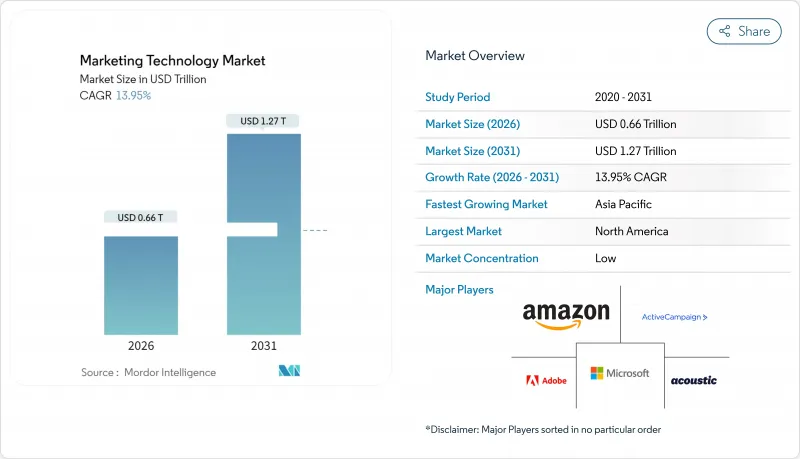
企業對雲端優先、嵌入式人工智慧技術堆疊的需求是關鍵的成長要素,它能夠實現宣傳活動調整、動態內容產生以及大規模跨通路歸因。市場領導企業正在將生成式人工智慧融入其核心產品。同時,監管機構日益施壓,要求企業轉向以隱私為先的資料策略,這推高了第一方和零方資料資產的價值。競爭格局有利於那些能夠在可配置架構中整合創新、數據和激活工作流程的供應商,從而使企業能夠精細控制成本、延遲和合規性。自動化內容管道帶來的營運效率提升已經提高了宣傳活動的投資報酬率,並抵消了不斷成長的人工智慧運算支出。
全球行銷科技市場趨勢與洞察
雲端優先行銷技術堆疊的採用率激增
企業持續積極向雲端原生架構轉型,以消除資料孤島,並在所有客戶觸點實現即時決策。微軟在墨西哥投資13億美元、在巴西投資27億美元建造資料中心,凸顯了建置區域基礎設施以支援低延遲客戶資料處理的必要性。 IT團隊報告稱,週期時間顯著縮短,使行銷人員能夠將宣傳活動部署時間從數週縮短至數小時,從而提高個人化精準度和產生收入速度。
生成式人工智慧貫穿整個宣傳活動編配
生成式人工智慧正在將傳統的、手動的、被動的流程轉變為主動的體驗編配引擎。 Adobe 的客戶經驗編配平台展示了人工智慧如何整合創新和行銷功能,從而實現持續的內容最佳化,而無需依賴耗費大量人力的 A/B 測試。企業強調利潤率的提升,其獨特的模式與傳統的 SaaS 工具相比,毛利率提高了 50-60%。
總擁有成本 (TCO) 增加和合併負債
企業在現有系統中加裝人工智慧工具會產生計畫外的資料遷移和維護成本,這些成本可能超出初始預算 40% 至 60%。僅雲端儲存一項,到 2025 年,IT 支出就將超過 2000 億美元,這將迫使財務長重新考慮他們的平台選擇。
細分市場分析
到2025年,行銷自動化將佔據行銷科技市場25.60%的佔有率,凸顯其作為全通路客戶體驗管理核心的地位。隨著企業轉向整合數據、內容和激活工作流程的編配引擎,與行銷自動化相關的行銷技術市場規模預計將持續成長。目前,人工智慧驅動的生成式內容工具的收入基數較小,但預計到2031年將以25.92%的複合年成長率成長,因為品牌會將支出重新分配到可擴展的人工智慧驅動的內容生成領域。社群媒體和內容行銷套件透過實現直接的受眾互動而穩定成長,而富媒體創作工具則受益於影片需求的不斷成長。
企業將快速內容部署視為永續的競爭優勢,並正將預算集中投入能夠將創意與即時效果分析結合的平台。 Adobe 的 GenStudio Foundation 就是一個很好的例子,它展示了供應商如何將自動化整合到內容供應鏈中,使行銷人員能夠在不損害品牌價值的前提下發佈內容。銷售賦能套件現在包含基於人工智慧訓練的過往成交資料的預測案源計分,以加速銷售轉換。
區域分析
到2025年,北美將佔據行銷技術市場37.60%的佔有率,這主要得益於成熟的雲端運算應用、創業融資以及先進的人工智慧研究能力。隨著各州隱私法的訂定,合規難度加大,區域領導企業正利用深度生態系統整合來維持競爭優勢。加拿大企業正在完善其用戶許可策略,以應對C-27法案的實施;而美國企業則正在採用隱私安全的分析技術,以規避訴訟風險。
亞太地區是成長最快的地區,預計2026年至2031年複合年成長率將達到15.95%。政府對數位基礎設施的支持正在加速行動優先消費群體對行銷技術的採用。在印度,受本地語言內容和人工智慧驅動的廣告導向創新推動,預計到2025年,數位行銷市場規模將達到11.2兆印度盧比(134億美元)。東南亞的廣告主正在將更大比例的媒體支出分配給社群電商,而澳洲公司則在增加人工智慧行銷預算,以逐步提高轉換率。
歐洲市場受到嚴格監管的影響。 《一般資料保護規範》(GDPR) 2025、《數位市場法案》和《數位服務法案》共同重新定義了資料管理義務。服務於該地區的供應商必須建立符合所有27個成員國標準的預設隱私架構,並且通常需要將這些標準推廣至全球。在拉丁美洲,墨西哥同時迎來了Netflix的10億美元製作投資計畫和阿里巴巴的首個本地雲端區域,預示著國際公司在該地區數位化業務的強勁成長。同時,在中東和非洲,隨著支付基礎設施的成熟和跨境物流的改善,開發者正在加速採用電子商務平台。
其他福利:
- Excel格式的市場預測(ME)表
- 3個月的分析師支持
目錄
第1章 引言
- 研究假設和市場定義
- 調查範圍
第2章調查方法
第3章執行摘要
第4章 市場情勢
- 市場概覽
- 市場促進因素
- 主流趨勢:雲端優先行銷技術堆疊的快速普及
- 主流趨勢-將生成式人工智慧融入整體宣傳活動編配
- 主流趨勢:以隱私為中心的第一方資料策略
- 鮮為人知的趨勢:零方資料微交換項目
- 不太受歡迎-可組合的CDP架構打破了套件鎖定。
- 市場限制
- 主流趨勢-總擁有成本 (TCO) 和合併負債不斷增加
- 主流趨勢-複雜行銷技術堆疊中的技能差距
- 鮮為人知的趨勢:蘋果私有中繼和瀏覽器級廣告攔截
- 一個鮮為人知的趨勢:ESG主導的雲碳排放上限限制數據密集型行銷技術
- 價值鏈分析
- 監管環境
- 技術展望
- 波特五力分析
- 新進入者的威脅
- 供應商的議價能力
- 買方的議價能力
- 替代品的威脅
- 競爭對手之間的競爭
- 產業資金籌措和併購趨勢
第5章 市場規模與成長預測
- 依產品
- 社群媒體工具
- 內容行銷工具
- 富媒體創作工具
- 行銷自動化平台
- 數據和分析工具
- 銷售賦能工具
- 透過使用
- 資訊科技/通訊
- 零售與電子商務
- 衛生保健
- 媒體與娛樂
- 體育賽事
- BFSI
- 按地區
- 北美洲
- 南美洲
- 歐洲
- 亞太地區
- 中東
- 非洲
第6章 競爭情勢
- 市場集中度
- 策略趨勢
- 市佔率分析
- 公司簡介
- Adobe Inc.
- Alphabet Inc.(Google Marketing Platform)
- Amazon Web Services(AWS for Martech)
- Salesforce Inc.
- Microsoft Corp.
- Oracle Corp.
- HubSpot Inc.
- SAP SE
- Shopify Inc.
- Mailchimp(Intuit)
- Hootsuite Inc.
- Sprinklr Inc.
- Zoho Corp.(Zoho Marketing Plus)
- Optimizely
- Klaviyo
- Acoustic LP
- ActiveCampaign
- FullCircl Ltd.
- Buzzoole Holdings Ltd.
- Konnect Insights
- Iterable
第7章 市場機會與未來展望
The Marketing Technology Market was valued at USD 580 billion in 2025 and estimated to grow from USD 660.91 billion in 2026 to reach USD 1,270.82 billion by 2031, at a CAGR of 13.95% during the forecast period (2026-2031).
Enterprise demand for cloud-first, AI-embedded stacks is the primary accelerator, enabling real-time orchestration of campaigns, dynamic content generation, and cross-channel attribution at scale. Market leaders are embedding generative AI in core products, while regulatory pressure to transition toward privacy-first data strategies raises the value of first-party and zero-party data assets. Competitive dynamics favor vendors that can unify creative, data, and activation workflows inside a composable architecture, giving enterprises granular control over costs, latency, and compliance. Operational efficiency gains from automated content pipelines are already improving campaign ROI enough to offset rising AI compute expenditures.
Global Marketing Technology Market Trends and Insights
Cloud-First Marketing Stacks Adoption Surge
Enterprises continue an aggressive pivot toward cloud-native architectures to collapse data silos and enable real-time decisioning across every customer touchpoint. Microsoft's USD 1.3 billion Mexico and USD 2.7 billion Brazil data-center commitments underscore the need for regional infrastructure that supports low-latency customer data processing. IT teams report cycle-time reductions that let marketers shrink campaign rollouts from weeks to hours, boosting personalization accuracy and revenue velocity.
GenAI Embedded Across Campaign Orchestration
Generative AI is transforming what used to be manual, reactive workflows into proactive experience orchestration engines. Adobe's Customer Experience Orchestration platform illustrates how AI unites creative and marketing functions under one roof, enabling continuous content optimization without relying on labor-intensive A/B testing. Enterprises highlight margin expansion as proprietary models deliver 50-60% gross margins versus legacy SaaS tools.
Rising Total Cost of Ownership and Integration Debt
Organizations layering AI tools onto legacy stacks face unplanned data-migration and maintenance bills that exceed initial budgets by 40-60%. Cloud storage alone surpassed USD 200 billion of IT spend in 2025, pressuring CFOs to reassess platform choices.
Other drivers and restraints analyzed in the detailed report include:
- Privacy-Driven First-Party Data Strategies
- Zero-Party Data Micro-Exchange Programs
- Skills Gap for Complex Martech Stacks
For complete list of drivers and restraints, kindly check the Table Of Contents.
Segment Analysis
Marketing Automation captured 25.60% of the marketing technology market share in 2025, validating its role as the control center for omnichannel journey management. The marketing technology market size tied to Marketing Automation is projected to grow alongside enterprises' pivot to unified orchestration engines that connect data, content, and activation workflows. GenAI-Powered Content Tools, while representing a smaller revenue base today, are forecast to post a 25.92% CAGR through 2031 as brands redistribute spend toward scalable, AI-driven content generation. Social media and content marketing suites post steady gains by enabling direct audience engagement, whereas rich-media creation tools benefit from rising video demand.
Enterprises view content velocity as a durable moat, directing budgets toward platforms that marry creative excellence with real-time performance insights. Adobe's GenStudio Foundation exemplifies how vendors integrate automation into the content supply chain, allowing marketers to publish without sacrificing brand integrity. Sales-enablement suites now embed predictive lead scoring that draws on AI-trained historical win data to accelerate pipeline conversion.
The Marketing Technology Market Report is Segmented by Product (Social Media Tools, Content Marketing Tools, Rich-Media Creation Tools, and More), Application (IT and Telecommunications, Retail and E-Commerce, Healthcare, Media and Entertainment, and More), and Geography. The Market Forecasts are Provided in Terms of Value (USD).
Geography Analysis
North America controlled 37.60% of the marketing technology market in 2025 due to mature cloud adoption, venture funding, and advanced AI research capabilities. Regional leaders leverage deep ecosystem integrations to maintain competitive edge, even as state-level privacy statutes multiply compliance tasks. Canadian enterprises refine consent strategies in anticipation of Bill C-27, while US-based firms deploy privacy-preserving analytics to stay ahead of litigation exposure.
APAC is the fastest-growing region, projected to log a 15.95% CAGR over 2026-2031. Governments support digital infrastructure build-outs, enabling widespread uptake of marketing tech among mobile-first consumers. India expects its digital marketing sector to reach INR 1.12 lakh crore (USD 13.4 billion) by 2025, powered by local-language content and AI-enabled ad-targeting innovations. Southeast Asian advertisers are directing larger shares of media spend toward social commerce, and Australian enterprises are expanding AI marketing budgets to capture incremental conversion gains.
Europe's outlook is colored by stringent regulations: GDPR 2025, the Digital Markets Act, and the Digital Services Act collectively redefine data stewardship obligations. Vendors serving the region must design default-privacy architectures that comply across all 27 member states, often rolling those standards global. In Latin America, Mexico welcomed both Netflix's USD 1 billion production pledge and Alibaba's first local cloud region, signals that international players foresee robust digital growth. Meanwhile, Middle East and Africa developers accelerate e-commerce stack adoption as payment rails mature and cross-border logistics improve.
- Adobe Inc.
- Alphabet Inc. (Google Marketing Platform)
- Amazon Web Services (AWS for Martech)
- Salesforce Inc.
- Microsoft Corp.
- Oracle Corp.
- HubSpot Inc.
- SAP SE
- Shopify Inc.
- Mailchimp (Intuit)
- Hootsuite Inc.
- Sprinklr Inc.
- Zoho Corp. (Zoho Marketing Plus)
- Optimizely
- Klaviyo
- Acoustic L.P.
- ActiveCampaign
- FullCircl Ltd.
- Buzzoole Holdings Ltd.
- Konnect Insights
- Iterable
Additional Benefits:
- The market estimate (ME) sheet in Excel format
- 3 months of analyst support
TABLE OF CONTENTS
1 INTRODUCTION
- 1.1 Study Assumptions and Market Definition
- 1.2 Scope of the Study
2 RESEARCH METHODOLOGY
3 EXECUTIVE SUMMARY
4 MARKET LANDSCAPE
- 4.1 Market Overview
- 4.2 Market Drivers
- 4.2.1 Mainstream - Cloud-first marketing stacks adoption surge
- 4.2.2 Mainstream - GenAI embedded across campaign orchestration
- 4.2.3 Mainstream - Privacy-driven first-party data strategies
- 4.2.4 Under-the-radar - Zero-party data micro-exchange programs
- 4.2.5 Under-the-radar - Composable CDP architectures beating suite lock-in
- 4.3 Market Restraints
- 4.3.1 Mainstream - Rising total cost of ownership and integration debt
- 4.3.2 Mainstream - Skills gap for complex martech stacks
- 4.3.3 Under-the-radar - Apple Private Relay and browser-level ad-blocking
- 4.3.4 Under-the-radar - ESG-driven cloud carbon limits on data-heavy martech
- 4.4 Value Chain Analysis
- 4.5 Regulatory Landscape
- 4.6 Technological Outlook
- 4.7 Porter's Five Forces Analysis
- 4.7.1 Threat of New Entrants
- 4.7.2 Bargaining Power of Suppliers
- 4.7.3 Bargaining Power of Buyers
- 4.7.4 Threat of Substitutes
- 4.7.5 Intensity of Competitive Rivalry
- 4.8 Industry Funding and M&A Trends
5 MARKET SIZE AND GROWTH FORECASTS (VALUE)
- 5.1 By Product
- 5.1.1 Social Media Tools
- 5.1.2 Content Marketing Tools
- 5.1.3 Rich-Media Creation Tools
- 5.1.4 Marketing Automation Platforms
- 5.1.5 Data and Analytics Tools
- 5.1.6 Sales Enablement Tools
- 5.2 By Application
- 5.2.1 IT and Telecommunications
- 5.2.2 Retail and E-commerce
- 5.2.3 Healthcare
- 5.2.4 Media and Entertainment
- 5.2.5 Sports and Events
- 5.2.6 BFSI
- 5.3 By Geography
- 5.3.1 North America
- 5.3.2 South America
- 5.3.3 Europe
- 5.3.4 Asia-Pacific
- 5.3.5 Middle East
- 5.3.6 Africa
6 COMPETITIVE LANDSCAPE
- 6.1 Market Concentration
- 6.2 Strategic Moves
- 6.3 Market Share Analysis
- 6.4 Company Profiles (includes Global level Overview, Market level overview, Core Segments, Financials as available, Strategic Information, Market Rank/Share for key companies, Products and Services, and Recent Developments)
- 6.4.1 Adobe Inc.
- 6.4.2 Alphabet Inc. (Google Marketing Platform)
- 6.4.3 Amazon Web Services (AWS for Martech)
- 6.4.4 Salesforce Inc.
- 6.4.5 Microsoft Corp.
- 6.4.6 Oracle Corp.
- 6.4.7 HubSpot Inc.
- 6.4.8 SAP SE
- 6.4.9 Shopify Inc.
- 6.4.10 Mailchimp (Intuit)
- 6.4.11 Hootsuite Inc.
- 6.4.12 Sprinklr Inc.
- 6.4.13 Zoho Corp. (Zoho Marketing Plus)
- 6.4.14 Optimizely
- 6.4.15 Klaviyo
- 6.4.16 Acoustic L.P.
- 6.4.17 ActiveCampaign
- 6.4.18 FullCircl Ltd.
- 6.4.19 Buzzoole Holdings Ltd.
- 6.4.20 Konnect Insights
- 6.4.21 Iterable
7 MARKET OPPORTUNITIES AND FUTURE OUTLOOK
- 7.1 White-space and Unmet-need Assessment

 2026年全球行銷人工智慧市場報告2026年人工智慧驅動的個人化互動廣告全球市場報告2026年全球人工智慧(AI)創作者變現最佳化市場報告2026年基於人工智慧(AI)的活動贊助分析全球市場報告
 全球人工智慧行銷市場規模、佔有率、趨勢和成長分析報告(2026-2034)
 人工智慧行銷市場-全球產業規模、佔有率、趨勢、機會和預測,按產品/服務、部署類型、技術、應用、最終用戶產業、地區和競爭格局分類,2021-2031年預測
 AI銷售開發代表(SDR)市場規模、佔有率和趨勢分析報告:按產品/服務、銷售策略、最終用途、地區和細分市場預測(2025-2033年)
 行銷產業的人工智慧
 行銷市場中的人工智慧:2025-2032 年全球預測(按技術、應用、部署、組織規模和產業)人工智慧金融解決方案市場(按技術類型、公司規模、部署類型和應用)—2025-2030 年全球預測