


 |
市場調查報告書
商品編碼
1851754
IT服務管理(ITSM):市場佔有率分析、產業趨勢、統計數據和成長預測(2025-2030年)ITSM - Market Share Analysis, Industry Trends & Statistics, Growth Forecasts (2025 - 2030) |
||||||

※ 本網頁內容可能與最新版本有所差異。詳細情況請與我們聯繫。
預計到 2025 年,IT 服務管理 (ITSM) 市場規模將達到 128.4 億美元,到 2030 年將成長至 278.1 億美元,複合年成長率為 16.72%。
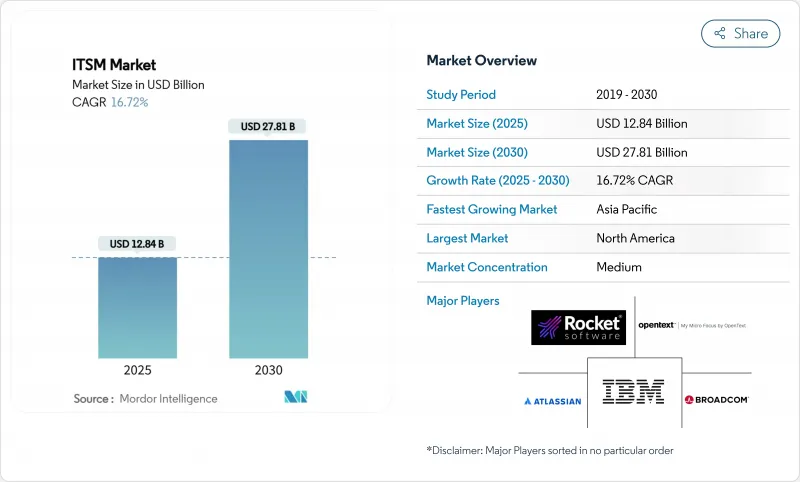
這種加速發展源自於三大驅動力:企業快速採用人工智慧驅動的自動化技術、向雲端原生架構轉型以及對混合雲端雲和多重雲端整合管理的需求。企業也正在採用低程式碼編配來彌補技能短缺,同時,FinOps 和 GreenOps 報告正將永續性和成本控制指標直接納入 IT 工作流程。隨著分散式設備需要即時支援,邊緣運算和 5G 的普及將進一步擴大 IT 服務管理市場的規模。
全球IT服務管理市場趨勢與洞察
向雲端原生IT服務管理平台的轉變
採用雲端原生技術消除了舊有系統每年高達 4 萬美元的維護成本,從而釋放了創新預算。與超大規模資料中心業者營運商建立策略合作夥伴關係,為人工智慧功能提供了彈性運算能力,推動 2025 年第一季季訂閱量年增 19%。遷移到雲端原生技術的製造商將支援時間從 30 分鐘縮短至 6 分鐘,顯著提高了生產效率。早期採用者獲得了成本和速度優勢,使得雲端原生功能成為整個 IT 服務管理市場的基本要求。
AI主導的服務自動化與AIOps整合
ServiceNow 的人工智慧交易量較上一季成長了 150%,預計到 2025 年,其人工智慧客戶數量將超過 1000 家。 AIOps 可將平均問題解決時間縮短高達 60%,並減少工單積壓。 IBM 的生成式人工智慧收入預計到 2025 年將達到 60 億美元,凸顯了企業對自主營運的強勁需求。採用對話式介面的供應商正在進一步普及人工智慧技術,改變買家的預期,並使自身與競爭對手形成鮮明對比。
傳統系統遷移的複雜性和高昂的轉換成本
雖然安全漏洞會增加風險,但分階段遷移並保護數據,遷移後可帶來高達 277% 的投資報酬率。儘管成本是一個障礙,且現有供應商仍將繼續留任,但現代化改造後的組織將獲得顯著的效率提升。
細分市場分析
預計到2024年,雲端採用將佔IT服務管理市場的64.8%,並在2030年之前以18.3%的複合年成長率成長。企業選擇雲端是為了獲取人工智慧功能並管理全球營運,而無需資本支出。在國防等資料密集型環境中,本地部署仍然至關重要。例如,微軟將其內部ServiceNow實例遷移到Azure,就體現了雲端在擴展創新規模方面所扮演的角色。
雲端運算透過提供預先建置的整合,也契合了多重雲端的現實。 ServiceNow 和 AWS 之間的策略合作,涵蓋了跨多個產業的 AI 應用,展現了強勁的發展勢頭。因此,雲端運算正迅速成為實現現代 IT 服務管理市場能力的預設途徑。
作為IT支援的基礎門戶,服務台和事件管理在2024年將維持35.3%的市場佔有率。配置和資產管理將以17.9%的複合年成長率成長,這主要受資產發現需求的驅動。整合發現、依賴關係映射和事件工作流程的平台化方法將改變預算優先順序。預計2025年至2030年間,配置和資產管理的IT服務管理市場規模將增加一倍。
人工智慧正在讓所有應用程式變得更加強大,ServiceNow 的 AI 代理編排器展示了多個自主代理如何協作解決工單,從而減少人工操作。隨著 DevOps 和混合架構對整合可見性的需求日益成長,變更管理、發布管理、網路管理和資料庫管理也呈現出強勁的成長動能。
區域分析
北美地區將繼續保持領先地位,預計到2024年將佔全球收入的37.2%,這主要得益於其在企業和公共部門的穩固裝置量。近期聯邦政府簽訂的合約金額均超過100萬美元,凸顯了平台持續升級的需求。該地區的重點正從初始部署轉向高階人工智慧和跨域可觀測性。
亞太地區是成長最快的地區。隨著企業將IT服務管理(ITSM)外包以保持敏捷性,預計到2025年,託管服務的需求將激增32%。中國製造商和銀行正在經歷大規模的數位化,而日本三菱日聯銀行(MUFG Bank)透過實施ServiceNow,預計到2025年每年可節省2200小時。印度的國內需求與其在全球外包領域的領導地位相輔相成。
歐洲、南美洲以及中東和非洲蘊藏著多元化的商業機會。歐洲企業需要符合嚴格資料保護法律和即將推出的人工智慧管治架構的IT服務管理(ITSM)解決方案。永續性報告的出現為財務營運(FinOps)和綠色營運(GreenOps)模組帶來了更廣闊的發展前景。拉丁美洲的雲端運算應用正在加速,海灣合作理事會(GCC)國家也加大了對ITSM的投資,以支持智慧城市建設。非洲的通訊業者和政府部門是經濟實惠的雲端基礎平台應用的新興領域,但前景看好。
其他福利:
- Excel格式的市場預測(ME)表
- 3個月的分析師支持
目錄
第1章 引言
- 研究假設和市場定義
- 調查範圍
第2章調查方法
第3章執行摘要
第4章 市場情勢
- 市場概覽
- 市場促進因素
- 向雲端原生IT服務管理平台的轉變
- AI驅動的服務自動化與AIOps整合
- 混合/多重雲端環境的整合管理
- 低代碼/無代碼編配支援公民IT服務管理
- ITSM 中內建了 FinOps 和 GreenOps 報告
- 將邊緣運算和 5G 營運納入 ITSM
- 市場限制
- 傳統系統遷移的複雜性和高昂的轉換成本
- ITSM和ITOM專業人員短缺
- 新的人工智慧管治和資料居住法規
- 可觀測資料成本的上升推動了工具的激增。
- 供應鏈分析
- 監管環境
- 技術展望
- 波特五力模型
- 供應商的議價能力
- 買方的議價能力
- 新進入者的威脅
- 替代品的威脅
- 競爭對手之間的競爭
第5章 市場規模與成長預測
- 透過部署
- 雲
- 本地部署
- 透過使用
- 服務台和事件管理
- 配置和資產管理
- 變更和發布管理
- 網路和資料庫管理
- 其他
- 按最終用戶行業分類
- BFSI
- 製造業
- 政府與教育
- 資訊科技/通訊
- 零售與電子商務
- 衛生保健
- 旅遊與飯店
- 其他行業
- 按公司規模
- 主要企業
- 中小企業
- 按服務類型
- 解決方案(平台/軟體)
- 服務(實施、管理、訓練)
- 按地區
- 北美洲
- 美國
- 加拿大
- 南美洲
- 巴西
- 阿根廷
- 歐洲
- 德國
- 英國
- 法國
- 俄羅斯
- 亞太地區
- 中國
- 日本
- 印度
- 韓國
- 東南亞
- 亞太其他地區
- 中東和非洲
- 中東
- 沙烏地阿拉伯
- 阿拉伯聯合大公國
- 土耳其
- 其他中東地區
- 非洲
- 南非
- 奈及利亞
- 埃及
- 其他非洲地區
- 北美洲
第6章 競爭情勢
- 市場集中度
- 策略趨勢
- 市佔率分析
- 公司簡介
- ServiceNow Inc.
- IBM Corporation
- BMC Software Inc.
- Atlassian Corporation PLC
- Broadcom Inc.(CA Technologies)
- Micro Focus International PLC
- Ivanti Inc.
- Freshworks Inc.
- ASG Technologies Group Inc.
- Axios Systems
- ManageEngine(Zoho Corp.)
- SolarWinds Corp.
- EasyVista SA
- USU Software AG
- SysAid Technologies Ltd.
- Cherwell(Ivanti)
- TOPdesk BV
- Hornbill Service Management Ltd.
- SymphonyAI Summit
- 4me Inc.
第7章 市場機會與未來展望
The IT service management market was valued at USD 12.84 billion in 2025 and is forecast to grow to USD 27.81 billion by 2030, reflecting a 16.72% CAGR.
The acceleration stems from three forces: rapid enterprise adoption of AI-driven automation, the migration to cloud-native architectures, and the need for unified management across hybrid and multicloud estates. Enterprises are also embracing low-code orchestration to offset skills shortages, while FinOps and GreenOps reporting embed sustainability and cost-control metrics directly into IT workflows. Edge-computing and 5G onboarding further expands the scope of the IT service management market as distributed devices require real-time support.
Global ITSM Market Trends and Insights
Shift to Cloud-Native ITSM Platforms
Cloud-native adoption removes the USD 40,000 annual maintenance burden linked to legacy systems, freeing budgets for innovation. Strategic alliances with hyperscalers enable elastic compute for AI features, driving 19% year-over-year subscription growth in Q1 2025. Migrating manufacturers cut support times from 30 minutes to 6 minutes, highlighting productivity gains. Early adopters gain cost and speed advantages, making cloud-native capability a baseline requirement across the IT service management market.
AI-Driven Service Automation and AIOps Integration
ServiceNow recorded 150% quarter-over-quarter growth in AI deals and surpassed 1,000 AI customers in 2025 ServiceNow. AIOps shortens mean time to resolution by up to 60%, reducing ticket backlogs. IBM's generative AI revenue reached USD 6 billion in 2025, underscoring enterprise appetite for autonomous operations.Vendors embedding conversational interfaces further democratize access, altering buyer expectations and sharpening competitive differentiation.
Legacy Migration Complexity and High Switching Cost
Enterprises devote USD 40,000 annually per legacy system and lose 17 hours a week to maintenance tasks.Security vulnerabilities heighten risk, yet phased migrations that safeguard data deliver up to 277% ROI post-transition. The expense forms a barrier, preserving incumbent vendor positions, but organizations that modernize enjoy significant efficiency gains.
Other drivers and restraints analyzed in the detailed report include:
- Unified Management for Hybrid/Multicloud Estates
- Low-Code/No-Code Orchestration Enabling Citizen ITSM
- Shortage of Skilled ITSM and ITOM Professionals
For complete list of drivers and restraints, kindly check the Table Of Contents.
Segment Analysis
Cloud deployments accounted for 64.8% of the IT service management market in 2024 and are projected to grow at 18.3% CAGR to 2030. Organizations select cloud to access AI functions and manage global operations without capital outlays. On-premise remains essential for data-sovereign environments such as defense. Real-world cases such as Microsoft migrating internal ServiceNow instances to Azure show cloud's role in scaling innovation.
Cloud also aligns with multicloud realities because it offers pre-built integrations. ServiceNow's strategic collaboration with AWS covers AI-powered applications across diverse industries and illustrates the momentum. Consequently, cloud is becoming the default path to modern IT service management market capabilities.
Service Desk and Incident Management retained 35.3% share in 2024 as the foundational gateway to IT support. Configuration and Asset Management, fueled by asset discovery needs, will expand at 17.9% CAGR. A combined platform approach that unifies discovery, dependency mapping, and incident workflows changes budget priorities. The IT service management market size for Configuration and Asset Management is forecast to double between 2025 and 2030.
AI further elevates every application. ServiceNow's AI Agent Orchestrator demonstrates multiple autonomous agents collaborating on ticket resolution to cut manual toil. Change, Release, Network, and Database Management segments climb steadily because DevOps and hybrid architectures demand integrated visibility.
IT Service Management Market Report is Segmented by Deployment (Cloud, On-Premises), Application (Service Desk and Incident Management, Configuration and Asset Management, and More), End-User Industry (BFSI, Manufacturing, IT and Telecommunications, and More), Enterprise Size (Large Enterprises, Smes), Service Type (Solutions, Services), and by Geography. The Market Forecasts are Provided in Terms of Value (USD).
Geography Analysis
North America retains leadership with 37.2% of 2024 revenue and an entrenched install base among enterprises and the public sector. Recent federal contracts surpass USD 1 million each, underscoring continued platform upgrades. Regional focus is shifting from first-time deployments toward advanced AI and cross-domain observability.
Asia-Pacific is the fastest-growing region. Managed services demand surged 32% in 2025 as companies outsource ITSM to stay agile. Chinese manufacturers and banks digitize operations at scale, while Japan's Mitsubishi UFJ Bank recorded 2,200 hours saved annually through its 2025 ServiceNow rollout. India's domestic demand strengthens alongside its global outsourcing leadership.
Europe, South America, Middle East, and Africa illustrate diverse opportunities. European enterprises need ITSM solutions that respect stringent data-protection laws and upcoming AI governance frameworks. Sustainability reporting brightens prospects for FinOps and GreenOps modules. Latin American adoption accelerates through cloud uptake, whereas GCC states invest in ITSM for smart-city initiatives. African telco and government segments form an early-stage but promising arena for affordable, cloud-based platforms.
- ServiceNow Inc.
- IBM Corporation
- BMC Software Inc.
- Atlassian Corporation PLC
- Broadcom Inc. (CA Technologies)
- Micro Focus International PLC
- Ivanti Inc.
- Freshworks Inc.
- ASG Technologies Group Inc.
- Axios Systems
- ManageEngine (Zoho Corp.)
- SolarWinds Corp.
- EasyVista SA
- USU Software AG
- SysAid Technologies Ltd.
- Cherwell (Ivanti)
- TOPdesk BV
- Hornbill Service Management Ltd.
- SymphonyAI Summit
- 4me Inc.
Additional Benefits:
- The market estimate (ME) sheet in Excel format
- 3 months of analyst support
TABLE OF CONTENTS
1 INTRODUCTION
- 1.1 Study Assumptions and Market Definition
- 1.2 Scope of the Study
2 RESEARCH METHODOLOGY
3 EXECUTIVE SUMMARY
4 MARKET LANDSCAPE
- 4.1 Market Overview
- 4.2 Market Drivers
- 4.2.1 Shift to cloud-native ITSM platforms
- 4.2.2 AI-driven service automation and AIOps integration
- 4.2.3 Unified management for hybrid / multicloud estates
- 4.2.4 Low-code / no-code orchestration enabling citizen ITSM
- 4.2.5 FinOps and GreenOps reporting embedded in ITSM
- 4.2.6 Edge-computing and 5G operations onboarding to ITSM
- 4.3 Market Restraints
- 4.3.1 Legacy migration complexity and high switching cost
- 4.3.2 Shortage of skilled ITSM and ITOM professionals
- 4.3.3 Emerging AI-governance and data-residency regulations
- 4.3.4 Rising observability-data costs causing tool sprawl
- 4.4 Supply-Chain Analysis
- 4.5 Regulatory Landscape
- 4.6 Technological Outlook
- 4.7 Porter's Five Forces
- 4.7.1 Bargaining Power of Suppliers
- 4.7.2 Bargaining Power of Buyers
- 4.7.3 Threat of New Entrants
- 4.7.4 Threat of Substitutes
- 4.7.5 Intensity of Competitive Rivalry
5 MARKET SIZE AND GROWTH FORECASTS
- 5.1 By Deployment
- 5.1.1 Cloud
- 5.1.2 On-premise
- 5.2 By Application
- 5.2.1 Service Desk and Incident Management
- 5.2.2 Configuration and Asset Management
- 5.2.3 Change and Release Management
- 5.2.4 Network and Database Management
- 5.2.5 Others
- 5.3 By End-user Industry
- 5.3.1 BFSI
- 5.3.2 Manufacturing
- 5.3.3 Government and Education
- 5.3.4 IT and Telecommunications
- 5.3.5 Retail and E-commerce
- 5.3.6 Healthcare
- 5.3.7 Travel and Hospitality
- 5.3.8 Other Industries
- 5.4 By Enterprise Size
- 5.4.1 Large Enterprises
- 5.4.2 Small and Mid-size Enterprises (SME)
- 5.5 By Service Type
- 5.5.1 Solutions (Platform/Software)
- 5.5.2 Services (Implementation, Managed, Training)
- 5.6 By Geography
- 5.6.1 North America
- 5.6.1.1 United States
- 5.6.1.2 Canada
- 5.6.2 South America
- 5.6.2.1 Brazil
- 5.6.2.2 Argentina
- 5.6.3 Europe
- 5.6.3.1 Germany
- 5.6.3.2 United Kingdom
- 5.6.3.3 France
- 5.6.3.4 Russia
- 5.6.4 Asia-Pacific
- 5.6.4.1 China
- 5.6.4.2 Japan
- 5.6.4.3 India
- 5.6.4.4 South Korea
- 5.6.4.5 Southeast Asia
- 5.6.4.6 Rest of Asia-Pacific
- 5.6.5 Middle East and Africa
- 5.6.5.1 Middle East
- 5.6.5.1.1 Saudi Arabia
- 5.6.5.1.2 United Arab Emirates
- 5.6.5.1.3 Turkey
- 5.6.5.1.4 Rest of Middle East
- 5.6.5.2 Africa
- 5.6.5.2.1 South Africa
- 5.6.5.2.2 Nigeria
- 5.6.5.2.3 Egypt
- 5.6.5.2.4 Rest of Africa
- 5.6.5.2.5 Egypt
- 5.6.5.2.6 Rest of Africa
- 5.6.1 North America
6 COMPETITIVE LANDSCAPE
- 6.1 Market Concentration
- 6.2 Strategic Moves
- 6.3 Market Share Analysis
- 6.4 Company Profiles (includes Global level Overview, Market level overview, Core Segments, Financials as available, Strategic Information, Market Rank/Share for key companies, Products and Services, and Recent Developments)
- 6.4.1 ServiceNow Inc.
- 6.4.2 IBM Corporation
- 6.4.3 BMC Software Inc.
- 6.4.4 Atlassian Corporation PLC
- 6.4.5 Broadcom Inc. (CA Technologies)
- 6.4.6 Micro Focus International PLC
- 6.4.7 Ivanti Inc.
- 6.4.8 Freshworks Inc.
- 6.4.9 ASG Technologies Group Inc.
- 6.4.10 Axios Systems
- 6.4.11 ManageEngine (Zoho Corp.)
- 6.4.12 SolarWinds Corp.
- 6.4.13 EasyVista SA
- 6.4.14 USU Software AG
- 6.4.15 SysAid Technologies Ltd.
- 6.4.16 Cherwell (Ivanti)
- 6.4.17 TOPdesk BV
- 6.4.18 Hornbill Service Management Ltd.
- 6.4.19 SymphonyAI Summit
- 6.4.20 4me Inc.
7 MARKET OPPORTUNITIES AND FUTURE OUTLOOK
- 7.1 White-space and Unmet-need Assessment

 IT 服務管理市場:按組件、部署類型、組織規模和產業分類-2026-2032 年全球市場預測
 2026-2030年全球IT服務管理(ITSM)市場
 2026年全球服務管理市場報告2026年全球IT服務管理(ITSM)市場報告
 資訊科技服務管理市場-全球產業規模、佔有率、趨勢、機會和預測,依部署方式、應用、最終用戶產業、地區和競爭格局分類,2021-2031年預測
 全球資訊科技服務管理(ITSM)市場全球資訊科技服務管理市場
 全球 IT 服務管理市場:依應用領域、垂直產業、元件、部署模式、組織規模和地區預測(~2032年)
 IT服務管理工具的全球市場:產業分析,規模,佔有率,成長,趨勢,預測(2024年~2033年)
 資訊科技服務管理市場規模、佔有率、趨勢分析報告:2025-2030 年按組件、技術、部署、公司規模、產業、地區和細分市場預測