


 |
市場調查報告書
商品編碼
1844710
塑膠黏合劑:市場佔有率分析、行業趨勢、統計數據和成長預測(2025-2030 年)Plastic Adhesives - Market Share Analysis, Industry Trends & Statistics, Growth Forecasts (2025 - 2030) |
||||||

※ 本網頁內容可能與最新版本有所差異。詳細情況請與我們聯繫。
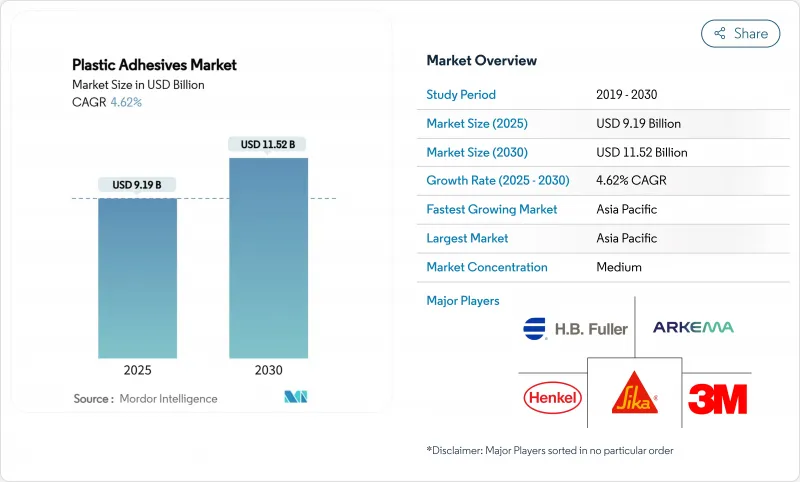
預計 2025 年塑膠黏合劑市場規模為 91.9 億美元,到 2030 年將達到 115.2 億美元,預測期內(2025-2030 年)的複合年成長率為 4.62%。
塑膠黏合劑市場正從通用黏合劑向特種化學品轉型,以支援電動車電池組、醫療穿戴式裝置和下一代建築板材。輕量化汽車需求的不斷成長、醫療保健領域向生物基聚氨酯薄膜的轉變以及揮發性有機化合物(VOC)法規的日益嚴格,正在推動其在汽車、醫療和建築領域的應用範圍不斷擴大。製造商正在推出符合中國、歐盟和美國不斷修訂的排放法規的水性和生物基牌號產品,使塑膠黏合劑市場能夠抓住永續性指令帶來的機會。競爭格局仍在不斷變化,製造商正在採取有針對性的併購和共同開發契約來彌補技術差距、平衡原料成本和風險,並拓展新的市場。
全球塑膠黏合劑市場趨勢與洞察
汽車產業輕量化的推動
汽車製造商正在用結構性黏著劑取代機械緊固件,以減輕車身重量並增強混合材料設計。一輛典型的2025款電動SUV如今整合了超過400線性英尺(約120米)的膠粘劑,而20年前還不到30英尺(約9米),這充分體現了膠粘劑在連接鋁、碳纖維和工程塑膠方面發揮的結構性作用。名古屋大學開發的一種抗衝擊彈性體-環氧樹脂混合物,其抗衝擊強度是傳統環氧樹脂的22倍,因此能夠製造更薄的面板和更吸能的碰撞結構,同時保持碰撞安全性。由於大多數汽車製造商都在努力減輕車身重量以延長續航里程,預計到2030年,塑膠膠合劑市場在汽車消費量中的年成長率將達到兩位數。
建築業轉向高性能塑膠
建築幕牆和結構玻璃系統正朝著輕質複合板的方向發展,這需要持久耐用、高彈性的黏合劑。西卡的防護嵌裝玻璃黏合劑系列能夠吸收地震荷載,同時保持剛性,非常適合用於抗颶風帷幕牆。新興經濟體的高層建築維修和亞洲的大型待開發區計劃需要兼具防火、抗紫外線和快速施工性能的塑膠黏合劑。快速固化 PVC TrimWelder 產品可在 30 分鐘內達到 80% 的工藝強度,使承包商能夠在不犧牲法規規性的情況下加快計劃週期。
石油原料價格波動
環氧樹脂和聚氨酯基礎樹脂的成本隨原油和丙烯價格走勢波動。由於庫存緊張,2025年1月德國液體環氧樹脂價格上漲1.73%,但由於賣家在農曆新年前清理過剩庫存,當月亞洲合約價格下跌1.4%。在美國,聚乙烯價格上漲5美分/磅,進一步刺激了包裝膠合劑的投入。科思創與HB Fuller簽署了經認證的物料平衡供應協議,旨在透過ISCC-PLUS認證的生物石腦油流緩解化石原料的波動性。
細分分析
到 2024 年,環氧樹脂將佔塑膠膠合劑市場規模的 32.45%,用於支援汽車白車身總成和鋼骨混凝土板中的結構接頭。高玻璃化轉變溫度和耐化學性使環氧樹脂適合於剪切負荷和溫度峰值集中的應用。然而,由於原始設備製造商追求小型電子設備更快的黏合速度,並需要用於熱敏基板的冷固化替代品,特種氰基丙烯酸酯、丙烯酸酯和混合胺甲酸乙酯將表現出 5.18% 的最快複合年成長率。因此,塑膠膠合劑市場在環氧樹脂的強大佔有率與優先考慮速度和靈活性的新興利基化學品之間取得平衡。氰基丙烯酸酯包裝,例如 HB Fuller 的 Cyberbond 系列,可以調整黏度以用於醫療設備中的微劑量,同時滿足 ISO 10993 細胞毒性要求。由生物基環狀碳酸酯製成的非異氰酸酯聚氨酯正在擴大中試生產線,標誌著塑膠黏合劑市場日益轉向永續樹脂。
製造商正在進行研發,以最佳化與低表面能聚烯界面的黏合促進劑,旨在無需底塗即可獲得更高的剝離強度。有機矽-環氧混合物可在高溫電子模組中保持密封,為配方設計師提供一條新的差異化途徑。隨著環境法規禁止使用雙酚A衍生物,環氧樹脂製造商正在加速推出雙酚A和酚醛清漆替代品,以符合歐盟即將訂定的內分泌干擾物審查規定,並保護其在塑膠黏合劑市場中的重要佔有率。
區域分析
亞太地區仍然是工程塑膠、電子產品和鞋類的主要製造地,使其成為塑膠黏合劑市場最大的收益貢獻者。中國的電動車生產、印度的高速公路和住房計畫以及東協的包裝工廠共同推動了消費。印度「智慧城市計畫」等政府舉措持續刺激公共工程支出,而公共工程支出依賴聚合物黏合板和管道。
北美市場日趨成熟,但仍保持著穩定成長,這得益於嚴格的燃油經濟性和建築節能法規,這些法規促進了輕質複合材料和氣密性建築圍護結構的使用。美國環保署大力推廣低全球暖化潛勢(GWP)建築材料,加速了屋頂和隔熱闆對低霧霾黏合劑的需求。塑膠黏合劑市場也受益於《美國-墨西哥-加拿大協定》,該協定獎勵汽車黏合劑的區域採購,並使其有資格享受關稅豁免。
歐洲正在利用《綠色交易》框架鼓勵可回收黏合劑的創新。生產商正在調整配方,以分解消費後廢物並實現封閉式塑膠流。更嚴格的EN 16603-20-01航太應用排氣標準開闢了塑膠黏合劑市場中一個利基但有價值的細分市場,迫使供應商對航太級黏合劑進行認證。
中東和非洲正在推動海水淡化、太陽能基礎設施和高層酒店業的擴建計劃。豪華酒店正在採用矽膠密封條來抵禦沙漠溫度,從而支持經濟成長。拉丁美洲的墨西哥和巴西的建築業正在復甦,陸上電子組裝也正在興起。
其他福利:
- Excel 格式的市場預測 (ME) 表
- 3個月的分析師支持
目錄
第1章 引言
- 研究假設和市場定義
- 調查範圍
第2章調查方法
第3章執行摘要
第4章 市場狀況
- 市場概況
- 市場促進因素
- 推動汽車產業輕量化
- 建築業轉向高性能塑膠
- 包裝和電子商務行業的需求不斷成長
- 用於醫療穿戴裝置的生物基聚氨酯薄膜
- 模組化電動車電池組溫度控管膠
- 市場限制
- 石油原料價格波動
- 全球VOC和有害物質法規日益嚴格
- 建築幕牆板防火規範升級
- 價值鏈分析
- 五力分析
- 供應商的議價能力
- 買方的議價能力
- 新進入者的威脅
- 替代品的威脅
- 競爭程度
第5章市場規模及成長預測
- 樹脂類型
- 環氧樹脂
- 氰基丙烯酸酯
- 胺甲酸乙酯
- 矽酮
- 其他樹脂類型(丙烯酸、熱熔 EVA 等)
- 科技
- 溶劑型
- 水性
- 最終用戶產業
- 車
- 建築/施工
- 電氣和電子
- 醫療保健
- 包裝
- 其他終端用戶產業(可再生能源、消費品等)
- 地區
- 亞太地區
- 中國
- 日本
- 印度
- 韓國
- 東南亞國協
- 其他亞太地區
- 北美洲
- 美國
- 加拿大
- 墨西哥
- 歐洲
- 德國
- 英國
- 法國
- 義大利
- 西班牙
- 俄羅斯
- 北歐國家
- 其他歐洲國家
- 南美洲
- 巴西
- 阿根廷
- 南美洲其他地區
- 中東和非洲
- 沙烏地阿拉伯
- 南非
- 其他中東和非洲地區
- 亞太地區
第6章 競爭態勢
- 市場集中度
- 策略舉措
- 市佔率(%)/排名分析
- 公司簡介
- 3M
- Arkema
- Avery Dennison Corporation
- BASF
- Dow
- Dymax
- HB Fuller Company
- Henkel AG and Co. KGaA
- Huntsman International LLC
- INTERTRONICS
- Master Bond Inc.
- Panacol-Elosol GmbH
- Permabond LLC
- Pidilite Industries Ltd.
- Sika AG
- Toyochem Co. Ltd.
第7章 市場機會與未來展望
The Plastic Adhesives Market size is estimated at USD 9.19 Billion in 2025, and is expected to reach USD 11.52 Billion by 2030, at a CAGR of 4.62% during the forecast period (2025-2030).
The plastic adhesives market is transitioning from general-purpose bonding agents toward specialized chemistries that address electric-vehicle battery packs, medical wearables, and next-generation construction panels. Rising demand for lightweight vehicles, the shift to bio-based polyurethane films in healthcare, and stricter VOC legislation are widening application scopes across automotive, medical, and building sectors. Producers are releasing water-based and bio-derived grades that comply with evolving emission ceilings in China, the European Union, and the United States, enabling the plastic adhesives market to capture opportunities created by sustainability mandates. Competitive dynamics remain fluid as manufacturers adopt targeted M&A and joint-development agreements to close technology gaps, balance feedstock cost risks, and reach new geographic pockets.
Global Plastic Adhesives Market Trends and Insights
Lightweight-vehicle push in automotive industry
Automakers are replacing mechanical fasteners with structural adhesives to eliminate excessive weight and strengthen mixed-material designs. A typical 2025 electric SUV now integrates more than 400 linear feet of adhesive compared with fewer than 30 feet two decades ago, illustrating the structural role adhesives play in joining aluminum, carbon fiber, and engineering plastics. Impact-toughened elastomer-epoxy hybrids developed at Nagoya University deliver 22-times higher impact strength than legacy epoxies, which allows thinner panels and energy-absorbing crash structures while maintaining crashworthiness. With most OEMs committing to lighter bodies for range extension, the plastic adhesives market expects automotive consumption to climb at double-digit annual rates through 2030.
Construction shift to high-performance plastics
Facade and glazing systems are moving toward lightweight composite panels that demand long-life, high-modulus bonding agents. Sika's protective glazing adhesive family can absorb seismic loads yet retain rigidity for hurricane-rated curtain walls. High-rise retrofits in developed economies and green-field megaprojects in Asia require plastic adhesives that balance fire resistance, UV durability, and fast installation. Fast-cure PVC TrimWelder products reach 80% handling strength in 30 minutes, enabling contractors to accelerate project cycles without sacrificing code compliance.
Petro-feedstock price volatility
Epoxy and polyurethane base-resin costs fluctuate with crude oil and propylene trends. German liquid epoxy prices rose 1.73% in January 2025 amid thin inventories, while Asian contracts slipped 1.4% later that month as sellers cleared surplus ahead of the Spring Festival. Polyethylene spikes of 5 ¢/lb in the United States further lifted packaging-grade adhesive inputs. Covestro signed a certified mass-balance supply agreement with H.B. Fuller to mitigate fossil feedstock swings through ISCC-PLUS-accredited bio-naphtha streams.
Other drivers and restraints analyzed in the detailed report include:
- Increasing demand from packaging and e-commerce industry
- Bio-based polyurethane films for medical wearables
- Tightening global VOC and hazard regulations
For complete list of drivers and restraints, kindly check the Table Of Contents.
Segment Analysis
Epoxy grades accounted for 32.45% of the plastic adhesives market size in 2024, underpinning structural joints in automotive body-in-white assemblies and steel-reinforced concrete panels. The high glass-transition temperature and chemical resistance keep epoxies relevant where shear loads and temperature spikes converge. Specialty cyanoacrylates, acrylics, and hybrid urethanes, however, exhibit the fastest 5.18% CAGR, as OEMs pursue rapid bonding in miniature electronics and need cold-cure alternatives for heat-sensitive substrates. The plastic adhesives market therefore balances epoxy's entrenched share with emergent niche chemistries that emphasize speed and flexibility. Cyanoacrylate packages such as H.B. Fuller's Cyberbond line allow viscosity tailoring for medical device micro-dosing while meeting ISO 10993 cytotoxicity requirements. Non-isocyanate polyurethanes made from bio-derived cyclic carbonates are scaling pilot lines, signalling a broader pivot toward sustainable resins inside the plastic adhesives market.
Manufacturers layer R&D to optimise adhesion promoters that interface with low-surface-energy polyolefins, aiming to unlock higher peel strengths without primers. Silicone-epoxy hybrids maintain hermetic seals in high-temperature electronics modules, giving formulators another route to differentiate. As environmental bans curb bisphenol-A derivatives, epoxy suppliers accelerate the launch of bis-F and novolac alternatives, guarding their sizeable plastic adhesives market share while aligning with upcoming endocrine-disruptor reviews in the EU.
The Plastic Adhesives Market Report is Segmented by Resin Type (Epoxy, Cyanoacrylate, Urethane, Silicones, Other Resin Types), Technology (Solvent-Based, Water-Based), End-User Industry (Automotive, Building and Construction, Electrical and Electronics, Medical, Packaging, Other End-User Industries), and Geography (Asia-Pacific, North America, Europe, and More). The Market Forecasts are Provided in Terms of Value (USD).
Geography Analysis
Asia-Pacific remains the principal manufacturing hub for engineering plastics, electronics, and footwear, positioning the region as the largest revenue contributor to the plastic adhesives market. China's EV output, India's highway and housing programs, and ASEAN's packaging plants collectively amplify consumption. Government initiatives such as India's Smart City Mission continue to stimulate public-works spending that relies on polymer-bonded panels and pipes.
North America, while mature, registers steady gains through stringent fuel-economy and building-energy codes that promote lightweight composites and air-tight building envelopes. The United States Environmental Protection Agency's push toward low-GWP construction materials accelerates demand for low-smog adhesives in roofing and insulation boards. The plastic adhesives market also benefits from the United States-Mexico-Canada Agreement, which incentivises regional sourcing of automotive adhesives to qualify for tariff exemptions.
Europe leverages its Green Deal framework to catalyse recyclable adhesive innovation. Producers adapt formulas to disassemble end-of-life consumer goods and enable closed-loop plastic flows. Stricter EN 16603-20-01 outgassing criteria in aerospace applications pressurise suppliers to certify space-grade adhesives, opening a niche yet valuable tier within the plastic adhesives market.
The Middle East and Africa host expansion projects in desalination, solar infrastructure, and high-rise hospitality. Premium hotel builds specify silicone weather-seals rated for desert temperatures, supporting incremental growth. Latin America's construction rebound and on-shore electronics assembly in Mexico and Brazil add diverse demand layers, albeit from a smaller base than the three dominant regions.
- 3M
- Arkema
- Avery Dennison Corporation
- BASF
- Dow
- Dymax
- H.B. Fuller Company
- Henkel AG and Co. KGaA
- Huntsman International LLC
- INTERTRONICS
- Master Bond Inc.
- Panacol-Elosol GmbH
- Permabond LLC
- Pidilite Industries Ltd.
- Sika AG
- Toyochem Co. Ltd.
Additional Benefits:
- The market estimate (ME) sheet in Excel format
- 3 months of analyst support
TABLE OF CONTENTS
1 Introduction
- 1.1 Study Assumptions and Market Definition
- 1.2 Scope of the Study
2 Research Methodology
3 Executive Summary
4 Market Landscape
- 4.1 Market Overview
- 4.2 Market Drivers
- 4.2.1 Lightweight-vehicle push in automotive industry
- 4.2.2 Construction shift to high-performance plastics
- 4.2.3 Increasing demand from packaging and e-commerce industry
- 4.2.4 Bio-based polyurethane films for medical wearables
- 4.2.5 Thermal-management adhesives for modular electric vehicle battery packs
- 4.3 Market Restraints
- 4.3.1 Petro-feedstock price volatility
- 4.3.2 Tightening global VOC and hazard regulations
- 4.3.3 Fire-safety code upgrades for facade panels
- 4.4 Value Chain Analysis
- 4.5 Porter's Five Forces
- 4.5.1 Bargaining Power of Suppliers
- 4.5.2 Bargaining Power of Buyers
- 4.5.3 Threat of New Entrants
- 4.5.4 Threat of Substitutes
- 4.5.5 Degree of Competition
5 Market Size and Growth Forecasts (Value)
- 5.1 Resin Type
- 5.1.1 Epoxy
- 5.1.2 Cyanoacrylate
- 5.1.3 Urethane
- 5.1.4 Silicones
- 5.1.5 Other Resin Types (Acrylic, Hot-Melt EVA, etc.)
- 5.2 Technology
- 5.2.1 Solvent-based
- 5.2.2 Water-based
- 5.3 End-user Industry
- 5.3.1 Automotive
- 5.3.2 Building and Construction
- 5.3.3 Electrical and Electronics
- 5.3.4 Medical
- 5.3.5 Packaging
- 5.3.6 Other End-user Industries (Renewable Energy, Consumer Goods, etc.)
- 5.4 Geography
- 5.4.1 Asia-Pacific
- 5.4.1.1 China
- 5.4.1.2 Japan
- 5.4.1.3 India
- 5.4.1.4 South Korea
- 5.4.1.5 ASEAN Countries
- 5.4.1.6 Rest of Asia-Pacific
- 5.4.2 North America
- 5.4.2.1 United States
- 5.4.2.2 Canada
- 5.4.2.3 Mexico
- 5.4.3 Europe
- 5.4.3.1 Germany
- 5.4.3.2 United Kingdom
- 5.4.3.3 France
- 5.4.3.4 Italy
- 5.4.3.5 Spain
- 5.4.3.6 Russia
- 5.4.3.7 NORDIC Countries
- 5.4.3.8 Rest of Europe
- 5.4.4 South America
- 5.4.4.1 Brazil
- 5.4.4.2 Argentina
- 5.4.4.3 Rest of South America
- 5.4.5 Middle East and Africa
- 5.4.5.1 Saudi Arabia
- 5.4.5.2 South Africa
- 5.4.5.3 Rest of Middle East and Africa
- 5.4.1 Asia-Pacific
6 Competitive Landscape
- 6.1 Market Concentration
- 6.2 Strategic Moves
- 6.3 Market Share(%)/Ranking Analysis
- 6.4 Company Profiles (includes Global level Overview, Market level overview, Core Segments, Financials as available, Strategic Information, Market Rank/Share for key companies, Products and Services, and Recent Developments)
- 6.4.1 3M
- 6.4.2 Arkema
- 6.4.3 Avery Dennison Corporation
- 6.4.4 BASF
- 6.4.5 Dow
- 6.4.6 Dymax
- 6.4.7 H.B. Fuller Company
- 6.4.8 Henkel AG and Co. KGaA
- 6.4.9 Huntsman International LLC
- 6.4.10 INTERTRONICS
- 6.4.11 Master Bond Inc.
- 6.4.12 Panacol-Elosol GmbH
- 6.4.13 Permabond LLC
- 6.4.14 Pidilite Industries Ltd.
- 6.4.15 Sika AG
- 6.4.16 Toyochem Co. Ltd.
7 Market Opportunities and Future Outlook
- 7.1 White-space and Unmet-Need Assessment


