


 |
市場調查報告書
商品編碼
2180632
汽車懸吊市場:按架構、系統、驅動方式、零件、車輛、售後市場和地區分類-全球預測至2033年Automotive Suspension Market by Architecture (MacPherson Strut, Double Wishbone, Multilink, Twist Beam, Leaf Spring, Air Suspension), System, Actuation, Component, Vehicle (ICE, Electric, Off- Highway), Aftermarket & Region - Global Forecast to 2033 |
||||||


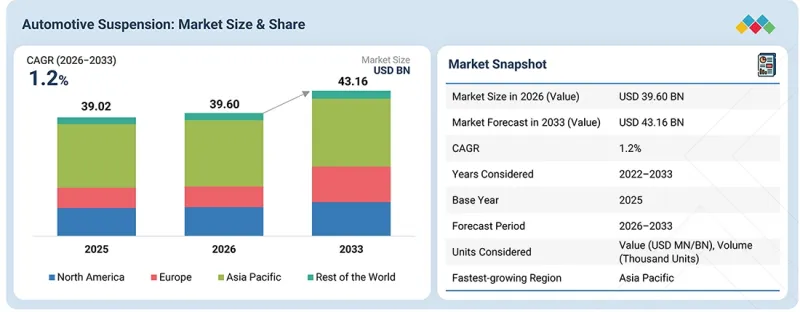
預計汽車懸吊市場將從 2026 年的 396 億美元成長到 2033 年的 431.6 億美元,複合年成長率為 1.2%。
| 調查範圍 | |
|---|---|
| 調查期 | 2026-2033 |
| 基準年 | 2025 |
| 預測期 | 2026-2033 |
| 目標單元 | 10億美元 |
| 部分 | 汽車懸吊市場按架構、系統、驅動方式、零件、車輛、售後市場和地區分類-全球預測至2033年 |
| 目標區域 | 亞太地區、歐洲、北美和世界其他地區 |
SUV、高階汽車和電動車需求的不斷成長正在加速先進懸吊系統的應用。這是因為車輛重量的增加、消費者對乘坐舒適性的更高期望以及對更佳操控性能的需求,正促使汽車製造商(OEM)採用空氣懸吊、自適應懸吊、多連桿懸吊和電子控制懸吊等技術。
軟體定義車輛 (SDV) 的興起正在從根本上改變乘用車工程,它將硬體和軟體解耦,並將車輛控制集中在高性能車載電腦中。這種由電氣化驅動的模式轉移要求車輛在滿足高乘坐舒適性的同時,還要應對沉重的電池重量和較低的車身高度,從而將懸吊系統轉變為智慧車輛動力學系統。因此,這種向軟體定義架構的轉變使得製造商能夠在車輛的整個生命週期內透過無線傳輸 (OTA) 不斷升級車輛的行駛剛度和操控動態性能。除了數位升級之外,這些智慧底盤創新還透過降低高速行駛時的車身高度來最佳化空氣動力學性能,從而延長續航里程,並透過先進的減震技術消除因靜音電動動力傳動系統而放大的道路振動。此外,最新的電子控制避震器能夠主動回收路面不平整產生的能量,並立即提高剛度,以保護安裝在底盤上的電池免受物理衝擊。這表明懸吊系統已經從被動的機械部件演變為高度整合、智慧化的安全資產,而這些資產對於現代出行至關重要。
“在預測期內,乘用車將佔據懸吊市場最大的佔有率。”
乘用車仍然是全球汽車懸吊市場最大的應用領域,這主要得益於乘用車的高產量、SUV和高階車型銷量的成長,以及消費者對乘坐舒適性、操控性和車輛動態性能日益成長的需求。在大眾市場的掀背車、轎車和緊湊型SUV中,尤其是在亞洲和歐洲,麥弗遜式前懸吊和扭力樑式後懸吊因其結構緊湊、輕量化、成本效益高以及與模組化平台兼容等優點,仍然被廣泛應用。隨著車輛尺寸、性能和價格範圍的擴大,汽車製造商正轉向雙橫臂和多連桿式懸吊結構。這些結構能夠提供更優異的車輪控制和操控性能,並廣泛應用於高階SUV、高性能汽車和大型車輛,尤其是在北美和歐洲市場。
主動和半主動懸吊系統透過與高級駕駛輔助系統 (ADAS) 直接協作,正在改變車輛動力學,將以往僅是被動的機械部件轉變為預測性安全資產。隨著汽車向軟體定義車輛 (SDV) 邁進,現代底盤控制器不再僅僅吸收路面顛簸。它們從前視 ADAS 攝影機、雷達和LiDAR獲取即時數據,掃描前方幾毫秒的道路地形。感測器與底盤之間的這種協同作用使車輛能夠在遇到路面顛簸之前進行預測性阻尼調整,從而有效減輕坑洞和減速帶的影響。此外,透過主動抑制車身側傾、俯仰和下沉,這些系統能夠保持車輛的完美水平和穩定。這顯著提高了擋風玻璃上安裝的 ADAS 感知器在緊急自動煞車和高速車道維持操作期間的視線範圍和校準精度。
“全球電動車銷量的成長預計將推動對懸吊系統的需求。”
隨著電池式電動車 ( PHEV) 的普及,由於電池、馬達及相關高壓部件的存在,車輛重量增加,重量分佈也隨之改變,這提高了汽車懸吊系統的技術要求。乘用車是電動車懸吊市場成長潛力最大的領域,亞太地區 (APAC) 仍然是最大的區域市場,這得益於中國電動車的高銷量以及其他亞洲市場電動車普及率的不斷提高。歐洲市場也在快速成長,而北美市場目前成長速度相對較慢,但具有長期成長潛力。乘用車的懸吊結構因車輛尺寸、車身類型和價格區間而異。被動式懸吊系統在注重成本的純電動車和插電式混合動力車中仍然佔據主導地位,但電子控制、半主動和主動式懸吊技術正擴大應用於價格更高的車型,以控制乘坐舒適性、操控性和車身動態。由於純電動車的電池組容量更大,因此通常需要懸吊系統具備更高的承載能力。另一方面,插電式混合動力汽車的電池質量較小,但懸吊必須能夠適應電池、電動馬達、引擎和燃料系統的總合重量和位置。
在卡車和客車領域,由於電池品質、負載容量波動較大以及高強度運作工況等因素,電氣化正在改變懸吊系統的要求。隨著商用車(尤其是輕型商用車 (LCV) 以及中重型卡車)電氣化程度的提高,對能夠承受更高軸載荷並同時保持乘坐舒適性、穩定性和耐久性的懸吊系統的需求日益成長。空氣懸吊、負載水平調節系統、電子控制阻尼和其他自適應技術正變得越來越重要,因為它們能夠適應不斷變化的車輛負載,並保持行駛高度和軸載荷分佈。因此,總體而言,電動車的普及不僅增加了需要懸吊系統的車輛數量,也提高了對負載能力、減重、乘坐舒適性控制和電子控制的要求。隨著車輛價格、性能要求和電氣化程度的提高,技術轉型預計將從經濟高效的被動懸吊轉向半主動和主動系統。同時,在商用車領域,負載管理和耐久性也變得越來越重要。
“在預測期內,北美有望成為世界第二大市場。”
北美是汽車懸吊的主要市場,其中對SUV和皮卡的需求尤為旺盛。 SUV主要採用麥花臣式或雙橫臂前懸吊和多連桿/獨立後懸吊系統,不過氣壓懸吊和電子控制避震器在豪華車型的應用也日益廣泛。皮卡通常採用雙橫臂/獨立前懸吊和鋼板彈簧彈簧後懸吊,但當乘坐舒適性、牽引性能和負載控制至關重要時,則會採用多連桿或空氣懸吊。懸吊技術正不斷發展,包括輕量化連桿、先進的襯套和幾何結構、可變/自適應阻尼、氣壓彈簧以及電子控制懸吊系統。天納克(Tenneco)正在為北美SUV開發採用MCx閥技術的被動阻尼技術,而麥格納(Magna)則供應懸吊連桿/控制臂和扭力軸系統。主要供應商包括天納克、採埃孚(ZF)、蒂森克虜伯比爾斯坦(ThyssenKrupp Bilstein)和KYB。
在重型卡車和客車領域,耐用性、軸荷管理、乘坐舒適性和可維護性至關重要。雖然重型卡車通常採用機械式鋼板彈簧和拋物線彈簧系統來保證其堅固性和高承載能力,但空氣懸吊正日益普及,以提升乘坐舒適性、均衡負載、保護車軸並延長輪胎壽命。在客車領域,前後整合式氣壓懸吊系統正變得越來越普遍,尤其是在提升乘客舒適性和控制車身高度方面。技術進步包括輕量化結構、最佳化幾何形狀、免維護襯套、車輛高度和負載管理以及電子控制或自適應系統。主要供應商包括亨德里克森(Hendrickson)、康明斯美馳(Cummins Meritor)、採埃孚(ZF)、天納克(Tenneco)和蒂森克虜伯比爾斯坦(ThyssenKrupp Bilstein)。
- 按公司類型分類:OEM廠商 - 30%,汽車懸吊製造商 - 70%
- 按職位等級分類:C級主管 -35%,總監級主管 -55%,其他級別 -10%
- 按地區分類:北美 -20%,歐洲 -45%,亞太地區 -30%,世界其他地區 -5%
汽車懸吊市場由一些老牌企業主導。這些企業積極生產和研發新型先進產品,並設有研發機構,致力於為客戶提供業界領先的產品。
調查範圍:
本研究按以下維度對汽車懸吊市場進行細分:系統(被動懸吊、半主動懸吊、主動懸吊)、主動懸吊市場、操作方式(液壓、電子)、結構(麥花臣式、雙橫臂式、多連桿式、扭力樑式、鋼板彈簧懸吊、氣壓懸吊)、原廠配套市場、零件(螺旋彈簧、氣壓彈簧、避震器、支柱、控制臂、球頭、橡膠襯套、鋼板彈簧、防傾桿/連桿穩定器)、售後市場、零零件(減震器、支柱、球頭、鋼板彈簧彈簧、控制臂、螺旋彈簧)、車輛類型(乘用車、輕型商用車、卡車、客車)、電動和混合動力乘用車懸吊、結構(鋼板彈簧懸吊、空氣懸吊、雙橫臂式、麥花臣式、多連桿式、扭力樑式)、電動和混合式卡車及客車懸吊、車輛類型(卡車和客車)、非公路應用(工程機械、礦業和農業用曳引機)、全地形車以及地區。 (亞太地區、北美地區、歐洲地區和世界其他地區)。
購買本報告的主要好處
本研究對主要市場參與者進行了詳細的競爭分析,包括公司概況、產品和營業內容洞察、近期發展以及關鍵市場策略。本報告旨在幫助市場領導者和新參與企業估算整個汽車懸吊市場及其細分市場的收入。此外,報告還幫助相關人員了解競爭格局,並獲得更多洞察,從而更好地定位自身業務並制定有效的打入市場策略。報告還涵蓋了關鍵的市場促進因素、限制因素、挑戰和機遇,幫助相關人員了解市場動態。
本報告深入分析了以下幾點:
- 對影響汽車懸吊市場成長的關鍵促進因素(對高階SUV和皮卡的強勁需求、有關車輛和乘員安全以及排放氣體法規的監管壓力)、阻礙因素(非高階細分市場中系統成本高昂與投資回報率不成正比)、機遇(將智慧/互聯懸架與ADAS和SDV整合、本地化生產和供應鏈機遇)以及機遇(將智慧/互聯懸架與ADAS和SDV整合、本地化生產和供應鏈機遇重量)以及懸架挑戰(平衡電動車里程)的懸架和重量分析。
- 產品開發/創新:深入了解汽車懸吊市場的未來技術、研發活動和新產品發布。
- 市場發展:盈利市場的全面資訊-本報告分析了各個地區的汽車懸吊市場。
- 市場多元化:對主要公司市場佔有率、成長策略和服務產品的詳細評估
目錄
第1章:引言
第2章執行摘要
第3章重要考察
- 汽車懸吊市場的企業面臨著極具吸引力的商機
- 汽車懸吊市場:按系統分類
- 汽車懸吊市場:依結構分類
- 汽車懸吊市場:按車輛類型分類
- 汽車懸吊原廠配套市場:按部件分類
- 汽車懸吊售後市場:按部件分類
- 電動和混合動力乘用車懸吊市場:按架構分類
- 電動車和混合動力重型商用車(HCV)懸吊市場:按車輛類型分類
- 主動懸吊市場:以驅動方式分類
- 非公路懸吊市場:按應用領域分類
- 汽車懸吊市場:按地區分類
第4章 市場概覽
- 市場動態
- 促進因素
- 抑制因子
- 機會
- 任務
- 未滿足的需求和未開發的領域
- 相互關聯的市場與跨產業機遇
- 一級/二級/三級主要公司的策略性舉措
- 電動車與內燃機汽車懸吊技術對比
- 向預測/軟體控制懸吊系統的演進
第5章 產業趨勢
- 宏觀經濟展望
- GDP趨勢與預測
- 全球汽車產業趨勢
- 生態系分析
- 原料和零件供應商
- 二級供應商
- 一級供應商
- OEM
- 售後市場營運商
- 供應鏈分析
- 價格分析
- 小型車懸吊系統平均售價(按地區分類)
- 卡車懸吊系統的區域平均售價
- 汽車懸吊原廠配件的區域平均售價
- 影響客戶業務的趨勢/變革
- 2026年至2028年主要會議及活動
- 貿易分析
- 進口方案(HS編碼870880)
- 出口方案(HS編碼870880)
- 貿易限制
- 美國與中國之間的出口禁令
- 歐盟補貼競爭
- 在地採購政策對採購的影響
- 案例研究分析
- LINK 與沃爾沃的工程團隊合作開發了一款獨特的應用程式,並檢驗了其提高燃油效率的效果。
- HENDRICKSON USA, LLC 的員工導入了懸吊系統的 CREO CAD 幾何圖形。
- 大陸集團開發了能夠承受高溫的HITEMP空氣彈簧。
- 投資和資金籌措場景
- 先進懸吊系統帶來的商機
- 向電動車架構轉型對汽車懸吊市場的影響
- OEM和售後市場的商機
第6章:技術進步、人工智慧的影響、專利、創新與未來應用
- 技術分析
- 主要技術
- 互補技術
- 鄰近技術
- 專利分析
- 未來應用
- 未來技術藍圖
- 成功案例和實際範例
- 人工智慧/生成式人工智慧對汽車懸吊市場的影響
- 人工智慧在先進懸吊系統中的應用:智慧、預測和自適應控制。
- 在汽車製造商中運用人工智慧:加速研發、最佳化車輛、打造差異化駕駛體驗
- 人工智慧在預測性維護、製造和售後服務中的應用
- 成功案例和實際應用範例
- 採埃孚腓特烈港:人工智慧驅動的自適應阻尼器校準
- KYB公司:電子阻尼器的預測性維護
- 日立ASTEMO:電液執行器的最佳化
- 大陸:整合式感測器的智慧空氣彈簧
第7章 監理情勢
- 區域法規和合規性
- 監管機構、政府機構和其他組織
- 世界各國安全法規
第8章:顧客趨勢與購買行為
- 決策流程
- 採購過程中的關鍵相關人員及其評估標準
- 採購過程中的關鍵相關人員
- 購買標準
- 實施障礙和內部挑戰
- 各個終端用戶產業尚未滿足的需求
- 市場盈利
- 電動巴士的市場盈利
第9章 汽車懸吊售後市場:依零件分類
- 避震器
- 支撐
- 球形關節
- 鋼板彈簧
- 控制臂
- 螺旋彈簧
- 關鍵產業洞察
第10章 汽車懸吊市場:依架構分類
- 麥弗遜式步態
- 雙橫臂
- 多鏈路
- 扭梁/扭轉梁
- 鋼板彈簧
- 關鍵產業洞察
第11章 汽車懸吊市場:按車輛類型分類
- 搭乘用車
- LCV
- 追蹤
- 公車
- 關鍵產業洞察
第12章 主動懸吊市場:以驅動方式分類
- 液壓操作
- 電子操作
- 關鍵產業洞察
第13章 汽車懸吊市場:依系統分類
- 被動的
- 半活性
- 積極的
- 主要行業趨勢
第14章 汽車懸吊原廠配套市場:依零件分類
- 螺旋彈簧
- 避震器
- 支撐
- 控制臂
- 橡膠襯套
- 鋼板彈簧
- 連桿穩定器/防傾桿
- 球形關節
- 關鍵產業洞察
第15章 電動車與油電混合車懸吊市場:依架構分類
- 電動車、插電式混合動力車和燃料電池車的電動和混合動力懸吊市場:按架構分類
第16章 電動車與混合動力重型商用車(HCV)懸吊市場:依車輛類型分類
- 追蹤
- 公車
- 關鍵產業洞察
第17章非公路用車輛懸吊市場:依應用領域分類
- 施工機械
- 農用曳引機
- 關鍵產業洞察
第18章 汽車懸吊市場:按地區分類
- 亞太地區
- 中國
- 印度
- 日本
- 韓國
- 亞太其他地區
- 北美洲
- 美國
- 墨西哥
- 加拿大
- 歐洲
- 德國
- 英國
- 法國
- 西班牙
- 義大利
- 俄羅斯
- 其他歐洲國家
- 其他地區
- 巴西
- 南非
- 其他
第19章 競爭情勢
- 概述
- 主要參與企業的策略/優勢,2023-2026 年
- 2021-2025年收入分析
- 市佔率分析(2025 年)
- 企業估值和財務指標
- 品牌/產品對比
- 企業估值矩陣:主要公司,2025 年
- 明星公司
- 新興領導者
- 業務範圍廣泛的公司
- 參與企業
- 企業企業發展:主要公司,2025 年
- 公司估值矩陣:新創企業/中小企業,2025 年
- 先進公司
- 應對力的公司
- 充滿活力的公司
- 起始點
- 競爭標竿分析:新創企業/中小企業,2025 年
- 競爭格局
- 產品發布
- 交易
- 業務拓展
- 其他趨勢
第20章:公司簡介
- 大公司
- ZF FRIEDRICHSHAFEN AG
- HYUNDAI MOBIS
- TENNECO INC.
- THYSSENKRUPP AG
- MAGNA INTERNATIONAL INC.
- BWI GROUP
- KYB CORPORATION
- HL MANDO CORP.
- MERITOR, INC.
- HENDRICKSON USA, LLC
- AUMOVIO
- 其他主要公司
- ASTEMO, LTD
- SOGEFI SPA
- EIBACH
- GESTAMP
- SIDEM
- PEDDERS SUSPENSION &BRAKES
- RTS
- YSS SUSPENSION
- BELLTECH
- SKYJACKER SUSPENSIONS
- MULTIMATIC INC.
- KING SHOCKS
- FOX FACTORY, INC.
- RANCHO SUSPENSION
- TEIN USA
- AIR LIFT COMPANY
- MOOG INC.
第21章調查方法
第22章附錄
The automotive suspension market is estimated to grow from USD 39.60 billion in 2026 to USD 43.16 billion by 2033, with a CAGR of 1.2%.
| Scope of the Report | |
|---|---|
| Years Considered for the Study | 2026-2033 |
| Base Year | 2025 |
| Forecast Period | 2026-2033 |
| Units Considered | USD billion |
| Segments | Automotive Suspension Market by Architecture, System, Actuation, Component, Vehicle, Aftermarket & Region - Global Forecast to 2033 |
| Regions covered | Asia Pacific, Europe, North America, and the Rest of the World |
Rising demand for SUVs, premium vehicles, and EVs is accelerating adoption of advanced suspension systems, as higher vehicle weights, stricter ride-comfort expectations, and the need for improved handling are driving OEMs toward air, adaptive, multi-link, and electronically controlled suspension technologies.
The rise of Software-Defined Vehicles (SDVs) is fundamentally reshaping passenger car engineering by decoupling hardware from software and centralizing vehicle control into powerful onboard computers. Driven by electrification, this paradigm shift requires vehicles to manage heavy battery weights and low ride heights while fulfilling high comfort expectations, transforming the suspension into an intelligent vehicle dynamics system. Consequently, this shift toward a software-defined architecture lets manufacturers continually upgrade ride stiffness and handling dynamics over the air throughout the car's lifecycle. Beyond digital updates, these smart-chassis innovations optimize aerodynamics by lowering the body at high speeds to extend driving range, while advanced insulation eliminates the road vibrations made obvious by quiet electric powertrains. Furthermore, modern electronic dampers actively harvest energy from road irregularities and instantly stiffen to protect floor-mounted batteries from physical impacts, proving that suspension has evolved from a passive mechanical commodity into a highly integrated, intelligent safety asset essential to modern mobility.
"Passenger cars form the largest market for suspension during the forecast period."
Passenger cars remain the largest application in the global automotive suspension market, supported by high production volumes, rising SUV and premium vehicle sales, and increasing demand for ride comfort, handling, and vehicle dynamics. In mass-market hatchbacks, sedans, and compact SUVs, MacPherson struts at the front and torsion beam systems at the rear remain widely used because of their compact packaging, low weight, cost efficiency, and suitability for high-volume modular platforms, particularly in Asia and Europe. As vehicle size, performance, and price positioning increase, OEMs are shifting toward double-wishbone and multi-link architectures, which provide greater wheel control and handling capability and are prevalent in premium SUVs, performance cars, and larger vehicles, particularly in North America and Europe.
Active and semi-active suspension systems are transforming vehicle dynamics by integrating directly with Advanced Driver Assistance Systems (ADAS), turning a historically reactive mechanical component into a predictive safety asset. As cars transition into Software-Defined Vehicles (SDVs), modern chassis controllers no longer just absorb bumps; they ingest real-time data from forward-looking ADAS cameras, radar, and LiDAR to scan the road topography milliseconds ahead. This sensor-to-chassis synergy lets the vehicle make predictive damping adjustments before it hits road irregularities, effectively neutralizing potholes and speed bumps. Furthermore, by actively countering body roll, dive, and squat, these systems keep the vehicle's body perfectly flat and stable, which drastically maximizes the line-of-sight and calibration accuracy of windshield-mounted ADAS sensors during sudden automated emergency braking or high-speed lane-keeping maneuvers.
"Global growth in electric vehicle sales is estimated to drive the demand for suspension systems."
The shift toward battery electric vehicles (BEVs) and plug-in hybrid electric vehicles (PHEVs) is increasing the technical requirements for automotive suspension systems as batteries, electric motors, and associated high-voltage components add vehicle mass and alter weight distribution. Passenger cars represent the largest EV-driven suspension opportunity, with APAC remaining the largest regional market, supported by high EV volumes in China and growing adoption across other Asian markets; Europe is also expanding rapidly, while North America is currently comparatively moderate but offers longer-term growth potential. Across passenger cars, suspension architecture varies by vehicle size, body type, and price positioning: cost-sensitive BEVs and PHEVs still rely primarily on passive systems, while higher-priced vehicles increasingly use electronically controlled, semi-active, and active suspension technologies to manage ride comfort, handling, and body motion. BEVs generally require greater suspension load capacity because of their larger battery packs, while PHEVs have lower battery mass but must accommodate the combined weight and packaging of the battery, electric motor, engine, and fuel system.
For trucks and buses, electrification creates different suspension requirements because battery mass is combined with substantial payload variations and demanding operating cycles. Electric commercial-vehicle adoption is growing, particularly in LCVs and increasingly in medium- and heavy-duty trucks, creating demand for suspension systems that can manage higher axle loads while maintaining ride comfort, stability, and durability. Air suspension, load-leveling systems, electronically controlled damping, and other adaptive technologies are becoming increasingly relevant because they can accommodate changing vehicle loads and maintain ride height and axle-load distribution. Overall, EV adoption is therefore not only increasing the number of vehicles requiring suspension systems but also raising their load-bearing, lightweighting, ride-control, and electronic-control requirements. The technology transition is expected to progress from cost-efficient passive suspension toward semi-active and active systems as vehicle price, performance requirements, and electronic-content levels increase, while commercial vehicles place greater emphasis on load management and durability.
"North America is expected to be the second-largest market during the forecast period."
North America is a major automotive suspension market, with SUVs and pickups as the dominant vehicle formats shaping suspension demand. SUVs mainly use MacPherson strut or double-wishbone front suspension and multi-link/independent rear suspension, while higher-end applications increasingly use air suspension and electronic dampers. Pickups typically use double-wishbone/independent front suspension and leaf-spring rear suspension, with multi-link or air suspension where ride, towing, and load management are important. Suspension technology is improving through lightweight links, advanced bushings and geometry, variable/adaptive damping, air springs, and electronic suspension systems. Tenneco is advancing passive damping with its MCx valve technology for North American SUVs, while Magna supplies suspension links/arms and Twist Axle systems. Major suppliers include Tenneco, ZF, thyssenkrupp Bilstein, and KYB.
Heavy trucks and buses prioritize durability, axle-load management, ride quality, and maintenance. Heavy trucks commonly use mechanical leaf/parabolic spring systems for robustness and high loads, while air suspension is increasingly used for ride quality, load equalization, axle protection, and tire life. Buses have strong air suspension adoption, particularly for passenger comfort and ride-height control, with integrated front and rear air suspension systems. Technology improvements include lightweight structures, optimized geometry, maintenance-free bushings, automatic ride-height/load management, and electronically controlled or adaptive systems. Key suppliers include Hendrickson, Cummins-Meritor, ZF, Tenneco, and thyssenkrupp Bilstein.
In-depth interviews were conducted with CEOs, marketing directors, other innovation and technology directors, and executives from various key organizations operating in this market.
- By Company Type: OEMs - 30%, Automotive Suspension Manufacturers - 70%
- By Designation: C-level - 35%, Director Level - 55%, and Others - 10%
- By Region: North America - 20%, Europe - 45%, Asia Pacific - 30%, and Rest of the World - 5%
Established players dominate the automotive suspension market, including ZF Friedrichshafen AG (Germany), Tenneco Inc. (US), Hyundai Mobis (South Korea), thyssenkrupp AG (Germany), and Magna International Inc. (US). These companies actively manufacture and develop new and advanced products. They have established R&D facilities and offer best-in-class products to customers.
Research Coverage:
The study segments the automotive suspension market and forecasts the market size based on system (passive suspension, semi-active suspension, and active suspension), active suspension market, actuation (hydraulically actuated and electronically actuated), architecture (MacPherson strut, double wishbone, multilink, twist beam/torsion beam, leaf spring suspension, air suspension), OE market, component (coil spring, air spring, shock dampener, strut, control arm, ball joint, rubber bushing, leaf spring, and sway bar/link stabilizer), aftermarket, component (shock absorber, strut, ball joint, leaf spring, control arm, coil spring), vehicle type (passenger cars, light commercial vehicles, trucks, and buses), electric & hybrid passenger car suspension, architecture (leaf spring suspension, air suspension, double wishbone, MacPherson strut, multilink, twist beam/torsion beam), electric & hybrid trucks and buses suspension, vehicle type (trucks and buses), off-highway application (construction & mining and agricultural tractors), all-terrain vehicle, and region (Asia Pacific, North America, Europe, and the Rest of the World).
Key Benefits of Purchasing this Report
The study offers a detailed competitive analysis of key market players, including company profiles, insights into product and business offerings, recent developments, and key market strategies. The report will help market leaders and new entrants estimate revenue figures for the overall automotive suspension market and its subsegments. It helps stakeholders understand the competitive landscape and gain additional insights to better position their businesses and develop effective go-to-market strategies. Additionally, the report covers key market drivers, restraints, challenges, and opportunities, helping stakeholders track market dynamics.
The report provides insights into the following points:
- Analysis of key drivers (strong premium SUV & pickup demand, regulatory pressure on vehicle & passenger safety & curb emissions), restraints (high system cost vs. ROI in non-premium segments), opportunities (integration of smart/connected suspensions with ADAS & SDVs, local manufacturing & supply chain opportunities), and challenges (balancing suspension weight and range efficiency in electric vehicles) influencing the growth of the automotive suspension market
- Product Development/Innovation: Detailed insights on upcoming technologies, R&D activities, and product launches in the automotive suspension market
- Market Development: Comprehensive information about lucrative markets - the report analyses the automotive suspension market across various regions
- Market Diversification: Exhaustive information about new products, untapped geographies, recent developments, and investments in the automotive suspension market
- Competitive Assessment: In-depth assessment of market shares, growth strategies, and service offerings of leading players like ZF Friedrichshafen AG (Germany), Tenneco Inc. (US), Hyundai Mobis (South Korea), Thyssenkrupp AG (Germany), and Magna International Inc. (US) in the market
TABLE OF CONTENTS
1 INTRODUCTION
- 1.1 STUDY OBJECTIVES
- 1.2 MARKET DEFINITION
- 1.2.1 INCLUSIONS AND EXCLUSIONS
- 1.3 STUDY SCOPE
- 1.3.1 MARKETS COVERED AND REGIONAL SCOPE
- 1.4 YEARS CONSIDERED
- 1.5 CURRENCY CONSIDERED
- 1.5.1 USD EXCHANGE RATES, BY COUNTRY, 2025-2022
- 1.6 STAKEHOLDERS
- 1.7 SUMMARY OF CHANGES
2 EXECUTIVE SUMMARY
- 2.1 MARKET INSIGHTS AND KEY HIGHLIGHTS
- 2.2 KEY MARKET PARTICIPANTS: MAPPING OF STRATEGIC DEVELOPMENTS
- 2.3 DISRUPTIVE TRENDS IN AUTOMOTIVE SUSPENSION MARKET
- 2.4 HIGH GROWTH SEGMENTS
- 2.5 REGIONAL SNAPSHOT: MARKET SIZE, GROWTH RATE, AND FORECAST
3 PREMIUM INSIGHTS
- 3.1 ATTRACTIVE OPPORTUNITIES FOR PLAYERS IN AUTOMOTIVE SUSPENSION MARKET
- 3.2 AUTOMOTIVE SUSPENSION MARKET, BY SYSTEM
- 3.3 AUTOMOTIVE SUSPENSION MARKET, BY ARCHITECTURE
- 3.4 AUTOMOTIVE SUSPENSION MARKET, BY VEHICLE TYPE
- 3.5 AUTOMOTIVE SUSPENSION OE MARKET, BY COMPONENT
- 3.6 AUTOMOTIVE SUSPENSION AFTERMARKET, BY COMPONENT
- 3.7 ELECTRIC & HYBRID PASSENGER CAR SUSPENSION MARKET, BY ARCHITECTURE
- 3.8 ELECTRIC & HYBRID HCV SUSPENSION MARKET, BY VEHICLE TYPE
- 3.9 ACTIVE SUSPENSION MARKET, BY ACTUATION
- 3.10 OFF-HIGHWAY SUSPENSION MARKET, BY APPLICATION
- 3.11 AUTOMOTIVE SUSPENSION MARKET, BY REGION
4 MARKET OVERVIEW
- 4.1 INTRODUCTION
- 4.2 MARKET DYNAMICS
- 4.2.1 DRIVERS
- 4.2.1.1 Increasing sales of SUVs and electric vehicles
- 4.2.1.2 Rising implementation of stringent vehicle safety regulations
- 4.2.1.3 Rapid electrification and shifting preference toward software-defined and zonal vehicle architecture
- 4.2.2 RESTRAINTS
- 4.2.2.1 High component and system costs
- 4.2.3 OPPORTUNITIES
- 4.2.3.1 Escalating ADAS and SDV adoption
- 4.2.3.2 Shift from highly distributed systems toward domain-based architectures
- 4.2.4 CHALLENGES
- 4.2.4.1 Suspension weight constraints in EV range, performance, and ride optimization
- 4.2.1 DRIVERS
- 4.3 UNMET NEEDS AND WHITE SPACES
- 4.4 INTERCONNECTED MARKETS AND CROSS-SECTOR OPPORTUNITIES
- 4.5 STRATEGIC MOVES BY TIER-1/2/3 PLAYERS
- 4.6 EV VS. ICE SUSPENSION TECHNOLOGY
- 4.7 EVOLUTION TO PREDICTIVE/SOFTWARE-CONTROLLED SUSPENSION SYSTEMS
5 INDUSTRY TRENDS
- 5.1 MACROECONOMIC OUTLOOK
- 5.1.1 INTRODUCTION
- 5.1.2 GDP TRENDS AND FORECAST
- 5.1.3 TRENDS IN GLOBAL AUTOMOTIVE INDUSTRY
- 5.1.3.1 Investment environment
- 5.2 ECOSYSTEM ANALYSIS
- 5.2.1 RAW MATERIAL & COMPONENT SUPPLIERS
- 5.2.2 TIER-2 SUPPLIERS
- 5.2.3 TIER-1 SUPPLIERS
- 5.2.4 OEMS
- 5.2.5 AFTERMARKET PLAYERS
- 5.3 SUPPLY CHAIN ANALYSIS
- 5.4 PRICING ANALYSIS
- 5.4.1 AVERAGE SELLING PRICE (REGIONAL) FOR LIGHT-DUTY VEHICLE SUSPENSION SYSTEM
- 5.4.2 AVERAGE SELLING PRICE (REGIONAL) FOR TRUCK SUSPENSION SYSTEM
- 5.4.3 AVERAGE SELLING PRICE (REGIONAL) FOR AUTOMOTIVE SUSPENSION OE COMPONENT
- 5.5 TRENDS/DISRUPTIONS IMPACTING CUSTOMER BUSINESS
- 5.6 KEY CONFERENCES AND EVENTS, 2026-2028
- 5.7 TRADE ANALYSIS
- 5.7.1 IMPORT SCENARIO (HS CODE 870880)
- 5.7.2 EXPORT SCENARIO (HS CODE 870880)
- 5.7.3 TRADE RESTRICTIONS
- 5.7.4 US-CHINA EXPORT BANS
- 5.7.5 EU SUBSIDY RACE
- 5.7.6 IMPACT OF LOCALIZATION POLICIES ON SOURCING
- 5.8 CASE STUDY ANALYSIS
- 5.8.1 LINK AND VOLVO ENGINEERING TEAMS COLLABORATED TO DEVELOP PROPRIETARY APPLICATION AND VALIDATE FUEL SAVINGS
- 5.8.2 EMPLOYEES OF HENDRICKSON USA, L.L.C. IMPORTED CREO CAD GEOMETRY OF SUSPENSION SYSTEM
- 5.8.3 CONTINENTAL AG DEVELOPED HITEMP AIR SPRINGS, CAPABLE OF WITHSTANDING TEMPERATURES
- 5.9 INVESTMENT AND FUNDING SCENARIO
- 5.10 REVENUE OPPORTUNITY FROM ADVANCED SUSPENSION
- 5.11 IMPACT OF TRANSITION TO EV ARCHITECTURE ON AUTOMOTIVE SUSPENSION MARKET
- 5.12 OE AND AFTERMARKET OPPORTUNITY
6 TECHNOLOGICAL ADVANCEMENTS, AI-DRIVEN IMPACT, PATENTS, INNOVATIONS, AND FUTURE APPLICATIONS
- 6.1 TECHNOLOGY ANALYSIS
- 6.1.1 KEY TECHNOLOGIES
- 6.1.1.1 Software-defined vehicles
- 6.1.1.1.1 Software-controlled damping
- 6.1.1.1.2 Continues suspension calibration
- 6.1.1.1.3 OTA suspension tuning
- 6.1.1.1.4 Centralized vehicle computing
- 6.1.1.2 Advanced actuation technologies
- 6.1.1.2.1 Electromechanical actuators
- 6.1.1.2.2 Electrohydraulic actuators
- 6.1.1.2.3 Electromagnetic dampers
- 6.1.1.2.4 Air suspension with electronic control
- 6.1.1.2.5 Integrated actuator damper modules
- 6.1.1.1 Software-defined vehicles
- 6.1.2 COMPLEMENTARY TECHNOLOGIES
- 6.1.2.1 ADAS and sensor fusion integration
- 6.1.2.2 Drive-by-wire technologies
- 6.1.3 ADJACENT TECHNOLOGIES
- 6.1.3.1 Lightweight materials and additive manufacturing
- 6.1.3.2 Regenerative suspension systems
- 6.1.1 KEY TECHNOLOGIES
- 6.2 PATENT ANALYSIS
- 6.2.1 INTRODUCTION
- 6.3 FUTURE APPLICATIONS
- 6.4 FUTURE TECHNOLOGY ROADMAP
- 6.5 SUCCESS STORIES AND REAL-WORLD APPLICATIONS
- 6.6 IMPACT OF AI/GEN AI ON AUTOMOTIVE SUSPENSION MARKET
- 6.6.1 AI IN ADVANCED SUSPENSION SYSTEMS - INTELLIGENT, PREDICTIVE AND ADAPTIVE CONTROL
- 6.6.2 AI AT OEMS - FASTER DEVELOPMENT, VEHICLE-LEVEL OPTIMIZATION AND DIFFERENTIATED DRIVING EXPERIENCES
- 6.6.3 AI IN PREDICTIVE MAINTENANCE, MANUFACTURING AND AFTERMARKET SERVICES
- 6.7 SUCCESS STORIES AND REAL-WORLD APPLICATIONS
- 6.7.1 ZF FRIEDRICHSHAFEN: AI-DRIVEN ADAPTIVE DAMPER CALIBRATION
- 6.7.2 KYB CORPORATION: PREDICTIVE MAINTENANCE FOR ELECTRONIC DAMPERS
- 6.7.3 HITACHI ASTEMO: ELECTROHYDRAULIC ACTUATOR OPTIMIZATION
- 6.7.4 CONTINENTAL: SMART AIR SPRING WITH SENSOR INTEGRATION
7 REGULATORY LANDSCAPE
- 7.1 REGIONAL REGULATIONS AND COMPLIANCE
- 7.1.1 REGULATORY BODIES, GOVERNMENT AGENCIES, AND OTHER ORGANIZATIONS
- 7.1.2 GLOBAL SAFETY REGULATIONS
8 CUSTOMER LANDSCAPE AND BUYER BEHAVIOR
- 8.1 DECISION-MAKING PROCESS
- 8.2 KEY STAKEHOLDERS INVOLVED IN BUYING PROCESS AND THEIR EVALUATION CRITERIA
- 8.2.1 KEY STAKEHOLDERS IN BUYING PROCESS
- 8.2.2 BUYING CRITERIA
- 8.3 ADOPTION BARRIERS AND INTERNAL CHALLENGES
- 8.4 UNMET NEEDS OF VARIOUS END-USE INDUSTRIES
- 8.5 MARKET PROFITABILITY
- 8.5.1 MARKET PROFITABILITY FOR ELECTRIC BUSES
9 AUTOMOTIVE SUSPENSION AFTERMARKET, BY COMPONENT
- 9.1 INTRODUCTION
- 9.2 SHOCK ABSORBERS
- 9.2.1 INCREASING VEHICLE PARC, AGING VEHICLES, HIGH ANNUAL MILEAGE, AND UNPAVED ROADS TO CONTRIBUTE TO SEGMENTAL GROWTH
- 9.3 STRUTS
- 9.3.1 LARGE GLOBAL INSTALLED BASE OF VEHICLES, HIGH ANNUAL MILEAGE, AND POOR ROAD CONDITIONS TO FUEL SEGMENTAL GROWTH
- 9.4 BALL JOINTS
- 9.4.1 RISING DEMAND FOR SUVS, PICKUPS, AND LIGHT COMMERCIAL VEHICLES TO BOLSTER SEGMENTAL GROWTH
- 9.5 LEAF SPRINGS
- 9.5.1 INCREASING COMMERCIAL VEHICLE ADOPTION, FLEET OPERATIONS, LAST-MILE DELIVERY, AND LOGISTICS TO EXPEDITE SEGMENTAL GROWTH
- 9.6 CONTROL ARMS
- 9.6.1 ABILITY TO AVOID CLUNKING NOISES, EXCESSIVE WHEEL MOVEMENT, OR WOBBLING OF STEERING WHEEL TO FUEL SEGMENTAL GROWTH
- 9.7 COIL SPRINGS
- 9.7.1 GROWING PENETRATION OF SUVS TO CONTRIBUTE TO SEGMENTAL GROWTH
- 9.8 KEY INDUSTRY INSIGHTS
10 AUTOMOTIVE SUSPENSION MARKET, BY ARCHITECTURE
- 10.1 INTRODUCTION
- 10.2 MACPHERSON STRUT
- 10.2.1 SUITABILITY FOR PASSENGER CARS DUE TO COST-EFFECTIVENESS AND SIMPLE DESIGN TO FOSTER SEGMENTAL GROWTH
- 10.3 DOUBLE WISHBONE
- 10.3.1 USE IN PREMIUM VEHICLES DUE TO COMPLEX DESIGN AND HIGH COST TO CONTRIBUTE TO SEGMENTAL GROWTH
- 10.4 MULTI-LINK
- 10.4.1 ABILITY TO PROVIDE ENHANCED RIDE QUALITY AND HANDLING TO ACCELERATE SEGMENTAL GROWTH
- 10.5 TWIST BEAM/TORSION BEAM
- 10.5.1 APPLICATION SCOPE IN ECONOMIC CARS TO CONTRIBUTE TO SEGMENTAL GROWTH
- 10.6 LEAF SPRING
- 10.6.1 PREFERENCE IN HEAVY TRUCKS DUE TO HIGH LOAD-CARRYING CAPACITY TO FACILITATE SEGMENTAL GROWTH
- 10.7 KEY INDUSTRY INSIGHTS
11 AUTOMOTIVE SUSPENSION MARKET, BY VEHICLE TYPE
- 11.1 INTRODUCTION
- 11.2 PASSENGER CARS
- 11.2.1 USE OF MACPHERSON STRUT IN PASSENGER CARS TO FOSTER SEGMENTAL GROWTH
- 11.3 LCVS
- 11.3.1 DEMAND FOR MULTI-LINK ARCHITECTURE TO CONTRIBUTE TO SEGMENTAL GROWTH
- 11.4 TRUCKS
- 11.4.1 NEED FOR LEAF SPRING SUSPENSION IN MAJOR REGIONS TO EXPEDITE SEGMENTAL GROWTH
- 11.5 BUSES
- 11.5.1 ADOPTION OF AIR SUSPENSION TO OFFER MAXIMUM COMFORT TO PASSENGERS TO DRIVE MARKET
- 11.6 KEY INDUSTRY INSIGHTS
12 ACTIVE SUSPENSION MARKET, BY ACTUATION
- 12.1 INTRODUCTION
- 12.2 HYDRAULICALLY ACTUATED
- 12.2.1 FOCUS ON IMPROVING RESPONSE SPEED, REDUCING ENERGY CONSUMPTION, AND ENABLING PREDICTIVE SENSING TO SPUR DEMAND
- 12.3 ELECTRONICALLY ACTUATED
- 12.3.1 INTEGRATION WITH SOFTWARE-DEFINED CHASSIS, ADAS, STEER-BY-WIRE, AND HIGH-VOLTAGE EV ARCHITECTURES TO DRIVE MARKET
- 12.4 KEY INDUSTRY INSIGHTS
13 AUTOMOTIVE SUSPENSION MARKET, BY SYSTEM
- 13.1 INTRODUCTION
- 13.2 PASSIVE
- 13.2.1 CONSIDERATION FOR COST EFFICIENCY, RELIABILITY, AND EASE OF MAINTENANCE TO BOOST SEGMENTAL GROWTH
- 13.3 SEMI-ACTIVE
- 13.3.1 MOUNTING DEMAND FOR HIGH-PERFORMANCE CARS TO DRIVE MARKET
- 13.4 ACTIVE
- 13.4.1 INCREASING NEED FOR AIR SUSPENSION IN BUSES TO FOSTER SEGMENTAL GROWTH
- 13.5 KEY INDUSTRY INSIGHTS
14 AUTOMOTIVE SUSPENSION OE MARKET, BY COMPONENT
- 14.1 INTRODUCTION
- 14.2 COIL SPRING
- 14.2.1 RISING PRODUCTION OF HIGH PASSENGER-CARS AND SUVS TO ACCELERATE SEGMENTAL GROWTH
- 14.3 SHOCK ABSORBER
- 14.3.1 INCREASING AVAILABILITY OF VEHICLES WITH VARYING WEIGHT, SUSPENSION ARCHITECTURE, AND OPERATING CONDITIONS TO DRIVE MARKET
- 14.4 STRUT
- 14.4.1 SHIFTING PREFERENCE TOWARD SUVS AND CROSSOVER VEHICLES TO CONTRIBUTE TO SEGMENTAL GROWTH
- 14.5 CONTROL ARM
- 14.5.1 REQUIREMENT FOR ROBUST SUSPENSION COMPONENTS TO MANAGE HIGHER VEHICLE WEIGHTS AND LARGER WHEEL LOADS TO EXPEDITE SEGMENTAL GROWTH
- 14.6 RUBBER BUSHING
- 14.6.1 ABILITY TO MINIMIZE THE TRANSMISSION OF NOISE AND SMALL VIBRATIONS TO FUEL SEGMENTAL GROWTH
- 14.7 LEAF SPRING
- 14.7.1 NEED FOR HIGH LOAD-CARRYING CAPACITY, DURABILITY, SIMPLICITY, AND LOW MAINTENANCE TO BOLSTER SEGMENTAL GROWTH
- 14.8 LINK STABILIZER/SWAY BAR
- 14.8.1 INCREASING EMPHASIS ON HANDLING AND STABILITY TO CONTRIBUTE TO SEGMENTAL GROWTH
- 14.9 BALL JOINT
- 14.9.1 FOCUS ON MEETING DEMANDING CHASSIS-PERFORMANCE REQUIREMENTS TO AUGMENT SEGMENTAL GROWTH
- 14.10 KEY INDUSTRY INSIGHTS
15 ELECTRIC & HYBRID PASSENGER CAR SUSPENSION MARKET, BY ARCHITECTURE
- 15.1 INTRODUCTION
- 15.2 ELECTRIC & HYBRID SUSPENSION MARKET FOR BEVS, PHEVS, AND FCEVS, BY ARCHITECTURE
- 15.2.1 BEVS, BY ARCHITECTURE
- 15.2.1.1 Use of active suspension systems to enhance driving performance to boost segmental growth
- 15.2.2 PHEVS, BY ARCHITECTURE
- 15.2.2.1 Demand for maximum comfort and safety in PHEVs to drive market
- 15.2.3 FCEVS, BY ARCHITECTURE
- 15.2.3.1 Need for suspensions that handle added weight of hydrogen tanks and fuel cell stacks to foster segmental growth
- 15.2.4 INDUSTRY INSIGHTS
- 15.2.1 BEVS, BY ARCHITECTURE
16 ELECTRIC & HYBRID HCV SUSPENSION MARKET, BY VEHICLE TYPE
- 16.1 INTRODUCTION
- 16.2 TRUCKS
- 16.2.1 FOCUS ON MAINTAINING PAYLOAD, STABILITY, COMFORT, SAFETY, AND EFFICIENCY TO FACILITATE SEGMENTAL GROWTH
- 16.3 BUSES
- 16.3.1 SHIFTING PREFERENCE TOWARD ELECTRIC AND HYBRID BUSES TO BOLSTER SEGMENTAL GROWTH
- 16.4 KEY INDUSTRY INSIGHTS
17 OFF-HIGHWAY VEHICLE SUSPENSION MARKET, BY APPLICATION
- 17.1 INTRODUCTION
- 17.2 CONSTRUCTION EQUIPMENT
- 17.2.1 INCREASED DEMAND FOR OPERATOR COMFORT AND EQUIPMENT STABILITY TO DRIVE MARKET
- 17.3 AGRICULTURAL TRACTORS
- 17.3.1 RISING FARM MECHANIZATION ACTIVITIES TO CONTRIBUTE TO SEGMENTAL GROWTH
- 17.4 KEY INDUSTRY INSIGHTS
18 AUTOMOTIVE SUSPENSION MARKET, BY REGION
- 18.1 INTRODUCTION
- 18.2 ASIA PACIFIC
- 18.2.1 CHINA
- 18.2.1.1 Escalating vehicle manufacturing and sales to augment market growth
- 18.2.2 INDIA
- 18.2.2.1 Mounting demand for vehicle comfort and safety to foster market growth
- 18.2.3 JAPAN
- 18.2.3.1 Electrification and premium vehicle development to drive market
- 18.2.4 SOUTH KOREA
- 18.2.4.1 Leadership in mobility technologies and EV production to support market growth
- 18.2.5 REST OF ASIA PACIFIC
- 18.2.1 CHINA
- 18.3 NORTH AMERICA
- 18.3.1 US
- 18.3.1.1 Focus on addressing evolving demands for ride comfort, handling precision, and heavier vehicle payloads to drive market
- 18.3.2 MEXICO
- 18.3.2.1 Strong vehicle production and export base to create market growth opportunities
- 18.3.3 CANADA
- 18.3.3.1 Increasing adoption of advanced suspension technologies to bolster market growth
- 18.3.1 US
- 18.4 EUROPE
- 18.4.1 GERMANY
- 18.4.1.1 Rising development and integration of advanced suspension architectures to fuel market growth
- 18.4.2 UK
- 18.4.2.1 Growing EV ecosystem and premium vehicle manufacturing to expedite market growth
- 18.4.3 FRANCE
- 18.4.3.1 Transition toward electrified and comfort-oriented vehicle platforms to boost market growth
- 18.4.4 SPAIN
- 18.4.4.1 Increasing production of compact cars, SUVs, and light commercial vehicles to accelerate market growth
- 18.4.5 ITALY
- 18.4.5.1 Growing focus on ride quality, high-speed stability, and lightweight design to drive market
- 18.4.6 RUSSIA
- 18.4.6.1 Increasing production of SUVs, LCVs, and off-road vehicles to support market growth
- 18.4.7 REST OF EUROPE
- 18.4.1 GERMANY
- 18.5 ROW
- 18.5.1 BRAZIL
- 18.5.1.1 Well-established automotive manufacturing base to contribute to market growth
- 18.5.2 SOUTH AFRICA
- 18.5.2.1 Expanding and aging vehicle fleet to create lucrative market growth opportunities
- 18.5.3 OTHERS
- 18.5.1 BRAZIL
19 COMPETITIVE LANDSCAPE
- 19.1 OVERVIEW
- 19.2 KEY PLAYER COMPETITIVE STRATEGIES/RIGHT TO WIN, 2023-2026
- 19.3 REVENUE ANALYSIS, 2021-2025
- 19.4 MARKET SHARE ANALYSIS, 2025
- 19.5 COMPANY VALUATION AND FINANCIAL METRICS
- 19.6 BRAND/PRODUCT COMPARISON
- 19.7 COMPANY EVALUATION MATRIX: KEY PLAYERS, 2025
- 19.7.1 STARS
- 19.7.2 EMERGING LEADERS
- 19.7.3 PERVASIVE PLAYERS
- 19.7.4 PARTICIPANTS
- 19.7.5 COMPANY FOOTPRINT: KEY PLAYERS, 2025
- 19.7.5.1 Company footprint
- 19.7.5.2 Region footprint
- 19.7.5.3 System footprint
- 19.7.5.4 Actuation footprint
- 19.7.5.5 Vehicle type footprint
- 19.8 COMPANY EVALUATION MATRIX: STARTUPS/SMES, 2025
- 19.8.1 PROGRESSIVE COMPANIES
- 19.8.2 RESPONSIVE COMPANIES
- 19.8.3 DYNAMIC COMPANIES
- 19.8.4 STARTING BLOCKS
- 19.8.5 COMPETITIVE BENCHMARKING: STARTUPS/SMES, 2025
- 19.8.5.1 Detailed list of key startups/SMEs
- 19.8.5.2 Competitive benchmarking of key startups/SMEs
- 19.9 COMPETITIVE SCENARIO
- 19.9.1 PRODUCT LAUNCHES
- 19.9.2 DEALS
- 19.9.3 EXPANSIONS
- 19.9.4 OTHER DEVELOPMENTS
20 COMPANY PROFILES
- 20.1 KEY PLAYERS
- 20.1.1 ZF FRIEDRICHSHAFEN AG
- 20.1.1.1 Business overview
- 20.1.1.2 Products offered
- 20.1.1.3 Recent developments
- 20.1.1.3.1 Product launches/developments
- 20.1.1.3.2 Expansions
- 20.1.1.4 MnM view
- 20.1.1.4.1 Key strengths
- 20.1.1.4.2 Strategic choices
- 20.1.1.4.3 Weaknesses and competitive threats
- 20.1.2 HYUNDAI MOBIS
- 20.1.2.1 Business overview
- 20.1.2.2 Products offered
- 20.1.2.3 Recent developments
- 20.1.2.3.1 Product launches/developments
- 20.1.2.3.2 Expansions
- 20.1.2.3.3 Other developments
- 20.1.2.4 MnM view
- 20.1.2.4.1 Key strengths
- 20.1.2.4.2 Strategic choices
- 20.1.2.4.3 Weaknesses and competitive threats
- 20.1.3 TENNECO INC.
- 20.1.3.1 Business overview
- 20.1.3.2 Products offered
- 20.1.3.3 Recent developments
- 20.1.3.3.1 Product launches/developments
- 20.1.3.3.2 Expansions
- 20.1.3.3.3 Other developments
- 20.1.3.4 MnM view
- 20.1.3.4.1 Key strengths
- 20.1.3.4.2 Strategic choices
- 20.1.3.4.3 Weaknesses and competitive threats
- 20.1.4 THYSSENKRUPP AG
- 20.1.4.1 Business overview
- 20.1.4.2 Products offered
- 20.1.4.3 Recent developments
- 20.1.4.3.1 Deals
- 20.1.4.3.2 Expansions
- 20.1.4.4 MnM view
- 20.1.4.4.1 Key strengths
- 20.1.4.4.2 Strategic choices
- 20.1.4.4.3 Weaknesses and competitive threats
- 20.1.5 MAGNA INTERNATIONAL INC.
- 20.1.5.1 Business overview
- 20.1.5.2 Products offered
- 20.1.5.3 MnM view
- 20.1.5.3.1 Key strengths
- 20.1.5.3.2 Strategic choices
- 20.1.5.3.3 Weaknesses and competitive threats
- 20.1.6 BWI GROUP
- 20.1.6.1 Business overview
- 20.1.6.2 Products offered
- 20.1.6.3 Recent developments
- 20.1.6.3.1 Product launches/developments
- 20.1.6.3.2 Deals
- 20.1.6.3.3 Expansions
- 20.1.6.3.4 Other developments
- 20.1.7 KYB CORPORATION
- 20.1.7.1 Business overview
- 20.1.7.2 Products offered
- 20.1.7.3 Recent developments
- 20.1.7.3.1 Product launches/developments
- 20.1.7.3.2 Deals
- 20.1.7.3.3 Expansions
- 20.1.7.3.4 Other developments
- 20.1.8 HL MANDO CORP.
- 20.1.8.1 Business overview
- 20.1.8.2 Products offered
- 20.1.8.3 Recent developments
- 20.1.8.3.1 Product launches/developments
- 20.1.8.3.2 Deals
- 20.1.8.3.3 Other developments
- 20.1.9 MERITOR, INC.
- 20.1.9.1 Business overview
- 20.1.9.2 Products offered
- 20.1.10 HENDRICKSON USA, L.L.C.
- 20.1.10.1 Business overview
- 20.1.10.2 Products offered
- 20.1.10.3 Recent developments
- 20.1.10.3.1 Product launches/developments
- 20.1.10.3.2 Deals
- 20.1.11 AUMOVIO
- 20.1.11.1 Business overview
- 20.1.11.2 Products offered
- 20.1.1 ZF FRIEDRICHSHAFEN AG
- 20.2 OTHER KEY PLAYERS
- 20.2.1 ASTEMO, LTD
- 20.2.2 SOGEFI S.P.A.
- 20.2.3 EIBACH
- 20.2.4 GESTAMP
- 20.2.5 SIDEM
- 20.2.6 PEDDERS SUSPENSION & BRAKES
- 20.2.7 RTS
- 20.2.8 YSS SUSPENSION
- 20.2.9 BELLTECH
- 20.2.10 SKYJACKER SUSPENSIONS
- 20.2.11 MULTIMATIC INC.
- 20.2.12 KING SHOCKS
- 20.2.13 FOX FACTORY, INC.
- 20.2.14 RANCHO SUSPENSION
- 20.2.15 TEIN USA
- 20.2.16 AIR LIFT COMPANY
- 20.2.17 MOOG INC.
21 RESEARCH METHODOLOGY
- 21.1 RESEARCH DATA
- 21.1.1 SECONDARY DATA
- 21.1.1.1 List of key secondary sources to estimate vehicle production
- 21.1.1.2 List of key secondary sources to estimate automotive suspension market
- 21.1.1.3 Key data from secondary sources
- 21.1.2 PRIMARY DATA
- 21.1.2.1 Primary interviews: Demand and supply sides
- 21.1.2.2 Breakdown of primary interviews
- 21.1.2.3 Primary participants
- 21.1.1 SECONDARY DATA
- 21.2 MARKET SIZE ESTIMATION
- 21.2.1 BOTTOM-UP APPROACH
- 21.2.2 TOP-DOWN APPROACH
- 21.3 DATA TRIANGULATION
- 21.4 RESEARCH LIMITATIONS
- 21.5 RESEARCH ASSUMPTIONS AND RISK ANALYSIS
22 APPENDIX
- 22.1 INSIGHTS FROM INDUSTRY EXPERTS
- 22.2 DISCUSSION GUIDE
- 22.3 KNOWLEDGESTORE: MARKETSANDMARKETS' SUBSCRIPTION PORTAL
- 22.4 CUSTOMIZATION OPTIONS
- 22.4.1 AUTOMOTIVE SUSPENSION MARKET, BY ICE VEHICLE TYPE (COUNTRY LEVEL)
- 22.4.1.1 Passenger cars
- 22.4.1.1.1 Front suspension, by architecture
- 22.4.1.1.1.1 Macpherson strut
- 22.4.1.1.1.2 Double wishbone
- 22.4.1.1.1.3 Multi-link
- 22.4.1.1.1.4 Twist beam/torsion beam
- 22.4.1.1.1.5 Air suspension
- 22.4.1.1.2 Rear suspension, by architecture
- 22.4.1.1.2.1 Macpherson strut
- 22.4.1.1.2.2 Double wishbone
- 22.4.1.1.2.3 Multi-link
- 22.4.1.1.2.4 Twist beam/torsion beam
- 22.4.1.1.2.5 Air suspension
- 22.4.1.1.1 Front suspension, by architecture
- 22.4.1.2 LCVs
- 22.4.1.2.1 Front suspension, by architecture
- 22.4.1.2.1.1 Macpherson strut
- 22.4.1.2.1.2 Double wishbone
- 22.4.1.2.1.3 Multi-link
- 22.4.1.2.1.4 Twist beam/torsion beam
- 22.4.1.2.1.5 Leaf spring
- 22.4.1.2.1.6 Air suspension
- 22.4.1.2.2 Rear suspension, by architecture
- 22.4.1.2.2.1 Macpherson strut
- 22.4.1.2.2.2 Double wishbone
- 22.4.1.2.2.3 Multi-link
- 22.4.1.2.2.4 Twist beam/torsion beam
- 22.4.1.2.2.5 Leaf spring
- 22.4.1.2.2.6 Air suspension
- 22.4.1.2.1 Front suspension, by architecture
- 22.4.1.3 HCVs
- 22.4.1.1 Passenger cars
- 22.4.2 PASSIVE, SEMI-ACTIVE, AND ACTIVE SUSPENSION, BY ARCHITECTURE (COUNTRY LEVEL)
- 22.4.2.1 Macpherson strut
- 22.4.2.2 Double wishbone
- 22.4.2.3 Multi-link
- 22.4.2.4 Twist beam/torsion beam
- 22.4.2.5 Leaf spring suspension
- 22.4.2.6 Air suspension
- 22.4.3 AUTOMOTIVE SUSPENSION MARKET, ELECTRIC & HYBRID VEHICLE (REGIONAL LEVEL), BY PROPULSION
- 22.4.3.1 BEV
- 22.4.3.1.1 Front suspension, by architecture
- 22.4.3.1.2 Rear suspension, by architecture
- 22.4.3.2 PHEV
- 22.4.3.2.1 Front suspension, by architecture
- 22.4.3.2.2 Rear suspension, by architecture
- 22.4.3.3 FCEV
- 22.4.3.3.1 Front suspension, by architecture
- 22.4.3.3.2 Rear suspension, by architecture
- 22.4.3.1 BEV
- 22.4.4 OFF-HIGHWAY SUSPENSION MARKET, BY TYPE AND REGION (REGIONAL LEVEL)
- 22.4.4.1 Construction equipment
- 22.4.4.1.1 Mechanical
- 22.4.4.1.2 Pneumatic
- 22.4.4.1.3 Hydropneumatics
- 22.4.4.2 Agricultural tractors
- 22.4.4.2.1 Mechanical
- 22.4.4.2.2 Pneumatic
- 22.4.4.2.3 Hydropneumatics
- 22.4.4.1 Construction equipment
- 22.4.1 AUTOMOTIVE SUSPENSION MARKET, BY ICE VEHICLE TYPE (COUNTRY LEVEL)
- 22.5 RELATED REPORTS
- 22.6 AUTHOR DETAILS
List of Tables
- TABLE 1 INCLUSIONS AND EXCLUSIONS
- TABLE 2 EXCHANGE RATE, 2025-2022
- TABLE 3 FUTURE REGULATORY MILESTONES FOR AUTOMOTIVE SUSPENSION
- TABLE 4 STRATEGIC MOVES OF KEY PLAYERS
- TABLE 5 ICE VS. EV SUSPENSION TECHNOLOGY COMPARISION
- TABLE 6 GDP PERCENTAGE CHANGE, BY KEY COUNTRY, 2022-2031
- TABLE 7 ROLE OF COMPANIES IN AUTOMOTIVE SUSPENSION ECOSYSTEM
- TABLE 8 INDICATIVE PRICE (REGIONAL) FOR LIGHT-DUTY VEHICLE SUSPENSION SYSTEM, 2025 (USD/UNIT)
- TABLE 9 INDICATIVE PRICE (REGIONAL) FOR TRUCK SUSPENSION SYSTEM, 2025 (USD/UNIT)
- TABLE 10 INDICATIVE PRICING (REGIONAL) FOR AUTOMOTIVE SUSPENSION OE COMPONENT, 2025 (US/UNIT)
- TABLE 11 AUTOMOTIVE SUSPENSION MARKET: KEY CONFERENCES AND EVENTS, 2026-2028
- TABLE 12 IMPORT DATA FOR HS CODE 870880-COMPLIANT PRODUCTS, BY COUNTRY, 2021-2025 (USD THOUSAND)
- TABLE 13 EXPORT DATA FOR HS CODE 870880-COMPLIANT PRODUCTS, BY COUNTRY, 2021-2025 (USD THOUSAND)
- TABLE 14 TYPES OF TRADE RESTRICTIONS AND SHORT-TERM EFFECT ON AUTOMOTIVE SUSPENSION SUPPLY
- TABLE 15 US-CHINA EXPORT BANS: TIMELINE AND EFFECT ON AUTOMOTIVE SEMICONDUCTORS
- TABLE 16 MAJOR EU SUBSIDIES AND EXPECTED EFFECT ON AUTOMOTIVE SUPPLY CHAIN
- TABLE 17 IMPACT OF LOCALIZATION POLICIES ON OEM SOURCING, BY SUSPENSION AUTOMOTIVE COMPONENT
- TABLE 18 LIST OF FUNDING, 2024-2026
- TABLE 19 FUTURE REVENUE OPPORTUNITY
- TABLE 20 IMPACT OF EV ARCHITECTURE CHANGES ON SUSPENSION
- TABLE 21 OE VS. AFTERMARKET OPPORTUNITY
- TABLE 22 RECENT SOFTWARE CONTROLLED DAMPING
- TABLE 23 OEMS OFFERING OTA SUSPENSION TECHNOLOGY
- TABLE 24 OEM INTEGRATING CENTRALIZED VEHICLE COMPUTING
- TABLE 25 OEMS OFFERING ELECTROMECHANICAL ACTUATORS
- TABLE 26 OEMS OFFERING ELECTROHYDRAULIC ACTUATORS
- TABLE 27 KEY PATENTS, 2025-2026
- TABLE 28 FUTURE TECHNOLOGY ROADMAP, 2026-2033
- TABLE 29 SUCCESS STORIES FROM KEY PLAYERS AND OEMS
- TABLE 30 NORTH AMERICA: REGULATORY BODIES, GOVERNMENT AGENCIES, AND OTHER ORGANIZATIONS
- TABLE 31 EUROPE: REGULATORY BODIES, GOVERNMENT AGENCIES, AND OTHER ORGANIZATIONS
- TABLE 32 ASIA PACIFIC: REGULATORY BODIES, GOVERNMENT AGENCIES, AND OTHER ORGANIZATIONS
- TABLE 33 SAFETY REGULATIONS, BY COUNTRY/REGION
- TABLE 34 INFLUENCE OF STAKEHOLDERS ON BUYING PROCESS, BY VEHICLE TYPE
- TABLE 35 BUYING CRITERIA FOR SUSPENSION TYPES IN PASSENGER CARS
- TABLE 36 MARKET PROFITABILITY FOR ELECTRIC BUSES BY VALUE-CHAIN SEGMENT
- TABLE 37 AUTOMOTIVE SUSPENSION AFTERMARKET, BY COMPONENT, 2022-2025 (MILLION UNITS)
- TABLE 38 AUTOMOTIVE SUSPENSION AFTERMARKET, BY COMPONENT, 2026-2033 (MILLION UNITS)
- TABLE 39 AUTOMOTIVE SUSPENSION AFTERMARKET, BY COMPONENT, 2022-2025 (USD MILLION)
- TABLE 40 AUTOMOTIVE SUSPENSION AFTERMARKET, BY COMPONENT, 2026-2033 (USD MILLION)
- TABLE 41 SHOCK ABSORBERS AFTERMARKET: AUTOMOTIVE SUSPENSION AFTERMARKET, BY REGION, 2022-2025 (MILLION UNITS)
- TABLE 42 SHOCK ABSORBERS AFTERMARKET: AUTOMOTIVE SUSPENSION AFTERMARKET, BY REGION, 2026-2033 (MILLION UNITS)
- TABLE 43 SHOCK ABSORBERS AFTERMARKET: AUTOMOTIVE SUSPENSION AFTERMARKET, BY REGION, 2022-2025 (USD MILLION)
- TABLE 44 SHOCK ABSORBERS AFTERMARKET: AUTOMOTIVE SUSPENSION AFTERMARKET, BY REGION, 2026-2033 (USD MILLION)
- TABLE 45 STRUTS AFTERMARKET: AUTOMOTIVE SUSPENSION AFTERMARKET, BY REGION, 2022-2025 (MILLION UNITS)
- TABLE 46 STRUTS AFTERMARKET: AUTOMOTIVE SUSPENSION AFTERMARKET, BY REGION, 2026-2033 (MILLION UNITS)
- TABLE 47 STRUTS AFTERMARKET: AUTOMOTIVE SUSPENSION AFTERMARKET, BY REGION, 2022-2025 (USD MILLION)
- TABLE 48 STRUTS AFTERMARKET: AUTOMOTIVE SUSPENSION AFTERMARKET, BY REGION, 2026-2033 (USD MILLION)
- TABLE 49 BALL JOINTS AFTERMARKET: AUTOMOTIVE SUSPENSION AFTERMARKET, BY REGION, 2022-2025 (MILLION UNITS)
- TABLE 50 BALL JOINTS AFTERMARKET: AUTOMOTIVE SUSPENSION AFTERMARKET, BY REGION, 2026-2033 (MILLION UNITS)
- TABLE 51 BALL JOINTS AFTERMARKET: AUTOMOTIVE SUSPENSION AFTERMARKET, BY REGION, 2022-2025 (USD MILLION)
- TABLE 52 BALL JOINTS AFTERMARKET: AUTOMOTIVE SUSPENSION AFTERMARKET, BY REGION, 2026-2033 (USD MILLION)
- TABLE 53 LEAF SPRINGS AFTERMARKET: AUTOMOTIVE SUSPENSION AFTERMARKET, BY REGION, 2022-2025 (MILLION UNITS)
- TABLE 54 LEAF SPRINGS AFTERMARKET: AUTOMOTIVE SUSPENSION AFTERMARKET, BY REGION, 2026-2033 (MILLION UNITS)
- TABLE 55 LEAF SPRINGS AFTERMARKET: AUTOMOTIVE SUSPENSION AFTERMARKET, BY REGION, 2022-2025 (USD MILLION)
- TABLE 56 LEAF SPRINGS AFTERMARKET: AUTOMOTIVE SUSPENSION AFTERMARKET, BY REGION, 2026-2033 (USD MILLION)
- TABLE 57 CONTROL ARMS AFTERMARKET: AUTOMOTIVE SUSPENSION AFTERMARKET, BY REGION, 2022-2025 (MILLION UNITS)
- TABLE 58 CONTROL ARMS AFTERMARKET: AUTOMOTIVE SUSPENSION AFTERMARKET, BY REGION, 2026-2033 (MILLION UNITS)
- TABLE 59 CONTROL ARMS AFTERMARKET: AUTOMOTIVE SUSPENSION AFTERMARKET, BY REGION, 2022-2025 (USD MILLION)
- TABLE 60 CONTROL ARMS AFTERMARKET: AUTOMOTIVE SUSPENSION AFTERMARKET, BY REGION, 2026-2033 (USD MILLION)
- TABLE 61 COIL SPRINGS AFTERMARKET: AUTOMOTIVE SUSPENSION AFTERMARKET, BY REGION, 2022-2025 (MILLION UNITS)
- TABLE 62 COIL SPRINGS AFTERMARKET: AUTOMOTIVE SUSPENSION AFTERMARKET, BY REGION, 2026-2033 (MILLION UNITS)
- TABLE 63 COIL SPRINGS AFTERMARKET: AUTOMOTIVE SUSPENSION AFTERMARKET, BY REGION, 2022-2025 (USD MILLION)
- TABLE 64 COIL SPRINGS AFTERMARKET: AUTOMOTIVE SUSPENSION AFTERMARKET, BY REGION, 2026-2033 (USD MILLION)
- TABLE 65 AUTOMOTIVE SUSPENSION MARKET, BY ARCHITECTURE, 2022-2025 (THOUSAND UNITS)
- TABLE 66 AUTOMOTIVE SUSPENSION MARKET, BY ARCHITECTURE, 2026-2033 (THOUSAND UNITS)
- TABLE 67 AUTOMOTIVE SUSPENSION MARKET, BY ARCHITECTURE, 2022-2025 (USD MILLION)
- TABLE 68 AUTOMOTIVE SUSPENSION MARKET, BY ARCHITECTURE, 2026-2033 (USD MILLION)
- TABLE 69 MACPHERSON STRUT MARKET, BY REGION, 2022-2025 (THOUSAND UNITS)
- TABLE 70 MACPHERSON STRUT MARKET, BY REGION, 2026-2033 (THOUSAND UNITS)
- TABLE 71 MACPHERSON STRUT MARKET, BY REGION, 2022-2025 (USD MILLION)
- TABLE 72 MACPHERSON STRUT MARKET, BY REGION, 2026-2033 (USD MILLION)
- TABLE 73 DOUBLE WISHBONE MARKET, BY REGION, 2022-2025 (THOUSAND UNITS)
- TABLE 74 DOUBLE WISHBONE MARKET, BY REGION, 2026-2033 (THOUSAND UNITS)
- TABLE 75 DOUBLE WISHBONE MARKET, BY REGION, 2022-2025 (USD MILLION)
- TABLE 76 DOUBLE WISHBONE MARKET, BY REGION, 2026-2033 (USD MILLION)
- TABLE 77 MULTI-LINK MARKET, BY REGION, 2022-2025 (THOUSAND UNITS)
- TABLE 78 MULTI-LINK MARKET, BY REGION, 2026-2033 (THOUSAND UNITS)
- TABLE 79 MULTI-LINK MARKET, BY REGION, 2022-2025 (USD MILLION)
- TABLE 80 MULTI-LINK MARKET, BY REGION, 2026-2033 (USD MILLION)
- TABLE 81 TWIST BEAM/TORSION BEAM MARKET, BY REGION, 2022-2025 (THOUSAND UNITS)
- TABLE 82 TWIST BEAM/TORSION BEAM MARKET, BY REGION, 2026-2033 (THOUSAND UNITS)
- TABLE 83 TWIST BEAM/TORSION BEAM MARKET, BY REGION, 2022-2025 (USD MILLION)
- TABLE 84 TWIST BEAM/TORSION BEAM MARKET, BY REGION, 2026-2033 (USD MILLION)
- TABLE 85 LEAF SPRING MARKET, BY REGION, 2022-2025 (THOUSAND UNITS)
- TABLE 86 LEAF SPRING MARKET, BY REGION, 2026-2033 (THOUSAND UNITS)
- TABLE 87 LEAF SPRING MARKET, BY REGION, 2022-2025 (USD MILLION)
- TABLE 88 LEAF SPRING MARKET, BY REGION, 2026-2033 (USD MILLION)
- TABLE 89 AUTOMOTIVE SUSPENSION MARKET, BY VEHICLE TYPE, 2022-2025 (THOUSAND UNITS)
- TABLE 90 AUTOMOTIVE SUSPENSION MARKET, BY VEHICLE TYPE, 2026-2033 (THOUSAND UNITS)
- TABLE 91 AUTOMOTIVE SUSPENSION MARKET, BY VEHICLE TYPE, 2022-2025 (USD MILLION)
- TABLE 92 AUTOMOTIVE SUSPENSION MARKET, BY VEHICLE TYPE, 2026-2033 (USD MILLION)
- TABLE 93 PASSENGER CARS SUSPENSION MARKET, BY REGION, 2022-2025 (THOUSAND UNITS)
- TABLE 94 PASSENGER CARS SUSPENSION MARKET, BY REGION, 2026-2033 (THOUSAND UNITS)
- TABLE 95 PASSENGER CARS SUSPENSION MARKET, BY REGION, 2022-2025 (USD MILLION)
- TABLE 96 PASSENGER CARS SUSPENSION MARKET, BY REGION, 2026-2033 (USD MILLION)
- TABLE 97 LCVS SUSPENSION MARKET, BY REGION, 2022-2025 (THOUSAND UNITS)
- TABLE 98 LCVS SUSPENSION MARKET, BY REGION, 2026-2033 (THOUSAND UNITS)
- TABLE 99 LCVS SUSPENSION MARKET, BY REGION, 2022-2025 (USD MILLION)
- TABLE 100 LCVS SUSPENSION MARKET, BY REGION, 2026-2033 (USD MILLION)
- TABLE 101 TRUCKS SUSPENSION MARKET, BY REGION, 2022-2025 (THOUSAND UNITS)
- TABLE 102 TRUCKS SUSPENSION MARKET, BY REGION, 2026-2033 (THOUSAND UNITS)
- TABLE 103 TRUCKS SUSPENSION MARKET, BY REGION, 2022-2025 (USD MILLION)
- TABLE 104 TRUCKS SUSPENSION MARKET, BY REGION, 2026-2033 (USD MILLION)
- TABLE 105 BUSES SUSPENSION MARKET, BY REGION, 2022-2025 (THOUSAND UNITS)
- TABLE 106 BUSES SUSPENSION MARKET, BY REGION, 2026-2033 (THOUSAND UNITS)
- TABLE 107 BUSES SUSPENSION MARKET, BY REGION, 2022-2025 (USD MILLION)
- TABLE 108 BUSES SUSPENSION MARKET, BY REGION, 2026-2033 (USD MILLION)
- TABLE 109 ACTIVE SUSPENSION MARKET, BY ACTUATION, 2022-2025 (THOUSAND UNITS)
- TABLE 110 ACTIVE SUSPENSION MARKET, BY ACTUATION, 2026-2033 (THOUSAND UNITS)
- TABLE 111 ACTIVE SUSPENSION MARKET, BY ACTUATION, 2022-2025 (USD MILLION)
- TABLE 112 ACTIVE SUSPENSION MARKET, BY ACTUATION, 2026-2033 (USD MILLION)
- TABLE 113 HYDRAULICALLY ACTUATED: ACTIVE SUSPENSION MARKET, BY REGION, 2022-2025 (THOUSAND UNITS)
- TABLE 114 HYDRAULICALLY ACTUATED: ACTIVE SUSPENSION MARKET, BY REGION, 2026-2033 (THOUSAND UNITS)
- TABLE 115 HYDRAULICALLY ACTUATED: ACTIVE SUSPENSION MARKET, BY REGION, 2022-2025 (USD MILLION)
- TABLE 116 HYDRAULICALLY ACTUATED: ACTIVE SUSPENSION MARKET, BY REGION, 2026-2033 (USD MILLION)
- TABLE 117 ELECTRONICALLY ACTUATED: ACTIVE SUSPENSION MARKET, BY REGION, 2022-2025 (THOUSAND UNITS)
- TABLE 118 ELECTRONICALLY ACTUATED: ACTIVE SUSPENSION MARKET, BY REGION, 2026-2033 (THOUSAND UNITS)
- TABLE 119 ELECTRONICALLY ACTUATED: ACTIVE SUSPENSION MARKET, BY REGION, 2022-2025 (USD MILLION)
- TABLE 120 ELECTRONICALLY ACTUATED: ACTIVE SUSPENSION MARKET, BY REGION, 2026-2033 (USD MILLION)
- TABLE 121 AUTOMOTIVE SUSPENSION MARKET, BY SYSTEM, 2022-2025 (THOUSAND UNITS)
- TABLE 122 AUTOMOTIVE SUSPENSION MARKET, BY SYSTEM, 2026-2033 (THOUSAND UNITS)
- TABLE 123 AUTOMOTIVE SUSPENSION MARKET, BY SYSTEM, 2022-2025 (USD MILLION)
- TABLE 124 AUTOMOTIVE SUSPENSION MARKET, BY SYSTEM, 2026-2033 (USD MILLION)
- TABLE 125 PASSIVE: AUTOMOTIVE SUSPENSION MARKET, BY REGION, 2022-2025 (THOUSAND UNITS)
- TABLE 126 PASSIVE: AUTOMOTIVE SUSPENSION MARKET, BY REGION, 2026-2033 (THOUSAND UNITS)
- TABLE 127 PASSIVE: AUTOMOTIVE SUSPENSION MARKET, BY REGION, 2022-2025 (USD MILLION)
- TABLE 128 PASSIVE: AUTOMOTIVE SUSPENSION MARKET, BY REGION, 2026-2033 (USD MILLION)
- TABLE 129 SEMI-ACTIVE: AUTOMOTIVE SUSPENSION MARKET, BY REGION, 2022-2025 (THOUSAND UNITS)
- TABLE 130 SEMI-ACTIVE: AUTOMOTIVE SUSPENSION MARKET, BY REGION, 2026-2033 (THOUSAND UNITS)
- TABLE 131 SEMI-ACTIVE: AUTOMOTIVE SUSPENSION MARKET, BY REGION, 2022-2025 (USD MILLION)
- TABLE 132 SEMI-ACTIVE: AUTOMOTIVE SUSPENSION MARKET, BY REGION, 2026-2033 (USD MILLION)
- TABLE 133 ACTIVE: AUTOMOTIVE SUSPENSION MARKET, BY REGION, 2022-2025 (THOUSAND UNITS)
- TABLE 134 ACTIVE: AUTOMOTIVE SUSPENSION MARKET, BY REGION, 2026-2033 (THOUSAND UNITS)
- TABLE 135 ACTIVE: AUTOMOTIVE SUSPENSION MARKET, BY REGION, 2022-2025 (USD MILLION)
- TABLE 136 ACTIVE: AUTOMOTIVE SUSPENSION MARKET, BY REGION, 2026-2033 (USD MILLION)
- TABLE 137 AUTOMOTIVE SUSPENSION OE MARKET, BY COMPONENT, 2022-2025 (THOUSAND UNITS)
- TABLE 138 AUTOMOTIVE SUSPENSION OE MARKET, BY COMPONENT, 2026-2033 (THOUSAND UNITS)
- TABLE 139 AUTOMOTIVE SUSPENSION OE MARKET, BY COMPONENT, 2022-2025 (USD MILLION)
- TABLE 140 AUTOMOTIVE SUSPENSION OE MARKET, BY COMPONENT, 2026-2033 (USD MILLION)
- TABLE 141 COIL SPRING OE MARKET, BY REGION, 2022-2025 (THOUSAND UNITS)
- TABLE 142 COIL SPRING OE MARKET, BY REGION, 2026-2033 (THOUSAND UNITS)
- TABLE 143 COIL SPRING OE MARKET, BY REGION, 2022-2025 (USD MILLION)
- TABLE 144 COIL SPRING OE MARKET, BY REGION, 2026-2033 (USD MILLION)
- TABLE 145 SHOCK ABSORBER OE MARKET, BY REGION, 2022-2025 (THOUSAND UNITS)
- TABLE 146 SHOCK ABSORBER OE MARKET, BY REGION, 2026-2033 (THOUSAND UNITS)
- TABLE 147 SHOCK ABSORBER OE MARKET, BY REGION, 2022-2025 (USD MILLION)
- TABLE 148 SHOCK ABSORBER OE MARKET, BY REGION, 2026-2033 (USD MILLION)
- TABLE 149 STRUT OE MARKET, BY REGION, 2022-2025 (THOUSAND UNITS)
- TABLE 150 STRUT OE MARKET, BY REGION, 2026-2033 (MILLION UNITS)
- TABLE 151 STRUT OE MARKET, BY REGION, 2022-2025 (USD MILLION)
- TABLE 152 STRUT OE MARKET, BY REGION, 2026-2033 (USD MILLION)
- TABLE 153 CONTROL ARM OE MARKET, BY REGION, 2022-2025 (THOUSAND UNITS)
- TABLE 154 CONTROL ARM OE MARKET, BY REGION, 2026-2033 (THOUSAND UNITS)
- TABLE 155 CONTROL ARM OE MARKET, BY REGION, 2022-2025 (USD MILLION)
- TABLE 156 CONTROL ARM OE MARKET, BY REGION, 2026-2033 (USD MILLION)
- TABLE 157 RUBBER BUSHING OE MARKET, BY REGION, 2022-2025 (MILLION UNITS)
- TABLE 158 RUBBER BUSHING OE MARKET, BY REGION, 2026-2033 (MILLION UNITS)
- TABLE 159 RUBBER BUSHING OE MARKET, BY REGION, 2022-2025 (USD MILLION)
- TABLE 160 RUBBER BUSHING OE MARKET, BY REGION, 2026-2033 (USD MILLION)
- TABLE 161 LEAF SPRING OE MARKET, BY REGION, 2022-2025 (THOUSAND UNITS)
- TABLE 162 LEAF SPRING OE MARKET, BY REGION, 2026-2033 (THOUSAND UNITS)
- TABLE 163 LEAF SPRING OE MARKET, BY REGION, 2022-2025 (USD MILLION)
- TABLE 164 LEAF SPRING OE MARKET, BY REGION, 2026-2033 (USD MILLION)
- TABLE 165 LINK STABILIZER/SWAY BAR OE MARKET, BY REGION, 2022-2025 (THOUSAND UNITS)
- TABLE 166 LINK STABILIZER/SWAY BAR OE MARKET, BY REGION, 2026-2033 (THOUSAND UNITS)
- TABLE 167 LINK STABILIZER/SWAY BAR OE MARKET, BY REGION, 2022-2025 (USD MILLION)
- TABLE 168 LINK STABILIZER/SWAY BAR OE MARKET, BY REGION, 2026-2033 (USD MILLION)
- TABLE 169 BALL JOINT OE MARKET, BY REGION, 2022-2025 (THOUSAND UNITS)
- TABLE 170 BALL JOINT OE MARKET, BY REGION, 2026-2033 (THOUSAND UNITS)
- TABLE 171 BALL JOINT OE MARKET, BY REGION, 2022-2025 (USD MILLION)
- TABLE 172 BALL JOINT OE MARKET, BY REGION, 2026-2033 (USD MILLION)
- TABLE 173 ELECTRIC & HYBRID PASSENGER CAR SUSPENSION MARKET, BY ARCHITECTURE, 2022-2025 (THOUSAND UNITS)
- TABLE 174 ELECTRIC & HYBRID PASSENGER CAR SUSPENSION MARKET, BY ARCHITECTURE, 2026-2033 (THOUSAND UNITS)
- TABLE 175 ELECTRIC & HYBRID PASSENGER CAR SUSPENSION MARKET, BY ARCHITECTURE, 2022-2025 (USD MILLION)
- TABLE 176 ELECTRIC & HYBRID PASSENGER CAR SUSPENSION MARKET, BY ARCHITECTURE, 2026-2033 (USD MILLION)
- TABLE 177 ELECTRIC PASSENGER CAR SUSPENSION MARKET, BY ARCHITECTURE, 2022-2025 (THOUSAND UNITS)
- TABLE 178 ELECTRIC PASSENGER CAR SUSPENSION MARKET, BY ARCHITECTURE, 2026-2033 (THOUSAND UNITS)
- TABLE 179 ELECTRIC PASSENGER CAR SUSPENSION MARKET, BY ARCHITECTURE, 2022-2025 (USD MILLION)
- TABLE 180 ELECTRIC PASSENGER CAR SUSPENSION MARKET, BY ARCHITECTURE, 2026-2033 (USD MILLION)
- TABLE 181 PLUG-IN HYBRID PASSENGER CAR SUSPENSION MARKET, BY ARCHITECTURE, 2022-2025 (THOUSAND UNITS)
- TABLE 182 PLUG-IN HYBRID PASSENGER CAR SUSPENSION MARKET, BY ARCHITECTURE, 2026-2033 (THOUSAND UNITS)
- TABLE 183 PLUG-IN HYBRID PASSENGER CAR SUSPENSION MARKET, BY ARCHITECTURE, 2022-2025 (USD MILLION)
- TABLE 184 PLUG-IN HYBRID PASSENGER CAR SUSPENSION MARKET, BY ARCHITECTURE, 2026-2033 (USD MILLION)
- TABLE 185 FUEL CELL ELECTRIC VEHICLES PASSENGER CARS SUSPENSION MARKET, BY ARCHITECTURE, 2022-2025 (THOUSAND UNITS)
- TABLE 186 FUEL CELL ELECTRIC VEHICLES PASSENGER CARS SUSPENSION MARKET, BY ARCHITECTURE, 2026-2033 (THOUSAND UNITS)
- TABLE 187 FUEL CELL ELECTRIC VEHICLES PASSENGER CARS SUSPENSION MARKET, BY ARCHITECTURE, 2022-2025 (USD MILLION)
- TABLE 188 FUEL CELL ELECTRIC VEHICLES PASSENGER CARS SUSPENSION MARKET, BY ARCHITECTURE, 2026-2033 (USD MILLION)
- TABLE 189 ELECTRIC & HYBRID HCV SUSPENSION MARKET, BY VEHICLE TYPE, 2022-2025 (THOUSAND UNITS)
- TABLE 190 ELECTRIC & HYBRID HCV SUSPENSION MARKET, BY VEHICLE TYPE, 2026-2033 (THOUSAND UNITS)
- TABLE 191 ELECTRIC & HYBRID HCV SUSPENSION MARKET, BY VEHICLE TYPE, 2022-2025 (USD MILLION)
- TABLE 192 ELECTRIC & HYBRID HCV SUSPENSION MARKET, BY VEHICLE TYPE, 2026-2033 (USD MILLION)
- TABLE 193 ELECTRIC TRUCKS SUSPENSION MARKET, BY ARCHITECTURE, 2022-2025 (THOUSAND UNITS)
- TABLE 194 ELECTRIC TRUCKS SUSPENSION MARKET, BY ARCHITECTURE, 2026-2033 (THOUSAND UNITS)
- TABLE 195 ELECTRIC TRUCKS SUSPENSION MARKET, BY ARCHITECTURE, 2022-2025 (USD MILLION)
- TABLE 196 ELECTRIC TRUCKS SUSPENSION MARKET, BY ARCHITECTURE, 2026-2033 (USD MILLION)
- TABLE 197 ELECTRIC BUSES SUSPENSION MARKET, BY ARCHITECTURE, 2022-2025 (THOUSAND UNITS)
- TABLE 198 ELECTRIC BUSES SUSPENSION MARKET, BY ARCHITECTURE, 2026-2033 (THOUSAND UNITS)
- TABLE 199 ELECTRIC BUSES SUSPENSION MARKET, BY ARCHITECTURE, 2022-2025 (USD MILLION)
- TABLE 200 ELECTRIC BUSES SUSPENSION MARKET, BY ARCHITECTURE, 2026-2033 (USD MILLION)
- TABLE 201 OFF-HIGHWAY VEHICLE SUSPENSION MARKET, BY APPLICATION, 2022-2025 (THOUSAND UNITS)
- TABLE 202 OFF-HIGHWAY VEHICLE SUSPENSION MARKET, BY APPLICATION, 2026-2033 (THOUSAND UNITS)
- TABLE 203 CONSTRUCTION EQUIPMENT SUSPENSION MARKET, BY REGION, 2022-2025 (THOUSAND UNITS)
- TABLE 204 CONSTRUCTION EQUIPMENT SUSPENSION MARKET, BY REGION, 2026-2033 (THOUSAND UNITS)
- TABLE 205 AGRICULTURAL TRACTORS SUSPENSION MARKET, BY REGION, 2022-2025 (THOUSAND UNITS)
- TABLE 206 AGRICULTURAL TRACTORS SUSPENSION MARKET, BY REGION, 2026-2033 (THOUSAND UNITS)
- TABLE 207 AUTOMOTIVE SUSPENSION MARKET, BY REGION, 2022-2025 (THOUSAND UNITS)
- TABLE 208 AUTOMOTIVE SUSPENSION MARKET, BY REGION, 2026-2033 (THOUSAND UNITS)
- TABLE 209 AUTOMOTIVE SUSPENSION MARKET, BY REGION, 2022-2025 (USD MILLION)
- TABLE 210 AUTOMOTIVE SUSPENSION MARKET, BY REGION, 2026-2033 (USD MILLION)
- TABLE 211 ASIA PACIFIC: AUTOMOTIVE SUSPENSION MARKET, BY COUNTRY, 2022-2025 (THOUSAND UNITS)
- TABLE 212 ASIA PACIFIC: AUTOMOTIVE SUSPENSION MARKET, BY COUNTRY, 2026-2033 (THOUSAND UNITS)
- TABLE 213 ASIA PACIFIC: AUTOMOTIVE SUSPENSION MARKET, BY COUNTRY, 2022-2025 (USD MILLION)
- TABLE 214 ASIA PACIFIC: AUTOMOTIVE SUSPENSION MARKET, BY COUNTRY, 2026-2033 (USD MILLION)
- TABLE 215 CHINA: AUTOMOTIVE SUSPENSION MARKET, BY ARCHITECTURE, 2022-2025 (THOUSAND UNITS)
- TABLE 216 CHINA: AUTOMOTIVE SUSPENSION MARKET, BY ARCHITECTURE, 2026-2033 (THOUSAND UNITS)
- TABLE 217 CHINA: AUTOMOTIVE SUSPENSION MARKET, BY ARCHITECTURE, 2022-2025 (USD MILLION)
- TABLE 218 CHINA: AUTOMOTIVE SUSPENSION MARKET, BY ARCHITECTURE, 2026-2033 (USD MILLION)
- TABLE 219 INDIA: AUTOMOTIVE SUSPENSION MARKET, BY ARCHITECTURE, 2022-2025 (THOUSAND UNITS)
- TABLE 220 INDIA: AUTOMOTIVE SUSPENSION MARKET, BY ARCHITECTURE, 2026-2033 (THOUSAND UNITS)
- TABLE 221 INDIA: AUTOMOTIVE SUSPENSION MARKET, BY ARCHITECTURE, 2022-2025 (USD MILLION)
- TABLE 222 INDIA: AUTOMOTIVE SUSPENSION MARKET, BY ARCHITECTURE, 2026-2033 (USD MILLION)
- TABLE 223 JAPAN: AUTOMOTIVE SUSPENSION MARKET, BY ARCHITECTURE, 2022-2025 (THOUSAND UNITS)
- TABLE 224 JAPAN: AUTOMOTIVE SUSPENSION MARKET, BY ARCHITECTURE, 2026-2033 (THOUSAND UNITS)
- TABLE 225 JAPAN: AUTOMOTIVE SUSPENSION MARKET, BY ARCHITECTURE, 2022-2025 (USD MILLION)
- TABLE 226 JAPAN: AUTOMOTIVE SUSPENSION MARKET, BY ARCHITECTURE, 2026-2033 (USD MILLION)
- TABLE 227 SOUTH KOREA: AUTOMOTIVE SUSPENSION MARKET, BY ARCHITECTURE, 2022-2025 (THOUSAND UNITS)
- TABLE 228 SOUTH KOREA: AUTOMOTIVE SUSPENSION MARKET, BY ARCHITECTURE, 2026-2033 (THOUSAND UNITS)
- TABLE 229 SOUTH KOREA: AUTOMOTIVE SUSPENSION MARKET, BY ARCHITECTURE, 2022-2025 (USD MILLION)
- TABLE 230 SOUTH KOREA: AUTOMOTIVE SUSPENSION MARKET, BY ARCHITECTURE, 2026-2033 (USD MILLION)
- TABLE 231 REST OF ASIA PACIFIC: AUTOMOTIVE SUSPENSION MARKET, BY ARCHITECTURE, 2022-2025 (THOUSAND UNITS)
- TABLE 232 REST OF ASIA PACIFIC: AUTOMOTIVE SUSPENSION MARKET, BY ARCHITECTURE, 2026-2033 (THOUSAND UNITS)
- TABLE 233 REST OF ASIA PACIFIC: AUTOMOTIVE SUSPENSION MARKET, BY ARCHITECTURE, 2022-2025 (USD MILLION)
- TABLE 234 REST OF ASIA PACIFIC: AUTOMOTIVE SUSPENSION MARKET, BY ARCHITECTURE, 2026-2033 (USD MILLION)
- TABLE 235 NORTH AMERICA: AUTOMOTIVE SUSPENSION MARKET, BY COUNTRY, 2022-2025 (THOUSAND UNITS)
- TABLE 236 NORTH AMERICA: AUTOMOTIVE SUSPENSION MARKET, BY COUNTRY, 2026-2033 (THOUSAND UNITS)
- TABLE 237 NORTH AMERICA: AUTOMOTIVE SUSPENSION MARKET, BY COUNTRY, 2022-2025 (USD MILLION)
- TABLE 238 NORTH AMERICA: AUTOMOTIVE SUSPENSION MARKET, BY COUNTRY, 2026-2033 (USD MILLION)
- TABLE 239 US: AUTOMOTIVE SUSPENSION MARKET, BY ARCHITECTURE, 2022-2025 (THOUSAND UNITS)
- TABLE 240 US: AUTOMOTIVE SUSPENSION MARKET, BY ARCHITECTURE, 2026-2033 (THOUSAND UNITS)
- TABLE 241 US: AUTOMOTIVE SUSPENSION MARKET, BY ARCHITECTURE, 2022-2025 (USD MILLION)
- TABLE 242 US: AUTOMOTIVE SUSPENSION MARKET, BY ARCHITECTURE, 2026-2033 (USD MILLION)
- TABLE 243 MEXICO: AUTOMOTIVE SUSPENSION MARKET, BY ARCHITECTURE, 2022-2025 (THOUSAND UNITS)
- TABLE 244 MEXICO: AUTOMOTIVE SUSPENSION MARKET, BY ARCHITECTURE, 2026-2033 (THOUSAND UNITS)
- TABLE 245 MEXICO: AUTOMOTIVE SUSPENSION MARKET, BY ARCHITECTURE, 2022-2025 (USD MILLION)
- TABLE 246 MEXICO: AUTOMOTIVE SUSPENSION MARKET, BY ARCHITECTURE, 2026-2033 (USD MILLION)
- TABLE 247 CANADA: AUTOMOTIVE SUSPENSION MARKET, BY ARCHITECTURE, 2022-2025 (THOUSAND UNITS)
- TABLE 248 CANADA: AUTOMOTIVE SUSPENSION MARKET, BY ARCHITECTURE, 2026-2033 (THOUSAND UNITS)
- TABLE 249 CANADA: AUTOMOTIVE SUSPENSION MARKET, BY ARCHITECTURE, 2022-2025 (USD MILLION)
- TABLE 250 CANADA: AUTOMOTIVE SUSPENSION MARKET, BY ARCHITECTURE, 2026-2033 (USD MILLION)
- TABLE 251 EUROPE: AUTOMOTIVE SUSPENSION MARKET, BY COUNTRY, 2022-2025 (THOUSAND UNITS)
- TABLE 252 EUROPE: AUTOMOTIVE SUSPENSION MARKET, BY COUNTRY, 2026-2033 (THOUSAND UNITS)
- TABLE 253 EUROPE: AUTOMOTIVE SUSPENSION MARKET, BY COUNTRY, 2022-2025 (USD MILLION)
- TABLE 254 EUROPE: AUTOMOTIVE SUSPENSION MARKET, BY COUNTRY, 2026-2033 (USD MILLION)
- TABLE 255 GERMANY: AUTOMOTIVE SUSPENSION MARKET, BY ARCHITECTURE, 2022-2025 (THOUSAND UNITS)
- TABLE 256 GERMANY: AUTOMOTIVE SUSPENSION MARKET, BY ARCHITECTURE, 2026-2033 (THOUSAND UNITS)
- TABLE 257 GERMANY: AUTOMOTIVE SUSPENSION MARKET, BY ARCHITECTURE, 2022-2025 (USD MILLION)
- TABLE 258 GERMANY: AUTOMOTIVE SUSPENSION MARKET, BY ARCHITECTURE, 2026-2033 (USD MILLION)
- TABLE 259 UK: AUTOMOTIVE SUSPENSION MARKET, BY ARCHITECTURE, 2022-2025 (THOUSAND UNITS)
- TABLE 260 UK: AUTOMOTIVE SUSPENSION MARKET, BY ARCHITECTURE, 2026-2033 (THOUSAND UNITS)
- TABLE 261 UK: AUTOMOTIVE SUSPENSION MARKET, BY ARCHITECTURE, 2022-2025 (USD MILLION)
- TABLE 262 UK: AUTOMOTIVE SUSPENSION MARKET, BY ARCHITECTURE, 2026-2033 (USD MILLION)
- TABLE 263 FRANCE: AUTOMOTIVE SUSPENSION MARKET, BY ARCHITECTURE, 2022-2025 (THOUSAND UNITS)
- TABLE 264 FRANCE: AUTOMOTIVE SUSPENSION MARKET, BY ARCHITECTURE, 2026-2033 (THOUSAND UNITS)
- TABLE 265 FRANCE: AUTOMOTIVE SUSPENSION MARKET, BY ARCHITECTURE, 2022-2025 (USD MILLION)
- TABLE 266 FRANCE: AUTOMOTIVE SUSPENSION MARKET, BY ARCHITECTURE, 2026-2033 (USD MILLION)
- TABLE 267 SPAIN: AUTOMOTIVE SUSPENSION MARKET, BY ARCHITECTURE, 2022-2025 (THOUSAND UNITS)
- TABLE 268 SPAIN: AUTOMOTIVE SUSPENSION MARKET, BY ARCHITECTURE, 2026-2033 (THOUSAND UNITS)
- TABLE 269 SPAIN: AUTOMOTIVE SUSPENSION MARKET, BY ARCHITECTURE, 2022-2025 (USD MILLION)
- TABLE 270 SPAIN: AUTOMOTIVE SUSPENSION MARKET, BY ARCHITECTURE, 2026-2033 (USD MILLION)
- TABLE 271 ITALY: AUTOMOTIVE SUSPENSION MARKET, BY ARCHITECTURE, 2022-2025 (THOUSAND UNITS)
- TABLE 272 ITALY: AUTOMOTIVE SUSPENSION MARKET, BY ARCHITECTURE, 2026-2033 (THOUSAND UNITS)
- TABLE 273 ITALY: AUTOMOTIVE SUSPENSION MARKET, BY ARCHITECTURE, 2022-2025 (USD MILLION)
- TABLE 274 ITALY: AUTOMOTIVE SUSPENSION MARKET, BY ARCHITECTURE, 2026-2033 (USD MILLION)
- TABLE 275 RUSSIA: AUTOMOTIVE SUSPENSION MARKET, BY ARCHITECTURE, 2022-2025 (THOUSAND UNITS)
- TABLE 276 RUSSIA: AUTOMOTIVE SUSPENSION MARKET, BY ARCHITECTURE, 2026-2033 (THOUSAND UNITS)
- TABLE 277 RUSSIA: AUTOMOTIVE SUSPENSION MARKET, BY ARCHITECTURE, 2022-2025 (USD MILLION)
- TABLE 278 RUSSIA: AUTOMOTIVE SUSPENSION MARKET, BY ARCHITECTURE, 2026-2033 (USD MILLION)
- TABLE 279 REST OF EUROPE: AUTOMOTIVE SUSPENSION MARKET, BY ARCHITECTURE, 2022-2025 (THOUSAND UNITS)
- TABLE 280 REST OF EUROPE: AUTOMOTIVE SUSPENSION MARKET, BY ARCHITECTURE, 2026-2033 (THOUSAND UNITS)
- TABLE 281 REST OF EUROPE: AUTOMOTIVE SUSPENSION MARKET, BY ARCHITECTURE, 2022-2025 (USD MILLION)
- TABLE 282 REST OF EUROPE: AUTOMOTIVE SUSPENSION MARKET, BY ARCHITECTURE, 2026-2033 (USD MILLION)
- TABLE 283 ROW: AUTOMOTIVE SUSPENSION MARKET, BY COUNTRY, 2022-2025 (THOUSAND UNITS)
- TABLE 284 ROW: AUTOMOTIVE SUSPENSION MARKET, BY COUNTRY, 2026-2033 (THOUSAND UNITS)
- TABLE 285 ROW: AUTOMOTIVE SUSPENSION MARKET, BY COUNTRY, 2022-2025 (USD MILLION)
- TABLE 286 ROW: AUTOMOTIVE SUSPENSION MARKET, BY COUNTRY, 2026-2033 (USD MILLION)
- TABLE 287 BRAZIL: AUTOMOTIVE SUSPENSION MARKET, BY ARCHITECTURE, 2022-2025 (THOUSAND UNITS)
- TABLE 288 BRAZIL: AUTOMOTIVE SUSPENSION MARKET, BY ARCHITECTURE, 2026-2033 (THOUSAND UNITS)
- TABLE 289 BRAZIL: AUTOMOTIVE SUSPENSION MARKET, BY ARCHITECTURE, 2022-2025 (USD MILLION)
- TABLE 290 BRAZIL: AUTOMOTIVE SUSPENSION MARKET, BY ARCHITECTURE, 2026-2033 (USD MILLION)
- TABLE 291 SOUTH AFRICA: AUTOMOTIVE SUSPENSION MARKET, BY ARCHITECTURE, 2022-2025 (THOUSAND UNITS)
- TABLE 292 SOUTH AFRICA: AUTOMOTIVE SUSPENSION MARKET, BY ARCHITECTURE, 2026-2033 (THOUSAND UNITS)
- TABLE 293 SOUTH AFRICA: AUTOMOTIVE SUSPENSION MARKET, BY ARCHITECTURE, 2022-2025 (USD MILLION)
- TABLE 294 SOUTH AFRICA: AUTOMOTIVE SUSPENSION MARKET, BY ARCHITECTURE, 2026-2033 (USD MILLION)
- TABLE 295 OTHERS: AUTOMOTIVE SUSPENSION MARKET, BY ARCHITECTURE, 2022-2025 (THOUSAND UNITS)
- TABLE 296 OTHERS: AUTOMOTIVE SUSPENSION MARKET, BY ARCHITECTURE, 2026-2033 (THOUSAND UNITS)
- TABLE 297 OTHERS: AUTOMOTIVE SUSPENSION MARKET, BY ARCHITECTURE, 2022-2025 (USD MILLION)
- TABLE 298 OTHERS: AUTOMOTIVE SUSPENSION MARKET, BY ARCHITECTURE, 2026-2033 (USD MILLION)
- TABLE 299 AUTOMOTIVE SUSPENSION MARKET: OVERVIEW OF STRATEGIES ADOPTED BY KEY PLAYERS, 2023-2026
- TABLE 300 AUTOMOTIVE SUSPENSION MARKET: DEGREE OF COMPETITION, 2025
- TABLE 301 AUTOMOTIVE SUSPENSION MARKET: REGION FOOTPRINT
- TABLE 302 AUTOMOTIVE SUSPENSION MARKET: SYSTEM FOOTPRINT
- TABLE 303 AUTOMOTIVE SUSPENSION MARKET: ACTUATION FOOTPRINT
- TABLE 304 AUTOMOTIVE SUSPENSION MARKET: VEHICLE TYPE FOOTPRINT
- TABLE 305 AUTOMOTIVE SUSPENSION MARKET: DETAILED LIST OF KEY STARTUPS/SMES
- TABLE 306 AUTOMOTIVE SUSPENSION MARKET: COMPETITIVE BENCHMARKING OF KEY STARTUPS/SMES (1/2)
- TABLE 307 AUTOMOTIVE SUSPENSION MARKET: COMPETITIVE BENCHMARKING OF KEY STARTUPS/SMES (2/2)
- TABLE 308 AUTOMOTIVE SUSPENSION MARKET: PRODUCT LAUNCHES/DEVELOPMENTS, JANUARY 2023-SEPTEMBER 2026
- TABLE 309 AUTOMOTIVE SUSPENSION MARKET: DEALS, JANUARY 2023-SEPTEMBER 2026
- TABLE 310 AUTOMOTIVE SUSPENSION MARKET: EXPANSIONS, JANUARY 2023-SEPTEMBER 2026
- TABLE 311 AUTOMOTIVE SUSPENSION MARKET: OTHER DEVELOPMENTS, JANUARY 2023-SEPTEMBER 2026
- TABLE 312 ZF FRIEDRICHSHAFEN AG: COMPANY OVERVIEW
- TABLE 313 ZF FRIEDRICHSHAFEN AG: PRODUCTS OFFERED
- TABLE 314 ZF FRIEDRICHSHAFEN AG: PRODUCT LAUNCHES/DEVELOPMENTS
- TABLE 315 ZF FRIEDRICHSHAFEN AG: EXPANSIONS
- TABLE 316 HYUNDAI MOBIS: COMPANY OVERVIEW
- TABLE 317 HYUNDAI MOBIS: PRODUCTS OFFERED
- TABLE 318 HYUNDAI MOBIS: PRODUCT LAUNCHES/DEVELOPMENTS
- TABLE 319 HYUNDAI MOBIS: EXPANSIONS
- TABLE 320 HYUNDAI MOBIS: OTHER DEVELOPMENTS
- TABLE 321 TENNECO INC.: COMPANY OVERVIEW
- TABLE 322 TENNECO INC.: PRODUCTS OFFERED
- TABLE 323 TENNECO INC.: PRODUCT LAUNCHES/DEVELOPMENTS
- TABLE 324 TENNECO INC.: EXPANSIONS
- TABLE 325 TENNECO INC: OTHER DEVELOPMENTS
- TABLE 326 THYSSENKRUPP AG: COMPANY OVERVIEW
- TABLE 327 THYSSENKRUPP AG: PRODUCTS OFFERED
- TABLE 328 THYSSENKRUPP AG: DEALS
- TABLE 329 THYSSENKRUPP AG.: EXPANSIONS
- TABLE 330 MAGNA INTERNATIONAL INC.: COMPANY OVERVIEW
- TABLE 331 MAGNA INTERNATIONAL INC.: PRODUCTS OFFERED
- TABLE 332 BWI GROUP: COMPANY OVERVIEW
- TABLE 333 BWI GROUP: PRODUCTS OFFERED
- TABLE 334 BWI GROUP: PRODUCT LAUNCHES/DEVELOPMENTS
- TABLE 335 BWI GROUP: DEALS
- TABLE 336 BWI GROUP: EXPANSIONS
- TABLE 337 BWI GROUP: OTHER DEVELOPMENTS
- TABLE 338 KYB CORPORATION: COMPANY OVERVIEW
- TABLE 339 KYB CORPORATION: PRODUCTS OFFERED
- TABLE 340 KYB CORPORATION: PRODUCT LAUNCHES/DEVELOPMENTS
- TABLE 341 KYB CORPORATION: DEALS
- TABLE 342 KYB CORPORATION: EXPANSIONS
- TABLE 343 KYB CORPORATION: OTHER DEVELOPMENTS
- TABLE 344 HL MANDO CORP.: COMPANY OVERVIEW
- TABLE 345 HL MANDO CORP.: PRODUCTS OFFERED
- TABLE 346 HL MANDO CORP.: PRODUCT LAUNCHES/DEVELOPMENTS
- TABLE 347 HL MANDO CORP.: DEALS
- TABLE 348 HL MANDO CORPORATION: OTHER DEVELOPMENTS
- TABLE 349 MERITOR, INC.: COMPANY OVERVIEW
- TABLE 350 MERITOR, INC.: PRODUCTS OFFERED
- TABLE 351 HENDRICKSON USA, L.L.C.: COMPANY OVERVIEW
- TABLE 352 HENDRICKSON USA, L.L.C.: PRODUCTS OFFERED
- TABLE 353 HENDRICKSON USA, L.L.C.: PRODUCT LAUNCHES/DEVELOPMENTS
- TABLE 354 HENDRICKSON USA, L.L.C.: DEALS
- TABLE 355 AUMOVIO: COMPANY OVERVIEW
- TABLE 356 AUMOVIO: PRODUCTS OFFERED
- TABLE 357 ASTEMO, LTD: COMPANY OVERVIEW
- TABLE 358 SOGEFI S.P.A.: COMPANY OVERVIEW
- TABLE 359 EIBACH: COMPANY OVERVIEW
- TABLE 360 GESTAMP: COMPANY OVERVIEW
- TABLE 361 SIDEM: COMPANY OVERVIEW
- TABLE 362 PEDDERS SUSPENSION & BRAKES: COMPANY OVERVIEW
- TABLE 363 RTS: COMPANY OVERVIEW
- TABLE 364 YSS SUSPENSION: COMPANY OVERVIEW
- TABLE 365 BELLTECH: COMPANY OVERVIEW
- TABLE 366 SKYJACKER SUSPENSIONS: COMPANY OVERVIEW
- TABLE 367 MULTIMATIC INC.: COMPANY OVERVIEW
- TABLE 368 KING SHOCKS: COMPANY OVERVIEW
- TABLE 369 FOX FACTORY, INC.: COMPANY OVERVIEW
- TABLE 370 RANCHO SUSPENSION: COMPANY OVERVIEW
- TABLE 371 TEIN USA: COMPANY OVERVIEW
- TABLE 372 AIR LIFT COMPANY: COMPANY OVERVIEW
- TABLE 373 MOOG INC.: COMPANY OVERVIEW
- TABLE 374 RESEARCH ASSUMPTIONS AND RISK ANALYSIS
- TABLE 375 RESEARCH ASSUMPTIONS: ARCHITECTURE
List of Figures
- FIGURE 1 AUTOMOTIVE SUSPENSION MARKET SEGMENTATION AND REGIONAL SCOPE
- FIGURE 2 AUTOMOTIVE SUSPENSION MARKET: DURATION COVERED
- FIGURE 3 AUTOMOTIVE SUSPENSION MARKET SCENARIO
- FIGURE 4 GLOBAL AUTOMOTIVE SUSPENSION MARKET SIZE, 2022-2033
- FIGURE 5 MAJOR STRATEGIES ADOPTED BY KEY PLAYERS IN AUTOMOTIVE SUSPENSION MARKET
- FIGURE 6 DISRUPTIONS INFLUENCING GROWTH OF AUTOMOTIVE SUSPENSION MARKET
- FIGURE 7 HIGH-GROWTH SEGMENTS IN AUTOMOTIVE SUSPENSION MARKET
- FIGURE 8 ASIA PACIFIC TO BE LEADING MARKET DURING FORECAST PERIOD
- FIGURE 9 RISING EV AND ACTIVE SUSPENSION IS CREATING ATTRACTIVE OPPOTUNITIES
- FIGURE 10 PASSIVE SUSPENSION SYSTEM TO CAPTURE MAJOR MARKET SHARE IN 2026, DUE TO THEIR LOWER MANUFACTURING AND SIMPLE MECHANICAL DESIGN.
- FIGURE 11 MULTI-LINK SUSPENSION SYSTEM TO RECORD HIGHEST CAGR DUE TO THEIR SUPERIOR RIDE COMFORT AND ENHANCED VEHICLE STABILITY
- FIGURE 12 PASSENGER CARS SEGMENT TO CAPTURE MAJOR MARKET SHARE DUE TO THEIR HIGH PRODUCTION VOLUMES AND WIDESPREAD ADOPTION ACROSS EMERGING AND DEVELOPED ECONOMIES
- FIGURE 13 RUBBER BUSHING SEGMENT TO CAPTURE LARGEST MARKET SHARE DUE TO ITS WIDESPREAD USE ACROSS SUSPENSION SYSTEMS WITH COST-EFFECTIVENESS
- FIGURE 14 SHOCK ABSORBERS SEGMENT TO REGISTER HIGHEST CAGR DUE TO INCREASING DEMAND FOR IMPROVED RIDE COMFORT, VEHICLE STABILITY, AND HANDLING PERFORMANCE.
- FIGURE 15 MULTI-LINK AUTOMOTIVE SUSPENION TO WITNESS HIGHEST CAGR DO TO THEIR ABILITY TO MANAGE HIGHER VEHICLE WEIGHT RESULTING FROM BATTERY PACKS, ACCOMMODATE EV-SPECIFIC CHASSIS DESIGNS
- FIGURE 16 TRUCKS SEGMENT TO EXHIBIT HIGHER CAGR AS HIGHER BATTERY WEIGHT AND VARYING PAYLOAD CONDITIONS ARE INCREASING THE NEED FOR ROBUST SUSPENSION SYSTEMS WITH IMPROVED LOAD MANAGEMENT
- FIGURE 17 ELECTRONICALLY ACTUATED SEGMENT TO GROW AT FASTEST RATE AS ADOPTION OF PREMIUM VEHICLES AND EVS, IS ENABLING SUSPENSION SYSTEMS TO RESPOND DYNAMICALLY ACCORDING TO ROAD CONDITIONS
- FIGURE 18 CONSTRUCTION & MINING SEGMENT TO RECORD HIGHER CAGR AS ADOPTION OF ADVANCED SUSPENSION SYSTEMS TO IMPROVE LOAD-BEARING CAPACITY AND MACHINE STABILITY FOR INCREASING ELECTRIFICATION IN OFF-HIGHWAY MACHINERY
- FIGURE 19 ASIA PACIFIC TO CAPTURE MAJOR MARKET SHARE IN 2026
- FIGURE 20 DRIVERS, RESTRAINTS, OPPORTUNITIES, AND CHALLENGES
- FIGURE 21 HYUNDAI'S NEXT GENERATION PLATFORM OUTLOOK
- FIGURE 22 VOLKSWAGEN DOMAIN TO ZONAL E/E ARCHITECTURE OUTLOOK
- FIGURE 23 EVOLUTION TOWARDS SOFTWARE CONTROLLED SUSPENSION SYSTEM
- FIGURE 24 AUTOMOTIVE SUSPENSION ECOSYSTEM
- FIGURE 25 AUTOMOTIVE SUSPENSION SUPPLY CHAIN ANALYSIS
- FIGURE 26 TRENDS/DISRUPTIONS INFLUENCING CUSTOMER BUSINESS
- FIGURE 27 IMPORT DATA FOR HS CODE 870880-COMPLIANT PRODUCTS FOR TOP FIVE COUNTRIES, 2021-2025 (USD THOUSAND)
- FIGURE 28 EXPORT DATA FOR HS CODE 870880-COMPLIANT PRODUCTS, BY COUNTRY, 2021-2025 (USD THOUSAND)
- FIGURE 29 INVESTMENT AND FUNDING SCENARIO, 2022-2026
- FIGURE 30 PATENTS APPLIED AND GRANTED, 2015-2026
- FIGURE 31 FUTURE APPLICATIONS OF AUTOMOTIVE SUSPENSION
- FIGURE 32 INFLUENCE OF STAKEHOLDERS ON BUYING PROCESS, BY VEHICLE TYPE
- FIGURE 33 KEY BUYING CRITERIA FOR SUSPENSION TYPES IN PASSENGER CARS
- FIGURE 34 AUTOMOTIVE SUSPENSION AFTERMARKET, BY COMPONENT, 2026 VS. 2033 (USD MILLION)
- FIGURE 35 AUTOMOTIVE SUSPENSION MARKET, BY ARCHITECTURE, 2026 VS. 2033 (USD MILLION)
- FIGURE 36 AUTOMOTIVE SUSPENSION MARKET, BY VEHICLE TYPE, 2026 VS. 2033 (USD MILLION)
- FIGURE 37 ACTIVE SUSPENSION MARKET, BY ACTUATION, 2026 VS. 2033 (USD MILLION)
- FIGURE 38 AUTOMOTIVE SUSPENSION MARKET, BY SYSTEM, 2026 VS. 2033 (USD MILLION)
- FIGURE 39 AUTOMOTIVE SUSPENSION OE MARKET, BY COMPONENT, 2026 VS. 2033 (USD MILLION)
- FIGURE 40 ELECTRIC & HYBRID PASSENGER CAR SUSPENSION MARKET, BY ARCHITECTURE, 2026 VS. 2033 (USD MILLION)
- FIGURE 41 ELECTRIC & HYBRID HCV SUSPENSION MARKET, BY VEHICLE TYPE, 2026 VS. 2033 (USD MILLION)
- FIGURE 42 OFF-HIGHWAY VEHICLE SUSPENSION MARKET, BY APPLICATION, 2026 VS. 2033 (USD MILLION)
- FIGURE 43 AUTOMOTIVE SUSPENSION MARKET, BY REGION, 2026 VS. 2033 (USD MILLION)
- FIGURE 44 ASIA PACIFIC: AUTOMOTIVE SUSPENSION MARKET SNAPSHOT, 2026
- FIGURE 45 NORTH AMERICA: AUTOMOTIVE SUSPENSION MARKET SNAPSHOT
- FIGURE 46 EUROPE: AUTOMOTIVE SUSPENSION MARKET SNAPSHOT
- FIGURE 47 ROW: AUTOMOTIVE SUSPENSION MARKET, BY COUNTRY, 2026 VS. 2033
- FIGURE 48 AUTOMOTIVE SUSPENSION MARKET: REVENUE ANALYSIS OF TOP FIVE PLAYERS, 2021-2025
- FIGURE 49 MARKET SHARE ANALYSIS OF COMPANIES OFFERING AUTOMOTIVE SUSPENSION SYSTEMS, 2025
- FIGURE 50 COMPANY VALUATION
- FIGURE 51 FINANCIAL METRICS (EV/EBITDA)
- FIGURE 52 BRAND/PRODUCT COMPARATIVE ANALYSIS
- FIGURE 53 AUTOMOTIVE SUSPENSION MARKET: COMPANY EVALUATION MATRIX (KEY PLAYERS), 2025
- FIGURE 54 AUTOMOTIVE SUSPENSION MARKET: COMPANY FOOTPRINT
- FIGURE 55 AUTOMOTIVE SUSPENSION MARKET: COMPANY EVALUATION MATRIX (STARTUPS/SMES), 2025
- FIGURE 56 ZF FRIEDRICHSHAFEN AG: COMPANY SNAPSHOT
- FIGURE 57 HYUNDAI MOBIS: COMPANY SNAPSHOT
- FIGURE 58 THYSSENKRUPP AG: COMPANY SNAPSHOT
- FIGURE 59 MAGNA INTERNATIONAL INC.: COMPANY SNAPSHOT
- FIGURE 60 BWI GROUP: COMPANY SNAPSHOT
- FIGURE 61 KYB CORPORATION: COMPANY SNAPSHOT
- FIGURE 62 HL MANDO CORP.: COMPANY SNAPSHOT
- FIGURE 63 MERITOR, INC.: COMPANY SNAPSHOT
- FIGURE 64 AUMOVIO: COMPANY SNAPSHOT
- FIGURE 65 AUTOMOTIVE SUSPENSION MARKET: RESEARCH DESIGN
- FIGURE 66 RESEARCH PROCESS FLOW
- FIGURE 67 MARKET ESTIMATION METHODOLOGY
- FIGURE 68 AUTOMOTIVE SUSPENSION MARKET: BOTTOM-UP APPROACH (ARCHITECTURE AND REGION)
- FIGURE 69 AUTOMOTIVE SUSPENSION MARKET: TOP-DOWN APPROACH
- FIGURE 70 AUTOMOTIVE SUSPENSION MARKET: DATA TRIANGULATION
- FIGURE 71 MARKET GROWTH PROJECTIONS FROM DEMAND-SIDE DRIVERS

 中國乘用車電子控制懸吊產業報告(2026年)
 汽車懸吊市場預測至2034年—按組件、懸吊配置、系統類型、車輛類型、驅動系統和地區分類的全球分析
 汽車懸吊系統:市場佔有率分析、產業趨勢與統計、成長預測(2026-2031)
 汽車雙橫臂懸吊系統市場-2026-2032年全球市場預測汽車懸吊市場-2026-2032年全球市場預測
 汽車懸吊系統市場分析與預測(至2035年):類型、產品、技術、組件、應用、材料類型、功能、安裝類型、設備、解決方案
 汽車懸吊市場 - 全球產業規模、佔有率、趨勢、機會、預測:按零件類型、車輛類型、類型、地區和競爭對手分類,2021-2031年
 2026年全球汽車懸吊系統市場報告
 汽車懸吊市場:按系統類型和地區分類CDC懸吊市場按車輛類型、控制機制、技術類型、組件和分銷管道分類,全球預測,2026-2032年