


 |
市場調查報告書
商品編碼
2121528
汽車懸吊系統:市場佔有率分析、產業趨勢與統計、成長預測(2026-2031)Automotive Suspension System - Market Share Analysis, Industry Trends & Statistics, Growth Forecasts (2026 - 2031) |
||||||

※ 本網頁內容可能與最新版本有所差異。詳細情況請與我們聯繫。
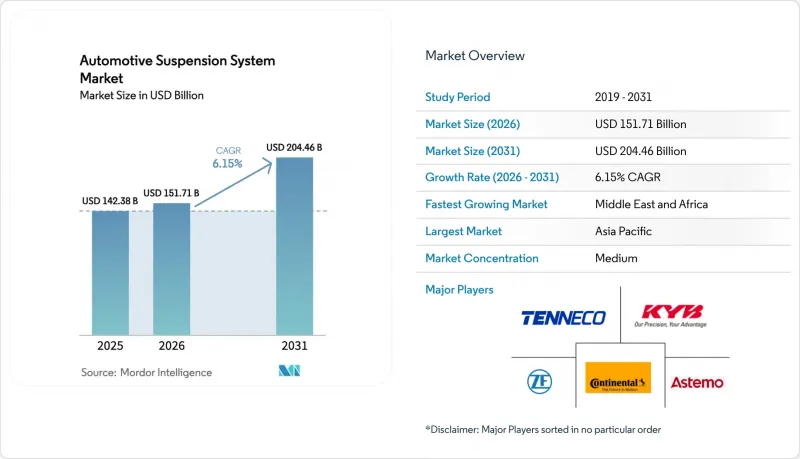
根據 Mordor Intelligence 預測,汽車懸吊系統市場將從 2025 年的 1,423.8 億美元成長到 2026 年的 1,517.1 億美元,到 2031 年達到 2044.6 億美元,預測期(2026-2031 年)的複合成長率為 6.15%。
這是因為電氣化和軟體定義車輛架構正在重新思考底盤設計的優先事項。
本報告按零件類型(螺旋彈簧、鋼板彈簧等)、懸吊系統類型(被動懸吊等)、幾何結構(麥花臣式、雙橫臂式等)、車輛類型(乘用車、輕型商用車等)、銷售管道(OEM、售後市場)、動力系統(內燃機等)和地區進行細分。市場預測以貨幣價值(美元)和銷售(輛)兩種形式呈現。
全球汽車懸吊系統市場趨勢及洞察
由電氣化驅動的輕量化自我調整懸吊
馬恆達 (Mahindra) 的 BE 6e SUV 配備了壓鑄鋁下控制臂,顯著提升了在印度崎嶇路面上的減震性能。採埃孚 (ZF) 的 sMOTION 系統整合了空氣彈簧和主動式防傾桿,相比傳統的鋼製螺旋彈簧系統,有效減輕了重量,幫助電動車恢復續航里程。歐盟委員會的 LEVA 專案已批准採用 3D 列印熱塑性複合複合材料控制臂,這種控制臂比鍛鋼控制臂更輕,並符合 ECE 碰撞安全標準。豐田 (Toyota) 的 bZ4X 系統透過有限元素分析和採用中空穩定器實現了減重。順應這一趨勢,亨德里克森 (Hendrickson) 的 PRIMAAX EX 系統成功降低了電動貨車的軸重,並且這項技術正在推廣到其他商用車輛領域。
支持ADAS聯動底盤安全性的監管趨勢
在歐洲,聯合國法規R171強制要求車輛維持車道,並隱含地建議使用半主動式阻尼系統,因為被動式系統難以在關鍵時限內穩定橫向載重。大陸集團已證實,安裝電子控制阻尼器後,車道偏離事故顯著減少。歐盟法規2019/2144強調了緊急煞車期間輪胎與路面保持穩定接觸的重要性。為此,採埃孚的sMOTION技術會在自動緊急煞車啟動前預先壓縮阻尼器。同時,美國國家公路交通安全管理局(NHTSA)的2025舉措旨在認證更高速度下的自動緊急煞車系統,這將增加美國市場對主動安全功能的需求。此外,ISO 26262將懸吊ECU指定為安全關鍵零件,此舉延長了研發週期,同時也凸顯了認證供應商的重要性。
智慧懸吊架構的初始成本和生命週期成本都很高
由於引入半主動式硬體會增加製造成本,大眾汽車已將可調式避震功能限制在價格較高的途觀車型上。此舉旨在保護公司的利潤率。雖然空氣彈簧壓縮機在行駛一定里程後需要更換,其生命週期成本高於螺旋彈簧,但半主動式減震器在印度特定里程範圍內故障率較高。此問題源自於電磁閥被鐵屑堵塞。相較之下,被動式避震器的故障率明顯較低。訂閱式定價模式降低了初始成本,但只有一小部分對價格敏感的消費者會在免費試用期結束後繼續付費。
細分市場分析
在汽車懸吊系統市場,電控系統和感測器的年複合成長率預計到2031年將達到9.22%,每輛車需要8到12個加速感應器和多個車身高度感測器。儘管避震器在2025年仍佔總銷售量的40.21%,但價格在55美元到75美元之間的單筒避震器升級產品,即使銷售量轉向自我調整減震器,其價值仍得以維持。由於產品組合的變化,單筒產品的散熱效率如今成為首要考慮因素,這對於電動車(EV)的再生煞車循環至關重要。螺旋彈簧和鋼板彈簧的出貨量保持穩定,而用於8級卡車的氣壓彈簧模組在北美車橋市場的佔有率正在不斷擴大。
即將推出的創新產品包括熱可塑性橡膠襯套,這種襯套在寬廣的溫度範圍內都能保持穩定的剛度,從而顯著降低噪音、振動和聲振粗糙度(NVH)申訴。磁流變引擎支架採用與避震器相同的磁流變液,可將衝擊力隔離在混合動力汽車的動力傳動系統中。預計這項技術將提高派克等供應商的單車採用率。中國單筒避震器供應商透過堅持GB/T 21510品質標準,同時提供比日本競爭對手更低的價格,在亞太地區的避震器市場佔據了相當大的佔有率。
預計到2025年,被動式懸吊系統將佔據汽車懸吊系統市場64.32%的佔有率。然而,隨著半主動式懸吊系統日益普及,這一佔有率正在萎縮,而半主動式懸吊系統普及的驅動力在於產量增加帶來的成本降低。福特決定為所有F-150 Lightning車型標配連續可變減震控制,這清楚地顯示了這個重要趨勢。半主動式懸吊系統正以8.74%的複合年成長率快速成長,這提升了電子元件在汽車懸吊市場中的作用,而專有控制演算法則進一步增強了供應商的競爭優勢。主動式液壓驅動系統的市場佔有率較小,但在豪華電動車領域逐漸佔有一席之地。例如,在賓士EQS車型中,座艙傾斜控制系統能夠有效降低駕駛者感受到的橫向力。
價格敏感度使得被動式懸吊系統主要局限於2.5萬美元以下的市場區隔領域,尤其是電子元件ISO 26262認證的高昂成本。扭力樑式懸吊在全球小型轎車生產中佔據主導地位,但正面臨變革浪潮,這主要是因為歐盟的車道維持法規迫使這些結構被獨立懸吊系統所取代。不同地區之間存在顯著差異。半主動式懸吊系統在歐洲的普及程度高於亞太地區,凸顯了消費者對汽車技術先進性的價值觀差異。
區域分析
預計到2025年,亞太地區將佔據汽車懸吊系統市場48.96%的佔有率。這部分歸功於比亞迪等本土汽車製造商在中國輕型車生產中為其「Seal」轎車配備了自適應減震器。在印度,塔塔汽車為因應SUV市場的快速成長,採用了多連桿後軸。這降低了車身側傾,並達到了現代途勝的標準。為了降低單位勞動成本,日本供應商已將避震器生產轉移到泰國和越南,導致日本在該地區市場佔有率下降。為了強調其對本地化的承諾,現代摩比斯在印尼開設了一家工廠,目標是實現懸吊模組的年產量。
北美和歐洲佔據了大部分銷量,其中半主動式組件的需求顯著成長。福特F-150 Lightning率先將自我調整減震器作為標準配置,並在所有售出的車型上實現了全面應用,開創了先河。採埃孚位於德國的生產線成功地為寶馬和梅賽德斯-奔馳提供了sMOTION組件。歐洲的車道維持法規正在推動半主動式系統的普及。同時,在北美售後市場,受電商平台對可調式絞牙減震器需求激增的推動,銷量也實現了成長。在加拿大,嚴酷的冬季促使越來越多的皮卡車主選擇氣壓彈簧以確保最佳的離地間隙。
儘管中東和非洲地區在2025年的銷售額佔比不高,但它們正以7.65%的年複合成長率(CAGR)推動全球成長,這一成長率將持續到2031年。沙烏地阿拉伯合資企業Lucid計劃每年生產空氣懸吊車輛,這將為大陸集團和採埃孚在該地區建立新的供應鏈。在阿拉伯聯合大公國,為了因應沙漠酷熱,豪華車市場對可調式避震系統的需求激增。同時,在南非,儘管電力供應挑戰導致汽車產量下降,但受蘭特疲軟和對歐洲出口的推動,出口量呈上升趨勢。為了因應埃及的高額進口關稅,天納克正在蘇伊士經濟特區建造一座避震器工廠。南美洲雖然市佔率較小,但在阿根廷取消零件進口上限後,需求激增。
其他好處:
- Excel格式的市場預測(ME)表
- 3個月的分析師支持
目錄
第1章:引言
- 市場分析與定義的前提條件
- 分析範圍
第2章 分析方法
第3章執行摘要
第4章 市場狀況
- 市場概覽
- 市場促進因素
- 對提升乘坐舒適性和操控性的需求日益成長。
- 由於電氣化,底盤進行了重新設計(輕量化自我調整懸吊)
- 促進ADAS聯動底盤的安全法規實施
- 新興市場SUV和高階汽車銷售快速成長
- 主動懸吊功能將透過基於訂閱的OTA更新提供。
- 3D列印複合材料懸吊零件可降低模具成本
- 市場限制因素
- 智慧懸吊架構的初始成本和生命週期成本都很高
- 惡劣環境下的可靠性與維護挑戰
- 網路安全和功能安全合規負擔
- 稀土元素磁流變液和半導體感測器的供應瓶頸
- 價值鍊和供應鏈分析
- 監理情勢
- 技術展望
- 波特五力分析
第5章:預測市場規模與成長率
- 依組件類型
- 螺旋彈簧
- 鋼板彈簧
- 空氣彈簧
- 避震器
- 穩定器/防傾桿
- 懸吊臂和連桿
- 電控系統/感測器
- 其他規則
- 懸吊系統類型
- 被動懸吊
- 半主動懸吊
- 主動懸吊
- 按形狀/結構
- 麥弗遜式步態
- 雙橫臂
- 多鏈路
- 扭梁/扭轉梁
- 其他形狀
- 按車輛類型
- 搭乘用車
- 輕型商用車
- 大型商用車輛
- 按銷售管道
- OEM(原始設備製造商)
- 售後市場
- 透過推進方法
- 內燃機車(ICE)
- 電動車、混合動力汽車
- 按地區
- 北美洲
- 美國
- 加拿大
- 其他北美國家
- 南美洲
- 巴西
- 阿根廷
- 其他南美國家
- 歐洲
- 德國
- 英國
- 法國
- 義大利
- 西班牙
- 俄羅斯
- 其他歐洲國家
- 亞太地區
- 中國
- 印度
- 日本
- 韓國
- 其他亞太國家
- 中東和非洲
- 沙烏地阿拉伯
- 阿拉伯聯合大公國
- 南非
- 埃及
- 土耳其
- 其他中東和非洲國家
- 北美洲
第6章 競爭情勢
- 市場集中度
- 策略趨勢
- 市佔率分析
- 公司簡介
- Continental AG
- ZF Friedrichshafen AG
- Tenneco Inc.
- KYB Corporation
- Hitachi Astemo Ltd.
- Thyssenkrupp AG
- Mando Corporation
- Marelli Corporation
- Hyundai Mobis Co. Ltd.
- BWI Group
- Sogefi SpA
- Parker LORD Corporation
- Benteler International AG
- Fox Factory Holding Corp.
- Hendrickson International
- Showa Corporation
第7章 市場機會與未來展望
According to Mordor Intelligence, the automotive suspension system market size is expected to grow from USD 142.38 billion in 2025 to USD 151.71 billion in 2026 and is forecast to reach USD 204.46 billion by 2031, advancing at a 6.15% CAGR during the forecast period (2026-2031), as electrification and software-defined vehicle architectures reshape chassis design priorities.
This report is Segmented by Component Type (Coil Spring, Leaf Spring, and More), Suspension System Type (Passive Suspension and More), Geometry (MacPherson Strut, Double Wishbone, and More), Vehicle Type (Passenger Cars, LCV, and More), Sales Channel (OEM and Aftermarket), Propulsion (ICE and More), and Geography. The Market Forecasts are Provided in Terms of Value (USD) and Volume (Units).
Global Automotive Suspension System Market Trends and Insights
Electrification-Driven Lightweight Adaptive Suspensions
Mahindra's BE 6e SUV, equipped with die-cast aluminum lower arms, enhances isolation indices on India's rugged roads. ZF's sMOTION, integrating air springs with active anti-roll bars, reduces mass compared to traditional steel coil counterparts, allowing electric vehicles to regain lost driving range. The European Commission's LEVA program has endorsed a 3D-printed thermoplastic composite arm, which is lighter than its forged steel counterpart and meets ECE crash standards. Toyota's bZ4X, using finite element analysis, has achieved weight reduction through a hollow stabilizer bar. Following this trend, Hendrickson's PRIMAAX EX has successfully reduced axle weight in electric delivery vans, a move that commercial fleets have echoed.
Regulatory Push for ADAS-Linked Chassis Safety
In Europe, UN R171 mandates lane-keeping and subtly advocates semi-active damping, as passive systems struggle to stabilize lateral loads within a crucial time window . Continental observed a significant reduction in lane-departure incidents with the installation of electronically controlled dampers. The EU regulation 2019/2144 emphasizes the importance of stable tire contact during emergency braking. In response, ZF's sMOTION technology pre-compresses the dampers before autonomous braking is activated. Meanwhile, NHTSA's 2025 initiative aims to certify automatic emergency braking systems for higher speeds, thereby amplifying the U.S. market's appetite for active safety features. Additionally, ISO 26262 has designated suspension ECUs as safety-critical, a move that extends development cycles but also underscores the importance of certified suppliers.
High Upfront and Lifecycle Cost of Smart Suspension Architectures
Volkswagen, facing higher vehicle build costs due to semi-active hardware, has limited adaptive damping to higher-priced Tiguan trims. This strategic move safeguards the company's margins. While air-spring compressors require replacement after a certain distance, overshadowing the lifetime costs of coil springs, India sees a higher failure rate in semi-active dampers within a specific distance. The issue arises from solenoid valves clogging with ferrous dust. In contrast, passive units report a significantly lower failure rate. Although subscription pricing eases entry costs, only a small percentage of price-sensitive buyers continue paying after the free trial period.
Other drivers and restraints analyzed in the detailed report include:
- Increasing Demand for Enhanced Ride Comfort and Handling
- Rapid SUV and Premium-Vehicle Sales in Emerging Economies
- Reliability and Maintenance Challenges in Harsh Conditions
For complete list of drivers and restraints, kindly check the Table Of Contents.
Segment Analysis
The automotive suspension system market for electronic control units and sensors is expanding at a 9.22% CAGR through 2031, driven by the 8-12 accelerometers and multiple ride-height sensors required per vehicle. Shock absorbers still accounted for 40.21% of 2025 revenue, but monotube upgrades, priced at USD 55-75, are holding their value even as volumes shift toward adaptive variants. Changes in the mix now prioritize monotube heat-dissipation efficiency, a key requirement for regenerative-braking duty cycles in electric vehicles (EVs). While shipments of coil and leaf springs remained stable, air-spring modules for Class 8 trucks have increased their share of North American axles.
Innovations on the horizon include thermoplastic-elastomer bushings, which maintain consistent stiffness across a wide temperature range, leading to a significant reduction in NVH complaints. Magnetorheological engine mounts, which utilize the same MR fluid as dampers, are isolating powertrain shocks in hybrids. This development is set to increase the content per vehicle for suppliers like Parker. Chinese monotube suppliers have captured a notable share of Asia-Pacific absorber revenue by pricing themselves lower than their Japanese counterparts, while adhering to GB/T 21510 quality standards.
Passive designs accounted for 64.32% of the automotive suspension system market share in 2025, but are ceding share as semi-active content rises due to volume-driven cost reductions; Ford's decision to standardize continuously controlled damping across all F-150 Lightning models underscores a significant trend. The growing adoption of semi-active systems, with a CAGR of 8.74%, is elevating the role of electronic components in the automotive suspension market, while proprietary control algorithms further solidify supplier dominance. While active hydraulically driven systems hold a smaller share of the market, they're finding a niche in luxury EVs. For instance, in the Mercedes-Benz EQS, cabin tilt control effectively reduces perceived lateral forces.
Price sensitivity keeps passive systems in the sub-USD 25,000 market segment, especially given the steep ISO 26262 validation costs for electronics. Torsion beams, which constitute a significant portion of the global compact-car output, are facing a shift. This is mainly due to EU lane-keeping mandates that are pushing for the replacement of these setups with independent systems. There's a notable regional disparity: Europe shows higher adoption rates for semi-active systems than Asia-Pacific, highlighting differing consumer valuations of automotive refinement.
Complete Report Scope:
- By Component Type
- Coil Springs
- Leaf Springs
- Air Springs
- Shock Absorbers
- Stabilizer / Anti-roll Bars
- Suspension Arms & Links
- Electronic Control Units and Sensors
- Other Components
- By Suspension System Type
- Passive Suspension
- Semi-Active Suspension
- Active Suspension
- By Geometry /Architecture
- MacPherson Strut
- Double Wishbone
- Multi-Link
- Torsion Beam / Twist Beam
- Other Geometries
- By Vehicle Type
- Passenger Cars
- Light Commercial Vehicles
- Heavy Commercial Vehicles
- By Sales Channel
- Original Equipment Manufacturer (OEM)
- Aftermarket
- By Propulsion
- Internal-Combustion-Engine Vehicles
- Electric & Hybrid Vehicles
- By Geography
- North America
- United States
- Canada
- Rest of North America
- South America
- Brazil
- Argentina
- Rest of South America
- Europe
- Germany
- United Kingdom
- France
- Italy
- Spain
- Russia
- Rest of Europe
- Asia-Pacific
- China
- India
- Japan
- South Korea
- Rest of Asia-Pacific
- Middle East and Africa
- Saudi Arabia
- United Arab Emirates
- South Africa
- Egypt
- Turkey
- Rest of Middle East and Africa
- North America
Geography Analysis
The Asia-Pacific region accounted for 48.96% of the automotive suspension system market share in 2025, as China's light-vehicle production saw local OEMs, such as BYD, equipping their Seal sedans with adaptive dampers. In India, a booming SUV market led Tata to implement multi-link rear axles, which reduced body roll and aligned with benchmarks set by the Hyundai Tucson. To reduce unit labor costs, Japanese suppliers relocated absorber production to Thailand and Vietnam, resulting in a drop in Japan's regional share. Highlighting the push for localization, Hyundai Mobis inaugurated a plant in Indonesia, aiming to produce suspension modules annually.
North America and Europe accounted for a significant portion of the turnover, with a noticeable tilt towards semi-active content. Ford's F-150 Lightning set a precedent by making adaptive damping standard, achieving full penetration across its sales. ZF's production line in Germany successfully delivered sMOTION units for BMW and Mercedes-Benz. Europe's lane-keeping regulations have driven the adoption of semi-active installations. Meanwhile, North America's aftermarket experienced a revenue boost, driven by the surge in e-commerce demand for adjustable coilovers. In Canada, frigid winters are prompting pickup buyers to opt for air-springs, ensuring optimal ground clearance.
The Middle East and Africa, although they held a smaller share of the 2025 volume, are pacing the global growth chart at a 7.65% CAGR through 2031. Saudi Arabia's Lucid joint venture plans to produce air-suspended cars annually, establishing new regional supply chains for Continental and ZF. In the UAE, luxury car demand skews heavily towards adaptive damping systems, a move aimed at combating the sweltering desert heat. While South Africa's power supply challenges led to a dip in car production, a weaker rand bolstered exports to Europe, seeing an uptick. In response to Egypt's high import tariffs, Tenneco is setting up a damper plant in the Suez zone. South America accounted for a small market share, with Argentina witnessing a surge after lifting caps on component imports.
- Continental AG
- ZF Friedrichshafen AG
- Tenneco Inc.
- KYB Corporation
- Hitachi Astemo Ltd.
- Thyssenkrupp AG
- Mando Corporation
- Marelli Corporation
- Hyundai Mobis Co. Ltd.
- BWI Group
- Sogefi SpA
- Parker LORD Corporation
- Benteler International AG
- Fox Factory Holding Corp.
- Hendrickson International
- Showa Corporation
Additional Benefits:
- The market estimate (ME) sheet in Excel format
- 3 months of analyst support
TABLE OF CONTENTS
1 Introduction
- 1.1 Study Assumptions and Market Definition
- 1.2 Scope of the Study
2 Research Methodology
3 Executive Summary
4 Market Landscape
- 4.1 Market Overview
- 4.2 Market Drivers
- 4.2.1 Increasing Demand for Enhanced Ride Comfort and Handling
- 4.2.2 Electrification-Driven Chassis Redesign (Lightweight Adaptive Suspensions)
- 4.2.3 Regulatory Push for ADAS-Linked Chassis Safety
- 4.2.4 Rapid SUV and Premium-Vehicle Sales in Emerging Economies
- 4.2.5 Subscription-Based OTA Upgrades Unlocking Active-Suspension Features
- 4.2.6 3-D Printed Composite Suspension Parts Reducing Tooling Cost
- 4.3 Market Restraints
- 4.3.1 High Upfront and Lifecycle Cost of Smart Suspension Architectures
- 4.3.2 Reliability and Maintenance Challenges in Harsh Conditions
- 4.3.3 Cyber-Security and Functional-Safety Compliance Burden
- 4.3.4 Rare-Earth MR-Fluid and Semiconductor Sensor Supply Bottlenecks
- 4.4 Value / Supply-Chain Analysis
- 4.5 Regulatory Landscape
- 4.6 Technological Outlook
- 4.7 Porter's Five Forces
- 4.7.1 Bargaining Power of Suppliers
- 4.7.2 Bargaining Power of Buyers/Consumers
- 4.7.3 Threat of New Entrants
- 4.7.4 Threat of Substitute Products
- 4.7.5 Intensity of Competitive Rivalry
5 Market Size and Growth Forecasts (Value (USD) and Volume (Units))
- 5.1 By Component Type
- 5.1.1 Coil Springs
- 5.1.2 Leaf Springs
- 5.1.3 Air Springs
- 5.1.4 Shock Absorbers
- 5.1.5 Stabilizer / Anti-roll Bars
- 5.1.6 Suspension Arms & Links
- 5.1.7 Electronic Control Units and Sensors
- 5.1.8 Other Components
- 5.2 By Suspension System Type
- 5.2.1 Passive Suspension
- 5.2.2 Semi-Active Suspension
- 5.2.3 Active Suspension
- 5.3 By Geometry /Architecture
- 5.3.1 MacPherson Strut
- 5.3.2 Double Wishbone
- 5.3.3 Multi-Link
- 5.3.4 Torsion Beam / Twist Beam
- 5.3.5 Other Geometries
- 5.4 By Vehicle Type
- 5.4.1 Passenger Cars
- 5.4.2 Light Commercial Vehicles
- 5.4.3 Heavy Commercial Vehicles
- 5.5 By Sales Channel
- 5.5.1 Original Equipment Manufacturer (OEM)
- 5.5.2 Aftermarket
- 5.6 By Propulsion
- 5.6.1 Internal-Combustion-Engine Vehicles
- 5.6.2 Electric & Hybrid Vehicles
- 5.7 By Geography
- 5.7.1 North America
- 5.7.1.1 United States
- 5.7.1.2 Canada
- 5.7.1.3 Rest of North America
- 5.7.2 South America
- 5.7.2.1 Brazil
- 5.7.2.2 Argentina
- 5.7.2.3 Rest of South America
- 5.7.3 Europe
- 5.7.3.1 Germany
- 5.7.3.2 United Kingdom
- 5.7.3.3 France
- 5.7.3.4 Italy
- 5.7.3.5 Spain
- 5.7.3.6 Russia
- 5.7.3.7 Rest of Europe
- 5.7.4 Asia-Pacific
- 5.7.4.1 China
- 5.7.4.2 India
- 5.7.4.3 Japan
- 5.7.4.4 South Korea
- 5.7.4.5 Rest of Asia-Pacific
- 5.7.5 Middle East and Africa
- 5.7.5.1 Saudi Arabia
- 5.7.5.2 United Arab Emirates
- 5.7.5.3 South Africa
- 5.7.5.4 Egypt
- 5.7.5.5 Turkey
- 5.7.5.6 Rest of Middle East and Africa
- 5.7.1 North America
6 Competitive Landscape
- 6.1 Market Concentration
- 6.2 Strategic Moves
- 6.3 Market Share Analysis
- 6.4 Company Profiles (Includes Global Level Overview, Market Level Overview, Core Segments, Financials as Available, Strategic Information, Market Rank/Share for Key Companies, Products & Services, and Recent Developments)
- 6.4.1 Continental AG
- 6.4.2 ZF Friedrichshafen AG
- 6.4.3 Tenneco Inc.
- 6.4.4 KYB Corporation
- 6.4.5 Hitachi Astemo Ltd.
- 6.4.6 Thyssenkrupp AG
- 6.4.7 Mando Corporation
- 6.4.8 Marelli Corporation
- 6.4.9 Hyundai Mobis Co. Ltd.
- 6.4.10 BWI Group
- 6.4.11 Sogefi SpA
- 6.4.12 Parker LORD Corporation
- 6.4.13 Benteler International AG
- 6.4.14 Fox Factory Holding Corp.
- 6.4.15 Hendrickson International
- 6.4.16 Showa Corporation
7 Market Opportunities and Future Outlook
- 7.1 White-space & Unmet-Need Assessment

 中國乘用車電子控制懸吊產業報告(2026年)
 汽車懸吊市場預測至2034年—按組件、懸吊配置、系統類型、車輛類型、驅動系統和地區分類的全球分析
 汽車雙橫臂懸吊系統市場-2026-2032年全球市場預測汽車懸吊市場-2026-2032年全球市場預測汽車懸吊系統市場預測至2034年-按懸吊類型、零件、懸吊結構、驅動類型、應用、銷售管道和地區分類的全球分析
 汽車懸吊市場分析及預測(至2035年):依類型、產品、技術、組件、應用、材料類型、最終用戶、功能及安裝方式分類汽車懸吊系統市場分析與預測(至2035年):類型、產品、技術、組件、應用、材料類型、功能、安裝類型、設備、解決方案
 汽車雙橫臂懸吊系統市場規模、佔有率和成長分析:按組件、車輛類型、銷售管道、材料、分銷方式和地區分類-2026-2033年產業預測
 汽車懸吊市場 - 全球產業規模、佔有率、趨勢、機會、預測:按零件類型、車輛類型、類型、地區和競爭對手分類,2021-2031年
 2026-2034年全球汽車懸吊系統市場規模、佔有率、趨勢和成長分析報告